Introduction
Alvin S. Thompson was born in Camden, New Jersey on March 21, 1895 to Harry H. Thompson and his wife, the former Georgetta Steed, according to New Jersey state records. He was the oldest child, coming before sister Lola and brothers Lydon and Harry Thompson. His father worked as a draughtsman at one of the shipyards along the Delaware. The 1900 Census shows the family at 708 Royden Street in Camden. The Thompson family left Camden shortly after the census was taken, but appears to have come back for a short time, as the 1905 and 1906 City Directories show them at 810 Haddon Avenue. By 1910 the family was living at 219 Eighth Avenue in Haddon Heights, New Jersey. The Thompson family later moved to a farm on Union Mill Road in Mt. Laurel, Burlington County, New Jersey.
Alvin Thompson came to Camden in the mid-1910s. When he registered for the draft on June 5, 1917, Alvin Thompson was boarding at 608 South 4th Street, the home of William and Emma Watts, and their daughter Maola. He then worked as a clerk at the J.B. Van Sciver furniture factory and store.
After serving in the military during World War I, Alvin Thompson returned to Camden. He moved back in with the Watts family at 608 South 4th Street. When the Census was taken in January of 1920, Alvin S. Thompson was then working as a bank clerk. Alvin and Maola married shortly after the Census was taken. On February 18, 1922 Alvin S. Thompson was appointed to the Camden Fire Department, and assigned to Engine Company 8. He was still living at 608 South 4th Street.
The 1930 Census shows the Watts and the Thompsons had moved to 305 Harvard Avenue in Collingswood, New Jersey. By the spring of 1942 the Thompsons had moved to 2818 Constitution Road.
Fear of enemy air raids in 1942 spawned a number of Federal Decrees regulating public conduct in the event of air raid warnings. One new Federal Regulation prohibited fire apparatus from using sirens in response to alarms. Under war-time regulations, sirens would be reserved exclusively for air raid warnings.
The use of audible warning devices by fire apparatus was restricted to bells only. The burden to both fire fighters and the public safety was formidable. On March 1, 1942, the inevitable happened. Engine Company 8 while responding to an alarm was involved in a collision with a ten ton truck at Third Street and Kaighn Avenue. Upon impact all of the firemen were thrown into the street. The truck driver declared that he failed to hear the bells of the approaching apparatus. The mishap resulted in injuries to six members and total destruction of the apparatus. Captain Alvin Thompson was listed in critical condition, while Firemen Mitchell Wojtkowiak, Philip Farrow, Leonard Oshushek, Lawrence Boulton and Edwin Robbins were admitted for lesser injuries. Battalion Chief Newton stated that he believed the accident might have been avoided if fire companies were not prohibited from using sirens.
Still at 2818 Constitution Road, Alvin S. and Maola Thompson appear in the 1947 Camden City Directory. He was still serving with the Camden Fire Department, with the rank of captain. He retired on November 15, 1948. The Thompsons later moved to Audubon, New Jersey.
Alvin S. Thompson passed away on November 19, 1962.
World War I Draft Card
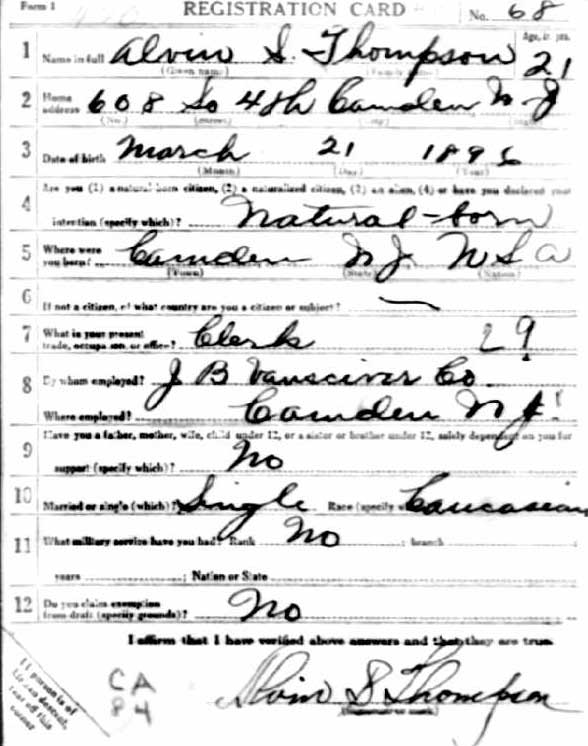
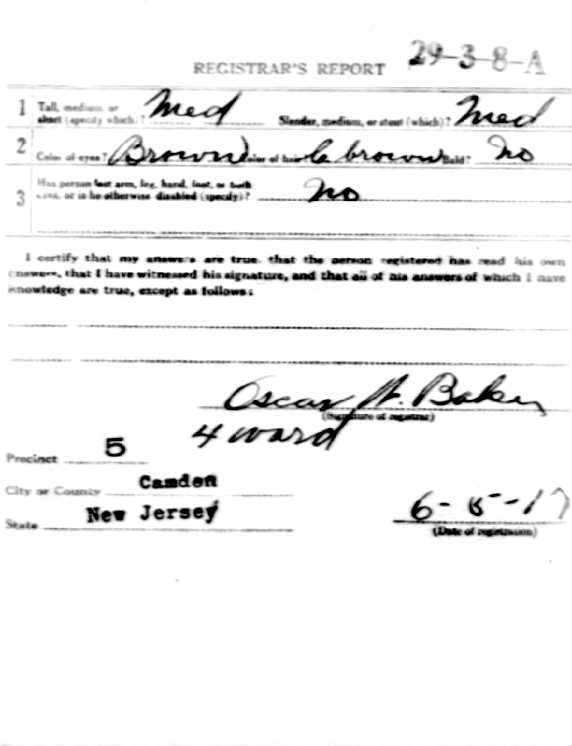
World War I Draft Registration Card
Fire Department Promotions
Camden Courier-Post —
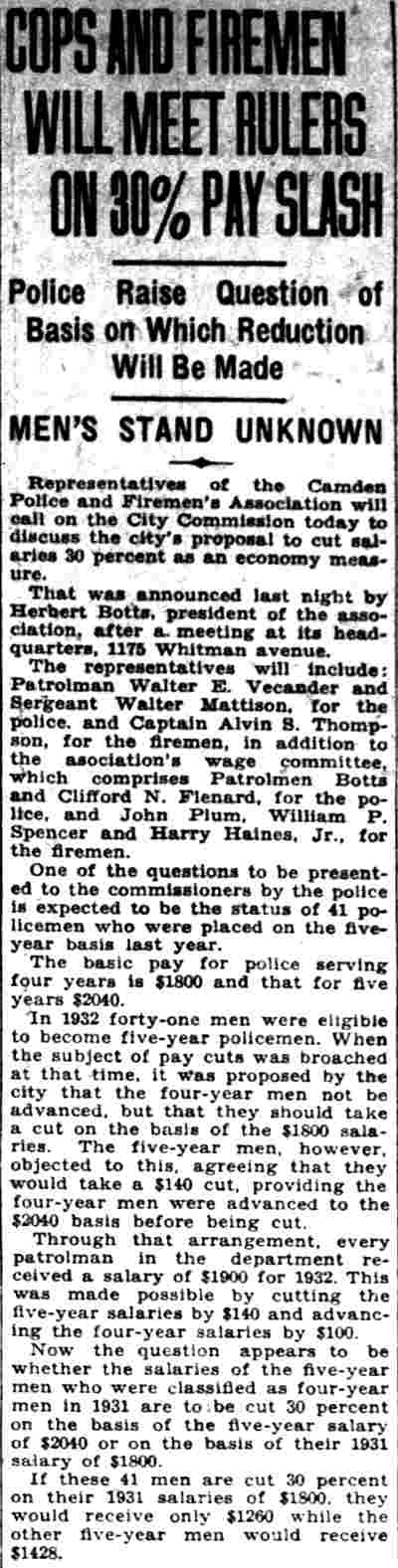
Police Raise Question of Basis on Which Reduction Will Be Made
MEN’S STAND UNKNOWN
Representatives of the Camden Police and Firemen’s Association will call on the City Commission today to discuss the city’s proposal to cut salaries 30 percent as an economy measure.
That was announced last night by Herbert Botts, president of the association, after a meeting at its headquarters, 1175 Whitman avenue.
The representatives will include: Patrolman Walter E. Vecander and Sergeant Walter Mattison, for the police, and Captain Alvin S. Thompson, for the firemen, in addition to the association’s wage committee, which comprises Patrolmen Botts and Clifford N. Flenard, for the police, and John Plum, William P. Spencer and Harry Haines, Jr., for the firemen.
One of the questions to be presented to the commissioners by the police is expected to be the status of 41 policemen who were placed on the five-year basis last year.
The basic pay for police serving four years is $1800 and that for five years $2040.
In 1932 forty-one men were eligible to become five-year policemen. When the subject of pay cuts was broached at that time, it was proposed by the city that the four-year men not be advanced, but that they should take a cut on the basis of the $1800 salaries. The five-year men, however, objected to this, agreeing that they would take a $140 cut, providing the four-year men were advanced to the $2040 basis before being cut.
Through that arrangement, every patrolman in the department received a salary of $1900 for 1932. This was made possible by cutting the five-year salaries by $140 and advancing the four-year salaries by $100.
Now the question appears to be whether the salaries of the five-year men who were classified as four-year men in 1931 are to be cut 30 percent on the basis of the five-year salary of $2040 or on the basis of their 1931 salary of $1800.
If these 41 men are cut 30 percent on their 1931 salaries of $1800, they would receive only $1260 while the other five-year men would receive $1428.
World War II Draft Card
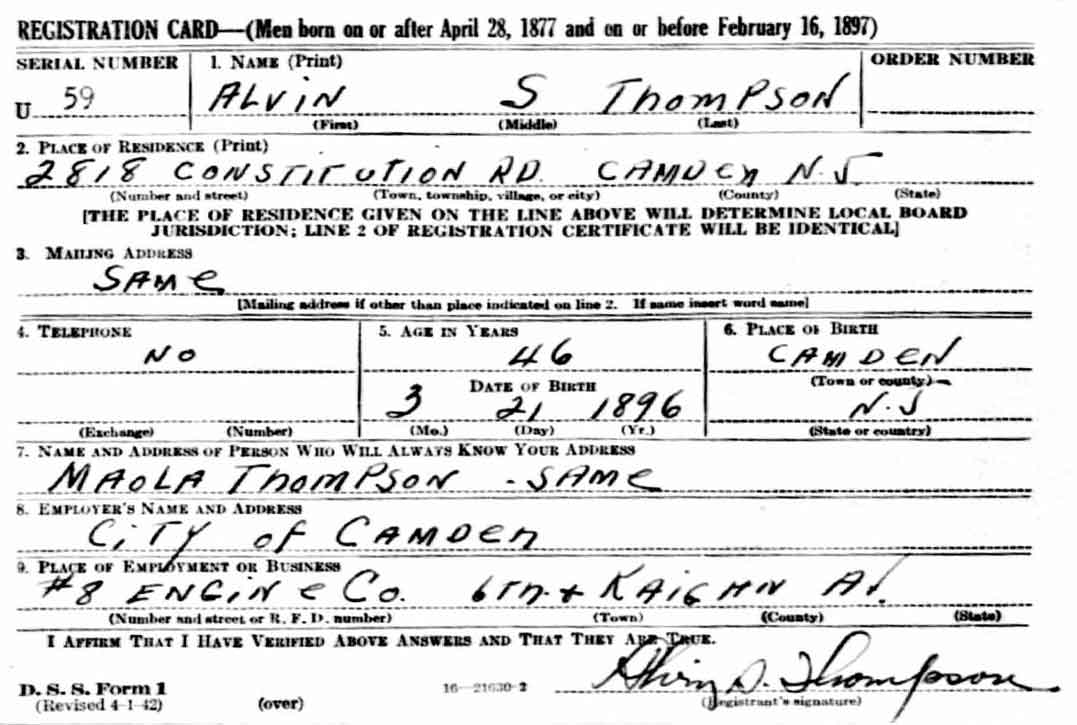
World War II Draft Registration Card
Fire Captain to Retire After 26 Years’ Service
Camden Courier-Post —
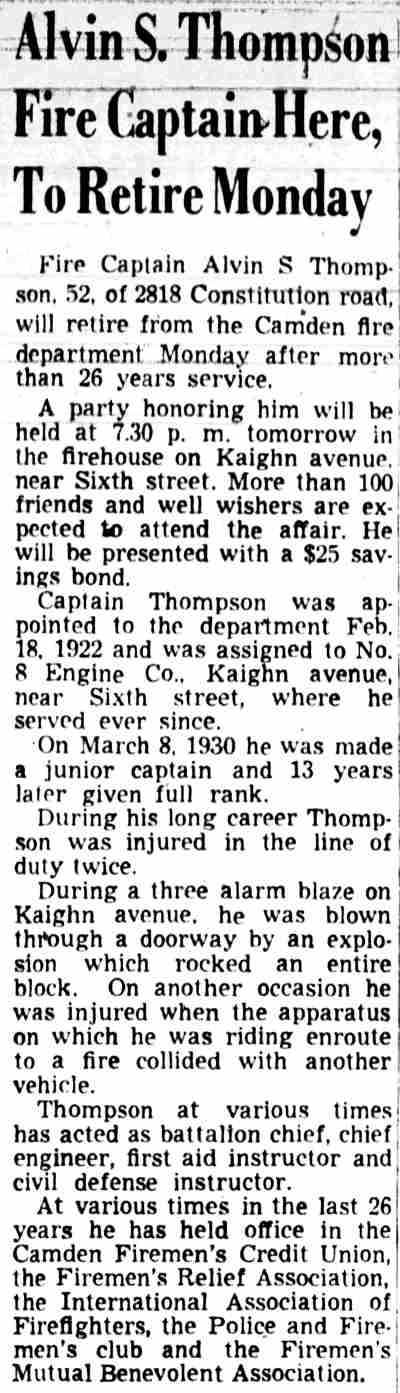
Retirement announcement for Captain Alvin S. Thompson after 26 years of service
Obituary
Camden Courier-Post —
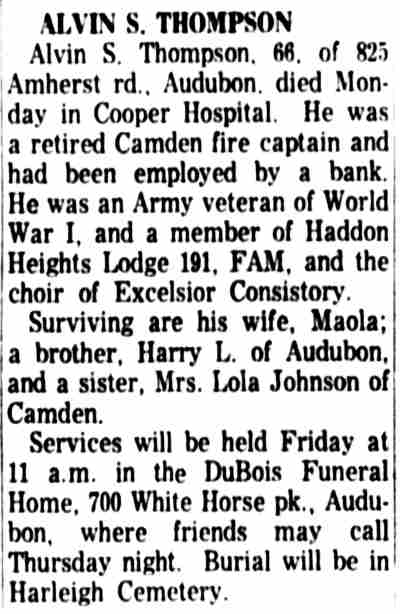
Obituary for Alvin S. Thompson