Introduction
650 Clinton Street was not always a bar. From 1887 through 1891 the building is listed in the Camden City Directories as the home of Tanser & McElwee, a painting business owned by Thomas W. Tanser and John H. McElwee. The building was later converted into a saloon and acquired by Philipp Berger.
Philipp Berger was the proprietor of the saloon at 650 Clinton Street in the years 1919 through 1921, according to Camden’s City Directories and the 1920 US Census. Born in 1859, he had emigrated from Germany in the 1880s, and became a citizen in 1892. By 1920 a widower, Philipp Berger resided above the bar, along with son William J. and daughter Loretta M. Berger. He owned the property as of 1920. Philipp Berger apparently passed away before 1930. His son William had by then moved from Camden.
The bar at 650 Clinton Street was acquired in the late 1930s by John F. McKenna. John F. McKenna was born in Gloucester City NJ. A fine ball player as a youth, he attracted the attention of Philadelphia Athletics star first baseman Stuffy McInnis, who got him a post as a pitcher on a semi-pro team at Old Orchard ME. After World War I, John McKenna was living in New York, supporting himself in a variety of jobs, including selling sheet music, and as an usher at the New Amsterdam Theater. During this time he met the great American humorist Will Rogers, and he soon was working for him, traveling the country and spending some time with Rogers in Hollywood, before returning to the East Coast.
John F. McKenna had opened up his cafe in Camden at 319 Federal Street by 1931, and he was listed at that address in the 1940 Camden City Directory. In 1939 he received a liquor license for 650 Clinton Street, and he moved his operation there. This is where he made his home, with his wife Catherine. McKenna’s Cafe operated at 650 Clinton through at least 1947.
John F. McKenna should not be confused with the John McKenna, who operated McKenna’s Tavern at 640 Pine Street, the corner of Pine Street and Newton Avenue from prior to 1918 through at least 1931.
McKenna's Cafe — October 21, 2003
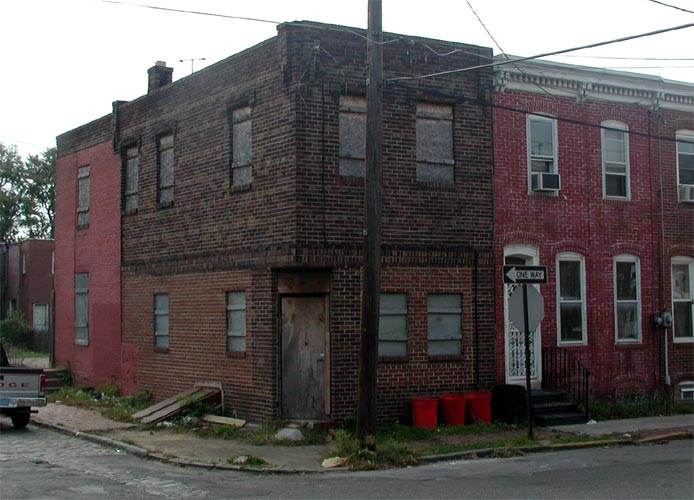
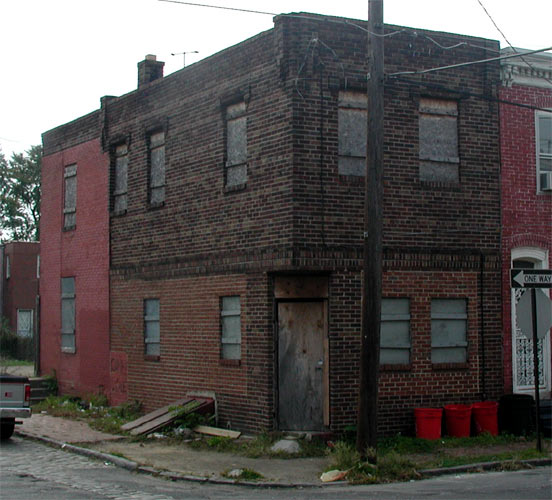
McKenna’s Cafe, 650 Clinton Street — October 21, 2003.
Is Zat So!
Camden Courier-Post —
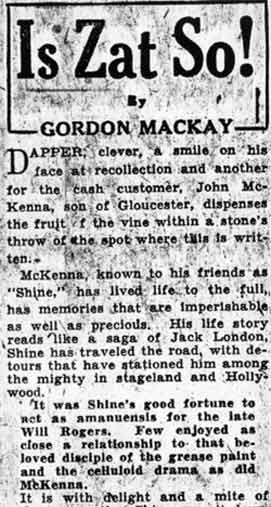
By Gordon Mackay—
Dapper, clever, a smile on his face at recollection and another for the cash customer, John McKenna, son of Gloucester, dispenses the fruit of the vine within a stone’s throw of the spot where this is written.
McKenna, known to his friends as “Shine,” has lived life to the full, has memories that are imperishable as well as precious. His life story reads like a saga of Jack London. Shine has traveled the road, with detours that have stationed him among the mighty in stageland and Hollywood.
It was Shine’s good fortune to act as amanuensis for the late Will Rogers. Few enjoyed as close a relationship to that beloved disciple of the grease paint and the celluloid drama as did McKenna.
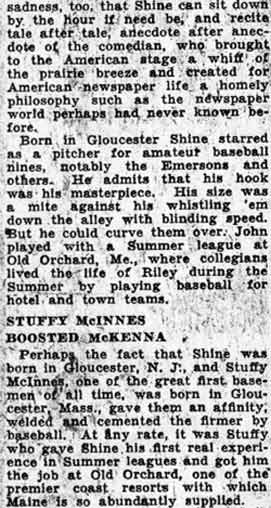
It is with delight and a mite of sadness, too, that Shine can sit down by the hour if need be, and recite tale after tale, anecdote after anecdote of the comedian, who brought to the American stage a whiff of the prairie breeze and created for American newspaper life a homely philosophy such as the newspaper world perhaps had never known before.
Born in Gloucester Shine starred as a pitcher for amateur baseball teams, notably the Emersons and others. He admits that his hook was his masterpiece. His size was a mite against his whistling ’em down the alley with blinding speed. But he could curve them over. John played with a Summer league at Old Orchard, Me., where collegians lived the life of Riley during the Summer by playing baseball for hotel and town teams.
Stuffy McInnes Boosted McKenna
Perhaps the fact that Shine was born in Gloucester, N. J., and Stuffy McInnes, one of the great first basemen of all time, was born in Gloucester, Mass., gave them an affinity, welded and cemented the firmer by baseball. At any rate, it was Stuffy who gave Shine his first real experience in Summer leagues and got him the job at Old Orchard, one of the premier coast resorts with which Maine is so abundantly supplied.
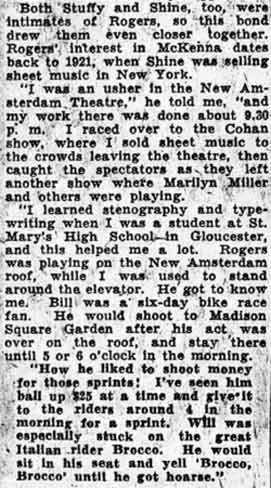
Both Stuffy and Shine, too, were intimates of Rogers, so this bond drew them even closer together. Rogers’ interest in McKenna dates back to 1921, when Shine was selling sheet music in New York.
“I was an usher in the New Amsterdam Theatre,” he told me, “and my work there was done about 9.30 p. m. I raced over to the Cohan show, where I sold sheet music to the crowds leaving the theatre, then caught the spectators as they left another show where Marilyn Miller and others were playing.
“I learned stenography and typewriting when I was a student at St. Mary’s High School in Gloucester, and this helped me a lot. Rogers was playing on the New Amsterdam roof, while I was used to stand around the elevator. He got to know me. Bill was a six-day bike race fan. He would shoot to Madison Square Garden after his act was over on the roof, and stay there until 5 or 6 o’clock in the morning.
“How he liked to shoot money for those sprints! I’ve seen him ball up $25 at a time and give it to the riders around 4 in the morning for a sprint. Will was especially stuck on the great Italian rider Brocco. He would sit in his seat and yell ‘Brocco, Brocco’ until he got hoarse.
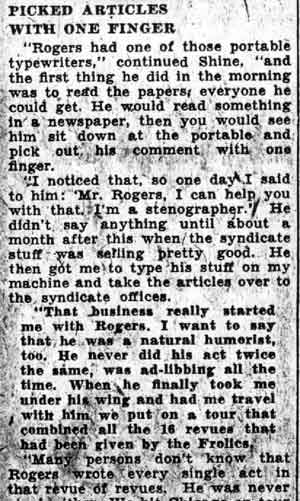
Picked Articles With One Finger
“Rogers had one of those portable typewriters,” continued Shine, “and the first thing he did in the morning was to read the papers; everyone he could get. He would read something in a newspaper, then you would see him sit down at the portable and pick out his comment with one finger.
“I noticed that, so one day I said to him: ‘Mr. Rogers, I can help you with that. I’m a stenographer.’ He didn’t say anything until about a month after this when the syndicate stuff was selling pretty good. He then got me to type his stuff on my machine and take the articles over to the syndicate offices.
“That business really started me with Rogers. I want to say that he was a natural humorist, too. He never did his act twice the same, was ad-libbing all the time. When he finally took me under his wing and had me travel with him we put on a tour that combined all the 16 revues that had been given by the Frolics.
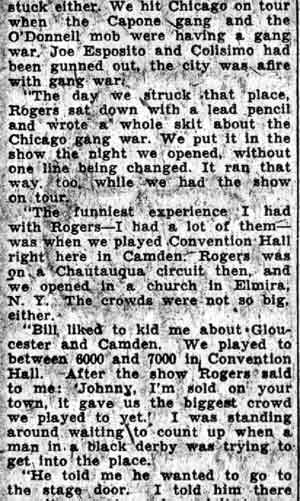
“Many persons don’t know that Rogers wrote every single act in that revue of revues. He was never stuck either. We hit Chicago on tour when the Capone gang and the O’Donnell mob were having a gang war. Joe Esposito and Colisimo had been gunned out, the city was afire with gang war.
“The day we struck that place, Rogers sat down with a lead pencil and wrote a whole skit about the Chicago gang war. We put it in the show the night we opened, without one line being changed. It ran that way, too, while we had the show on tour.
“The funniest experience I had with Rogers—I had a lot of them—was when we played Convention Hall right here in Camden. Rogers was on a Chautauqua circuit then, and we opened in a church in Elmira, N. Y. The crowds were not so big, either.
“Bill liked to kid me about Gloucester and Camden. We played to between 6000 and 7000 in Convention Hall. After the show Rogers said to me: ‘Johnny, I’m sold on your town; it gave us the biggest crowd we played to yet.’ I was standing around waiting to count up when a man in a black derby was trying to get into the place.
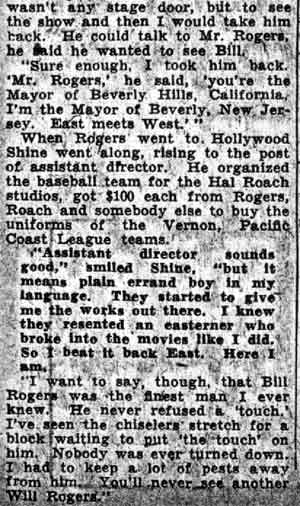
“He told me he wanted to go to the stage door. I told him there wasn’t any stage door, but to see the show and then I would take him back. He could talk to Mr. Rogers, he said he wanted to see Bill.
“Sure enough, I took him back. ‘Mr. Rogers,’ he said, ‘you’re the Mayor of Beverly Hills, California. I’m the Mayor of Beverly, New Jersey. East meets West.’”
When Rogers went to Hollywood Shine went along, rising to the post of assistant director. He organized the baseball team for the Hal Roach studios, got $100 each from Rogers, Roach and somebody else to buy the uniforms of the Vernon, Pacific Coast League teams.
“‘Assistant director sounds good,’ smiled Shine, ‘but it means plain errand boy in my language. They started to give me the works out there. I knew they resented an easterner who broke into the movies like I did. So I beat it back East. Here I am.
“‘I want to say, though, that Bill Rogers was the finest man I ever knew. He never refused a touch. I’ve seen the chiselers stretch for a block waiting to put the ‘touch’ on him. Nobody was ever turned down. I had to keep a lot of pests away from him. You’ll never see another Will Rogers.’”
Photos
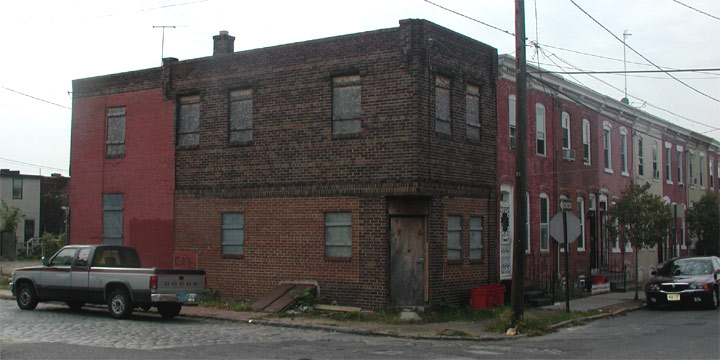
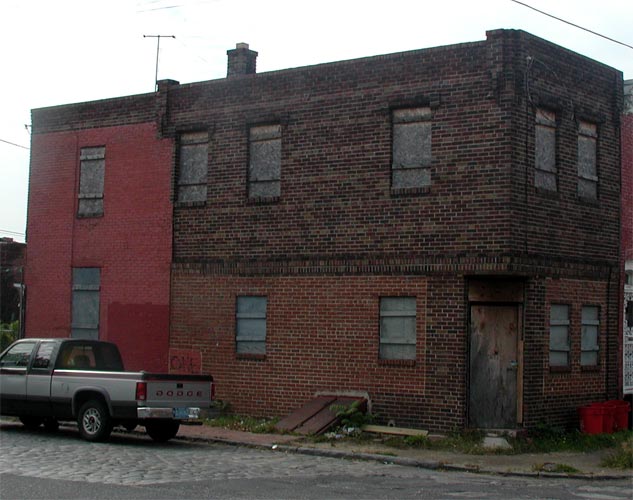
McKenna’s Cafe, 650 Clinton Street — October 21, 2003.