Introduction
Phil Cohen —
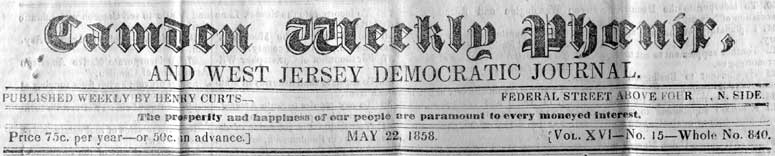
Camden Weekly Phenix & West Jersey Democrat Journal — May 22, 1858
The Camden Weekly Phenix and West Jersey Democrat Journal was published briefly in Camden during the late 1850s. It must not have been too successful or long-lived, as no mention of it appears in George Reeser Prowell's History of Camden County, New Jersey, which was written in the 1880s.
The May 22, 1858 edition of this newspaper was included in the contents of a time capsule buried in June of 1858. This is how this page came to be:
In September of 2005, workmen employed by the FFC Construction Company of Gloucester City NJ were instructed to erect a fence at the south-west corner of Fifth and Federal as a safety precaution for pedestrians, as the recently installed River Line light rail tracks pass by the intersection. The workers were using a large auger to dig a hole for one of the fenceposts to be installed. At one point in the installation, the auger struck a metal box. The box, made of lead and sealed by having its seams welded, was penetrated. The workers looked at the contents, and seeing old newspapers and other artifacts, turned the box over to Mr. James Ferry, the owner of the company.
Mr. Ferry, whom I was acquainted with professionally but had only by telephone, mentioned the discovery to a mutual friend, Ed Neumann, who thought that it would be a good idea to copy as much of the printed material as possible for inclusion on this website. Mr. Ferry was in agreement. Due to circumstances beyond everyone's control, it was not until the first week of June 2006 that the contents of the box that were undamaged were turned over to me to be scanned for the Internet.
Upon examination, I determined that the time capsule was buried in June of 1858, when the new building of the Camden Mutual Insurance Association was dedicated at the southwest corner of Fifth and Federal Streets. In 1881 the business was renamed the Camden Fire Insurance Association. This building stood for about 40 years, and was replaced by a new building designed by architect Arthur Truscott, brother of then Association vice-president J. Lynn Truscott. The new building, known as the Camden Fire Insurance building, stood for about 100 years before being razed.
Among the contents of the time capsule was a copy of the May 22, 1858 edition of the Camden Weekly Phenix & West Jersey Democrat Journal, a four page newspaper published by Henry Curts. I’ve excerpted the articles of local interest.
To the Public
Camden Weekly Phenix —
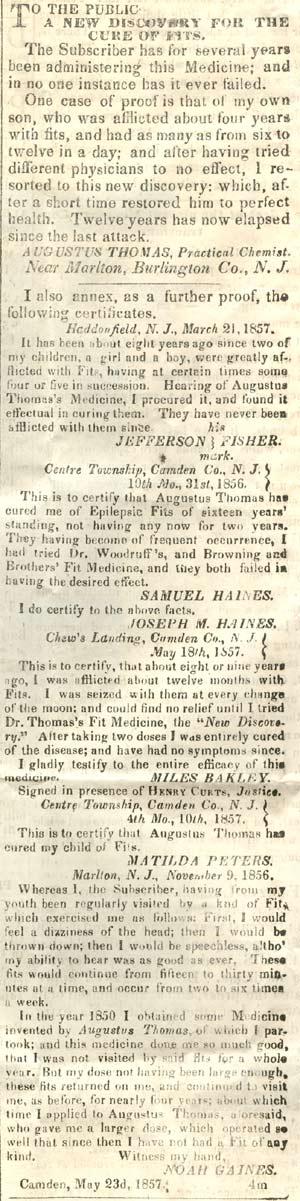
A New Discovery for the Cure of Fits.
The Subscriber has for several years been administering this Medicine; and in no one instance has it ever failed.
One case of proof is that of my own son, who was afflicted about four years with fits, and had as many as from six to twelve in a day; and after having tried different physicians to no effect, I resorted to this new discovery: which, after a short time restored him to perfect health. Twelve years has now elapsed since the last attack.
AUGUSTUS THOMAS, Practical Chemist.
Near Marlton, Burlington Co., N. J.
I also annex, as a further proof, the following certificates.
Haddonfield, N. J., March 21, 1857.
It has been about eight years ago since two of my children, a girl and a boy, were greatly afflicted with Fits, having at certain times some four or five in succession. Hearing of Augustus Thomas's Medicine, I procured it, and found it effectual in curing them. They have never been afflicted with them since.
his JEFFERSON FISHER. mark.
Centre Township, Camden Co., N. J. 10th Mo., 31st, 1856.
This is to certify that Augustus Thomas has cured me of Epilepsic Fits of sixteen years' standing, not having any now for two years. They having become of frequent occurrence, I had tried Dr. Woodruff's, and Browning and Brothers' Fit Medicine, and they both failed in having the desired effect.
SAMUEL HAINES.
I do certify to the above facts.
JOSEPH M. HAINES.
Chew's Landing, Camden Co., N. J. May 18th, 1857.
This is to certify, that about eight or nine years ago, I was afflicted about twelve months with Fits. I was seized with them at every change of the moon; and could find no relief until I tried Dr. Thomas's Fit Medicine, the "New Discovery." After taking two doses I was entirely cured of the disease; and have had no symptoms since. I gladly testify to the entire efficacy of this medicine.
MILES BAKLEY.
Signed in presence of HENRY CURTS, Justice.
Centre Township, Camden Co., N. J. 4th Mo., 10th, 1857.
This is to certify that Augustus Thomas has cured my child of Fits.
MATILDA PETERS.
Marlton, N. J., November 9, 1856.
Whereas I, the Subscriber, having from my youth been regularly visited by a kind of Fit, which exercised me as follows: First, I would feel a dizziness of the head; then I would be thrown down; then I would be speechless, altho' my ability to hear was as good as ever. These fits would continue from fifteen to thirty minutes at a time, and occur from two to six times a week.
In the year 1850 I obtained some Medicine invented by Augustus Thomas, of which I partook; and this medicine done me so much good, that I was not visited by said fits for a whole year. But my dose not having been large enough, these fits returned on me, and continued to visit me, as before, for nearly four years; about which time I applied to Augustus Thomas, aforesaid, who gave me a larger dose, which operated so well that since then I have not had a Fit of any kind.
Witness my hand,
NOAH GAINES.
Camden, May 23d, 1857.
Philadelphia & New York Lines
Camden Weekly Phenix —
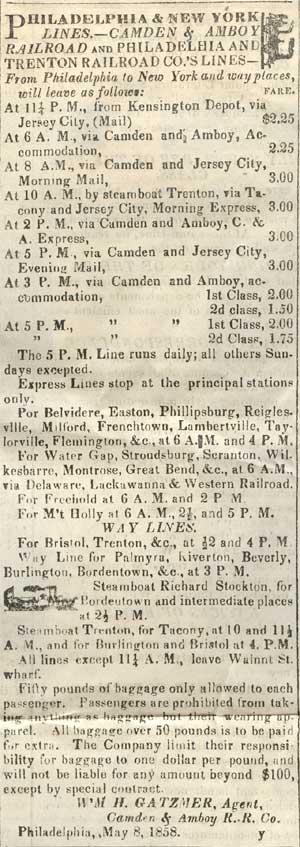
Camden & Amboy Railroad and Philadelphia and Trenton Railroad Co.'s Lines
From Philadelphia to New York and way places, will leave as follows: FARE.
At 11¼ P. M., from Kensington Depot, via Jersey City, (Mail) $2.25
At 6 A. M., via Camden and Amboy, Accommodation, 2.25
At 8 A. M., via Camden and Jersey City, Morning Mail, 3.00
At 10 A. M., by steamboat Trenton, via Tacony and Jersey City, Morning Express, 3.00
At 2 P. M., via Camden and Amboy, C. & A. Express, 3.00
At 5 P. M., via Camden and Jersey City, Evening Mail, 3.00
At 3 P. M., via Camden and Amboy, accommodation, 1st Class, 2.00 2d class, 1.50
At 5 P. M., " " 1st Class, 2.00 " " 2d Class, 1.75
The 5 P. M. Line runs daily; all others Sundays excepted.
Express Lines stop at the principal stations only.
For Belvidere, Easton, Phillipsburg, Reiglesville, Milford, Frenchtown, Lambertville, Taylorville, Flemington, &c., at 6 A. M. and 4 P. M.
For Water Gap, Stroudsburg, Scranton, Wilkesbarre, Montrose, Great Bend, &c., at 6 A. M., via Delaware, Lackawanna & Western Railroad.
For Freehold at 6 A. M. and 2 P. M.
For M't Holly at 6 A. M., 2½, and 5 P. M.
WAY LINES.
For Bristol, Trenton, &c., at 12[?] and 4 P. M.
Way Line for Palmyra, Riverton, Beverly, Burlington, Bordentown, &c., at 3 P. M.
Steamboat Richard Stockton, for Bordentown and intermediate places at 2½ P. M.
Steamboat Trenton, for Tacony, at 10 and 11½ A. M., and for Burlington and Bristol at 4 P. M.
All lines except 11¼ A. M., leave Walnut St. wharf.
Fifty pounds of baggage only allowed to each passenger. Passengers are prohibited from taking anything as baggage but their wearing apparel. All baggage over 50 pounds is to be paid for extra. The Company limit their responsibility for baggage to one dollar per pound, and will not be liable for any amount beyond $100, except by special contract.
WM. H. GATZMER, Agent,
Camden & Amboy R. R. Co.
Philadelphia, May 8, 1858.
West-Jersey Rail-Road Company
Camden Weekly Phenix —
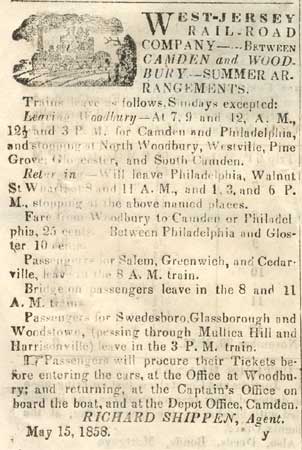
Between Camden and Woodbury.—Summer Arrangements.
Trains leave as follows, Sundays excepted:
Leaving Woodbury—At 7, 9 and 12, A. M., 12½ and 3 P. M. for Camden and Philadelphia, and stopping at North Woodbury, Westville, Pine Grove, Gloucester, and South Camden.
Returning—Will leave Philadelphia, Walnut St. Wharf, at 8 and 11 A. M., and 1, 3, and 6 P. M., stopping at the above named places.
Fare from Woodbury to Camden or Philadelphia, 25 cents. Between Philadelphia and Gloster 10 cents.
Passengers for Salem, Greenwich, and Cedarville, leave in the 8 A. M. train.
Bridgeton passengers leave in the 8 and 11 A. M. trains.
Passengers for Swedesboro, Glassborough and Woodstown, (passing through Mullica Hill and Harrisonville) leave in the 3 P. M. train.
Passengers will procure their Tickets before entering the cars, at the Office at Woodbury; and returning, at the Captain's Office on board the boat, and at the Depot Office, Camden.
RICHARD SHIPPEN, Agent.
May 15, 1858.
Reed St. Ferry
Camden Weekly Phenix —
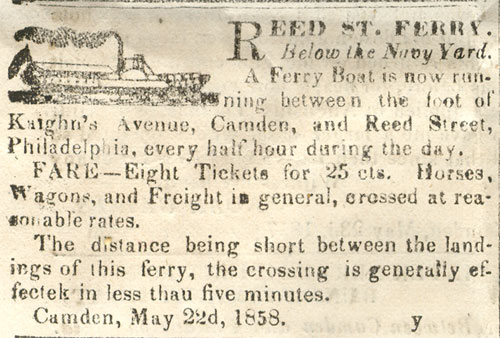
Below the Navy Yard.
A Ferry Boat is now running between the foot of Kaighn's Avenue, Camden, and Reed Street, Philadelphia, every half hour during the day.
FARE—Eight Tickets for 25 cts. Horses, Wagons, and Freight in general, crossed at reasonable rates.
The distance being short between the landings of this ferry, the crossing is generally effected in less than five minutes.
Camden, May 22d, 1858.
Camden Marble Works
Camden Weekly Phenix —
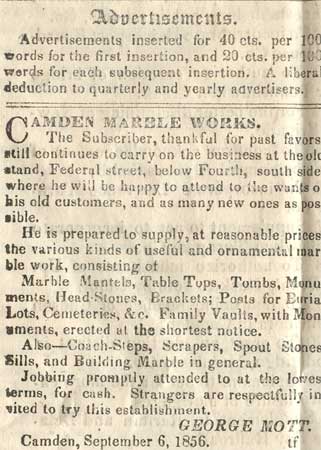
Advertisements.
Advertisements inserted for 40 cts. per 100 words for the first insertion, and 20 cts. per 100 words for each subsequent insertion. A liberal deduction to quarterly and yearly advertisers.
The Subscriber, thankful for past favors still continues to carry on the business at the old stand, Federal street, below Fourth, south side where he will be happy to attend to the wants of his old customers, and as many new ones as possible.
He is prepared to supply, at reasonable prices the various kinds of useful and ornamental marble work, consisting of
Marble Mantels, Table Tops, Tombs, Monuments, Head-Stones, Brackets; Posts for Burial Lots, Cemeteries, &c. Family Vaults, with Monuments, erected at the shortest notice.
Also—Coach-Steps, Scrapers, Spout Stones[,] Sills, and Building Marble in general.
Jobbing promptly attended to at the lowest terms, for cash. Strangers are respectfully invited to try this establishment.
GEORGE MOTT.
Camden, September 6, 1856.
Valuable Real Estate at Private Sale
Camden Weekly Phenix —
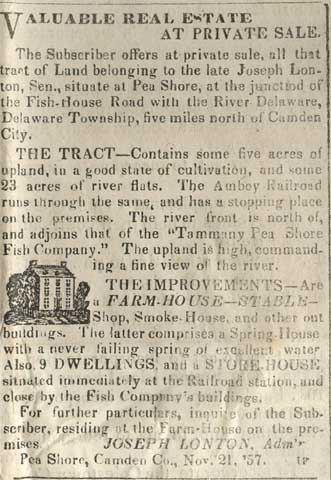
The Subscriber offers at private sale, all that tract of Land belonging to the late Joseph Lonton, Sen., situate at Pea Shore, at the junction of the Fish-House Road with the River Delaware, Delaware Township, five miles north of Camden City.
THE TRACT—Contains some five acres of upland, in a good state of cultivation, and some 23 acres of river flats. The Amboy Railroad runs through the same, and has a stopping place on the premises. The river front is north of, and adjoins that of the "Tammany Pea Shore Fish Company." The upland is high, commanding a fine view of the river.
THE IMPROVEMENTS—Are a FARM-HOUSE—STABLE—Shop, Smoke-House, and other out buildings. The latter comprises a Spring-House with a never failing spring of excellent water Also, 9 DWELLINGS, and a STORE-HOUSE situated immediately at the Railroad station, and close by the Fish Company's buildings.
For further particulars, inquire of the Subscriber, residing at the Farm-House on the premises. JOSEPH LONTON, Adm'r.
Pea Shore, Camden Co., Nov. 21, '57.
Marmaduke B. Taylor
Camden Weekly Phenix —
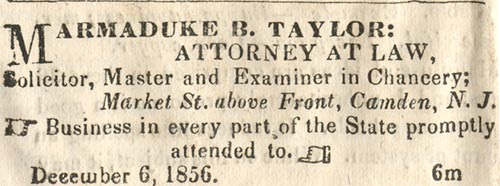
Attorney at Law,
Solicitor, Master and Examiner in Chancery;
Market St. above Front, Camden, N. J.
Business in every part of the State promptly attended to.
December 6, 1856.
Mc'Lain's Livery Stables
Camden Weekly Phenix —
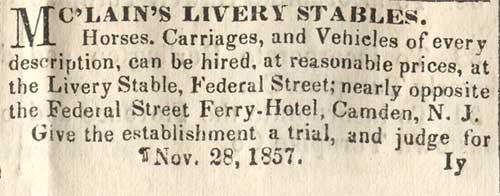
Horses, Carriages, and Vehicles of every description, can be hired, at reasonable prices, at the Livery Stable, Federal Street; nearly opposite the Federal Street Ferry-Hotel, Camden, N. J.
Give the establishment a trial, and judge for
Nov. 28, 1857.
The New York Steam Saw-Mill and Machine Company
Camden Weekly Phenix —
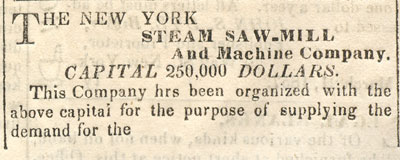
Capital 250,000 Dollars.
This Company has been organized with the above capital for the purpose of supplying the demand for the
[cut off at the crop edge]
Camden Mutual Insurance Association
Camden Weekly Phenix —
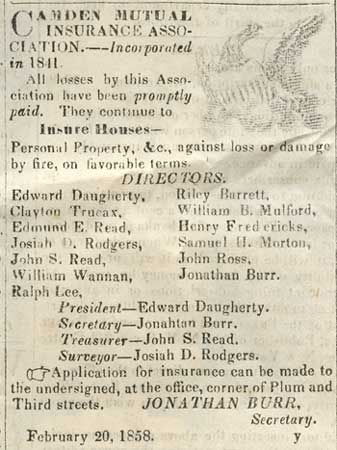
Incorporated in 1841.
All losses by this Association have been promptly paid. They continue to Insure Houses—Personal Property, &c., against loss or damage by fire, on favorable terms.
DIRECTORS.
Edward Daugherty, Riley Barrett, Clayton Truex, William B. Mulford, Edmund E. Read, Henry Fredericks, Josiah D. Rodgers, Samuel H. Morton, John S. Read, John Ross, William Wannan, Jonathan Burr. Ralph Lee,
President—Edward Daugherty.
Secretary—Jonahtan [sic] Burr.
Treasurer—John S. Read.
Surveyor—Josiah D. Rodgers.
Application for insurance can be made to the undersigned, at the office, corner of Plum and Third streets.
JONATHAN BURR, Secretary.
February 20, 1858.
An Old Indian Doctor
Camden Weekly Phenix —
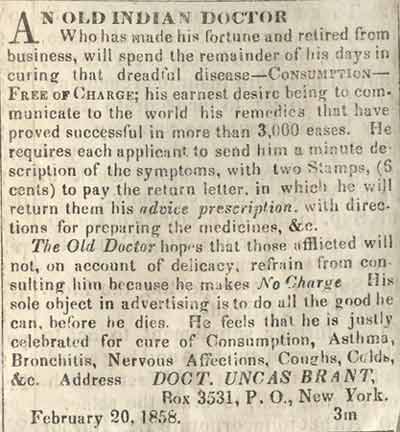
Who has made his fortune and retired from business, will spend the remainder of his days in curing that dreadful disease—CONSUMPTION—FREE OF CHARGE; his earnest desire being to communicate to the world his remedies that have proved successful in more than 3,000 cases. He requires each applicant to send him a minute description of the symptoms, with two Stamps, (6 cents) to pay the return letter, in which he will return them his advice prescription, with directions for preparing the medicines, &c.
The Old Doctor hopes that those afflicted will not, on account of delicacy, refrain from consulting him because he makes No Charge. His sole object in advertising is to do all the good he can, before he dies. He feels that he is justly celebrated for cure of Consumption, Asthma, Bronchitis, Nervous Affections, Coughs, Colds, &c. Address DOCT. UNCAS BRANT, Box 3531, P. O., New York.
February 20, 1858.
The Effect of the present Monetary Contraction
Camden Weekly Phenix —
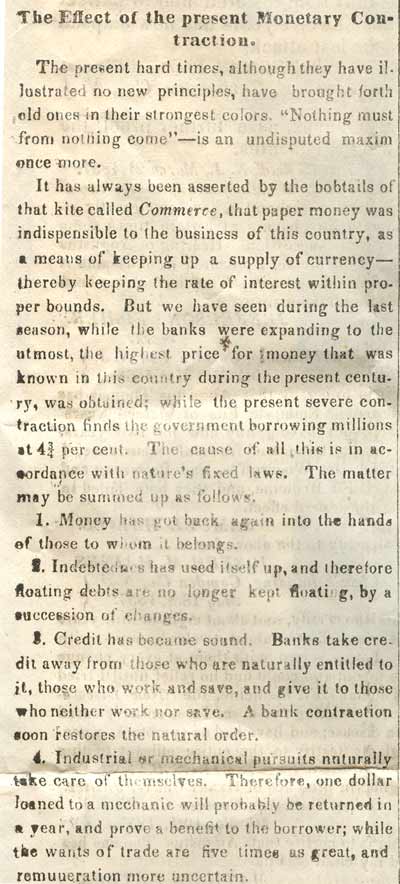
The present hard times, although they have illustrated no new principles, have brought forth old ones in their strongest colors. "Nothing must from nothing come"—is an undisputed maxim once more.
It has always been asserted by the bobtails of that kite called Commerce, that paper money was indispensible to the business of this country, as a means of keeping up a supply of currency—thereby keeping the rate of interest within proper bounds. But we have seen during the last season, while the banks were expanding to the utmost, the highest price for money that was known in this country during the present century, was obtained; while the present severe contraction finds the government borrowing millions at 4¾ per cent. The cause of all this is in accordance with nature's fixed laws. The matter may be summed up as follows.
1. Money has got back again into the hands of those to whom it belongs.
2. Indebtedness has used itself up, and therefore floating debts are no longer kept floating, by a succession of changes.
3. Credit has became [sic] sound. Banks take credit away from those who are naturally entitled to it, those who work and save, and give it to those who neither work nor save. A bank contraction soon restores the natural order.
4. Industrial or mechanical pursuits naturally take care of themselves. Therefore, one dollar loaned to a mechanic will probably be returned in a year, and prove a benefit to the borrower; while the wants of trade are five times as great, and remuneration more uncertain.
"Rational Guide to Spelling"
Camden Weekly Phenix —
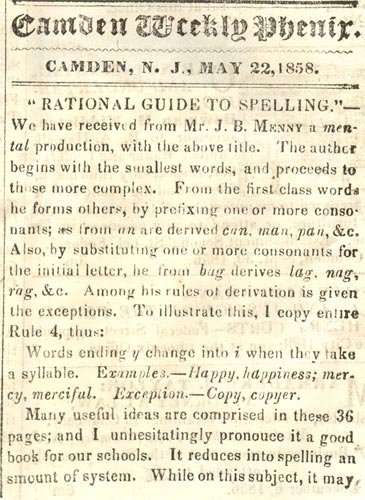
We have received from Mr. J. B. Menny a mental production, with the above title. The author begins with the smallest words, and proceeds to those more complex. From the first class words he forms others, by prefixing one or more consonants; as from an are derived can, man, pan, &c. Also, by substituting one or more consonants for the initial letter, he from bag derives lag, nag, rag, &c. Among his rules of derivation is given the exceptions. To illustrate this, I copy entire Rule 4, thus:
Words ending y change into i when they take a syllable. Examples.—Happy, happiness; mercy, merciful. Exception.—Copy, copyer.
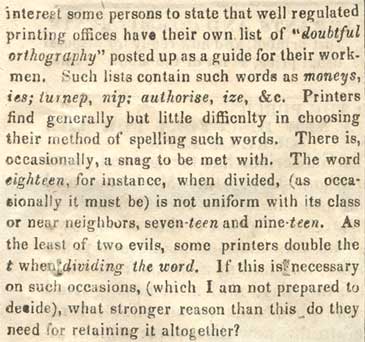
Many useful ideas are comprised in these 36 pages; and I unhesitatingly pronouce [sic] it a good book for our schools. It reduces into spelling an amount of system. While on this subject, it may interest some persons to state that well regulated printing offices have their own list of "doubtful orthography" posted up as a guide for their workmen. Such lists contain such words as moneys, [mon]ies; turnep, nip; authorise, ize, &c. Printers find generally but little difficulty in choosing their method of spelling such words. There is, occasionally, a snag to be met with. The word eighteen, for instance, when divided, (as occasionally it must be) is not uniform with its class or near neighbors, seven-teen and nine-teen. As the least of two evils, some printers double the t when dividing the word. If this is necessary on such occasions, (which I am not prepared to decide), what stronger reason than this do they need for retaining it altogether?
City Alderman—and Justice of the Peace
Camden Weekly Phenix —
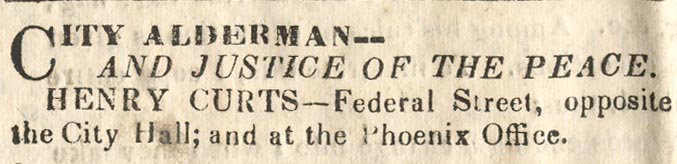
HENRY CURTS—Federal Street, opposite the City Hall; and at the Phoenix Office.
Justices' Blanks
Camden Weekly Phenix —
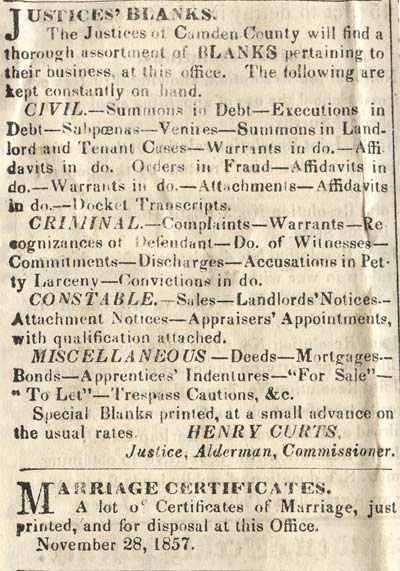
The Justices of Camden County will find a thorough assortment of BLANKS pertaining to their business, at this office. The following are kept constantly on hand.
CIVIL.—Summons in Debt—Executions in Debt—Subpœnas—Venires—Summons in Landlord and Tenant Cases—Warrants in do.—Affidavits in do. Orders in Fraud—Affidavits in do.—Warrants in do.—Attachments—Affidavits in do.—Docket Transcripts.
CRIMINAL.—Complaints—Warrants—Recognizances of Defendant—Do. of Witnesses—Commitments—Discharges—Accusations in Petty Larceny—Convictions in do.
CONSTABLE.—Sales—Landlords' Notices—Attachment Notices—Appraisers' Appointments, with qualification attached.
MISCELLANEOUS—Deeds—Mortgages—Bonds—Apprentices' Indentures—"For Sale"—"To Let"—Trespass Cautions, &c.
Special Blanks printed, at a small advance on the usual rates. HENRY CURTS, Justice, Alderman, Commissioner.
Marriage Certificates.
A lot of Certificates of Marriage, just printed, and for disposal at this Office.
November 28, 1857.
Commissioner for Deeds
Camden Weekly Phenix —
HENRY CURTS—At the Phoenix Office, adjoining his residence, Federal Street, opposite the City Court House.
Job Printing.
Of every description, promptly attended to at this Office, on reasonable terms.
Warrants and Commitments,
Camden Weekly Phenix —
Just printed, and now ready for disposal at the usual price, a lot of the above named blanks,
Apprentices' Indentures
Camden Weekly Phenix —

A lot just printed, for retail, at this office.
February 20, 1858.
Fruit of Liberal Advertising
Camden Weekly Phenix —
The energetic proprietor of the Antiphogistic Salt, the past year, has advertised in 1250 1250 [sic] papers, (one-fourth of all published in the U.S.,) and sold 40,000 packages of the medicine. Dr. Coggswell appreciates the press, and avails himself of its power. Let others profit by his extra ordinary success.