1870
The West Jersey Press Building at Front and Market Street was formally opened December 22, 1870. It was sold to the Victor Talking Machine Company and torn down in May of 1914 to make room for one of the large buildings of the Victor Plant. The fourth floor of the Press building was used as the Armory of the Sixth Regiment, National Guard of New Jersey. Gatling Gun Company B, organized in 1878, also had its first quarters in this building.
1871
Asbury Methodist Episcopal Church dedicated its first frame meetinghouse in May of 1871, near Pavonia Station. For ten years the organization was known as Harmony Methodist Episcopal Church. The name was next changed to Dudley Methodist Episcopal Church. In August of 1879, a lot was purchased on Westfield Avenue near Church Street and the present building was erected in 1881. On April 3, 1897, the name was again changed, to Asbury Methodist Episcopal Church.
1872
P.T. Barnum’s “great traveling museum, menagerie and caravan” exhibited on the lots on Broadway below Bridge Avenue on April 20, 1872.
1873
The Soldiers’ Monument, erected with funds raised partly by private subscription and by an appropriation by the Board of Freeholders, was unveiled June 9, 1873, in the old Court House Yard. It was removed to the ground adjacent to the City Hall when the jail building was erected on Federal Street. The Soldiers’ Monument now sits on the grounds of Cooper Hospital, at Haddon Avenue and Benson Street.
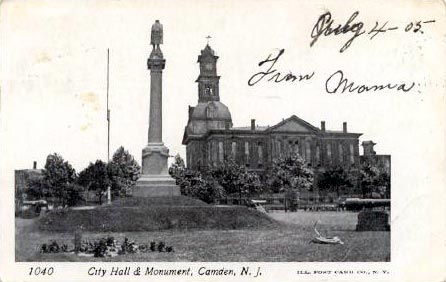
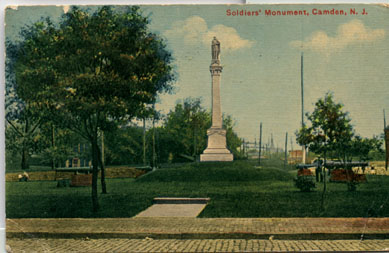
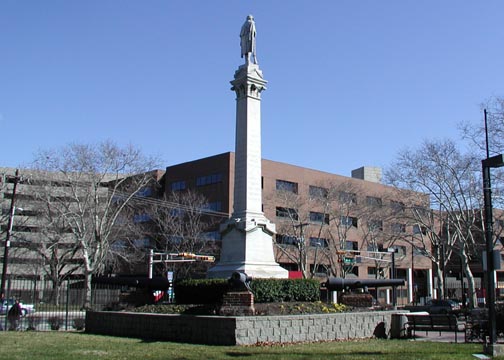
Above: Soldiers’ Monument & City Hall. Below: The Soldiers’ Monument.
The Soldiers’ Monument in 2002.
1874
The West Jersey Orphanage was chartered February 17, 1874. The home was organized by the Society of Friends and its object was to provide a home for destitute colored children. Joseph M. Kaighn donated three lots of ground at Oak and Chestnut Streets, and the three adjoining lots were purchased. Subsequently, however, it was decided to purchase of James W. Purnell the two-story brick building, erected by Joseph Kaighn for a farmhouse, at 6th and Mechanic Streets, together with one-half acre of land adjoining. The building was opened for the reception of colored children January 20, 1875.
1875
A committee of City Council appointed to select a site for a new City Hall reported on July 13, 1871 that they had received from Jesse W. Starr a deed of conveyance with the accompanying documents for the property on Haddon Avenue. Among the conditions attached to the conveyance were the following: 1. That the erection of a City Hall should begin thereon within three years and completed within five years; 2. That the ground should always be used for a City Hall and public park and if it should cease to be so used it was to revert to him or his heirs. The land consisted of four and one-half acres, but as it was outside the built up portion of the city, considerable opposition developed to its acceptance for the specified purpose, and it was not until 1874 that the deed of gift was finally accepted. On July 2, 1874, Mr. Starr also gave the city the ground upon which the Soldier’s Monument now stands, upon the same conditions. The City Hall, which cost about $140,000, was completed in 1875. On December 20, 1883, the City of Camden wishing to own the grounds free of all conditions paid Jesse W. Starr $10,813.19 for an absolute conveyance.
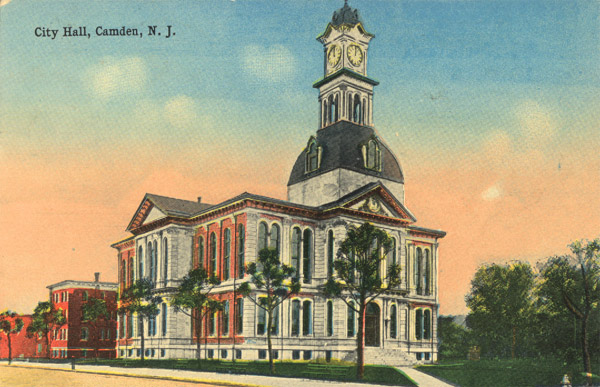
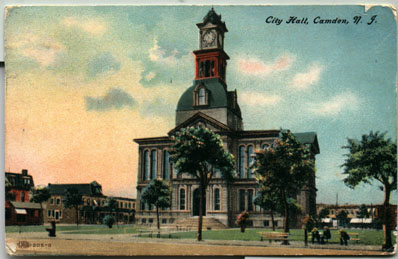
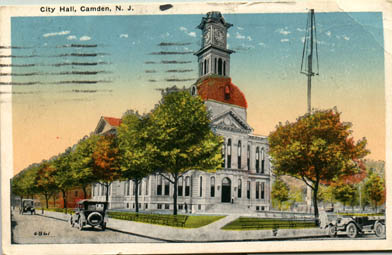
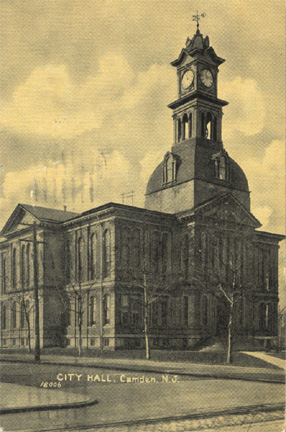
Postcards of Camden’s first City Hall. The postcard to the left also shows the Soldiers’ Monument; it was mailed August 4, 1905.
1876
John Hunt, proprietor of the Franklin Carpet Works, on Front Street above Market, exhibited in January of 1876 a “Centennial Carpet” which he made in honor of the Centennial in Philadelphia.
1877
St. Stephen’s Protestant Episcopal Church was built near 10th and Cooper Streets in 1877, being known as St. Paul’s Chapel. On August 17, 1896, the cornerstone of the building to be hereafter designated as St. Stephen’s was laid by Bishop Scarborough and the opening service in that church was held on the following November 22nd. On May 28, 1907, the congregation voted to become an independent parish to be known as St. Stephen’s.
1878
The Young Men’s Christian Association of Camden was organized on October 16, 1878. The first meeting was held at the residence of Samuel B. French, northeast corner of Front and Cooper Streets. Subsequent meetings were held in the Chapel of the Tabernacle Baptist Church (later the Hatch Post 37 of the Grand Army of the Republic Hall), and about January of 1879 quarters were secured at 318 Federal Street, where the Association remained until 1880, when the hall at the southeast corner of 3rd and Market Streets was built and the second and third floors occupied by the association. In March of 1894 the house of Thomas B. Harned, on Federal Street east of Broadway, was bought for $16,500 and after some alterations was occupied in April. The YMCA as it is now constituted was incorporated on November 21, 1899. In 1907 a campaign was conducted to secure $250,000 for a new building, which was erected in 1909 on the site that the building formerly occupied.
1879
Epiphany Evangelical Church was formed in 1879. The church building at 7th and Market Street was dedicated December 11, 1887.