It’s All In The Game
By A. Charles Corotis — Published 1955
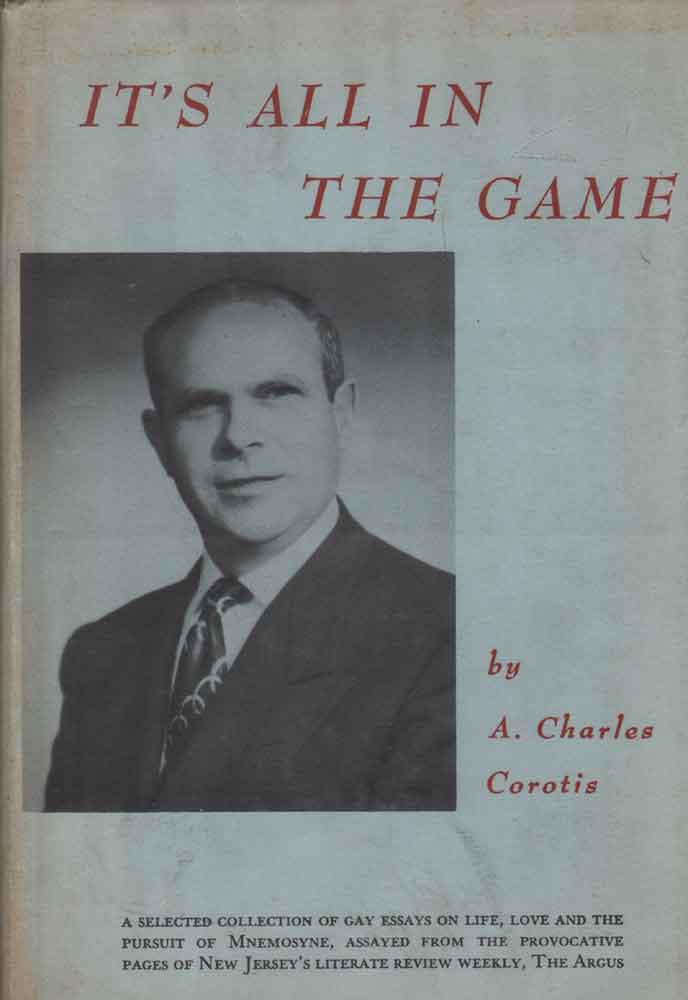
A. Charles Corotis, 1955.
Abraham Charles Corotis was well-known for many years as a reporter, public relations man, and publisher in Camden and South Jersey. After working in daily newspaper journalism for twenty years, he went into public relations, eventually maintaining offices in Camden, Trenton, and Newark and publishing a dozen trade magazines and public weeklies.
For many years the author of a column called “It’s All In The Game,” in 1955 Mr. Corotis published a book of the same name with a collection of articles from his column in The Argus, New Jersey’s literary review weekly. In 1957, Mr. Corotis lost a libel suit to State Senator Joseph Cowgill and the Argus ceased publication. He also published “A Thousand Eyes” in 1957 and a novel, “B. Bull, Bastard,” in 1959.
Corotis writes about many well-known people in Camden and New Jersey in It’s All In The Game, including realtor Leon Todd, boxers Sergeant Ray Smith and Jersey Joe Walcott, and baseball pitcher Grover Cleveland Alexander.
Preface
It was a long, long time ago under circumstances of exceedingly pleasant remembrance that I once was told, “You make love like you write: sometimes tenderly, sometimes violently.
The combined limitations of literary dissemination and advancing age make academic the most intriguing phase of that analogy. What follows on these pages are examples of the belletristic gamut.
It has been no easy matter to sift through hundreds of tracts and select a few for purposes of publication. It's al-most like choosing from among one's own children. Man and boy, I've been setting down my observations and notions on a wide range of subjects for more than thirty years, in daily and weekly newspapers and trade magazines of one kind and another. A man can conceive a lot of manuscriptive siblings that way.
What we've tried to do here, the publishers and I, is serve up a smorgasbordic indictment that is reasonably representative. Variety has been the keynote of our quest. Thus our hors d'oeuvres range from the light-hearted, sometimes flippant, through music, sports, travel, even philosophy—all the way to canapes sober and earnest. In this collection you will find a few niblets of alleged humor, a few hopefully poetic excursions into verse, some tidbits smacking of the sentimental, others mercilessly lampooning, twitting alike the large and the small.
For in these past three decades of typewriter pounding, your correspondent has tried to be a bit of everything—reporter, essayist, biographer, dramatist, poet, novelist, wit, critic, scenarist, in some cases an amanuensis seeking to record for a newspaper's circulation those moving and delightful excerpts from the classics.
I regard this last as far from the least important, and I'll tell you why. It is not easy, for example, for many of us to digest all of Carlyle, yet some of the most beautiful and inspiring passages ever created came from his pen, and such nuggets need to be dredged from the great ore fields of Cheyne Row. One needn't be an intellectual to appreciate those extracts any more than he must be a “highbrow” lover of opera to enjoy the “Habanera” from “Carmen” or the “Barcarolle” from “Tales of Hoffman,” to thrill to “la donna e mobile” from “Rigoletto” or “mi chiamano Mimi” from “La Boheme.”
Not only do the score or more of pieces that follow ramble over a wide range of subjects; they cover a considerable period of time, too. This condition makes for some opinionated inconsistencies, even conflicts. I realize, for instance, that my spoofing of television, made in the ignorant innocence of life before I became a video addict, will receive the derision it deserves from those of my regular readers who recognize how important a part this miracle of free entertainment has come to play in my life, but in such instances I can do noth-ing but salt down my crow and make it as palatable as possible.
Some among these selections, I hope most sincerely, will please you. The versatility of the subject matter should see to that, although by the same token it virtually rules out any chance of acceptance of all by anyone.
You may, for example, shy away from violence. In that case, try a little tenderness.
See you in a sequel?
A. C. C.
Get Thee Behind Me
They swooped down on me with the horn of Ray Prideaux's new Cadillac calling enticingly, alluringly, like the siren-song of Homer's sea-nymphs. “Come and join us this sunny weekend in Atlantic City,” the fluted notes seemed to say.
Realtor leaders from upstate, they were on their way to the Traymore to make convention arrangements. At least, that was their excuse. “Come with us,” was the theme of their bewitching siren choir . . . “celestial music warbles from their tongue, and thus the sweet deluders tune the song.”
I couldn't go; too much unfinished work lay piled up on rny desk, including a column to be written. But, unlike Ulysses, I had no wax-stuffed seamen to hold me in spite of mvself . . . “now round the masts my mates the fetters rolled, and bound me limb by limb with fold on fold.”
Contrariwise, I had only my unselfish wife joining her entreaties to theirs: a weekend of relaxation in such pleasant company would do me good.
So I stood wavering, alone, I and my sense of duty, until a brilliant thought assailed me—a fragment of a conversation with Leon Todd at dinner in Newark some nights before.
I didn't pay too much attention to it at the time,“ a tanned, clearer-eyed Leon was saying, ”because I never had d a roomette before. But now that I just came up from Florida in one, I'd like to reread what you wrote about 'em a couple of years ago.“
Well, why not? And, while I'm about it, why not the whole column? Reprinting requires less energy and imagination and, most important, less time than does creating. So it is—forgive me, please, and thanks for a nice weekend.
From a personal standpoint, the week's visit to Chicago— my first, incidentally —was highly successful.
Both at the national realtor convention at the Stevens and the savings and loan affair at the Palmer House, New Jersey's defeat of public housing at the November 8th election was a favorite topic of conversation. A display of the material used in the campaign put our state in the limelight, and folks like Armel Nutter, Harrison Todd, Henry Stam, Emil Gallman, Jack Kempson, George Seiler, Jim Holton, Garry Winter and other realtors and newspapermen saw to it that everyone knew I had directed the campaign.
Then, too, New Jersey won first prize in the Constitution Day publicity contest, and I took bows on that achievement. We beat every other state in the country in this competition.
I spoke on the program of the National Association of Real Estate Editors; everything went well, and at the cocktail party and dinner which followed, I was honored by being made a member of this select group.
My big day, though, was Saturday, at least gastronomically. After breakfast, I dropped in to see Leon Todd, confined to his bed with pleurisy following a heart attack, in time to have some more breakfast with him. The Greyhound taking the newspapermen on a tour of Chicago left the hotel at eleven. At noon we lunched at Illinois Tech. Alas, I couldn't do justice to the smorgasbord that I love so well.
Our tour ended at the State-Madison building and a cocktail party featuring delicious canapes. Back at the hotel for a 5:30 reception to Harold Stassen and General Motor's Alfred Sloan in the Stevens' Royal Skyway suite, no less. From there to a rip-roaring Ohio reception, then a Virginia ham sandwich in the Virginia suite, orange juice, in the Florida suite, and finally to a full-course meal at the banquet of the Society of Industrial Realtors. Eventually to the Hotel Sherman where Carl Byoir had rented the famed House on the Roof for a press party.
I couldn't eat another thing.
ROOMETTE WRESTLING
My roomette on the Broadway Limited provided a nice view of incandescent- pricked blackness when finally I retired. The gang from New York and North Jersey was on, and we and the Philly crowd joined them, so it was a short night at best.
The secret of getting along in a roomette is to refrain from drinking before you go to bed, or alternatively to stay up so late that you won't have to get up during the night. The wall bed in a roomette, you know, occupies the entire space. To pull it down, you park your rear out the curtain, fasten it down (the bed, I mean), clamor in, then draw shut the mirrored door to your compartment. The bed covers everything, including the toilet.
Should you awaken during the night—and stay awake— you've got a problem on your hands. First, you kick off the covers, slide down to the foot of the bed, get on your knees, slide back the door, slide out of bed, your derriere pushing the curtain into the aisle, release the catch on the bed, let it go up to the wall; then some time later reverse the entire procedure.
Roomettes are not for folks with weak kidneys.
They are nice, compact, modern examples of utility, though, all glass and steel and aluminum with every possible convenience, even luxury.
I made sure I stayed awake for the crossing of the Alleghenies, especially the horseshoe curves, including the famous one at Altoona, where you could see the brightly lighted front section of the Broadway wending its serpentine way laboriously up the mountain. The darker outlines of distant mountain ranges added a pleasantly eerie touch. Lights of an occasional town punctured the darkness spas-modically.
After Pittsburgh I let myself be carried into slumber by the gentle motion of the train and slept all the way across Ohio and into Fort Wayne, Indiana. The homestretch was enlivened by a race between the Broadway and the New York Central's crack 20th Century Limited. We won. In fact, we got in to Union Station fifteen minutes ahead of schedule.
TAKE THE AIR, BOY
Returning was even a better deal. I swapped with Leon Todd, whose doctors didn't want him to fly home. It was my first flight in an airliner, although I had been up many times.
From now on I'm a fly-boy.
Tuesday at noon was Chicago's first sunny day in a week although no less windy than the others. A half hour's ride by limousine to the Chicago municipal airport—“aviation center of the world”—took us past the stockyards and trucks of hogs that made me think of my epicurean indulgence the Saturday before.
After watching Northwest's huge stratocruiser take off, I settled down in TWA's 460 for another first in my life. The Pullman had been one, Chicago another.
We soared above toy houses set in aimless patterns on a vari-hued and vari-shaped patchwork quilt, crisscrossed with tiny silver threads and calcimine seams, some winding, some die-straight, with pokey bugs crawling along them at intervals. Here was a golf course whose scraped roughs looked like foot-stomps of a berserk giant. As we climbed higher, the miniature buildings became shapeless tomb-stones, nondescript and indefinable, with here and there a larger-than-usual cemetery.
Lake Michigan—the Atlantic without whitecaps—lay se renely to the north. The whole countryside was covered with a mantle of marble, the handiwork of the Snow King. Soon, as the snow belt slipped behind, the obliterated checker board reasserted itself.
What a grand feeling, this overseeing of earth from on high, this choice seat at a panoramic showing of the world at its kaleidoscopic best!
IMPRESSIONS
Thousand Island dressing floating by leisurely as we rise above the clouds —and overhead the unbroken blueness of the sky, the unfiltered glare of the sun reflecting on our silver wings . . . the horizon a level mountain of alabaster, and above it long, slender wolfhounds darting out from time to time … Finally, after the first thrilling hour, surfeited with the soul-cleansing prophylaxis of noble white and azure, comes relaxation and realization of the gracious charm of the air hostess. But even her radiant personality can't com-pete long with Nature's … The clouds scooting below become increasingly prolific and it is apparent we are approaching Pittsburgh, a supposition confirmed as an off-white haze settles over everything … Finally, solid banks of smoke close in and blot out the earth completely … Perceptibly cooler in the plane as we climb to keep above the sea of solid cloudbergs, their tops more varied in shape than mountains … Marveling that the pilots, with all their training and instruments, can find their way down through that cottonfield, layer after layer, to hit the thin splinter of a runway … Settling down over Pittsburgh Airport, the world we know takes shape again. Houses look like houses, hills like hills, the quilt becomes farms, the Al-legheny and Monongahela become rivers, clouds float over-head where they belong.
REFLECTIONS
Crossing the Alleghenies as the sun is setting is a mem orable experience … A mammoth amphitheatre, its rim encircled by pink and blue puff balls, mountain ranges the various levels of seats, the green-gray-brown patchwork a tarraza laced by seams of concrete and water … Here and there a red-thatched spectator sits or a group cluster together in attentive immobility, enjoying the regal, panoramic splendor … Harrisburg at dusk, its airport a citadel protected by a turret of hills cuddled alongside the graceful Susquehanna … After Harrisburg, night closes in and the sky becomes inverted, with myriads of stars twinkling below in building and on street corner … Venus hangs a slender silver sliver in the western sky and her planetary namesake emerges in all her robust beauty to form the celestial version of the Turkish crescent … Below, jeweled necklaces strung across the earth's throat and bosom, and the liquid gold of moving motor lights … The great locket of diamonds and rubies and emeralds that is Philadelphia beckons us enticingly to journey's end, in time for dinner after lunch in Chicago … It's the air for me henceforth.
Neigh, Nay
Venus. Paris was the judge and Helen of Troy the pawn. Result: the Trojan War. Somebody always gets hurt.
This is all by way of explaining that when I accepted Sam Walker's invitation to a party at Monmouth Park I was motivated solely by a desire for pleasant and congenial companionship. I had no illusions about what was going to happen to the ten cents tucked away in the corner of my wallet.
First came lunch, and it was very nice, there on the breeze-buffeted veranda. There were seven in our party—that is, Sam's party—but I might as well have been eating alone. I defy any of the others to identify so much as one morsel of their meal, or even to testify under oath that they ate at all! They were too intent on form sheets, scratch sheets, dope sheets, and pensive nibbling at something long and cool.
Now, I am not one of those to let anything interfere with my eating, and none of my people before me ever has been. So I gave myself up to solitary nourishment and contemplation.
The lot of a waiter in a racetrack restaurant is a hard one indeed. He is ignored as firmly and thoroughly as a tout. No one pays any attention to his entreaties to order. When he brings an assortment of foodstuffs, no one knows what is his: the ham and cabbage, or pickles and ice cream, or fried frog's liver flavored with prune juice. The food remains untouched except for the cigarette ashes and butts which form a sort of salprunella sauce coating chicken and pie indiscriminately and with fine impartiality.
Well, enough of this digression. Emory Haskell didn't send me a working press pass to cover nicotinic luncheons. Exciting and amusing as this account of meals at Monmouth has been for all of us, I am sure, duty impels me to the task of reporting the races. It is not a pleasant charge. I hate those horses just thinking about it.
Now, if duty impels, candor compels me to confess that it was no one's fault but my own that I didn't win. I had plenty of good advisers. I just didn't have sense enough to tell them what to do with their advice.
Take the first race. Or did the first race take me? Anyway: “Cookie K is the horse,” confided John Harkins, who makes an avocation, if not indeed a vocation, of studying the habits and habitat of the steenbock. But word of the imminent coup we had planned on Cookie K must have got around. He was scratched.
Leon Todd introduced me to Jimmie Stout's wife (the Stouts live in Medford Lakes between race meets) so we had to go along with Silk Quest, which James was riding. Harry Willson, who does pretty well, all things considered, came up with Fizzle. And he was! Recurring was Sam Walker's pet. He placed, at that. Jack McGarrity was positive it would be Moon Dots.
Other hot tips: Bank Drive (Hanford was up); Sir Lionel (he was sent down from New York); Jewel's Fern one of the Fernandez boys had him); Yalta (a hunch—another peace parley was on); Skidallday (presumably because the name was catchy).
I threw up my hands in despair.
“Since,” I said, “all these nags are sure to win and it is anybody's race, I will plunge and risk six dollars across the board on the longest shot.”
The longest shot was Number 9 — Pip. Mora was riding him. He went to the post at 70 to 1. He finished at a quarter to 10, in darkness.
The winner: Bunny Hug. Dave Cronheim had him; had tried to give him to Mayor Charlie Gillen and me, but by that time I was surfeited with tips, hot, cold, or lukewarm.
But I had learned my lesson. I was smart enough to prof-it by my experience. I went sheepishly to Cronheim's box, apologized for disregarding his advice, begged forgiveness another chance.
He relented. “Number 1,” he said with a knowing look out of the corner of his mouth. That is, the words came out the corner of his mouth, not the look.
Number 1 was Samson D. To the combination window I hurried again, a sawbuck and a fin clutched in my perspiring paw.
Number 1 finished fourth.
“Dave,” I told him severely, “I shall give you one more chance.” And I fixed a reproving eye on the man who owns, half of Newark.
He seemed penitent. “This is a tough one,” he frowned in intense concentration like when he was counting out the two million simoleons to buy the Broad & Market Building “but I like Number 1 again.”
This Number 1 was Boy Blue and Hanford was blowing his horn. But this time I was cagey. I wasn't putting all fifteen of my eggs in one basket again. So I consulted other advisers.
“Texas Skies sure,” said Jack McGarrity, who had been equally sure of Moon Dots and Ignite in the first two. Neither finished yet.
“I've got Stag,” said Johnny Harkins, who turned up. with tickets on Bunny Hug and Pomace, winners of the first two.
“I like Bolog,” said Leon Todd. I consulted my program. Yep, Stout was up on Bolog. Mrs. Stout is a very attractive young lady.
While I was frantically buying win, place, show, and combination tickets, respectively, on Boy Blue, Texas Skies,, Stag and Bolog, the horses pranced to the gate.
Toy Fox won.
By now serious consultation was indicated, and we went into a huddle in Box 51, joined by influential outsiders like Morris Goldfarb and Don Connolly, mayor of Trenton, and Les Burdick, on leave from investigating committees.
The consensus eliminated all entries except (a) Blue Moon, (b) Carolina Queen, and (c) On. It was a six-horse race. They finished, in order (a) Sea Fan, (b) Elope, and_ (c) Tea Deb.
But I perked up when they came on for the fifth race. It was being run on turf. Now surely my luck would change. Grass couldn't do that to an old lawn-mower like me. Why, I love nothing better than to stretch out on a patch of green clover in the shade of a maple or elm. I'm so pasturable they call me Herb.
Quite a classical lineup, too. Octavia's Daughter, Nereid, Gallalad, by Sir Gallahad. They presented something of a dilemma, though. Which of the three should I play? Gallahad always was my favorite knight; I felt a sense of loyalty to him. But then, I was on Octavia's side in her contest with Cleopatra for the affections of her husband, Mark Anthony. However, I never met her daughter.
And those Nereids. Woo-woo! They are among my fabled favorites of all mythology, those luscious Lorelei. Any time I get near the water's edge, you can hear me calling in a loud, beseeching voice: Amphitrite . . . Thetis . . . Galatea . . . Chloe. No, not Chloe. How'd she get out of that bayou? Of course, this flirtation with the sea-nymphs is all quite respectable, you understand. I am a friend of their ma and pa, Doris and Nereus.
Well, I finally contrived an ingenious combination on win, place, and show, in order not to slight any of the three, and felt quite satisfied with myself.
Palatial Appetite won.
Must I go on with gory details? Suffice it to say that I didn't have a winner; not one, not even when I was reduced to playing place and show. I seem destined to go through life contributing to bookmakers or their mechanical counterparts. Uncle Sam should permit me to deduct my losses as gifts. Even if Bellerophon brought Pegasus down, the Pallas Athene's golden bridle and all, he couldn't beat a turtle six furlongs if I had a deuce riding on his wings. Jupiter probably would send another gadfly to sting him and make him throw his jockey.
I'd better stick to parchesi.
Eenie-Meenie-Meyner
Of Large Mice and Small Men
Eenie, Meenie, Meyner mo, Catch Corotis by the toe, If he hollers let 'im go; Eenie, Meenie, Meyner mo.
But, from Eeenie Richman, whoa! This Corotis so-and-so Never was a crying Joe; Eenie, Meenie, Meyner mo.
Meenie Alexander: Oh, Sometime everyone eats crow; Kick 'im where the scars won't show; Eenie, Meenie, Meyner mo.
You mean, Meyner all aglow, Let 'im have it down below? Goody; Archie, you're a doe; Eenie, Meenie, Meyner mo.
Ring-around-a-rosie; lo, Hand in hand they do-se-do, Singing whoops and hi-de-ho; Eenie, Meenie, Meyner mo.
Vital business? Heavens no! Let affairs of State go blow; We've some seeds of hate to sow; Eenie, Meenie, Meyner mo.
Slap 'im high and smash 'im low, Beat 'im out of all his dough; Watch us make his troubles grow; Eenie, Meenie, Meyner mo.
Tell his clients, let 'em know Old Corotis is our foe; We insist he's gotta go; Eenie, Meenie, Meyner mo.
But no buts; our course you'll row, Discontent you'd better stow; We're real brutal, awfully so; Eenie, Meenie, Meyner mo.
Oh, we're fearsome; clever, though, Each a bright politico With ambitious rows to hoe; Eenie, Meenie, Meyner mo.
Watch us brew a stew, steeped slow; Curds and sherd stirred to and fro, Nails and snails and tales of woe, Eenie, Meenie, Meyner mo.
Round about the cauldron go, In the poisoned slanders throw, Dragon's scale, newt's tail, toad's toe; Eenie, Meenie, Meyner mo.
Lizard's eyes and lies next flow, Potion vile, the while we grow Into men of stature quo; Eenie, Meenie, Meyner Co.
“For Pete's sake,” protested my exasperated roommate in 768 of Washington's Statler Hotel, “will you put down that pencil and put out that light and go to sleep?”
“My friend,” I told Leon Todd — for it was indeed he — “my friend, I feel too good to sleep.”
“And what, may I inquire, is the reason for such unac customed happiness?”
“It is the sweet solace of good companionship that soothes and succors men's minds. Here I am far from the ozostomic atmosphere of the State House. For a whole week. I can for get that mental minor Meyner and his jackal janissaries and mingle with gentlemen of gentle discernment. It is a pleasant feeling.”
“Then go to sleep and dream about your joy.”
“You know I don't dream. Never in my whole life have I experienced the briefest visit to dreamland. I am one of those rarities who doesn't revel in reverie.”
“Then just sleep. It is now 3 a.m. In exactly five hours Room Service will come tapping at the door with my eggs and your kippers — ugh, those kippers — and we have a busy day ahead of us. And this evening Leon and Helen Raesly are taking us to dinner at their club.”
“I know and I am looking forward to it. And you know I am not normally an insomniac. But right now my mind is wrestling with the contrast between those mental midgets in Trenton — those psychicecdysiasts — and real men like Bob Gerholz and Paul Guthery and Marty McGrath and Bemis Lawrence and Walter Dayton and Walter Graves . . . .”
“Fine gentlemen indeed, but I am tired and I am sleepy and I found the Sassafras Room of the Old New Orleans tonight somewhat less than stimulating . . . .”
“The Zazarac Room. And how could you imply that it was dull with Fernanda Montel purring those provocative chansons your way?”
“Mile. Montel may be internationally famed for her glamor as they claim, but she repelled me because of the thick coat of glistening oil with which she greased her body and I could not understand her songs because they were in French and I didn't think she rated a $3 cover charge. Neither did I think the oysters Rockefeller were worth $2.25 or the lamb chops $4.50 or the cocktails $2 each.”
“Come, come, my engaging friend, it is not like you to concern yourself with price. And remember, this is my birthday anniversary and you wanted me to enjoy this festive oc casion which after all cannot be repeated too many times more, and I found my escargots Bourguignonne tasty even if they did cost $2.25 and my pompano en papillotte good even at $4 and the crepe Suzette satisfactorily flamboyantly aflame for $2. Count your blessings: we could have eaten Carre d'Agneau at $11 or Chateaubriand Maison at $12.”
“All right, so it was a nice evening and I enjoyed being your host on your birthday. But now I'd like to enjoy what's left of the night in the rejuvenating repose of sleep.”
“You are so right. But when I think of that solipsist un der the guilded dome breathing fire like Typhon, piling Ossa upon Pelion, I am impelled to set down my thoughts on paper lest by morning they elude me.”
“That what's-ist doing what?”
“Solipsist. You know, Mein Meynheer Meyner with the vanity of Narcissus, certain he is the only truly conscious being in the whole world, that he governest this universe by mandate eternal.”
“He certainly brings out the classicist in you.”
“He brings out the disgust in me. Here is a small-town political hack with a mind to match, beaten for the legislature in his own rural Democratic county after one dismal, non-productive term, who unexpectedly finds himself in a big job by the flick of fate and the dictation of a letter, and he thinks he's to the manor born. He fancies himself one of the ancient Roman censors, with power to weigh others' actions and mete out punishment by his captious, capricious likes and dislikes.”
“Patience; the days of his rule are numbered.”
“Even if I had the patience of Rusticus . . . .”
“Of who'sticus?”
“The philosopher Rusticus. You remember old Rusty. He was put to death by Domitian for his attacks upon the despot Nero. Even had I his patience I couldn't sit silently while Meynheer Meyner dissembles his misused power, perpetrating the grossest impostures and impositions in the blindness of preconceived notion while his sycophants fawn upon him and devise new refinements of adulation which he embraces greedily, so overpowering is his ego.”
“Whew! But what does it get you to let him molest your sleeping hours?”
“Alas, I have no pitch-pipe like Licinius to serve as an antidote to my distemper and lull me into soothing slumber, even though I know this peevish, petty regime will dry up and perish with the want of wit. What was it St. Augustine wrote: 'Fools dwelling in darkness, wise in their own conceit and puffed up with vain knowledge, going round and round, staggering to and fro like blind men led by the blind.' ”
“Is that what he wrote? But you can't say he was incited to it by Meyner; he didn't even know the guy.”
“No, and had he, he'd have done better. Indeed, Bacon might very well have known Meyner when he observed 'this very littleness of spirit comes with a certain air of ar rogance and superiority.'
“To what low estate has our chief magistracy fallen! Shades of Al Driscoll, of Walter Edge. Wandering and stray ing as they do with no settled course, Meyner & Co. fetch a wide circuit and meet with many matters, but make little progress. Instead, they plant new standards in the immeasurable circumambient realm of nothingness and night, looking fearfully towards all the thirty-two points of the compass. Such is the melancholy condition which prevails.”
Genteelly jarring sounds from the plush pallet across the wide room told me I was talking to myself.
From the radio came the soft strains of “Let Me Go, Lover.” I switched on the television and there soon intruded into the background Muzak the bouncy rhythms of Georgia Gibbs' energetic record being spun by the disc jockey on Channel 9.
“Tweedle-de-dum, tweedle-de-dee,” cadenced Her Nibs into my tympanum, and somehow it came out of my pencil “Eenie, Meenie, Meyner Mo.”
I'm afraid there was a beatific grin on my face, sadist that I am, when finally I dropped the pencil and switched off the light and drifted off into somnolence.
A few hours later while I was drooling over my much- loved kippers and Leon was trying to keep his eyes averted from the unappetizing sight and on his pullet-sperm, I read him my nocturnal odinic ode.
“Remind me,” he said, “never to pick a fight with you.”
“I cannot help my outspoken forthrightness,” I pro tested. “Blame it on the stars. Bing Crosby explained it all Friday night.”
“Bing Crosby?”
“Yes, I listened to his radio program and he was talking about history's greatest stirrer-upper, that creator of con troversy and inherent revolutionary, the essayist Tom Paine, whose stubborn sense of outraged justice and vitriolic pen had him exiled from his native England, imprisoned in the America he helped free, sentenced to the guillotine in the France he helped to arise. We Aquarians who are born on the 29th day of January just can't help being that way, it would seem.”
“You could try, couldn't you? Must you speak your mind on everything?”
“Alas, I fear 'tis so. You, Friend Todd, may be my Calli machus and paraphrase the epitaph he wrote for Timon:
Timon, the misanthrope, am I below; Go, and revile me, traveler, only go.
November Song
The newly wedded couple smiled out at me from the pages of the New York Times, and involuntarily I smiled back—a warm smile of sympathetic understanding. More power to you, I thought. How wonderful that age is not proof against beauty, charm, nor of courage to stand up to passion and meet it “hand to hand as in the ring,” in the words of Plutarch.
I can't understand the scoffing, deprecating reaction I've heard to the marriage of John D. Rockefeller, unless it be charged to envy. Envy, vexed at what is great and transcend-ent, always strives to depreciate it and find some flaw in it.
I think it's wonderful. How fortunate are they to find “still in its embers living the strong fire of their affection.” Love at that age must be like living again. The sweet poign-ancy of earlier happiness dimmed by time, they must think these are the most beautiful days of their lives. Joy is written all over their faces in the news photo; joy and an apprecia-tion of their good fortune, and yet something akin to apology for finding it.
Why should that be necessary? Why should they show awareness of existing resentment? Why are so many folks so quick to resent others' happiness? Are we innately envious, selfish? Can't we bear the thought of others finding pleasure that, perhaps, eludes us?
This seeming reluctance to grant others enjoyment of which we are not a part seems a characteristic of modern cynicism. The ancient sophists and mystics frowned on fun, but for themselves as well as others. They simply took a dim view of sensual pleasures, holding it to run counter to true nobility of character, purity of the soul. Witness the indif-ference and statuesque coldness towards “the heated folly of the emotions” which the Stoics advocated: the no-more-laughing and no-more-weeping of Spinoza.
“The pleasures of love never profited a man, and he is lucky if they dp him no harm,” growled Epicurus 2200 years ago, and he threw in this bit of advice: “Remove sight, sen-sation and contact, and the passion of love is at an end.”
What the old boys didn't seem to realize was that the live-liest thought still is inferior to the dullest sensation. Even Emerson, a scant century ago, complained that the ingenuity of man has always been dedicated to the solution of one prob-lem: how to detach the sensual sweet, the sensual strong, the sensual bright from the moral sweet, the moral deep, the moral fair.
It remained for Henri Bergson, of the modern crop of philosophers, to point out that the mechanistic instinct of the mind is stronger than reason. Love is an insidious, subtle god that laughs at logic and overpowers obstacles with a mere glance. To ignore that fact is to be guilty of what the Greeks call acatalepsia—a. denial of the capacity of the mind to comprehend obvious truths.
But love is not merely pervasive and persuasive—it is un-predictable and unexplainable too. Its whimsy is not best illustrated by its visitation to septuagenarians, by any means. How can you account for a sultry sophisticate like Ava Gardner falling for the likes of Mickey Rooney and Frank Sinatra? Or luscious Paulette Goddard for Charlie Chaplin and Burgess Meredith?
But who am I to complain? Without that wonderful, in-explicable idiosyncracy of womanhood where love is con-cerned, where would guys like me come off!
So here's to love—at any age—and here's to the honey-mooning Rockefellers. May they heed the words of Plato: “We must not regard what the many say of us, but what he who has understanding of just and unjust will say, and what the truth will say”; and take solace in the pronouncement of Lucretius: “Envy like a thunderbolt sometimes strikes and dashes men down from the highest point with ignominy in-to noisome Tartarus”; and find comfort in Aristotle's recipe: “It is for the sake of happiness that we all do all that we do”; and inspiration from Confucius: “There is no one who does not eat and drink, but few there are who really know flavor.” Me? I think love is here to stay—I'm for it.
If the ascendancy of Joe Walcott is solace and inspiration to us fortyish folk, think what encouragement the Rock-efeller saga gives us. And then there was William Randolph Hearst, dying at eighty-eight—exactly twice my age—and Marion Davies still with him. What have I been worrying about?
That was Great Romance too, a September-May song that started over thirty years ago and continued until December's days ran out.
As far as I'm concerned, the best thing about Hearst al-ways was Marion Davies, and the paeans of praise poured upon him since his death by the hirelings of his far-flung newspaper empire are rather sickening. One syndicated writer lamented the “tragedy” that befell the nation when Hearst failed to get the Democratic presidential nomination in 1904. He would have beaten Theodore Roosevelt easily, says this character. How loyal can you get!
Orson Welles did a masterful job of portraying the lord of San Simeon in “Citizen Kane,” I thought. Hearst, for all his power and wealth, his influence and affluence, couldn't keep the film out of the movie houses, although Welles went on the dirt list and was blacklisted by all Hearst operations until Rita Hayworth left him, an opportunity seized upon with glee by Hearst's smearers to maul the nervy young gen-ius with paper bullets.
The picture really was terrific, with a spine-tingling end-ing, dramatic in its impact through its very simplicity.
Well, no matter how much Hearst irked one with his high handed misuse of the power of the press and his flam-boyant yellow journalism, he was a champion in his own field and he contributed a chapter to Americana. And mighty as he was, he could find in all the wondrous maze of San Simeon no armor tough enough to repel the heart-piercing love bug when it really bit him.
Ad hominem . . omnia vincit amor . . . sic itur ad astra.
SALMAGUNDI
Ohio Supreme Court has ruled that public housing is not “public property used exclusively for any public purpose,” and therefore is not entitled to tax exemption. Effect may be far-reaching … Intrigued by this thought in an obscure weekly paper: “Having removed ourselves from participation in government we look upon it as a wealthy old uncle whom it would seem we wish to die that we may inherit mythical benefits. We storm the ramparts of our economy to demand that which will impoverish us. Americanism is a beautiful and a workable thought but it takes people to make it work and to make it beautiful. The same people can de-stroy it through selfishness.” . . . Agreeably surprised to find the support aroused by my reference to Senator Bob Hendrickson as New Jersey's next governor … Beardsley Ruml says American industry could spend over two billion out of their taxes under the five per cent clause for research and welfare but they muff the ball and use less than one-seventh of it … The film “Take Care of My Little Girl” is a devastating satirical expose of college sororities … What made “On Moonlight Bay,” vocals by Doris Day and Spring Lake's Gordon MacRae, particularly interesting to me were the songs circa 1917, just after my col'm on tunes of that World War i era. Couldn't have timed it better myself than did Old Man Coincidence with his long arm … Walt Disney is truly a genius. Saw a cartoon about a windmill and its animals that lifted me right out of my seat with its impact. Just a cartoon, mind you! His “Nature's Half Acre” is an enthrall-ing experience in naturalism. . . . What a provocative job Danielle Darrieux and Fernando Lamas do with that teaser “We Just Sat Around” in “Rich, Young, and Pretty,” a first-rate musical, incidentally. The timing and expression of the sophisticated, charm-laden duo are something to see, and the piano background is something to hear … “Showboat” is in all-around good film, tuneful and colorful, but the high tpot came when Ava Gardner sidled onto the piano to sing “My Bill” as Helen Morgan used to do. She has a sultry, haunting quality in her voice best manifest in the bluesy “Can't Help Lovin' That Man.” The Warfield rendition of “Old Man River” compares favorably with Paul Robeson's too … Rosemary Clooney has some more recordings com-ing up with the same celeste background that was so effec-tive in “Come On-a My House.” . . . Have you caught Tony Bennett's deal on “Cold, Cold Heart”? Also, in the same vein, “Warm Beer and a Cold, Cold Woman” and “60 Min-ute Man.” Phew! . . . June and her cute friend, Brenda Turley, thought we were merely going for a ride the other Sunday eve, and when Ross's persuasion took us to the board-walk at Seaside Heights they found themselves transplanted into the midst of throngs, wearing shorts and sans shoes. Shorts were not uncommon, but the nudity of their nether extremities was embarrassingly distinctive, to say the least. Two pairs of unclad feet never before were the object of so much attention. Seems like a commentary on modern civili-zation in that somehow: deshabile has practically no limits on the beach, but keep those tootsies decently covered on the boards. I don't get it … Incidentally, the fuss and furore over gambling seems to have passed Ocean County by; Seaside Heights is as wide open as Atlantic City used to be … Fleet Farquhar Jones, the former Penn backfield flash, is the latest to pay the extreme penalty for football fame. Jones died at twenty-five from an illness resulting from a ruptured spleen suffered in the Penn-Brown game a few years ago. And his dad is a big physician, too. Few escape some lasting effect of grid activity … Speaking of middle age, as I was awhile back, I've decided they call it that because that's usually where it shows first. Swimming has slimmed me down some this Summer, though. If only I didn't like my victuals so much!
Chastity Can Be Sinful
Far be it from me to minimize the virtue of virtue, but there is such a thing as carrying goodness too far. Like Marcus Cato when he kept the consulship of Rome from Manilius and had him evicted from the Senate because, in open day and in the presence of his daughter, he kissed his own wife!
I am inclined to agree with Montaigne that “we may so clutch at virtue that if we embrace it with an over-greedy and violent desire, it may become vicious.” Invariant virtue, says John Dewey, appears to be as mechanical as uninter- rupted vice. And, he might have added, considerably duller.
Forty-five, it seems to me, is an age overripe for inno cence, a long time to live in the solitude of unrelieved purity. Why, even ancient Solon, stern and strait-laced as he was, recognized the need for connubial communion: one of his laws required the husband of an heiress “to consort with her thrice a month.” Fortune hunters had to give something for the drachmas they were marrying.
I don't know what the oracle would have said about chastity in literature—he called public entertainment par asitein— but it seems to me deplorable that a book born in 1906, which is older even than I, should have preserved its virginity all these tumultuous, eventful years. Admittedly some books are better untouched, even unborn, but I speak not of those. I am referring to books in the classical sense. As I took down my 45-year-old edition of Sartor Resartus and, leafing through it, found half its pages uncut, I thought of Christopher Sly in The Taming of the Shrew: “Sit by my side, and let the world slip: we shall ne'er be younger.”
The time had come for the despoiling of this lovely little volume, truly a morsel for a monarch, or at least a tidbit for a thane.
Book buyers are curious folk. On a day in May of 1906 a certain gentleman, whose name I shall not divulge, paid a visit to Thomas Carlyle's home in Chelsea, London, and there paid 3s.6d. [ 3 shillings, 6 pence- PMC] for a special autographed memorial edition with portrait, foolscap octavo, cloth back and corners, burnished top and roughened edges. Not only that, but, presumably a devotee of Carlyle, he paid a shilling to get into the hallowed house at 24 Cheyne Row.
My innocent abroad toted the precious cargo back home, undoubtedly awarded it the place of honor in his library, certainly showed it proudly to guests—but never got around to reading it. What other conclusion can one reach who finds it necessary to cleave a full half of the 311 pages in order to peruse Carlyle's ambitious, often obtuse but always exciting treatise on clothes and things in general? I might say paren thetically that my incisorial expedition was justified by the opportunity to meet Diogenes Teufelsdrockh, the unlikely philosopher of unlikely Weissnichtwo, and his equally ephemeral Boswell, Herr Hofrath Heuschrecke.
Perhaps I should explain how this 45-year-old virgin came into my avaricious possession and thus fell afoul of my lust for literatesque license— helluo librorum.
One of our Moorestown churches gave a bazaar, and I wandered up to look over the book stall, notwithstanding Hazel's standing threat to leave me whenever another vol ume finds its way into the house. Most of the books were of recent vintage, donated by parishioners. But what intrigued me was a group of wonderful old gems going back to the 19th century, two-score or more, all valuable titles, ornately done in the elegant style of the day, the piece de resistance an all-inclusive gold-edged volume of The Complete Dramatic Works of William Shakespeare “Accurately Printed from the Text of the Corrected Copies with a Copious Glossary. Philadelphia: Lippincott, Grambo & Co. 1851.” 1851. Abraham Lincoln hadn't yet been elected to the Presidency. The Civil War hadn't been fought. 1851 . . . 1951.
Here, now, is the payoff. The task of pricing the books evidently was assigned to an automobile salesman or some one else who operates upon the theory that the older any thing is, the less is its value. Common contemporary stuff worth a dime a dozen was marked from fifty cents up; my precious, priceless old antiques were five and ten cents each!
Needless to say, I seized every one, the acquisitive bar gain hunter I am. Unquestionably there is a story with trag ic over-tones behind the whole transaction. Some old book lover must have accumulated a library at great pains and considerable expense, someone now departed this vale of wrath and tears, and bequeathed them to a less appreciative de scendant. I can visualize the sigh of relief when the old junk was hauled away to the church.
Maybe I shouldn't be so solicitous of the shade, at that, for it must have been he who set himself up as guardian of Sartor Resartus' morals and left her untouched all those years. Maybe he just didn't get around to reading, what with showing his prized possession off, but omittance is no quit tance and I can't find it in my heart to forgive him his lack of literary lasciviousness. Maybe he was akin to one of Carlyle's own Half-Men in whom “that divine handwriting has never blazed forth, all-subduing in true sun-splendor, but quivers dubiously amid meaner lights, or smolders, in dull pain, in darkness, under earthly vapors.”
Well, he missed a great deal. Witness the chapter titled J 'The Everlasting Yea“ :
Fly, false shadows of Hope; I will chase you no more, I will believe you no more. And ye too, haggard spectres of Fear, I care not for you; ye too are all shadows and a lie. Let me rest here; for I am way-weary and life- weary; I will rest here, were it but to die: to die or to live is alike to me; alike insignificant.
Despair? But magnificent despair, beautifully wrought.
Carlyle was at his bitter, biting best in debunking the ego, in exploring the sanctuary of sorrow and probing the divine depth of sadness. What does man require for his per- manent satisfaction and saturation? Simply this allotment, no more, and no less: “God's infinite Universe altogether to himself, to enjoy infinitely, and fill every wish as fast as it rose.” Oceans of Hochheimer, a throat like that of Ophiuch us: they are as nothing.
No sooner is his ocean filled than he grumbles that it might have been of better vintage. Try him with half a Universe, of an Omnipotence, he sets to quarreling with the proprietor of the other half, and declares himself the most maltreated of men. Always there is a black spot in our sunshine, the Shadow of Ourselves.
The whim we have of Happiness is somewhat thus: by certain valuations and averages of our own striking we come upon some sort of average terrestrial lot; this we fancy belongs to us by nature, and of indefeasible right. It is simple payment of our wages, of our deserts; requires neither thanks nor complaint; only such over-plus as there may be do we account Happiness; any def-icit again is Misery. Now consider that we have the valuation of our own deserts ourselves, and what a fund of self-conceit there is in each of us—do you wonder that the balance should so often dip the wrong way, and many a Blockhead cry: See there, what a payment; was ever worthy gentleman so' used—I tell thee, Blockhead, it all comes of thy Vanity; of what thou fanciest those same deserts of thine to be. Fancy that thou deservest to be hanged (as is most likely) thou wilt feel it happiness to be only shot; fancy that thou deservest to be hanged in a hair-halter, it will be a luxury to die in hemp.
So true it is that the Fraction of Life can be increased in value not so much by increasing your Numerator as by lessening your Denominator … Make thy claim of wages a zero; then, thou hast the world under thy feet.
What is this that, ever since earliest years, thou hast been fretting and fuming, and lamenting and self-tor-menting, on account of? Say it in a word: is it not be-cause thou art not Happy? Because the Thou (sweet gentleman) is not sufficiently honoured, nourished, soft-bedded, and lovingly cared-for? Foolish soul! What Act of Legislature was there that thou shouldest be Happy?
A little while ago thou hadst no right to be at all. Art thou nothing other than a Vulture that fliest through the Universe seeking after somewhat to eat, and shriek-ing dolefully because carrion enough is not given thee? Close thy Byron; open thy Goethe.
Es leuchtet mir ein, I see a glimpse of it! There is in man a higher than love of happiness: he can do without happi ness, and instead thereof find blessedness!
Hast thou in any way a Contention with thy brother, I advise thee, think well what the meaning is. If thou gauge it to the bottom, it is simply this: “Fellow, see! thou art taking more than thy share of Happiness in the world, something from my share: which, by the Heav-ens, thou shalt not; nay I will fight thee rather.”
Alas, and the whole lot to be divided is such a beg garly matter, truly a feast of shells, for the substance has been spilled out: not enough to quench one Ap petite; and the collective human species clutching at them!—Can we not, in all such cases, rather say: “Take it, thou too-ravenous individual; take that pitiful addi tional fraction of a share, which I reckoned mine, but which thou so wantest; take it with a blessing; would to Heaven I had enough for thee!”
\ If Fichte's Wissenschaftslehre be, to a certain extent, ap plied Christianity, surely to a still greater extent is this:
Let him who gropes painfully in darkness or uncer tain light, and prays vehemently that the dawn may ripen into day, lay this other precept well to heart: Do the Duty which liest nearest thee, which thou knowest to be a Duty! Thy second Duty will already have become clearer.
When your Ideal World, wherein the whole man has been dimly struggling and inexpressibly languishing to work, becomes revealed and thrown open, you discover, with amazement enough, like the Lothario in Wilhelm Meister, that your America is here or nowhere.
The situation that has not its Duty, its Ideal, was never yet occupied by man. Yes here, in this poor, miserable, hampered despicable Actual, wherein thou even now standest, here or nowhere is thy Ideal: work it out therefrom; and working, believe, live, be free.
Fool! the Ideal is in thyself, the impediment too is in thyself; thy Condition is but the stuff thou art to shape that same Ideal out of: what matters whether such stuff be of this sort or that, so the Form thou give it be heroic, be poetic? O thou that pinest in the imprison- ment of the Actual, and criest bitterly to the gods for a kingdom wherein to rule and create, know this of a truth: the thing thou seekest is already with thee, here or nowhere, couldst thou only see!
But it is with man's Soul as it was with Nature; the beginning of Creation is— Light. Till the eye have vision, the whole members are in bonds. Divine moment, when over the tempest-tost Soul, as once over the wild-weltering Chaos, it is spoken: Let there be Light! Even to the greatest that has felt such moment, is it not miraculous and God-announcing; even as, under simpler figures, to the simplest and least. The mad primeval Discord is hushed; the rudely-jumbled conflicting ele-ments bind themselves into separate Firmaments: deep silent rock-foundations are built beneath; and the skyey vault with its everlasting Luminaries above: instead of a dark wasteful Chaos, we have a blooming, fertile, heav-en-encompassed World.
Produce! Produce! Were it but the pitifullest infini tesimal fraction of a Product, produce it, in God's name! 'Tis the utmost thou has in thee: out with it, then. Up, up! Whatsoever thy hand findeth to do, do it with thy whole might. Work while it is called Today; for the Night cometh, wherein no man can work.
Thus commences our spiritual majority; henceforth should we work in well-doing, with the spirit and clear aims of a man, those of us with the capacity to read and heed and think. The ideal workshop we so panted for is the same ac tual, ill-furnished workshop we have so long been stumbling in.
Americans Abroad
Two hours never passed faster than that session in Mayor Brunner's office atop Camden City Hall the other late after-noon. Jersey Joe Walcott was there, and Ange Malandra, the Mayor's ubiquitous, exuberant deputy, came in.
The three had toured Europe together when Joe went abroad to fight Ten Hoff at Mannheim. He wasn't the champ then, but so starved are Europeans for entertainment that he was treated like Pompey returning triumphant from the wars with Mithridates and Tigranes in the East. Everywhere wild, milling throngs besieged him, with shrill shouts of Walcott and Jersey Yoe. Harried police, who implored him to stay off the streets or slip out the rear door of shops and hotels to foil the waiting crowds, found no cooperation in lightening their burdens.
“If they want to see me, they can see me,” Joe would say with characteristic selflessness. “What if they did rough me up and muss me up and maybe tear a shirt?” he added with a wry smile.
A shirt in those days was an item for the challenger to the world's heavyweight championship. Now, as Malandra delights in reminding him loudly and often, he wears silk shirts—“Thirty dollars he pays for a shirt, the poor man; I feel so sorry for him . . . don't give me that business about how hard it is to cash in on the title!”
Ange and Joe are pals; the champ takes his incessant needling good humouredly. And neither Ange nor anyone else can begrudge him a dime; he toiled and sacrificed for twenty-one long years in the rough, tough Tartarus of fistiana before he made it, and he deserves all he can get while the getting's good.
'No wonder the kids went crazy over him,“ Malandra was saying. ”The smart guy took three hundred dollars in bright, shiny nickels with him and sowed them like kernels of good will through Italy, Germany and France.“
Six thousand are a lot of nickels and a lot of money, es-pecially in Italy, with its devalued currency.
“A thousand-lire note there,” Malandra pointed out, “is worth $1.60.”
“They're as big as pillow cases,” Walcott interposed, stretching his hands two feet apart, then demonstrating how they folded them to carry them in their breast pockets.
“And we handed them out as tips,” Ange continued. “They loved us, the rich Americanos. After all, they didn't make that much money in a week. A thousand lire!”
“We'd go into a night spot,” Joe recalled gleefully, “and I'd hear the mayor or Ange call out: 'Give them a big one.' That was the signal to pull out one of our folded thousand-lire notes to tip a waiter or check girl or musician. Suddenly over the din of the place a voice would boom out in English, 'Give them a big one.' ”
One fiddler was so overwhelmed with the big ones, Joe continued, that he insisted on following them to their hotel and serenading them all night. His favorite number: “Jealousy.” “I'll never hear it without going into a mental tango,” Joe chuckled.
When they boarded their plane for home, “Jealousy” accompanied them to the airport, fiddling all the while, and shed real tears as the craft bearing away big Joe cut off the supply of big ones.
Most of the Europeans, especially the Italians, are des-perately poor. Mayor Brunner tells of alighting from a plane with two big bags, and being pounced upon by a porter. “Hotel Metropole,” he directed.
“One minoot,” said the fellow, holding up a finger.
They walked five minoots that sunny, hot May day, and His Honor began perspiring.
“How far?” he demanded.
“One minoot,” came the stock phrase, with gestures.
That continued for thirty-five minutes, until a fuming but helpless Brunner saw the welcome facade of the Metropole. What gives the story a touch of pathos is the fact that the porter carried those two heavy bags all that distance rather than take a cab, so he could get a larger tip.
You can imagine, then, the impact of Walcott's nickels on a war-born generation to whom five cents in American coin is a young fortune.
Joe went along with the night-clubbing for laughs—he doesn't drink. He got the laughs, too. Like the night they found themselves ankle-deep in champagne; someone was tipping over the bottles and charging them for it. Expensive floor wash.
Malandra delights in telling one on his boss. “The mayor told us all the way over how well he handles the German language,” Ange said. “He got a chance to try it out with an old German couple on the train from LeHavre to Paris. I could see he wasn't doing so well, but he insisted everything was fine.”
Anyway, when they reached Stuttgart and stopped at a bar, Ange told Brunner, “Okay, here's where you take over.”
George, his confidence evidently shaken by his experience on the train, offered the conventional, “Shpiken English?”
“Ja, ja,” the waiter nodded while Malandra made derisive sounds and scoffed, “So you speak German— Shpiken English— some German!”
Brunner ignored him and ordered, “Dry martini.”
Back came the waiter and placed three drinks in front of him.
“What's this?” asked George.
“Drei Martini” replied the waiter, and counted them out: “Ein, zwei, drei.”
Well, German-speaking or not, Brunner was well re-ceived there; they called him Ober-burgemeister and Malan-dra Burgemeister. The two thus salute each other in mo-ments of levity now.
But it was in Switzerland that Brunner really came into his own, his fame eclipsing Walcott's. They visited George's mother's folks, whom he never had seen. The town went wild at the visit of the mayor of an American city who has Swiss blood in his veins. They really trod the royal carpet, and consumed eight-course dinners, by far the best food of the whole trip. Italian food was a disappointment to them— “We get better spaghetti right here in Camden,” Brunner insists loyally.
Malandra took over the ordering in Italy. “When in Rome eat as the Romans eat,” explained Walcott sagely. But Ange admitted ruefully that Alfredo's famed spaghetti turned out to be baked macaroni with butter sauce. “Gene Leone wouldn't dare serve it,” he said.
The Swiss were so determined to do everything up in a big way for Brunner that they wouldn't let him take the regular flight to Rome because it stopped at Geneva and took two and one-half hours. Nothing but a special non-stop trip would do for the American mayor of Swiss ancestry. So with great ceremony George was bundled onto a special plane. Enroute to Rome, it flew hither and yon so his hosts could point out spots of interest in Switzerland or France or Italy.
“It was non-stop, all right,” Brunner said, “but it flew all over Europe.”
Elapsed time for the regular two and one-half hour run: eight hours.
Malandra never had been up, and vowed he never would. But they hustled him onto a plane at Zurich and he received his baptism of flying 30,000 feet over the Alps!
“I was trying to say my prayers and the mayor was trying to cheer me up. He kept telling me, 'Look how pretty the Alps look below us.' Those jagged mountain peaks below us, and he called that cheering!”
But it was mainly of Rome that they talked, where they had an audience with Pope Pius and visited the landmarks of antiquity. They had a Jewish friend in the retinue who made it a habit to saunter into their room every morning promptly at 7:30, no matter how late they had been up the night before. Friends of Mayor Brunner know he doesn't go for that early rising. Leave the early worms for the early birds, is his philosophy. Anyway, this particular 7:30 a.m. found Abe, clad in bathrobe and slippers, rousing the others. “So what's for today?” he asked.
“Today we better buy souvenirs to take home to our friends,” suggested Malandra.
“What kind of souvenirs?”
“In Rome, religious souvenirs, what else?”
“Good, I'll go with you.”
“What will you do with religious souvenirs from Rome?” demanded Malandra.
“Listen,” said Abe, “do you think I have only Yiddisha friends?”
“And,” concluded Ange, “he bought more than any of us, and took them all to the Vatican and had them blessed by the Pope.”
As every fight fan knows, Walcott won his bout at Mannheim. But not only do the Germans forbid taking money out of the country that is earned there, they ration your spending, at the rate of seventy-five marks per person per day. They used up what they could, and later Joe went back with his eldest son and spent two months there. But he still has seven thousand dollars worth of marks deposited to his credit in Berlin.
He'll be going over again soon, on an exhibition tour. Before he leaves, though, he wants to start a program of lasting value to kids. Joe is intensely serious on this subject; his affection for youngsters is genuine and something truly noble. If he can use his prestige and influence to help the small fry and steer them in the direction of good citizenship, harnessing their energies along proper channels, he will con-sider the whole long, difficult, often tedious twenty-year grind worth while. He's most sincere about this—he's absolutely crazy over children.
“I want to do something for your boys,” he said. “What can I do?” .
“Just write them a note,” I suggested. “They'll get a charge out of that.”
He's the same kindly, courteous, good-natured fellow 1 knew in the early 30s, gentlemanly, deferential, unaffected by fame, a credit to his race and to a game that sorely needs weighting on the credit side.
Holiday Americana
It was the darnedest thing I've ever seen on a gridiron, and man and boy, I've been watching 'em for thirty years. The mud oozed 'round my shoes as I stood on the soggy sidelines at Mt. Holly Thanksgiving Day awaiting the kickoff. I wasn't exactly happy. The prospect of squishing in goo to view the annual turkey classic between traditional rivals of intra-county interscholastica left me as cold as my nether extremities were moist.
But I had been promising Bruce all season I would go to see him and his trumpet in action with the Moorestown band, and this was the final game. My procrastination was over, my excuses at an end. I was up a blind alley.
The kids certainly looked smart in their natty uniforms, including the dozen or more short-skirted lassies—majorettes, flag bearers and the like; and Bruce did very well on his new King, and Ross' eyes glowed as he watched big brother, smartly done up in black and gold. His cup ran over when they made room for him up in the bandstand.
I stood. And I squished. And I glowered. But not for long. Things began happening. Within three minutes, Moorestown had scored three times without once having possession of the ball. Three touchdowns from defense be-fore you could say dichlorododecaftuoroheptane.
How happened this football phenomenon? I'll tell you.
Returning the opening kickoff, the Mt. Holly receiver fumbled when tackled. A Moorestown boy snatched the ball in the air and dashed across the goal line. Mt. Holly's first play from scrimmage after the second kickoff was a pass de-flected by one Moorestonian into the hands of another, who sprinted into the end zone. Again Mt. Holly received and, unable to gain, punted. Moorestown's flashy quarterback, Bob Fish, who was playing a defensive wing and not safety, snatched the ball over his shoulder while on a dead run toward his own goal, wheeled, sideslipped, and in a classy exhi-bition of stepping raced sixty yards for the third touchdown.
Finally, after all that, Moorestown took possession and in its first offensive bid ripped off eighty yards in six run-ning plays to score its first orthodox touchdown! Final score, incidentally: 51-0.
It may have been turkey day for most of us, but Moores-town made the Hollies eat seafood: Fish and Walt Salmon were the stars of the attack. Fo'give me.
Thanksgiving dinner afterwards was the first in twenty years that the whole family, including Hazel's folks and mine, hasn't enjoyed together at our house. Illness confined them to their own homes, and Ross, in his little invocation, asked that it not happen again.
Thanksgiving. How lightly we accept it, maybe even grouse over it.
Swinburne told us off in “The Triumph of Time”:
Oh brother, the gods were good to you. Sleep, and be glad while the world endures. Be well content as the years wear through; Give thanks for life, and the loves and lures.
I should have better sense than to essay one of my rare poetic flights after quoting Algernon Charles, but he died when I was born so he won't rnind, and I have something to get off my chest, however belated thanksgiving thaumatrope
You have something to say? Speak out, then; it's America, friend, have your say. We've no sinister OGPU, no grim NKVD to torture and banish and slay.
How sweet freedom's flavor, how cherished: work and worship, write, wed as we please; Best of all: precious freedom from terror; hearts tranquil, minds placid, at ease.
When you left for your labors this morning, were your children beginning their day? Whither bound? A rice paddy for piteous toil? No. School, life-preparing, then play.
“We'll see you tonight, Dad!” Ah yes, yes; no fears for their safety, their pleasures; No hordes of invaders, no death-dealing bombers imperil your home and its treasures.
Home! Oh wondrous word., your castle inviolate, no ruthless storm troopers defiling, No dread tread of ominous boot-beats brings fear's tears to faces best smiling.
Your very own home, peaceful haven; unsullied, a harbor serene; No pawn of the State, you; for shelter at mercy of some despot's spleen.
You don't like certain leaders? Well, change them; they've no army to crush others' views; Don't you know it's your vote wields the power; for your favor each job-seeker sues?
Equality's yours with your neighbor, no caste brands your young ones at birth; Our great Constitution protects us, the only criterion: worth.
Opportunity too is assured us, safeguarded on Capitol Hill; Learn and earn, work or shirk, dine and wine, play, pray—so to fashion our lives as we will.
'Tis not so all over this world, friend: only self-imposed limits to bide; Innate talent, ambition mean little with liberty's vantage denied.
Smart as you might the Muscovite be, sir; the Berber or coolie or Hessian; What avails them their drive, their acumen, in the soul-stifling stench of oppression?
Indistinctive components of man-mass, individualism suppressed, Dreary drudges without aspiration, human dignity only a jest
Undeveloped ability wasted, frustration the lot of crude jewels; Unskilled, unschooled, ill-fed, ill-bred, mere existence grubbed out with rude tools.
Comfort? Conveniences? Empty words; labor saving devices unknown; Central heating, bath, car, television? Lucky to have shoes of their own!
They know nothing of antibiotics, of other miraculous drugs Staving death from the wan brow of loved ones, conquering once fearsome, life-stealing bugs.
To your knees then, America, humbly, for the greatest of blessings give thanks To the Father whose light shines upon you, that you and your family are Yanks .
Nationalistic? No need for apology; Americanism is meed; Our task: to extend its beneficence through a world pain-wracked, sorely in need.
Then let's dedicate prayers of Thanksgiving to the challeng-ing job that's at hand: Share our gladness by word, deed, and action with brethren in each troubled land.
Children everywhere happy as ours! What a wonderful cause to embrace. Our best effort to gain this millenium we owe in return for God's Grace.
Let this then be our heart's undertaking: freedom's seeds sown in worldwide dispersal; Here's a hope and a prayer to All-Highest: May Thanks-giving become universal.
Who Can Afford It?
I didn't mind too much when the price of haircuts went to 75 cents, then 85, then a dollar . . . $1.25—even $1.50, which makes the rate to me about 15 cents a hair.
I didn't complain when 2-cent newspapers—which were a penny when I first peddled them—became a nickel, and 5-cent magazines 15 cents. I didn't even object to paying 15—and sometimes 20—cents for a nickel hot dog … a dime to ride the IRT, to make a phone call.
But when they double the tariff on Man's Best Friend—I rebel. I may even start a movement to have Congress pass a law placing them under controls. Commission to Control Commercial Closets, we might call the administrative agency. Too bad Chic Sale isn't around to head up my CCCC.
I voiced my plaint to Vincent Lopez at the Astor the other night. I had drifted away from the, er— Coffee Shop, and purposefully pushed open the hob-nailed leather door down the hall. gentlemen the sign said, but I ignored that and walked right in, clutching the time-honored 5-cent piece in my eager little hand.
It was all I could do to hold my grip on the coin at what I saw. The little tabs all had been changed. They now read: insert dime in slot. Virtually the last lone remaining us-age to which a nickel can be put was gone. That's carrying inflation too far!
My natural inclination, after bristling and bridling at the effrontery, the inhumanity of the concessionaire, was to refuse them my business. But another instinct, more per-suasive and persistent, vetoed the idea. The rebellion thus quelled I probed into my change pocket.
It was barren of dimes. I rhumbad and sambad all over the place while the attendant tried to make change— unsuccessfully.
Out in the lobby I dashed, to the cigar counter all the way down the other end. When finally I got back to the torture chamber all four places lucre occupied.
Now my question, Mr. Anthony, is this: Have I a case against the Astor that will stand up in court?
Vince Lopez thought not. “You should always be prepared,” he insisted between “Nola” and “Kitten on the Keys.” “Where's your Boy Scout training? Be prepared. A man should no more think of starting out in the evening without a dime than without his tie.”
“In Los Angeles they go without ties,” I insisted stub-bornly if irrelevantly.
“That's beside the point,” he snorted.
“But it's profiteering,” I stormed, “a 100 per cent increase. It's getting so a man can't afford to—well, how can you justify it?”
“Everything's going up,” said the pianist soothingly, “look at wages.”
“Whose wages?” I demanded. “I've never had anyone yet wait on me in one of those little booths.”
“Well, prices are higher all along the line. Materials cost more
“Materials?” I shrieked.
“Never mind, never mind, I see your point. Well, of course there's always one way you can beat them at their own game.”
“What's that?” I asked eagerly.
“Take a room in the hotel,” he flung over his shoulder as he headed back to the bandstand.
I'll fix 'em. I'll take my business elsewhere.
THOSE DARLING DARDANELLES
I wondered why the walls of the Empire State Building's observation tower were given over to a pictorial exhibit of life in Turkey. One couldn't escape the display as he waited his turn into the tiny elevator which shuttles tourists be-tween the 86th and 102d floors.
It was only later that I learned this year marks the 500th anniversary of the fall of Constantinople.
It was 1453 which saw the final eclipse of the Eastern Roman Empire and the ascendancy of its successor, the Ottoman, on European soil. The coup de grace was the storming of the ramparts of Byzantium by the Osmanli of Sultan Mahomat II on the 29th of May. Thus 1453 for the Turks is comparable to 1066 for the British and 1776 for us.
It's a strange and fascinating thing, history. We learned to loathe the terrible Turk and cheer the Crusader; World War I propaganda had us bleeding for the Armenian, persecuted by the ruthless infidel, but now they're our allies and friends and bulwark against Soviet aggression and we join them in paying tribute to Fatih.
Why not? It's a cheap price to pay for Turkey's valuable friendship. For ten years Russia has sought to revise the Montreux pact to restrict control of the Straits of the Bosporous and the Dardanelles to the Black Sea powers, which means her satellites Romania and Bulgaria in addition to herself and Turkey. Since the days of Peter the Great, Russia has sought free egress from her warm water ports on the Black Sea into the Mediterranean.
It is to our interest to see that Turkey succumbs to neither Soviet wiles or pressure. So we celebrate with the Turks in spirit as they illuminate the brilliant ivory facades of the great mosques of Suleiman the Magnificent along the Grand Seraglio, and generously devote our loftiest showcase to her fame.
The Montreux agreement expires in 1956.
HEAVENLY CHOIR ENRICHED
Jessica Dragonette's recent TV appearance—and I don't mean “St. George and the Dragnet”—inevitably recalled the days when she and Frank Munn were the golden-voiced “Olive Palmer and Paul Oliver” of radio's Palmolive Hour in the 20s.
We got into a nostalgic conversation about the great pleasure the two had brought us through the years with their superb singing, and we wondered what had happened to Munn since his beautiful smooth tenor had left the airwaves. For years he was a glorious part of Abe Lyman's delightful “Waltz Time” radiocasts.
He always was something of a mystery, was Frank Munn. He never made public appearances of any kind, confining his artistry to radio and records. The fact that he spurned movies, the theatre, concert halls and recitals where he could be seen led to all kinds of rumors about him. One had it that he was a priest; another that he was a victim of elephantiasis. He seemed to shun publicity and remain aloof from the gossip columnists, too. I never remember reading; anything about his life. All I knew was what my ears told me: that he had one of the sweetest, most listenable voices I've ever heard.
Then suddenly Frank Munn was in the news. A week or so after his partner of so many programs emerged from her own retirement the papers carried Frank Munn's obit. The stories of his death did little to clear up the mystery, except to refute the rumors. He was fifty-eight when he died— somewhat older than I would have guessed—left a widow, and there was no inkling of any disease so horrible as to have confined him to unseen roles.
But to this day I never recall having seen a picture of Frank Munn; haven't the faintest idea how he looked. But I know how he sounded. His glorious voice enriched our lives during radio's heyday. If the angels needed a songbird in Heaven, here's their man.
BIG, WIDE, WONDERFUL WORLD
Sometimes something happens that makes you think the world isn't such a bad place after all. But twice in one day?' Isn't that above par for the be-kind-to-your-fellow-man course?
It started at the railroad station in Newark on a recent Monday. I had to be in Trenton before 5 p.m. so I set my sights on the 3:14 out of Newark. I missed the 3:25— the Nellie Bly— by the minute it took to stop and greet Chet Ligham, the state rent director, as he was leaving the terminal.
The Patriot from Boston, due at 3:44, was half an hour late. Neither it nor the regular 4:14 could get me there in time. My steam was rising by the minute, my safety valve gauge fighting a losing battle with my gorge. I was, in short, about to blow my top when the sleek, silvery Florida East Coast Champion slid in at 3:49, normally an all-Pullman bound for Miami. But as it slithered gleamingly past, I noticed two chair coaches deadheading up front.
Essaying my most forlorn expression that I fancied better typified pathos and pain than Hedda Gabbler's morose demeanor, I sought out the conductor and said appealingly: “Would you take a fellow as far as Trenton in one of those coaches forward?”
“Sure,” he replied kindly and immediately, to my amaze-ment, adding: “Just be sure no doors are left open when you leave.”
Here I was all alone in this beautiful, luxurious, air-conditioned pride of the Silver Fleet, the last word in comfort and elegance, lovely enlarged Kodachrome cine-scenes of my much adored Miami Beach adorning the walls. As effort-lessly and smoothly as a sail on a becalmed lake we flowed along, to pull into Trenton at 4:19. Think of it: 45 miles in 30 minutes.
Sometimes I love conductors.
When my business in Trenton ended and I started home-ward—I customarily drive to Trenton, train from there—I discovered that the fuel tank was low but my resources even lower. My wallet was home. That's what comes of having two suits. I had exactly 31 cents in my pocket.
Certain I couldn't make it to Roy Hullings' in Moorestown, I pulled into the Bordentown Sunoco station opposite Hamburger Heaven where I refuel occasionally.
“Can I interest you in selling me 31 cents worth of gas?” I asked the owner apologetically.
“Sure,” he replied. Then, as the indicator began to go around: “You can have more if you want it.”
“This is all the money I have with me,” I explained.
“That's okay,” he countered.
“But I won't be up this way until Thursday.”
“What's the difference?”
“Well, fine, if you're willing to trust me.”
“How much do you want?”
“Fill it up, of course, if you're that much of a gambler.”
And he did.
Maybe people aren't so cold and suspicious after all.
PRESS GANGS - AND WAGS
There's never a dull moment when Atlantic City news-men get together. They're not only able reporters but tops as entertainers. Every time a Jim Hackett leaves for other fielda a Joe Grossman comes along; if a Josh Weintraub isn't available a Reese Smith is.
We were relaxing in the elegance of Haddon Hall's smart Derbyshire Lounge over a Coca-Cola or two while some clients of mine were convening in AC recently. This is one of those modern setups where divans and all kinds of chairs and benches are arranged with studied carelessness in the approximate vicinity of a table, and a party of six or seven sprawl around like the club car of the Superchief.
Jim Tomlinson, the Associated Pressman, and Allan Jones, AC Press staffer and Newark News correspondent, were recalling some of the high spots of newspaper life down there, of which there are none higher, when Joe Grossman of United Press went into the act that enabled him to fight the war as a member of Melvyn Douglas' entertainment unit. With International News Service's Smitty, he regaled the gathering with the tales of a frontline troubador. Ted Gray,, a visiting fireman from Columbus, Ohio, joined the act.
“Tell 'em about the time you started going with girls,” prompted Smitty.
It seems that Joe, a handsome, dashing young bachelor, squired Christine Jorgensen around while she was booked into Atlantic City night spots. That's a story in itself—wish I could tell it.
Anyway, came Miss America time and Joe made his own selection. Miss Kansas. They were in the 500 Club when one of Joe's press pals came to their table and in a stento-rian bellow that drowned out the orchestra, roared: “Well, Joe, it's good to see you out with a girl.”
What a gang!
TO EACH HER OWN
It was in the midst of the dinner Senator Hap Farley gave for Paul Troast, with GOPoliticos from all over South Jersey as guests, that a Walt Whitman bellboy brought the message: Call Operator 288 in New York.
Dutifully I went to a phone booth and put in the call.
“This is 289,” a voice finally said. “Please call your operator.”
I did. Again I got 9.
“Jiggle your hook,” she suggested.
“My hook is all jiggled out,” I replied in despair. “Can't you help me.”
“Certainly not,” she retorted, indignation in her voice. “You want eight, I'm nine.”
“And I'm tense,” I said, hanging up in disgust.
I didn't find out who called. Maybe the Duke of Windsor arrived in town and wanted me to cut a caper or keelhaul a kipper with him, don'tcherknow! Now I'll never know.
FAME
Mischa Elman's recent appearance at Robin Hood Dell, a tremendous triumph as always, recalled an anecdote the art-ist likes to tell on himself. I should point out that Elman studied with my uncle and namesake, who used to delight patrons of the Mastbaum in its early days, when stage shows still were the rage, with his violin solos. As a boy he played at the wedding of my mother and father forty-seven years ago; twenty-six years later he played at mine.
Anyway, Elman tells of meeting a dowager, following one of his concerts abroad, who told him: “Mr. Elman, the last time I heard you play you were a curly-haired boy of ten.”
“That was a long time ago,” smiled Elman ruefully. “Why, I have a son now who is older than that.”
“Does he play the violin?” asked the lady eagerly.
“A little,” Elman replied.
“How nice,” she beamed. “If he practices real hard, maybe he'll grow up to be another Heifetz.”
From Sea to Shining Sea…
The colossus of Rhodes? A midget. Babylon's Hanging Gardens? Mere window boxes. The Pyramids of Egypt? Children's toys. The Pharos Lighthouse . . . Temple of Diana . . . Mausoleum at Halicarnassus . . . Statue of Zeus? These were wonders ?
Pigmean they were, pikers, all seven of them, compared to the prodigy that is America! This is the miracle of all history, this fabulous United States; this prodigious prodigal Uncle Samson the Samaritan, as lavish with his land as with his money.
What other nation ever has been so rich in resources, so profuse in production, that it can afford to contribute half its area to theatrics, write off thousands of square miles of its territory for scenic display?
From the Continental Divide across the enormous states of Wyoming and Colorado, New Mexico and Arizona, Utah and Nevada, this country of ours devotes itself to spectacu-lar splendor. Mountains and canyons, deserts and salina combine to form an awesome, wondrous panorama viewed from four miles up in the troposphere.
What wonderful waste! What portentous profligacy!
Even California—sumptuous, summery Cal, with its sun-drenched slopes and vinous verdure—still gives up most of its acreage to wild mountainry and bleached desiccation, equally barren, alike unproductive, unpopulated.
This, it seems to me, is the overriding impress fixed so indelibly on the mind of the transcontinental novitiate. I know that as I winged my way for the first time over mile after mile of geodetic dramatics—black hills and brown sands, forlorn gorges and pathetic arroyos, schistose formations of an immensity beyond the dimensions of a dozen states like ours, of a character that absolutely defies description—the thought impinged upon my enthralled consciousness with the violence and vehemence of a whiplash: what a country is ours that we dare dedicate so much of it to non-utilitarian use, and still remain the greatest on earth, the richest in the annals of all mankind!
For hours on end my fascinated gaze fixed itself raptly on—nothing—nothing except extravagant splendor, wasteful magnificence, spendthrift grandeur. No sign of life met my probing eyes, no smoking factories or tumultuous cities, nothing but rugged vastness, multi-hued, vari-shaped pageantry, awe-inspiring, breath-taking in its sublime stillness.
Oh, 1 know we dredge oil and ore from some of it, mine metals and mill lumber, but mostly it's waste, intrinsically speaking: rude, rough, unrefined, only for great things good, such great things as shame the seven celebrated marvels of the ancient world. Nowhere is the prodigality of Nature so calculated to excite wonder and exaltation as here. Inspired by the limitless reaches of our wanton West, the giddy Dame pulls out all the stops, really lets herself go. She doesn't know her own strength.
On what lavish a scale does Nature the exhibitionist per-form here in this ennobling setting! She thinks nothing of flinging billions of tons of rock across Uncle Sam's face to raise livid welts, gouging out vivid pock-marks of canyons and craters, digging arroyo scars with her scratching fingers. Exuberantly she yanks out forested forelocks by their hir-sute roots, leaving stark patches of sterile baldness, only an occasional cactus and chaparral where there should be healthy, luxuriant crops. Almost exultantly she turns his own salty tears into excrescence that pollutes his pools, sali-nating his sorely-needed water supply.
Oh, she can be hard, can Nature, a relentless Niobe who would destroy all she bore. But she can be kind and gentle, too, can this lady of many moods, and even at her worst, her most ruthless, she offers something extraordinarily inspiring in the very majesty of her misbehavior. Vixen she may be, but yet she is an artist, a recusant regnant whose optigraphic masterpieces have been wrought by aeons of unbridled, un-restrained caprice.
We mere mortals accept her didactic dictum unquestion-ing, uncomplaining, satisfying our sensuous sentiency on the visional feasts she spread tantalizingly before us, caring little about sensorial sensibilities.
Not so old Sam. He's not without an appreciation of the scenic splendent, but he's a practical cuss, too. And he's not taking such cavalier treatment lying down.
I saw him fighting back there in the once forbidding Black Canyon hewed by the fearsome Colorado out where the westernmost Rockies come to grips with the desert.
Since the dawn of time the old Dame had delighted in brushing the snow off the mountains with one wide sweep-ing seasonal gesture, tossing the ermine mass into the river, to send it cascading rampantly, swollen in its own conceit like Loki gone berserk, through the countryside, destroying all in its rampaging way. In between these cruel, destructive sorties the parched land wilted and burned and produced nothing but mesquite and sage brush.
President Hoover and his commissioner of reclamation, Dr. Elwood Mead, threw down the gauntlet twenty-three years ago. In an inaccessible spot at the foothills of Fortifi-cation Mountain where sheer walls of mighty rock astride the boundary between Arizona and Nevada compressed the Colorado into a narrow enraged maelstrom and only the most intrepid of explorers ever had set foot, Sam went to work.
A road was thrown across the desert, the town of Boulder City was built to house the workers, millions of tons of gla-cial stone were blasted out of the canyon in simultaneous trinitrotoluene fusillades to fashion the v-shaped support for what today is Hoover Dam, greatest undertaking of its kind ever dared.
On the last day of my westward adventure for the con-vention of the National Association of Real Estate Boards, I visited this miracle of modern techtonics only thirty miles from Las Vegas in the heart of such scenic classics as the Bryce and Grand Canyons, Death Valley, Pike's Peak, Zion National Park, Kaibab Forest, Pueblo ruins, ghost towns of the old mining days.
Some 550 feet—the height of a 46-story building— I de-scended to the massive power plant, down into natural rock tunnels through which the raging waters of the Colorado once surged, down at the base of the dam where the con-crete is 660 feet thick because the water pressure is 45,000 pounds on each square foot, where the air escaping from the turbines churns up an agitated two-tone green show.
I was the 414,353rd rubberneck last year to view this largest of all dams that rises 727 feet above bedrock, is 1244 feet long at its crest, with a power plant capacity of 1 !/£ mil-lion kilowatts. Its production exceeding the combined out-put of Muscle Shoals and Niagara Falls, it furnishes elec-trical energy to Nevada, Arizona and Southern California, including Los Angeles.
But low cost electricity—which incidentally makes the gigantic project self-sufficient—is only one of many benefits wrested from Nature in this operation that excavated 6i/£ million cubic yards of stone and sand, employed 96 million pounds of steel and metal, 33 million of valves, gates and hoists, and 41/9 million cubic yards of concrete.
It provides desperately needed flood control and silt con-trol, too, and water storage and irrigation. Lake Mead, the inland sea created by the dam, a spectacular sight in its can-yon setting, is the world's largest man-made reservoir, 115 miles long, 58 feet deep with a capacity of 31 million acre-feet and a flood-control reserve of 9i/£ millions. With the Colorado capable of a flow as great as 300,000 cubic feet of water a second as Spring warmth melts the snowpack on the Rockies, Mead can impound two years' average flow within its spillway gates. An acre-foot, incidentally is the water necessary to cover an acre of land to a depth of one foot, which you probably knew all the time. I didn't.
The Lake, named for Commissioner Mead, contains 550 miles of scenic shoreline abounding in vari-colored lava deposits like the famed paint pots of Yellowstone. The Newark News' Jack Kempson, supposed to be fishing for the bass and bluegill that abound there, was more interested in scram-bling along the shore for exotic pieces of odd-shaped driftwood and bizarre chunks of petrified rock. Even the sight of a coyote leaping into the water and paddling out to seize a gamecock shot down by a hunter didn't feaze him. Acquisi-tion of choice driftwood seems to be a hobby as insidious and sometimes invidious as golf. Another caught in its toils is Ray Balasny, my preceptor and guide—in absentia—on this trip.
Hoover Dam impressed me not only by the enormity of its undertaking, the daring of its conception and successful translation of a bold dream into reality, but as an excellent example of government's proper function.
Anti-federalists like I, who fear and oppose concentration of great power in Washington, often are chided for alleged inconsistency: we favor a little government aid, or indirect aid, or aid that helps us specifically, we're told and scolded; we're constantly being challenged to spurn all help and intervention of any kind in proof of our sincerity.
Exemplimatic was the press conference, near the close of the convention at Los Angeles, with Al Cole, who heads the government's housing program.
Some of the boys gleefully pounced upon a NAREB reso-lution calling for the disposal of all public housing by sale to private, taxpaying ownership, and its interim “competent and efficient private management” to eliminate political extravagance from operational costs. This was construed as a willingness by realtors, vigorously free enterprise minded, to themselves accept public funds, and Cole was induced to voice his disapproval of the idea, to the ill-concealed satisfaction of some of the newsmen.
I, of course, opined that maybe the National Association of Real Estate Boards is naive enough to accept at face value the representation that we are a nation which fosters individual opportunity and that the proper role of government is to encourage and stimulate private effort, not substitute itself for it by stretching unduly its own powers at the ex-pense of the citizen.
That day at lunch at the Biltmore I heard Governor Bracken Lee of Utah say unequivocally that there are only two ways in which people can prosper: under a system of complete free enterprise or a complete dictatorship; that we've nourished under the first but are heading rapidly toward the second.
This thought intrigued me, and I meant to explore it in conversation with Governor Lee after the luncheon, but it happened that Ginny Simms was present, and she looked so sweet and lovely and not a day older than when she began singing many years ago that I couldn't resist chatting with her, and when finally I sought out the Governor he had de-parted, presumably for Salt Lake City.
But when later I stood on the crest of Hoover Dam and looked down its mammoth, monolithic gleaming white wall on the swirling black-green waters of the harnessed Colorado River and gazed out over Lake Mead where billions of gal-lons are stored to assure a stable supply of domestic and in-dustrial use to the seven states which are signatories to the Colorado River Compact, and I saw the All-American Canal wending its serpentine way across desert wastelands to serve California's Imperial and Coachella and Palo Verde valleys, Arizona's Yuma and Gila areas, and I realized that the re-gion below Hoover Dam receives no more than five inches of rain a year and without irrigation crop production is impossible, and I see the steel derricks anchored into the moun-tains stretching as far in all directions as the eye can see, carrying electrical power from this once vicious, totally useless river, then I understand plainly enough government's role.
It is to fight wars. Not necessarily or exclusively wars against external enemies, but wars against famine and fear, and against Nature herself. When a natural menace like the Colorado can be tamed and converted into a national re-source, government is doing its job.
For only government could tackle so formidable a foe as the Dame. And in doing so it employed to best advantage the product of private enterprise in a working partnership: the unbelievable accomplishments were performed by firms on contract. But the impetus, the stimulation, came from government, and so did the financing and, of necessity, the land acquisition, utilizing its sovereign right of eminent domain.
Never, I might mention parenthetically, was $172,000,000 spent more judiciously. The investment is being repaid through annual amortization of fifty-year bonds bearing 3% interest, mostly through the sale of electrical energy, supple-mented to a lesser extent by water storage charges. Thus power and water are picking up the tab for a project that is reclaiming and developing a tremendously large and impor-tant part of our land.
That $172,000,000, it should be pointed out, is equivalent to half a billion by today's standards. Indicative of the economic trend this past generation, the huge turbo-generators which originally cost $21/4 millions each now cost $7 millions. Their number has been increased as population and industrial growth have expanded, stepping up demands for electricity.
Its herculean task achieved, government now is edging out of the picture. The dam is paying its way. Boulder City is to be disposed of to private interests and soon will take its place among the incorporated municipalities of Nevada. Through the years it has been publicly-owned, a neat, clean little community faithful to the careful planning that created it as a model. Lawns and hedges are kept trimmed, flower gardens vie with Joshua trees in eye-appeal, houses are mod-ern and attractive. And— strange as it may seem for Nevada- there are no cafes or liquor stores; stranger still, gambling strictly taboo!
Those bans may end when Uncle Sam relinquishes his landlordship, but it is altogether fitting and proper none-theless that Boulder City should be loosed of its federal reins, set free to determine its own destiny.
The battle is over. Nature has been licked on the Colorado River front, has capitulated to the combined forces of governmental initiative and industrial genius.
The war continues in other sectors, pitting the co-operative teamwork of governing and governed against the wild might of Nature which has reigned unchecked, unhampered, these many millenniums since the dawn of day.
Hoover Dam— symbol of progress, exemplification of leadership's proper role. For a government cannot have too much of the kind of activity which does not impede or supplant, but rather aids and stimulates individual exertion and development.
Body and Soul
I dangled precariously and somewhat self-consciously, but certainly not unpleasantly, on the twin horns of a dilemma: one labeled mauvais honte, the other mauvais gout. Where does false modesty end and bad taste begin, anyway?
The scene was the elegant dining room of the Commo-dore. One of my luncheon companions had a clipping out of Sunday's Times, an Associated Press dispatch reporting the Freedoms Foundation awards made in Philadelphia the day before.
Should I try to deny a measure of pleasure at the stir that clipping caused? To do so would be to insult your intelligence. These were important, learned men, and they were impressed. It was one of a series of conferences I had in New York that Tuesday, and in every instance there were present some who had seen the piece in the metropolitan papers and commented upon it.
What made the story newsworthy, I assumed, were such award recipients as Harold Stassen, Dr. Robert Johnson, national chairman of the Citizens Committee for the Hoover Report; Dr. Daniel Poling, prospective mayor of Philadelphia; Robert Nishiyama, the former Kamikaze pilot who is studying at Lafayette on a scholarship given by the parents of an American who went down in flames to his death during aerial action against the Japs.
So mine was, at best, a role of reflected glory, I was certain. But lo! when I saw the article it was no such thing; for some inexplicable reason—maybe because my third-place prize was higher and larger than most of the others, or perhaps because it was for editorial work— anyway, my name, like Abou Ben Adham's, led all the rest, to my equal amazement.
Well, as I say, if I tried to deny a feeling of pride at the presentation ceremonies— a glow of pleasure at my meager mite to a noble cause— you wouldn't believe me— and you'd be right! I try to appear unaffected by tribute, and think I do a fairly convincing job of it, but let's face it: Shakespeare knew what he was about when he had Queen Hermione say in The Winter's Tale : “Our praises are our wages; you may ride with one soft kiss a thousand furlongs ere with spur we heat an acre.”
So I don't go as far as Emerson in disdaining the “foolish face of praise.” But neither do I entertain any self-delusions: I am too conscious of my own limitations. Epictetus warned 1900 years ago that “if you try to act a part beyond your powers, you not only disfigure yourself in it, but you neglect the part which you could have filled with success.”
Believe me, therefore, when I say I have no illusions. Sometimes I take my work seriously; myself, never. The “un-remitting rage of distinguishing ourselves” is not my motivation in life.
But that is not to say that I would rather be a spectator than an actor in the plays exhibited on the theatre of the world. I think all men in the recesses and secret thoughts of their hearts like to think they are making a contribution, however slight. And there is solace for the slightest of us who are sincere, in the advice of Bacon: “The lame man who keeps the right road outstrips the runner who takes a wrong one . . . when a man runs the wrong way, the more active and swift he is the further he will go astray.”
There is an effectual antidote to egotism in the critically antagonistic, in those whose “malignity and envy would determine them to endeavor to discover in our work what partiality conceals from the eyes of friends.” It is wise, I have found, to court hostile comment, thus to temper the blindness alike of friendly devotion and preconceived opinion.
Here in Byzantine ruggedness in the Baptist Temple at Broad and Berks Streets stands this interfaith memorial, a sanctuary for brotherhood. An illuminated revolving altar is framed by an ornamental arch at the south end of the nave. As it turns slowly in response to a push button, it presents symbolic evidence of the greatness of each of the three faiths whose differences were transcended by those four who in service and sacrifice found a cause that surmounts all differences.
It was on the night of February 3d, 1943, off the coast of Greenland in freezing North Atlantic waters, that the Dor-chester was torpedoed. The heroism of the chaplains has be-come legend: their rescue work that saved lives as well as souls; their Godlike sacrifice that extended to giving up their life jackets to others, which meant giving up their lives for others. Shoulder to shoulder, arms linked in comrade-ship, each prayed in the tradition of his own faith but all to Him who first bestowed motion on this immense machine, as the frigid, smothering waters engulfed them.
And now here were men, noble men of faith and feeling, of rational insight, men who wish to see the hearts of all mankind bathed by an inundation of eternal love, men who understand how the lesser forces flow everywhere like river currents while the great forces of Creation go silently and steadily on, striving to preserve the unity, the brotherhood, the freedom for which those four died. Men like Dr. John Robbins Hart, the rector of Valley Forge Memorial Chapel, and Dr. Daniel A. Poling, father of one of the four martyrs. How earnestly must he wish that this shrine for freedom created by his son's death could purge humanity of those evils that excite such acute torments, that produce such ma-lignant humors in the body politic; could drive out those base thoughts that too often occupy and possess the minds of men. Who could own a soul so mean that he could re-main unmoved in such an atmosphere? The man who does not rejoice in noble actions is pitiable indeed.
It was singularly appropriate that Freedoms Foundation should present its awards in the inspiring presence of these four great spirits. For this is a worthy work designed to induce all to speak out for preservation of our American heri-tage, a cause for which thousands of fine young men have given their lives.
Do you wonder, then, why those of us who were being honored in that limestone-walled chapel, from the biggest of them like Harold Stassen and Dr. Robert Johnson down to the lowliest— me — must in all humility feel ourselves a tiny part of an earnest movement to get down to the solid substance of things? Are we dealing with intangibles, of spirits vexed by the muddiness and accidentally of the world of sensible things? I think not. Freedom and faith are the most tangible, the most basic of all properties. Life would be stunted and narrow if we could feel no significance in the world around us beyond that which can be weighed and measured.
I treasure— and shall to my last day— the beautiful gold medal, engraved with a replica of Washington at Valley Forge, my name inscribed upon it, encased in a velvet shield, that symbolizes my award. Of less value to me, but still welcome, is the two hundred dollars in cash, also given for a piece that filled one of these columns last year, But most of all, I shall remember the significance of that occasion, in that setting, with that background of heroic martyrdom to a great cause hovering over us, its spirit of sacrifice and brotherhood transcending all. It is a remem-brance I shall cherish always. I'm glad indeed to have been fortunate enough to be a small part of it..
On The Insignificance of Man
Thoughts While Waiting for a Bellboy at the Traymore
The restless sea Rolls into shore, Cascades its spume Upon the beach, Retreats, leaves eddied Pools, ridged flumes
Leaves too the floss Of shell and sherd: Wave-born debris, Molluscan casts, Minutiae tossed Onto land
Sandpipers snatch Delicacies While glistening Inedibles: Driftwood, flotsam lie Wetly still
Grim flight for life: Dislodged, distraught Crustaceans Scurry in search Of haven, burrow Frantically
No pity shows Old Pontius; He knows one thing, One only: ride Unceasingly those Frothy swells
Oblivious To mundane cares, Scornful of strife, The surging sea Pursues its own fixed Destiny
Prance by, brown steed On hard-pressed sands; Trudge slowly, man; Four-footed, two; Weighty, light matters Not at all
Aloof the sea; The elements Distract it not, Nor lure it from Its resoluteness Of purpose
Apollo's heat? Rain's beat? Alike; Gulls' scolding cry, The whine of winds; The sea spurns all Enticements
Constant the sea, Eternally Its foam-flecked spray Kisses the strand In soft caressing Intimacy
Years come and go, Life starts, life ends; Disdaining all, Inexorably The sea rolls on, wave After wave
Bow, puny man, Before the might Of Triton's main; Fume, rant, command, The sea “vet rolls; it Ever will.
On The Boardwalk
Through that whole week's sojourn in Atlantic City in early December I was in a poetic mood. Hesoid's memorable marriage of Uranus and Gaea never seemed more estimable. Caelion and Mundus seemed to join in a mammoth, color-ful, surpassingly beautiful extravaganza to delight the senses even of those less susceptible to sentience than I.
Often at eventide I sat in my beachfront room high up in the ornate Traymore, watching the Celestials parade their chromoscopic wares across the heavens: blues and golds, pinks and purples, every shade and nuance of all the primary colors reflecting in the vast dimpled reaches of the sea, smooth and calm as a softly painted pond except along the shoreline where it came surging onto land, row after lacy row.
Soon came the handiwork of mere mortals to embellish the twilight masterpiece of the gods. The curving line of amethysts along the boardwalk's edge vied with the majesty of Hyperion himself. Downshore the multi-chromatic curv-ings of the domed Marlborough, the white-lighted cupola of the Shelburne, in the distance the red Ritz-Carlton tower challenged the pale loveliness of Cytherea and Diana.
The resort's new blue sodium boardwalk lights had just been turned on, simultaneously with the brightly sparkling Christmas trees, and the blue and silver simulated light-houses erected to promote Atlantic City's centennial winked on and off coquettishly from alternate light standards.
They never had it so pretty down there.
The clime was balmy as late Spring. Saturday afternoon, after my responsibilities of running the realtor convention press room were discharged, Hazel and I sauntered out onto the boards and turned right around to return our coats to our room. It was shirtsleeve weather.
Trunks-clad men did calisthenics on the beach, one or two even ventured into the surf. Jauntily erect, eyes straight ahead, a bearded character who might have been a disciple of Bernarr McFadden paraded the Walk in shorts.
Later, lazing in a roller rickshaw, we window-shopped from that moving—and safe—vantage. So delightful was the day that even natives came out: an interesting foursome com-prised Max Malamut, owner of the luxurious Shelburne; his son Lewis; Joe Hitzel, the hotel's manager; and Sammy Schor, my newspaper pal who is living there. We enjoyed very much our brief chat with them.
A night or two before we had been at the Shelburne, guests of Fidelity Union Trust Co. of Newark at a glossy little reception and dinner they hosted in the lush Mirror Room of that plush hostelry, and it was one of the social high spots of the convention. There is no better food or more elegant setting for it anywhere than Max's hotel, and Fidelity V-P Ben Leonard, George Johnson and Fred Berry did it up right.
Conventions, of course, are highly social affairs anyway. Par for our course is about six cocktail parties and room soirees a night. Then, in addition to the Fidelity dinner, we had the past presidents' dinner-dance, with huge silvery cornucopiae pouring festive foodstuffs onto the buffet tables —I stuffed myself into stuffiness—and the gala banquet with its dramatic notes heightened by Ronco's flaming Cherries Jubilee and the lighted march of the waiters in the darkened American Room, and our own clubby little press dinner featuring lobster Newburgh and baked Alaska, so that few evenings were left for visits to famed shore restaurants like Hackney's and Starn's, Bishop's and Phillips'.
One of my rare ventures from home base was to the air-port with Art Van Winkle to meet Fritz Burns, the fabulous developer recently profiled by Life, who planed in from Los Angeles to report on the realtors' Build America Better program which he heads. Art didn't know Fritz, wanted some-one along who did.
This is one convention that goes in strongly for speakers-more than a score of topnotchers, ranging from Elmer “Siz-zle” Wheeler to Georgia's fiery Congressman Bill Wheeler, from FHA Commissioner Guy Hollyday to Governor-elect Bob Meyner, addressed the 1953 edition.
Before returning home Sunday, we ran down to Wild-wood for the testimonial dinner given Lou Gould by Beth Judah Temple for twenty-eight years of devoted service as secretary. Lou took the job in 1925 when his late father was Temple president, has been at it ever since.
Some men seem never too busy to give unsparingly of their time and vitality. Lou also is secretary of the Wildwood-Cape May County realtors, vice-president of the state asso-ciation, active in many capacities in addition to running a big and highly successful real estate business, with assists from his lovely wife Yetta and their handsome son Phil, youngest ever to receive a salesman's license in New Jersey.
It was a gay affair graced by the presence of several from Lou's and Yetta's families, including her father Joseph Balasny, one of the Temple's founders who was given a similar fete some time ago. Here truly is a remarkable man, eighty-five and as sharp and full of life as one half his age.
Hazel expressed what was in both our hearts as we drove home. “There are so many wonderful folks in this world,” she said.
There are indeed.
Noel in New York
The Big Town was at its splendrous best this holiday sea-son, and so was Newark, the golden web spun across Broad Street putting to shame such relatively tawdry exhibitions as Camden's.
Manhattan's magnum opus, of course, was the five-ton Norway spruce, bedecked in sixty-five hundred sparkling electric lights and as many twirling dazzling aluminum icicles, rising seventy-five feet skyward from the skating rink and sunken gardens of Rockefeller Center.
Up Park Avenue from 34th to 96th marched scores of bright, stately sentinels: memorial Christmas trees honor-ing for the ninth year America's war dead. The shop win-dows on Fifth Avenue seemed more elaborate this year, too, paced by Lord & Taylor's cloud-billowy angelic realm.
Gentle music vied with the glittering lights. No fewer than ten choral groups sent their harmonic gems caroling through the vast marble and buff-pillared reaches of Grand Central Station, the terminal-temple in French Renaissance that encircles Park Avenue. It was quite an experience to walk off 42d Street through the monumental triumphal arch surmounted by forty-eight-feet-high symbolic statuary into this goliathic structure, to be met by a crescendo of vocal and organ music, seasonally sweet, swelling past the light-shafted, dome-like windows all the way up to the star-stud-ded vaulted ceiling, lights shining softly through the con-stellations.
The Savoy Room of the Savoy Plaza offered seven church choirs for dinner music during the Christmas season, and out on Fifth Avenue, Wallach's coach drawn by two prize white steeds braved Gotham's omnipresent congestion to add a Pickwickian touch to the festive fortnight.
Enchanting, fabulous, Babylonish Baghdad on the Battery.
Success Story
The big fellow with the portable mike came to the table at Weinman's in Trenton where Herm Ringle and I were having lunch. It was during the 1949 gubernatorial cam-paign, and in the course of the interview he asked me who my favorite client was.
“Governor Driscoll,” I shot back without a moment's hesitation, and went on to use the opportunity to throw an election pitch for friend Alfred.
What gave me a particular charge out of the incident was that Trenton station WTTM, which was broadcasting the program, then was owned by Elmer Wene, Driscoll's opponent in the campaign. I thought of all that the other Tues-day as I watched the antics of Ernie Kovacs on my telescreen, coming through the mighty CBS TV network. My interview-er that day in 1949 was Ernie Kovacs.
Battle of the Sexes
Ross at eight is having woman trouble. His special problem is Ann, one of the Gibson girls behind us on Maple Avenue.
I couldn't help overhearing, one recent evening just be-fore dinner, this conversation:
“Ross, you hurt me. You're always hurting me.”
“I'll keep hurting you as long as you keep kissing me.”
That's my boy—I mean, is that my boy?
“You hurt me in the store today. You threw me down.”
“I told you a dozen times if you didn't stop kissing me I'd do something you wouldn't like.”
“You don't hurt Barbara.”
“She doesn't kiss me.”
Wait'll I show him this—ten years from now!
“You like Barbie better—you sat next to her riding home from the store.”
“I sat next to you going to the store.”
“Why wouldn't you sit with me coming back?”
“Because you tried to kiss me.”
This amazing dialogue—amazing to one who certainly never had to strike or shove girls to keep them away from his lips—had an epigrammatic epilogue a few minutes later.
Ann slipped up behind the chair where Bruce was clean-ing his shotgun, put her chubby little arms around his neck and planted a resounding buss on his cheek.
“Look, Ross,” she said, “I'm kissing your brother instead of you.”
If she thought that little bit of coquetry would arouse
Ross' jealousy, she miscalculated the depth of his juvenile and-I trust- temporary misogyny. Without looking up from Michael Gorham's Real Book About Indians, he snorted: “Let's keep it that way.” Such troubles I should have.
Spectre
Tthis column might aptly be titled: “The Menace of Television” or “Conversation? What's That?”
Maybe I'm an old fuddy-duddy, a mere grain of sand on the flywheel of progress. But honestly, the imminent approach of that day when every home has a video receiver fills me with apprehension. Moribundincy has set in; the life we've known and I've enjoyed has been sabotaged by technology. And it's made me techy.
I can foresee the typical library or living room of the not distant future, its seats arranged like a miniature theatre. Family and guests will dash from the dinner table (and dinner hour will be regulated by television programs) to the video room, there to watch the latest manifestation of the Miracle Century until favored programs end and visitors depart.
What will happen to the art of conversation? Will there be no more reading, no card playing, no airy banter? How can amateur cinematographers like me compete, with our crude chronicles of family festivity, against the finished product of the professionals giving forth from the telescreen? What will happen to the genial conviviality of entertainment? How can a host be expected to pry himself away from the show long enough to mix a round of drinks?
It doesn't look good to me.
How can the youngsters be expected to study, with Trigger putting Roy Rogers through his paces downstairs? The radio is pretty stiff competition, but it is possible to make a stab at homework with one ear cocked for the doings of Henry Aldrich.
Mere auditory reception needn't interfere too much with reading, either—or bridge, or conversation pieces. But I defy anyone to rise and shine as a brilliant conversationalist at a party in the face of video competition. He'd be hissed into abashed silence. Oscar Wilde never would have made his reputation had England had television in the 19th century.
The tongue eventually may become as useless as the bottom vertebra, a flatulent flaccidity in ninety-nine mouths out of a hundred. Entertainers will be the macaws of humankind, they alone retaining the power of articulation.
Conversely, future generations will develop eyes like hootowls, able to penetrate stygian darkness and locate television lenses, giving off sparks at the discovery. Maybe they'll come equipped with geigers that will buzz wildly when they come into contact with video screens.
Dancing will become as obsolete as drawing room repartee; toes will lose their flexibility and the foot will be one big flabby heel. The buttock even more so. It will become larded with layer over layer of cushiony fat, upholstered for long hours of sitting, and even more than now will be the most pronounced feature of the human anatomy. Spines will be curved at birth, the head to lap forming a perfect c, two weak, spindly legs dangling like pipe stems.
Thus does imperturbable Nature, which learned aeons ago not to be amazed or dismayed by anything done by mortals, make adjustments to meet changing conditions.
Television! Tettervision, that's what it is.
While I'm in this irascible mood, let me unburden myself of another irritant. Not serious, certainly not important, but in the eyes of this ardent exponent of freedom-at-any-cost, impressment. I'm anti-regimentation.
The freshman class at Moorestown Friends is the party-ingest class I've ever seen. Weekends find our house either gaily, euphonically full of kids or drearily barren of them; Bill Oaks drove me up from the Claridge last Sunday into an atmosphere of silent solemnity: June was away at Joan Roberts', Bruce was at Pierre Contenson's. Anyway, those kids live a full social life for fourteen-year- olds, and I say more power to 'em, so long as the fun and frolic is confined to weekends and doesn't interfere with school work.
Apparently my view is the minority view. There is a movement on foot now to curb the extra-curricular activity of the youngsters. Parents are conspiring and conniving against the unbridled partying of their gay offsprings. Telephones have been busy, there has been correspondence back and forth, and, the inevitable development of so serious a campaign, an Important Meeting has been called. The purpose: to limit the number of parties to two a month!
Shades of Patrick Henry, of Nathan Hale, of snow stained by bleeding feet at Valley Forge. Is this what our fathers fought for? Are those precious Constitutional words “. . . the pursuit of happiness” to become meaningless— hollow high-sounding phrases? Has it come now to the rationing of pleasure, to the institution of joy-control? Will we be queuing up to apply for Party Permits? Will our paternalistic govern-ment step in and set up another agency?
Two parties a month, indeed! Why there are four Friday evenings and four Saturday evenings in a month, sometimes five! What's a young lady and young gentleman to do with their spare time, read a book? And with new formals, too.
Well, far be it for this mere male parent to tilt a lance at the organized might and wisdom of the Moralistic Order of Mothers. If the MOMS say two parties a month, two parties it shall be. If they want to act like parents and flaunt their authority, I suppose the kids have no standing in any juridical tribunal, Constitutional congruence notwithstanding.
But if I know my fourteen-year-olds, they have other weapons in their teen-age arsenal more formidable and efficient than courts: their artful way of appearing artless, their innate gift for beguiling cajolery, their demure, seemingly innocuous sweetness, and, if needed as a last resort, a demulcent lachrymal treatment guaranteed to soften the heart of the sternest parent.
Two parties a month? Why, they have at least three next week alone, that I know about: Janet Carslake's dinner dance, Diane Dingee's caroling festival, and, Monday evening, they'll be at 600 Chester Avenue— for the third time in six weeks!
Welcome, kids—have fun.
The Moving Finger Writes
some columnar day, I have promised from time to time, I shall review this or that book whose author has been kind enough to send his work my way.
Alas, I have been grievously derelict in honoring such pledges, finding that one tractile tract a week, however lengthy, is scarcely enough to keep up with current happen-ings, and allows little time for indulging in the luxury either of commentary, critique, or philosophic observation.
Adding to the problem are my frequent sojourns hither and yon: e.g… Houston just last week. Cursed as I am by this itch for scribbling—cacoethes scribendi— I can't relax and simply enjoy new vistas like sensible folk; I must write my experiences—copiously. Witness the recent transcontinen tal panegyric with stopovers in Los Angeles, San Francisco and Las Vegas,
Actually I have half a year's supply of these diaritic dis quisitions on hand at all times, so far ahead of schedule am I; some have been yellowing in my file for years, sidetracked, since they have no particular time element, by more topical pieces. The temptation to pontificate on current subjects that happen to hit the news is too compelling to resist, especi ally if there has been an incident in my reasonably active life that permits personalization. This is no mitigation, I know, for the iniquity of procrastination, and it is offered not by way of justification but of explanation.
Anyway, among the relatively recent tomes I've wanted to discuss with you were the latest volume by my friend An drew Salter, the eminent Park Avenue psychologist who threw down the gauntlet to Freudians with his bluntly labeled Case Against Psychoanalysis; Ralph Wescott's illu minating Walt Whitman in Camden, and Martha deSanto's brave adventure vis-a-vis old Khayyam in her unique The Rubaiyat and The Wine of Cana.
With typical perversity, I think I shall tackle this last first, if for no other reason than the opportunity it gives me to read again the Alcaic prosody with which Edward Fitz- Gerald a century ago adorned the iconoclastic observations of the llth century paynim, Ghiyathuddin Abulfath Omar bin Ibrahim al-Khayyami of Naishapur, more concisely, Omar, son of Abraham the tent maker.
With what boldness brash and rash and wonderful has this earnest disciple of religiosity from Merchantville pitted her well-intentioned stanzas against the magic melody of Omar-FitzGerald!
It is not my purpose to essay a judgement as between the respective and divergent beliefs of Mrs. deSanto and Khay-yam, to give him his Takhallus poetical name. The out-spoken latitudinarian, like Plato's restive and rebellious horse of the human soul, was not above flinging off all good and wholesome counsel and breaking fairly loose.
Omar made no secret of his affection for Dionysius who, in the words of Milton, “first from the purple grape crushed the sweet poison of misused wine.” Like Epicurus, he sought to release himself from the prison of affairs and politics; he embraced the Athenian's hedonism, agreeing with him that “we are born once and cannot be born twice, but for all time must be no more. But you, who are not master of to-morrow, postpone your happiness; life is wasted in procras- tination and each one of us dies without allowing himself leisure.”
His tetrastichs, too, echo the materialistic paganism of the Roman Lucretius, who complained that mankind ever toils vainly and to no purpose and wastes life in groundless cares: “Men wear themselves out and sweat drops of blood as they struggle on along the strait road of ambition.”
Such philosophy of carpe diem shocks Mrs. deSanto, as it has shocked generations before her—“that large infidel” was Tennyson's phrase for the Persian Voltaire—and, deeply re-ligious herself, she has been stirred into audacious action, not with such irony as Carlyle used in labeling pantheism “pot-theism,” but in a sincere attempt to transpose Khay-yam's quatrains into a hymnal of faith.
Irrespective of the side you choose between the Eccle- siastes and Democritus, you must admire the courage of one who wades determinedly and untimorously into the river of flowing gold that is the Rubaiyat. Sensuous and satir-ical as is his Epicurean eclogue in a Persian garden, lightly twitting alike the reader and the deity, disdaining moralistic agonizing and ecstatic lamentations, Omar sang his sybaritic song with ear-caressing cadence: “O danad O danad O danad O,” breaking off like a wood-pigeon's tremolo.
The sternly Hebraic admonition “vanity, vanity, all is vanity” he answered in light-hearted Grecian “Eat, drink and be merry, for tomorrow we die.”
“The hope men set their hearts upon,” he scoffed, “turns ashes, or vanishes like snow … We are shadows in a phan- tom caravan; hurry, before we reach the Nothing from which we set out … Make the most of the moment; too soon everything descends into the dust… Paradise is a far prom-ise; fame is a food for dead men—take the living today.”
Even the 19th century English squire, who discovered his long discarded and contemporaneously discredited works, who polished and pumiced them into the literary gems that fascinated the pre-Raphaelite Dante Gabriel Rossetti and thus lifted them from obscurity, wasn't at all sure he shared his inspiration's atomistic libertarianism, his propensity for exalting aesthetic pleasures above all else.
“Having failed, however mistakenly, of finding any Provi-dence but Destiny,” FitzGerald says, “and any world but this, he set about making the most of it, preferring rather to soothe the Soul through the Senses into acquiescence with things as he saw them, than to perplex it with vain disquie-tude after what they might be.”
Together these two, separated by seven centuries, half a world and linguistic barriers, yet contrived to collaborate in the weaving of a mosaic so beautifully wrought as to enchant the sentiency, with no necessity at all for subscribing to the philosophy, just as one appreciates Bizet's stirring music for “Carmen” with no implication of condonation for her wantonness.
For her verse-by-verse comparison Mrs. deSanto has used FitzGerald's original interpretation. This is the one that begins:
Awake! for morning in the bowl of night Has flung the stone that puts the stars to flight: And lo! the hunter of the East has caught The sultan's turret in a noose of light.
Dreaming when dawn's left hand was in the sky I heard a voice within the tavern cry, “Awake, my little ones, and fill the cup Before life's liquor in its cup be dry.”
Subsequent editions revised this brilliant beginning con-siderably, although not, in my opinion, for the better. What do you think?
Wake! For the sun, who scatter'd into flight The stars before him from the field of night, Drives night along with them from heav'n, and strikes The sultan's turret with a shaft of light.
Before the phantom of false morning died, Methought a voice within the tavern cried, “When all the temple is prepared within, ”Why nods the drowsy worshiper outside?“
Other ruba-i were not so completely rewritten. Witness the justly famed 7th, for example:
Come, fill the cup, and in the fire of spring The winter garment of repentance fling: The bird of time has but a little way To fly—and lo! the bird is on the wing.
The last line becomes To flutter—and the bird is on the wing. The even more famous 11th:
Here with a loaf of bread beneath the bough, A flask of wine, a book of verse—and thou Beside me singing in the wilderness— And wilderness is paradise enow
becomes in the so-called compressing and sharpening process:
A book of verses underneath the bough, A jug of wine, a loaf of bread—and thou Beside me singing in the wilderness— Oh, wilderness were paradise enow!
The 13th of the revision:
Some for the glories of this world; and some Sigh for the prophet's paradise to come; Ah, take the cash, and let the credit go, Nor heed the rumble of a distant drum!
originally was interpreted by FitzGerald to read:
“How sweet is mortal sovranty!”— think some: Others—“How blest the paradise to come!” Ah! take the cash in hand and waive the rest; Oh, the brave music of a distant drum!
Unchanged are these two tetrastichs of magnificent de spair:
The worldly hope men set their hearts upon Turns ashes—or it prospers; and anon, Like snow upon the desert's dusty face Lighting a little hour or two—is gone.
And those who husbanded the golden grain, And those who flung it to the winds like rain, Alike to no such aureate earth and turn'd As, buried once, men want dug up again
except that they are reversed in the revisions. The original 16th:
Think, in this batter'd caravanserai Whose doorways are alternate night and day, How sultan after sultan with his pomp Abode his hour or two,, and went his way
is virtually unchanged. Doorways become portals; his hour or two now is his destined hour. Even less changed is:
I sometimes think that never blows so red The rose as where some buried Caesar bled; That every hyacinth the garden wears Dropt in its lap from some once lovely head
the pronominal becoming her lap. Retained intact, happily, was the 20th:
Ah! my beloved, fill the cup that clears Today of past regrets and future fears- Tomorrow?—why, tomorrow I may be Myself with yesterday's sev'n thousand years.
The 23rd:
Ah, make the most of ivhat we yet may spend, Before we too into the dust descend; Dust is dust, and under dust, we lie, Sans zuine, sans song, sans singer and—sans end!
was changed only in the third line, thusly: Dust into dust, and under dust to lie.
The 25th:
Why, all the saints and sages who discuss'd Of the two worlds so learnedly are thrust Like foolish prophets forth; their words to scorn Are scatter'd, and their mouths are stopt with dust
merely made the second line Of the two worlds so wisely- they are thrust.
My favorite of all:
The moving finger writes; and, having writ, Moves on: nor all thy piety nor wit Shall lure it back to cancel half a line, Nor all thy tears wash out a word of it
in the transposition merely has the substitution your for the archaic but moving thy.
FitzGerald's final revision, with 101 stanzas compared to the original 75, contains some of the most provocative, albeit beautiful of the lyrical lines, as though the interpreter hesi- tated before subjecting them to Victorian Britain's mores. Finally he seemed emboldened to go full way; thus:
Oh, come with old Khayyam, and leave the wise To talk; one thing is certain, that life flies; One thing is certain, and the rest is lies; The flower that once has blown forever dies.
Substituted for these first two lines in the revision are these:
Oh threats of hell and hopes of Paradise! One thing at least is certain—this life flies.
Only in the very last stanza did Mrs. deSanto forsake the original for the revision, sacrificing Thyself with shining foot in the first line of the Tamam:
And when like her, oh Saki, you shall pass Among the guests star-scatter'd on the grass, And in your joyous errand reach the spot Where I made One—turn down an empty glass!
Yes, our lady of Merchantville essayed a formidable task in thus crossing rhymes with the Iranian. Skeptic, libertine that he was, he could weave words into a magic spell:
The wine of life keeps oozing drop by drop, T he leaves of life keep falling one by one. Each morn a thousand roses brings, you say: Yes, but where leaves the rose of yesterday?
Alike for those who for today prepare, And those that after some tomorrow stare, A muezzin from the tower of darkness cries, “Fools! your reward is neither here nor there.”
There was the door to which I found no key; There was the veil through which I might not see. Some little talk awhile of me and thee There was—and then no more of thee and me.
Perplext no more with human or divine, Tomorrow's tangle to the winds resign, And lose your fingers in the tresses of The cypress-slender minister of wine.
And if the wine you drink, the lip you press, End in what all begins and ends in—yes; Think then you are today what yesterday You were—tomorrow you shall not be less.
Waste not your hour, nor in the vain pursuit Of this and that endeavor and dispute; Better be jocund with the fruitful grape Than sadden after none, or bitter, fruit.
You know, my friends, with what a brave carouse I made a second marriage in my house; Divorced old barren reason from my bed, And took the daughter of the vine to spouse.
And lately, by the tavern door agape, Came shining through the dusk an angel shape Bearing a vessel on his shoulder; and He bid me taste of it; and 'twas—the grape!
I must abjure the balm of life, I must, Scared by some after-reckoning ta'en on trust, Or lured with hope of some diviner drink, To fill the cup—when crumbled into dust!
I sent my soul through the invisible, Some letter of that after-life to spell: And by and by my soul return'd to me, And answer'd “I myself am heav'n and hell.”
And that inverted bowl they call the sky, Whereunder crawling coop'd we live and die, Lift not your hands to it for help—for it As impotently moves as you and I.
And much as wine has play'd the infidel, And robb'd me of my robe of honor—well, I wonder often what the vintners buy One half so precious as the stuff they sell.
It is of such stuff that Mrs. deSanto's epodic target is made. The lover of lyrical beauty will find The Ru- baiyat and The Wine of Cana a bargain addition to his library, since in one little tome he can get the tentmak er's treasure trove of exquisite if testy tetrastichs and at the same time satisfy his curiosity as to how a sincere Moralist would answer them, verse by verse. Tamam Shud. .
The Ermine Lion
The snow lies thick on Valley Forge.
I murmured those meaningful words from Kipling's “American Rebellion” as we surveyed the majestic sweep of fields hallowed by historic heroism. If tradition ever wore a snowy beard it was now, in this glistening, glittering, alabaster setting at Valley Forge where men once cursed the snow that added to their woe as they fought to found a nation.
Now, 175 years later, there was no seamy side. That “fairest meadow white with snow” was all loveliness and serenity: Heine's whitest blanket indeed; the snow of heaven, heavy, soft, and slow, shiningly cold, brilliantly, sparkingly, appeal-ingly warm.
It was mere coincidence that took us to this revered spot just after the fleeces of descending snow had painted the earth with dazzling patterns.
We had planned the trip for some time. I'd like Bruce to go to military school next term and begin ROTC. We've been up to New York Military Academy, there high above the Hudson opposite West Point. But Valley Forge has a magic all its own in the very name's connotations. And, too, it's closer to home.
The date originally was for the Sunday before, but when I made it I forgot that I had to be at the Traymore in Atlantic City that day. So it was deferred one week. That in turn conflicted with a dinner party in East Orange, but we didn't dare disappoint Colonel Prentiss again.
As it turned out, we couldn't have chosen a better time even if we had consulted that gypsy with the crystal ball Patti Page purrs about. The drive through scenic countryside was one breathless excursion into unparalleled beauty. Truly terra wore a diadem of white that day. No one but the Master Painter can achieve that hue of sublime, unsullied purity: “as chaste as unsunn'd snow,” Shakespeare sang in “Cymbeline.”
There's something elevating, exalting about so awesome a spectacle. George Noel Gordon felt it when he penned those inspired words: “He who ascends to mountain tops shall find the loftiest peaks most wrapt in clouds and snow.”
And here on the historic proving ground of American mettle it seemed to take on added significance, recalling Tennyson's line: “the splendor falls on castle walls and snowy summits old in story.”
It was a soul-stirring experience.
Actually it had begun the day before, that first day of March when the world drew over its shoulders a cloak of ermine. What a thrill to wake unexpectedly to such a vision of loveliness!
Have you seen but a bright lily grow Before rude hands have touched it? Have you marked but the fall o' the snow Before the soil hath smutched it?
I knew then how Ben Jonson felt. The evergreens and trees that surround our place were transformed into classic adornments of indescribable beauty as the flakes filtered softly through their outstretched arms, clinging to barren limbs, settling on leafy foliage. Lawns, terraces and driveways were one huge indistinguishable expanse of marble, so far unbroken by milkman's tires or animals' paws.
Complications loomed: Ross the practical wanted to know how June was going to get to Van Pelt Street in Philadelphia to put the finishing touches on Moorestown Friends' yearbook, a must for that day. But time enough for such mundane considerations later; for the moment I chose to put aside all earthly thoughts and concentrate on the sheer joy of this silent delight.
O the snow, the beautiful snow. Filling the sky and the earth below. Over the house-tops, over the street, Over the heads of the people you meet, Dancing, Flirting, Skimming along, Beautiful snow, it can do nothing wrong.
Ah yes, John Whittaker Watson, your beautiful snow could do no wrong in that first breath-taking moment. Later, perhaps, I would complain at its inconvenience, at the nuisance of overshoes, at the task of shoveling paths, possibly at the arduous job of freeing snow-slipping wheels, although the station wagon, at least, has snow tires.
Yes, it might well be that before the day was out I would be quoting William Dean Howells: “Tossing his mane of snows in wildest eddies and tangles, lion-like March cometh in, hoarse, with tempestuous breath.”
But time enough for that later. Now I was closing my mind inflexibly to intruding whispers of uneasy concern. Thirstily I drank in the virgin charm of white-clad fairies that only the day before had been gaunt trees barren of leaves, terraced lawns that had not yet achieved their Spring greenness. Toreutic as finely carved sculpture was this guilloche landscape of myriad interwoven ornaments.
It helped, I must confess, to view the peaks of dazzling beauteousness from the comfort of our insulated, storm-sashed, well-heated home. Someone once remarked satirically that storms are enjoyable only to the protected. But shortly I ventured out into it, and enjoyed the contact too.
A lot of snow fell, during that night and day. Enough for snowmen and snowball fights, sledding and toboganning. I won't tax your credulity as Rudolf Erich Raspe did when he had Baron Munchausen say: “What in the dark I had taken to be a stump of a little tree appearing above the snow, to which I had tied my horse, proved to have been the weathercock of the church steeple.”
But it was a good, rousing snowfall nonetheless, applying a fetching frosting, an appetizing coat of icing to Nature's vari-colored, multi-layered cake. We romped and played in it, Ross on his 'boggan, but its greatest asset was visionary. From the eye-opening thrill Saturday morning to the drive back from Valley Forge Sunday night, when we saw Whittier's “purple lights on Alpine snow,” when we knew what Otis Hite felt when he wrote:
The moon is never half so bright As when she pours her silver light Down on a world of drifted white Through a calm midwinter night.
Potourri
Eisenhower will be in Washington well in advance of the convention, maybe even before New Jersey's primary election day. He's doing a terrific job with NATO … Don't know when I've enjoyed anything more than my Newark debate with Assemblyman Joya, leader of the Essex delegation. Subject: Compulsory Automobile Insurance … Too bad they chose such a hideous color for the year New Jersey inaugurated its semi-permanent license plates … While Putrid Service extracts exorbitant fares from those forced to rely on it for transportation, independent lines such as No. 16 between Newark and Irvington still charge only seven cents. How long are the people going to hold still for the official discrimination in favor of the rich, greedy but campaign-contributing octopus … I took a turn through Newark's 1st ward, which the public housers propose to raze to build a $40,000,000 tax-free monument to socialism. No wonder the folks there are up in arms. I didn't see one slum house. The pictures used in the Newark News were houses bought by the state for the extension to Route 10, already vacated and vandalized pending their demolition. What kind of skulduddery is that? … I must look like a soft touch—the patsy type. It's got so that I can't afford to walk along the street in Newark any more. Cheaper to pay cab fare than be accosted by panhandlers … Does it occur to you that we're going plumb stark crazy? Exactly ten years ago our federal tax take was 7.2 billions, then the highest in history. In 1945, the peak war-spending year, it was a shocking 44.8 billions. But that alarming figure was only temporary, made necessary by the war, we were assured. This year's budget is 88.5 billions! … Why can't Route 25 be declared a parkway and closed to trucks? It would have the dual effect of forcing them onto the turnpike, where they belong, and saving motorists from the danger of having these behemoths of the road roar past them at 60 and 70 miles an hour, with their windslipping suction … The root of a Chinese plant named Ch'ang Shan, used 3000 years to treat malaria, was the starting point of American research that led to the discovery of a substitute for scarce quinine from the roots of the hydrangea plant … Smirking Bill Hayes, the tenor on “Show of Shows,” doesn't have a bad voice, but he's an ungainly oaf. Why they emphasize his awkwardness by having him do a turn with expert dancers is beyond me. Judy Johnson, on the other hand, is a gal of talent and grace who stacks up pretty well alongside the professionals … Can't understand Sid Caesar's hold, anyway. After the first stint he always becomes weary … While I'm in this querulous mood I might as well register another gripe. If there's anything that irritates me it's looking up a phone number and being referred to another listing. Like Star-Ledger— see Newark Star-Ledger. Or Delaware Lackawanna — see Lackawanna. Why shouldn't it be just as easy to repeat the number as to say see so and so? Oh well … I'm not a Billy Eckstine fan but I do appreciate his bringing back “A Room With a View” … I couldn't get along very well without Evelyn Knight's tender “I Get Along Without You Very Well” … Alan Dale partially atones for Violent Ray with his recording of “Broken Hearted” … Johnny Green's “Invitation” accepted … The latest Guy Mitchell- Mitch Miller melange is a dubious salute to “Pittsburgh, Penn-syl-van-i-a.” Tricky, though. . .
The 4 Aces bit off more than they could digest in the old tango “Perfidia.” Better stick to 4-beat rhythm … Georgia Gibbs nostalgically lists some memorable old titles in her clever two-part vocalization of “Bring Out Those Old Records” … Thrilling to hear the music in the Cole Porter saga. I've always had a soft spot for him. His first hit, the 1916 “Old Fashioned Garden,” was one of my early piano efforts. It's a far cry from the sophisticated motif that dominates later numbers by America's answer to Noel Coward … The musical thrill of the week came when I heard my provocative old teen-age favorite, “You're Cheatin' On Me.” First time in over twenty-five years. Kate Brown has recorded it. Next they'll be bringing back “In the Middle of the Night” and “Just a Night for Meditation” … The Andrews have a mean version of “Mean to Me” … Dick Haymes' “You're My Everything” has everything … Kinda go for Gordon Jenkins' arrangement of “Every Hour,” too … And I'll always be in love with Helen Forrest's torrid version of “I'll Always Be in Love With You” … At his age Clifton Webb should know better than to essay a terpsi-chorean comeback. He collapsed while dancing with Ginger Rogers for a film sequence. But it recalls the smooth job old Puttynose used to do on the revue stage. I'll never forget his numbers with Libby Holman in “The Little Show” and Tamara Geva in “Three's a Crowd,” set to such haunting melodies as “Moanin' Low” and “Body and Soul.” Real nasty … “Come What May” sounds good when Bing sings it, too … “Take Me Home” is a teasy number … A plug long overdue: for the good listening on KYW mornings driving to Trenton. I followed Godfrey-like Hal Moore over from WCAU. Enjoy equally the program preceding him, featuring Jack Pyle and his gang of clever zanies. Delighted with their banter.
Salmagundi
I guess Philly always will remain a small town. Driving along Ridge Avenue recently even on a Sunday was made tortuous by its antiquated traffic light system. Impossible to make more than one. Hope the new administration brings some long-delayed, big-time touches to the burg … Jack Fitzgerald's passing means the end of the journalistic tradition at the Courier. He and Charlie Humes were the last of the newspapermen in the colorful old tradition. What a book could be written about Fitz … If you've become timid about air travel and dissatisfied with the Pennsy and B&O trains to Chicago, take Carl Withers' advice. The Newark banker, former state banking commissioner, recommends the Lackawanna's Phoebe Snow for a beautiful trip… Test borings for Newark's new YMCA building will be made this month. A $3,000,000 program. . . . “New Jersey Turnpike—Engineering Miracle” is the title of an article in the New Jersey Engineer. They should know … In Jersey City the other day, met John Grossi, the power behind Kenny. If he withdraws his support, Mayor Johnny is a dead duck … How ridiculous can you get? Well, however, Berle will make it. Did you hear his ecstatic introduction o£ “one of the greatest entertainers of all times— Georgie Taps!” Walking east on 51st Street from Toots Shor's to Ray Balasny's car the other night, I was fascinated by the lovely lighting effect of the dome atop the GE building. Just a hick at heart… The fabulous dancing Costellos at the Latin Quarter are an act that's truly different. Real big timey … Ed Sullivan never will learn to act as long as he has a hole in his head, but you'd think someone could teach him to count. Introducing Toni Arden for a number from the 1926 “Scandals,” he said: “And now, sixteen years later . . . .” Oh, well. He has done a good job of reviving old memories, and giving some of the old-timers a new lease on life. In one recent show he had George White, Harry Richman, Frances Williams and Smith & Dale, the duo that was wowing audiences in the '90s. But no Ann Pennington, the original “Black Bottom” gal from Camden. Last reports I heard about her weren't good … I want to get in a plug for Roger Price, a crack comedian whose droll humor tickles my fancy … Dinah Shore does beautifully by the oldie “Anytime,” but she taxes one's credulity with the lyrics to “Warm Hearted Women.” I don't believe it … Vivian Blaine is louzay in “Tell Me Why” — or anything else, for that matter. Overdoes the dramatics … Even when Montevani plays “I'm Dancing With Tears in My Eyes” it sounds like “Charmaine.” Nice, though … Expert wordage in “They're Playing Our Song,” and expertly recorded by Toni Arden. What voice control that gal has … Pleasant to have Wayne King back on the airways. Always liked his hesitation waltz rhythm. He recalled another old timer recently when he featured Isham Jones' lovely “If You Were Only Mine.” . . . The 41-year-old Jolson record played by Eddie Cantor, the first Al ever made, shows he already had established his inimitable style back in 1911. Norah Bayes' platter of “Over There” shows why she was such a sensation, considering the inferior quality of recording techniques in 1918 compared with today … Perry Como has recorded “That Old Gang of Mine,” and very nicely, too … Saw Pat Wymore in New York. Woo, woo. What a doll … Today's record I'm gaga about is Doris Day's provocative “A Guy Is a Guy” … Don Cornell is reviving Dinah Shore's “I'll Walk Alone” … James Melton did a nice TV job with “On Miami Shore.” Enjoy those Ford commercials, too. Dr. Roy Marshall is instructive in a pleasing, personable, unaffected way, and the theme song with its flashing signs is tricky. Other sponsors, please copy … Red Book's award to MGM's Dore Senary of Newark gave Lanza an excuse to bring the all-time great music from “The Great Caruso” to his radio program, and what a half hour it was! He shouldn't even deign to bother with pop stuff that doesn't offer full range for his brilliant voice … Did you hear Jerry Lewis telling about the movie he saw featuring Victor Russell and Jane Mature? When Dean Martin scolded him for transposing the names, he cracked: “Well, maybe Victor ain't Russell but don't tell me Jane ain't mature!”
Prime Clime in Rhyme
There are times when I wish I wore Venus' cestus—the didie of Aphrodite— and could woo Euterpe or Calliope, those Camenaen daughters o£ Jupiter and Mnemosyne who dwelt on lofty Helicon. But alas! I never drank from the Odroerer like the Icelandic Skalds; never made love to Gun-lad to savor of Suttung's inspiring mead. Which is by way of confessing that I'm no poet.
Nevertheless, I feel impelled occasionally to burst into rhyme. And why not? Does lack of talent dissuade enter-tainers? For the answer obvious I refer you to any handy radio, video set or movie screen.
So the pseudo-poetic effort below is dedicated in all humility and full recognition of its deficiencies to my Summertime county of Monmouth. More odorous than ode, I'm afraid, but I mean well, folks.
Ode to Monmouth County
Favored fount of sea-borne treasure: land-locked lakes and mighty wave, Yours the privilege to give pleasure by the grace of Triton's stave.
Favored too by Ceres' goodness, pastoral port of Pales' herds; Fertile fields and emerald woodness, capering deer and lilting birds.
Fruitful Faunus, dripping Pontius vie with Iris' huesome bow; Hercules for your enjoyment made the Cornucopia grow.
How diverse your precious product: shrines historic, nation's life, Spring that freshened Henrik Hudson, site of Revolution's strife.
Summer Mecca for the hallowed, presidents and greats galore, Ancient, venerated landmarks that recall bright days of yore.
White-frothed ocean, waving cornfields, citadel at Highland's brow, Scenic grandeur, man-made splendor, lush estates your fame endow.
Opulence thy name is Monmouth; picturesque, palatial, fair, Yet your heart beats with benevolence: scores are grateful for Allaire.
Hancock guards your nothern waters, seascapes paint your length around, Mantoloking and Metedeconk sentinel your southern bound.
Navesink, the broad Shrewsbury, Manasquan, yon coiling Shark Lave your verdant, rolled interior; feed the festive pool and park.
Sunset, Silver, long Sylvania, Takanosee, Wesley, Deal, Other lakes like Shadow, Fletcher, Como add their eye appeal.
Sandy Hook, ponds Whale, Wreck, Hurley carry on the aqueous theme, Boating, fishing, crabbing, clamming popular in bay and stream.
Pisces' fleets roam all the waters, berthed at Belmar and Brielle, Taking toll of blue and tuna, some for sport and some to sell.
Guy Lombardo and his Tempo set the speedboats' dashing pace, Monmouth Park and Freehold Raceway give the horsy set its place.
Yacht clubs, golf clubs flourish gaily, tony surf clubs, night clubs too; Sea Bright, famed for title tennis; Long Branch, old lore meeting new.
Reigning mistress of resortdom, cosmopolite Asbury Park, Boasts convention hall and boardwalk, offers concerts, cultured lark.
Staid, God-fearing Ocean Grove's there, haven from life's hectic whir; Tranquil, peaceful, calm, serene, sans bar, sans noise, sans Sabbath stir.
Spring Lake's pride: its grand hotel queens; Red Bank dotes on Molly Pitcher; Rumson, Deal and Little Silver: rarely found are towns much richer.
Neptune City, Bradley Beach and classic Avon-by-the-Sea, Wanamassa, Interlaken, each boasts popularity.
Wayside, Oakhurst, Elberon, Loch Arbour, Allenhurst, and 'Squan All contribute to the weal your reputation's built upon.
Eatontown is Army camp site, Navy depots compass Earle, Guardsmen have the choice location: Sea Girt, water-circled pearl.
Neighbor Ocean near the border features Lakehurst's hangars dualled; Lakewood, Winter-missed as in the days of Rockefeller, Gould.
Juvenile fun-seekers find amusement parks are paradise, All the way to gay Point Pleasant thrills are bought at modest price.
Access? Millions dwell close by, of your attractions well aware; Westerly your territory almost meets the Delaware.
Plane and train, highway and parkway link you with metropolies, Transport minimizes distance: plant or office reached with ease.
Houses building, new and swanky, show your future strong and sound, More and. more seasonal dwellers call you home the year around.
So take a bow, all praise to you, you modern Fields Elysian, Enchanting Circe lures us all, plebeian and patrician.
In dulcet tones Nereids, Druades their magic Pandean spell quoth, Twice blessed the happy land that wins these nymphs of sea and dell both.
Along your shore Palaemon rolls astride his dolphin specious, Dionysus in quest for peace meets joyous Dionysius.
'Twas from your spume Cytherea rose up in all her glory, Poseidon, Tethys, Nereus—all sea gods chant your story.
Anthedon and his Derceto, your finny liege address you, Priapus guards your fruits and flocks; Phoebus' choice beams caress you.
Our thanks to you; when in your realm we're carefree as Phaeacions, Hyperboreans match not us in jubilant sensations.
Then grow and prosper, province rare, your heritage so glorious; Your potions bring surcease from care; hail Happiness Victorious!
A Flat Tom Collins
Back through the recesses of my memory I wandered as I watched the slaughter on First Avenue, Boston. I was trying to recall anything to match this mismatch for frequency and force of floorings, every knockdown so clean-cut and emphatic.
Seven times in one round, ten times in five minutes the lethal lefts and rights of lightweight champion Jimmy Carter drove doughty Tommy Collins to the canvas. No stumb-ling, half-hearted, half-slipping, down-on-one-knee upsets were these. No sirree. Every knockdown found the dashing darling of Beantown stretched full length, flat on his back, momentarily out as cold as a manager's heart.
What an exhibition of grit and gameness that handsome little Irishman gave! Pathetic as was the sight, one couldn't help admiring such amazing courage as the outclassed idol of Boston fans struggled to his feet each time, groggy and bewildered, but still disdaining to back-pedal or clinch or cover up, fighting back as hard as he could, swapping punches with a much harder puncher if it killed him—and it almost did. A forlorn, and yet heroic figure he made as round three ended. He reeled and groped blindly, trying to find his way to his corner—and he couldn't. I never saw handlers so slow getting into the ring and to his rescue, or more callous in sending him out for the fourth round.
It took bravery far beyond the call even of pugilistic duty for Collins to answer that bell of doom. What a pity his chin isn't as stout as his heart.
In all my years of experience in covering bouts I could think of nothing quite up to this—or down. Oh, I've seen many in which the gore flowed more freely, sometimes spat-tered onto us in the working press row; I've seen them in which men actually took more punishment, even died from the brutal beating they absorbed. Ernie Schaaf, for instance, and Les Darcy, fine men both, and first-rate fighters.
Yes, I've seen them battered into bloody hulks, endur-ing tortures beyond belief, without the intermittent surcease from assault represented in those cease-fire seconds of recumbency as they stubbornly refused to go down. Actually Collins' glass jaw was a blessing, providing him as it did with an accumulative two minutes of escape from Carter's flailing fists. From the first knockdown to the last, Tommy spent half his time on the canvas, more if you count the rest between rounds.
So I can't agree with television fans— most of whom never actually watched a scrap at ringside— that Collins' beating was worse than many another gladiator has assimilated. What made this one unprecedented in my book was the vivid de-cisiveness of the knockdowns.
The all-time height of unadulterated, fearsome ferocity, I think, was reached in the Dempsey-Firpo brawl up in Jersey City. Perhaps Jack was fiercer in chopping down Jess Willard, Joe Louis more vicious in his return go with Schmeling, but those were so one-sided they could have taken place in Chicago's stockyards.
There in Boyle's Thirty Acres, Firpo, a powerful oak of a man, was felled six or seven times by Dempsey's deadly attack before he himself caught the champ with a club-like right that knocked Jack clear out of the ring. Nothing fist-iana ever can produce will match the supreme thrill of that moment.
But even those knockdowns, and the final one that put the Wild Bull from the Argentine pampas away for good, couldn't match those Carter scored over Collins for full-draped form. These were truly picture-type floorings, in the classic sense. Each time Carter connected, Collins hit the deck as though pole-axed, as flat as the head of the match-maker who brought them together. Tommy actually took off and sailed head first through the air, landing sprawled with a crash, only the back of his skull breaking the fall.
No, I couldn't think of anyone who had experienced such treatment before. Wait a minute— I have one: me.
A skinny, brittle kid I was in my youth, given to breaking bones every time I played football or anything else in-volving bodily contact. My right arm alone was in a cast three different times, not to mention collarbone, shoulder blade, foot, ankle— even fingers and toes. But I was fairly fast afoot, and that's how it all started.
Joe Brooks and I were chums back in those long-ago days in Westmont. A husky, plodding boy, big and strong, he shielded me from the bullies; I in turn helped him weather the rigors of scholastic onslaught; one of those combinations in which each gave of his own natural talents to fill a deficiency in the other's armor. He was the physical type, I the mental: you know, class valedictorian and that sort of thing.
We entered Collingswood High together as freshmen away back in 1920 and joined the Hi-Y. The program included boxing, and I was pretty good in a Fancy Dan sort of way, using my speed to step around, jabbing and tapping gingerly while keeping out of harm's way. The emphasis was on skill, and no one actually tried to hurt anyone else. Our leaders saw to that. And that's what misled me.
I don't remember what the quarrel that developed between Joe and me was about, but I guess I was pretty cocky because I used to dance rings around him in those touch-tangoes and actually began to believe I could lick him. Joe, my protector, who could hold his own with the big, tough Rufe Wards and Lefty Joyces.
Anyway, we had words this particular morning in the classroom, and agreed to fight it out on the school grounds during lunch hour. No ring, no gloves, no unwritten agree-ment about easy blows. The only similarity to our Hi-Y hop-scotches was the presence of a referee: big Eggs Warren, the strapping fullback, star of the football team.
Eggs stood between us, suddenly stepped back, and while I was flexing my knees for a balanced position, left foot for-ward in the classic posture, Joe, disdaining the niceties of Hi-Y protocol, let one go. I hadn't even thought about starting yet, hadn't yet cradled my chin with my shoulder, brought my right up to protect it, extended my left, when Joe's first punch caught me flush on the button. I never even saw it coming.
That's when I first learned that knockdowns in the true sense actually are momentary knockouts. I felt no sensation of falling, had no opportunity to put my hand down in an effort to break the fall. First thing I knew after Joe's fist ex-ploded on my chin I was skidding along the cinder path on my face.
Intuitively I got to my feet, never even thinking about a count, to be met with another right my pal brought up from his shoetops. A dozen times it happened. Each time I was unconscious from the moment of fist-meets-jaw impact until I landed, the force of the fall seeming to return me to consciousness. If you've never been flattened, that's how it feels. You can take my word for it—and I advise you to do it!
Through it all, it never occurred to me to protect myself. I got to my feet as soon as I hit, made no effort to duck or slip a blow, bob, or weave or sidestep, let alone clinch or hold. Nor did I throw a single punch. I was more over-matched than Collins. Gone was everything I had learned about boxing. This was the raw, savage law of the jungle, and I was lost in its unfamiliar maze.
Eggs stopped it finally, not so much, I think, to save me from further punishment but because lunch hour was run-ning out and he had to eat. He was a big eater, Edgar Warren was. Even then, as a high school junior, he weighed well over two hundred.
Joe took me to the washroom, I remember, picked the cinders out of my face and elbows, scrubbed the grime off me, brushed the dirt from my clothes, then ate lunch.
I couldn't eat a thing. Gingerly I fingered my aching face and pondered the difference between boxing and brawling.
As I watched Carter clip Collins neatly on the chin and drive him to the canvas flat on his back time after time, I rubbed my jowls reflectively. I knew how he felt.
I've always owned a set of boxing gloves and I've always enjoyed donning the mitts with someone, but I never forgot the painful lesson Joe Brooks taught me—the hard way. A polite, friendly display of skill and speed is one thing; a slug-fest quite another.
When I first joined the Courier sports staff thirty years ago, I went to the Y daily to keep in shape (boy, could I use some of that shape now!) and loved to beat a tattoo on the light bag, pummel the heavy sandbag. I was quite adept at it, too, and should have been, since my original instructor was Benny Leonard, probably the classiest mittman, pound for pound, who ever lived.
Some of the scrappers of the day used to work out there, and occasionally they'd induce me to spar with them, but I always made it plain I was doing it to sharpen their speed and not their punching prowess. Once in a while one of those pros would become annoyed at my jab-and-run tactics, my tantalizing flicking left, and I could see his eyes hardening, his mouth tightening, as he began maneuvering me into a position where he could nail me. Whereupon I would unceremoniously call time, climb out of the ring and shed the gloves. A little later, when I began covering boxing, I stopped fooling around with those boys altogether. I'll tell you why.
No official decisions were given in New Jersey bouts in those days. There were no judges, and a referee's duties were confined to refereeing. All bets were paid off on newspaper verdicts, which meant on my decisions. I used to get more threatening messages than Casanova, and once I tangled with a copy boy from the rival Morning Post (I always suspected Dan McConnell, then Post sports editor, put him up to it) who tried his hand at the game. Not only did I give the duke to his opponent that night; I derided his efforts in print the next day. He resented it.
To Lew McFarland I was worse than Ali Baba and all forty of his thieves, to use his eloquently descriptive allusion, when one of my findings went against him. roxie allen, Mickey Blair, Jackie Hindle, Nick Nichols, Watson Finch, Battling Mack—all the boys were my friends—so long as I scored them their way. Otherwise it was the brightly lighted streets and keep out of the dark alleys for me.
One pug back in my Y days even suggested I should consider a fistic career, insisting I had a sharp, kayo punch and speed both in hands and feet! I and my porcelain promontory. Thanks be to the Lord I had enough sense to reject that invitation to hari-kiri, anyway, or my brain would be even more scrambled than it is.
More recently I've confined my fisticuffing to not-always-gentle sessions with my youngsters, although I wouldn't dare tangle with Bruce now that he's six-one and a military cadet. When he was about five (years, not feet) and I was spending all my extra time and money accumulating miles of home movies in color that now is drying up from disuse, we filmed a bout between Bruce and me. I remember projecting it one night when we had guests, among them Lucy and Pete Burling. Pete wasn't on the Supreme Court bench yet in those days, but he had a sense of the fitness of things, and he bristled at the unequal struggle— until Bruce caught me with a left hook and right cross that draped me outstretched for the full count. That delighted him no end.
You know something? I've never shown that film to Ross — and I don't think I will, because we still put on the gloves occasionally.
Before writing finis to this excursion into a bygone era- gone by some thirty years and forty pounds— I must relate this one incident.
Saturday afternoons always were dull around the Courier back in the 20s. Dave Stern hadn't yet bought the Post-Telegram and made it into a morning paper, which brought around-the-clock shifts and ended our watchful, usually idle lobster trick. I suppose they're back to it since the Stretches abandoned the Post because they couldn't make a success of it.
Those also were the days, incidentally, before the forty-hour week, the Wage and Hour Law, the Wagner Labor Relations Act, and the Newspaper Guild. Come to think of it, none of these marks of progress is taken very seriously by the present management either. There isn't even a Guild chapter in the place, and it runs as wide open as bookie joints in Camden. Strange, the propensity of cycles for mak-ing complete revolutions if you wait long enough.
Anyway, some of us had to stick around those Saturday afternoons in case anything happened, and we used to amuse ourselves at chess or checkers, or some other harmless pas-time like black-jack and spit-in-the-ocean. For us sissies there was tic-tac-toe, and I quickly mastered the simple game, becoming the champ of Third and Federal. To this day I'll play anybody for any stakes he names. That is, I'll bet him he won't win, not so much as a single game.
Well, I digress. This particular Saturday afternoon who came up for a visit but Sergeant Ray Smith. The sarge wasn't too long out of the service, where he had been AEF light-heavyweight champion, and had been doing well profession-ally, one of his recent opponents being Gene Tunney.
Some sadist suggested Ray and I put on an exhibition, and in the brashness of my seventeen years I consented. After all, what could happen? The whole second floor was our ring, and quick as I was in those long-gone days I felt reasonably safe.
It really was a lot of fun. Ray was fast and shifty for a big man, and kind, too. He contented himself with stepping around, flicking out his long left and using that punishing right only to counter to my body when I led, and I fancied that we were putting on quite a flashy display of boxing skill and that I was acquitting myself very well indeed.
At that moment the big boss entered the room, saw us sparring, stepped between us and, taking me by my scrawny arm, said: “You're a damned good man, Abe, and I don't want to lose you.”
Well, my chagrin at being treated like a little boy was mitigated somewhat by Mr. Stern's inferred praise of my work. I didn't realize he even knew my name!
Immediately he gave orders that such horseplay cease and desist, and if I had sense I'd have been grateful to him. As I outgrew my teens and picked up a little wisdom, I learned that it's a mistake to cross gloves with a professional, even in fun. Their intentions may be good, but if they're stung they react instinctively, or if an opening presents itself they seize it automatically, without even thinking. A thing like that can prove fatal!
It's a tough game, pugilism, tough, rough, and rugged. And as I watch those young hopefuls on TV, getting their physiognomy and cerebrum alike scrambled, I can't help but feel that Amycus and Epeius did mankind a grave dis-service when they invented fisticuffs.
This much I know: no youngster, however quick and elusive, skilled and brave, even if he possesses the wraithlike speed and will-o'-the-wisp cleverness of Chuck Davey, should fool around with prize-fighting unless (a) he has a crushing punch that, landed squarely, can stiffen the hardiest oppo-nent; and (b) he himself is the possessor of a chin of granite and a body of tempered steel.
Salmagundi
I don't get the point in that broadcast $100,000 “reward” for any enemy flier who deserts and brings an MIG with him. Sounds coldly mercenary to me, and I'm sure to the people of the world whose esteem we're wooing. Have police stool pigeon tactics invaded the military? . . . Newark's old Broad Street Theatre at Broad and Fulton has been razed for a parking lot, and produced a whole gallery of photos for the Newark library. One was autographed by Vivienne Segal in 1917 when she appeared in “Blue Paradise” there. The same Vivienne Segal who is currently delighting Broad-way in the revival of “Pal Joey”—nearly forty years later! . . . June's roommate at Pembroke, Marian Mixon of Scotch Plains, has been elected by the class of '56 as its president for next year. A clever, personable gal … Guess I was wrong about April; it's May when Moorestown must be at its color-ful best, with the plethora of dogwood trees, white and pink; red and purple azalea, violet lilac and wisteria and Judas trees, fiery red maple, tulips and heart's-ease of all hues. Adding to the riotous display are the brilliant cardinals and bluejays, thrush and robins. Never saw them so plentiful, around our place, anyway, vying with the scampering squir-rels and bounding bunnies. What a show they put on, chasing one another up and down trees and around bushes, filled with the joy of living in Springtime … Ox DaGrosa's passing leaves a void. The Egg Harbor husky made sports his-tory at Atlantic City High, Wenonah Military Academy and Colgate and later as coach, manager, Pennsylvania athletic commissioner, etc. I used to see him often on the speak-for-your-supper circuit. He told a good story … I'm getting into the bark and bite fraternity myself; spoke at two meetings in one day: Paterson YMCA and Summit Rotary Club. A Kiwanian who sneaked into that den of Rotarian din tried to book me for his club, but it conflicted with my promise to John Stevens to speak my piece before the Essex County Insurance Association. Amazing how hungry business men are to learn something about public relations … Wasn't Maurice Evans superb in Hamlet ? Finest thing yet done on TV, I thought … Speaking of the Bard, June was home over the May day weekend, mainly to attend a military ball at St. Joe's College with Gus Weiland, and among the trinkets she brought from Providence was a box of “Shakespeare Howls” for me. They're cocktail napkins illustrating immortal lines from his plays and sonnets. Like the gals of varying width perched on bar stools: “There's a divinity that shapes our end.” Hamlet, Act V, Scene II . . . . Margaret Phelan sounds so sweet on that show from Houston's Shamrock that it's hard for me to place her as the same gal who bills herself as the Naughty Sophisticate. Caught her act last time I stayed at the Washington Statler. Radio cramps her style, but even her risque nightclub songs are genteel. . . . Sinatra doesn't do too well with Billy May's provocative “My Lean Baby” but he deserves a vote of thanks for bringing its teasing tune to popularity. “She's frantically, romantically mine”: whew! . . . I'm delighted that they've revived “All By Myself,” but whose idea was it to “improve” on Berlin's lyrics by changing “I sit alone in a cozy Morris chair” to “I sit alone with a table and a chair”? . . . Dolores Gray's great in “Say You're Mine Again”----------------- Ditto the Modernaires in “Tell Me You're Mine”------------- And Kay Armand's echo version of “It's A Sin to Cry Over You” … Kay Starr does a tremendous job with “What Can I Say, Dear, After I Say I'm Sorry?” and sings up a mean billow with “the wind that fills the sail that moves the ship that's bringing her honey back to her,” but she's at least as lousy as Frankie Laine with her atrocious maltreatment of “Tonight You Belong To Me” -and brethren and sistern, that's lousay. Must be something about that beauti-ful number that brings out the worst in vocalists. Peggy Lee is even more irritating than usual with it, too … Tops for putridity, though, is Johnnie Ray's “Somebody Stole My Gal.” No wonder somebody took her away .
Rainy Day Refrain
It started inauspiciously enough, giving no hint it was to become one of those rare, memorable days that stir the hidden founts of feeling.
The rains wept in slanting lines, steadily, relentlessly. Not the “shower of commanded tears” Shakespeare teases about in The Taming of the Shrew but rather Coates Kin- ney's “subdued, subduing strain which is played upon the shingles by the patter of the rain.”
I lay indolently, luxuriously in bed this sodden Sunday morning and listened to the silvery symphony playing its soft pleasant tune on the window panes. What is it Proverbs says? “A continual dropping in a very rainy day and a con-tentious woman are alike.” Well, there are no contentious women in our house, so my rain-cadenced mind groped for more pertinent expressions.
“Then the rain fell on the roof and the twilight dark- ened,” I recalled reading from the pen of Stephen Vincent Benet. Pretty, but the twilight was not darkening; it was mid-morning.
I thought of Henry Timrod's “spring with her golden suns and silver rain.” Well, it was spring, early spring, but there was no sun this day.
Automatically my mind turned to my favored passage from my much-loved “Song of Songs of Solomon”: “For, lo! the winter is past, the rain is over and gone, the flowers ap-pear on the earth, the time of the singing of birds is come, and the voice of the turtle is heard in our land.”
I glowed in ecstatic enjoyment of the beauty of the bib- lical words, but reality compelled me to reject it as inappro- priate. Winter was over, true enough, but the rain definitely was not; the blossoms hadn't yet emerged from their hiber-nation, the birds were huddled silently in the shelter of tree trunks, and the mournful coo of the dove still was stilled.
Well, let's see. There was Portia's tender “the quality of mercy is not strain'd, it droppeth as the gentle rain from heaven.”
Oh, come now, Corotis, let's not wander completely off the beam. You can do better than that!
You think it's easy? Old Lear saw “sunshine and rain at once, her smiles and tears,” but now there was no sun. Only rain, only torrents of tears. Jonathan Swift, the epigrama- rian, saw it “rain cats and dogs,” but that's silly. Longfellow, of course, gave sound if unimaginative advice in “The Birds of Killingworth”: “For after all, the best thing one can do when it is raining, is to let it rain.”
All right, all right. Then how about Andrew Cherry's “the rain a deluge showers”? Better, eh.
Well, try this on for size: “Though it rain daggers with their points downward.” Too fanciful? Don't blame me; Robert Burton wrote it. What of Paul Hamilton Hayne's “lines of rain like glittering spears deprest”? Or Thomas Lovell Beddoes' “silver chain of rain unravel'd from the tum-bling main”? Or William Rose Benet's “rain with a silver flail”? Oh, you like them better. So do I. And best of all, Thomson's “the clouds consign their treasures to the fields, and softly shaking on the dimpled poor prelusive drops, let all their moisture flow, in large effusion, o'er the freshened world.”
Well, that will give you an idea of my mood and the set- ting for this rainy Sunday in early April that I'd like you to share with me.
You must remember it. It climaxed a four-day spell of spillage that seemed “to rise eternal, impalpable out of the land and bottomless sea,” as Walt Whitman put it in “Voice of the Rain,” his Poem of the Earth.
Now I, like Hamlin Garland, don't fear “the slash of the rain,” and I don't let it drive me to fanciful speculation like John Lyly: “The soft droppes of rain perce the hard mar- ble; many strokes overthrow the tallest oaks.” I agree with Margaret Sangster that “folks should carry bright umbrellas in the rain to smile into the sullen sky and make it glad again.”
But there is an inescapable feeling of melancholy that comes with the fourth successive day of rainfall. The dash-ing dance of the singing rain on the pane makes mournful music for the mind, especially when the house is eerily quiet save for the steady tick-tock of the cuckoo clock in Ross' room next door, punctuated by the punctual silvery chord- ing of quarterhour chimes from the august old grandfather's clock below. The dominant note still is the pouring patter on windows and eaves, and through the trees' nascent leaves.
Longfellow, I think, put it best in “The Day Is Done”:
A feeling of sadness and longing That is not akin to pain, And resembles sorrow only As the mist resembles the rain.
It was that kind of day. The night before, Hazel, June and I had gone to a dance—pardon me, a ball— and didn't get in 'til quite late. The boys had attended the school fair, and afterwards the movie house. A sleepy, rain-induced lethargy seemed to grip the whole household. The stage was set for a lazy, leisurely day, one of those occasional excur-sions into phantasmagoria that knits the family closer to- gether—a moment when Home becomes deep imaged in the soul … Home, the sphere of harmony and peace. There is a magic in that little word home; Southey saw it “a mystic circle that surrounds comforts and virtues never known be- yond its hallowed limits”
This was a day so pleasant, so serene, so intimate that tears trembled in the heart. Before it ended, we were to know what Cicero meant when he said “there is no place more delightful than home.” Lytton opined that “ 'tis at sixty men learn how to value home,” but awakening comes earlier on days such as this when home is indeed bright with a calm delight, when it truly becomes Washington Irving's “paternal hearth, that rallying place of the affections.”
The basement at 600 Chester is a perfect haven for a bluesy day. In fact, it is suitably equipped to sit out a siege— or more topically, a bombing.
Knotty pine walls and ceiling provide a satiny-rough, carefree motif. The asphalt tile flooring is gaily designed. Inset musical notes mark June's recessed victrola stall and the television-radio-record player which dominates the front part of the room. A smart top-hat-white-gloves-cane inset ushers in the bar at the far end. Similarly sophisticated prints and figurines—some more so—adorn that department which, of course, was out of bounds on this memorable day.
Built-in shelves hold some of our most cherished books and volumes of art reproductions. Our own personal library of movie film is there, with projector and screen—miles and miles of tightly coiled impressions in color of cherished mo- ments in our family life.
Collections of matches, menus and other memory-stir- ing mementos of hotels, restaurants and night spots visited around the country add a cosmopolitan flavor that guests of- ten find intriguing.
Comfortable and gaily colored furniture abounds—deep- seated chairs, straight and curved divans, hassocks and the like. In an adjoining room is an electric refrigerator, well- stocked with soft stuff and brew, and a tempting supply of nibblings: cans of pretzels, potato chips, peanuts, a wide va- riety of crackers and cookies.
In another room is the ping-pong table and the tables for cards; in still another a punching bag, the toolshop, toy stor age.
Off to one side is a door with the allegedly whimsical sign: gentlemen without ladies not admitted here. Behind that door are the remaining facilities requisite for a self-contained living unit.
Yes, you can do most anything down in our basement on a rainy day.
June started the trek downstairs while the rest of us lingered over our sausages and wheatcakes in the breakfast nook. Soon lovely FM music was flooding the place like a softly glowing sunset. Bruce and Ross went down and intro- duced a competitive note via TV.
When June switched to the phonograph, one wonderful old tune after another, Hazel and I no longer could resist.. Certainly there was work to be done, but it just would have to wait. It was that kind of day. It was glorious.
We played records and piano, danced and sang; we watched television and movies, we listened to the radio, we played table tennis and rummy. And occasionally we just sat and beamed in meditative silence, like parties to a sly, secretive conspiracy, to the accompaniment of the caressing strains of the rains. Just the five of us.
Life is good at such blessed moments. What more could a man want than thus to have his family around him in soft content? I've always subscribed to Swinburne's philosophy in Erechtheus: “Many loves of many a mood and many a kind fill the life of man, and mold the secret mind,” but truly love's heart is home. “Love comforteth like sunshine after rain,” Adonis tells Venus in one of Shakespeare's loveliest sonnets, and where we love is home—“the sweetest type of heaven,” in Holland's words.
“Home,” sang Charles Swain, “is where Affection calls, filled with shrines the Heart hath builded,” and Byron ad ded: “Without hearts there is no home.”
“But we who inherit the primal curse and labor for our bread,” Joyce Kilmer wrote, “have yet, thank God, the gift of Home, though Eden's gate is barred.”
Verily, this is the true nature of home, this day of domi-ciliary, domestic joy, heightened by the contrasting desola-tion of the elements without. What was it Hare wrote? “To Adam paradise was home—to the good among his descend-ants, home is paradise.” And Young: “The first sure symp-tom of a mind in health, is rest of heart, and pleasures felt at home.”
“Into each life some rain must fall, some days must be dark and dreary,” penned Longfellow. Well, must they? Taking H. W. literally, must they? I'd rather say with Christina Rossetti: “I shall not see the shadows, I shall not feel the rain.”
I disagree, too, with Thomas Stearns Eliot when he says ^'April is the crudest month, breeding lilacs out of dead land, mixing memory and desire, stirring dull roots with spring rain.“
It need not be so. No, it need not indeed. Nor must we •echo Stephen Benet's cynicism: “Now grimy April comes again … maketh silvers in the rain.”
No, April in the rain can be beautiful. “Hark how the rain is pouring,” but that's outside. Inside is home, a cheery, paneled basement, and Ross, still in red pajamas, squealing delightedly as he relives anew the pleasures given him by long-discarded toys. And June, supervising the nostalgic pa-rade of old favorites—Ruth Etting and Gene Austin and Frank Crumit, Caruso and Galli-Curci and McCormack. And Hazel, perusing books on home decorating—she loves to identify our furniture by period and mode: Regency, Chip-pendale, Hepplewhite, Sheraton, Queen Anne, Duncan Phyfe, French provincial, and we have some of each. But no Victorian—absolutely no Victorian.
Then finally, Bruce, the champ, disposing of my table tennis challenge fairly handily, now trying to do as well by himself at solitaire. And I doing some long-delayed splicing of Kodachrome with one eye on my much-loved family, an ear to their chatter and to the music, a thought to my good fortune, a silent prayer of gratitude suffusing my soul.
“He is the happiest,” said Goethe, “be he king or peas- ant, who finds peace in his home.” Happy then am I. And joyous by Pestalozzi's definition: “Our home joys are the most delightful earth affords, and the joy of parents in their children is the most holy joy of humanity.”
So it was raining. Outside the day was dark and dreary, cheerlessly dismal.
But inside there was light and music, laughter and love. Remember Robert Loveman's “April Rain”:
It is not raining rain to me, It's raining daffodils; In every dimpled drop I see Wild flowers on the hills.
A health onto the happy! A fig for him who frets! It is not raining rain to me, It's raining violets.
Memory Morsel
MILLIONS of beautiful Xmas trees formed a coniferous vista covering rolling countryside like a bright green mansard as far as the eye could see. It was a stirringly impressive sight, and I told him so, the old gentleman at my side, proud as Punch of this hobby of his. Henry Jeffers was one of the kindliest, most interesting men I've ever known, and some of my fondest recollections are of hours spent in his company.
That great fir factory spread over many miles of south-western Pennsylvania was perhaps the least of his many and varied accomplishments, although it took second place to none in his personal preference. The first time I met him, on his neat, meticulous Walker-Gordon dairy at Plainsboro, he told me of his woodlands up around Kingsley near Harford, his birthplace.
I was inspecting the “Rotolactor” at the time; the 100-ton carousel without music that takes cows on a twelve-min-ute merry-go-ride, washing, drying and milking them in the process. Mr. Jeffers had invented the rotary milking ma-chine for his pet bovine, Elsie. I had admired it at the World's Fair a few years before. And now here it was in this beautiful farm outside Princeton, and I was receiving a course in its intricacies from the inventor himself.
I knew Henry Jeffers by repute as president of Walker-Gordon, as an ingenious pioneer who had produced such progressive advances in dairying as the Jeffers Bacteriology Counter and Jeffers Feed Calculator. I knew him, too, as a bank director in Princeton, a trustee of the University of Pennsylvania, president of the State Board of Regents and chairman of the Republican State Committee.
It was this last which intrigued me most at the moment, for I was head over heels in a political campaign, one in which Mr. Jeffers, I felt, could play a most important part.
Alex Smith, the austere Princetonian, was making his first bid for election to the United States Senate. The Democratic nominee opposing him was Elmer Wene. I was in charge of Wene's publicity.
Mr. Jeffers had given up the GOP state chairmanship and, I was given to understand, had absolutely no love whatso-ever for Alex Smith. Further, he was one of the state's top agriculturists, and I had reason to suspect he would be kindly disposed toward the candidacy of the Vineland poultryman.
So I went to Plainfield to visit with Mr. Jeffers, conscious of the value of a statement from the recent Republican State chairman in behalf of the Democratic candidate.
I got the statement ultimately, but it took several visits and many pleasurable hours in the prodigal company of Mr. Jeffers before he consented—for which I've always been grate-ful. For the delay, I mean. Pleasant are the memories of meetings and parties at Plainsboro, and on the Jeffers farms over Pennsylvania way. I think he had twenty in all, there in rug-ged Susquehanna county.
Wene lost the election, despite Mr. Jeffers' considerable help, thanks to a double-x by one Frank Hague. Perhaps double-cross is too strong a term to use in this instance. The Boss didn't really do in Wene deliberately; he simply sacrificed him on the altar of a larger mission, at least as he saw it.
That was the year Walter Edge was trying to revise the State Constitution, and the question was on the general election ballot. Hague was firmly convinced its approval by the people would deal irreparable damage to the Democratic party. It may be recalled that some years later, when Edge's successor, Governor Driscoll, put through revision, conces-sions were made to the Democracy to overcome its objections.
Anyway, Hague made defeat of the Edge revision a crusade, and he told me very frankly that he didn't give a hoot in Hades about Wene or any other candidate that year; the all important thing was to lick revision. Otherwise the party was out of business.
Hague did lick revision, by the simple expedient of throwing his candidates down the trade rivers. The Bergen county results were a case in point: the referendum just about broke even there, but Smith carried it by 80,000 votes —and that was before the days of uncovered corruption and tremendous majorities out of Bergen. What happened was obvious enough: the Bergen Demmie leadership concentrated on the fight against revision, didn't push Wene, while the GOP ignored revision and put all its efforts behind Smith. A cozy, convenient arrangement all around.
It was the same in other counties that Hague could manipulate. With it all, Wene came within a hair's breadth of winning. He seems to have a penchant for being caught in such situations: he'd have licked Driscoll in 1949 and become governor had he not been betrayed by John Kenny in the since exposed bi-partisan Dickerson deal.
Poor Elmer—always in the right place at the wrong time.
Well, I've thought of all this since news of Mr. Jeffers' death in Princeton Hospital. He was up in years—I know he was past seventy in those days about which I'm reminiscing—and they go back a decade. But he was a remarkably keen man. I can see him yet, receiving my enthusiastic acclamations about Elsie and her Rotolactor toy with quiet modesty, blurting out suddenly: “You ought to see my Christmas trees.”
“I'd love to,” I assured him, and shortly I did, and it was a weekend I'll never forget. Neither shall I forget Henry Jeffers. One encounters too few men of his stature in this prosaic old meandering through life.
Soiree in Caelion
It seemed passing strange that the aerial phenomenon should have occurred, there in the northern sky, on the night of July 15, the holiday sacred to Castor and Pollux. They're the sons of Jupiter himself, and, after the Argonautic expedi-tion, were slain in the war with Idas and Lynceus, whereupon Jove placed them among the stars as Gemini, the Twins. So, at least, legend has it.
In case you wonder how Zeus came to have mortal sons, mythology is full of the earthly and earthy goings-on of the boss-man of all the gods who frequently left his throne high up on Mount Olympus in Thessaly and, much to Juno's chagrin, awooing went.
The old boy was not one to worry about constancy, nor did he pay much heed to the words of antiquity's philosophers. Certainly he defied Aristotle's warning: “In an irra-tional being the desire for pleasure is insatiable even if it tries every source of gratification, and the exercise of ap-petite increases its innate force.”
Similarly he must have spurned such advice as Agathon's: “Look not round at the depraved morals of the others, but run straight along the line without deviating from it.” And Theophrastus: “The offenses which are committed through desire are more blamable than those which are committed through anger, for the one is compelled by pain, but the other is moved by one's own impulse to do wrong.”
“The ways of the moral man,” Confucius said, “are un-obtrusive and yet they grow more and more in power and evidence; whereas the ways of the vulgar person are ostentatious but lose more and more in influence until they perish and disappear.”
Epicurus found that pleasure is not a bad thing in itself, but insisted the means which produce it often bring with them disturbances many times greater than the pleasures.
“Vice may be had in abundance without trouble,” observed Hesiod; “the way is smooth and her dwelling-place is near. But before virtue the gods have set toil.”
Equally challenging, Plutarch declared: “How mad a thing human nature is when once possessed with any pas-sion … The better pleasures gained in successful action and effort leave the baser appetites no time or place.”
Well, if Jupe heard such words, he chose to ignore them. Varied were the disguises he wore for his excursions into immortal immorality: to Leda he was a swan, and following frequent visits from Cygnus emerged not only Castor and Pollux but beauteous Helen, she whose flight with the shep-herd Paris from Sparta precipitated the Trojan War, theme of the greatest poems of antiquity: Homer's and Virgil's.
To deceive Europa, daughter of the Phoenician King Agenor, Zeus assumed the form of a bull—remember Ten-nyson's “Sweet Europa's mantle blew unclasp'd, from off her shoulder backward borne: from one hand droop'd a crocus; one hand grasp'd the mild bull's golden horn.” Minos, Rha-damanthus and Sarpedon came eventually of that stunt.
Danae's father, Acrisius, king of Argos, imprisoned her in a tower of brass to foil Jupiter, but the god effected his entrance into the brazen tomb in the form of a golden shower. Result: Perseus, conqueror of the Gorgon monster Medusa.
Jealous Juno banished Latona to Delos, a rock in the Aegean Sea, and there the daughter of the Titans presented Jove with Apollo and Diana, the sun god and moon goddess.
Ill-fated lo, daughter of the river god Inachus, was turned into a heifer and guarded by Argus, sentinel of the heavens, until rescued by Mercury; then Hera forced her to flee over the whole world, roaming the plains of Illyria, as-cending Mt. Haemus, crossing the Thracian Strait and swim-ming the Ionian Sea to which she gave her name. Her dis-guise and flight evidently kept her occupied, for there is no record of issue.
But there were others: Maia, mother of winged Mercury . . . Dione, whose daughter was the ravishing Venus . . . Al-cimena, who bore the mighty Hercules . . . Semele, mother of fun-loving Bacchus . . . Aegena, who produced Aeacus . . . Callistondo, who with her son Areas became the never-setting Great and Little Bear carrying Cynosure the Pole-star in their tail, were among goddesses and nymphs of mor-tal mold alike who helped Zeus while away the hours when he wasn't ruling Hellas or Rome.
Then, of course, there was Mnemosyne, with whom Jove's extra-marital relations produced the Muses: Calliope, muse of epic poetry; Clic, of history; Euterpe, of lyric poetry; Melpomene, of tragedy; Terpsichore, choral dance and song; Erato, love-poetry; Polyhymnia, sacred poetry; Urania, astrology; Thalia, comedy.
Well, pardon my Bullfinch! How'd I get involved in that? Oh, yes—the Dioscuri. I don't know whether or not you were outside sometime past midnight that particular Wednesday, but if you happened to be floating on a lake in a canoe as a heat-escape device, with millions of twinkling stars forming a gold-specked canopy overhead, you couldn't have missed it.
Luckless Orion, slain by Phoebe's fatal love, fated since to pursue the Pleiades through the sky, was following his scheduled course, when suddenly a brilliant light swept the heavens like Phaeton's fiery ride of desolation. The Valky-rios might have set forth on one of their borealic missions, flashing across the northern skies in quest of new blood for Valhalla. Or it could have been something akin to flying saucers—and I don't mean the kind Joe Joh saw when he thrust a probing finger at the waitress.
Whatever the cause, the result was a display that momen-tarily rivaled The Bulletin's brilliant Independence Day fireworks fete champetre which in turn was by far the great-est presentation of man-made pyrotechnics I've seen in forty-odd years of faithful viewing—and that includes the annual dillies Hammonton used to put on in the days of my youth in Berlin. I never tire of those melanges of prismatic pro-jectiles—I love 'em.
That Fairmount Park festival offered some spectacularly new and terrific features that eclipse all past oh-and-ah eliciters, but it still lacked the sheer majesty and dramatics of that unexpected, unexplained shaft of brilliance that swept the heavens. It was a picturesque month, July.
Potpourri
Ablett Village, the political housing project peopled largely by city employees, had to install its own police force in an effort to curb vandalism. This is the same place where a husband and wife were jailed for using their tax-supported apartment as a sin-den for teen-agers. The police blotters are full of Ablett Village addresses … Average income on Labor Day was 21% higher than before the Korean war, twice the increase in the cost of living during that period, according to the Bureau of Labor Statistics, which places both earnings and employment at record highs. A total of 63,408,000 at work … America's antibiotic industry pro-duced 1,320,000 pounds of life-saving drugs worth $150,000,000 last year … Some character named Calvin Hoffman now is trying to prove Shakespeare's works were written by Christopher Marlowe. These jerks are as screwy as the professors who insist a curve ball doesn't break … Sep-tember 13 will go down in video history as a landmark. That night the world's two great glamour pusses, Marilyn Monroe and Ava Gardner, made their TV debut: for $7500 and $5000 respectively … Now that we've rid the airways of Bill Stern, can't we do something about Jack Drees? He alone saw Henry Davis blocking those sharp jolting straight rights of Johnny Gonsalves that won the Oakland flash a unanimous decision. So unschooled is Drees in fisticuffs that he calls a right cross a hook! And Jimmy Powers—the first we knew Charley Riley's eye had been cut by Glen Flanagan was several rounds later when the doc climbed into the ring to examine it, and found it too grievous a wound to permit the bout to go on. Can't these birds understand that it's such information as that we want, not their opinion of the action which we can see for ourselves? . . . Truck drivers blame the owners' high pressure schedules for highballing along the highways in disregard alike of speed limits and the wel-fare of mere motorcars. Does that account for the seeming immunity they enjoy in New Jersey? . . . Take it from a critical critic, From Here To Eternity is all it's cracked up to be … Shades of Al Jolson and Ruth Etting! Have you heard what Sinatra does to “It All Depends On You”? Incidentally, they're filming the fabulous career of that lovely thrush who was my generation's answer to Dinah Shore. Good news … Cadillac is shedding its fishtails … Have you heard Merrill Moore beat out the “House of Blue Lights”? Somep'n … Como has recorded “That Old Gang of Mine,” nicely and tenderly … I saw Bob Trice's mound debut with the A's and thought him one of the most likely looking prospects I've seen in a long time. A natural ball player with graceful ease and fluidity of motion, he handles himself with the confidence and poise of a. veteran. Good to see Philly's color bar removed … Welcome comebacks: Connee Boswell, bringing with her “I'm Gonna' Sit Right Down and Write Myself a Letter” … I could learn to like the Jane Froman program if Susan Hayward stood in for her and Jane's voice was dubbed in a la the movie … Doris Day was never so sweetly mellifluous as when she does “I Didn't Know What Time It WTas” … Debussy's “Afternoon of a Faun” has become “Afternoon Dream,” and in the ten-der hands of Gordon Jenkins and Stewart Foster retains its beauty … The Hill toppers have brought back “Love Walked In,” smoothly and rhythmically … The Mariners have a lilting version of “I Just Want You.” . . . Buddy Grecco does a pleasant job in 3-4 time to “Don't Tell Me Goodbye.”
Salmagundi
Did you get a good look at the mountainous cloud forma-tions that completely girdled the earth like Saturn's rings before the rains came September 4th? A majestically beauti-ful sight. How I'd love to have been in a plane looking down on those fleecy fields … Did you see where Harry Stuhldreher says football players are better today? More in-telligent, he opines. Well, far be it from me to pit my opin-ions against one of Rockne's famed “Four Horsemen,” but how many contemporary gridders are reckoned all-time greats? … Lazing by the lovely Berkeley-Carteret pool the other Sunday, I couldn't help thinking how closely I've been linked by past events with this newly decorated and much beautified hotel. I was the first in the pool when it was com-pleted several years ago. Toni Kieb and I were the first to use the reopened Berkeley after the British Navy evacuted it in 1946. And it was here that Ross, then four, told me accus-ingly he was staying at a hotel “for the first time in his whole life” … Kids are something these days. Ross came to his mother, bedded by a bug, and reported: “Helen has baked a cake for us, but she used our ingredients ” … Caught one of Godfrey's telecasts from his farm in Virginia. I can share his enthusiasm for the Blue Ridge mountain country. I thought the noises of nature in the background stole the show: crickets chirping, birds twittering, dogs barking. I found Godfrey and Frank Parker's discourse on how it feels to be fifty heartening, too, convinced as I am that Kurt Weill wrote his wonderful “September Song” just for me. Neither looks nor acts it … Parker, it seems to me, is a clever enter-tainer in his own right, although harried in his attempts at philosophizing by Archie Blyer's teasing penchant for break-ing into the strains of “Hearts and Flowers” whenever he became serious. As for Arthur—well, he wanted to go to Paris because buxom Sophie Tucker was opening an engagement there. Presumably at the Folies Bergere ! Add synonyms: as incongruous as little Lu Ann Sims singing “If I Could Be With You.” .
The Great Alexander
I''m thoroughly disgusted with myself that it has taken me all these months to remark upon the passing of my first baseball hero: Grover Cleveland Alexander.
I've meant to, but too many topical subjects crop up for this space. Now I'm impelled to the task by the revelation that they're filming the colorful life of the big, convivial, party-lovin' Nebraskan.
I was all of eight when I first saw Alex fling those side-arm slants in the bandbox at Broad & Lehigh known as Bak-er Bowl. A pitcher had to be super to keep popflies from clearing that short right field wall, and old Pete was. It was an exception when he didn't turn in a shutout; today goose eggs in baseball are as rare as virgins in the Virgin Islands since Joe Twomby went to St. Thomas.
Anyway, Alex was one of the half dozen best hurlers in diamond history. How I worshiped him for the calm ease with which he mowed down John McGraw's snarling, fero-cious New York Giants and the rest of those tough, hateful National League clubs. That sharp-breaking curve of his was a thing of beauty; his control was uncanny.
So it was through the retrospective eyes of an impression-able eight-year-old that I sat in the press box one hot Sunday afternoon many years later and saw an aging Pete shuffle to the mound to fan Tony Lazzeri with the bases full, and go on to win the world's championship for Rogers Hornsby and his St. Louis Cardinals over Babe Ruth and the other mur-derous Yanks. That was the most dramatic moment in all baseball history for me.
Mine was the supreme, sublime thrill as my thoughts turned to Philadelphia and a more youhtful, slimmer Alex who earned a permanent niche in a tender young heart with his feats of diamond legerdemain. Almost single-handedly he pitched Pat Moran's nondescript gang to a pennant and won a World Series game from the greatest club in baseball an-nals, the 1915 Boston Red Sox.
Had Alex been as abstinent as those other two pitching greats, Walter Johnson and Christy Mathewson, his wonder-ful career probably would have attained the miraculous. As it was, he can't be kept off any all-time all-star team.
Matty and Barney and Pete
What's that stir up above? Do you sense it: That concert of voices so tense? More audible now: Why, they're calling For Matty and Barney and Pete.
Hear that murmur of pent-up excitement? The atmosphere's charged with suspense; And the sounds that reverberate 'round us Say Matty and Barney and Pete.
Yes, there's action in heaven today, folks: The big baseball game's due to start. The Chief's got his aces unlimbering, There's Matty, and Barney, and Pete.
The buzzing becomes a great roar now, A thunderous wave of applause; What a thrill to see stars of such brilliance As Matty and Barney and Pete!
That's a staff to delight any skipper, With slider, the hard one, and hook; They had everything: savvy, stuff, moxie Had Matty and Barney and Pete.
How they mowed doivn the hitters on earth here, What class they could show on that mound; The kingpin of all in their heyday Were Matty and Barney and Pete.
Big Six . . . the Big Train (how he fogged 'em) . . . And canny old Alex the Great; Ah, what memories they bring to us oldsters, Do Matty and Barney and Pete.
When the day comes that ends life's long journey, I'll eagerly leap at the chance To see them once more toe that rubber- Old Matty and Barney and Pete.
National Spotlight
I had no idea of the furore I had caused until Governor Driscoll got me on the 'phone in Newark Thursday. A long while ago— it's been well over a year, I think— I reported on a clandestine meeting in General Eisenhower's office at Columbia U. Conferees were reported to be the governors of New York, Pennsylvania, and New Jersey. Obviously they weren't talking about the relative scholastic merits of Colum-bia, Penn, and Princeton.
I had occasion to refer again to this alleged session six or eight weeks ago. It appears that Carl Ring, who is opposing Alex Smith for the Senate nomination, picked it up and hung it around Mr. Driscoll's neck. It was supposed to prove Alfred has selfish motives— the vice-presidency— behind the rug-pulling that discomfitted and discombooberated Robert Taft.
“Your column is the 'secret document' Mr. Ring claims he has to prove the plot,” the Governor told me. “The Argus isn't secret, is it?”
“It's more secret than I wish it was,” I admitted ruefully, with circulation statistics in mind.
What really had upset the Governor was not Mr. Ring but the subsequent national prominence given the whole thing by Fulton Lewis, Jr. The famed radio commentator is an ardent Taft man, and probably no booster of Driscoll any-way, because Al is too far over to the left by his standards, a
CIO-lover and advocate of public this-and-that. Everything is relative, anyway, as I've remarked so many times, and noth-ing more so than ideologies.
Anyway, Lewis used my story to give Driscoll a resound-ing whack in the aspirations, and Al turned to me. The story, he assured me, wasn't accurate. He was over at Columbia that day, sure enough, but for the purpose of lecturing at the School of Journalism. The honorable governors of New York and Pennsylvania weren't there, not to his knowledge, anyway. At least, he didn't see them or talk politics with them.
Well, if Al says it isn't so, it isn't so. He should know.
Of course, my intelligence came from one who should know also. Someone very close to His Excellency. But that someone could have been “pulling my leg,” as the Governor suggested. Or could have had two fingers too many. Or may-be just likes to talk in big and mysterious ways.
Maybe I should employ a device like the Joan News Letter which carries the legend: “This letter is based on information compiled from sources generally considered to be reliable. While we believe the facts to be authentic, we can make no guarantee as to accuracy.”
Anyway, the thing has repercussions which haven't died down yet. But it did get The Argus publicity in newspapers and on radio broadcasts around the country.
For a day or two it was hot and hectic. I left Newark for Dover after my conversation with Driscoll, and upon arrival found a call waiting from Washington. It was Ab Herrmann, of Republican national headquarters. He was upset, too. Another caller from Washington to Dover was Senator Smith. He was calm; merely wanted to confirm a dinner date for the next night.
In Camden next day, I found Chicago had been trying to reach me for two days. The call came through: it was Bruce McFarlane of WGN. While I was rehashing the whole situation with him, Mrs. MacDonald told me Washington was on the wire.
By this time, having a more-than-full day ahead of me, I was beginning to sour on the whole thing. But when I took the Washington call and heard the pleasant voice of Mary Thompson, it sweetened me immediately. Mary is Senator Bob Hendrickson's secretary.
“I'm in trouble,” she began. “I suppose it's my fault, but it was an act of God, too
“Why, Mary!” I interrupted her in my best vocal leer.
She quickly set me straight. It appears that a small fire in the office had damaged her desk and destroyed a few papers, among them some correspondence I had had with the Senator. I was so glad 1 didn't have to go through the Eisenhower-Driscoll-Dewey routine again that I could have kissed her— and will when I see her next. Meanwhile, I assured her no harm had. been done at all; I would have Miss Drill send her a copy of the communication from Newark.
But the fuse I lighted still sputters and crackles. Do you suppose it will be Eisenhower and Driscoll in Chicago next June?
Horrible Thought
I guess I'm not as young as I used to be. Time was when I could work far into the night and arise at dawn full of pep and vigor. Every election found me working the clock around at the Courier-Post, all night and right through the next day.
I'm afraid those days are gone. I am forced to that reluctant conclusion because it is 9 a.m. of a Saturday and truthfully I'd rather have stood in bed.
I suppose it really started Wednesday. The meeting of the state pharmacy leaders at Elizabeth didn't break up until nearly 1 a.m. Ira Schwarz got me to the Penn Station in Newark in time to catch the 1:33, which didn't get to Trenton 'til 2:30, so it was after three before I got home. I'd have stayed upstate but I had to be in Camden the next morning, so nothing to do but come on down, as Nellie Lutcher puts it.
Friday was even worse. By the time I could get away from South Plainfield it was pushing 2 a.m. The 2:02 at New Brunswick was nearly three quarters of an hour late. I finally hit the downy 'long about four.
No, I'm not exactly full of vim and vitality today.
I suppose one reason for my sluggishness is my well-known propensity for over-indulgence, gastronomically speaking. Somehow victuals have an irresistible fascination for me. A recent high spot was dinner at Townley's in Union, one of my favorite eating places. What food. And what por-tions! By the time I polished off half a dozen butter and poppyseed rolls, a plate of green tomatoes, pickles, ripe olives and such, I couldn't handle more than two hip steaks.
The very next night found me at Oak Hill Manor in Metuchen, another paradise for the porcine.
Ah, gastronomy.
Award Reward
One of the pieces of business on my agenda that busy Friday when the calls were coming from Chicago and Washington was a dash over to Temple in Philly for my third succes-sive Freedoms Foundation awards presentation at the Chapel of the Four Chaplains.
It was full of surprises. I was delightfully surprised to find Judge Donges and his charming lady there. Unknown to me, the veteran jurist-scholar had served on the twenty-eight member distinguished panel that judged the tons of material in the Americanism competition.
Then, to cap the climax, who should come marching in but Hazel, her mother, and my mother. They had been over to the Commercial Museum for the flower show, and since they were in town anyway they thought they might as well drop in and see me sweat out the ceremonies.
I don't know what they thought of it, but I know that all the way home they talked only of the flower show! It must have been a gorgeous sight indeed. Wish I had been able to make it. .
Knickerbocker Holiday
Onofry Wasilyshyn fingered the rich tapestries, the antique vases with the loving care of a devoted mother. These were links to the past, these handsome relics of a day long gone, resplendent in their elegance, and Onofry treasured them as though his own.
It was early in 1914 that a young Ukranian, fired with tales of the magic wonders in a glorious land across the sea, fled the oppression of a medieval czaristic tyranny and became one of Emma Lazarus's “huddled masses, yearning to breathe free.”
The eager young immigrant settled, like most of the “tempest-tossed,” on the New World's doorstep, and got a job at the McAlpin Hotel. A few months later, he shifted to the Waldorf-Astoria, and has been with that famed citadel of splendor ever since.
When the rococo old Waldorf on 34th street was razed to make way for the Empire State Building, Onofry went with Oscar, the fabled chef, and other old-timers to the lovely new building on Park Avenue. Oscar and most of the others who hark back to the old days are gone, but Onofry has his cherished mementoes nevertheless that keep alive the glory of the old queen.
We had gone up the mezzanine stairways, the family and I, to feast our appetite for beauty on the fabulous ball-rooms of the Waldorf-Astoria. Touched by our manifest interest, the old gentleman appointed himself a committee of one to guide us through the magnificence, and it was from him we learned that some of the most sumptuous of the ornamentation that embellishes the new Waldorf was transplanted from the old.
Carefully, tenderly, there were extricated from the debris and protected from the cataclysmic might of the wreckers some of the noblest murals and portraits, statuary and bric-a-brac, marble and vertu.
Painstakingly, paintings imported from abroad— from France and Italy and Britain— were removed from walls, frescoed into the gilded, curving ceilings of the foyers and ante-rooms to the great hall in the new Waldorf. Some, lending themselves not too well to such treatment, were woven into screens, others hung on walls. Lustrous, ornate objets d'art added a brilliantly decorative touch to the mez-zanine floors, shining in their resplendence, precious, many of them priceless.
But it was plain Onofry Wasilyshyn was less interested in their intrinsic value than their sentimental attachment. To him the mirrors of distressed glass with their 14-karat gold leaf frames, the splendent carpeting, the marble fireplaces, their mantles adorned with Wedgewood and Darby, Bayreuth and Bristol, all are nostalgic symbols of a day of dignified leisure—otium cum dignitate—when the sumptuosity of such as the Waldorf was reserved for royalty and wealth, when noblesse oblige was the theme and haughty grandeur the motif.
“Now,” complains the old ouvrier, with just the suggestion of a sigh, “everyone comes to the Waldorf.”
I wondered, self-consciously, if we had perhaps stirred up the resentful resignation in his voice.
No longer are the institutions of old sanctified by their reservation for the Pentacosiomedimni, true enough, but that scarcely is a condition to be deplored. Today almost anyone with eyes to see and sense of sentience can enjoy the luxuries that once were thought the exclusive right of the rich.
Onofry himself, with all his time-tinted longing for the old days when visitors to the Waldorf were almost sure to be kings or millionaires, yet is not averse to reaping the benefits of the progress that has seen the old order changeth.
“I never knew what it was to have a Sunday off,” he admitted ruefully. “We worked fourteen hours a day, seven days a week. Now it's an eight hour day, five day week.”
No, for all his glorified memories, I can't believe our newfound friend from the Ukrainian plains would return willingly to those days of yore. And as for returning to his homeland—a fate worse than death!
“This is the only country,” he says fervently. “This is the world.”
It is indeed. Lucky we.
New York is more than a cold, heartless monster of steel and masonry and brick, an iceberg that towers a quarter mile into the sky and burrows in multi-layered, caterwauling catacombs almost equidistant into the lithosphere. Millions of miles of wire and cable, piping and conduit form a metallic mat gaping above caverns, one below the other, which are home for Manhattan's mole-like subway and train systems.
But New York is more than a miracle of techtonics. It is truly the metropolis of Mundus, the conglomerate, cosmo-politan cosmorama of all history, and its people, rendezvousing here from every point of the earth, reflect every facet and nuance of humanity. Who is to say the people are less exciting, less newsworthy than the skyscrapers and marts?
Take Morris Jacobs: “Fifty years ago I used to drive a nanny-goat carriage on the mall there,” he reminisced while he kept one eye warily on an eager Ross, handling the reins for our hansom meander through Central Park. Chubby, a sad-faced, fat twenty-one, knew his way around, of course, but still responded sensitively to pressure on the bit, and he was inclined to ignore such modern trappings as traffic lights without a firm tug.
“Yes, sir, New York has changed,” vouchsafed old Mr. Jacobs.
“Everything has changed. Look at automobiles. When a car plows into one of these iron carriages it crumbles up. Tissue paper,” he snorted.
Morris was in fine fettle. Before leaving his home in Coney Island to report for duty that pleasantly cool day in mid-August he had had himself a swim for a mile or so out into the ocean.
“Used to belong to the Polar Bears Club,” he explained. “Swam all winter. Cut that out, though. But I still get in a swim every morning this time of year.”
Morris Jacobs began his equestrian career away back in the 19th century, driving a horse-car on the First Avenue line. He's stuck to horses ever since, except for his Capran interlude on the mall.
“Al Smith and Jimmy Walker wouldn't ride with anybody else,” he says proudly. “When they felt like a turn to relax, they'd wait for me. Oh, I've seen 'em come and I've seen 'em go.”
Morris Jacobs, like Onofiy Wasilyshyn, is not entirely convinced the changes he's seen have been for the best. “Look at these roads,” he says, hurt in his voice. “Concrete. Concrete roads in a park. Horses have to be shod twice a week. Not right.”
Our sympathetic tsk-tsks paid dividends, for from Cabbie Jacobs we learned much of the history of Central Park; the spot where Sousa conducted his band for concerts, who did what and where, what the various statues and monuments represent, who built and lived in the hotels and apartment houses surrounding the park— “See that twin-topped place there? That's the Majestic. Frank Costello had a penthouse suite there.”
You can learn a lot by listening to the oldtimers.
We managed to piece together a few more days for a re-turn visit to the big town before the youngsters left on their several scholastic ways. Again we were fortunate: clear and cool was that week of August 17, perfect for New York, and we made the most of it. We toured on land and water, we visited theatres and movie houses, we tried restaurants we had missed before. And we marveled anew at the ability of this fabulous place to take everything in its stride.
The very day Onofry Wasilyshyn was drawing the veil from the mysteries of the Waldorf, President Eisenhower was there, but we didn't even see him. Adlai Stevenson was over at the Biltmore, Governor Dewey at the Commodore. Farther to the east, the diplomats of the world were wrestling with the problems imposed by the Korean truce. But all this simultaneous activity of historic significance made no dent at all on the complacent metropolis which, like Moloch, consumes all that come within its embrace without disturbing the equability and equanimity of its placid pace.
Down the Hudson steamed our sightseeing yacht Circle Line on the first leg of a three-hour cruise encircling Manhattan. On our left towered the world-famed skyline of the downtown financial district, to the right the busy Jersey ports of Weehawken, Hoboken and Jersey City; ahead whole freight trains on barges ponderously passed on their lighterage trip to East River piers, towed by toiling tugs. Like a spectator at a tennis match, one's head swivels from side to side, turning from the world's fleetest craft, the sleek United States, on the left to the world's largest clock, the fifty-feet Colgate octagon on the right; from the world's largest communications center, the Long Lines of AT&T on the left to the forty-two-acre Todd Shipyards, largest and best equipped ship repair shop anywhere, on the right.
Today meets yesterday as the Empire State Building rises majestically above the tiny Custom House where Peter Minuit constructed Fort Amsterdam in 1626. Chrysler lords it over Bowling Green Park, where the Canarsie Indians from Brooklyn sold Manhattan Island, which wasn't even theirs to sell. Those Brooklyns!
A mark of the swift pace of modern progress is the forty-year-old Woolworth Building, once the world's tallest, now eclipsed by many, only half the size of the Empire State.
Past Ellis Island, first acquaintance with America for mil-lions, we steam, into Upper New York Bay, within hailing hearing of the Lady with the Lamp. In the distance, the twin funnels of the giantess of ships, the Queen Elizabeth, stand boldly against the sky as the 85,000-ton empress maneuvers through the Narrows bound for the open sea and Britain.
Into the East River we swing, past the Battery where a fort was built to protect New York in the War of 1812, past historic Governor's Island. Familiar landmarks drift by: narrow little Wall Street with famous old Trinity Church its anchor and marker . . . the Fulton Fish Market, Al Smith's beloved alma mater . . . the teeming East Side where so many famous Americans began life under forbidding but conquerable odds . . . the bridges spanning the East River, including the oldest—Brooklyn—which launched the Roebling empire . . . America's favorite flattop, the Hornet., in Brooklyn Navy Yard for repairs . . . the monolithic giants—Empire State, Chrysler, RCA—passing in review . . . the newer type structures: UN and Lever House . . . Welfare Island, with its hospital and upsidedown house that starts at the elevator off the Queensboro Bridge and builds downward . . . the plush apart-ment buildings beyond the East River Drive . . . the great number of hospitals, famed Bellevue, New York Hospital, Cornell Medical Center, Columbia Presbyterian Medical Center among them . . . the public housing projects on both sides of the river, nice to look at but testimony to New York's tax headache . . . graceful Gracie Mansion, interim residence of New York's successive mayors . . . Ward's Island and the footbridge across the Harlem River leading to its little-known and slightly-used park . . . youngsters stepping out of their clothes and diving au naturel into the Harlem . . . the huge “house that Ruth built,” Yankee Stadium, and across the river the older Polo Grounds, home of both the baseball and football Giants . . . New York University and its famed Hall of Fame . . . the cove where Henry Hudson anchored the Half Moon in 1609, and beyond, the bridge named in his memory, spanning the Harlem ship canal where it meets the Hudson … Down the majestic river then, the Palisades to the right, on the left such treasures as Fort Tryon Park, the Cloisters museum, Castle Village which won George Pelham the American Institute of Architecture Award, the vine-clad wall of Dr. Charles Paterno's famous castle, George Washington Memorial Bridge, Grant's Tomb, Riverside Church, the Soldiers and Sailors Monument; finally the piers, one after another, temporary home for the great vessels of the world, gathered from all the oceans, moored within halloo distance of bustling Broadway. What a city!
Hedonic Highlights
Still Broadway's biggest bargain after four years— “South Pacific.” Ross, inclined to complain that thirty dollars was too much to pay for five tickets to see a show, silenced by the excitement, enthralled by the robust action … The cuisine and atmosphere of the Plaza's Palm Court … The tour of Rockefeller Center, an international city of its own … The Gothic splendor of St. Patrick's Cathedral from the seventieth floor of the RCA Building … The adult— and unadulterated— wit of “The Moon Is Blue.” . . . Holland House Taverne, faithful to Ross's emphasis on things Dutch this past year at MFS, with its Hollandsche Voorgerechten, Erwten soep met kluif en worst, hutspot van peen en uien en klapstuk, nassi goreng oost indiesche stijl, gebakken versche schol, doperwtjes and aardappelen, arnendel broodje, banket, leidsche, goudsche of edammer kaas and the rest of those mys-terious Dutch dishes … The precise Rockettes in a Swiss setting at that modern Hippodrome, Radio City Music Hall, where I saw “The Band Wagon” for the second time so the family could see it for the first time … The Brooklyn-Battery tunnel, world's longest under water. . . . The well kept gardens on all the setbacks of the Rockefeller Center buildings— tons of soil hoisted high into the air … The American counterpart of Rumpelmayer's famous Parisian restaurant in the flossy St. Moritz. As frothy and delicate as its profiteroles and marrons … The madhouse that is Grand Central at five. Ross intrigued, even more than with the teeming homebound hordes and famous gold clock, by the animated advertising signs … Driving through Times Square with a hitchhiking pigeon perched nonchalantly on the hood … Emil Coleman's continental melodies on the Waldorf's Starlight Roof … The crooked winding streets of Chinatown, and Tien Sang's exotic wares at 1 Doyer Street … The unexcelled cuisine of Gluckstern's on 49th. But with all of New York's wonderful restaurants I couldn't find a place near the hotel that served kippers for breakfast … The perfumed lobbies of the Waldorf, converted into a temporary cocktail lounge by the seasonal shutdown of the Peacock Alley cafes for alterations and redecoration … Fifth Avenue from 88th to 89th, where the controversial $8,000,000 glass-domed, bulging round Guggenheim art museum, designed by Frank Lloyd Wright, is to go … The incomparable facade of the great, glittering Street of Dreams —some realized, more broken: Broadway.
Seventeen
What a lovely, lovely word. What a lovely age. Seventeen. I hope June finds as much fun at seventeen as I did. For me it was the opening of a new world: out of school … at work that I enjoyed … on my first vaca-tion . . . my first serious romance— at least I thought at the time it was serious.
Her name was Fay. That's all I remember. We met at a vacation farm outside Collegeville, Pennsylvania. I was shy and reticent in those days—somehow my friends snort derisively when I tell them of my early introversion; or, if they're ladies, they slant a glance of genteel disbelief in my direction—and for the most part I pursued my courtship within my own heart. But not altogether.
We were seventeen, Fay and I, when Gus Kahn and Charles Rosoff wrote the song in 1924, and we thought it was written just for us.
“When you and I were seventeen, and life and love were new___ ”
Now my song is the “September Song”: “The days dwindle down to a precious few.” But on one score Kurt Weill was wrong. It's not such a long, long time from May to Sep-tember, Seventeen seems only yesteryear to me . . . “that golden spring when I was king and you my beautiful queen.”
And now my firstborn is seventeen, finishing secondary school, preparing for college, a wealth of activity behind her that I never had, opportunities denied me, or ungrasped by me. They should make her sojourn from May to September happier, fuller, richer in enjoyment of life's pleasurable treas-ures than mine. I hope so—and that's wishing her a lot.
While I'm in this uncharacteristically tender mood, let me make an observation. Lew Lehr used to say “monkeys are the craziest people.” Seems to me people are the craziest monkeys, at least so far as love is concerned. Homo sapiens will scoff at such manifestations of love as the Rockefeller romance, insisting it can't be real; will deride such great pas-sions as Bergman-Rossellini, smugly ignoring the fact that when Cupid bends that bow he doesn't ask if his victim is eligible or worthy or even willing. Love is real and irresist-ible, it would seem, only when it comes to ourselves. Then we defend it and excuse any transgression in its name, offer-ing to ourselves the balm of palliation that we deny others.
I am moved to discourse on this intriguing subject by a scented epistle from one who complains of the unreasonable inconsistency of her philandering— and now cuckolded— husband and asks in a plaintive aside: “Why are husbands always so dull— your own, that is— while other women's husbands are always so fascinating?”
One question at a time, lady. That last crack opens up an interesting study of its own.
But for now I can give you no better answer to your first plaint than the obvious, hackneyed— double standard. What's good for the gander is not good for the goose under our scheme of things, unfair and defective as such an arrange-ment might appear. I know men who never attempted to conceal their infidelities, who actually flaunted them in their wives' faces and thought it was great fun—until the inevitable result: mistreated, neglected wife falls in love with someone more appreciative. Then friend husband reacts in characteristic manly fashion, roaring with shocked pain, self-righteously indignant, hurt, enraged, threatening, naively unable to understand how such injustice could come to him.
How demagogic can you be? And yet he's right; someone must uphold the sanctity of marriage and the future of family life. Man is a polygamous animal, and if he had his way, life would be one long bacchanal. Not all men, of course; but it wasn't mere whimsy that set the pattern of things from Mohammedism to Mormonism. Who ever heard of a harem of husbands?
So woman, with all her progress and freedom in this so-called enlightened age, cannot alter the way of nature. She can call to her hand all such weapons in the arsenal of womanhood as cajolery, flattery, tears and threats, but in the final analysis she must accept, licking her wounds and hiding her grief behind a front of simulated ignorance for the sake of family and posterity. Never may she retaliate in kind.
Don't tell me it isn't fair; I know it very well. But it's the way of life, and a fortunate way if our thin veneer of civilization is to remain unshattered, separating us from the anarchy of unbridled instinct.
Does new love, then, come only to men and unattached women? No. But wives must sublimate their feelings, must close their minds to the blandishments of “the wimpled, whining, purblind, wayward boy, this senior-junior giant-dwarf, Dan Cupid,” as Berowne put it in Love's Labor's Lost. Never may she echo Goneril in King Lear: “O' the difference of man and man! To thee a woman's services are due: my fool usurps my bed.”
Maybe she can take refuge in the advice of Byron:
There is a pleasure in the pathless woods; There is a rapture in the lonely shore; There is society, where none intrudes, By the deep sea, and music in its roar: I love not man the less, but Nature more.
Salmagundi
Veterans' organizations are demanding licensing of home builders … Is television improving? Even Berle looked good to me the other night. But then it was his first show of the season. Maybe he'll revert to character. Jackie Gleason is tops in my video book … The Oscar Hammerstein story hit a new high in TV entertainment, despite the presence of frozen-faced Sullivan. But how could it miss, with that wonderful music? . . . Clifton Fadiman puts on a good show, but he must be a very patient man. George Kaufman is as obstreperous as Oscar Levant used to be. Well, Mary Astor liked him, so he must have something … “Place In the Sun” is high-powered drama, as anyone who has read An American Tragedy realizes, and Montgomery Clift, Shelley Winters and Elizabeth Taylor give effective portrayals. But in its lighter moments it parades a nostalgic pageant of popular music of Dreiser's day. All in all, an excellent, moving picture. The scene in Alice's room that night with its tragic consequences was a masterpiece of suggestion, showing how Hollywood has progressed in its handling of delicate situations. And how far public opinion has advanced in permit-ting realism that only a few years ago was taboo … “Painting the Clouds With Sunshine” isn't much, but it too offers a pleasant panorama of old time song hits, and presents gorgeous Virginia Mayo, once merely Danny Kaye's foil, as MGM's answer to Betty Grable. That “Birth of the Blues” number is real Grableish, saucy and nasty. If only the doll could learn to act! Well, what d'ya want, Corotis, egg in your beer? Or, as Falstaff put it in Merry Wives of Windsor: “Pullet-sperm in your brewage!”
Pathos
It was the greatest performance I've ever seen—and I've seen 'em all: Bernhardt, Duse, Nazimova, LeGalliene, Fiske, Cornell, Hayes.
So superb was her pretending that no one watching the little tableau vivant ever would have suspected the tragic truth: that her heart was shattered into smithereens, her soul suffocated by unrequited love.
Who, studying that impassive face, could have known how horrendous was her hurt, the depth of her ardor; how madly in love she was, how fervently, desperately she adored me. I admired her artistry even as my heart felt for her in her anguish.
“Marilyn,” said Al Harriday of 20th Century publicity, “this is Mr. Corotis.”
I could see passion course through her being with the un-bridled surge of an electric urge; but with remarkable re-straint, she masked her emotions and essayed a deceivingly indifferent, even seemingly annoyed “Who?”
It was almost convincing even to me, who knew all too well her innermost feelings, how profound was her desolation, her despair. Truly the girl deserves an Anatomy Award —what am I saying: Academy Award—for that one bit alone. It was magnificent!
“You know, the one who wrote those pieces about you.”
As if she didn't know all the time!
But for the benefit of the others present, she managed a casual “Oh, yeh. Hi.”
Brave girl. Gad, how she carried it off.
Without another word she turned and walked away, her shoulders squared, her head held high to conceal the pain and yearning.
Poor thing. I don't blame her for hurrying off with her bitter grief. Skilled as she is in histrionics, there's a limit to human endurance. How much can a crushed heart stand? How much longer could she have contained herself, facing me there in that breathless moment? She knew she had to go quickly, or there'd be a scene that would be grist for the gossip mills all over the world.
And they say Marilyn Monroe can't act!
AUT VlNCERE AUT MORI
Blue Boy is dead— a martyr to the cause of manumission. Deep-rooted within him flamed liberty's lamp, a fiery yearn-ing that burns eternally. His self-destruction is proof that the ennobling quest for emancipation is not man's mo-nopoly, by any means.
Washington didn't restrict his pungent observation a century and a half ago to hold that interwoven is the love of liberty with every ligament of the human heart. Dryden wasn't speaking only for humankind when he wrote: “Oh, give me liberty! for even were paradise my prison, still I would long to leap the crystal walls.”
No, mankind has no corner or copyright on independence. The passion to be free beats resolutely in dumb breasts, too.
Blue Boy proved that. By his sacrifice he has refuted our smug, supercilious notion that none merits freedom until fit to use it effectively. We might as well deny the seas to those who have not yet learned to swim.
Southey said easier were it to hurl the rooted mountain from its base than force the yoke of slavery upon men determined to be free.
Well, that goes for parakeets, too.
There was a time when our feathered lapis lazuli was content to hop and play within his silvery cage. That was last Christmas, when Ross first acquired him and named him, seeing in his delicately cerulean coloring the aqua-marine brilliance of Gainsborough's famed painting.
But Blue Boy adjusted quickly to his new surroundings, soon overcame his reticence, and flitted around the house like a tiny azure angel. It became commonplace to see him perched on Hazel's shoulder as she performed her household chores, or hanging on a light fixture overseeing Ross' activities in his third-floor playroom.
But, alas, as so often happens with freedom, it is misused. Blue Boy began committing abuses in its name. At the very least he should have returned to his own little home for those certain functions whose delicate nature entitles them to privacy.
In more ways than one our sovereign sapphire turned into a turquoise terror. Not only did he overstep the bounds of decency, he took charge of the household. Hazel couldn't keep him out of the kitchen as she prepared meals. He sampled every dish, nibbled at our choicest viands, and met all protests with an angry tirade. He'd anchor himself on the nape of my neck and peck away at the tender flesh, or right smack dab on the top of my pate, which is just as barren of hirsute protection. Every effort to brush him off produced a raucous scolding, and when finally I'd try to grasp hold of him he'd take off in a flurry of pastel wings and a barrage of indignant imprecations. It reached the point where incar-ceration was the only answer. Our bluebird, once timorous, had become boldly, annoyingly pestiferous.
Now home for Blue Boy was no dingy oubliette. His cage was spacious and attractively done in pale blue and silver, on a pedestal to match his own shading and richly equipped with swings, ladders, baths, and all the trimmings and trap-pings that are supposed to delight an accaiiescent little parroquet.
But Blue Boy had had his taste of unbridled freedom. No longer could he stand durance, however plush and lush. “What is life?” I could hear him chirp with Addison. “It is not to stalk about, and draw fresh air, or gaze upon the sun; it is to be free … a day, an hour of virtuous liberty is worth a whole eternity of bondage.”
Yes, poor Blue Boy never again could accept the thralldom of confinement. Where liberty dwells, there is my coun-try, he echoed Milton. He'd wing his way around the house, unrestrained and unrestricted, or he'd die in the attempt.
He died. Blue Boy beat himself to death against the cruelly lovely, disarmingly fragile looking glass bars of his cell. One morning when I was out of town, Hazel and Ross found the cold, still little body on the floor of the hated hoosegow. Pathetically thin it seemed beneath the sky-tinted fur. Never again would that lithe little figure streak from one room to another, up stairs and down, like a badminton shuttlecock.
Blue Boy had essayed the role of an avian Patrick Henry. Is life so dear or peace so sweet as to be purchased at the price of chains and slavery? Forbid it, Almighty God! “I know not what course others may take, but as for me, give me liberty or give me death.”
Ross was desolate. He wept copious tears through hurt eyes that seemed to accuse us. Murderers, I could read them, tyrants, enslavers. You killed my little friend.
But in the end he could do nothing but give his friend a decent burial as befits a martyr, in a snug little coffin with a marker over the grave that bears the heroic inscription: blue boy—free at last.
Nostalgia
I was a teenager again, writing sports for the old Courier, when I saw the fuel oil truck with the firm name obergfell & fisher spelled out on it as I drove along Route 130 (what happened to 25?).
Names to be reckoned with were they in the '20s. Big Bill Obergfell was a plunging, bruising fullback, Eddie Fisher a fleet, elusive halfback on the much-feared Riverside Big Green, a power in semi-pro football back in those sports-thriving days.
Later, Eddie turned to the ring and did well as Kid Fisher, a lithe, fast-stepping lightweight with a kayo punch in either hand.
Bill Connor was a cameraman with the Courier then. I was running the sports department and used to make photographic assignments that would take us out together. There was the time, for instance, when we went to cover a track meet at Camden High's athletic field.
Arriving early on a relaxant spring-feverish sort of day, we stretched out on the grass of Farnham Park under a shady maple. When we awoke the track meet was over! But that's another story.
Well, to the point of this tale: Bill, a Philadelphian, had a friend over there who wanted to carve out a ring career for himself and, thinking he had talent and promise, agreed to manage him. At his request I prevailed upon Basil Cook, then running fights at Fairview, to put him on one of his weekly cards. He did, in the main prelim. And how he did: he matched him with Fisher.
Bill's boy was tall, rangy and fast, and it was a great boxing exhibition for a round or two, with Bill's hopeful step-ping around like a real fancy Dan, stabbing, stabbing the more experienced Fisher with a machinegun-like left jab— until Eddie got inside, nailed the lanky lad with that deadly right, and it was all over but Pose Robinson tolling the fateful ten.
So far as I know, Bill never ventured into the fight managerial game again. He still makes his living taking pictures, at which art he's one of the best.
Memories.
Never Thought I'd Use It
The handsome youth with the engaging smile approached me as I alighted from the 7th Avenue express at Fulton Street and started for the Hudson Tubes to complete my return journey from Columbia, up at 116th and Broadway, to Jersey.
Someone, I thought, was pulling my leg. The lad looked like anyone's idea of a bright young American but the mumbojumbo he sent smilingly my way was the most broken broken English I've ever heard. He didn't merely fracture the language— he atomized it.
Then I noticed the copy of La Prensa under his arm. “Esta usted de Argentina?” I asked.
If he was aglow before, he was effervescent now. He literally shouted the inevitable “Habla usted Espanol?”
“No muy bien— muy poco,” I replied with more honesty than modesty.
“Es bueno,” he insisted graciously. I couldn't see if his fingers were crossed.
“Estudo dos anos en la escuela,” I told him, “pero es viente y nuevo, mas, triento anos.”
But believe it or not, we got along fine, although I could see what an effort it was for him to control his mirth. He must have been saying to himself: “Este hombre crea Yo hablo pasa!”
He was, I learned, a Cuban, dashing as Desi Arnaz, in Nueva York tres dias with a fruit ship and he was trying to get over to Ciudad de Harsay.
I learned a lot about Antilles' Pearl on that brief trip under the river, and before he left the train at J.C. with a cheery hola and an envious bien amor from me, I even had a couple of addresses. I'll bet they're pips, too.
Now let's see, when is that convention in cordialidad y solaz Habana?
Time Marches On
It was Hallowe'en—October 31—which also doubles in brass for Bruce's birthday. We had just finished a filet mi-gnon meal at the picturesque Millburn Inn overlooking pop-ular Paper Mill Playhouse up in Essex county, the five of us, for we had gathered up the family for this natal occasion.
Deftly our newly nineteen extracted a big Corona from his breast pocket, fingered it tenderly, lighted it expertly, savored of it appreciatively, rolled it around like the sophisticate who advertises Websters on TV.
I couldn't help bursting into astounded laughter, although not without a touch of admiration, even envy. In all my life I've never mastered the manly art of cigar smoking, and here was my collegian son as proficient at it as Sir Winston.
Oh, they learn a lot in school these days.
It was truly a delightful Sunday. Hazel, Ross and I crossed the Tacony- Palmyra to Jenkintown to pick up June, at Beaver, rolled northward along broad Roosevelt Boulevard, past teeming Langhorne, bustling with raceday excitement, across the Delaware on the new bridge, through Trenton via Freeway, up Route 1 to the Garden State Parkway above New Brunswick, then over its smooth, unobstructed roadbed into suburban Newark.
The scenery was simply gorgeous. North Jersey wasn't hit at all hard by Hazel (the hurricane, that is), and its mil-lions of deciduous trees on mountain slopes and heights and in valleys and groves were at the colorful zenith of their autumnal splendor.
The day was mild and sunnily bright, the cloud formations voluptuous. So enjoyable was it that the minute we reached East Orange, we transferred to Bruce's convertible, the better to savor of its Indian Summer delights.
Through the Oranges, Maplewood, Short Hills, Millburn, we drove to show Hazel and June the beautiful homes, the lovely shops, stopping at Bill Naue's renowned Chanticler for dinner.
Alas, Chanticler doesn't crow until five, and I'm an impatient man where food is concerned. I, who have been there frequently, took the family through to inspect this elegantly appointed hostelry, probably the most famous spot of its kind in the area. Bill also operates the Roost in Newark, which vies with the Tavern as top restaurant in that metropolis, and in summer the Sea Girt Inn.
Nearby Millburn Inn did quite well by us, though, so we had no regrets, and the scene that unfolds from the porch of this historic spot is one of grandeur.
Followed then our visit to the Playhouse, a turn through the Caldwells, Livingston, Irvington, and back to Upsala; but not without a stop at the superbly majestic Cathedral of the Sacred Heart, a tremendously impressive edifice that has been fifty years in the building and still is incomplete. Scaffolding stretches high up in the lofty upper reaches of the nave.
A filial high spot that Hallowe'en, up there with our cigar-smoking sibling. Beaux esprits . . . beaux yeux.
Four and Twenty Blackbirds
Leon Todd already was in the dining room of Newark's Essex House when I got down the other morning. I slid in-to the chair opposite him and, as if on cue, the waitress sat down in front of me a big, thick, juicy sirloin with french fries, A-l sauce and all the trimmings.
In answer to the query in my eyes, Leon explained, “I'm tired of hearing you complain because you can't get anything but eggs for breakfast and how Reub Lundy has steak for you when you stay over with him.”
Essex House breakfasts always have been a controversial point with us. One of my idiosyncracies is an abhorrence of eggs in the morning. I can eat them for lunch, and nothing pleases me more before bedtime than a trilby, but I simply have no stomach for them in the ayem.
Hazel solves the problem by having fish or meat for me, and when I'm away I seek out a place that has kippers or finnan haddie or some similarly delectable dish. But morn-ing menus at the Essex House are strictly fowl.
The night before, we got into quite a discussion on this point at the bar while sipping our after-dinner cognac and comparing the relative merits of Remy Martin and Courvoisier. Hours later when I had progressed to Advet Pere & Fils, I recall that some words of Leon's did penetrate my champagne-induced aura of euphoria as from a far-off, cloud-borne height; something about steak for breakfast.
I mentioned that that very morning Hazel had heated over a piece of porterhouse left from dinner the night before. But I had no idea Leon already was giving the order to Jimmy, our favorite Hellenic headwaiter, to take one of his prize sirloins out of the deep freeze and earmark it for an unaccustomed role as a breakfast entree.
Ah, Lucretius … ah, Lucullus. While we live, let us live. Dum vivimus, vivamus.
Carpe Diem…Caput Mortuum
My frequent references to death have piqued the interest of a lady named Ruth Ostermyer, or at least aroused her curiosity, for she writes to ask if I regard death as the end or the beginning of things vital.
I presume she means whether I subscribe to the theological concept of life after death or the cynical theory of the final, irrevocable curtain; or perhaps to a confessed uncertainty, like Henley's “horror of the shade.”
Now this is a subject that has fascinated and intrigued mankind from the beginning of time, and has engaged the attention of all philosophers. I suppose a man becomes a philosopher in the first place by reason of a certain perplexity from which he seeks to free himself, and what question is more perplexing than this, with its conclusions rooted in faith? Emerson says the faith that stands on authority is not faith. So men believe or disbelieve, and rarely do they cast about for proofs and supporting evidence—unless they are philosophers or scientists.
“There is no death,” said Longfellow unequivocally, “what seems so is transition; this life of mortal breath is but a suburb of the life elysian, whose portal we call death.”
There is indeed a great deal of learned support for the conviction that death is, in the words of Milton, “the golden key that opens the palace of eternity.”
“Is death the last sleep?” asked Scott, and proceeded to answer himself firmly: “No, it is the last and final awakening.”
This belief has been accepted by many profound thinkers. The ancient Hindus admonished all to grieve neither for the living nor the dead . . . “Never did we not exist, nor will any of us ever hereafter cease to be.”
Wrote Pindar: “All human bodies yield to Death's decree; the soul survives to all eternity.”
But there is a whole history of scientific and intellectual literature on the other side of the question; there are, too, diversions and tangents which serve to obscure and confuse.
For example, devachan cannot be squared with faith-rooted acceptance of the soul's immortality, although it em-braces the philosophy of spiritistic phenomena. The devachanee professes to know; he is a devotee of occultism whose pretensions to divine wisdom, based on a theosophic concept of extraordinary illumination, lead him to certain, assured enjoyment of life after death.
Even farther removed from pure belief is metamorphosis, although this materialistic approach has persisted in varying degrees for centuries.
Metempsychosis' original exponent, Pythagoras the Samian, preached the doctrine of the transmigration of souls. He insisted that he himself at the time of the Trojan Wars was Euphorbus, son of Panthus, who fell by the spear of Menelaus, cuckolded spouse of Helen, daughter of Jupiter and paramour of Paris of Troy.
So widespread was the influence of the theosophist of Crotona that his disciples held no regard at all for life, considering it merely a transitory state in present form.
Philosophy through the ages has been inclined to scoff at death; whether its practitioners believed in reincarnation, or accepted unending existence as a fact in faith, or felt death was truly the end of the road, they yet held it lightly.
“The only dreadful thing about death is man's judgment that it is dreadful,” said Epictetus nineteen hundred years ago. Even earlier, Epicurus deprecated worry on so uncontrollable a subject: “The draught swallowed by all of us at birth is a draught of death . . . against all else it is possible to provide security, but as against death all of us mortals alike dwell in an unfortified city.” And long before that, Sangaya recorded in the Epic Phagavadgita : “To one that is born, death is certain; to one that dies, birth is certain. Grieve not about this unavoidable thing … what occasion is there for lamentation?”
Yes, the old boys took a dim view of life. The difficulty, said Socrates, is not to avoid death but to avoid unrighteousness, “for that runs faster than death,” and the great Athenian translated his words into action when he drank the poison potion after spurning proffers of release. Plato, his pupil and chronicler, added: “Think not of life first, and of jus-tice afterward, but of justice first.”
Nor was this strictly a Grecian approach, this disregard for earthly existence. The Romans waged war, as they said, to reduce the over-vehement heat of youth: “to lop off sprigs and thin the branches of the over-spreading tree, growing too rapidly in the foliage.”
The ancients actually embraced death, accepted it eagerly as something to be desired, just as the Kamikaze of Japan were taught to do during the war by alluring portraits of the life to come.
Cicero tells us that Agamedes and Trophonius, the architects who built the temple Apollo at Delphi, begged the sun god to give them “that which is best for men.” Cynthius promised their wish should be fulfilled on a stipulated day. When the day came, both died.
Mythology cites the case of Bitone and Cleobis, devoted sons of the priestess Cydippe, who prayed to Hera to grant them what was best of all gifts for mortals. During the night both died in their sleep.
To some extent this disdain for materialism has come down through the ages. Schopenhauer, the philosopher of disillusion and doom, held a scant century ago that the world is only object in relation to subject, anyway; perception of a perceiver— an ideal. “Man knows not a sun and earth but only an eye that sees a sun, a hand that feels an earth,” he taught, and as the world exists only through the understand-ing, it exists only for the understanding. To Schopenhauer, death was preferable to ignorance and error: “Nothing-serves as a mode of escape from suffering except death.”
Colton, too, found death “the liberator of him whom freedom cannot release; the physician of him whom medicine cannot cure; the comforter of him whom time cannot console.” Hawthorne saw death as surcease: “We sometimes congratulate ourselves at the moment of waking from a troubled dream; it may be so the moment after death.”
A more fanciful poet, Swinburne, put it this bluntly realistic way in The Triumph of Time : “At the door of life, by the gate of breath, there are worse things waiting for men than death.”
“The gods,” old Lucan wrote, “conceal from men the happiness of death, that they may endure life.”
Shakespeare looked long and quizzically upon the subject of life and death, found the former scarce worth the candle, the latter so desirable that he felt it incumbent to warn against seeking it prematurely. Thus the dying Hamlet, imploring Horatio against draining the poisoned cup: “Absent thee from felicity awhile, and in this harsh world draw thy breath in pain to tell my story.”
“Those wounds heal ill,” Patroclus warns in Troilus and Cresside, “that men do give themselves.” And Edgar in King Lear : “World, world, O world! But that thy strange mutations make us hate thee, life would not yield to age.”
The Bard could deal flippantly with death. Antony's and Cleopatra's Order of the Inimitable Livers is supplanted, after his defeat at Augustus Caesar's hand, by the Order of the Diers Together, not one whit inferior to the other in splendor, luxury, and sumptuosity. “The stroke of death,” Cleopatra vouchsafes, “is as a lover's pinch, which hurts, and is desir'd.”
In his calm acceptance of death's inevitability, Shake-speare echoed the philosophers of old. Thus the Queen in Hamlet : “All that lives must die, passing through nature to eternity.”
Pericles, noble Prince of Tyre, knew the key to the boundless abyss of the past and future into which all things disappear: “Time's the king of men; he's both their parent and their grave, and gives them what he will, not what they crave.”
Both Julius Caesar and Brutus philosophized upon death in Shakespeare's gifted hands. Said Pompey's conqueror: “Cowards die many times before their deaths; the valiant never taste of death but once. Of all the wonders that I yet have heard, it seems to me most strange that man should fear, seeing that death, a necessary end, will come when it will come.” And the noblest Roman of them all: “That we shall die, we know; 'tis but the time and drawing days out, that men stand upon.”
Caius Marcius in Coriolanus spelled out the type of men he wanted around him: “If any fear lesser his person than an ill report; if any think brave death outweighs bad life, and that his country's dearer than himself.”
The English general Siward, told of his young son's death at the hands of Macbeth, reacted with Stoic indifference, with Buddhist calm: “Had I as many sons as I have hairs, I would not wish them to a fairer death: and so, his knell is knoll'd.”
Shakespeare could be unfeeling, as witness the prologue to Comedy of Errors: “Hopeless and helpless doth Aegon wend, but to procrastinate his lifeless end.” But he also has Capulet say of Juliet: “Death lies on her like an untimely frost upon the sweetest flower of all the field.” And in Love's Labor Lost, Berowne protests: “To move wild laughter in the throat of death? It cannot be; it is impossible; mirth can-not move a soul in agony.”
Best known, of course, of Shakespeare's penetrating poetic analyses of life and death is the melancholy passage by the disillusioned Macbeth:
Tomorrow, and tomorrow, and tomorrow, Creeps in this petty pace from day to day, To the last syllable of recorded time; And all our yesterdays have lighted fools The way to dusty death. Out, out, brief candle! Life's but a walking shadow, a poor player That struts and frets his hour upon the stage, And then is heard no more; it is a tale Told by an idiot, full o-f sound and fury, Signifying nothing.
Nearly two thousand years before the Bard fingered his first quill, Aristotle took cognizance of the appeal in death, and found it advisable to warn against self-destruction. “To die to escape from poverty or love or anything painful,” he wrote in his Nicomachean Ethics, “is not the mark of a brave man, but rather of a coward, for it is softness to fly from what is troublesome.”
It would indeed appear that death held no terrors in those days of antiquity. When the temple of life no longer afforded a santuary, many took refuge at a mightier altar, freeing themselves from travail and laughing to scorn the cruelty of fate.
And the feeling that death is release, escape, has to some extent persisted; at least, placid acceptance. Thus Edwards observes that one of the great lessons of the fall of the leaf teaches us this: “Do your work well, and then be ready to depart when God shall call.”
Webster applied the force of his intellect to this subject and reasoned: “One may live as a conqueror, a king, or a magistrate, but he must die a man. The bed of death brings every human being to his pure individuality, to the intense contemplation of that deepest and most solemn of all relations— the relation between the creature and his Creator.”
The most pithy and succinct apothegm on death, perhaps, was uttered eighteen hundred years ago by the great Roman emperor, Antoninus: “Thou hast embarked, thou hast made the voyage, thou art come to shore: get out.”
As for me, I have no profound observations, certainly nothing to add to the writings on this fundamental subject through the years. I don't suppose the prospect or sight of death ever is pleasant, except perhaps when it involves a mosquito that has just nipped you. Timorous as I am, I'm not overly squeamish in death's presence, for I was subjected to an early baptism.
I wasn't seventeen yet, covering the old Pyne Poynt beat in North Camden for the Courier, when I ran up against death in perhaps its most revolting aspects. The old city morgue was on my beat, at 5th and Arch, and part of my job was to view the remains of derelicts, accident victims, murderees and others, unidentified, waiting on a cold slab for a possible claimant. My first case was a girl who had been pulled out of the Delaware some three weeks after plunging into it.
Water is not a preservative.
It also was my unpleasant duty to be present when relatives or friends looked upon a once smiling face and provided identification.
Death can be horrible.
Without being fanatical about it, I can say firmly, with certainty, that I am a believer, and my belief is based not so much on blind, unquestioning faith as on commonsense appraisal. Notwithstanding Einstein's equations, the splitting of the atom, the harnessing of hydrogen, there are too many unexplained mysteries to say of our amazingly complete, complex, comprehension-defying world: “This is man's work.”
It is not man's work—it cannot be. It is too vast, too intricate, too old, too everything to brook mortal explanation; the perfection of its operation too astounding for frail, error-fraught human achievement. This paltry little dog-cage of an earth that waited thousands of years to uncover the secrets of aerodynamics and aerostatics, of electrokinetics and electrolysis, of radio and radiography, cinematography and cinerama could no more have conceived and executed our habitable and habilable globe than Gorgidas' Sacred Band of three hundred Thebans could have withstood a modern army.
Antiquity marveled at the Colossus of Rhodes, a mere 126-feet-high brass statue; paid homage to Mnesicles, the architect who designed the Acropolis. Hannibal, wily, crafty leader of the Carthaginians, master of traps and ambuscades, won the battle of Casilinum by lighting fagots on the heads of two thousand oxen! Great Marcellus was confounded by the geometrical engines of Archimedes the Syracusan. It was out of such crude Teufelschmiele, such a devil's smithy of a world that Man, as in Prospero's island wonderlighted, wonderbodied himself forth, scarcely knowing the difference between darkness and light, between Nifl and Muspel. The wonder is that any survived those unenlightened days of in-credible cruelty, of human sacrifice when the so-called higher animals knew no more about the systole and diastole of the heart than of centrifugal and centripetal gravity.
And how far have we progressed? We still are, in the bit-ing words of Carlyle, “little visual spectra of men, hovering with insecure enough cohesion in the midst of the unfathom-able, to dissolve therein, at any rate, very soon,” and yet rarely content to wait, intermittently exploding one another into dissolution. “What with the labors and ardent genius of our scientists,” the satirist tells us with tongue-in-cheek irony in Sartor Resartus, “it has come about that now the Creation of a World is little more mysterious than the cooking of a dumpling!”
“God must needs laugh outright,” said von Trimberg, scornfully, “to see his wondrous manikins here below.”
Truly, all our progress has brought us no closer to a solution of the Great Mystery than Newton's vague wave of the hand toward Fortune's wheel in the expositive delineation of his corpuscular theory of light— his corpuscles, he said, were subject to alternate fits of easy transmission and easy reflection. “We are like children playing with pebbles on the seashore while the great ocean of truth rolls, unexplored, beyond our reach,” admitted the mathematician in his Philosophiae Naturalis Principia Mathematica — even after the apple hit him on the head.
It hasn't been a hundred years since Comte, the French sociologist who founded positivism, conceded that “our intellectual resources are too narrow, and the universe is too complex, to leave any hope that it will ever be within our power to carry scientific perfection to its last degree of simplicity.”
Even Darwin the evolutionist, with his theory of gradual development of plants and animals—“species are produced and exterminated by slowly acting and still existing causes, and not by miraculous acts of creation”—acknowledged the existence of God and saw nothing inconsistent between his doctrine and his early religious training. To him it was sim-ply inconceivable that the busy Lord should have bothered himself with each of the multitudinous forms and varieties of life: “From the war of nature, from famine and death, the most exalted object which we are capable of receiving, namely, the production of the higher animals, directly follows. There is grandeur in this view of life, with its several powers, having been originally breathed by the Creator into a few forms or into one; and that, whilst this planet has gone cycling on according to the fixed law of gravity, from so simple a beginning endless forms most beautiful and most wonderful have been, and are being evolved.”
In our own day, the brilliant astronomer Eddington, he who coined such terms as mind-stuff reality (loud cheers), hero now, took a typically discerning look at the whole matter. Here is his conclusion: “Descriptions of the phenomena of atomic physics have an extraordinary vividness. We see the atoms with their girdles of circulating electrons darting hither and thither, colliding and rebounding. Free electrons torn from the girdle hurry away a hundred times faster, curv-ing sharply round the atoms with side slips and hairbreadth escapes. The truants are caught and attached to the girdles and the escaping energy shakes the aether into vibration.
X-rays impinge on the atoms and toss the electrons into higher orbits. We see these electrons falling back again, sometimes by steps, sometimes with a rush, caught in a cul-de-sac of metastability, hesitating before forbidden passages.
Behind it all the quantum h regulates each change with mathematical precision. This is the sort of picture that appeals to our understanding—no insubstantial pageant to fade like a dream. The spectacle is so fascinating that we have perhaps forgotten that there was a time when we wanted to be told what an electron is. The question was never an-swered. No familiar conceptions can be woven round the electron; it belongs to the waiting list. Similarly the description of the processes must be taken with a grain of salt. The tossing up of the electron is a conventional way of depicting a particular change of state of the atom which cannot really be associated with movements in space as macroscopically conceived.
“Something unknown is doing we don't know what—that is what our theory amounts to.”
Cynics and scoffers may liken our reliance on a Supreme Being to the heathen's belief in idols, to the ancient's worship of mythological gods— and call it all superstition, self-delusion.
But when I behold the mighty firmament and consider the precision with which it all functions; when I think of the study and work that goes into the manufacture of a mere motor and then place it in my mind's eye against the incomprehensible, awesome machine that is the universe; when I marvel at the process of reproduction, and see something as minutely perfect as a child shaped from nothing— from less than nothing; when I grope for some realization of the enormity of existence and the way factors of space, time, gravity, solar attraction, symbiosis, isostacy complement one another in orderly teamwork; when I strive to understand how I can be always moving in three directions at unbelievable speed and yet am seemingly motionless: (1) the earth is rotating on its axis, (2) it is racing on its orbit around the sun, (3) the sun is carrying the earth and me with it through space, all simultaneously and all without mishap— and without disturbing my equilibrium and equanimity — I know such omnipresent, omniscient and omnipotent, albeit commonplace miracles cannot be explained by any scientific formula or theory.
I agree with the scholars that death is nothing to be feared, for what can we gain by fearing it ? Fear is a useless flagellant, anyway. But that is not to say that I wouldn't dislike dying, and wouldn't fight against the sweet light of ebbing life with all the strength at my command. I enjoy living too much to surrender easily to death. Maybe, as Plutarch said, in ceasing to be numbered with mortals we enter upon the heritage of a diviner life; “the briefer life, the earlier immortality,” as Millman put it— but I can wait. I'm in no hurry.
Think what I'd have missed if I had died yesterday; and what I'll miss if I die today ! But if I do, grieve not for me: I'm away ahead of the game. I've lived.
It has been my credo that insofar as life is concerned, it's not length that counts so much as breadth. I realize that I've roamed and rambled all over the center spread and still haven't answered the question. The truth is that I don't know the answer, nor have I any really well-considered convictions on the subject. But come what may, I can face up to it and accept the inevitable. I think, when the time comes, I will be able to embrace death without cringing. Emerson didn't mean me when he wrote: “The sinews and heart of man seems to be drawn out, and we are become timorous, desponding whimperers. We are afraid of truth, afraid of fortune, afraid of death, and afraid of each other … We shun the rugged battle of fate, where strength is born. We are parlor soldiers. ”
I would rather say with Epicurus: “I have anticipated thee, Fortune, and entrenched myself against all thy secret attacks. And we will not give ourselves up as captives to thee or to any other circumstance; but when it is time for us to go, spitting contempt on life and on those who here vainly cling to it, we will leave life crying aloud in a glorious triumph-song that we have lived well.” Dum vivimus, vivamus. So be it..
Confidentially, Dr. Einstein
Terse Verse Loosed by Life’s Look at the Universe
Remember back in 1905 (Millions of men are still alive) You showed a marked proclivity For Quantum Relativity; 'Twas then you stupefied the sages With the discovery of the ages, Unveiling for posterity Your celebrated Theory That changed the philosophic notion Of time and space and mass and motion, Demolishing in one fell swoop Ike Newton and the ether group; A stroke of genius bold and sheer That set all Science on its ear, Gave birth to the atomic age, Made electronics all the rage, Solved the Mercurial ellipse, Doppler effect, the sun's eclipse; Velocity, energization Owe to you their elucidation; Defying custom and convention, You introduced a fourth dimension; What fundamental change you wrought In every physicist's deep thought! But tell us, with no ifs or buts, Confidentially, Dr. Einstein, How did you keep from going nuts?
Billions, trillions, aeons, and such, Such enormity's just too much; Much as I've a questing brain, Brains can stand just so much strain; Strain in excess makes minds pop; Confidentially, Dr. Einstein, How did you keep from blowing your top?
A mathematic matter, you say, Starlight bending a certain way; Cosmologists with telescopes Corroborate your youthful hopes; Two billion light years is their sphere (Six trillion miles make one light year), How far then are the farthest isles When measured in terrestrial miles? Into your mighty mind you delve: “Twenty-one zeroes after twelve.” Simple as that, but tell us, do, Confidentially, Dr. Einstein, How do you keep from throwing a shoe?
A million earths make up one sun, But saying that, you've just begun; A billion suns make one great star Like billions in that pearly bar, Our luminescent Milky Way, Girdling the sky in bright array, But least of galaxies that race A trillion strong through outer space, Andromeda, the rest, all gyral: Elliptical, spheroid, and spiral, Dense nuclei that seem to merge Into one while contiguous splurge, Yet trillions of miles separate Each from its nearest cosmic mate; Tell me, though I may seem quite hazy, Confidentially, Dr. Einstein, How do you keep from going crazy?
With solemn verve you threw a curve Deflected by light's rays; observe How 4-dimensional space-time Continuum is warped by clime; Oh, you're, a cutie, that's a fact, But confidentially, Dr. Einstein, How do you keep from getting cracked?
Cloud-veiled Venus, Martian dunes, Banded Jupiter's dozen moons, Saturn's slight concentric rings Drenched in dense ammonia stings, Hapless, frozen Pluto strays Four billion miles from solar rays, Poor tiny Mercury, top-side seared By quenchless fires fierce and weird But bottom caught in deepest freeze, Sub-zero thousands of degrees; A comet called 1910-A Comes each four million years this way; All this and more a stunted ray In that great disk, the Milky Way; We laymen hardly grasp it, do we? Confidentially, Dr. Einstein, How do you keep from going screwy?
The solar system's but a speck In our great constellation's trek, And yet the Way itself is just, In all of space, a dot of dust; Epsilon Aurigae, I'm wise, Exceeds 3000 suns in size; Multiple stars: Persei, Mizar— Sand grains compared to those afar; The purple Pleione, Bet Lyrae, Sirius and his faithful Tray, Polaris's trio, Castor's six Adorn like jeiuels our visual styx; Still all are nothing measured by The whole illimitable sky; I realize my gray stuffs fatty, But confidentially, Dr. Einstein, How do you keep from going batty?
Ether is fluid, we were told, Or else elastic solid; hold, It isn't so, you postulate, And all new rules you formulate; Our old beliefs you've sure impinged, But confidentially, Dr. Einstein, How have you kept from getting unhinged?
Centauri Alpha's our first star, Trillions of miles from Palomar; Blue Rigel on Orion's knee Takes us a thousand years to see; Betelgeuse too, yon sparkler red, Up closer to the giant's head, Floats in astronomy's domain; But what of sur-celestial reign Far out beyond the billions bright Caught in the telescopic sight? Are nebulae and spectrum sure? Which plus or minus curvature? Does other life besides ours grace The vast drained depths of time and space? Nobody knows, but you're at work; Confidentially, Dr. Einstein, How do you keep from going berserk?
Cosmos, orbits, satellites, Asteroids' eccentric flights, Magellanic Clouds, of course, Centrifugally held by force; Incandescent hydrogen Blazing ceaselessly since when? Self-consuming Phoenix fire Raging through its gaseous pyre 'Til, in fifty billion years All's burnt out, and disappears, Prey to flaming capers orgial, Back we'll be in times primordial, Darkness' inchoative mass, Unregenerated gas, Raw protoplast of creation, Swirling 'round in wild gyration; Doesn't the prospect make you sad? Confidentially, Dr. Einstein, How do you keep from going mad?
Many are the aid beliefs Shattered on your mental reefs; Mass is changeable, you found; |Light's velocity is sound; Oh, you've made a lustrous way, sire, But confidentially, Dr. Einstein, How have you kept from going haywire?
Pythagoras, Ptolemy (His Almagest is there to see); Copernicus and Kepler too, Galileo plagued like you, Gamov with his ylem (grand, that), Michelson and Morley stand pat; Do you find Euclid abusive, His geometric rules delusive? Then what of Hubble, Humason, Building their Law in unison? Gravitational field: old hat? Interferometer, wrong bat? Is space indefinite or finite? What's the velocity of skylight? Who is right? Who's to say? Who on earth can call the play? In scientific hands I'm putty; Confidentially, Dr. Einstein, How do you keep from going nutty?
How'd it happen? When'd it start? Are we splitting far apart? Where's it end, the universe? Is it round or flat or, luorse, Saddle-shaped, curved wrong way out? What's the temperature, about? In the billions, so they say; What's the farthest point away? Does it take five billion years For light to reach us from some spheres? Do unreplenished gases doom us, By 50,000,000,000 will consume us? Is what we call an hour really Fifteen degrees of arc moved freely? When with such knowledge, sir, you're saddled, Confidentially, Dr. Einstein, How do you keep from getting addled?
Why can't you view the star-strewn vault Without pedantic grains of salt? Restrict your after-dark employment To mere zodiacal enjoyment; Why seek to strip the mystery From life's unfathomable key? Mark but the beauty of the bowl's Globular clusters' aureoles; Let Antares and Aldebaram Enjoy their planetary harem, Let constellation Monoceros Cope with its own destructive Neros; Must each celestial revolution Bring thoughts of stellar evolution? Let Nature work, her wondrous way Safe from your savant's expose; Leave unmolested worlds to divell Locked in their gravitating cell; Relax; forget your prying craft; Confidentially, Dr. Einstein, How do you keep from going daft?
Your fame's undying, I suspect, Thanks to your super intellect; Of only eight immortals rated Through history, you're one, 'tis stated; You've had your heyday, bright and palmy, Though how you've kept from going balmy These fifty years of cerebration Since your report's first publication Is something far beyond my ken, Just like the precepts from your pen; If I were you (Heaven forbid!) I'd long ago have flipped my lid; Enjoy life now, don't be a gooney; Confidentially, Dr. Einstein, How do you keep from going looney?
My Aching Back — and Front
Maybe it's because my own active Y days are so far behind me, and coed swimming has made me slightly prudish, but the sight of the camp dock thronged with undraped male specimens of all ages—and sizes—struck me as strangish, un-accustomed as I am to Turkish baths.
Don Sherman and I were paddling our canoe from the nefher end of Quick Pond when the white mass resolved itself into an assorted collection of fleshpots—and, since this was annual reunion weekend, I do mean pots!
Truthfully, though, they weren't so bad, considering their ages. After all, these men were athletes in their salad days, and most of them have managed to keep in pretty fair shape. Nevertheless, there's a roundness and fullness about the rarely exposed regions that strikes the uninitiated eye as passing strange.
Not, you understand, that I had any qualms about join-ing the army en deshabile. Modesty never has been one of my virtues. And as a matter of bare fact, the all-or-nothing custom solved a problem for me.
I was up at the Newark Y's Kamp Kiamesha high in the hills of Sussex county for the weekend, all packed to go directly from there to the elegant Traymore in Atlantic City for the druggists' convention. The difficulty posed by wet swim trunks troubled me. The problem resolved itself. My fleshy derriere took its place unclad among the others and trunks remained dry for the sojourn to the shore.
Later, lying in my canvas bunk, I was inspired by the recollection of that motley array to write a paraphrase of Whittier's “Barefoot Boy.” “. . . Blessings on thee, little man . . . .” Remind me to recite it to you one of these days.
There was another throwback to my boyhood there in the tranquil northern Blue Ridge Mountains, where the Appalachian Trail winds its aboriginal way—back to an era when government was less solicitous about the fingers and eyes of its subjects, and fireworks were not outlawed by stodgy statute. Some old grad, who lives in a backward state that places firecrackers on a lethal level somewhat below the dead-ly automobile, brought a goodly supply with him—goodly and loudly. Did I ever really enjoy having a cannon-cracker explode under my bunk just when I was dozing off? I won-dered as I scrambled about on the tent house floor on hands and knees looking for the missing parts of my skull.
But there was something nostalgic about those pyrotech-nics, for all 'a that. I floated in a pungent sea of remem-brance as Independence Days I have known drifted past. Like the time the string of torpedoes frightened Mr. Kelsey's skittish mare, overturning the sulky and breaking his old mother's hip in three places. Ah, memories!
But I digress. I am dealing with a later day, and hips of a different gender, if not much different in embonpoint. Middle-aged man and woman look nowhere so much alike as from the rear, the view unencumbered by cover.
Take my friend Toni Kieb, mine host on this adventure. Now Toni was a terrific athlete in his hey-hey day, a champion swimmer, aquatic and athletic director of camps and Y gyms, a real man's man. But Toni in a bathing suit could be my Aunt Matilda. From aft, that is. Many a man looks almost reversible in trunks, his fore protuberance approxi-mating in size and shape, and even in location, the bulge behind. Could Frank Fifty screw his head around you couldn't tell at a cursory glance— I almost said at first blush — whether he was coming or going. But there on the dock at Kiamesha I had no trouble at all.
This I know you won't believe: I wouldn't myself if each thigh didn't sigh with the aching memory; but I played not one game Saturday afternoon but two. And I lugged my pro-testing carcass around to home plate half a dozen times, and snared everything that came reasonably close to first base, including some pop flies within ambling distance.
You needn't tell me I'm too old for that sort of thing; I know it very well. I purposely avoid these trappings of youth as much as possible, because my resistance is never lower than at a camp or playground, unless it is a smorgasbord table. I am a sucker for a court, tennis or basketball. I love nothing better than to drive my aging right toe (broken three times) into a bloated pig bladder, or snatch it up and dash with verve and eclat through a bewildered field of would-be tacklers. But somehow a hurricane always seems to be blowing in my face when I punt. And how it is that Ross and his six-year-old playmates always manage to trip me up when I'm carrying the ball I can't for the life of me explain. That little Mary Jane is a deadly tackier!
But it is at the sight of a baseball diamond that I really lose all reason, throwing off the restraining hand of aged discretion, and prance into action like an ancient, spavined fire horse that hears the gong and sniffs the nostalgic acrid odor of smoke. I dearly love to take my cut at the ball, a slashing, vigorous swing that some not-too-distant-day will dislocate my sacroiliac. Disdaining caution and common sense, I run those bases like crazy—anyway, like a crazy hip-popotamus. Younger men watch me with consternation and implore me to “take it easy” while they tag me out. If I took it any easier I'd be running in reverse.
So I played both ends of a double-header there at Kiamesha, with lads who for the most part are camp counsellors, natural athletes, in training, some still in school. Having sur-vived that, did I rest on my laurels, quit while I was ahead? No. When an old non-combatant forsakes the lethargic and sedentary life, he goes all out until he drops from exhaus-tion or coronary thrombosis. From a sluggish, almost station-ary symbol of idleness, he transforms himself into a veritable whirling dervish, arousing muscles and organs from their long hibernation, to their bumpy amazement and, judging from their counter-attacking reaction, their displeasure.
Two ball games? Merely a warmup for this young-in-heart. I swam the eternal triangle, qualification for aquatic laurels, without going over on my back to float my breath back more than twenty or thirty times.
I paddled my borrowed canoe— one of those floating sardine cans of lightweight metal, happily— from one end of Quick Pond to another (the ends are not very far apart; it's a rather small lake).
The volleyball court, though, was my undoing. It was there that I covered myself with something less than glory- I, who had one of the most bruising overhead clenched-fist serves in the salad-and-fish course of my youth; who could set with feathery touch and net-grazing accuracy; who could spike with fearsome force.
How was I to know they use higher nets and smaller courts these days? Every year, new rules! Even the gremlins conspired against me. One alternately hoisted up the net and moved in the backline when I served; another stiffened my fingers when they should have been curved and supple and pliable; another weighted my feet with anchors when I strove to spring into the air to spike a smash down through the numbed hands of the opposing front lines. Mean, nasty old gnomes.
Well, that did it. I didn't mind spots before my eyes, but when the sweat pouring down my face sprouted great red flames out of which emerged twenty horned disciples of Sa-tan beating upon my bald pate with iron mallets, I knew my excursion into exercisia was over.
I thought about it next day, trying to rest on the train to the Traymore. It kept me busy putting my legs back on at each jar and jostle of the roadbed from Newark to Atlantic City.
Adding to my discomfort was delayed penance for my unusual and unseemly exposure. I shouldn't have lolled in the sun so long, baring to Sol's fierce frown certain tender parts that had no previous coating of tan. Public beaches in this country draw two lines, below and above which, respec-tively, neither Apollo's rays nor mankind's gaze may venture with propriety and the law's immunity. True the area be-tween those extremities is slight latitudinally, (let us not discuss longitude, diameter or, above all, circumference), but what is contained therein is highly sensitive to such in-fluences as fiery Phoebus exerts.
Well, I took mental solace if not physical relief in the thought that every steaming mile was taking me closer to my pharmaceutical friends who would have balm and un-guents for my salvation.
It wasn't only a retreat from the conventional, that sunny June weekend— it was a memorable, youth-reviving experience.
Kiamesha means “placid waters” in Indian dialect, and Quick Pond, named for the famed trapper and Indian fighter, Tom Quick, sits serenely in the lap of majestic mountains that encircle the lake like an emerald pendant around a sparkling sapphire.
Newark Y sends over a thousand youngsters up to this healthful haven for varying periods during the summer sea-son. It exemplifies the grand contributions made by this organization to the well-being of the community. Boldly displayed in the dining hall is the camp motto: “God First, Other Fellow Second, I'm Third,” a provocative lesson in sacrificing humility.
That spirit of unselfishness characterizes everything about Kiamesha: the loyalty and enthusiasm of adult volunteers who work to improve it constantly; the affection and respect that campers and camp leaders alike show the veteran director, Moose Wands; the lessons of sportsmanship and honesty given youngsters by example. It was a refreshing experience to play baseball and volleyball with men who are so honorable they seem more intent on calling fouls on themselves than in winning!
It was a heartwarming spectacle, too, this get-together of men who had played together years before. Reunion is really something to see— something touching and fine—the feeling and warmth of these old friends greeting one another, the respect and manly affection they hold for one another. Men like Tubby Barr, Lancaster Y executive and Franklin & Marshall College leader; like Jim Fithian, who wrote a dozen memorable musical productions for the camp down through the years, and played the melodies while Al Pearsall led a gripping group songfest. Toni Kieb, back from a transcon-tinental speaking tour as president of the National Institute of Real Estate Management, brought back greetings of old camp men he saw in Denver, Oakland and other distant points. Truly it's a sight to warm a sentimental old heart. I wouldn't have missed it for the world, aching bones notwith-standing.
About the Author
A. Charles Corotis is a native of Philadelphia who has spent most of his life in southern New Jersey. He resides with his wife and three children in Moorestown, a pleasant residential community in Burlington County started by Friends and famed as the home of the Johnsons and the Dorrances, founders of the Victor talking machine and Campbell soups.
After a twenty-year apprenticeship in daily newspaper work, he went out on his own in public relations, and now, ten years later, has offices in Camden, Trenton and Newark and publishes a dozen trade magazines and public weeklies. His column “It's All in the Game” has appeared in daily and weekly papers in South Jersey for twenty years. He also has written numerous biographical and historical tracts and has been contributing editor to several magazines.
Four times in the past five years his writings on behalf of Americanism have won him awards by the Freedoms Foundation of Valley Forge. Public relations-wise, he has received citations from the National Association of Real Estate Boards and the National Association of Insurance Agents. His pamphlet subjects have ranged from Peter J. McGuire, father of Labor Day (The Life Story of a Forgotten Giant), written for the American Federation of Labor, to New Jersey versus Alcoholism, a treatise on a complex problem, compiled for the State.
Mr. Corotis has directed publicity in scores of election campaigns and public referenda, including those of New Jersey's former governor, Alfred E. Driscoll. Bipartisan politically, he took part in the campaigns of Franklin D. Roosevelt and Dwight D. Eisenhower.