Introduction
French’s Court was a small street that ran west from 1021 Broadway. Originally known as French Street, it appeared as early as 1850. Sometime between 1863 and 1867 it was renamed French’s Court, and was still being listed in directories as late as 1922. There were four frame buildings on French’s Court in 1891, all were gone by 1906.
A Mrs. Miller, who in 1891 won a settlement going back to the War of 1812, lived on French’s Court, as did murderer Isaac Merrick.
1891 Sanborn Map
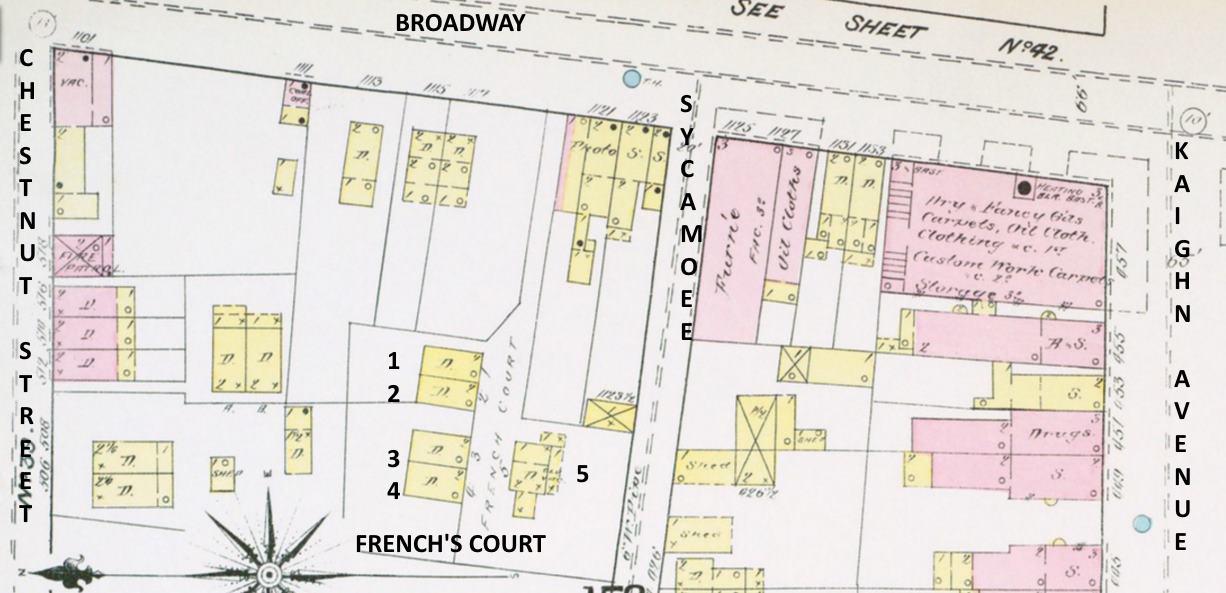
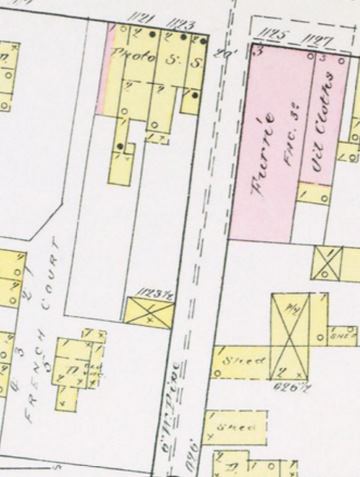
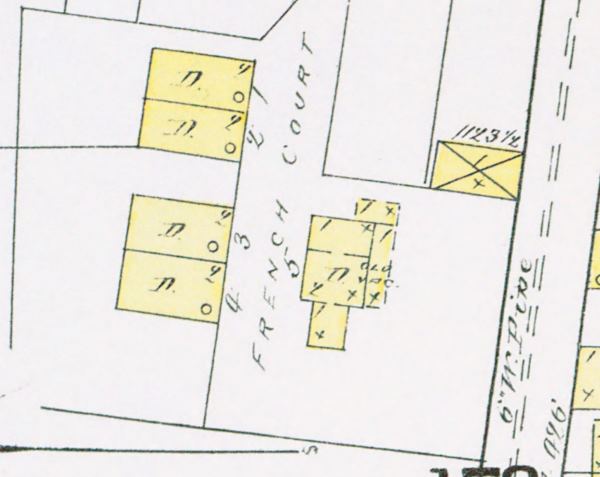
French’s Court — 1891 Sanborn map.
French's Court — Occupants
City directory records, 1890–1891.
1 French's Court (no listing)
| Year ↕ | Name ↕ |
|---|---|
| 1891 | No information available |
2 French's Court (no listing)
| Year ↕ | Name ↕ |
|---|---|
| 1891 | No information available |
3 French's Court
| Year ↕ | Name ↕ |
|---|---|
| 1890–1891 | Mrs. J. E. Miller |
4 French's Court (no listing)
| Year ↕ | Name ↕ |
|---|---|
| 1891 | No information available |
5 French's Court (no listing)
| Year ↕ | Name ↕ |
|---|---|
| 1891 | No information available |
A Camden Woman's Windfall
Philadelphia Inquirer —
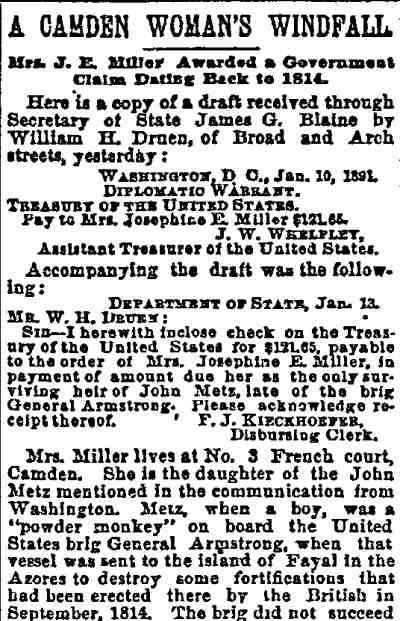
Mrs. J. E. Miller Awarded a Government Claim Dating Back to 1814.
Here is a copy of a draft received through Secretary of State James G. Blaine by William H. Druen, of Broad and Arch streets, yesterday:
Washington, D. C., Jan. 10, 1891. Diplomatic Warrant. Treasury of the United States. Pay to Mrs. Josephine E. Miller $121.65. J. W. Whelpley, Assistant Treasurer of the United States.
Accompanying the draft was the following: Department of State, Jan. 13. Mr. W. H. Druen: Sir — I herewith inclose check on the Treasury of the United States for $121.65, payable to the order of Mrs. Josephine E. Miller, in payment of amount due her as the only surviving heir of John Metz, late of the brig General Armstrong. Please acknowledge receipt thereof. F. J. Kieckhoefer, Disbursing Clerk.
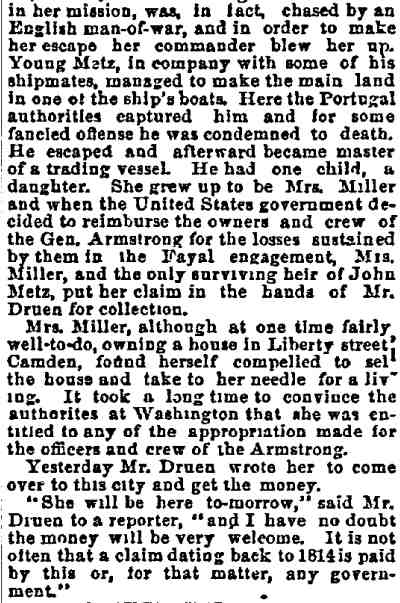
Mrs. Miller lives at No. 3 French court, Camden. She is the daughter of the John Metz mentioned in the communication from Washington. Metz, when a boy, was a “powder monkey” on board the United States brig General Armstrong, when that vessel was sent to the island of Fayal in the Azores to destroy some fortifications that had been erected there by the British in September, 1814. The brig did not succeed in her mission, was, in fact, chased by an English man-of-war, and in order to make her escape the commander blew her up. Young Metz, in company with some of his shipmates, managed to make the main land in one of the ship’s boats. Here the Portugal authorities captured him and for some fancied offense he was condemned to death. He escaped and afterward became master of a trading vessel. He had one child, a daughter. She grew up to be Mrs. Miller and when the United States government decided to reimburse the owners and crew of the Gen. Armstrong for the losses sustained by them in the Fayal engagement, Mrs. Miller, and the only surviving heir of John Metz, put her claim in the hands of Mr. Druen for collection.
Mrs. Miller, although at one time fairly well-to-do, owning a house in Liberty street, Camden, found herself compelled to sell the house and take to her needle for a living. It took a long time to convince the authorites at Washington that she was entitled to any of the appropriation made for the officers and crew of the Armstrong.
Yesterday Mr. Druen wrote her to come over to this city and get the money. “She will be here to-morrow,” said Mr. Druen to a reporter, “and I have no doubt the money will be very welcome. It is not often that a claim dating back to 1814 is paid by this or, for that matter, any government.”