Willibold A. Stefan
Rank: Private, U.S. Army
Serial: 32267190
Unit: 141st Infantry Regiment, 36th Infantry Division
Entered service from: New Jersey
Died:
Awards: Purple Heart
Buried: Sicily-Rome American Cemetery, Plot E Row 13 Grave 24, Nettuno, Italy
Biography
Private Willibold A. Stefan was born in 1913 to Mr. and Mrs. Adam Stefan. Prior to his induction into the United States Army in May of 1942, he had lived at 132 Baird Avenue in Mount Ephraim, New Jersey. He was engaged to Miss Olga Davis, also of Mount Ephraim, and they were to wed after the war was over.
Private Stefan was assigned to the 141st Infantry Regiment, 36th Infantry Division. After training at Camp Blanding, Florida and Wadesboro, North Carolina, he shipped out with his unit via Camp Edwards, Massachusetts and the New York Port of Embarkation on April 1, 1943. The 36th Infantry Division arrived in North Africa on April 13, 1943, and trained at Arzew, Algeria and Rabat, Morocco.
While in North Africa, Private Stefan was briefly reunited with his brother Joseph, who had spotted trucks bearing his unit insignia. When those trucks stopped nearby, the brothers met and were able to dine together.
The 36th Infantry Division landed at Paestum on the Gulf of Salerno, Italy on September 9, 1943. Private Stefan was killed in action on the first day of the invasion. He was survived by his fiancée, his parents, and his four brothers, Joseph, Rudolf, John, and Walter Stefan. His death was reported in the October 6, 1943 edition of the Camden Courier-Post.
Salerno
Salerno was one of the bloodier, more critical operations of the Second World War. For a time the action hung in the balance as strong enemy counterattacks smashed and threatened the very existence of the initial beachhead. But at the last a gallant defense held firm and Salerno was won. This was the opening struggle of the long and bitter Italian campaign.
On their first combat mission, 36th Division troops under the command of Maj. Gen. Fred L. Walker became the first American division to invade the European mainland and test Hitler’s continental fortress. Before dawn of Thursday morning, September 9, 1943, without previous naval or air bombardment, the leading waves stepped ashore on the sandy beaches near ancient Paestum.
The Italian surrender had been announced only the night before. Unwarranted optimism was soon reduced as the Germans in waiting faced the invaders. Shoved back from the beaches, the enemy thrust powerfully at Altavilla and along the Sele River. Casualties were heavy. Airborne reinforcements arrived from Sicily at the height of the battle.
The first wave fanned out onto all four beaches exactly at H-Hour, 0330. Enemy guns roared as 36th Division infantrymen leaped into the water and started inland for the pre-designated assembly areas. On the left at Red and Green beaches the 142nd Infantry began the push that was designed to take it to the core of the beachhead and to the ground around Albanella and Altavilla. On the right at Yellow and Blue beaches, the 141st Infantry moved to maintain contact with 142nd at Mount Vesole and Magliano, seize Agropoli and defend the right flank. The second and third waves hit the beaches at eight-minute intervals.
Both assault battalions of the 142nd on Red and Green beaches were pinned down from time to time. On the right flank the assault battalions of the 141st Infantry landed on schedule and began working through wire obstacles and mines. Intense fire from machine guns, field pieces, mortars, and tanks made their progress difficult.
Everywhere there was great confusion. Officers and men were separated; assembly points were not easily located. Shortly after 0530, the amphibious “ducks” came ashore. The 133rd Field Artillery Battalion brought in twelve 105-mm howitzers. Each of these guns was loaded on a “duck,” together with 21 rounds of ammunition and a gun section of seven men.
At 0640 the 143rd Infantry, initially in reserve, crossed the beaches and began moving toward Cappacio, a village on the slopes of Mt. Soprano. Almost from the moment of landing, enemy tanks in scattered positions had made it difficult for all combat teams to reach their objectives, but not until 0700 did they attack on a large scale. At this time the battalions of the 141st were still attempting to reorganize when they were struck by 15 or more Mark IV’s. Then a column of the 36th Cavalry Reconnaissance Troop landed on Yellow Beach and helped to fight off seven Mark IV’s which were firing opposite the right flank. In the center of the 141st line, the men of the 2nd Battalion beat off tanks with infantry weapons. For its role in repulsing the enemy tank attacks, Lt. Col. Edward D. McCall’s 3rd Battalion of the 141st was awarded the Division’s first Presidential Unit Citation.
By noon the main tank assault on the southern beaches had been brought virtually to a standstill. Naval gunfire and fire from mortars and howitzers had helped to make the operations costly for the enemy, but to a large extent the battle had been fought by infantrymen and infantry weapons.
In anticipation of the fierce struggle, Lt. Col. John N. Green, commanding the 132nd Field Artillery Battalion, coined a Division classic on the eve of D-Day. Asked by one of his men, “What are we going to do if we run out of ammunition?” “Fight with the Rammerstaff!” was the Colonel’s bellowing reply.
The 36th Division, untried in battle, had landed under fire, overcome prepared beach defenses, and reached its initial objective. The Allies now controlled the plain south of the Sele River and occupied the high ground, an average distance of five miles from the beaches. On the right flank, the 141st Infantry had absorbed vicious enemy attacks, but was ready to occupy its assigned objectives on September 10. Men, vehicles, artillery, and supplies continued to pour onto the beaches, where the engineers labored efficiently under constant fire. The hours of confusion had passed. Dumps were set up, exit roads were operating, anti-aircraft batteries were in position, and communications finally working. The Salerno landing had been successful in spite of a prepared and alerted enemy.
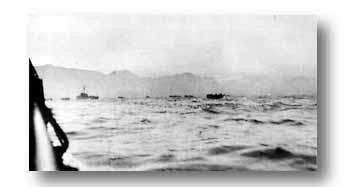
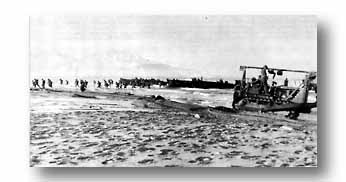
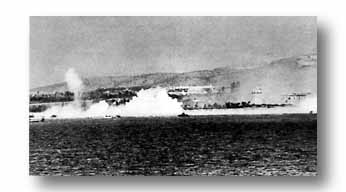
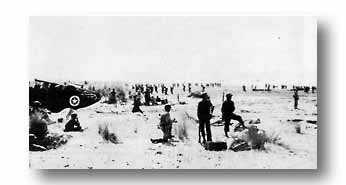
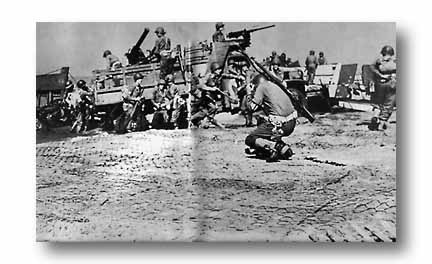
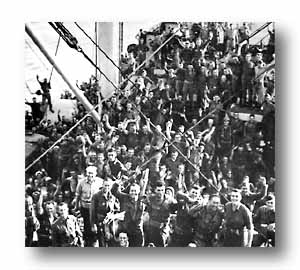
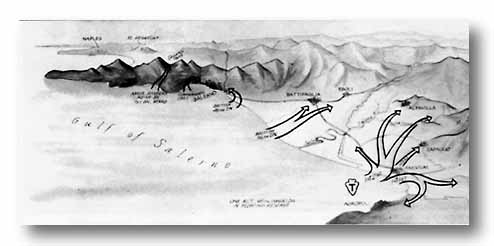
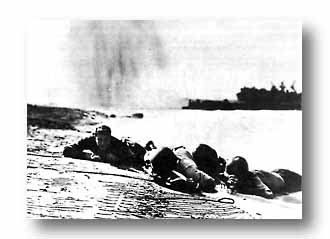
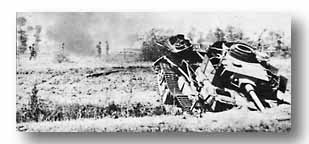
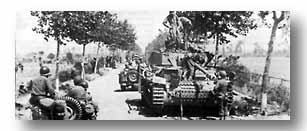
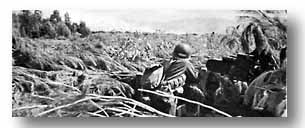
Photographs from the Salerno landing, September 9, 1943 — 36th Infantry Division operations at Paestum