William J. Shallcross
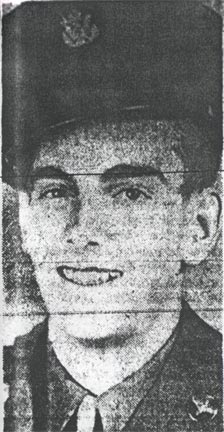
William J. Shallcross
Staff Sergeant, U.S. Army Air Forces
Serial: 32489438
677th Bomber Squadron, 444th Bomber Group
Entered the Service from: New Jersey
Died: August 2, 1944
Buried at: Plot 79 O 496 A-C
Jefferson Barracks National Cemetery
St. Louis MO
Introduction
Staff Sergeant William Jesse Shallcross was born on May 23, 1923 in Cape May NJ to Howard Walter and Mary Mott Shallcross. He was the fourth of five children, coming after sisters Beatrice, Anna, and Mildred, and before younger brother Harry. Howard Shallcross was born in Camden NJ, and worked as a radio operator in the merchant marine. Sadly, Howard Shallcross passed away in Atlantic City NJ on September 19, 1929. The Shallcross family had moved to 821 Merrick Avenue in Collingswood NJ by the time of the April 1930 census.
Known to friends as Billy, William Shallcross attended Collingswood High School, in Collingswood NJ. Having a background in radio from his father, he qualified for flight duty, and was inducted into the Army Air Force on February 2, 1942, and trained as a radio operator at Miami Florida, Scott Field IL, the Philco Radio School in Philadelphia PA and Great Bend KS before shipping out with his crew in the then very new B-29 Superfortress bombers, to India by way of North Africa.
Staff Sergeant Shallcross and his crew participated in the first B-29 raid against Japan on June 15th, 1944 when 47 B-29s of the 58th Bombardment Wing attacked the steel works at Yawata. This raid originated in India, with a refueling stop in China. It involved long hours in the air and flying over the Himalayan Mountains.
Shortly afterward, he met up in Calcutta, India with a friend from Collingswood who was serving with the 40th Bombardment Group (Very Heavy), Carlton Fairchild.
On the return flight from his second mission, the aircraft carrying Sergeant William Jesse Shallcross was caught in a monsoon wind and crashed. His body and those of his comrades were burned beyond recognition, and he and his crew were buried together, first overseas, then on November 17, 1949 at the Jefferson Barracks National Cemetery in St. Louis MO.
MACR Report 11299 lists aircraft 42-6228, being lost, with three of the crew killed on August 2, 1944.
He was survived by his mother, Mrs. Mary Shallcross Stone of 708 Atlantic Ave., Collingswood NJ, his brother Harry, and two sisters, Mrs. Mildred Smith and Mrs. Anna Fiedler.
The Gathering Storm: The B-29 Bombing Offensive Against Japan
The first B-29 bombing raid took place on June 5, 1944. Led by General Saunders himself, 98 B-29s took off from bases in eastern India to attack the Makasan railroad yards at Bangkok, Thailand. This involved a 2,261 mi (3,640 km) round trip, the longest bombing mission yet attempted during the war. The engines of the B-29 were still causing problems, and fourteen B-29s were forced to abort because of engine failures. The target was obscured by bad weather, necessitating bombing by radar. The formations became confused and dropped their bombs at altitudes between 17,000–27,000 ft (5,200–8,200 m) rather than the planned 22,000–25,000 ft (6,700–7,600 m). Only eighteen bombs landed in the target area. Five B-29s crashed upon landing after the mission and 42 were forced to divert to other airfields because of a shortage of fuel. The B-29 campaign was off to a bad start, although none of the bombers were actually lost to enemy action.
Under heavy pressure from the Joint Chiefs of Staff and Washington to mount an immediate attack on Japan proper, General Wolfe attempted to delay the next mission until late June when he would have a larger force and more supplies in place at the forward bases in China. However, Washington demanded that he put a minimum of 70 B-29s over Japan by June 15. One of the problems was that only 86 B-29s could be equipped with the bomb-bay tanks needed for the long flight to Japan and, based upon previous experience, more than 20 of them would fail to leave the base in China while others would fail to bomb the target.
By mid-June, enough supplies had been stockpiled at Chinese forward bases to permit the launching of a single sortie against targets in Japan. It was a night time raid to be carried out on the night of June 14/15, 1944 against the Imperial Iron and Steel Works at Yawata on Kyushu. This plant was considered to be the most important single objective within Japan’s steel industry, and had long held top priority for the first strike. This facility produced nearly a quarter of all the rolled steel for Japan. The secondary target was Laoyao harbor, an outlet for much coking coal, manganese and phosphates. Because of the long distance (3,200 mi/5,150 km), Washington had ordered a night mission with planes bombing individually. Bombing was to be done from two levels, 8,000 to 10,000 ft and 14,000 to 18,000 ft. Two pathfinder aircraft from each group were to light off the target. Takeoff was scheduled for 1630 (4:30 pm) local time, June 15, 1944, permitting the aircraft to arrive over the target during darkness.
Staging at the forward bases in China began on June 13, 1944 and was completed shortly before H-hour on June 15. The B-29s had left India fully loaded with bombs, requiring only refueling at the forward bases in China. Each plane carried two tons (1,815 kg) of 500 pound (226 kg) general purpose bombs. Of the 92 aircraft leaving India, only 79 had actually reached China, with one plane crashing en route. The staging bases were:
Hsinching for the 40th Bombardment Group (Very Heavy)
Kwanghan for the 444th Bombardment Group (Very Heavy)
Chiung-Lai for the 462d Bombardment Group (Very Heavy)
Pengshan for the 468th Bombardment Group (Very Heavy)
Takeoffs from the forward bases in China began early in the evening and of the 75 B-29s dispatched, one crashed and four were forced to return to base due to mechanical problems. Of the 68 aircraft that had left China, only 47 attacked the intended target. One B-29 crashed in China (cause unknown), 6 jettisoned their bombs because of mechanical difficulties, 2 bombed the secondary target and 5 bombed targets of opportunity.
Yawata was blacked out and haze and/or smoke helped to obscure the target. Only 15 aircraft bombed visually while 32 bombed by radar. Only one bomb actually hit anywhere near the intended target. This was a bomb which had hit a power house some 3,700 ft (1,120 m) from the coke ovens. Some damage had been done to the Kokura Arsenal, to miscellaneous industrial buildings, and to business-industrial areas. The steel industry was essentially untouched. One B-29 was lost to enemy fire and six were lost in various accidents.
Although very little damage was actually done, the Yawata raid was hailed as a great victory in the American press, since it was the first time since the Doolittle raid of 1942 that American aircraft had hit the Japanese home islands. Soon afterwards General Wolfe was replaced by Brig. Gen. LaVerne G. Saunders temporarily until a new permanent commander could be found.
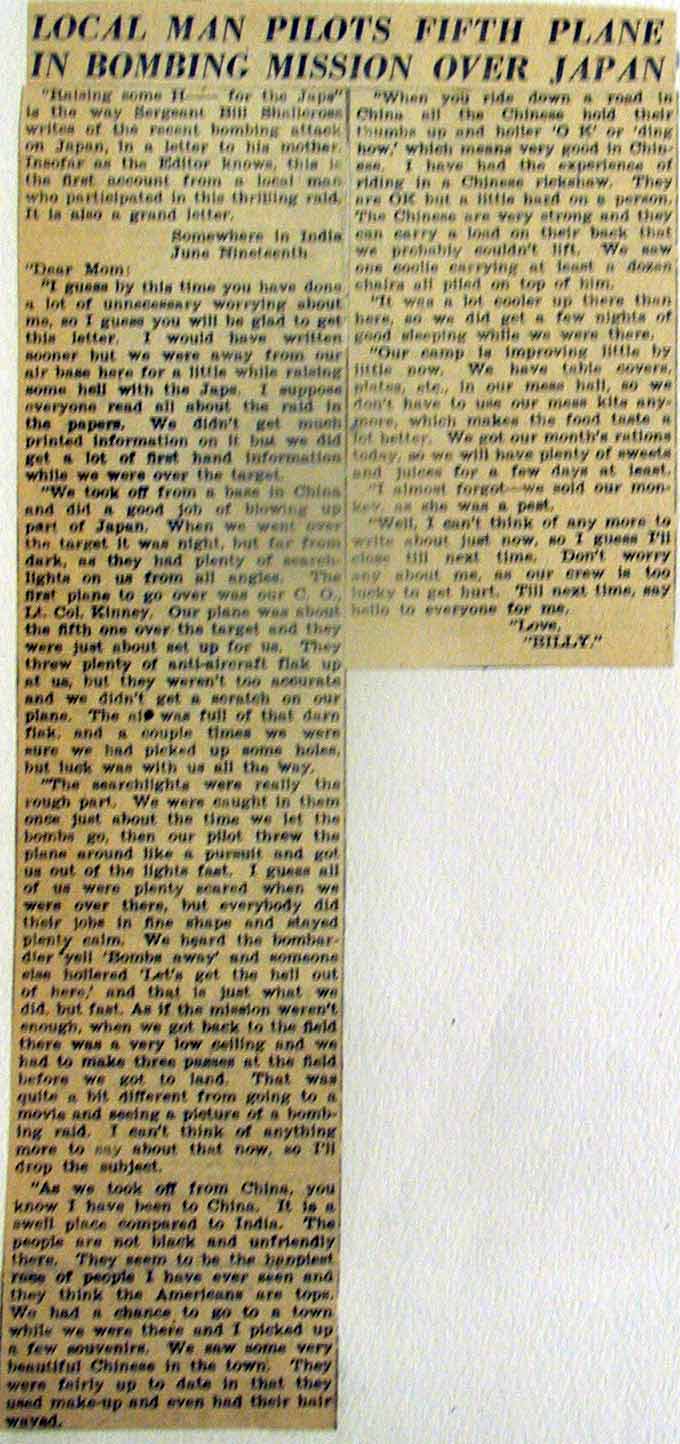
A Letter from Billy
Camden Courier-Post
Local Man Pilots Fifth Plane in Bombing Mission over Japan
Final Rites Thursday For Sgt. Shallcross
Camden Courier-Post —
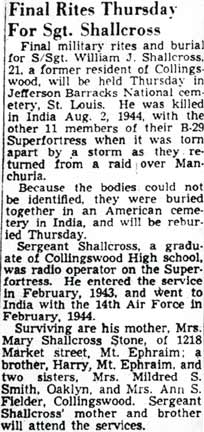
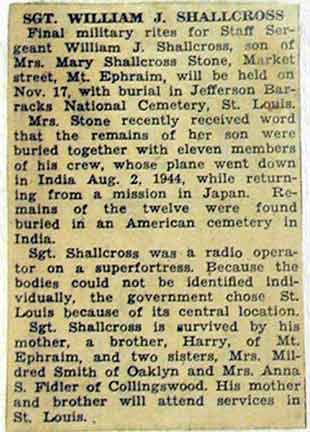
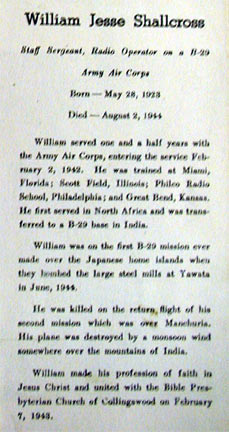
FINAL RITES THURSDAY FOR SGT. SHALLCROSS
Final military rites and burial for S/Sgt. William J. Shallcross, 21, a former resident of Collingswood, will be held Thursday in Jefferson Barracks National cemetery, St. Louis. He was killed in India Aug. 2, 1944, with the other 11 members of his B-29 Superfortress when it was torn apart by a storm while they returned from a raid over Manchuria.
Because the bodies could not be identified, they were buried together in an American cemetery in India, and will be reburied Thursday.
Sergeant Shallcross, a graduate of Collingswood High school, was radio operator on the Superfortress. He entered the service in February, 1943, and went to India with the 14th Air Force in February, 1944.
Surviving are his mother, Mrs. Mary Shallcross Stone, of 1218 Market street, Mt. Ephraim; a brother, Harry, Mt. Ephraim, and two sisters, Mrs. Mildred S. Smith, Oaklyn, and Mrs. Ann S. Fielder, Collingswood. Sergeant Shallcross’ mother and brother will attend the services.
Photos
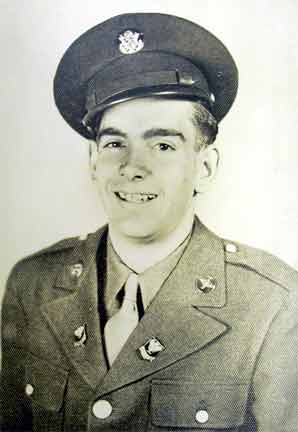
Collingswood NJ World War II War Memorial marker for William J. Shallcross