William F. Hanson
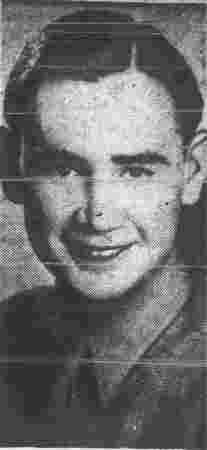
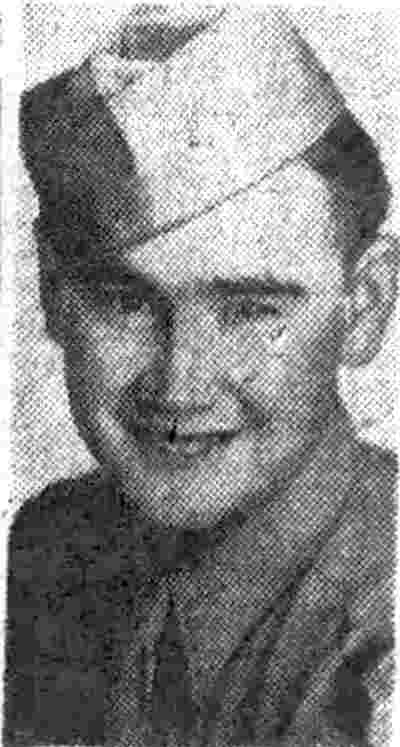
William F. Hanson.
Private First Class, U.S. Army
Serial: 32483621
415th Infantry Regiment
104th Infantry Division
Entered the Service from: New Jersey
Died: February 23, 1945
Buried at: Plot D Row 23 Grave 1
Ardennes American Cemetery
Neupré, Belgium
Awards: Air Medal, Purple Heart
Introduction
Private First Class William F. Hanson was born in 1920. He was the son of William J. and Anna Hanson. He grew up in Oaklyn, New Jersey with his parents and sister Anna at 54 East Beechwood Avenue, Oaklyn NJ. William F. Hanson attended Camden Catholic High School and St. Joseph's and LaSalle colleges before being inducted into the Army on December 7, 1942.
William F. Hanson went overseas in 1944 with the 415th Infantry Regiment, 104th Infantry Division. The 104th Infantry Division landed in France on September 7, 1944 and moved into a defensive position in the vicinity of Wuustwezel, Belgium, October 23, 1944. There it relieved the British 49th Division and joined the First British Corps, First Canadian Army. The 104th went over to the offensive on the 25th, soon liberating Zundert, Holland, gaining control of the Breda-Roosendall Road, and overrunning the Vaart Canal defenses.
Leur and Etten fell as the Division advanced in a coordinated drive to the Mark River at Standdarbuiten on November 2, 1944 and established a bridgehead. Zevenbergen was captured and the Maas River reached November 5. The bulk of the Division moved near Aachen, Germany to relieve the First Division; join the U.S. Seventh Corps, First U.S. Army, with some elements remaining to secure Moerdijk, Holland until November 7.
On November 16, 1944 the 104th attacked, taking Stolberg and pushing on against heavy resistance. Eschweiler fell on the 21st and the enemy was cleared from the area west of the Inde River, including Inden, by December 2. Lucherberg was held against enemy counterattacks on December 3, and all strongholds west of the Roer (Ruhr) River were captured by the 23rd. The 104th actively defended its sector near Duren and Merken from December 15, 1944 to February 23, 1945, and moved across the Roer, taking part in Operation Grenade.
When the 104th crossed the Roer (Rur) River on February 23, 1945, it was not alone. The German's “Ardennes Offensive” had only delayed the inevitable and with that interruption contained, the Allies were anxious to continue their drive to end the war in Europe. Several plans had been under study, causing renewed lively debate among Allied commanders. But on February 2, at a meeting on the Mediterranean island of Malta, the Combined Chiefs of Staff of the United States and Great Britain approved the specifics of Supreme Commander Eisenhower's plan for a drive to the Rhine; a staggered attack starting at the north to be joined step by step to the south.
The plan was for a major offensive to be put into effect and to start with Field Marshal Sir Bernard L. Montgomery's Twenty-first Army Group, at the northern end of the front facing Germany. With his Canadian First Army and British Second Army, Montgomery's Operation Veritable was set to start the attack on 8 February. Two days later (Feb 10), an operation code-named Grenade was to start with the U.S. Ninth Army commanded by Lt. General William H. Simpson. The Ninth Army, under command of Montgomery's Twenty-first Army since the Battle of the Bulge, was to cross the Roer and link up with the Canadians coming from the Nijmegen area of Holland. Coverage of the right flank of the Ninth Army was assigned to the VII Corps of the U.S. First Army commanded by Maj Gen J. Lawton Collins & on loan from First Army for this task. Following Operation Grenade was to be General Omar Bradley's Twelfth Army Group, the center of the front facing Germany, in an operation named Lumberjack. But Bradley wasn't to move until Montgomery reached the Rhine, with this move scheduled to begin on February 23. Next in line was the Sixth Army Group, on the south end of the line, commanded by Lt. General Jacob L. Devers, and it was to remain on the defensive until Bradley reached the Rhine. Code-named Undertone, this operation was set to begin on 15 March.
A key to crossing the Roer River was control of the major dams upstream from the assault divisions and responsibility for reaching them was with General Bradley's XII Army Group. The dams had been constructed to control flooding of the Roer and both the Americans and Germans recognized their importance. After a much tougher battle than anticipated, the dams were not reached until February 9, and unfortunately only after the retreating Germans had opened the flood gates. Operation Veritable, of the British & Canadian Armies, had moved as scheduled at 5 AM, 8 February, after 5½ hours of artillery fire from 1050 guns, firing 500,000 shells on their 6 mile front. But the rapidly rising waters of the Roer forced a delay of the Ninth Army's Operation Grenade. Once the vast storage of water was released from the locks of the dams, the once peaceful Roer flooded its banks. At the north, making matters worse for the Canadians, the retreating Germans had dynamited the area's dikes and by the second day of the attack, hundreds of men were stranded by swiftly rising floodwaters. At the south end of the line, the water from the largest Roer dam, the Schwammenauel, rushed out after the Germans destroyed the power-room machinery and the discharge valves, making it impossible to halt the flow of water. Operation Grenade would have to wait. Rising in depth by as much as 5', the worst effect of the flood was to increase the current sharply, at some points to more than 10 miles per hour. Along most of its banks, the Roer poured over its banks and inundated the valley floor. Just north of Linnich where the river is normally 25 to 30 yards wide, it spread into a lake more than a mile wide. More common were areas of 300 to 400 yards across and Grenade was to undergo successive postponements.
Acting on advice of the engineers, Ninth Army's Gen Simpson reset D-day for February 23, one day before it was calculated that the reservoirs would be drained. By moving one day early, General Simpson hoped to achieve some measure of surprise. As the target date for Grenade approached, the accumulated stocks of supplies rose to huge proportions. In one 5-day period, for example, over 40,000 long tons was received, the biggest delivery to any army in the theater in a comparable period. Most of it arrived by rail in more than 6,000 freight cars.
Six infantry divisions were to lead the attack (left to right), 84th & 102nd from the XIII Corps, 29th & 30th from the XIX Corps, and 104th & 8th of the VII Corps. The XIII & XIX Corps were to represent the main effort with the VII guarding the right flank. This plan not only gave the VII Corps, protecting the Ninth Army's drive, the deepest area of penetration, its own right flank was exposed for at least two full days. Methods of crossing the swollen Roer varied to some extent from division to division. The plans for some were for only a relatively small force to cross in assault boats with the balance to use foot-bridges to be constructed as soon as bridgeheads could be secured; a task that proved easier to plan than execute. The 8th Division planned to make use of motor boats, but had extreme problems in starting the motors. Some units planned to rely heavily on cable ferries and amphibious vehicles, while others, including the 104th, relied more heavily on transporting the attacking companies by assault boats. While some elected to use smoke and others didn't, all plans had problems and the mighty Roer took its toll.
Private First Class Hanson was killed on the first day of Operation Grenade. He was severely wounded after stepping on a land mine. Private First Class Hanson was not able to be evacuated, and apparently died of his wounds on the battlefield. His family was notified that he had been wounded in March of 1945, however, for a year there was no news as to his whereabouts or circumstances. In July of 1945 the Army changed his status to missing. His body was located months later and in March of 1946 the Army notified his family that he had died. William F. Hanson was buried at the Ardennes American Cemetery in Neupré, Belgium.
Photos
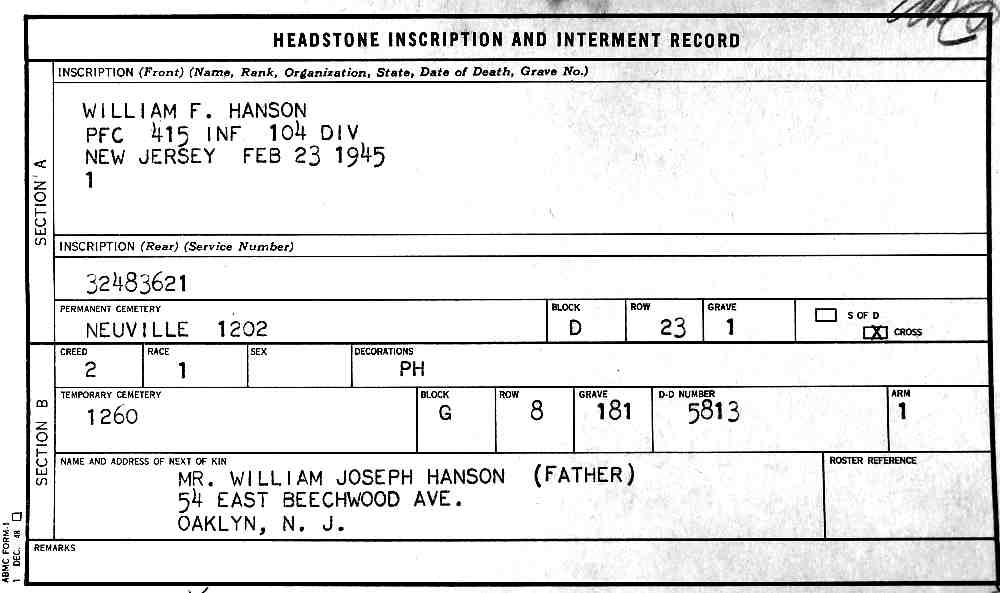
Interment record for William F. Hanson, Ardennes American Cemetery, Neupré, Belgium.
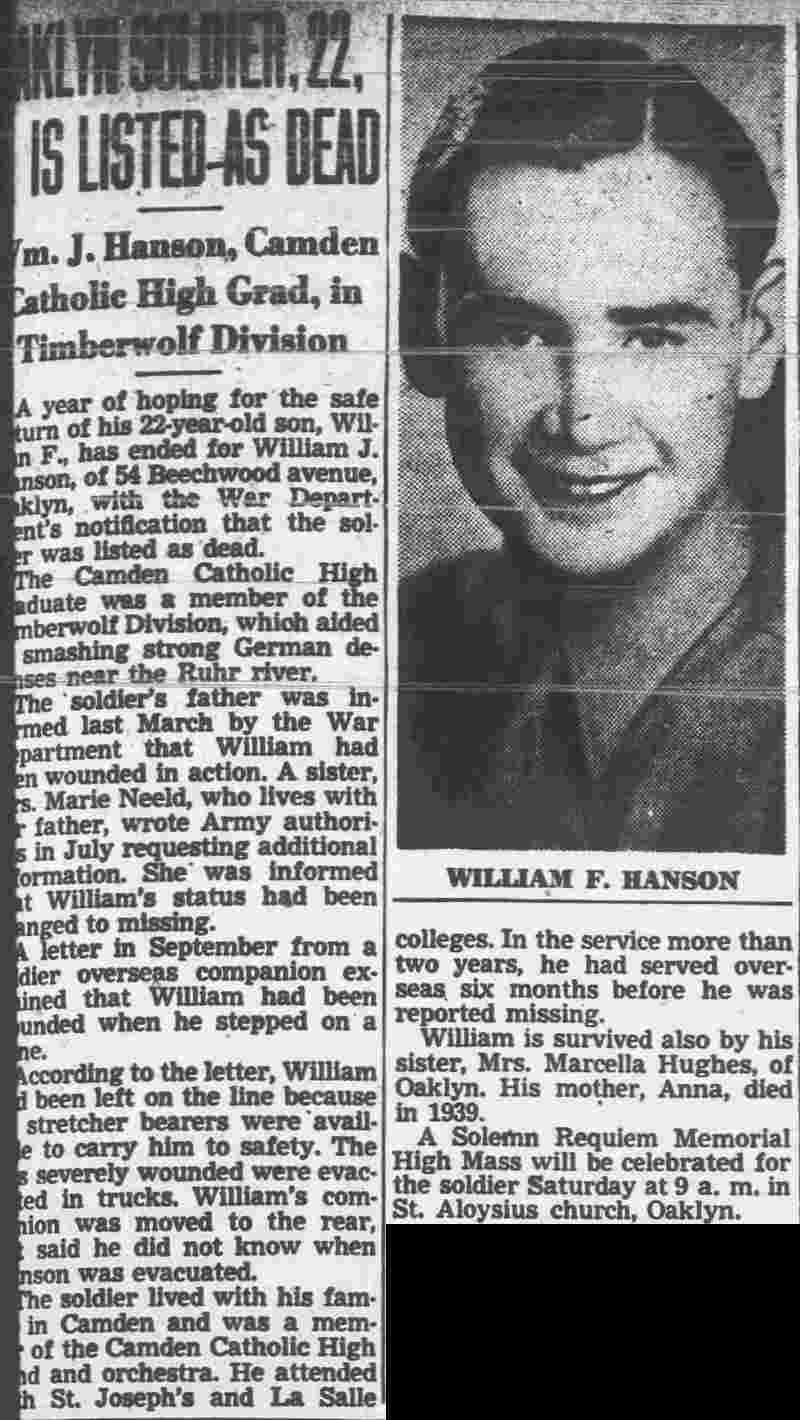
Camden Courier-Post, March 7, 1946 — “Oaklyn Soldier, 22, Is Listed As Dead.”