William A. Knortz
Rank: Captain, U.S. Army Air Forces
Serial: O-2031889
Unit: Headquarters, U.S. Army Air Forces, Far East
Entered service from: New Jersey
Died:
Awards: Distinguished Flying Cross, Legion of Merit, Soldier’s Medal, Bronze Star, Purple Heart
Memorialized: Tablets of the Missing, Manila American Cemetery, Manila, Philippines
Biography
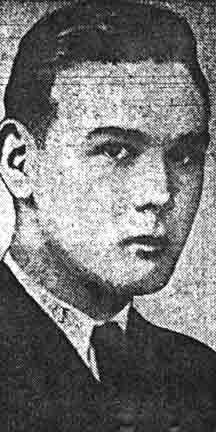
Captain William A. Knortz
Captain William A. Knortz, Jr. had lived in Haddonfield, New Jersey, with his parents and brother Robert. A graduate of Haddonfield High School, he starred in baseball and track before enlisting in the Army on August 7, 1939, at Camden, New Jersey. Qualifying for flight duty, he was a member of one of the first B-17 Flying Fortress squadrons to become operational.
In September of 1941, he was one of 75 American flight personnel who ferried a squadron of B-17s from Hawaii to the Philippine Islands. He was the squadron radio operator on this mission, and was awarded the Distinguished Flying Cross for his role in the flight.
William Knortz had sent a postcard home which was received on December 5, 1941. It was the last communication his family received from him. On December 7, the Japanese attacked Pearl Harbor, and the Philippines were attacked shortly thereafter.
Captain Knortz’s bombers were destroyed at the outset of the fighting. He did not surrender to the Japanese when Corregidor fell in early 1942. He continued to fight the Japanese as a guerrilla under the command of Lt. Colonel Ernest McLish, on the island of Mindanao.
Captain Knortz was killed in action fighting the Japanese on September 11, 1943, at the age of 25. His death was reported in the Camden Courier-Post on December 2, 1943. Funeral rites were held for him at Christ the King Roman Catholic Church in Haddonfield, New Jersey, on December 6, 1943.
On December 9, 1941, the Camden Courier-Post, as part of a news story informing local readers about men stationed in the Pacific at the time of Pearl Harbor, printed the following: “Captain William A. Knortz, 24, of 11 Friends Avenue, Haddonfield, is with the Army Air Force in Manila. He graduated Haddonfield High School in 1937, and enlisted in 1939. He was sent to the Philippines in August, 1940, and is the son of Mr. and Mrs. William Knortz, and has a brother, Robert.
Flying Cross Given Resident Of Haddonfield
Camden Courier-Post —
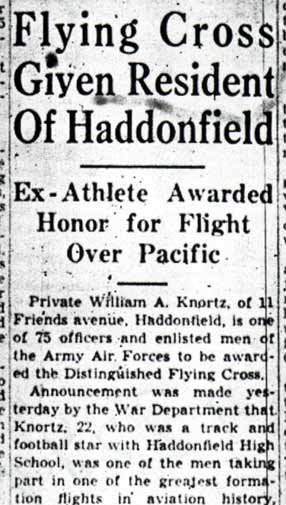
Ex-Athlete Awarded Honor for Flight Over Pacific
Private William A. Knortz, of 11 Friends avenue, Haddonfield, is one of 75 officers and enlisted men of the Army Air Forces to be awarded the Distinguished Flying Cross. Announcement was made yesterday by the War Department that Knortz, 22, who was a track and football star with Haddonfield High School, was one of the men taking part in one of the greatest formation flights in aviation history, September 5–12. This flight was made by a number of four-motored bombardment planes from Honolulu to the Philippine Islands, where the planes since have been heavily engaged in the defense of the islands against Japanese attacks.
Kelly Was Among Pilots
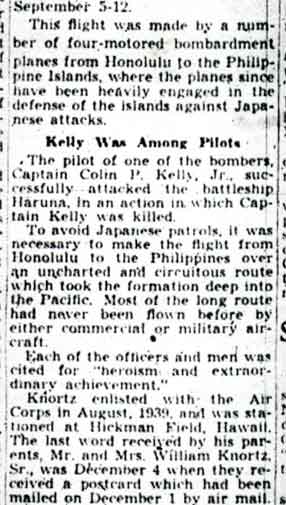
The pilot of one of the bombers, Captain Colin P. Kelly, Jr., successfully attacked the battleship Haruna, in an action in which Captain Kelly was killed.
To avoid Japanese patrols, it was necessary to make the flight from Honolulu to the Philippines over an uncharted and circuitous route which took the formation deep into the Pacific. Most of the long route had never been flown before by either commercial or military aircraft.
Each of the officers and men was cited for “heroism and extraordinary achievement.”
Knortz enlisted with the Air Corps in August, 1939, and was stationed at Hickman Field, Hawaii. The last word received by his parents, Mr. and Mrs. William Knortz, Sr., was December 4 when they received a postcard which had been mailed on December 1 by air mail. The young man is a member of Christ the King R.C. Church in Haddonfield. His father is a paperhanger. He has an older brother, Robert, also of Haddonfield.
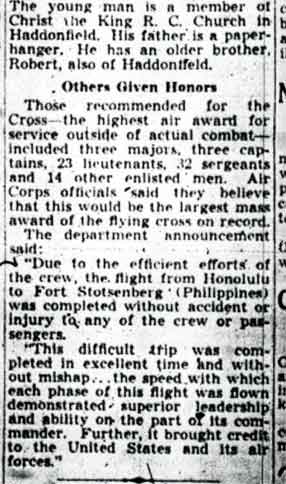
Others Given Honors
Those recommended for the Cross — the highest air award for service outside of actual combat — included three majors, three captains, 23 lieutenants, 32 sergeants and 14 other enlisted men. Air Corps officials said they believe that this would be the largest mass award of the flying cross on record.
The department announcement said:
“Due to the efficient efforts of the crew, the flight from Honolulu to Fort Stotsenberg (Philippines) was completed without accident or injury to any of the crew or passengers.”
“This difficult trip was completed in excellent time and without mishap…the speed with which each phase of this flight was flown demonstrated superior leadership and ability on the part of its commander. Further, it brought credit to the United States and its air forces.”
Haddonfield Man Dead in Philippines
Camden Courier-Post —
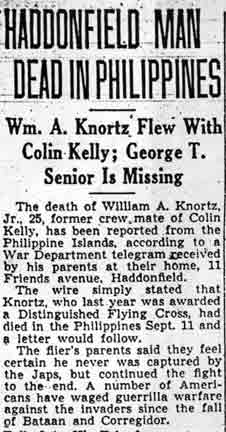
Wm. A. Knortz Flew With Colin Kelly; George T. Senior Is Missing
The death of William A. Knortz, Jr., 25, former crew mate of Colin Kelly, has been reported from the Philippine Islands, according to a War Department telegram received by his parents at their home, 11 Friends avenue, Haddonfield.
The wire simply stated that Knortz, who last year was awarded a Distinguished Flying Cross, had died in the Philippines Sept. 11 and a letter would follow.
The flier’s parents said they feel certain he never was captured by the Japs, but continued the fight to the end. A number of Americans have waged guerrilla warfare against the invaders since the fall of Bataan and Corregidor.
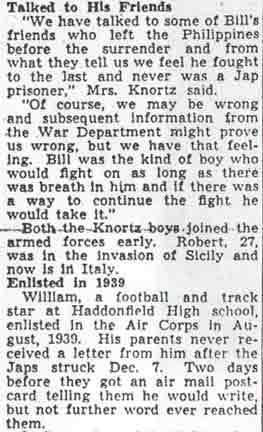
Talked to His Friends
“We have talked to some of Bill’s friends who left the Philippines before the surrender and from what they tell us we feel he fought to the last and never was a Jap prisoner,” Mrs. Knortz said.
“Of course, we may be wrong and subsequent information from the War Department might prove us wrong, but we have that feeling. Bill was the kind of boy who would fight on as long as there was breath in him and if there was a way to continue the fight he would take it.”
Both the Knortz boys joined the armed forces early. Robert, 27, was in the invasion of Sicily and now is in Italy.
Enlisted in 1939
William, a football and track star at Haddonfield High school, enlisted in the Air Corps in August, 1939. His parents never received a letter from him after the Japs struck Dec. 7. Two days before they got an air mail postcard telling them he would write, but not further word ever reached them.
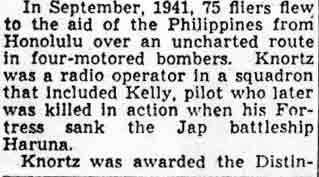
In September, 1941, 75 fliers flew to the aid of the Philippines from Honolulu over an uncharted route in four-motored bombers. Knortz was a radio operator in a squadron that included Kelly, pilot who later was killed in action when his Fortress sank the Jap battleship Haruna.
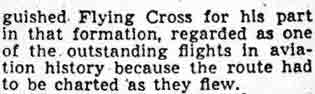
Knortz was awarded the Distinguished Flying Cross for his part in that formation, regarded as one of the outstanding flights in aviation history because the route had to be charted as they flew.
Parents Deny Son Died in Jap Prison
Camden Courier-Post —
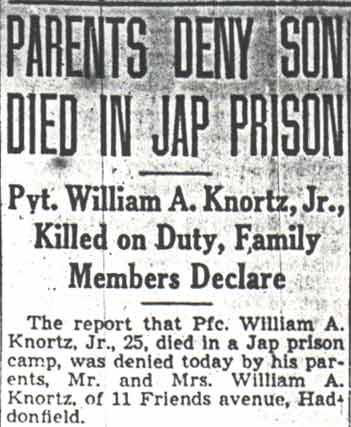
Pyt. William A. Knortz, Jr., Killed on Duty, Family Members Declare
The report that Pfc. William A. Knortz, Jr., 25, died in a Jap prison camp, was denied today by his parents, Mr. and Mrs. William A. Knortz, of 11 Friends avenue, Haddonfield.
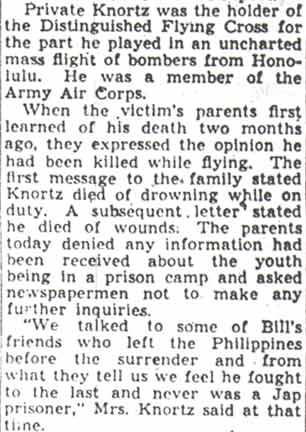
Private Knortz was the holder of the Distinguished Flying Cross for the part he played in an uncharted mass flight of bombers from Honolulu. He was a member of the Army Air Corps.
When the victim’s parents first learned of his death two months ago, they expressed the opinion he had been killed while flying. The first message to the family stated Knortz died of drowning while on duty. A subsequent letter stated he died of wounds. The parents today denied any information had been received about the youth being in a prison camp and asked newspapermen not to make any further inquiries.
“We talked to some of Bill’s friends who left the Philippines before the surrender and from what they tell us we feel he fought to the last and never was a Jap prisoner,” Mrs. Knortz said at that time.