Thomas P. Flaherty
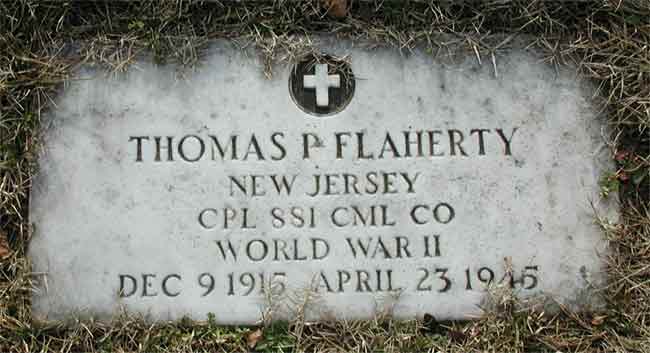
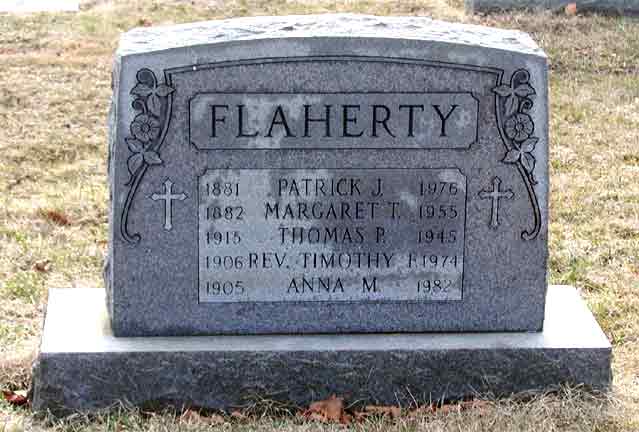
Thomas P. Flaherty.
Corporal, U.S. Army
Serial: 32269773
881st Chemical Company
Chemical Warfare Service
Entered the Service from: New Jersey
Died: April 23, 1945
Buried at: Calvary Cemetery
State Highway 70 and Hampton Road
Cherry Hill, New Jersey
Introduction
Corporal Thomas P. Flaherty was born December 9, 1915 in New Jersey to Patrick J. and Margaret T. Flaherty. In 1920 the Flaherty family owned a home at 705 Clinton Street in Camden NJ; by the time of the 1930 census, the family had bought a home at nearby 445 Carteret Street. There were at least seven other Flaherty children: Anna M., Timothy, James F., Marguerite, and Joseph, who were older, and Francis and Marion who were younger. Another younger brother, John Jr., had passed away in the 1920s. Patrick J. Flaherty worked as a glazier in a leather works in Camden, and by 1930 the four older children were all employed in various businesses or industries in Camden. Thomas Flaherty attended Camden High School and Camden Catholic High School, and he starred in football at both schools and in basketball at Camden Catholic. After graduating from Camden High in January of 1934 he attended the University of South Carolina and graduated after transferring to St. Joseph’s College in Philadelphia. He played football at both colleges.
Thomas Flaherty was inducted into the Army in April of 1942. He was assigned to a detachment of the 881st Chemical Company, Air Operations, which serviced a bomber group of the 8th Air Force in England. It is likely that his was one of the Chemical Companies, Air Operations, that trained at H. Smart Field near Macon GA, before going overseas, in May of 1943.
Corporal Thomas P. Flaherty was killed in a plane crash on the Isle of Man on April 23, 1945.
Corporal Flaherty was brought home after the war. He was buried at Calvary Cemetery in what was then Delaware Township (present day Cherry Hill) NJ in July of 1948. He rests next to his parents, sister Anna, and brother, the Reverend Timothy Flaherty.
Camden High Girl Given Six Awards
Philadelphia Evening Public Ledger —
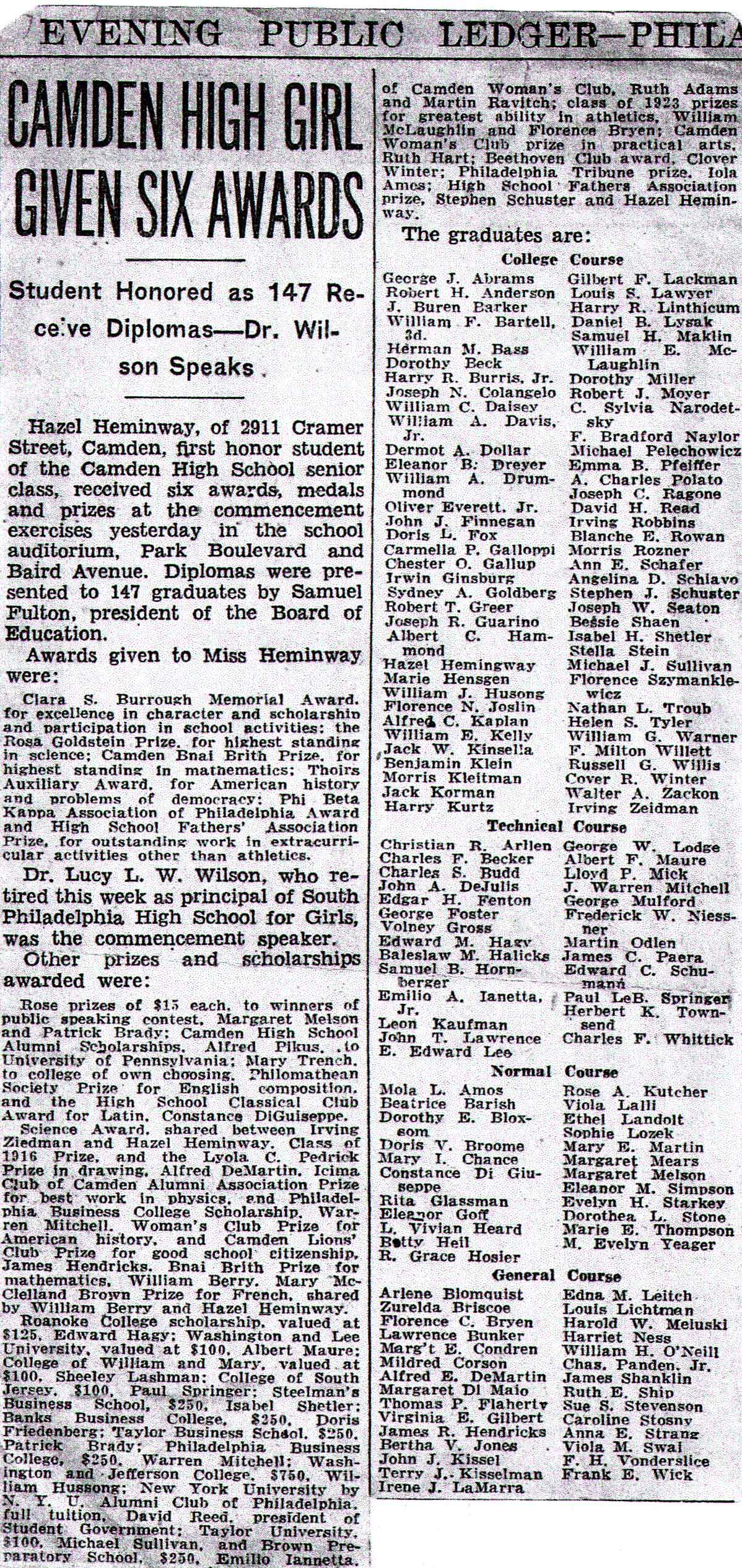
Student Honored as 147 Receive Diplomas—Dr. Wilson Speaks
Hazel Heminway, of 2911 Cramer Street, Camden, first honor student of the Camden High School senior class, received six awards, medals and prizes at the commencement exercises yesterday in the school auditorium, Park Boulevard and Baird Avenue. Diplomas were presented to 147 graduates by Samuel Fulton, president of the Board of Education.
Awards given to Miss Heminway were:
Clara S. Burrough Memorial Award, for excellence in character and scholarship and participation in school activities; the Rosa Goldstein Prize, for highest standing in science; Camden Bnai Brith Prize, for highest standing in mathematics; Thoirs Auxiliary Award, for American history and problems of democracy; Phi Beta Kappa Association of Philadelphia Award and High School Fathers’ Association Prize, for outstanding work in extracurricular activities other than athletics.
Dr. Lucy L. W. Wilson, who retired this week as principal of South Philadelphia High School for Girls, was the commencement speaker.
Other prizes and scholarships awarded were:
Rose prizes of $15 each, to winners of public speaking contest, Margaret Melson and Patrick Brady; Camden High School Alumni Scholarships, Alfred Pikus, to University of Pennsylvania; Mary Trench, to college of own choosing. Philomathean Society Prize for English composition, and the High School Classical Club Award for Latin, Constance DiGuiseppe.
Science Award, shared between Irving Ziedman and Hazel Heminway. Class of 1916 Prize, and the Lyola C. Pedrick Prize in drawing, Alfred DeMartin. Icima Club of Camden Alumni Association Prize for best work in physics, and Philadelphia Business College Scholarship, Warren Mitchell. Woman’s Club Prize for American history, and Camden Lions’ Club Prize for good school citizenship, James Hendricks. Bnai Brith Prize for mathematics, William Berry. Mary McClelland Brown Prize for French, shared by William Berry and Hazel Heminway.
Roanoke College scholarship, valued at $125, Edward Hagy; Washington and Lee University, valued at $100, Albert Maure; College of William and Mary, valued at $100, Sheeley Lashman; College of South Jersey, $100, Paul Springer; Steelman’s Business School, $250, Isabel Shetler; Banks Business College, $250, Doris Friedenberg; Taylor Business School, $250, Patrick Brady; Philadelphia Business College, $250, Warren Mitchell; Washington and Jefferson College, $750, William Hussong; New York University by N. Y. U. Alumni Club of Philadelphia, full tuition, David Reed, president of Student Government; Taylor University, $100, Michael Sullivan, and Brown Preparatory School, $250, Emilio Iannetta.
of Camden Woman’s Club, Ruth Adams and Martin Ravitch; class of 1923 prizes for greatest ability in athletics, William McLaughlin and Florence Bryen; Camden Woman’s Club prize in practical arts, Ruth Hart; Beethoven Club award, Clover Winter; Philadelphia Tribune prize, Iola Ames; High School Fathers Association prize, Stephen Schuster and Hazel Heminway.
The graduates are:
College Course
George J. Abrams; Gilbert F. Lackman; Robert H. Anderson; Louis S. Lawyer; J. Buren Barker; Harry R. Linthicum; William F. Bartell, 3d.; Daniel B. Lysak; Herman M. Bass; Samuel H. Maklin; Dorothy Beck; William E. McLaughlin; Harry R. Burris, Jr.; Dorothy Miller; Joseph N. Colangelo; Robert J. Moyer; William C. Daisey; C. Sylvia Narodetsky; William A. Davis, Jr.; F. Bradford Naylor; Dermot A. Dollar; Michael Pelechowicz; Eleanor B. Dreyer; Emma B. Pfeiffer; William A. Drummond; A. Charles Polato; Oliver Everett, Jr.; Joseph C. Ragone; John J. Finnegan; David H. Read; Doris L. Fox; Irving Robbins; Carmella P. Galloppi; Blanche E. Rowan; Chester O. Gallup; Morris Rozner; Irwin Ginsburg; Ann E. Schafer; Sydney A. Goldberg; Angelina D. Schiavo; Robert T. Greer; Stephen J. Schuster; Joseph R. Guarino; Joseph W. Seaton; Albert C. Hammond; Bessie Shaen; Hazel Hemingway; Isabel H. Shetler; Marie Hensgen; Stella Stein; William J. Husong; Michael J. Sullivan; Florence N. Joslin; Florence Szymanklewicz; Alfred C. Kaplan; Nathan L. Troub; William E. Kelly; Helen S. Tyler; Jack W. Kinsella; William G. Warner; Benjamin Klein; F. Milton Willett; Morris Kleitman; Russell G. Willis; Jack Korman; Cover R. Winter; Harry Kurtz; Walter A. Zackon; Irving Zeidman.
Technical Course
Christian R. Arllen; George W. Lodge; Charles F. Becker; Albert F. Maure; Charles S. Budd; Lloyd P. Mick; John A. DeJulis; J. Warren Mitchell; Edgar H. Fenton; George Mulford; George Foster; Frederick W. Niessner; Volney Gross; Martin Odlen; Edward M. Hagy; James C. Paera; Baleslaw M. Halicks; Edward C. Schumann; Samuel B. Hornberger; Paul LeB. Springer; Emilio A. Ianetta, Jr.; Herbert K. Townsend; Leon Kaufman; Charles F. Whittick; John T. Lawrence; E. Edward Lee.
Normal Course
Mola L. Amos; Rose A. Kutcher; Beatrice Barish; Viola Lalli; Dorothy E. Blossom; Ethel Landolt; Doris V. Broome; Sophie Lozek; Mary I. Chance; Mary E. Martin; Constance Di Giuseppe; Margaret Mears; Rita Glassman; Margaret Melson; Eleanor Goff; Eleanor M. Simpson; L. Vivian Heard; Evelyn H. Starkey; Betty Heil; Dorothea L. Stone; R. Grace Hosier; Marie E. Thompson; M. Evelyn Yeager.
General Course
Arlene Blomquist; Edna M. Leitch; Zurelda Briscoe; Louis Lichtman; Florence C. Bryen; Harold W. Meluski; Lawrence Bunker; Harriet Ness; Marg’t E. Condren; William H. O’Neill; Mildred Corson; Chas. Panden, Jr.; Alfred E. DeMartin; James Shanklin; Margaret Di Maio; Ruth E. Ship; Thomas P. Flaherty; Sue S. Stevenson; Virginia E. Gilbert; Caroline Stosny; James R. Hendricks; Anna E. Strang; Bertha V. Jones; Viola M. Swal; John J. Kissel; F. H. Vonderslice; Terry J. Kisselman; Frank E. Wick; Irene J. LaMarra.
Services Monday For Cpl. Flaherty
Camden Courier-Post —
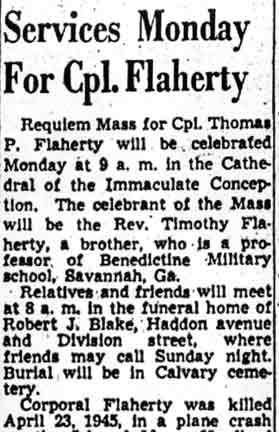

Requiem Mass for Cpl. Thomas P. Flaherty will be celebrated Monday at 9 a.m. in the Cathedral of the Immaculate Conception. The celebrant of the Mass will be the Rev. Timothy Flaherty, a brother, who is a professor of Benedictine Military school, Savannah, Ga. Relatives and friends will meet at 8 a.m. in the funeral home of Robert J. Blake, Haddon avenue and Division street, where friends may call Sunday night. Burial will be in Calvary cemetery.
Corporal Flaherty was killed April 23, 1945, in a plane crash on the Isle of Man. He lived with his parents at 445 Carteret street.
He was a football star at Camden Catholic High and Camden High schools, where he also played basketball. He later played football at St. Joseph’s college, from which he graduated. He also played football at South Carolina university, from which school he transferred to St. Joseph’s college.
Corporal Flaherty entered the army in April, 1942, and went overseas in May, 1943, serving with the Air Forces.
Two other brothers, both of whom played scholastic football, also were in the service. Joseph was a corporal in the army Air Forces, and John served in the Coast Guard.
Also surviving are his parents, Mr. and Mrs. Patrick J. Flaherty, and three sisters, Anna, Marguerite and Marion.
H. Smart Field
H. (Herbert) Smart Field is located in Bibb County, Georgia, approximately 2 miles east of Macon. The facility was the result of President Roosevelt’s Works Progress Administration and its effort to revive a troubled economy. The airport was named after Mayor Herbert Smart “who struggled to keep the city from financial ruin” during the depression years.
In the World War II period on 390.34 leased acres, the government constructed a landing field utilized by the U.S. Army Air Force as a training area. The site, now known as the Herbert Smart Airport, was comprised of numerous structures, including a hangar, several latrines, post office, classrooms, mess hall, supply rooms, etc. These building structures were scattered near three each taxiways and runways, and off the airport in an administration and living (cantonment) sector.
In November 1941, headquarters was established at the Herbert Smart Airport in a tent (then Macon’s Municipal Airport). At this time, the site was located 7 miles east of Macon and adjoined Camp Wheeler. Camp Wheeler was a permanent military camp that contributed in both World Wars. Initially, an air depot was to be constructed in Wellston, GA, however there were no available facilities, so Herbert Smart was to suffice temporarily. On January 7, 1942 the airport was turned over to the government. The airport also served as the first subordinate installation of Warner Robbins Air Service Command which was originally the Wellston Air Depot. The government constructed many improvements at the site. These improvements included a hangar, office quarters, mess hall, power and light systems and paving improvements. The government spent a million dollars in transforming the site into a military base.
The first troops at Herbert Smart were those of the 4th Air Depot group in the period of September–December 1941. However, due to Pearl Harbor they only stayed until the 20th of December. On December 6, 1941 the 5th Air Depot group arrived and were later joined by 200 enlisted men from Brookley Field, Mobile, Alabama. Herbert Smart then became a chemical troop training center. From September 24 to October 4, 1942, twenty-five (25) Air Operations companies arrived at Herbert Smart (none were activated at the airport). The height of troop strength came during October when 3200 men were stationed at the base. The strength capacities of these companies varied and some had to be reduced in order to bolster the weaker companies. These original chemical companies had lacked adequate officer strength. In November of 1942, 35 Chemical Warfare Service officers from the Chemical Warfare School at Edgewood Arsenal, Maryland, arrived at Herbert Smart. On December 8, 1942, 80 Second Lieutenants were transferred to this station from the Chemical Warfare Service Replacement Pool at Edgewood Arsenal.
The purpose of the base through 1943 was to train troops in chemical warfare with reference to air operations activity. The training unit was known as chemical company air operations.
Between April and November of 1943 many chemical companies received orders to leave for Point of Embarkation. At first the men left with their chemical equipment, but after September they left with only their “housekeeping equipment.” The supply agency soon became overloaded and at one time, one man was responsible for 98 trailers and 139 trucks. During 1943 Herbert Smart witnessed a gradual decrease in the numbers of its men. On September 26, 1943, 1200 troops went to Camp Kilmer, NJ. By the end of 1943, 14 chemical companies, air operations, had been trained and equipped at Herbert Smart and departed this station for a point of embarkation.
During the first few months of 1944, chemical activity continued on a lesser scale. After chemical companies had left, the station was still receiving trucks and trailers. On January 2, 1944 the 803rd Chemical Company Air Operations left for an Italian campaign. Between January, February and March of 1944, 6 chemical companies remained to train. The last air operation company was the 870th, which left on May 16th to Barksdale Field, Louisiana; and the last chemical aviation company left on April 10th, 1944.