Sylvester F. Wilson
Sylvester F. Wilson was, when it all comes down to it, not a very nice person. In Camden he made the newspapers in the 1870s for assault and battery, ticket scalping (which involved a certain amount of forgery and counterfeiting), and no doubt more transgressions than the surviving record captures.
Not long after he wore out his welcome in Camden, Sylvester Wilson began promoting all-girl baseball teams… the “English Blondes” and the “American Brunettes.” In time he ran afoul of the law, as at least two of the girls were underage. He also appears to have had a habit of skipping out on paying bills. Sylvester Wilson served time in the New York penal system in the 1890s for his activities, and apparently was still up to his old tricks as late as 1903.
In his time, Sylvester Wilson generated a lot of newspaper articles, which make for an interesting look into days gone by.
In the Cage
Philadelphia Inquirer —
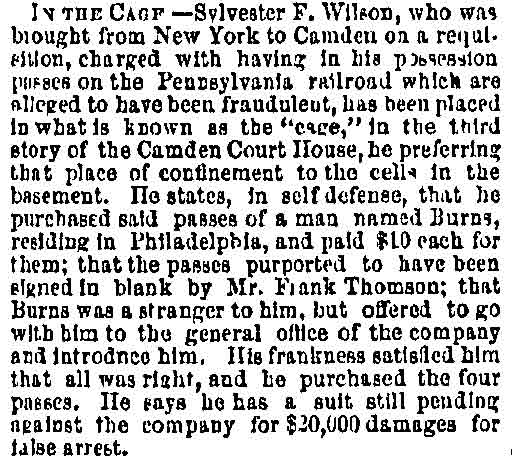
In the Cage — Sylvester F. Wilson, who was brought from New York to Camden on a requisition, charged with having in his possession passes on the Pennsylvania railroad which are alleged to have been fraudulent, has been placed in what is known as the “cage,” in the third story of the Camden Court House, he preferring that place of confinement to the cells in the basement. He states, in self defense, that he purchased said passes of a man named Burns, residing in Philadelphia, and paid $10 each for them; that the passes purported to have been signed in blank by Mr. Frank Thomson; that Burns was a stranger to him, but offered to go with him to the general office of the company and introduce him. His frankness satisfied him that all was right, and he purchased the four passes. He says he has a suit still pending against the company for $20,000 damages for false arrest.
Over the River
Philadelphia Inquirer —
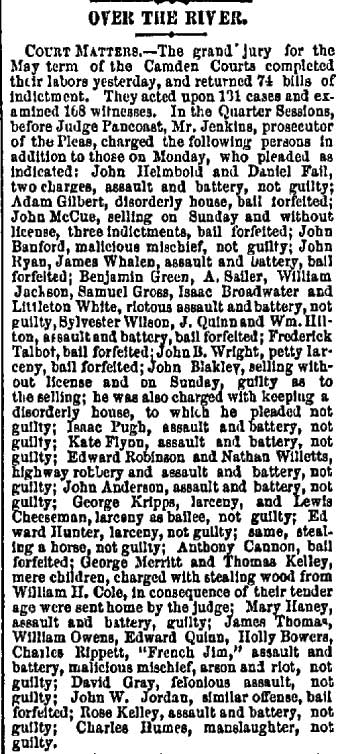
Court Matters. — The grand jury for the May term of the Camden Courts completed their labors yesterday, and returned 74 bills of indictment. They acted upon 131 cases and examined 168 witnesses. In the Quarter Sessions, before Judge Pancoast, Mr. Jenkins, prosecutor of the Pleas, charged the following persons in addition to those on Monday, who pleaded as indicated: John Helmbold and Daniel Fall, two charges, assault and battery, not guilty; Adam Gilbert, disorderly house, bail forfeited; John McCue, selling on Sunday and without license, three indictments, bail forfeited; John Banford, malicious mischief, not guilty; John Ryan, James Whalen, assault and battery, bail forfeited; Benjamin Green, A. Sailer, William Jackson, Samuel Gross, Isaac Broadwater and Littleton White, riotous assault and battery, not guilty; Sylvester Wilson, J. Quinn and Wm. Hilton, assault and battery, bail forfeited; Frederick Talbot, bail forfeited; John B. Wright, petty larceny, bail forfeited; John Blakley, selling without license and on Sunday, guilty as to the selling; he was also charged with keeping a disorderly house, to which he pleaded not guilty; Isaac Pugh, assault and battery, not guilty; Kate Flynn, assault and battery, not guilty; Edward Robinson and Nathan Willetts, highway robbery and assault and battery, not guilty; John Anderson, assault and battery, not guilty; George Kripps, larceny, and Lewis Cheeseman, larceny as bailee, not guilty; Edward Hunter, larceny, not guilty; same, stealing a horse, not guilty; Anthony Cannon, bail forfeited; George Merritt and Thomas Kelley, mere children, charged with stealing wood from William H. Cole, in consequence of their tender age were sent home by the judge; Mary Haney, assault and battery, guilty; James Thomas, William Owens, Edward Quinn, Holly Bowers, Charles Rippett, “French Jim,” assault and battery, malicious mischief, arson and riot, not guilty; David Gray, felonious assault, not guilty; John W. Jordan, similar offense, bail forfeited; Rose Kelley, assault and battery, not guilty; Charles Humes, manslaughter, not guilty.
Forger and “Scalper” on Trial
Cincinnati Daily Gazette —
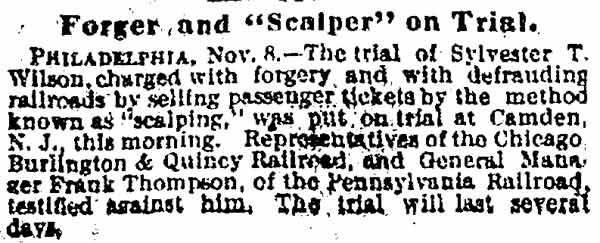
Philadelphia, Nov. 8. — The trial of Sylvester T. Wilson, charged with forgery and with defrauding railroads by selling passenger tickets by the method known as “scalping,” was put on trial at Camden, N. J., this morning. Representatives of the Chicago, Burlington & Quincy Railroad, and General Manager Frank Thompson, of the Pennsylvania Railroad, testified against him. The trial will last several days.
The Wilson Case
Philadelphia Inquirer —
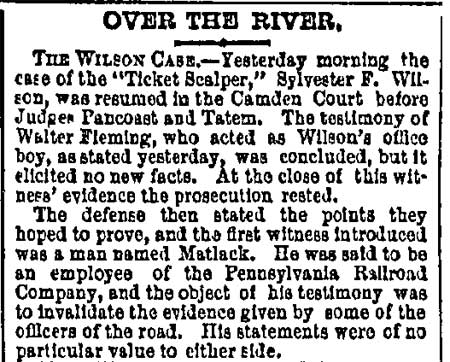
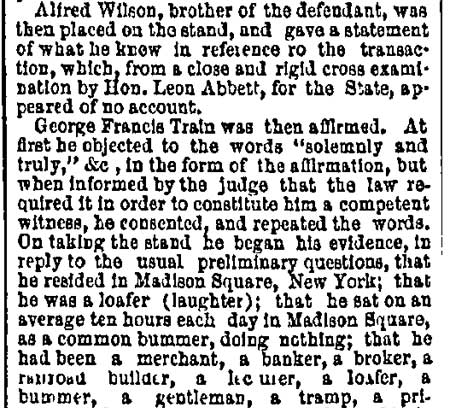
Over the River. The Wilson Case. — Yesterday morning the case of the “Ticket Scalper,” Sylvester F. Wilson, was resumed in the Camden Court before Judges Pancoast and Tatem. The testimony of Walter Fleming, who acted as Wilson’s office boy, as stated yesterday, was concluded, but it elicited no new facts. At the close of this witness’ evidence the prosecution rested.
The defense then stated the points they hoped to prove, and the first witness introduced was a man named Matlack. He was said to be an employee of the Pennsylvania Railroad Company, and the object of his testimony was to invalidate the evidence given by some of the officers of the road. His statements were of no particular value to either side.
Alfred Wilson, brother of the defendant, was then placed on the stand, and gave a statement of what he knew in reference to the transaction, which, from a close and rigid cross examination by Hon. Leon Abbett, for the State, appeared of no account.
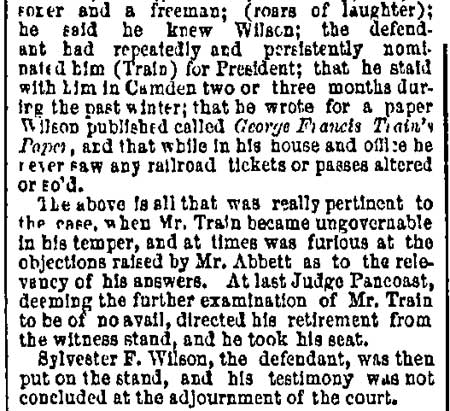
George Francis Train was then affirmed. At first he objected to the words “solemnly and truly,” &c, in the form of the affirmation, but when informed by the judge that the law required it in order to constitute him a competent witness, he consented, and repeated the words. On taking the stand he began his evidence, in reply to the usual preliminary questions, that he resided in Madison Square, New York; that he was a loafer (laughter); that he sat on an average ten hours each day in Madison Square, as a common bummer, doing nothing; that he had been a merchant, a banker, a broker, a railroad builder, a lecturer, a loafer, a bummer, a gentleman, a tramp, a prisoner and a freeman; (roars of laughter); he said he knew Wilson; the defendant had repeatedly and persistently nominated him (Train) for President; that he staid with him in Camden two or three months during the past winter; that he wrote for a paper Wilson published called George Francis Train’s Paper, and that while in his house and office he never saw any railroad tickets or passes altered or so’d.
The above is all that was really pertinent to the case, when Mr. Train became ungovernable in his temper, and at times was furious at the objections raised by Mr. Abbett as to the relevancy of his answers. At last Judge Pancoast, deeming the further examination of Mr. Train to be of no avail, directed his retirement from the witness stand, and he took his seat.
Sylvester F. Wilson, the defendant, was then put on the stand, and his testimony was not concluded at the adjournment of the court.
Camden Courts
Philadelphia Inquirer —
Camden Courts — There was no business transacted in the Camden Courts yesterday. Today the case of Sylvester F. Wilson will be re-sumed, and it is thought it will be finished on Friday.
Over the River
Philadelphia Inquirer —
Camden Courts. — Yesterday, in the Court of Oyer and Terminer, before Judges Pancoast, Tatem and Horner, Sylvester F. Wilson was arraigned for trial on the charge of forging railroad passes and tickets. The prosecution demanded a struck jury, and the case was laid over until to-morrow. John Owens was then put on trial on a charge of arson in setting fire to his own store on Spruce street, near Third, in August last.
Jurors Discharged
Philadelphia Inquirer —
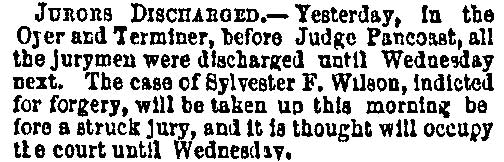
Jurors Discharged. — Yesterday, in the Oyer and Terminer, before Judge Pancoast, all the jurymen were discharged until Wednesday next. The case of Sylvester F. Wilson, indicted for forgery, will be taken up this morning before a struck jury, and it is thought will occupy the court until Wednesday.
The Wilson Case
Philadelphia Inquirer —
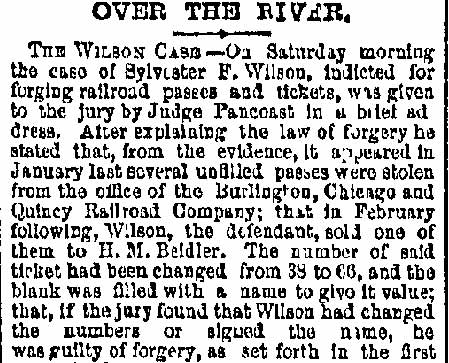
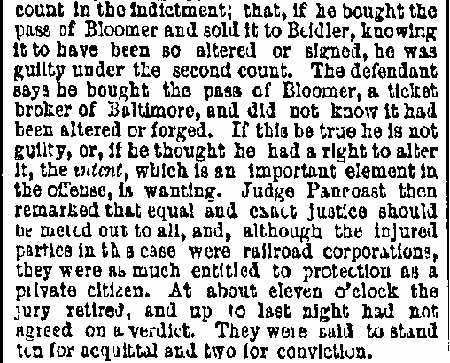
Over the River. The Wilson Case. — On Saturday morning the case of Sylvester F. Wilson, indicted for forging railroad passes and tickets, was given to the jury by Judge Pancoast in a brief address. After explaining the law of forgery he stated that, from the evidence, it appeared in January last several unfilled passes were stolen from the office of the Burlington, Chicago and Quincy Railroad Company; that in February following, Wilson, the defendant, sold one of them to H. M. Beidler. The number of said ticket had been changed from 38 to 66, and the blank was filled with a name to give it value; that, if the jury found that Wilson had changed the numbers or signed the name, he was guilty of forgery, as set forth in the first count in the indictment; that, if he bought the pass of Bloomer and sold it to Beidler, knowing it to have been so altered or signed, he was guilty under the second count. The defendant says he bought the pass of Bloomer, a ticket broker of Baltimore, and did not know it had been altered or forged. If this be true he is not guilty, or, if he thought he had a right to alter it, the intent, which is an important element in the offense, is wanting.
Judge Pancoast then remarked that equal and exact justice should be meted out to all, and, although the injured parties in this case were railroad corporations, they were as much entitled to protection as a private citizen. At about eleven o’clock the jury retired, and up to last night had not agreed on a verdict. They were said to stand ten for acquittal and two for conviction.
Camden Courts
Philadelphia Inquirer —
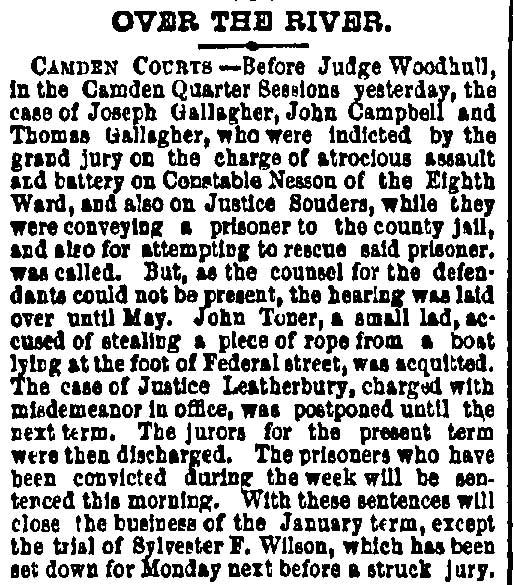
Over the River. Camden Courts — Before Judge Woodhull, in the Camden Quarter Sessions yesterday, the case of Joseph Gallagher, John Campbell and Thomas Gallagher, who were indicted by the grand jury on the charge of atrocious assault and battery on Constable Nesson of the Eighth Ward, and also on Justice Souders, while they were conveying a prisoner to the county jail, and also for attempting to rescue said prisoner, was called. But, as the counsel for the defendants could not be present, the hearing was laid over until May. John Toner, a small lad, accused of stealing a piece of rope from a boat lying at the foot of Federal street, was acquitted. The case of Justice Leatherbury, charged with misdemeanor in office, was postponed until the next term. The jurors for the present term were then discharged. The prisoners who have been convicted during the week will be sentenced this morning. With these sentences will close the business of the January term, except the trial of Sylvester F. Wilson, which has been set down for Monday next before a struck jury.
Trial of Sylvester F. Wilson
Philadelphia Inquirer —
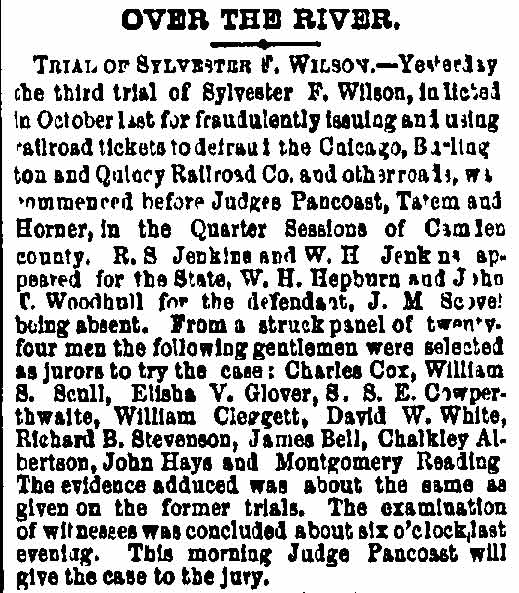
Over the River. Trial of Sylvester F. Wilson. — Yesterday the third trial of Sylvester F. Wilson, indicted in October last for fraudulently issuing and using railroad tickets to defraud the Chicago, Burlington and Quincy Railroad Co. and other roads, was commenced before Judges Pancoast, Tatem and Horner, in the Quarter Sessions of Camden county. R. S. Jenkins and W. H. Jenkins appeared for the State, W. H. Hepburn and John C. Woodhull for the defendant, J. M. Scovell being absent. From a struck panel of twenty-four men the following gentlemen were selected as jurors to try the case: Charles Cox, William S. Scull, Elisha V. Glover, S. S. E. Cowperthwaite, William Cleggett, David W. White, Richard B. Stevenson, James Bell, Chalkley Albertson, John Hays and Montgomery Reading. The evidence adduced was about the same as given on the former trials. The examination of witnesses was concluded about six o’clock last evening. This morning Judge Pancoast will give the case to the jury.
Acquitted
Philadelphia Inquirer —
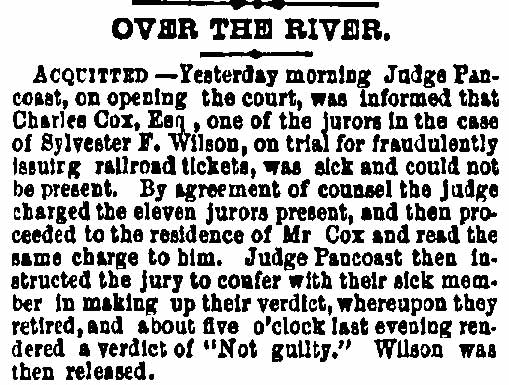
Over the River. Acquitted — Yesterday morning Judge Pancoast, on opening the court, was informed that Charles Cox, Esq., one of the jurors in the case of Sylvester F. Wilson, on trial for fraudulently issuing railroad tickets, was sick and could not be present. By agreement of counsel the judge charged the eleven jurors present, and then proceeded to the residence of Mr. Cox and read the same charge to him. Judge Pancoast then instructed the jury to confer with their sick member in making up their verdict, whereupon they retired, and about five o’clock last evening rendered a verdict of “Not guilty.” Wilson was then released.
Disposition of a Ticket Scalper
Cleveland Plain Dealer —
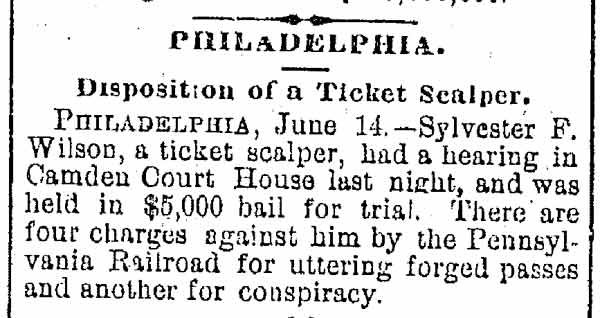
Philadelphia. Disposition of a Ticket Scalper. Philadelphia, June 14. — Sylvester F. Wilson, a ticket scalper, had a hearing in Camden Court House last night, and was held in $5,000 bail for trial. There are four charges against him by the Pennsylvania Railroad for uttering forged passes and another for conspiracy.
Sylvester F. Wilson Again
Philadelphia Inquirer —
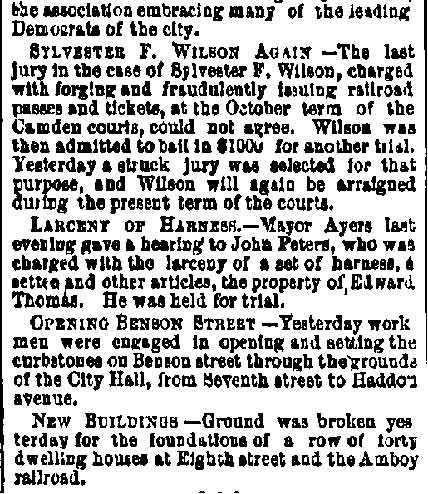
Sylvester F. Wilson Again — The last jury in the case of Sylvester F. Wilson, charged with forging and fraudulently issuing railroad passes and tickets, at the October term of the Camden courts, could not agree. Wilson was then admitted to bail in $1000 for another trial. Yesterday a struck jury was selected for that purpose, and Wilson will again be arraigned during the present term of the courts.
Sporting Matters
Lowell Daily Citizen —
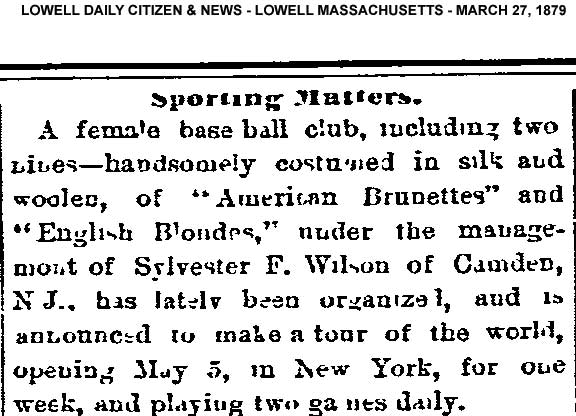
Sporting Matters. A female base ball club, including two nines — handsomely costumed in silk and woolen, of “American Brunettes” and “English Blondes,” under the management of Sylvester F. Wilson of Camden, N.J., has lately been organized, and is announced to make a tour of the world, opening May 5, in New York, for one week, and playing two games daily.
Baseball by Ladies
New York Herald —
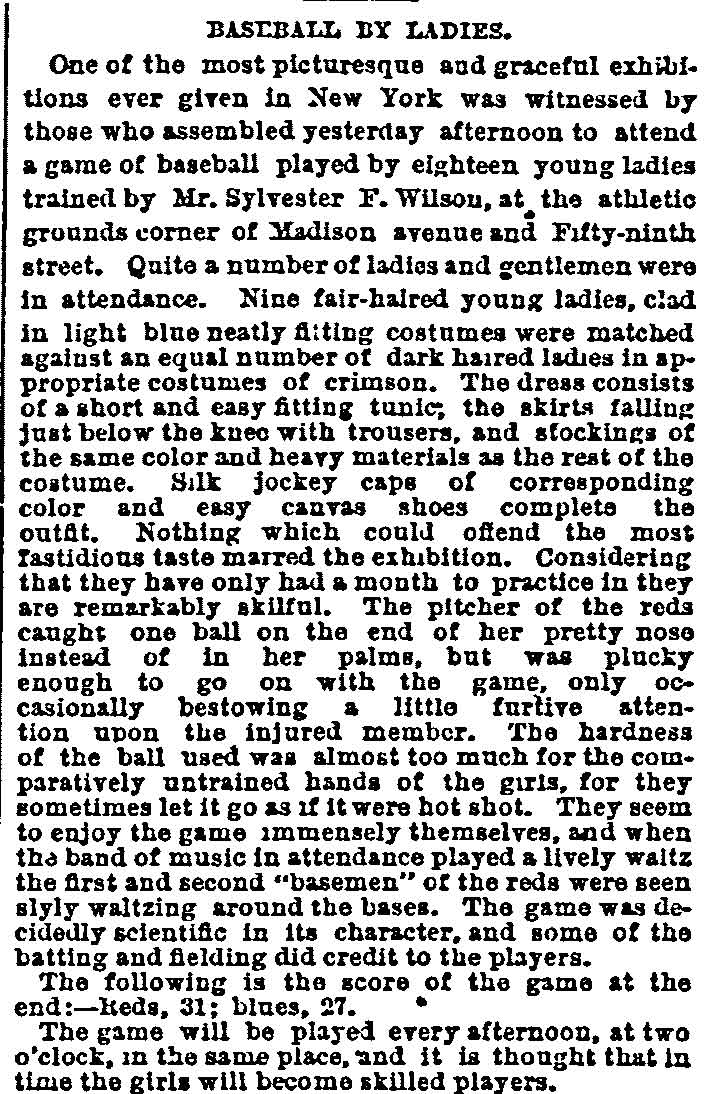
Baseball by Ladies. One of the most picturesque and graceful exhibitions ever given in New York was witnessed by those who assembled yesterday afternoon to attend a game of baseball played by eighteen young ladies trained by Mr. Sylvester F. Wilson, at the athletic grounds corner of Madison avenue and Fifty-ninth street. Quite a number of ladies and gentlemen were in attendance. Nine fair-haired young ladies, clad in light blue neatly fitting costumes were matched against an equal number of dark haired ladies in appropriate costumes of crimson. The dress consists of a short and easy fitting tunic, the skirts falling just below the knee with trousers, and stockings of the same color and heavy materials as the rest of the costume. Silk jockey caps of corresponding color and easy canvas shoes complete the outfit. Nothing which could offend the most fastidious taste marred the exhibition. Considering that they have only had a month to practice in they are remarkably skillful. The pitcher of the reds caught one ball on the end of her pretty nose instead of in her palms, but was plucky enough to go on with the game, only occasionally bestowing a little furtive attention upon the injured member. The hardness of the ball used was almost too much for the comparatively untrained hands of the pupils, for they sometimes let it go as if it were hot shot. They seem to enjoy the game immensely themselves, and when the band of music in attendance played a lively waltz the first and second “basemen” of the reds were seen slyly waltzing around the bases. The game was decidedly scientific in its character, and some of the batting and fielding did credit to the players.
The following is the score of the game at the end: — Reds, 31; Blues, 27.
The game will be played every afternoon, at two o’clock, in the same place, and it is thought that in time the girls will become skilled players.
Ticket Scalping — The Constitutionality of the Law Doubted
Philadelphia Inquirer —
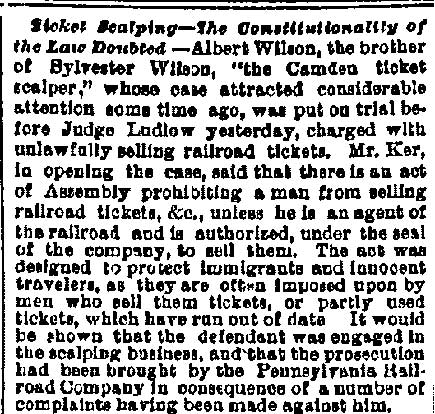
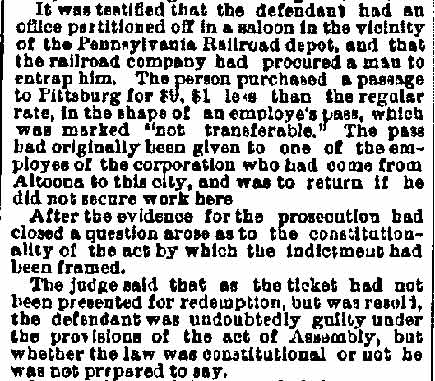
Ticket Scalping — The Constitutionality of the Law Doubted — Albert Wilson, the brother of Sylvester Wilson, “the Camden ticket scalper,” whose case attracted considerable attention some time ago, was put on trial before Judge Ludlow yesterday, charged with unlawfully selling railroad tickets. Mr. Ker, in opening the case, said that there is an act of Assembly prohibiting a man from selling railroad tickets, &c., unless he is an agent of the railroad and is authorized, under the seal of the company, to sell them. The act was designed to protect immigrants and innocent travelers, as they are often imposed upon by men who sell them tickets, or partly used tickets, which have run out of date. It would be shown that the defendant was engaged in the scalping business, and that the prosecution had been brought by the Pennsylvania Railroad Company in consequence of a number of complaints having been made against him.
It was testified that the defendant had an office partitioned off in a saloon in the vicinity of the Pennsylvania Railroad depot, and that the railroad company had procured a man to entrap him. The person purchased a passage to Pittsburg for $9, $1 less than the regular rate, in the shape of an employee’s pass, which was marked “not transferable.” The pass had originally been given to one of the employees of the corporation who had come from Altoona to this city, and was to return if he did not secure work here.
After the evidence for the prosecution had closed a question arose as to the constitutionality of the act by which the indictment had been framed. The judge said that as the ticket had not been presented for redemption, but was resold, the defendant was undoubtedly guilty under the provisions of the act of Assembly, but whether the law was constitutional or not he was not prepared to say.
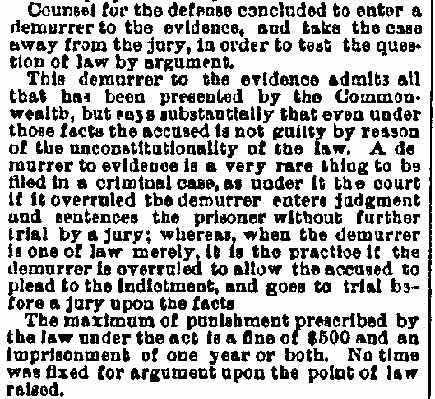
Counsel for the defense concluded to enter a demurrer to the evidence, and take the case away from the jury, in order to test the question of law by argument. This demurrer to the evidence admits all that has been presented by the Commonwealth, but says substantially that even under those facts the accused is not guilty by reason of the unconstitutionality of the law. A demurrer to evidence is a very rare thing to be filed in a criminal case, as under it the court if it overruled the demurrer enters judgment and sentences the prisoner without further trial by a jury; whereas, when the demurrer is one of law merely, it is the practice if the demurrer is overruled to allow the accused to plead to the indictment, and goes to trial before a jury upon the facts.
The maximum of punishment prescribed by the law under the act is a fine of $500 and an imprisonment of one year or both. No time was fixed for argument upon the point of law raised.
Christian Wilson, Abductor
New York Times —
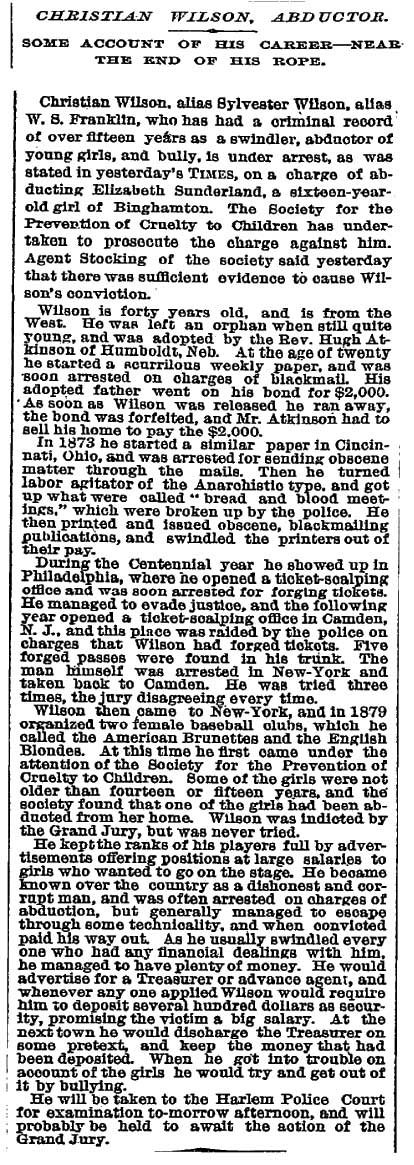
Some Account of His Career — Near the End of His Life
Christian Wilson, alias Sylvester Franklin Wilson, alias W. S. Franklin, who has had a criminal record of over fifteen years as a swindler, abductor of young girls, and bully, is under arrest, as was stated in yesterday’s Times, on a charge of abducting Elizabeth Sunderland, a sixteen-year-old girl of Binghamton. The Society for the Prevention of Cruelty to Children has undertaken to prosecute the charge against him. Agent Stocking of the society said yesterday that there was sufficient evidence to cause Wilson’s conviction.
Wilson is forty years old and is from the West. He was left an orphan when still quite young, and was adopted by the Rev. Hugh Atkinson of Binghamton, N. Y. While a youth he started a scurrilous weekly paper, and was soon arrested on charges of blackmail. His adopted father paid his bond for $2,000. As soon as Wilson was released, he ran away, the bond was forfeited, and Mr. Atkinson had to sell his home to pay the $2,000.
In 1873 he started an obscene paper in Cincinnati, Ohio, and was arrested for sending obscene matter through the mails. Then he turned his attention to lecturing, trying to get up what were called “bread and blood meetings,” which were broken up by the police. He printed and issued obscene, blackmailing publications, and swindled the printers out of their pay.
During the Centennial year he showed up in Philadelphia as a ticket-scalping office and was soon arrested for forging tickets. He managed to evade justice, and the following year opened a ticket-scalping office in Camden, N. J., and this paper learned that he was there on charges that Wilson had forged tickets. Five forged passes were found in his trunk. The matter thus coming to light, Wilson was taken back to Camden. He was tried three times, the jury disagreeing every time.
Wilson then came to New York, and in 1879 organized two female baseball clubs, which he called the American Brunettes and the English Blondes. At this time he first came under the attention of the Society for the Prevention of Cruelty to Children. Some of the girls were not older than fourteen or fifteen years, and the society found that one of the girls had been abducted from her home. Wilson was indicted by the Grand Jury, but was never tried.
He kept the ranks of his players filled by advertising, offering positions and large salaries to girls who wanted to go on the stage. He became known over the country as a dishonest and corrupt man, and was often arrested on charges of abduction, but managed to get out of trouble through some technicality, and when convicted paid his way out. As he usually swindled every one who had anything to do with him financially, he managed to have plenty of money. He would advertise for a Treasurer or advance agent, and whenever any one applied Wilson would require him to deposit a liberal sum as a bond for security, promising the victim a big salary. At the next town he would discharge the Treasurer on some pretext and retain the money that had been deposited. When he got into trouble on account of the girls he would try and get out of it by bullying.
He will be taken to the Harlem Police Court for examination to-morrow afternoon, and will probably be held to await the action of the Grand Jury.
A Despicable Villain
St. Louis Republican —
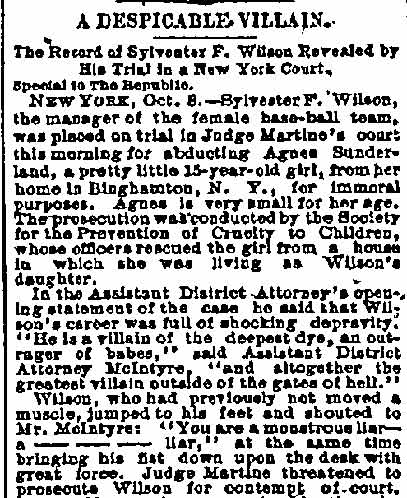
The Record of Sylvester F. Wilson Revealed by His Trial in a New York Court.
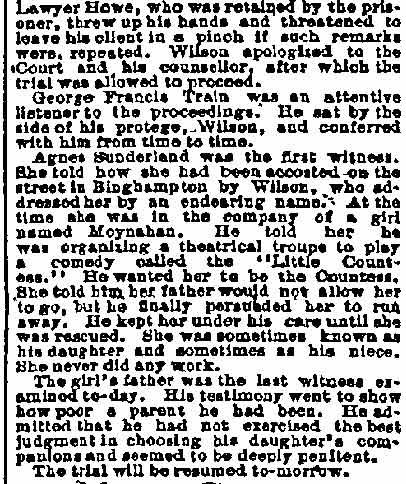
New York, Oct. 8. — Sylvester F. Wilson, the manager of the female base-ball team, was placed on trial in Judge Martine’s court this morning for abducting Agnes Sunderland, a pretty little 15-year-old girl, from her home in Binghamton, N. Y., for immoral purposes. Agnes is very small for her age. The prosecution was conducted by the Society for the Prevention of Cruelty to Children, whose officers rescued the girl from a house in which she was living as Wilson’s daughter.
In the Assistant District Attorney’s opening statement of the case he said that Wilson’s career was full of shocking depravity. “He is a villain of the deepest dye, an outrager of babes,” said Assistant District Attorney McIntyre, “and altogether the greatest villain outside of the gates of hell.”
Wilson, who had previously not moved a muscle, jumped to his feet and shouted to Mr. McIntyre: “You are a monstrous liar — a ——— liar,” at the same time bringing his fist down upon the desk with great force. Judge Martine threatened to prosecute Wilson for contempt of court. Lawyer Howe, who was retained by the prisoner, threw up his hands and threatened to leave his client in a pinch if such remarks were repeated. Wilson apologised to the Court and his counsellor, after which the trial was allowed to proceed.
George Francis Train was an attentive listener to the proceedings. He sat by the side of his protege, Wilson, and conferred with him from time to time.
Agnes Sunderland was the first witness. She told how she had been accosted on the street in Binghamton by Wilson, who addressed her by an endearing name. At the time she was in the company of a girl named Moynahan. He told her he was organizing a theatrical troupe to play a comedy called the “Little Countess.” He wanted her to be the Countess. She told him her father would not allow her to go, but he finally persuaded her to run away. He kept her under his care until she was rescued. She was sometimes known as his daughter and sometimes as his niece. She never did any work.
The girl’s father was the last witness examined to-day. His testimony went to show how poor a parent he had been. He admitted that he had not exercised the best judgment in choosing his daughter’s companions and seemed to be deeply penitent.
The trial will be resumed to-morrow.
Train and the Wilson Case
St. Louis Republican —
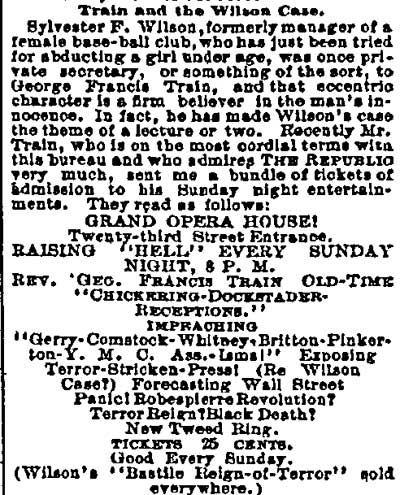
Train and the Wilson Case. Sylvester F. Wilson, formerly manager of a female base-ball club, who has just been tried for abducting a girl under age, was once private secretary, or something of the sort, to George Francis Train, and that eccentric character is a firm believer in the man’s innocence. In fact, he has made Wilson’s case the theme of a lecture or two. Recently Mr. Train, who is on the most cordial terms with this bureau and who admires The Republic very much, sent me a bundle of tickets of admission to his Sunday night entertainments.
They read as follows:
Grand Opera House!
Twenty-third Street Entrance.
Raising “Hell” Every Sunday Night, 8 P. M.
Rev. Geo. Francis Train Old-Time “Chickering-Dockstader-Receptions.”
Impeaching “Gerry-Comstock-Whitney-Britton-Pinkerton-Y. M. C. Ass.-Isms!” Exposing Terror-Stricken-Press! (Re Wilson Case?) Forecasting Wall Street Panic! Robespierre Revolution? Terror Reign? Black Death? New Tweed Ring. Tickets 25 Cents. Good Every Sunday. (Wilson’s “Bastile Reign-of-Terror” sold everywhere.)
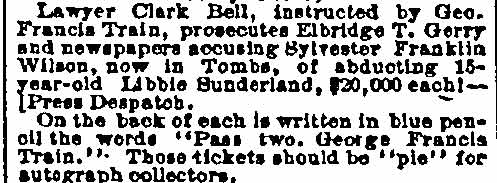
Lawyer Clark Bell, instructed by Geo. Francis Train, prosecutes Elbridge T. Gerry and newspapers accusing Sylvester Franklin Wilson, now in Tombs, of abducting 15-year-old Libble Sunderland, $20,000 each — [Press Despatch.] On the back of each is written in blue pencil the words “Pass two. George Francis Train.” Those tickets should be “pie” for autograph collectors.
Denied His Baby
St. Louis Republican —
Sylvester F. Wilson, the Manager of Female Ball-Players, Has a Hard Time.
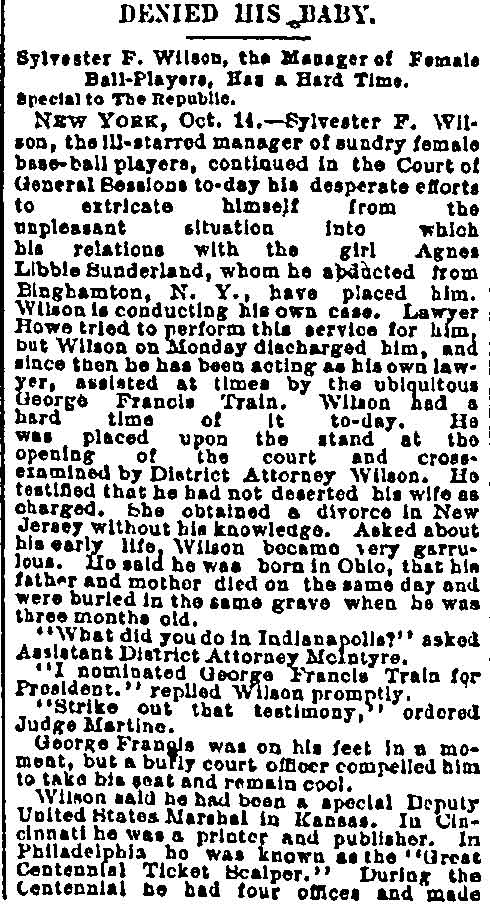
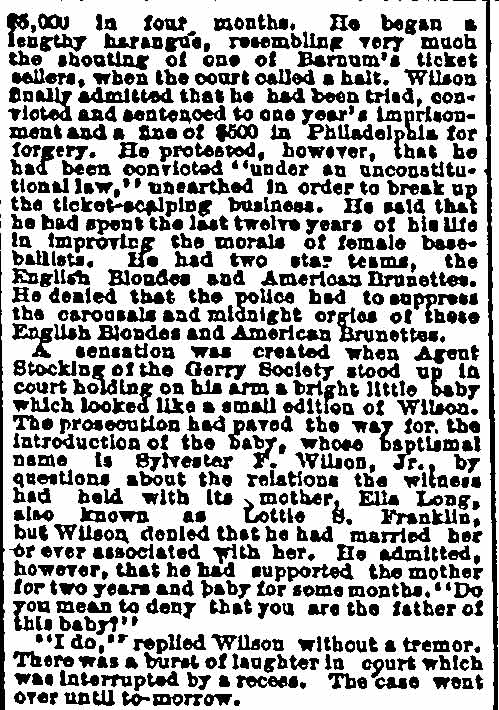
New York, Oct. 14. — Sylvester F. Wilson, the ill-starred manager of sundry female base-ball players, continued in the Court of General Sessions to-day his desperate efforts to extricate himself from the unpleasant situation into which his relations with the girl Agnes Libbie Sunderland, whom he abducted from Binghamton, N. Y., have placed him. Wilson is conducting his own case. Lawyer Howe tried to perform this service for him, but Wilson on Monday discharged him, and since then he has been acting as his own lawyer, assisted at times by the ubiquitous George Francis Train. Wilson had a hard time of it to-day. He was placed upon the stand at the opening of the court and cross-examined by District Attorney Wilson. He testified that he had not deserted his wife as charged. She obtained a divorce in New Jersey without his knowledge. Asked about his early life, Wilson became very garrulous. He said he was born in Ohio, that his father and mother died on the same day and were buried in the same grave when he was three months old.
“What did you do in Indianapolis?” asked Assistant District Attorney McIntyre.
“I nominated George Francis Train for President,” replied Wilson promptly.
“Strike out that testimony,” ordered Judge Martine.
George Francis was on his feet in a moment, but a burly court officer compelled him to take his seat and remain cool.
Wilson said he had been a special Deputy United States Marshal in Kansas. In Cincinnati he was a printer and publisher. In Philadelphia he was known as the “Great Centennial Ticket Scalper.” During the Centennial he had four offices and made $6,000 in four months. He began a lengthy harangue, resembling very much the shouting of one of Barnum’s ticket sellers, when the court called a halt. Wilson finally admitted that he had been tried, convicted and sentenced to one year’s imprisonment and a fine of $500 in Philadelphia for forgery. He protested, however, that he had been convicted “under an unconstitutional law,” unearthed in order to break up the ticket-scalping business. He said that he had spent the last twelve years of his life in improving the morals of female base-ballists. He had two star teams, the English Blondes and American Brunettes. He denied that the police had to suppress the carousals and midnight orgies of these English Blondes and American Brunettes.
A sensation was created when Agent Stocking of the Gerry Society stood up in court holding on his arm a bright little baby which looked like a small edition of Wilson. The prosecution had paved the way for the introduction of the baby, whose baptismal name is Sylvester F. Wilson, Jr., by questions about the relations the witness had held with its mother, Ella Long, also known as Lottie S. Franklin; but Wilson denied that he had married her or ever associated with her. He admitted, however, that he had supported the mother for two years and baby for some months. “Do you mean to deny that you are the father of this baby?”
“I do,” replied Wilson without a tremor.
There was a burst of laughter in court which was interrupted by a recess. The case went over until to-morrow.
Abductor Wilson’s Heavy Sentence
New York Sun —
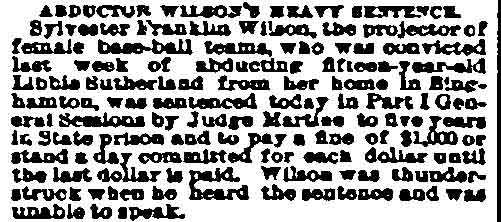
Abductor Wilson’s Heavy Sentence. Sylvester Franklin Wilson, the projector of female base-ball teams, who was convicted last week of abducting fifteen-year-old Libbie Sutherland from her home in Binghamton, was sentenced today in Part I General Sessions by Judge Martine to five years in State prison and to pay a fine of $1,000 or stand a day committed for each dollar until the last dollar is paid. Wilson was thunderstruck when he heard the sentence and was unable to speak.
Wilson Gets Five Years in Prison
Springfield Republican —
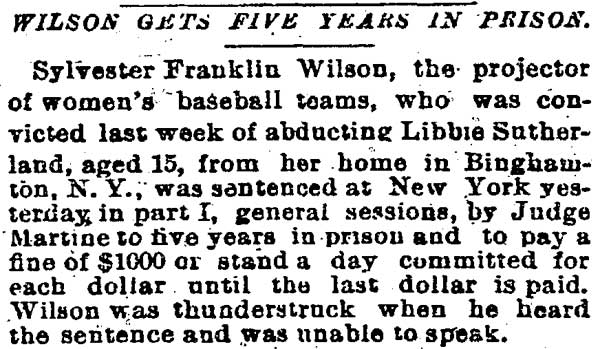
Wilson Gets Five Years in Prison. Sylvester Franklin Wilson, the projector of women’s baseball teams, who was convicted last week of abducting Libbie Sutherland, aged 15, from her home in Binghamton, N. Y., was sentenced at New York yesterday in part I, general sessions, by Judge Martine to five years in prison and to pay a fine of $1000 or stand a day committed for each dollar until the last dollar is paid. Wilson was thunderstruck when he heard the sentence and was unable to speak.
Wilson Gets Another Stay
New York Times —
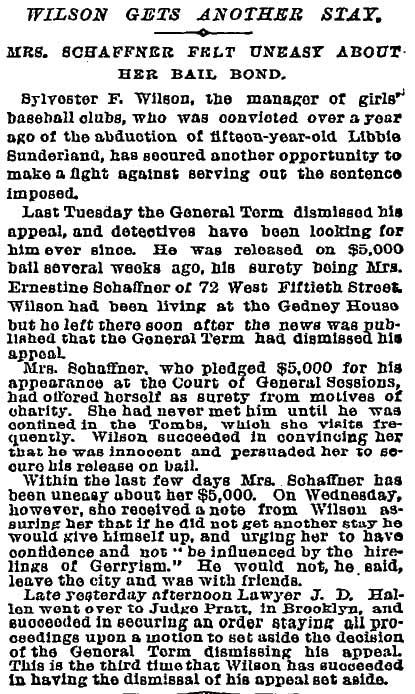
Mrs. Schaffner Felt Uneasy About Her Bail Bond.
Sylvester F. Wilson, the manager of girls’ baseball clubs, who was convicted over a year ago of the abduction of fifteen-year-old Libbie Sunderland, has secured another opportunity to make a fight against serving out the sentence imposed.
Last Tuesday the General Term dismissed his appeal, and detectives have been looking for him ever since. He was released on $5,000 bail several weeks ago, his surety being Mrs. Ernestine Schaffner of 72 West Fiftieth Street. Wilson had been living at the Gedney House but he left there soon after the news was published that the General Term had dismissed his appeal.
Mrs. Schaffner, who pledged $5,000 for his appearance at the Court of General Sessions, had offered herself as surety from motives of charity. She had never met him until he was confined in the Tombs, which she visits frequently. Wilson succeeded in convincing her that he was innocent and persuaded her to secure his release on bail.
Within the last few days Mrs. Schaffner has been uneasy about her $5,000. On Wednesday, however, she received a note from Wilson assuring her that if he did not get another stay he would give himself up, and urging her to have confidence and not “be influenced by the hirelings of Gerryism.” He would not, he said, leave the city and was with friends.
Late yesterday afternoon Lawyer J. D. Hallen went over to Judge Pratt, in Brooklyn, and succeeded in securing an order staying all proceedings upon a motion to set aside the decision of the General Term dismissing his appeal. This is the third time that Wilson has succeeded in having the dismissal of his appeal set aside.
Wilson Means to Fight
New York Times —
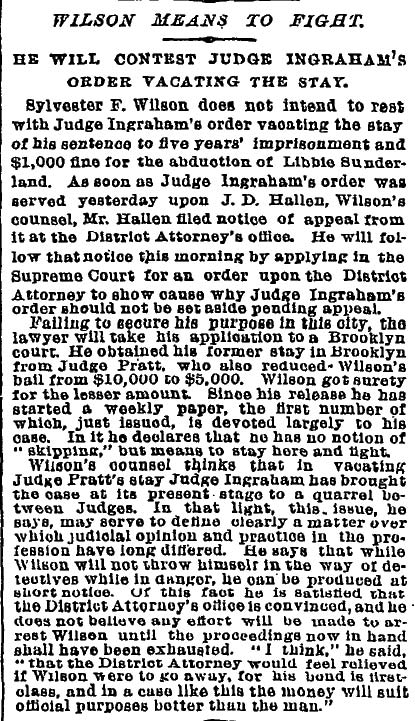
He Will Contest Judge Ingraham’s Order Vacating the Stay.
Sylvester F. Wilson does not intend to rest with Judge Ingraham’s order vacating the stay of his sentence to five years’ imprisonment and $1,000 fine for the abduction of Libbie Sunderland. As soon as Judge Ingraham’s order was served yesterday upon J. D. Hallen, Wilson’s counsel, Mr. Hallen filed notice of appeal from it at the District Attorney’s office. He will follow that notice this morning by applying in the Supreme Court for an order upon the District Attorney to show cause why Judge Ingraham’s order should not be set aside pending appeal.
Failing to secure his purpose in this city, the lawyer will take his application to a Brooklyn court. He obtained his former stay in Brooklyn from Judge Pratt, who also reduced Wilson’s bail from $10,000 to $5,000. Wilson got surety for the lesser amount. Since his release he has started a weekly paper, the first number of which, just issued, is devoted largely to his case. In it he declares that he has no notion of “skipping,” but means to stay here and fight.
Wilson’s counsel thinks that in vacating Judge Pratt’s stay Judge Ingraham has brought the case at its present stage to a quarrel between Judges. That, in that light, this issue, he says, may serve to define clearly a matter over which judicial opinion and practice in the profession have long differed. He says that while Wilson will not throw himself in the way of detectives when in danger, he can be produced at short notice. Of this fact he is satisfied that the District Attorney’s office is convinced, and he does not believe any effort will be made to arrest Wilson until the proceedings now in hand shall have been exhausted. “I think,” he said, “that the District Attorney would feel relieved if Wilson were to go away, for his bond is first-class, and in a case like this the money will suit official purposes better than the man.”
And Deserves Every Minute of It
Charlotte Observer —
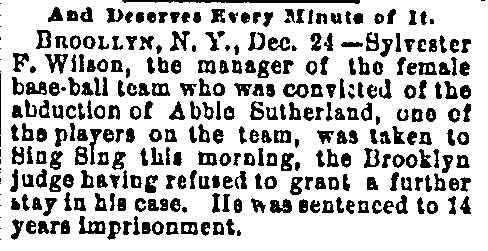
And Deserves Every Minute of It. Brooklyn, N. Y., Dec. 24 — Sylvester F. Wilson, the manager of the female base-ball team who was convicted of the abduction of Abbie Sutherland, one of the players on the team, was taken to Sing Sing this morning, the Brooklyn judge having refused to grant a further stay in his case. He was sentenced to 14 years imprisonment.
Philadelphia Inquirer — December 25, 1892
Sylvester F. Wilson
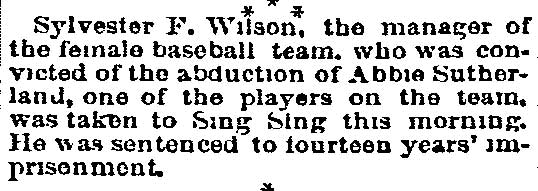
Sylvester F. Wilson, the manager of the female baseball team, who was convicted of the abduction of Abbie Sutherland, one of the players on the team, was taken to Sing Sing this morning. He was sentenced to fourteen years' imprisonment.
Sylvester F. Wilson, the manager of the female baseball team, who was convicted of the abduction of Abbie Sutherland, one of the players on the team, was taken to Sing Sing this morning. He was sentenced to fourteen years’ imprisonment.
New Orleans Times Pelican — December 27, 1892
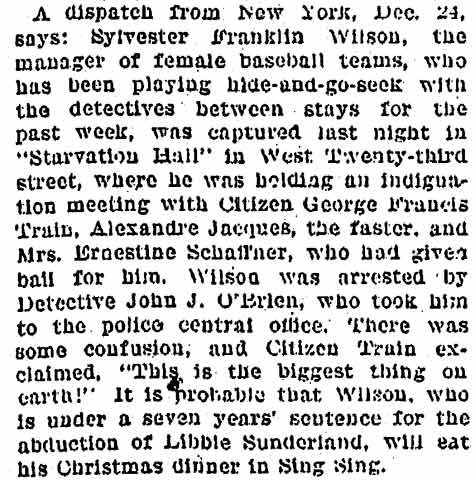
A dispatch from New York, Dec. 24, says: Sylvester Franklin Wilson, the manager of female baseball teams, who has been playing hide-and-go-seek with the detectives between stays for the past week, was captured last night in “Starvation Hall” in West Twenty-third street, where he was holding an indignation meeting with Citizen George Francis Train, Alexandre Jacques, the factor, and Mrs. Ernestine Schaffner, who had given bail for him. Wilson was arrested by Detective John J. O’Brien, who took him to the police central office. There was some confusion, and Citizen Train exclaimed, “This is the biggest thing on earth!” It is probable that Wilson, who is under a seven years' sentence for the abduction of Libbie Sunderland, will eat his Christmas dinner in Sing Sing.
A dispatch from New York, Dec. 24, says: Sylvester Franklin Wilson, the manager of female baseball teams, who has been playing hide-and-go-seek with the detectives between stays for the past week, was captured last night in “Starvation Hall” in West Twenty-third street, where he was holding an indignation meeting with Citizen George Francis Train, Alexandre Jacques, the factor, and Mrs. Ernestine Schaffner, who had given bail for him. Wilson was arrested by Detective John J. O’Brien, who took him to the police central office. There was some confusion, and Citizen Train exclaimed, “This is the biggest thing on earth!” It is probable that Wilson, who is under a seven years’ sentence for the abduction of Libbie Sunderland, will eat his Christmas dinner in Sing Sing.
Female Baseball Club Originator in Tombs
Boston Journal —

New York Police Nab Him on Charge of Abduction. May Get Twenty Years. Mother of Young Girl He Hired for Basketball Team Is the Complainant.
Special to The Boston Journal. New York, June 28. — Arrested on a warrant charging him with abduction, Sylvester F. Wilson, alias Frank W. Hartigat, alias W. S. Franklin, an old-time citizen of the female baseball club, spent today in the Tombs. Having seen conviction several times, Wilson is liable, if convicted again, to get a 20-year sentence under the habitual offender law.
Last January Wilson advertised for a partner with $500. L. L. Bachman of Philadelphia answered the advertisement, as did also a number of girls. Wilson advertised himself as “Monday, Tuesday, Wednesday Thursday, Friday and Saturday — at 135 Manhattan ave. 1; Monday Colonial Hall, 20 lots at, and Columbus ave.
Detectives on Track. The advertisement was so like the one Wilson had printed over the name of Frank Watkins several years ago, that the Children’s Society promptly started an investigation. Detectives Piersma and Fogarty learned that the advertiser was Wilson, who had assumed the name of Hartwick. They found that he had been advertising for girls who wanted to play basketball and that those already engaged were practicing at Brady’s Lyceum Academy, 135-137 West One Hundred and Twenty-first street, and at other places.
On the night of May 27 the first week’s salary of the basketball players fell due. Wilson put them off in the morning and at 3 o’clock in the morning of the twenty-eighth was seen going down the street followed by the girls, demanding their board bill and salary and started out to find Wilson.
The hotel proprietor where the party lodged, Fogarty learned, refused their board bill and paid their passage back to this city. Piersma and Fogarty found that Wilson was at 1 Broom Binnamon avenue, one of the girls deserted by Wilson, and on her testimony, corroborated by another girl, Wilson was indicted last Monday.
The officers of the Children’s Society recall Wilson’s record. He is the worst offender, if not the very worst offender, they have encountered. In August 1901, Wilson brought Libbie Sunderland, a years old, to New York from Binghamton, abducting her from her home. After serving Five years in Sing Sing and $1000 fine for abduction was his sentence. After his release from Sing Sing he appeared in Philadelphia, charged with enticing young girls from their homes. He was convicted and sentenced to one year, commencing his sentence in Moyamensing. He then appeared in New York, again beginning his old career.
During the hearing of the board nothing of Wilson was heard. He advertised for the “female basketball team” in January.