Sholom Secunda
Show Business
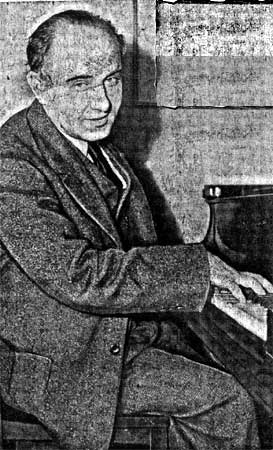
Sholom Secunda
There is a popular myth that when the Andrews Sisters released their hugely successful recording of Sholom Secunda’s “Bei Mir Bist Du Schön” in 1938, the composer’s mother was so distraught, she fasted for a week to expiate her sins. The reason for her distress? Only two months earlier, her son had sold the rights to the song for a mere thirty dollars!
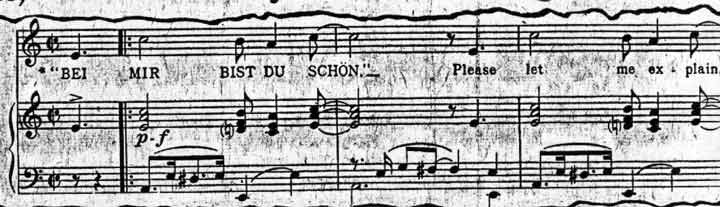
While the extreme reaction of Secunda’s mother, perpetrated by a sensational article in the Brooklyn Daily Eagle, is most likely an exaggeration, the amazingly low amount of the sale is true. Of course, the composer had no idea the song would become such a hit. Written in 1932, “Bei Mir Bist Du Schön” (translation: “To Me You Are Beautiful”) was part of a Yiddish operetta called I Would If I Could, written in 1932 by Abraham Bloom, with music by Secunda and lyrics by his writing partner, Jacob Jacobs.
The trio had attempted to sell the show to Hollywood, with no success. Even Eddie Cantor, who years later would feature the song and its composer on his radio show, originally turned the show down. With no greater prospects in sight for their song, Secunda and Jacobs decided they might as well sell the rights to a publisher.
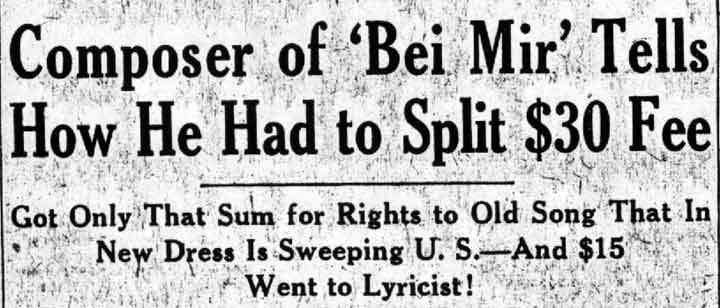
Composer of ‘Bei Mir’ Tells How He Had to Split $30 Fee
Camden Courier-Post —

Got Only That Sum for Rights to Old Song That In New Dress Is Sweeping U.S. — And $15 Went to Lyricist!
SHOLOM SECUNDA — New York composer who was paid $30 for the song currently sweeping the country, and had to divide that sum with a friend who wrote the original lyrics. According to latest reports, however, Secunda may expect a share of royalties from the publishers.
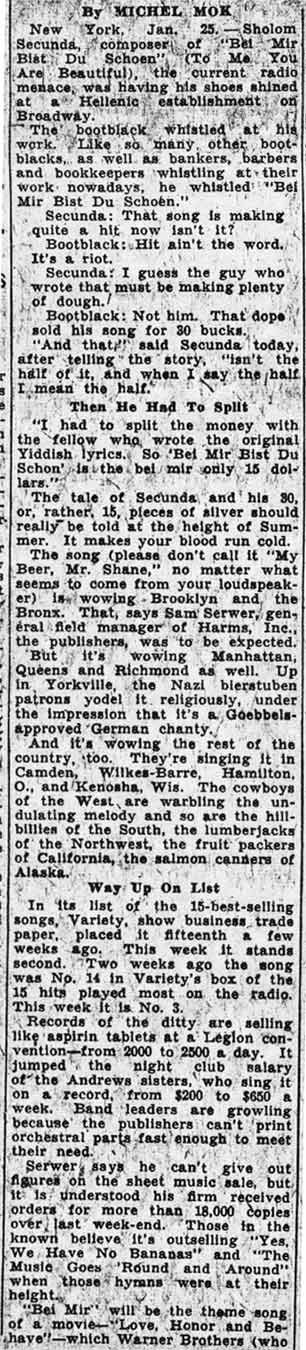
By MICHEL MOK
New York, Jan. 25. — Sholom Secunda, composer of “Bei Mir Bist Du Schoen” (To Me, You Are Beautiful), the current hit romance, was having his shoes shined at a bootblack establishment near Broadway.
The bootblack whistled at his work. Like as many other bootblacks, and elevator operators, and bookkeepers whistling at their work, he was whistling “Bei Mir Bist Du Schoen.”
Secunda: “Is making quite a hit now isn’t it?”
Bootblack: Not him. That dope wrote it for $30. What $30. “It’s a riot.”
Secunda: “I guess the guy who wrote that must be making plenty of dough.”
Bootblack: Not him. That dope wrote it for $30.
“And that?” said Secunda today, after he got the shine. “I got one-half of it, and when I say the half I mean the half.”
Then He Had To Split
“I had to split the money with the fellow who wrote the original Yiddish lyrics. So ‘Bei Mir Bist Du Schoen’ was a $15 song. That’s all.”
The tale of Secunda and his 15 pieces of silver should really make you feel good this winter. It makes your blood run cold.
The song can’t stop. “Excuse me Beer, Mr. Shane,” no matter what variations or interpolations they are using; it’s wowing Brooklyn and the Bronx and everywhere else. Leon Abbey, theatrical field manager of Harms, Inc., heard it at a Bronx night club. But it’s wowing Manhattan, too. It’s working its way up in Yorkville, the Nazi bierstrüben already are using it, giving you the impression that it’s a Gobbels-approved German chanty.
And it isn’t! The rest of the country, too. They’re singing it in Kansas City, and in Davenport, Ia., and Kenosha, Wis. The cowboys of the West, who go in for that insinuating melody, and so are the hillbillies of the South and the loggers of the Northwest, the fruit pickers of California, and the gold miners of Alaska.
Way Up On List
In its list of the 15-best-selling songs, Variety, the theatrical trade paper, placed it fifteenth a few weeks ago, and now it’s in its second. Two weeks ago the song placed third. In a new list of the 15 hits played most on the radio, it is now first.
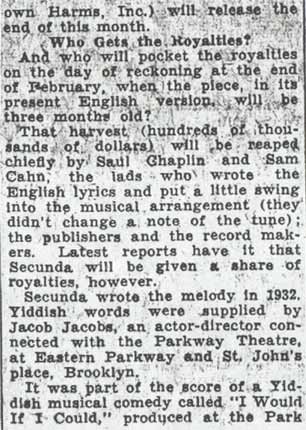
Records of the ditty are selling like aspirin tablets at a Legion convention. A big announcement of another recording (own Harms, Inc.) will release at the end of this month.
Who Gets the Royalties?
And who will pocket the royalties on the day of reckoning at the end of February, when the piece, in its present English version, will be three months old?
That harvest (hundreds of thousands of dollars) will be reaped chiefly by Saul Chaplin and Sam Cahn, the lads who wrote the English lyrics and put a little swing into the musical arrangement (they didn’t change a note of the tune); the publishers and the record makers. Latest reports have it that Secunda will be given a share of royalties, however.
Secunda wrote the melody in 1932. Yiddish words were supplied by Jacob Jacobs, an actor-director connected with the Parkway Theatre, at Eastern Parkway and St. John’s place, Brooklyn.
It was part of the score of a Yiddish musical comedy called “I Would If I Could,” produced at the Park Theatre, then the Rolland. Aaron Lebedeff and Lucy Levine introduced it. It was followed by a neighborhood run of 10,000 copies and was being sung in all the cafes and clubs in lower East Side night clubs.
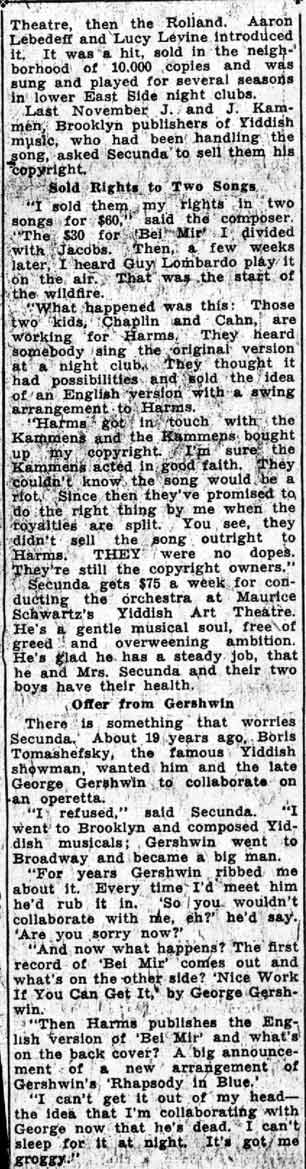
In 1933 the firm of Kammen Brothers, Brooklyn publishers of Yiddish music, who held the rights to the song, asked Secunda to sell them his copyright.
Sale of Rights to Two Songs
“I sold them my rights in two songs together,” said Secunda, “for the $30 for ‘Bei-Mir.’ I divided that half with Jacob Jacobs. And later, I heard Guy Lombardo play it and couldn’t believe my ears about the wildfire.
“It’s outrageous that those two kids, Chaplin and Cahn, are working a big hit musical and the bookkeepers sing the original version at a night club. And I sold the idea of an English version with a swing arrangement to Harms, Inc.”
“Harms got in touch with the Kammens, who said ‘We’ll get your copyright.’ I’m sure the Kammens didn’t know the song would be a hot, big hit; I think they would do the right thing by me when the time comes. But the fact is they didn’t sell the song outright to Harms. They’re still the copyright owners.”
Secunda is 43, conducting the orchestra at Maurice Schwartz’s Yiddish Art Theatre. He’s a gentle musical soul, free of rancor and bitterness, he says. He’s glad he has a steady job, that his wife is healthy and their two boys have their health.
Offer from Gershwin
There’s something that worries Secunda. About 19 years ago, Boris Thomashefsky, a famous theater showman, wanted him and the late George Gershwin to write music for an operetta.
“I refused,” said Secunda. “I went to Brooklyn and composed Yiddish musicals. Gershwin went to Manhattan and composed for himself.
“For years Gershwin ribbed me about it. Every time he saw me he’d rub it in. ‘So you wouldn’t collaborate with me!’ he’d say. ‘Are you sorry now?’”
“And now the problem! The first record of ‘Bei Mir’ comes out and it’s ‘Bei Mir Bist Du Schoen (To Me, If You Can Get It)’ by George Gershwin.”
“Then Harms published the English Version of ‘Bei-Mir’ and I want to get out of my mind that George Gershwin is somehow connected with this song. Now that George is dead I can’t even settle it with him.”
“Bei Mir Bist Du Schön” — How Sholom Secunda Gave Away the Rights to His Classic…for a Song
Milken Archive of American Jewish Music

“At the time, it was considered good publicity in Yiddish theater circles to have your songs published,” said Secunda in a 1961 interview with The New York Times. “Most of the time we would publish our songs at our own expense. If you could sell it to a publisher later on, you were that much richer. I had sold hundreds of songs for thirty dollars and was happy to get the money for this one. Jacobs and I split 50–50.”
An Enormous Success
Within two months of the sale, a then-little-known musical trio called the Andrews Sisters recorded a newly adapted English-language version of the song, with lyrics by Sammy Cahn and Saul Chaplin. The only Yiddish that remained was the title, repeated throughout the song.
Released by Decca Records, it became the Andrews Sisters’ first major hit record.
Even Americans unfamiliar with Yiddish bought the song in droves. Undaunted by the title, they requested the recording or sheet music using such approximations as “Buy Me a Beer, Mr. Shane” or “My Mere Bits of Shame.” However it was pronounced, the song was an enormous success.
“Bei Mir Bist Du Schön” quickly became a worldwide phenomenon. The Russians loved it so much that they claimed it as their own, recording a Russian-language version with the State Jazz Orchestra of the Soviet Union and crediting composers O. Kandat and Fidrovsky with authorship.
It was even a hit in Germany under the Nazi regime — that is, until it was discovered that the composer and lyricist were Jewish, whereupon the song was promptly banned.
During the 28 years that the copyright of “Bei Mir Bist Du Schön” was owned by Kammen and other entities, it is estimated that the song grossed $3,000,000. Many illustrious musical stars shared in its success, including Ella Fitzgerald, Guy Lombardo, Nelson Eddy, Benny Goodman and his Orchestra, Judy Garland, Rudy Vallee, and Bette Midler. Lyricist Sammy Cahn bought his mother a house from the money he earned from the song. It seemed as if everyone was reaping the rewards of “Bei Mir Bist Du Schön.”
Everyone, that is, but the composer.
Recreating the Original Sound
In 2001, the Milken Archive of American Jewish Music decided to revisit the old standard by recording a new orchestration featuring soloist Simon Spiro and the Vienna Chamber Orchestra, led by Israeli conductor Elli Jaffe.
Though original orchestrations of many Yiddish theater shows have been lost or discarded over the years, the Milken Archive — through extensive research and collaboration with some of the world’s finest reconstruction orchestrators — was able to reconstruct the full-pit orchestra sound and style of the time. Thus the Milken Archive recording of “Bei Mir Bist Du Schön” is the first time audiences will hear the song as it might have sounded in a Second Avenue theater in New York City in the early 1930s.
When asked why the Milken Archive decided to record the song in its original Yiddish format rather than the Andrews Sisters’ English/Yiddish version, marketing and A&R director Paul Schwendener replied, “It is, in fact, a Yiddish song from the beginning. Because of the catchy tune, it became a huge international hit and was translated into many languages. The Archive naturally wanted to record the original version.”
A Happy Ending
Remarkably, Secunda was not bitter about losing out on more than $350,000 in royalties throughout the years. As he told The New York Times, “It bothered everyone else more than it bothered me. I’ve been more interested in my symphonic music.”
Fortunately for Secunda, the story of his most popular composition has a happy ending. In 1961, the copyright on “Bei Mir Bist Du Schön” expired, reverting ownership to Secunda and Jacobs. They immediately signed a contract with Harms, Inc., the music publishing company that had acquired the rights from the Kammen brothers. This time Secunda negotiated for himself the full percentage of the composer’s royalties. Current copyright law holds that this will remain in effect until 75 years after his death.
And in 1964, Secunda’s oratorio, If Not Higher, premiered in New York featuring opera stars Richard Tucker and Norman Atkins. It received great critical acclaim.
Bei Mir Bist Du Schön (Means You’re Grand)
Words by Jacob Jacobs, Sammy Cahn and Saul Chaplin; music by Sholom Secunda. Originally written in Yiddish by Jacob Jacobs (lyrics) and Sholom Secunda (music) for the Yiddish musical “I Would If I Could” in 1933. English lyrics written for The Andrews Sisters by Sammy Cahn within a couple of days of the November 24, 1937 recording.
Of all the boys I’ve known, and I’ve known some
Until I first met you, I was lonesome
And when you came in sight, dear, my heart grew light
And this old world seemed new to meYou’re really swell, I have to admit you
Deserve expressions that really fit you
And so I’ve racked my brain, hoping to explain
All the things that you do to meBei mir bist du schön, please let me explain
Bei mir bist du schön means you’re grand
Bei mir bist du schön, again I’ll explain
It means you’re the fairest in the landI could say “Bella, bella,” even say “Voonderbar”
Each language only helps me tell you how grand you areI’ve tried to explain, bei mir bist du schön
So kiss me and say you understandBei mir bist du schön, you’ve heard it all before
but let me try to explain
Bei mir bist du schön means that you’re grand
Bei mir bist du schön, it’s such an old refrain
and yet I should explain
It means I am begging for your handI could say “Bella, bella,” even say “Voonderbar”
Each language only helps me tell you how grand you areI could say “Bella, bella,” even say “Voonderbar”
Each language only helps me tell you how grand you areI’ve tried to explain, bei mir bist du schön
So kiss me and say that you will understand