Sherwood T. Eriksson
Rank: Second Lieutenant, U.S. Army Air Forces
Serial: O-2069989
Unit: 28th Bomber Squadron, 19th Bomber Group, Very Heavy
Entered service from: New Jersey
Died:
Awards: Air Medal, Purple Heart with Oak Leaf Cluster
Memorialized at: Tablets of the Missing, Manila American Cemetery, Manila, Philippines; and Arlington National Cemetery, Arlington, Virginia
Biography
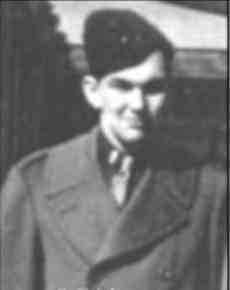
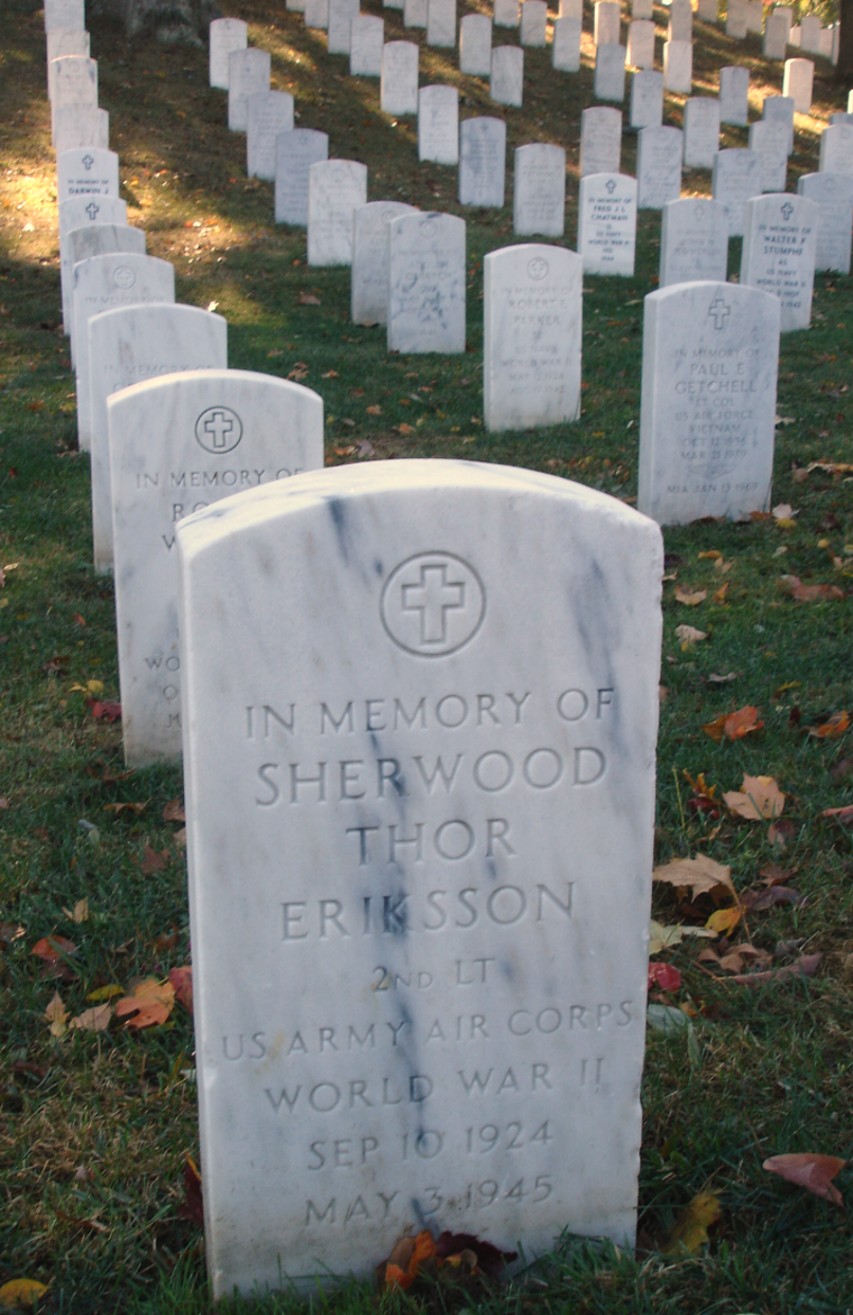
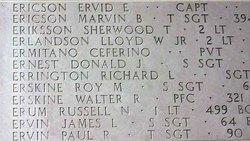
Second Lieutenant Sherwood T. Eriksson of Haddonfield, New Jersey. Memorialized at Manila American Cemetery and at Arlington National Cemetery.
Second Lieutenant Sherwood Thor Eriksson was born on September 10, 1924, in Seattle, Washington, to Gustaf Harry “Harry” Eriksson and his wife, the former Enid Gertrude Bell. The family moved to the Camden area shortly afterward, and a second son, Harold, was born in 1927, followed by daughter Thora Belle in 1928. The 1930 Census shows the Eriksson family living on East Cottage Avenue in Haddonfield, New Jersey. Harry Eriksson worked for an aluminum company as a supervisor, and later worked as an electrical cable supervisor for a public utility, most likely Public Service Electric and Gas Company.
Sherwood T. Eriksson attended Clarkson College of Technology in Potsdam, New York. Interested in astronomy and mathematics, he had been a member of the American Meteor Society. He worked with a Professor of Mathematics at the University of Michigan to disprove the geometric axiom which states that there are an infinite number of points on a given line.
After entering the United States Army, Sherwood T. Eriksson qualified for flight duty. He was trained as a radar operator on a bomber crew, and in 1944 was assigned to a crew led by First Lieutenant Robert H. Spencer Jr. The crew completed its training in the winter of 1945 and in March picked up a new B-29-55-BW Superfortress (#42-24873) and flew to Guam to join the 28th Bomber Squadron, 19th Bomber Group, Very Heavy. The plane was given the nickname “City of Dallas.”
Second Lieutenant Eriksson was wounded by anti-aircraft fire on his second mission, a raid on the Mitsubishi engine plant in Nagoya, Japan on April 7, 1945.
On May 3, 1945, during the crew’s seventh mission, the City of Dallas was hit by anti-aircraft fire. First Lieutenant Spencer ditched the plane 80 miles off the coast of Japan. When the plane hit the water the nose caved in, flooding the forward section, either trapping or killing four men. The nose went underwater so the rear of the forward section was 90 degrees, submerged to the trailing edge of the wing. The forward section sank in about six minutes. Lost in the crash were First Lieutenant Spencer the airplane commander, Second Lieutenant Burl Wiley the pilot, Second Lieutenant Adolph Hechinger the navigator, and Technical Sergeant Lynn Barnett the flight engineer. Of those in the rear of the plane, waist gunner Sergeant Alex Nomick was killed on impact, as was Second Lieutenant Eriksson. Radio Operator John Kimball survived the crash but was lost in the rough waters. Four other crew members were rescued and survived the war.
Second Lieutenant Sherwood T. Eriksson is memorialized on the Tablets of the Missing at Manila American Cemetery in Manila, Philippines, and at Arlington National Cemetery in Arlington, Virginia.
The Last Mission of the City of Dallas
Spencer’s Crew, March 1945
| Position | Duty | Rank | Name | Serial | Home |
|---|---|---|---|---|---|
| S4 | A/C | 1st Lt. | Spencer, Robert H. | 0-408355 | Big Spring, TX |
| S5 | Pilot | 2nd Lt. | Wiley, Burl T. Jr. | 0-772623 | Santa Anna, TX |
| S1 | Bombardier | 2nd Lt. | Vezeau, Dean F. | 0-2061288 | St. Louis, MO |
| S3 | Navigator | 2nd Lt. | Hechinger, Adolph Jr. | 0-2057918 | Adrian, MI |
| S2 | Radar Operator | 2nd Lt. | Eriksson, Sherwood T. | 0-2069989 | Haddonfield, NJ |
| K6 | Flight Engineer | S/Sgt. | Barnett, Lynn V. | 17010753 | Colby, KS |
| K5 | Radio Operator | Cpl. | Kimbell, John T. Jr. | 14183148 | Montgomery, AL |
| K3 | Central Fire Control | S/Sgt. | Ownby, Edwin W. | 18005169 | Gainesville, TX |
| K2 | Right Gunner | Cpl. | Nomick, Alex | 33899134 | Baltimore, MD |
| K4 | Left Gunner | Cpl. | Muchkivch, William H. | 33708493 | Pittsburgh, PA |
| K1 | Tail Gunner | Cpl. | Marolewski, Richard V. | 36683388 | Chicago, IL |
The rank of each crew member is that at the time they joined the 19th Bomb Group. Each enlisted man received one or more promotions to Sergeant or higher. The officers, however, remained in grade.
My name is Richard V. Marlowe (nee Marolewski), the Tail Gunner on the crew of 1st Lt. Robert H. Spencer. Like so many others in the Aviation Cadet Training Program, I was sent to Gunnery School at Tyndall Field when the program was canceled in February, 1944. My wife saved every letter I sent her while in the Service. I kept a log of all my flights, and saved all special orders pertaining to our crew. Surviving members of my crew gave me some names, addresses, and comments of their own that helped me to give you the history of Spencer’s crew. Bob Spencer was a quiet and unassuming man. He could easily be lost in a crowd of three people. But, oh, how that man could fly an airplane!! I will give you a few examples later. We came together in Grand Island, Nebraska, assigned to the 39th Bomb Squadron of the 6th Bomb Group.
We trained in B-17s and B-29s to develop the proficiency and coordination necessary for a combat crew. But, on September 20, 1944 crew alignments took place; some crews and crewmen would be retained as part of the 6th Bomb Group, while others were sent to Pyote, Texas to train as replacement crews. We were one of those sent to Pyote. During the transition—in Grand Island and Pyote, some of our original crew were transferred, and new members added. Finally, Spencer’s crew was set:
1st Lt. Robert Spencer,Spence,” was a soft-spoken, patient man, a leader, sound in his judgment, and an expert pilot in single and multi-engine aircraft. Before becoming our Airplane Commander, he was a Flight Instructor.
2nd Lt. Burl Wiley was only slightly more outgoing than Spence. Burl was a new pilot in four-engine aircraft but, in Spence, had as fine a teacher as you could expect.
2nd Lt. Dean Vezeau was everyone’s friend. He was short in stature, but don’t let that fool you; he was solid, muscular, and a tremendous athlete. He stood tall with us! I said that Spence was soft-spoken—Dean could be shouting and you could scarcely hear him.
2nd Lt. Adolph Hechinger “Heck” was an enigma. He was quiet, then boisterous. He was sullen, then quite a jokester. When you thought you understood him, maybe you didn’t. He was our crew “mystery man.
2nd Lt. Sherwood Eriksson was outgoing, fun-loving and he really understood radar—theory and operations. When he wasn’t engaged in crew activities, he worked with a Professor of Mathematics at the University of Michigan to disprove the geometric axiom which states that there are an infinite number of points on a given line.
S/Sgt. Lynn Barnett was, in my opinion, the finest Flight Engineer I have ever known. As a Kansas farm boy, he was always working with machinery, and things mechanical were second nature to him. Not only did he know the functioning of the airplane, he studied the CFC systems, guns, and every aspect of the plane. Other Flight Engineers and Crew Chiefs sought his counsel to solve problems and remedy conditions.
Cpl. John Kimbell was a fun-loving Alabama youth with a grin as large as his face. He was smart. He was a free-spirit, jocular, and had a quick wit. When it came time to perform, he performed!
S/Sgt. Edwin Ownby epitomized everything you ever heard of or read about Texans. He was big, strong, and a take-charge guy. He was a tremendous softball pitcher and player. In everything, you wanted him on your side.
Cpl. Alex Nomick was the Yankee counterpart to the Rebel Johnny Kimbell. That might explain why they were best friends. Al was a planner and doer; you never knew what to expect from these friends when they cooked up some outrageous scheme.
Cpl. William Muchkivch “Muskie” was the most mature of the enlisted men. He knew people and he knew his job. We would regularly solicit his advice and (sometimes) act upon it. Don’t misunderstand, he was more often than not the source of practical jokes on anyone we thought might be vulnerable.
Cpl. Richard Marolewski was the schemer and doer of the crew. He would plan days in advance to gain some advantage for the benefit of the crew. If they needed something, he could get it. He, along with Muskie and Lynn Barnett were close friends. Together they could fix almost anything, either on the ground or in the air.
This is a very brief thumbnail sketch of the members of Spencer’s crew. I don’t suppose they are much different than any other crew.
I referred earlier to Spencer’s flying ability; here is one example. On January 27, 1945, near the end of our training at Pyote, we were to fly a mission equivalent to the distance from the Marianas to Japan. We were to fly across the Gulf of Mexico to the city of Batista, Cuba and make a simulated bombing run. We would then proceed further to Cayo Traviesa, a small island in the Caribbean Sea to drop our practice bombs. All went well until we turned around to cross the Gulf back to Texas. Our radio went out. Instead of landing in Cuba (as so many other crews joyfully did), Spence flew the coastline of the U.S. to take advantage of commercial airline frequencies.
All went well until we ran low on gas. We feathered one prop, while the prop of another engine was wind milling enough to take up its drag. We were approaching Hensley Field—a fighter strip—near Dallas. Spence calmly requested permission to land (if it were me, you could hear panic in my voice). Spence landed our B-29 on a short strip next to a North American plant (which built P-51s) using only two functioning engines—at night. We had been airborne for 15 hours and 40 minutes; the ground crews at Hensley couldn’t believe an airplane could possibly remain aloft that long.
After explaining our gas problem, they asked Lynn Barnett what we might need for us to get to our destination. Lynn told them that 4,000 gallons would be ideal, but given the short runway and the weight factor, we might manage with 2,000 gallons. 4,000 gallons? 2,000 gallons? It was unheard of at a field where P-51s were fueled with 270 gallons! They used three gas trucks to supply our needs. At that time the B-29 was considered a “secret weapon” so the Air Corps assigned MP’s to guard the plane for the night. They wouldn’t allow us to enter the plane, even though we were the crew flying it.
Now…how do we take off with a moderately loaded B-29 from a short airstrip designed for fighter planes? Both Spence and Burl literally stood on the brakes while they advanced the throttles to wide open. When they released the brakes, the B-29 all but jumped, leaving the ground with nose raised to near the stalling angle. We cleared high tension wires just beyond the end of the runway by not much more than 30 feet. That took extraordinary flying skill!! Spencer, Wiley and Lynn Barnett deserved medals for their accomplishment. We all aged 10 years.
On March 7, 1945 we left Pyote and flew to Kearney, Nebraska to pick up a brand-new airplane, and get all our gear together for the trip overseas. On March 9th we flew to Mather Field in Sacramento for final preparations, briefing and orders.
We took off on March 12, 1945 for Hawaii, the first leg of our destination. That flight proved to be a precursor of what was to come. Take off was at night—the lights of San Francisco and the Golden Gate Bridge were still visible, when suddenly we heard panic emanating from the voice of Johnny Kimbell. Our assigned radio frequency was being jammed! Here we are, still over US waters, and the Japanese were already targeting us! He found an alternate frequency that was clear, and we continued. Five or six hours into the flight we ran into a storm and developed severe icing. The plane was becoming increasingly more difficult to control. The hand-held spotlight we used, showed that our antenna wire was about the thickness of your middle finger from the accumulation of ice. Spence alerted us to the possibility of ditching if icing became worse and we continued to lose altitude. I guess the Lord was looking out for us, thanks in part to Spence’s flying skills. We passed through the storm and made it to Hawaii safely. We were fast becoming veterans.
On March 14th we flew to Kwajalein in the Marshall Islands for refueling; then on the 15th of March, we arrived on Guam. The orders we received stateside assigned us to the 93rd Squadron; but upon our arrival, we were assigned to the 28th Squadron, 19th Bomb Group, effective March 17, 1945.
We thought we would keep our nice new airplane. We thought there would be reasonable crew quarters to move to. Neither was the case. When we arrived (it was during the rainy season) we removed all our gear from the nice new airplane, got into the back of a 6 x 6 truck for transport to our area, driving through mud and muck. Another truck joined us, took us to our destination, where the officer in charge, pointing to a rain-soaked clearing announced, “OK, you enlisted men build your tent here—and you officers, build your tent there” (about 20 feet away). Thus, we were introduced to the 28th Squadron.
In preparation for our first combat mission we made some practice runs to Rota. We were getting advice from ground and combat crews on the preparations and precautions necessary for our first mission.
Our FIRST MISSION took place on April 3, 1945. It was a night mission to Shizuoka to bomb their aircraft plant. We would all fly individually, entering Suruga Bay on the West leg, drop our bombs, then fly out near the East leg. As we were approaching Suruga Bay, one of the gunners noticed blue running lights atop airplanes going in the opposite direction. Heck got us to the Japanese coastline, but on the outward leg. It was Erik and his radar reading that confirmed this error. We made a hasty left turn and got on the right track. We dropped our bombs and made a hasty retreat out of the area, and returned to Guam for debriefing. During the debriefing, I experienced my one and only dispute with the rest of the crew. To me, this was a milk run—no flak, no opposition. Remember, I was the tail gunner—I saw what had been rather than what was taking place. To the rest of the crew, there was flak in the air, and searchlights highlighting the bursts. I didn’t see it that way. Nevertheless, the first mission was now under our belts—a milk run for me, a typical response from the Japanese for the rest of the crew.
I passed on my shot of whiskey, but the donuts were good.
We flew our SECOND MISSION on April 7, 1945, and it is one I can never forget. The mission was to Nagoya, Japan to bomb the Mitsubishi Aircraft plant. As I understood it, there were previous missions to bomb this plant, each at an altitude of some 25,000 feet. The result was that only a few bombs hit the plant. This time, General Curtis LeMay decreed that it will be a maximum effort bombing, at 9,000 feet. The Japanese were ready for us. There was flak, lots of it, there were fighter planes, lots of them. We were hit by flak several times; one burst took out the Co-Pilot control cables. The gunners were busy; fighter planes coming at us from every angle. I had one experience that will remain vividly in my memory for the rest of my life: I happened to be looking at one B-29 when, suddenly, the entire tail was blown off. The B-29 rolled over and spun down to earth. I saw no parachutes. I realized then that it was me (us) they were shooting at; it was me (us) they wanted to kill. Life now became even more precious.
We left the target area encountering opposition until we reached the sea. Then, quietly, Erik, the Radar Officer, got on the intercom and said, “Spence, your Radar Officer now has two ass holes.” We went to him and found him sitting at his radar scope, blood all over his seat from a piece of flak that hit him. What with one set of control cables cut and an officer wounded, we had no choice but to head for Iwo Jima. Again, casually, Spence informed Iwo Jima control that we had a wounded man aboard—they gave us landing priority, and informed us that medical attention will be waiting.
After we landed, medics had a chance to minister to Erik. The wound was not as bad as the blood led you to believe. They did all that was necessary for him so he could be transported back to Guam and our own medical facilities. When we examined our plane, we found flak holes all over. Burl Wiley had a queasy feeling when he found that a good size piece of flak had gone through the bottom of the plane and stopped about a foot from his seat. The vertical and horizontal stabilizers had flak holes all around me, but the tail remained untouched.
American ingenuity always comes into play when necessity requires. Lynn Barnett, Muskie, Al, and myself improvised repair of the control cables by using parachute shroud lines and a tomato juice can to allow for smooth rolling. In an emergency, it worked. We got our airplane back to Guam safely; within 5 days Erik was mended enough to fly again.
Iwo Jima had a profound effect upon me. The air strip we landed on was a strip hewn from rock and ash. It was necessary to wear goggles each time a plane landed or took off because the ash dust was so thick. I could not find a rock larger than a football that didn’t have bullet holes in it. While we were there, Marines were still fighting in outlying areas to secure the island. I also saw bodies (I suspect they were Japanese) piled high, like a hill of coal. A bulldozer operator was digging a trench nearby where they would be buried. This was a memorable mission!
I passed on the whiskey, but the donuts were good.
On the 12th of April 1945, we flew our THIRD MISSION. We were part of a maximum effort to bomb the Koriyama Chemical plant in Northern Honshu. The purpose was to knock out the Japanese capacity to produce tetraethyl lead needed in the production of high octane aviation fuel. We did just that. By some standards it might be considered an uneventful mission. But, when you consider that the mission lasted 18 hours (said, at that time, to be the longest multi-plane mission of the war), had gas tanks in both bomb bays, and required spending some two hours over enemy territory, always vulnerable to antiaircraft and fighter plane attacks, then, you might say it was uneventful.
I passed on the whiskey, but the donuts were good.
Our FOURTH MISSION took us to Tokyo on April 14th. It was a night mission on urban Tokyo, with bomb bays full of incendiary bombs. It is the kind of mission where you feel joy and sorrow: joy, because of the success of the mission; sorrow, because there were civilian people down there. The most memorable part of this mission was the searchlights and flak. There was lots of each. Some tactical genius determined that the Japanese used sonic devices to locate B-29’s in the night sky to aim their searchlights and shoot us down. So, to counteract their sonic devices, each engine on our planes was set at a different RPM. Time and again we saw searchlights come dangerously close to our plane, then veer off in another direction. Whew! Except once. We got caught by one searchlight for a minute or two (it seemed forever), and I was near panic. The light was so intense, amplified by the heavy glass in the tail, that you could not see out, and you were almost blinded by its intensity. You were sure that flak was close to you, but you couldn’t see it. Prayer helped, and we got away safely.
I passed on the whiskey, but the donuts were good.
Our FIFTH MISSION occurred on April 21st to Nittagahara. We were told we would have fighter escort from aircraft now stationed on Iwo Jima. We did—one P-51 that huddled under the wing of a B-29 and remained there. That’s okay, not much opposition over the target area. We did have some excitement en route. We, like every other crew, test fire our guns and operate our turrets. Ed Ownby’s guns wouldn’t fire—the first emergency he encountered. He didn’t do too well on this one. Muskie and I took his turret enclosure apart, got to his gun chargers, and put it back together in short order. This was our only “milk run.
I passed on the whiskey, but the donuts were good.
Our SIXTH MISSION is still indelibly imprinted in my mind. It occurred on April 24, 1945, a maximum daylight effort to bomb the Hitachi Aircraft plant at Tachikawa. We rendezvoused over the Pacific and proceeded to the target in formation. We were greeted by more flak and fighter planes than on any previous mission. Being in the tail, I was probably the busiest member of the crew, because fighter planes always end up at the tail and I couldn’t seem to keep up with them. Fighters were everywhere! Flak was everywhere!
I caught a glimpse of a B-29 in the formation immediately behind us with two engines on fire. Two crew members bailed out. Their parachutes opened (probably too early) and Japanese fighter planes were strafing them. Hanging helplessly in their chutes, they were sitting ducks for the Japanese pilots. When I saw this, I cried! I’m not ashamed to admit it; I blubbered like a baby. Those poor guys! I don’t know who they were, or the squadron they were from, but they didn’t deserve this fate. What was even more sad was the fact that the crew on that B-29 was able to put out the fire and continue away from the target area.
To hell with the donuts, give me a double shot of whiskey!
Our SEVENTH MISSION was on May 3, 1945. We flew a few rough missions so the squadron gave us a little time off. Right after Tachikawa, the 19th embarked on several missions to Kanoya, to bomb airfields used by Kamikaze planes to impede the Navy’s progress in our invasion of Okinawa. The crews on these missions all acknowledged that they were “milk runs” where they encountered virtually no opposition. They were getting mission credit for a leisurely flight. We asked Spencer to talk with Operations in hopes that we could get a “milk run” or two. They agreed. So, on May 3d we were part of the squadron that went to bomb the Kanoya East airfield. It was just as the other crews told us—no flak, no fighters. We opened our bomb bays, dropped our bombs, and were in the process of closing the doors when we were hit—hard! Whatever hit us (we learned much later that it was a coast artillery shell) went through our center wing gas tank, blew out the tunnel, went through the top of the airplane, then exploded. I shudder to think what might have happened if it exploded inside the plane.
We couldn’t close our bomb bay doors—they remained open about 8–10 inches, and gasoline from the center wing tank was entering the bomb bay. There was 2 to 3 inches of gas in the bomb bay, held there by the slipstream, and gas fumes filled the plane. We shut off our guns, turned off radio equipment, because the slightest spark would set off the gas. Other planes in the formation realized we were in trouble; it appeared we were trailing smoke, when in reality it was gasoline. We were falling back from the rest of the formation. We lost our number three engine within a few minutes because the gas was being siphoned out, and it was not possible to transfer fuel. The prop was feathered.
When the Japanese realized that a B-29 was in trouble, they sent up their fighter planes to attack us. Two B-29’s stayed behind to escort us and protect us. One of the B-29’s was that of Capt. Vernon Chandler and his crew; the other was Capt. Thomas Reidheimer and his crew. The Japanese fighter planes started firing at us, but Chandler and Reidheimer’s crews kept them away. The fighters then flew above us and began dropping phosphorus bombs on us, hoping to knock us out of the sky that way. The streamers from the phosphorous bombs are scary, but their aim was lousy. Thanks to our two buddy planes, we got out of the area.
Spencer decided to head for Okinawa, the closest emergency landing field. It took only a few minutes for Spence and Lynn Barnett to realize that we couldn’t make it. We then changed our heading in the direction of a destroyer that was on Dumbo duty. We began to prepare for ditching by throwing out all loose and unnecessary equipment. Everything that could be thrown out was jettisoned.
(This is an interesting sidebar to what was happening. We, just like all crews, I suppose, often discussed their feelings over bailing-out versus ditching. On our crew, the vote was six for bailing-out, five for ditching. Now, when the opportunity presented itself, not one man suggested bailing-out; we all elected to remain with the plane.)
I can’t explain what went on in the front of the airplane regarding the jettisoning of their gear. In the tail, I removed the tail gunner’s hatch and tried to throw it out. No luck—the slipstream would wedge it crosswise in the opening. It took me almost ten minutes, using every ounce of strength I had, to finally jettison it. But then, I encountered another problem, severe vibration in my compartment. The slipstream of the fuselage entered the angled opening of my hatch, causing such vibrations that I could hardly see, and it affected my stability. I solved that problem by keeping my elbow outside the hatch. I flew with my elbow protruding from the plane until just before ditching.
In the meantime we lost number one engine and were dangerously low on fuel for the remaining two. Shortly before ditching, number two engine was shut off and the prop feathered as part of standard operating procedures. Spencer was flying the airplane with only one functioning engine. He made one of the smoothest descents you could imagine given the conditions he was under. We were some 80 miles off the coast of Japan, landing on a choppy ocean, wind speed some 15 knots, and swells 6 to 10 feet high, with crests about 30 feet. In a ditching, the tail always hits first. I could hear and feel the spray ever so gradual, getting heavier and heavier, until CRASH, the impact. We hit the water at an air speed of 125 MPH and, if it were not for the rough seas, it could have been a perfect landing. But, it was not to be. The plane broke in two at the aft bulkhead where four men were sitting, braced for the impact. No pilot could have done a better job than Bob Spencer!
When the plane hit the water the nose caved in, flooding the forward section, either trapping or killing four men. The nose went underwater so the rear of the forward section was 90 degrees, submerged to the trailing edge of the wing. The forward section sank in about 6 minutes. Lost in crash was Bob Spencer the A/C, Burl Wiley the Pilot, Adolph Hechinger the Navigator, and Lynn Barnett the Flight Engineer. Dean Vezeau said he noticed a patch of light over his head and swam to it, breaking the surface. Johnny Kimbell lay in the tunnel, feet braced on the forward turret, and escaped through the astrodome.
I, Richard Marolewski, was alone in the tail section. The impact was so severe that when it severed at the aft bulkhead, the tail was twisting and rolling. The hatch which I had opened earlier made it possible for me to get out of the twisted tail section, and I was able to get away from the plane before it sank. When I surfaced, I found Eddie Ownby in a dinghy, and Muskie in the water. Muskie had been injured in the crash. Muskie was a big man, perhaps 220 or more pounds. We placed him in a second dinghy and made him as comfortable as possible. Eddie and I shared the remaining small dinghy, riding on the raft, feet alternately dangling in the water.
Eddie and I did all we could all night to minister to Muskie; to help relieve his pain, and to make him as comfortable as possible. We were scared, but we felt confident he’d make it. It was his nature.
Morning came and Muskie was in agony. There was a lot of bloody water in his dinghy so I started bailing it out. In only a matter of minutes, sharks appeared. I had my .45, took a couple shots, but abandoned the notion of shooting them. Shortly afterward a school of dolphins went by and so did the sharks.
We saw a couple airplanes flying high, off in the distance; too far to use a signal mirror on them. About noon, we spotted a B-29 flying in the area, but going in another direction. Nevertheless, I used my signal mirror over and over again, and just about the time we were losing hope that they had seen us, they turned around, descended, and began to fly over us. In the course of their searching the area, they evidently spotted Johnny Kimbell in his raft. This airplane, we learned later, was the OILY BOID from the 29th Bomb Group. It was the tail gunner that saw the signal mirror while making their last pass before returning home. That tail gunner, I was told, was in Aviation Cadet training with me at Fenn College in Cleveland, Ohio.
OILY BOID remained with us for a couple hours. They notified authorities that they found us, and our position. When they were informed that the Navy was sending a submarine to rescue us, they began to drop smoke flares near our position so the submarine could find us. When they knew the sub was close, they left for Iwo Jima, for refueling and return to Guam.
The three of us were picked up first, by the USS Scabbardfish, skippered by Lt. Commander Frederick A. “Pop” Gunn. They then began a search of the area to find any other survivors. As I understood it, about an hour after rescuing the three of us, they came across Johnny Kimbell in his raft. After another couple hours of searching, they almost ran over Dean Vezeau who spent all the time in the water wearing only a Mae West. His was a harrowing experience with sharks, turtles, and sea creatures. I really believe that his physical conditioning saved his life.
The Scabbardfish was diverted to rescue us while on their way to the Yellow Sea on patrol. I can’t say enough about the heroics of these men. We were picked up less than 80 miles off the coast of Japan. Scabbardfish crewmen lined the deck, binoculars in hand, scanning the skies for enemy aircraft, while searching the waters for any possible additional survivors. We had to dive a number of times because of approaching unidentified aircraft, then back to the surface to search some more. Scabbardfish personnel told us they would attempt to transfer us to a submarine returning from patrol; otherwise, we would have to continue the patrol with them.
We were picked up by the Scabbardfish on May 4, 1945 after spending 23 hours in our dinghies; Johnny and Dean even longer. Scabbardfish made contact with E.T. Shepard, skipper the USS Picuda who was returning from patrol, and on May 6, 1945, with billowing clouds hovering over the Japanese mainland nearby, made the transfer.
The Picuda took us to Saipan. Muskie was flown to the States (where he ultimately spent 3 years and 5 months in the hospital and had over 20 operations). Dean, Eddie, Johnny, and myself, Dick Marlowe, were flown back to Guam. We were returned to the 19th Bomb Group on May 10th. It is a strange feeling to walk into the orderly room and see your name on a board listing you as Missing In Action.
That pretty much tells the story of Spencer’s crew. After 10 days at a rest camp in Hawaii, we returned to Guam and given other assignments. Each of us flew again; Johnny Kimbell probably flew more missions than we. I was flying with another crew over the Battleship Missouri in Tokyo Bay during the signing of the Japanese surrender.
Also flying with me, in my heart and mind, were Bob Spencer, Burl Wiley, Adolph Hechinger, Sherwood Eriksson, Lynn Barnett, and Al Nomick. I said many prayers for them—Lord, let them rest in peace on their final and eternal mission.
There is one more irony to this story. A post-war irony. I said earlier that one of my best friends on the crew was Bill Muchkivch. After he was shipped back to the States, I had not heard from him for many years. I am, and always will be proud of my Polish heritage. In 1951, because of commercial reasons, I changed my name (removing only the ski, but retaining the other letters). People with whom I dealt with on a daily basis had difficulty spelling and pronouncing my name, so I changed it for them. When finally I was able to locate Muskie and arrange to visit with him, I found it ironic that he also changed his name, even before he was discharged from the service. It was changed to Marlowe, just like mine. Each was done independently, each without the knowledge of the other. We were like brothers then, and still feel like brothers now; particularly so with the same last name.
I could go on and on telling of our goofs and gaffes, our heroics, theatrics, adventures and misadventures. But, I suppose that they were not much different than those of any other crew. I am a better man today for having been part of Spencer’s crew, and the same can be said for my experiences in the 19th Bomb Group. Much of it had shaped my life for all time.
—Richard V. Marlowe
Popular Astronomy — January 1947
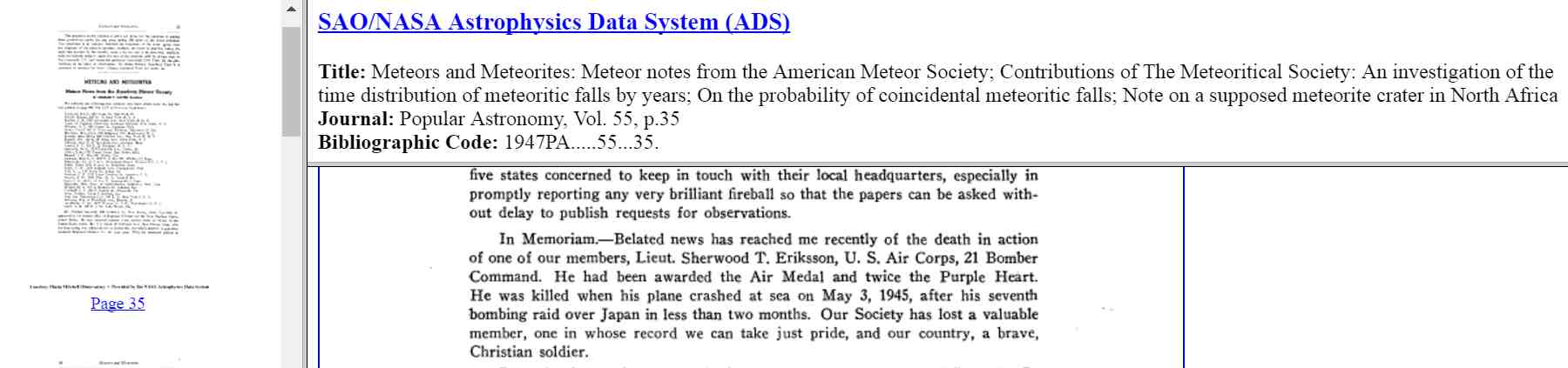
An entry in the January 1947 issue of Popular Astronomy commemorating Sherwood T. Eriksson.