Samuel J. Leyman
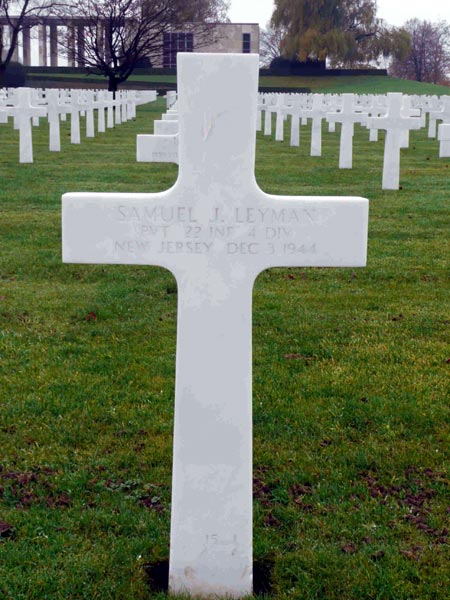
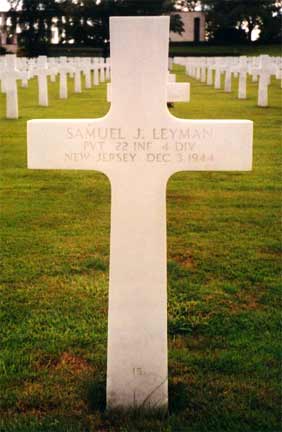
Private Samuel J. Leyman, Serial: 42141834, 22nd Infantry Regiment, 4th Infantry Division, U.S. Army. Awards: Purple Heart. Buried at Henri-Chapelle American Cemetery, Henri-Chapelle, Belgium, Plot C Row 14 Grave 15.
Private Samuel Leyman operated Buddy’s Sandwich Shop at 2001 Federal Street in Camden, where he also lived, with his wife Elizabeth and daughters Anne and Patricia. His next door neighbor, at 2003 Federal Street, was popular Camden political figure Bernard J. “Barney” Tracy. Samuel Leyman also worked for the Camden Board of Education. Shortly after the birth of his daughter Patricia, Samuel Leyman was inducted into the United States Army, in May of 1944.
Private Leyman was sent overseas in October of that year, and assigned as a replacement to the 22nd Infantry Regiment, 4th Infantry Division. He was 26 years old when he was killed during the Battle of the Hürtgen Forest on December 3, 1944.
Buddy's Sandwich Shop — St. Joseph's Church Golden Jubilee Yearbook, 1943
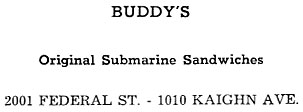
Advertisement for Buddy’s Sandwich Shop, 2001 Federal Street, Camden NJ, from the St. Joseph’s Church 1893–1943 Golden Jubilee Yearbook.
2001 Federal Street, Camden NJ


2001 Federal Street, Camden NJ, December 27, 2003 — formerly the site of Buddy’s Sandwich Shop, operated by Samuel Leyman before his induction.
The 22nd Infantry Regiment in the Hürtgen Forest

Shoulder sleeve insignia of the 4th Infantry Division.
On 16 November 1944, the 4th Infantry Division attacked into the Hürtgen Forest as one of ten divisions participating in a combined offensive by First and Ninth U.S. Armies to close to the Rhine River.
As one of the infantry regiments of the 4th Division, the 22nd Infantry spent eighteen days in November and early December 1944 in the Hürtgen Forest. In a battle many believed mattered little in the big picture, the 22nd suffered 2,773 casualties, or 85 percent of its normal complement of 3,257 soldiers to take one village and 6,000 yards of forest. Each rifle company went into the action averaging 162 soldiers. Seven days later the rifle companies averaged eighty-seven men, of whom 42 percent were replacements who had arrived during the battle. By the end of the battle, losses in the rifle companies reached an estimated average of 151 percent of their original strength.
The conditions of the battle negated the impact of American superiority in aviation and armor and made the battle an infantryman’s fight from beginning to end. Although massive amounts of artillery fire assisted the forward movement of the regiment, the infantry still had to take the ground.
The 22nd was neither poorly trained nor poorly led. Lieutenant General J. Lawton Collins, the VII Corps Commander and later Chief of Staff of the Army, considered the 22nd one of the premier infantry regiments in the ETO. By all accounts, the regiment’s commander, Colonel Charles T. Lanham, and his battalion commanders were effective leaders. They did what they could to influence the battle and their attempts to turn the German flanks reflected tactical sophistication.
The 22nd Infantry entered the Hürtgen Forest expecting a low-cost success. Instead the regiment fought its way through the woods virtually unsupported in a battle of attrition against three German divisions and elements of two others. Although the 22nd suffered more casualties than any other regiment in the Hürtgen, it lost no ground not immediately recovered. The last days of the battle saw fresh German battalions breaking through decimated companies of the 22nd, only to be cut off, killed or captured by other equally attrited companies rushed into the breach. During the battle the 22nd captured 764 Germans.
December 3 — German Counterattack and Relief of the 22nd: Early in the morning before the relief begins, one of the 1st Battalion companies is hit by a newly committed German battalion of the 272nd Volksgrenadier Division. Only 25 Germans penetrate the line, and these are rounded up by headquarters elements of the three rifle companies and the weapons company. The German Luftwaffe sorties and about thirty aircraft strafe and bomb the regiment’s positions, but cause few casualties. The relief continues into the night and the regiment pulls out towards its next assignment in Luxembourg on 4 December. Casualties: 76. Another 80 casualties were reported on 4 December after headcounts were made at the new location. After 18 days the battle in the Hürtgen Forest was over for the 22nd. During the battle, every rifle battalion and company commander was lost, with two companies losing four commanders and another six. At the roll call in Luxembourg, each rifle company had fewer than ten soldiers who had begun the battle on 16 November.
— Extracted from Paschendale with Treebursts: The 22nd Infantry Regiment’s Experience in the Hürtgen Forest, 16 November through 03 December 1944, by Robert S. Rush.