Robert Peacock
ROBERT “BOB” PEACOCK was well-known in Camden in the 1900s as a bartender and as a quoits player. He worked for several years at William “Billy” Moore’s bar at 550 Federal Street, and also for Owen Kernan at 601 Pearl Street.
Robert Peacock does not appear in the 1910 Camden City Directory or 1910 Census in Camden. By December of 1911 he had moved to Atlantic City, New Jersey. He was working as a bartender when he was fatally injured in a confrontation with a customer. Thomas Clark was charged with manslaughter and was acquitted, with the jury having to deliberate for only five minutes.
Ed Welsh and Bob Peacock
Camden Post-Telegram —

Ed Welsh and Bob Peacock are now located with Owen Kernan at Sixth and Pearl, and business is on the boom.
Waited Here for Alleged Slayer
Camden Post-Telegram —
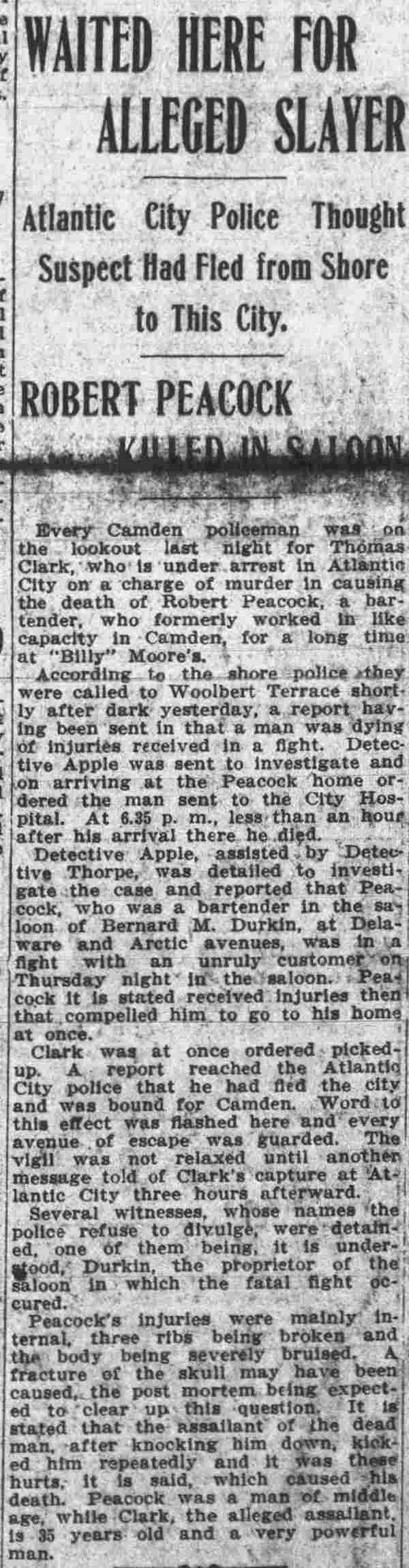
Every Camden policeman was on the lookout last night for Thomas Clark, who is under arrest in Atlantic City on a charge of murder in causing the death of Robert Peacock, a bartender, who formerly worked in like capacity in Camden, for a long time at “Billy” Moore’s.
According to the shore police they were called to Woolbert Terrace shortly after dark yesterday, a report having been sent in that a man was dying of injuries received in a fight. Detective Apple was sent to investigate and on arriving at the Peacock home ordered the man sent to the City Hospital. At 6.35 p.m., less than an hour after his arrival there he died.
Detective Apple, assisted by Detective Thorpe, was detailed to investigate the case and reported that Peacock, who was a bartender in the saloon of Bernard M. Durkin, at Delaware and Arctic avenues, was in a fight with an unruly customer on Thursday night in the saloon. Peacock it is stated received injuries then that compelled him to go to his home at once.
Clark was at once ordered picked up. A report reached the Atlantic City police that he had fled the city and was bound for Camden. Word to this effect was flashed here and every avenue of escape was guarded. The vigil was not relaxed until another message told of Clark’s capture at Atlantic City three hours afterward.
Several witnesses, whose names the police refuse to divulge, were detained, one of them being, it is understood, Durkin, the proprietor of the saloon in which the fatal fight occurred.
Peacock’s injuries were mainly internal, three ribs being broken and the body being severely bruised. A fracture of the skull may have been caused, the post mortem being expected to clear up this question. It is stated that the assailant of the dead man, after knocking him down, kicked him repeatedly and it was these hurts, it is said, which caused his death. Peacock was a man of middle age, while Clark, the alleged assailant, is 35 years old and a very powerful man.
Holds Negro for Peacock’s Death
Camden Post-Telegram —
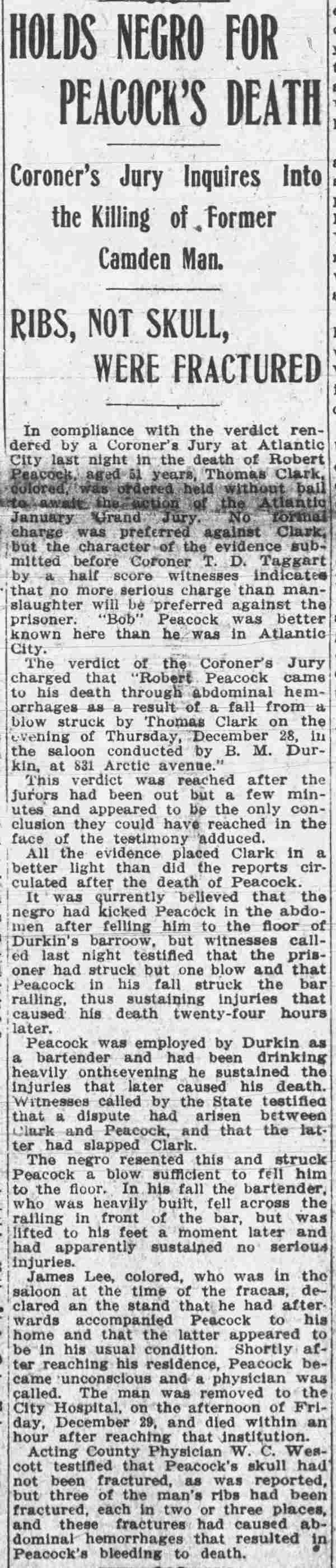
In compliance with the verdict rendered by a Coroner’s Jury at Atlantic City last night in the death of Robert Peacock, aged 51 years, Thomas Clark, colored, was ordered held without bail to await the action of the Atlantic January Grand Jury. No formal charge was preferred against Clark, but the character of the evidence submitted before Coroner T. D. Taggart by a half score witnesses indicates that no more serious charge than manslaughter will be preferred against the prisoner. “Bob” Peacock was better known here than he was in Atlantic City.
The verdict of the Coroner’s Jury charged that “Robert Peacock came to his death through abdominal hemorrhages as a result of a fall from a blow struck by Thomas Clark on the evening of Thursday, December 28, in the saloon conducted by B. M. Durkin, at 831 Arctic avenue.”
This verdict was reached after the jurors had been out but a few minutes and appeared to be the only conclusion they could have reached in the face of the testimony adduced.
All the evidence placed Clark in a better light than did the reports circulated after the death of Peacock.
It was currently believed that the negro had kicked Peacock in the abdomen after felling him to the floor of Durkin’s barroom, but witnesses called last night testified that the prisoner had struck but one blow and that Peacock in his fall struck the bar railing, thus sustaining injuries that caused his death twenty-four hours later.
Peacock was employed by Durkin as a bartender and had been drinking heavily on the evening he sustained the injuries that later caused his death. Witnesses called by the State testified that a dispute had arisen between Clark and Peacock, and that the latter had slapped Clark.
The negro resented this and struck Peacock a blow sufficient to fell him to the floor. In his fall the bartender, who was heavily built, fell across the railing in front of the bar, but was lifted to his feet a moment later and had apparently sustained no serious injuries.
James Lee, colored, who was in the saloon at the time of the fracas, declared on the stand that he had afterwards accompanied Peacock to his home and that the latter appeared to be in his usual condition. Shortly after reaching his residence, Peacock became unconscious and a physician was called. The man was removed to the City Hospital, on the afternoon of Friday, December 29, and died within an hour after reaching that institution.
Acting County Physician W. C. Wescott testified that Peacock’s skull had not been fractured, as was reported, but three of the man’s ribs had been fractured, each in two or three places, and these fractures had caused abdominal hemorrhages that resulted in Peacock’s bleeding to death.
Free Clark of Blame in Death of Peacock
Camden Post-Telegram —
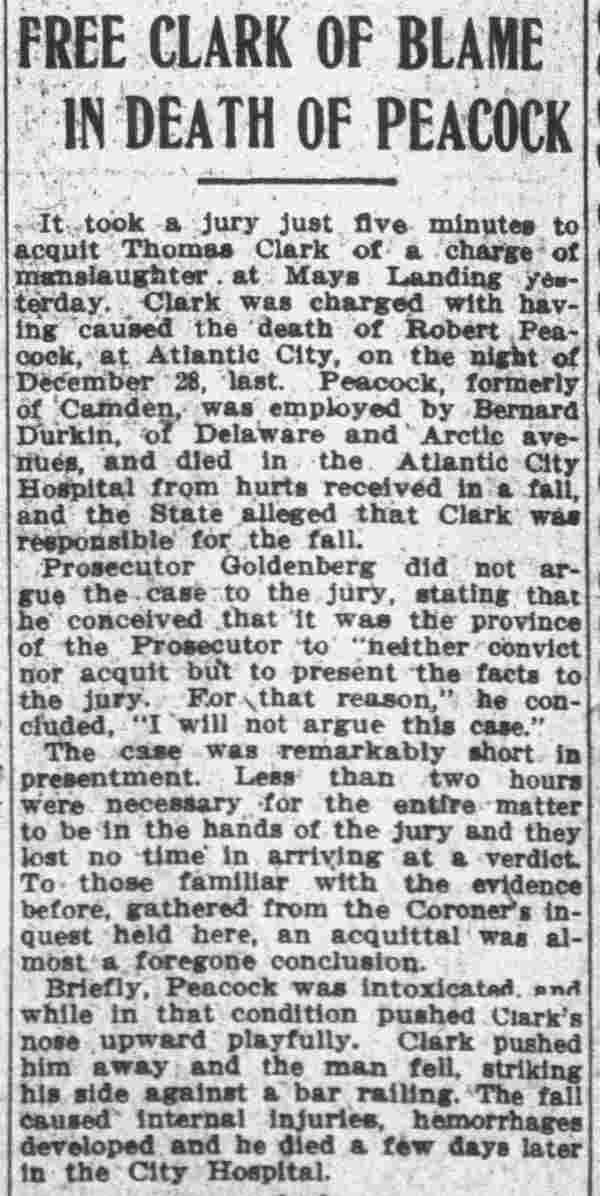
It took a jury just five minutes to acquit Thomas Clark of a charge of manslaughter at Mays Landing yesterday. Clark was charged with having caused the death of Robert Peacock, at Atlantic City, on the night of December 28, last. Peacock, formerly of Camden, was employed by Bernard Durkin, of Delaware and Arctic avenues, and died in the Atlantic City Hospital from hurts received in a fall, and the State alleged that Clark was responsible for the fall.
Prosecutor Goldenberg did not argue the case to the jury, stating that he conceived that it was the province of the Prosecutor to “neither convict nor acquit but to present the facts to the jury. For that reason,” he concluded, “I will not argue this case.”
The case was remarkably short in presentment. Less than two hours were necessary for the entire matter to be in the hands of the jury and they lost no time in arriving at a verdict. To those familiar with the evidence before, gathered from the Coroner’s inquest held here, an acquittal was almost a foregone conclusion.
Briefly, Peacock was intoxicated, and while in that condition pushed Clark’s nose upward playfully. Clark pushed him away and the man fell, striking his side against a bar railing. The fall caused internal injuries, hemorrhages developed and he died a few days later in the City Hospital.