Robert Hanley
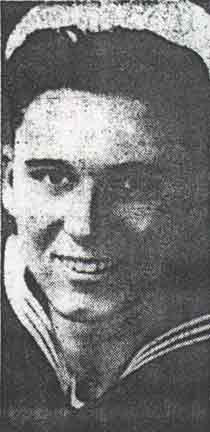
Robert Hanley, Signalman First Class, U.S. Navy.
Signalman First Class • U.S. Navy • Serial 02439602
USS Liscombe Bay (CVE-56)
Entered service from New Jersey • Died November 24, 1943
Missing in action or buried at sea — Tablets of the Missing at Honolulu Memorial, Honolulu, Hawaii
Awards: Purple Heart
Introduction
Signalman First Class Robert Hanley was the son of Mr. and Mrs. John Hanley. The Hanleys lived at 409 Haakon Road in Brooklawn, NJ. Robert Hanley was a student at Gloucester High School in Gloucester City, NJ, before enlisting in the United States Navy at the age of 17. In April of 1943 he was selected to become one of the crew of the new escort carrier USS Liscombe Bay (CVE-56).
The Liscombe Bay had an interesting history. On December 9, 1943, the keel was laid for this carrier, the second built at Vancouver, WA. She was launched on April 19 as the HMS Ameer and was intended to become a part of the British fleet. Her sponsor was Mrs. Benjamin Morrell, wife of Admiral Morrell, chief of the Bureau of Stocks and Yards. Before delivery, however, the Ameer was turned over to the U.S. Navy and her name changed to the USS Liscombe Bay.
The Liscombe Bay was torpedoed by the Japanese submarine I-175 off of Makin Island in the Gilbert Islands on November 24, 1943. The Liscombe Bay was taking part in Operation Galvanic, the seizure of Makin and Tarawa Atolls in the Gilbert Islands. Liscombe Bay’s aircraft supported operations ashore between November 20–23, 1943. At 5:10 AM, while cruising near Butaritari Island, a single torpedo from Japanese submarine I-175 struck the escort carrier aft of the machinery space, near the stern. The aircraft bomb magazine detonated a few moments later, followed by other explosions as the fire reached ammunition storage. With her hangar decks ablaze, the fantail gone, and a portion of the after starboard side blown away, the once-mighty carrier turned in the water and sank by the stern within minutes.
So violent were the blasts that hundreds of the carrier’s personnel were trapped below decks and killed as they attempted to escape. In an outstanding act of heroism, Lt. Commander Bizz Carroll, damage control officer, led at least a dozen men to safety, although he himself was mortally wounded. Among the dead were the carrier’s skipper, Capt. Irving D. Wiltsie, and Rear Admiral Henry M. Mullinix aboard the ship as a task force commander. Also lost was Medal of Honor recipient Ships Cook Third Class Doris “Dorie” Miller, a hero of Pearl Harbor. Only 272 sailors survived the sinking of Liscombe Bay, while 646 died.
Robert Hanley last wrote home in a letter posted on November 13, 1943. He was a veteran of seven campaigns against the Japanese. Listed as missing following the loss of the carrier, he was officially presumed dead on November 25, 1944, a year and a day after the loss of Liscombe Bay. Besides his parents, he was survived by two brothers, Howard, who served in the Navy, and Robert, who entered the Army late in 1943.