Richard Rourke
Richard Rourke was born in Ireland around 1820. By 1855 he had come to America and was living in Pennsylvania with his wife Mary and infant daughter Emily. The family remained in Pennsylvania through 1861, with three more children coming, Joseph, Owen, and Mary. By 1866 the family had moved to New Jersey and had been blessed with another child, Annie. A sixth child would come in 1869, Nicholas. The 1870 Census shows the family living in Camden’s South Ward. Richard Rourke was then working as a laborer. The 1872 City Directory shows him at 809 Locust Street. The family moved to 708 South 2nd Street not long after the compilation of the 1872 Directory.
By December of 1873 Richard Rourke had obtained employment as a watchman at the Pennsylvania Railroad roundhouse at the foot of Mickle Street. He was fatally injured on December 23, 1873 when the boiler of Engine 688 exploded. Mary Roarke and her children stayed in South Camden after the accident. She was still alive as late as 1893.
Railway Accident
New York Daily Graphic —
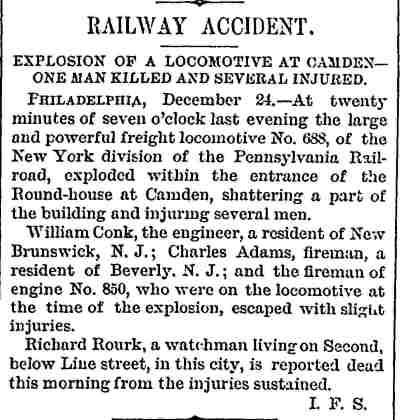
Explosion of a Locomotive at Camden—One Man Killed and Several Injured.
Philadelphia, December 24.—At twenty minutes of seven o’clock last evening the large and powerful freight locomotive No. 688, of the New York division of the Pennsylvania Railroad, exploded within the entrance of the Round-house at Camden, shattering a part of the building and injuring several men.
William Conk, the engineer, a resident of New Brunswick, N. J.; Charles Adams, fireman, a resident of Beverly, N. J.; and Elias —, the fireman of engine No. 850, who were on the locomotive at the time of the explosion, escaped with slight injuries.
Richard Rourk, a watchman living on Second, below Line street, in this city, is reported dead this morning from the injuries sustained.
I. F. S.
Died of His Injuries
Philadelphia Inquirer —
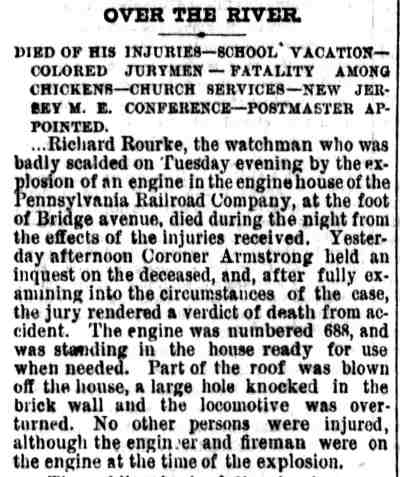
…Richard Rourke, the watchman who was badly scalded on Tuesday evening by the explosion of an engine in the engine house of the Pennsylvania Railroad Company, at the foot of Bridge avenue, died during the night from the effects of the injuries received. Yesterday afternoon Coroner Armstrong held an inquest on the deceased, and, after fully examining into the circumstances of the case, the jury rendered a verdict of death from accident. The engine was numbered 688, and was standing in the house ready for use when needed. Part of the roof was blown off the house, a large hole knocked in the brick wall and the locomotive was overturned. No other persons were injured, although the engineer and fireman were on the engine at the time of the explosion.
Fatal Accident
New York Herald —
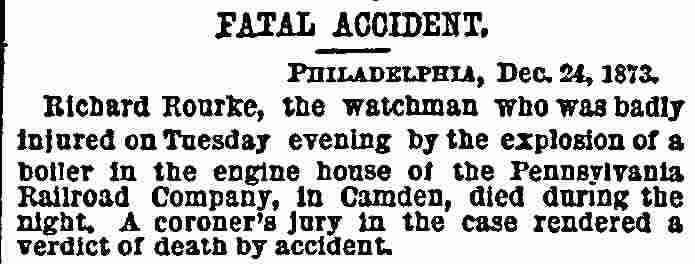
Philadelphia, Dec. 24, 1873. Richard Rourke, the watchman who was badly injured on Tuesday evening by the explosion of a boiler in the engine house of the Pennsylvania Railroad Company, in Camden, died during the night. A coroner’s jury in the case rendered a verdict of death by accident.
Fatal Results of a Locomotive Explosion
Camden Democrat —
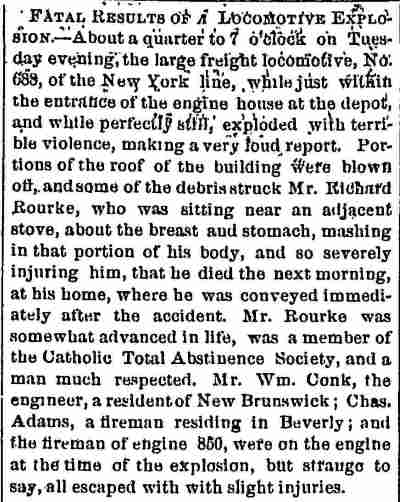
About a quarter to 7 o’clock on Tuesday evening, the large freight locomotive, No. 688, of the New York line, while just within the entrance of the engine house at the depot, and while perfectly still, exploded with terrible violence, making a very loud report. Portions of the roof of the building were blown off, and some of the debris struck Mr. Richard Rourke, who was sitting near an adjacent stove, about the breast and stomach, mashing in that portion of his body, and so severely injuring him, that he died the next morning, at his home, where he was conveyed immediately after the accident. Mr. Rourke was somewhat advanced in life, was a member of the Catholic Total Abstinence Society, and a man much respected. Mr. Wm. Conk, the engineer, a resident of New Brunswick; Chas. Adams, a fireman residing in Beverly; and the fireman of engine 850, were on the engine at the time of the explosion, but strange to say, all escaped with slight injuries.
Terrific Explosion of a Locomotive
Camden New Republic —
Several Persons Injured.
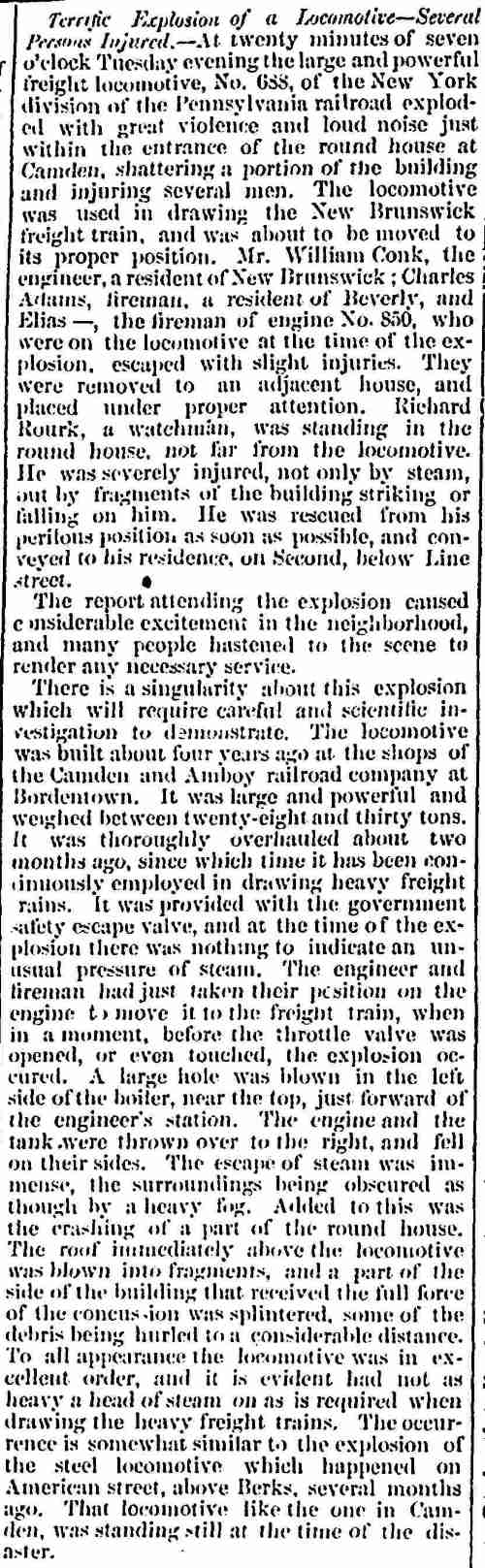
At twenty minutes of seven o’clock Tuesday evening the large and powerful freight locomotive, No. 688, of the New York division of the Pennsylvania railroad exploded with great violence and loud noise just within the entrance of the round house at Camden, shattering a portion of the building and injuring several men. The locomotive belonged to the New Brunswick freight train, and was about to be moved to its proper position. Mr. William Conk, the engineer, a resident of New Brunswick; Charles Adams, fireman, a resident of Beverly, and Elias —, the fireman of engine 850, who were on the locomotive at the time of the explosion, escaped with slight injuries. They were removed to an adjacent house, and placed under proper attention. Richard Rourke, a watchman who was standing in the round house, not far from the locomotive. He was severely injured, not only by steam, but by fragments of the building striking or falling on him. He was rescued from his dangerous position as soon as possible, and conveyed to his residence, on Second, below Line street.
The report attending the explosion caused considerable excitement in the neighborhood, and many people hastened to the scene to render any necessary service.
There is a singularity about this explosion which will require careful and scientific investigation to demonstrate. The locomotive was built about four years ago at the shops of the Camden and Amboy railroad company at Bordentown. It was large and powerful and weighed between twenty-eight and thirty tons. It had been carefully overhauled about six months ago, since which time it has been continuously employed in drawing heavy freight rains. It was provided with the government safety escape valve, and at the time of the explosion was not known to be running at the usual pressure of steam. The engineer and fireman had just taken their position on the engine to move it to the freight train, when in a moment, before the throttle valve was opened, or even touched, the explosion occurred. A large hole was blown in the left side of the boiler, near the top, just forward of the engineer’s station. The engine and tank were thrown over to the right, and fell against the building. The smoke was immense, the surroundings being obscured as though by a heavy fog. Added to this was the crashing of a part of the round house. The roof immediately above the locomotive was shattered into fragments, and the outside of the building that received the full force of the concussion was splintered, and some of the debris being hurled to a considerable distance. The locomotive had lately been placed in excellent order, and it is evident had not as heavy a head of steam on as is required when drawing the heavy freight trains. The occurrence is somewhat similar to the explosion of a locomotive at the Camden & Amboy depot, American street, above Berks, several months ago. That locomotive like the one in Camden, was standing still at the time of the disaster.
Fatal Result.
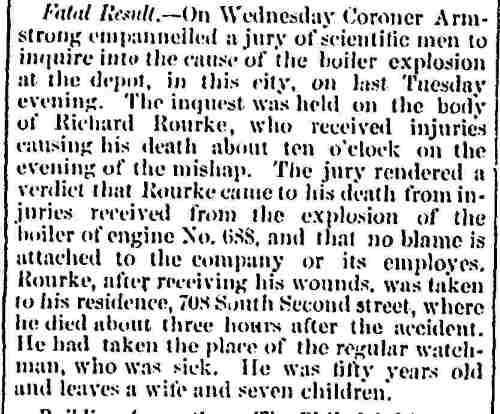
On Wednesday Coroner Armstrong empanneiled a jury of scientific men to inquire into the cause of the boiler explosion at the depot, in this city, on last Tuesday evening. The inquest was held on the body of Richard Rourke, who received injuries causing his death about ten o’clock on the evening of the mishap. The jury rendered a verdict that Rourke came to his death from injuries received from the explosion of the boiler of engine No. 688, and that no blame is attached to the company or its employes. Rourke, after receiving his wounds, was taken to his residence, 708 South Second street, where he died about three hours after the accident. He had taken the place of the regular watchman, who was sick. He was fifty years old and leaves a wife and seven children.
West Jersey Press — December 31, 1873
West Jersey Press — December 31, 1873
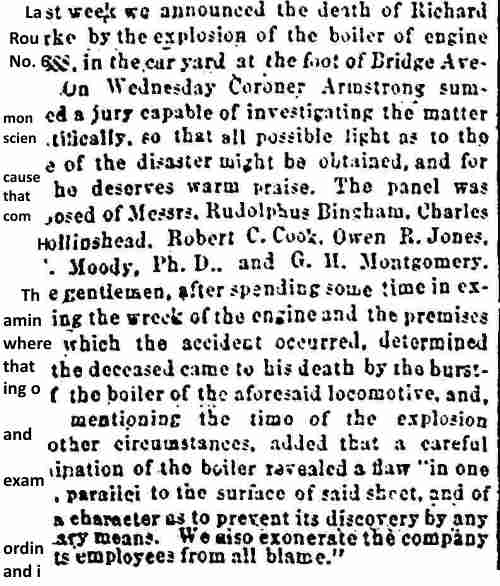
Last week we announced the death of Richard Rourke by the explosion of the boiler of engine No. 688, in the car yard at the foot of Bridge Avenue.
On Wednesday Coroner Armstrong summoned a jury capable of investigating the matter scientifically, so that all possible light as to the cause of the disaster might be obtained, and for that he deserves warm praise. The panel was composed of Messrs. Rudolphus Bingham, Charles Hollinshead, Robert C. Cook, Owen R. Jones, J. Moody, Ph. D., and G. H. Montgomery.
The gentlemen, after spending some time in examining the wreck of the engine and the premises where the accident occurred, determined that the deceased came to his death by the bursting of the boiler of the aforesaid locomotive, and, mentioning the time of the explosion and other circumstances, added that a careful examination of the boiler revealed a flaw “in one parallel to the surface of said sheet, and of a character as to prevent its discovery by any ordinary means. We also exonerate the company and its employees from all blame.”