Ralph H. Dunn
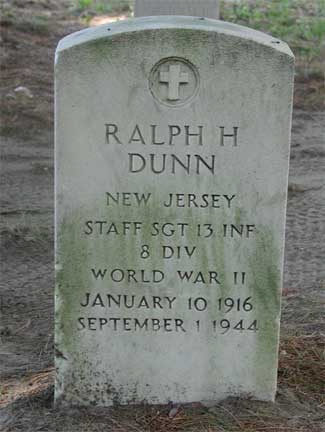
Ralph H. Dunn
Staff Sergeant, U.S. Army
Serial: 32080866
Company E, 13th Infantry Regiment, 8th Infantry Division
Entered the Service from: New Jersey
Died: September 1, 1944
Buried at: Plot I O 212
Beverly National Cemetery, Beverly, New Jersey
Awards: Purple Heart
Introduction
Staff Sergeant Ralph H. Dunn was born in Philadelphia, Pennsylvania on January 10, 1916. He eventually moved to Camden, New Jersey, where he lived with his parents at 134 North 32nd Street. He was inducted into the Army in April 1941 and went overseas in December 1943. Ralph H. Dunn was killed in action while serving with Company E of the 13th Infantry Regiment, 8th Infantry Division on September 1, 1944. He was survived by his parents, three sisters, and two brothers. He was brought home after the war ended and was buried at Beverly National Cemetery in Beverly, New Jersey on July 10, 1948.
The 8th Infantry Division in World War II
Origins and Training
The 8th Infantry Division was reactivated July 1, 1940, at Fort Jackson, South Carolina under the command of Brig. General James I. Muir. Within a short time the Division moved to Fort Moultrie, South Carolina and its sub-posts of Fort Sumter, Fort Johnson, and Sullivan’s Island in Charleston Harbor. The period at Moultrie was one of intensive training for the numerous recruits who were entering the ranks of the Division through Selective Service. The Division then moved to Camp Jackson, South Carolina for the Carolina Maneuvers, following which it returned to Fort Jackson, South Carolina in November 1941.
When this country was plunged into World War II by the Japanese attack on Pearl Harbor, the 8th Division began its movement to Camp Forrest, Tennessee on December 9, 1941, where during the winter of 1941–1942, it engaged in intensive training activities and contributed large numbers of its men as cadres for newly activated divisions. In the fall of 1942, the Division moved to Camp Polk, Louisiana, and participated in the Louisiana Maneuvers. Elements of the Division performed guard duty along the coastline to prevent enemy submarine operations and possible enemy landings. The Division returned to Camp Polk, Louisiana and engaged in intensive training activities until the spring of 1943, when it moved to Camp Forrest, Tennessee for additional training.
In August 1943, Division units were moved to Camp Shanks, New York for staging. Sailing from New York August 6 1943, the Division arrived in Northern Ireland on August 14th. Division Headquarters was established at Omagh, County Tyrone.
Normandy — D-Day
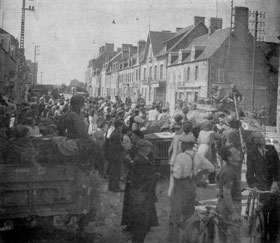
Men of the 8th Division in Normandy
In Great Britain, training continued through the spring and early summer of 1944. On D-Day June 6, 1944, elements of the Division assisted in the assault by providing personnel as coxswains. Shipping under cover of darkness, the main elements of the Division landed on Utah Beach Normandy, France, on July 3–4, 1944.
Battle-Tried
After moving to an assembly area northeast of Carentan, the Division was committed to combat near Pretot on July 4th. When it entered action for the first time, the Division drove south from the Carentan-Periers highway to take its objective on the west bank of the Seves River, meeting fierce German resistance. Elements of the Division successfully seized their objectives, crossing the River at Seves Island despite murderous enemy small arms, machine gun, and mortar fire, and while suffering considerable casualties.
Casualties throughout the action were heavy, as might be expected among troops in combat for the first time. The Assistant Division Commander, Brigadier General Nelson Walker, was seriously wounded while at the front, during the second day of action. He died early the following morning. Maj. James P. Mallory assumed command of the 2nd Bn. 121st Infantry that spearheaded the attack of that regiment until he was killed in action. Lt. Colonel Augustine D. Dugan, battalion commander of the 121st infantry, though seriously wounded, refused to be evacuated until the action had ended. On July 11, the Division Commander, Maj. General William C. McMahon was succeeded by Brig. General Donald A. Stroh. Shortly after this, Colonel John R. Jeter and Kenneth B. Anderson succeeded Colonels Albert H. Peyton and Lester A. Webb as regimental commanders of the 121st and 28th Infantry respectively.
During the following eleven days, the Division continued to hold its position, waiting for the VIII Corps under which would begin a new general offensive. Artillery continued to shell enemy positions across the Ay River. Air bombardment leveled numerous German strongpoints. At night, Division Artillery lifted its fire to allow patrols to reconnoiter south of the River and to clear gaps in enemy mine fields. The 709th Tank Battalion and the 644th Tank Destroyer Battalion were attached to the Division. Members of the 8th Division Band became combatants, serving as military police or signal company linesman during the period of fighting.
Each night, shortly after darkness, the enemy sent over lone aircraft, usually reconnaissance planes, which attempted to detect troop movements by dropping flares. Occasionally there were also strafing attacks. Enemy artillery continued to harass the troops, and on one occasion it became necessary to shift the Division command post to avoid the nightly shelling.
The Ay River
Finally, after several tentative dates for the offensive had been announced and subsequently cancelled, the attack was set for 0530, July 26. The line of the Ay River, from its mouth to the bridge at Lessay, was so swampy and so strongly defended that an advance southward by the 79th Division, which held this sector, was impossible. The Lessay bridge had been destroyed, and the only ford crossing the River was so heavily mined and covered by hostile machine gun fire that it could not be used.
Similarly, along the eastern flank of the line, the sector of the 90th Division, the ground was swampy and strongly held by the Germans. On the entire Corps front, only a segment in the center, approximately two kilometers in width, was practicable for an attack. This was the front of the 8th Division.
The VIII Corps plan of attack was to have the 8th Division push forward, overcome the strong enemy defenses to the south, and established a bridgehead between the south bank of the Ay River and the Lessay Perier railway. The 79th Division was to follow the 8th through this gap, fan out to the southwest, and take out the German defenses along the western sector of the river line from the flank.
Similarly, the 90th Division was to take advantage of the breakthrough by the 8th Division, by-pass the German strongpoints to the east, and continue to attack to the southeast. The success of the entire Corps attack depended on the ability of the 8th Division to break through the German defenses.
Breakthrough
Both assaulting regiments, the 28th and 121st, jumped off as scheduled. The enemy established an observation post in the tower of a church which afforded observation of most of the Division sector of advance. Requests for air bombardment of the church were denied. Corps and Division Artillery fired on the tower for two days before it was finally relinquished by the enemy.
The 28th, attacking with the 1st and 2nd Battalions forward, met resistance immediately. As it advanced, its front lines became irregular, and it was necessary to halt for reorganization. A second attack penetrated the enemy’s defensive position, and the 28th reached the Lessay-Periers road, making untenable the entire enemy position across the Corps front. (For their part in this action, the 1st and 2nd Battalions of the 28th Infantry have been recommended for the Presidential Citation.)
The 121st Infantry reported no resistance initially, but in the afternoon it was evident that the report was overly optimistic. One battalion had actually been pushed back across the Ay River to the original line of departure. It was planned that on the following day the 28th Infantry would hold its position until the 121st came abreast. At this time both regiments were to attack again.
The plan was carried out. The 121st, meeting little resistance, came abreast of the 28th at 1400 that afternoon. At 1500, the coordinated attack began, and the only resistance encountered was light artillery and mortar fire, and heavy mine fields. This day was the beginning of the mass retreat of the German Seventh Army.
The mission of the 8th Division had been completely accomplished. The 79th and 90th Divisions followed through the gap in the enemy lines, fanned out to the west and east respectively, and joined in the pursuit of the fleeing enemy. American Armor drove into the breakthrough area created by the infantry elements and began lightning thrusts through Brittany and Eastern France, which were to sweep beyond Paris to the frontiers of Germany.
Pursuit
Resuming the advance on the morning of July 28th, the 8th Division proceeded rapidly against light resistance, until it had taken all objectives. In the days immediately following, pursuit of the enemy continued. The 4th and 6th Armored Divisions had passed through the VIII Corps sector. Closely following them, in route column, was the 8th Division. South through Coutances, and Avranches the march continued, until the Division, less Combat Team 13, reached an assembly area southeast of Avranches. The 445th Anti-Aircraft Artillery Battalion, attached to the Division, assisted the advance by protecting the advancing columns from air attack. Combat Team 13, which had been motorized and attached to the 4th Armored Division, was sent ahead to secure the towns of La Jourdaniere and La Mourdraquiere. It rejoined the Division in the assembly area on August 1st.
During the following days, the Division continued to move southward, clearing out small pockets of resistance and securing road nets and vital installations along the route of march. Combat Team 13 was again attached to the 4th Armored Division on August 2nd, and transported south to St. Aubin D’Aubigne, eleven miles north of Rennes. By nightfall of August 3rd, the 8th Division, less Combat Team 13, had reached St. James.
On the morning of August 4th, the Division continued the movement by motor. Combat Team 13, having reached St. Aubin D’Aubigne, and discovering that the enemy had withdrawn from Rennes, passed through that city and occupied the heights south of it. By 1100, the situation was so favorable that the Division Commander ordered the remaining elements of the Division to move to an assembly area near Betten, slightly northeast of Rennes. By 2200, outposts were set up defending all roads and railroads leading into the city.
Until August 13th, the 8th Division, less the 121st Infantry, which remained near St. James under VIII Corps control, continued its mission of holding and defending Rennes. During this period, it maintained road blocks, cleared rubble and obstacles from the streets, and engaged in extensive patrolling. Although some prisoners were taken, no contact was made with organized enemy forces. On August 8th, the 1st Battalion, 28th Infantry, was attached to the 6th Armored Division, operating in the direction of Brest.
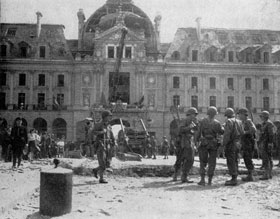
French civilians and men of the 8th Division look at the damage caused during the liberation of Rennes, France from German yoke.
121st Takes Dinard
The 121st Infantry, under VIII Corps control, was attached, on August 6th, to the 83rd Infantry Division, and immediately began movement by motor to Dinard. Near Tremereuc, on the following day, it encountered determined resistance. Road blocks and heavy machine gun fire forced the Regiment to detruck and fight its way forward. Scarcely was the attack underway when the enemy showed that he was prepared to offer the most determined resistance. From concrete pillboxes, protected by formidable tank obstacles and numerous minefields and barbed wire entanglements, the Germans fought back. Enemy mortar and machine gun fire was severe, and several tanks were encountered.
On August 9th, the 3rd Battalion was cut off from the Regiment. For three days it withstood almost incessant artillery bombardment and repeated attempts by the enemy to annihilate it, suffering many casualties, but throwing the enemy back every time he attacked. Two artillery liaison planes flew over the position, successfully dropping blood plasma, and then collided in mid air, destroying both planes and killing all occupants. Late in the afternoon of August 12th, contact with the “lost Battalion” was regained. The Regiment then drove through the remaining enemy defenses, occupied Dinard on August 14th, mopped it up on the 15th, and reverted again to 8th Division control.
The Division, meanwhile, had moved to an assembly area near Dinan, where it remained until August 17th. On August 14th, a task force, composed mainly of the 3rd Battalion, 28th Infantry, moved to the Cap Frehel peninsula, farther east in Brittany, to take over positions held by French Forces of the Interior, and reduce the enemy. It was joined on August 15th by the remainder of Combat Team 28. Before noon of that day, the enemy surrendered. Three hundred prisoners were taken.
On August 17th, the remaining elements of the Division began movement to an assembly area near Brest. There, for three days, operations were confined to patrolling. Then, on August 21st, the Division closed into its sector and awaited orders to attack.
Brest
At Brest, an estimated 50,000 enemy troops were trapped within an arc drawn tightly around the city and its port, the second largest in France. The German Commander of the port, Lt. General Hermann Bernhard Ramcke, was a ruthless soldier who had previously led the German airborne invasion of the Island of Crete. He was under direct orders from Adolph Hitler to hold out for at least four months, and had already refused two Allied demands for his surrender. The troops under his command included three German divisions, the 266th, 343rd and 2nd Paratroop, and a number of marine units and labor battalions. The defenses of the old city on the top of the Brittany peninsula were as formidable a series of strongpoints and obstacles as were encountered anywhere in France. They were bolstered by numerous heavy coast artillery guns which had been turned around to fire inland.
The three divisions of the American VIII Corps, the 2nd, 29th and 8th, were assigned to the battle for Brest. Tremendous artillery strength was brought in to assist in the attack. The Corps plan of attack was to use all three divisions to close in on the German defenders from three sides. The 2nd Division was to attack from the northeast; the 29th from the northwest; and the 8th was to make the main effort with a frontal attack from the north.
Attack
Shortly before midnight on August 24th, elements of the 13th and 28th Regiments, on line for the 8th, began infiltrating toward preliminary objectives from which the attack was to jump off. The offensive began shortly after noon of the following day. Before nightfall, an advance of 1200 yards had been made against heavy resistance. The next morning, the attack was resumed. In the face of an enemy deeply entrenched and employing intense small arms automatic weapons, mortar and light artillery fire, only slight gains could be achieved. That night Ralph Dunn wrote home. He wrote that he was eagerly awaiting the day he got to Paris.
Enemy resistance increased during the succeeding three days. After slight advances, the 13th and 28th Infantry Regiments consolidated their gains and strengthened their positions. They repulsed numerous counterattacks and sent out patrols to the south. On August 26th, Lt. Colonel Edmund Fry, commander of the 12th Engineer Combat Battalion was captured by the enemy, only to escape by sea and rejoin his battalion on the Crozon peninsula nineteen days later. On the morning of August 29th, the enemy in the sector of the 3rd Battalion, 28th Infantry, called a truce to evacuate wounded. Previously, two companies of the 2nd Battalion, 28th Infantry, had advanced beyond their adjacent units, been cut off and captured by the Germans. Following the truce, it was found that communications with these two companies had been cut. Several weeks later, after Brest had capitulated, these two companies were freed by men of their own unit from a German prisoner of war enclosure on the Crozon peninsula, south of the harbor of Brest, and returned to their unit.
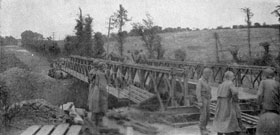
Men of the 12th Combat Engineer Battalion complete a Bailey Bridge over a ravine near Lambzellec, France, on the road to Brest.
On August 30th, Brig. General Stroh was promoted to the rank of Major General. That day and the next, the 8th Division consolidated further small gains and regrouped. The 121st Infantry, which had been in reserve, went forward to relieve the 28th. On August 31st, the 8th prepared for a coordinated Corps attack which was to include also the 2nd Division. A road in the vicinity of the town of Kergroas was the objective.
On the following day, when the attack was begun, this objective was quickly seized. Besides cleaning out strong enemy pockets of resistance in the villagers of Kergroas and Kergaclet, this action materially assisted the 2nd Division in the capture of the town of Fourneuf. Ralph Dunn was killed in action while serving with Company E of the 13th Infantry Regiment, 8th Infantry Division, during this action on September 1, 1944.
Beverly National Cemetery
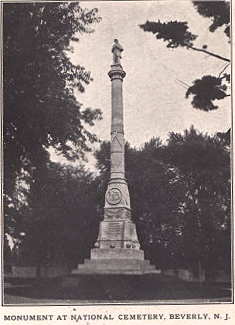
Beverly National Cemetery, Beverly, New Jersey