Norman Nicholson
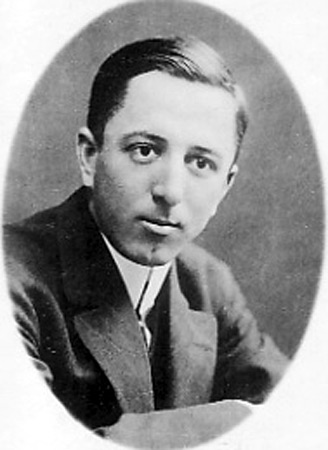
World War I Honor Card
Private, U.S. Army
153rd Depot Brigade
Entered the Service from: New Jersey
Died: October 4, 1918
Buried at: Section E Lot 30 Plot 2 Grave 3
Colestown Cemetery
Church Road & Kings Highway
Cherry Hill NJ
Introduction
Private Norman Nicholson was born May 4, 1890 in Haddonfield NJ, where he lived his entire life until being drafted. When he registered for the draft in June of 1917, he lived at 45 West End Avenue. Norman Nicholson worked in Camden in the real estate office of Wilson & Carr, at North 4th and Market Street. His uncle Howard A. Clement was superintendent of the water department in Haddonfield.
Norman Nicholson was called to the colors on May 27, 1918, and attached to the 153rd Depot Brigade at Camp Dix NJ. Owing to his already impaired health, he was assigned to the camp post office as a clerk. When the Spanish influenza epidemic broke out he was stricken and pneumonia quickly set in. Private Nicholson passed away at Camp Dix on October 4, 1918.
Norman Nicholson was survived by his widowed mother Anna E. Clement Nicholson, older sister Marian Nicholson, uncle Howard A. Clement and his wife Katherine A., all of the West End Avenue address. Norman Nicholson had been a member of the First Presbyterian Church of Haddonfield, which stood at 20 East Kings Highway. He was buried at Colestown Cemetery in Delaware Township (present-day Cherry Hill) NJ.
Honor Roll
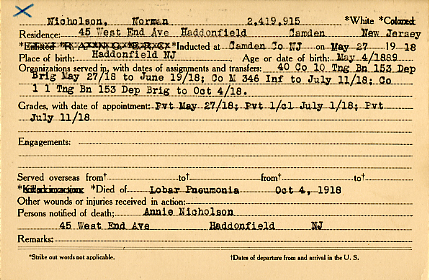
Camden County World War I Honor Roll
Unveiling Ceremony Is Peace Jubilee
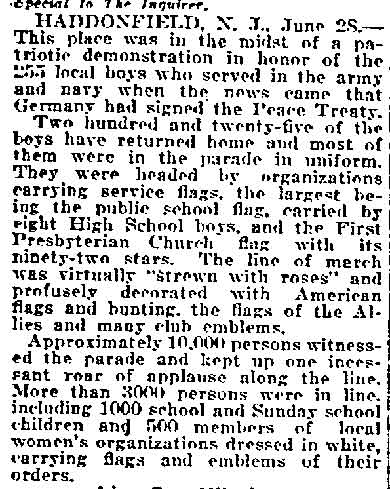
Philadelphia Inquirer —
Haddonfield Honoring Boys When Peace News Reaches Committees in Charge
Governor Runyon Delivers Patriotic Address at Uncovering of Bronze Tablet
HADDONFIELD, N. J., June 28.—This place was in the midst of a patriotic demonstration in honor of the 255 local boys who served in the army and navy when the news came that Germany had signed the Peace Treaty.
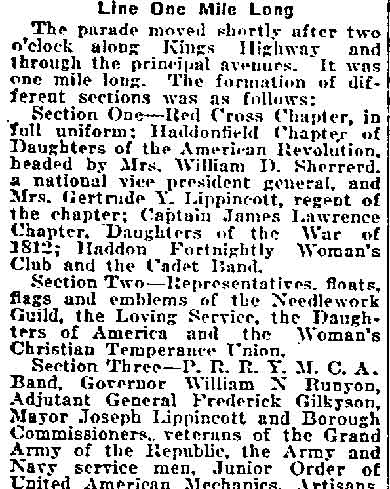
Two hundred and twenty-five of the boys have returned home and most of them were in the parade in uniform. They were headed by organizations carrying service flags, the largest being the public school flag, carried by Big High School boys, and the First Presbyterian Church flag with its twenty-nine stars. The march was virtually “strewn with roses,” and profusely decorated with American flags and bunting, the flags of the Allies and many club emblems.
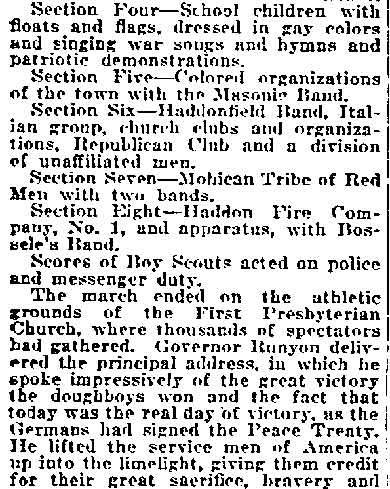
Approximately 10,000 persons witnessed the parade and kept up one incessant roar of applause along the line. More than 4,000 persons were in line, including 1,000 school and Sunday school children and 500 members of local women’s organizations dressed in white, carrying flags and emblems of their orders.
The parade moved shortly after two o’clock along Kings Highway and through the principal avenues. It was one mile long.
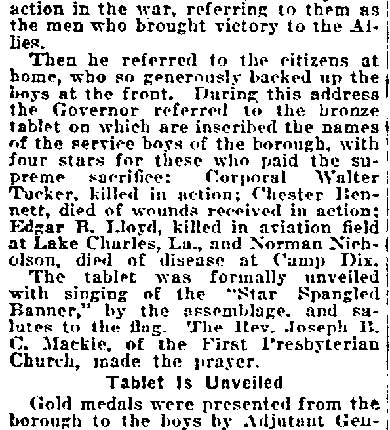
The march ended on the athletic grounds of the First Presbyterian Church, where thousands of spectators had gathered. Governor Runyon delivered the principal address, in which he spoke impressively of the great victory the doughboys won and the fact that today was the real day of victory, as the Germans had signed the Peace Treaty. He lifted the service men of America up into the limelight, giving them credit for their great sacrifice, bravery and action in the war, referring to them as the men who brought victory to the Allies.
Then he referred to the citizens at home, who so generously backed up the boys at the front. During this address the Governor referred to the bronze tablet on which are inscribed the names of the service boys of the borough, with four stars for these who paid the supreme sacrifice: Corporal Walter Tucker, killed in action; Chester Bennett, died of wounds received in action; Edgar B. Lloyd, killed in aviation field at Lake Charles, La., and Norman Nicholson, died of disease at Camp Dix.
The tablet was formally unveiled with singing of the “Star Spangled Banner,” by the assemblage, and salutes to the flag. The Rev. Joseph B. C. Mackie, of the First Presbyterian Church, made the prayer.
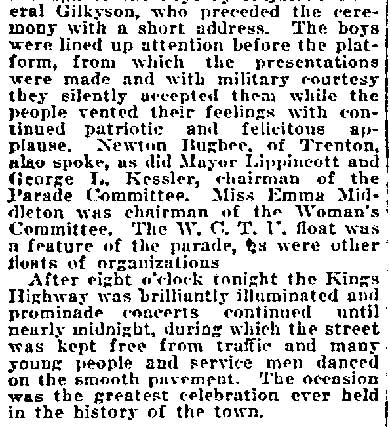
Gold medals were presented from the borough to the boys by Adjutant General Gilkyson, who preceded the ceremony with a short address. The boys were lined up at attention before the platform, from which the presentations were made and with military courtesy they silently accepted them while the people vented their feelings with continued patriotic and felicitous applause. Newton Bugbee, of Trenton, also spoke, as did Mayor Lippincott and George L. Kessler, chairman of the Parade Committee. Miss Emma Middleton was chairman of the Woman’s Committee.
After twilight tonight the Kings Highway was brilliantly illuminated and promenade concerts continued until nearly midnight, during which the street was kept free from traffic and many young people and service men danced on the smooth pavement. The occasion was the greatest celebration ever held in the history of the town.