Nicola Berardo
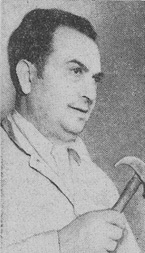
Nicola Berardo — 1939
Nicola Berardo was born in Italy in 1892 to Luigi and Maria Bernardo. His father, a railroad worker, sent him to the Academy of Arts in Naples at the age of 9. When circumstances forced him to leave school at 13, he was able to save a little money and attend the Royal Academy in Rome. At sixteen he emigrated to the United States, joining his uncle Angelo, who lived at 819 Coates Alley in Camden. Once in America, his uncle arranged for him to attend the Academy of Fine Arts in Philadelphia. Nicola Berardo became an American citizen in 1918. By the time of the 1920 Census he had married, and the family, which included a step-daughter, his parents-in-law, and mother-in-law, was living in a rented house at 444 Henry Street. Besides his art studies, Nicola Berardo by this time also owned a shoe shine stand.
Nicola Berardo did well at the Academy, and prospered throughout the 1920s. Besides working as an assistant professor at the Academy, he opened a cleaning and dyeing business, and a shoe repair shop at 20 Haddon Avenue, learning the trade himself from the man he hired to work there. He sold many pieces during this period, which included busts of prominent citizens, such as Wilfred W. Fry. By the time the census was taken again, in April of 1930, Nicola Berardo and family were living at 5801 Westfield Avenue in Pennsauken NJ.
Perhaps the most memorable sculpture that Nicola Berardo executed during this period was a bronze statue of an American Indian chief that was commissioned by the Improved Order of Red Men as a memorial to Camden city and county members who died while serving with America’s armed forces during World War I. Until 1981 this statue stood in a park that was located between Haddon Avenue and South Seventh Street below Benson Street, which is now occupied by the University of Medicine and Dentistry of New Jersey Camden Campus. The statue was moved to a site on Route 9 in Tuckerton NJ, where it stands today.
Nicola Berardo took the money that he made on those and other pieces, about $100,000.00, and invested in real estate. Unfortunately, his fortune was erased when the Depression struck the United States in the fall of 1929. He was left with his shoe repair shop, and forced to pursue the trade that he had unintentionally acquired.
The federally-funded Works Progress Administration provided work for many people in the Arts during the 1930s. Nicola Berardo was hired to teach classes in sculpture. He founded the Camden Academy of the Fine Arts, which he was still operating as late as 1947, at 731 Federal Street. He appears to have passed away by October of 1956. He was survived by his wife, who was still living at 20 Haddon Avenue. Sadly, the Camden Academy of Fine Arts did not survive Nicola Berardo’s passing.
Improved Order of Red Men — World War I Memorial
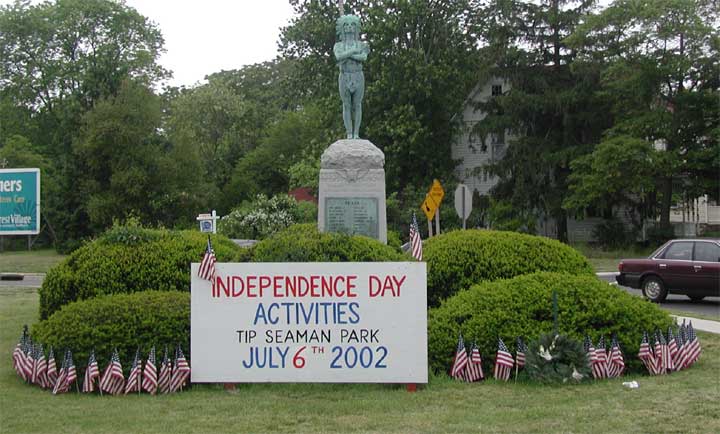
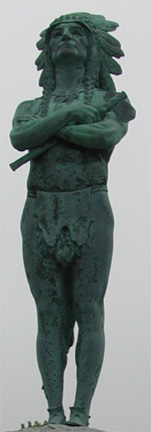
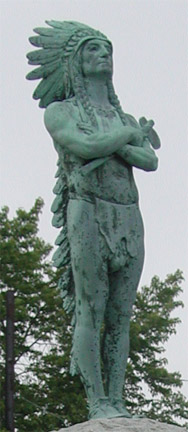
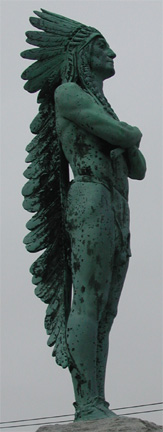
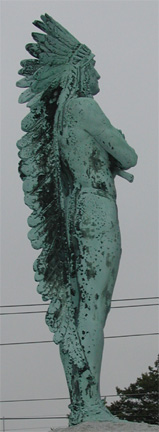
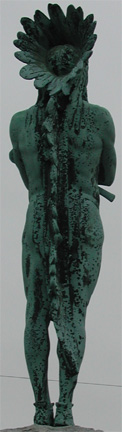
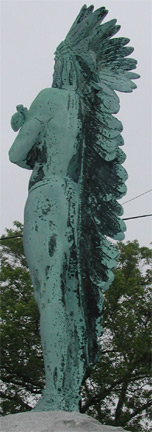
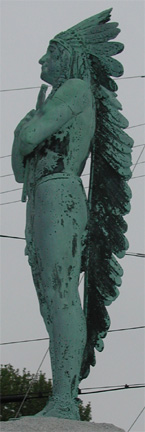
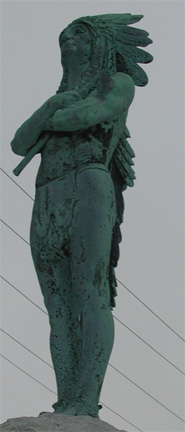
Bronze statue of an American Indian chief, commissioned by the Improved Order of Red Men as a World War I memorial — sculpted by Nicola Berardo — originally located in a park between Haddon Avenue and South 7th Street; moved to Route 9, Tuckerton NJ in 1981
Cleaners Board Camouflaged Code
Camden Courier-Post —

Altman Admits That But Insists Measure Helps Tailors
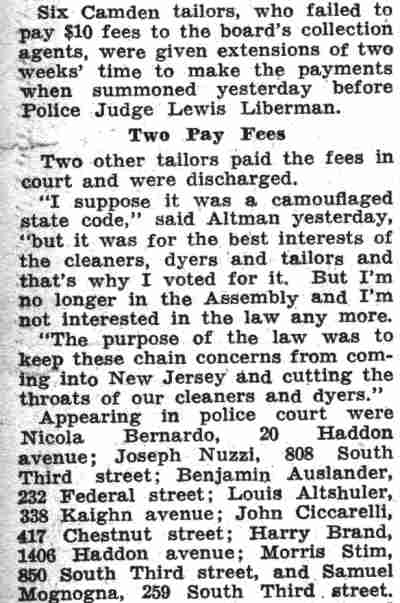
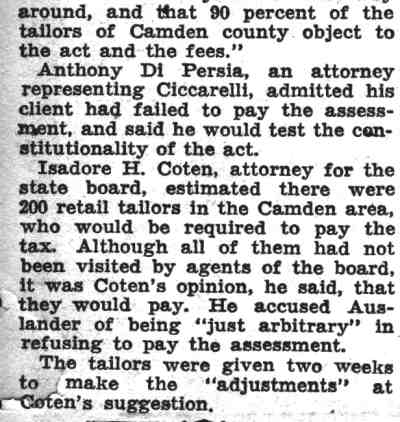
Virtual admission that the law creating the State Board of Cleaners was nothing more than a “camouflaged state code,” was made yesterday by former Assemblyman Joseph Altman, who sponsored the bill.
Altman, now a resident of Atlantic county, made that admission as tailors throughout South Jersey and the state protested against the fee-collecting activities of the state board.
Six Camden tailors, who failed to pay $10 fees to the board’s collection agents, were given extensions of two weeks’ time to make the payments when summoned yesterday before Police Judge Lewis Liberman.
Two Pay Fees
Two other tailors paid the fees in court and were discharged.
“I suppose it was a camouflaged state code,” said Altman yesterday, “but it was for the best interests of the cleaners, dyers and tailors and that’s why I voted for it. But I’m no longer in the Assembly and I’m not interested in the law any more.
“The purpose of the law was to keep these chain concerns from coming into New Jersey and cutting the throats of our cleaners and dyers.”
Appearing in police court were Nicola Bernardo, 20 Haddon avenue; Joseph Nuzzi, 808 South Third street; Benjamin Auslander, 232 Federal street; Louis Altshuler, 338 Kaighn avenue; John Ciccarelli, 417 Chestnut street; Harry Brand, 1406 Haddon avenue; Morris Stim, 850 South Third street, and Samuel Mognogna, 259 South Third street.
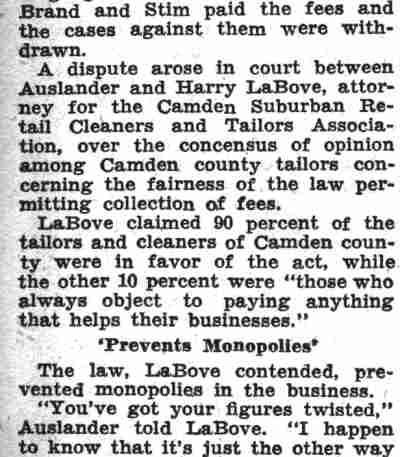
Brand and Stim paid the fees and the cases against them were withdrawn.
A dispute arose in court between Auslander and Harry LaBove, attorney for the Camden Suburban Retail Cleaners and Tailors Association, over the concensus of opinion among Camden county tailors concerning the fairness of the law permitting collection of fees.
LaBove claimed 90 percent of the tailors and cleaners of Camden county were in favor of the act, while the other 10 percent were “those who always object to paying anything that helps their businesses.”
‘Prevents Monopolies’
The law, LaBove contended, prevented monopolies in the business.
“You’ve got your figures twisted,” Auslander told LaBove. “I happen to know that it’s just the other way around, and that 90 percent of the tailors of Camden county object to the act and the fees.”
Anthony Di Persia, an attorney representing Ciccarelli, admitted his client had failed to pay the assessment, and said he would test the constitutionality of the act.
Isadore H. Coten, attorney for the state board, estimated there were 200 retail tailors in the Camden area, who would be required to pay the tax. Although all of them had not been visited by agents of the board, it was Coten’s opinion, he said, that they would pay. He accused Auslander of being “just arbitrary” in refusing to pay the assessment.
The tailors were given two weeks to make the “adjustments” at Coten’s suggestion.
Art School at ‘Y’ Will Hold Exhibit
Camden Courier-Post —
50 Students Will Display Their Work Every Night of This Week
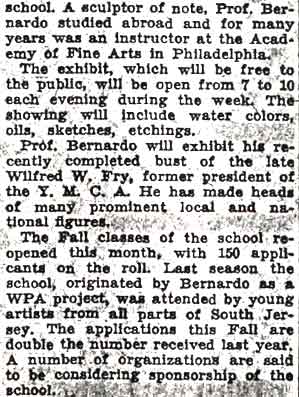
Art connoisseurs and students are anticipating the first annual exhibit to be held at the School of Sculpture and Fine Arts at the Camden Y. M. C. A. today to Saturday.
Several hundred exhibits will be shown by 50 students of Prof. Nicolai Bernardo, instructor at the school. A sculptor of note, Prof. Bernardo studied abroad and for many years was an instructor at the Academy of Fine Arts in Philadelphia.
The exhibit, which will be free to the public, will be open from 7 to 10 each evening during the week. The showing will include water colors, oils, sketches, etchings.
Prof. Bernardo will exhibit his recently completed bust of the late Wilfred W. Fry, former president of the Y. M. C. A. He has made heads of many prominent local and national figures.
The Fall classes of the school reopened this month, with 150 applicants on the roll. Last season the school, originated by Bernardo as a WPA project, was attended by young artists from all parts of South Jersey. The applications this Fall are double the number received last year. A number of organizations are said to be considering sponsorship of the school.
One of Camden’s Unsung Heroes
Camden Courier-Post —
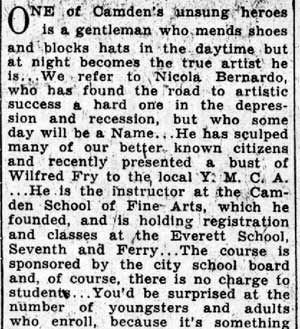
ONE of Camden’s unsung heroes is a gentleman who mends shoes and blocks hats in the daytime but at night becomes the true artist he is…We refer to Nicola Bernardo, who has found the road to artistic success a hard one in the depression and recession, but who some day will be a Name…He has sculpted many of our better known citizens and recently presented a bust of Wilfred Fry to the local Y. M. C. A.…He is the instructor at the Camden School of Fine Arts, which he founded, and is holding registration and classes at the Everett School, Seventh and Ferry…The course is sponsored by the city school board and, of course, there is no charge to students…You’d be surprised at the number of youngsters and adults who enroll, because it’s something that has received a minimum of publicity…Nick has a hat and shoe shop on Haddon avenue which is like any other shop…But in the rear is an amazing collection of plaques, busts, statues, reliefs and whatever else there is in the business or rather art, of sculpture…In spite of his commercial station in life, he has a substantial artistic background…Born in Italy and a student under masters in Naples and Rome, he came to this country in 1910, and some years later enrolled at the Philadelphia Academy of Fine Arts…It wasn’t long before he became an assistant professor there…He has walked off with top honors in a number of expositions…Sculpture is a luxury few can afford in trying times, but we repeat that some day he’ll be a celebrity.
Shop Inaugurates Fast Valet Service
Camden Courier-Post —
Delivery Made in Three Hours for Any Type of Work
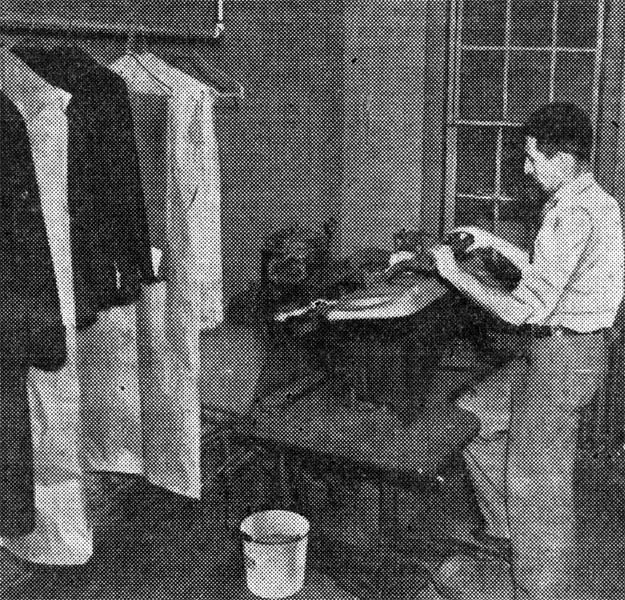
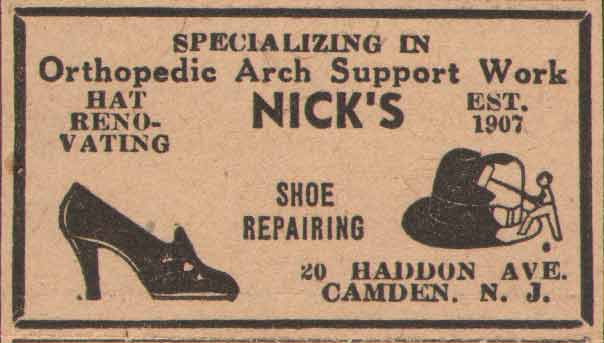
A fast valet service has been inaugurated by Nick’s Shoe Repair Shop, 20 Haddon Avenue, for the convenience of traveling men or office workers. The service provides delivery in three hours for any type of work including French dry cleaning. A traveling man can check into his hotel at 1 p. m., and send his garments to Nick’s Shop. He can have his suit dry cleaned and pressed, his overcoat pressed, his hat cleaned, blocked and a new band put on, his shoes soled and shined, and all returned at 4 p. m.
Quick Service Offered
The service is not restricted to traveling people but may be enjoyed by anyone. If the office executive is called on short notice to attend an evening sales dinner, he may use the same fast service in having his apparel freshened up.
Special attention is given to ladies’ garments and the quick service does not reduce the quality of the work. Altering, repairing and tailoring is done when desired.
Hat renovating has long been a specialty with this shop. All types of felts, derbies, or ladies hats are renovated and reshaped. Nicola Berardo, proprietor of the shop, is also known through his service in building in flexible arch supports in any kind of shoes to aid foot discomfort.
Sculptor by Profession and Shoemaker by Fate
Camden Courier-Post —
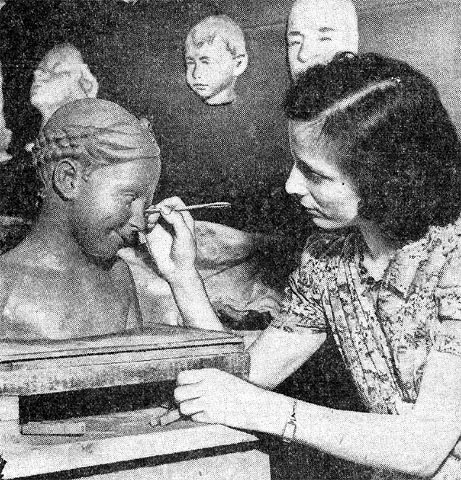
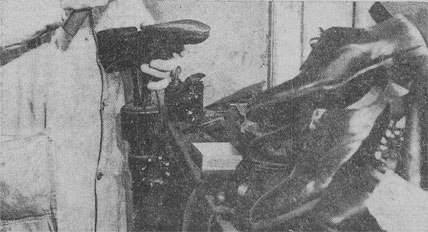
Made $100,000 as an Artist and Then the Depression Stripped Him of Cash and Realty
FINDS 3 GENIUSES AMONG 500 PUPILS
Don’t tell Nicola Berardo a shoemaker should stick to his last. Nick, as he is known, is a sculptor by profession and a shoemaker by fate, and his patrons have the privilege accorded to few other customers of the gentlemen in olden days known as cobblers.
Nick has a shoe repairing shop at 20 Haddon avenue and his patrons can visit his studio there, whenever they drop in for a pair of rubber heels or to get the old “kicks” half-soled.
Bernardo is a cobbler, but he likewise is an artist and a personage. His years are 48, but he has been immersed in sculpture, so to speak, since he was a youth of nine.
At present he is in charge of the Academy of Fine Arts, operating under the benevolence of WPA, where the maestro makes $20 a week, which is something like penury to a man who was kicked out of $100,000 when the depression settled its sinister mantle on this land.
Three Bright Pupils
Despite this rebuff of fate, Nick is yet an optimist, who is happy over the fact that he has 500 pupils ready to dabble in sculpture, three of whom are positive geniuses to the master. One is a Russian miss of 16, another a French girl, 50 whose only identity to Nick is “Hazel of Palmyra” and Tony Di Felipo, 19, of Camden.
“They are positive geniuses” opined Nick, in chatting about his discoveries, “and some day they should make their mark as great sculptors.”
Nick’s own career reads like something out of Arabian Nights. Back in Casertto, where he was born—Casertto is a little city near Naples—Nick’s father had a good railroad job. Nick early evinced a natural Latin strain as an artist, so the parents sent him at the age nine, to the Academy of the Fine Arts in Naples.
“I was there until I was about 13,” said Bernardo, “when my father lost his job and I had to go back home to help the family fortunes. I did some sculpture then, made money in a little studio I had near the railroad station, and when I had enough I went to the Royal Academy in Rome.
“When I was about 16 it looked as if the family fortunes would never mend enough for me to become a sculptor, so I wrote to my uncle, Petrone, who lived in Camden and asked him to send me money to come to America.”
“That was 30 years ago when I was 18. My uncle sent me the steamship tickets, and gave me $5 to see me across the ocean. I landed in America with no knowledge of English and my uncle sent me to the Academy of Fine Arts in Philadelphia.”
“I began to do pretty well, and when I had some money I opened this shop—I’ve lived here ever since I’ve been in the United States—and put an Italian in as the workman. I learned my trade from him.”
“That’s a fact, he taught me to be a shoemaker, all the time I was making good money in sculpture. I did the ‘Indian’ that stands on the lot where the old City Hall once stood and was given $18,000 for executing that commission. I did busts for the best-known men in Camden and altogether I must have made $100,000 from sculpture.”
“I put my money in real estate, bought this home and shop, and then bang! The depression came along, I lost all the property in which I had invested my money, and believe it or not I’m paying rent for this very house today, the home I had bought when things were prosperous.”
Grandsons Have Talent
Heredity also has come into its own in the person of Nick’s two grandsons, Jerome, 10, and William, 12, both of whom are pupils at St. Mary’s Parochial School. They are children of Nick’s daughter, Theresa, and their childish talent runs to painting.
Nick says he has a flair for the brush and that he teaches his grandsons how to work in oils and that for juvenile artists, they are both good. Inside his shop are pieces of sculpture that lend an artistic atmosphere that the whirring machines and the spinning brushes cannot eradicate.
Behind the repair shop is the studio where things that have transpired are housed until Nick can find other lodgings for his masterpieces. There is a magnificent full length statuette of the late Dr. S. Weir Mitchell, of Philadelphia, one of the world famous neurologists and an author as well. Likewise are busts of some of Camden’s best known citizens, all of which art work has grown a trifle ivoried by age.
Nick treasures a photograph from Constance Bennett, the screen actress, autographed, a souvenir of a pupil that Nick taught, and who was a protégé of the Hollywood thespian.
Two of Bernard’s treasures are the originals of the design for the button worn by soldiers of the World War, who fought, under the Stars and Stripes, and the original also of the Navy button, awarded the seadogs who also fought for their country.
Despite all the buffeting of fate and fortune, Nick still is the artist at heart, and for $20 a week he is teaching a class, doing cultural work that he finds a balm to his feelings, wounded by the crass fortune that kicked him so unmercifully, when his fellows suffered its stings and arrows, too, starting in 1929.