Introduction
Marco Reginelli (January 2, 1897 – May 26, 1956), nicknamed "The Small Man," was an influential underboss of the Philadelphia crime family who operated from Camden, New Jersey, and owned the famed 500 Club in Atlantic City.
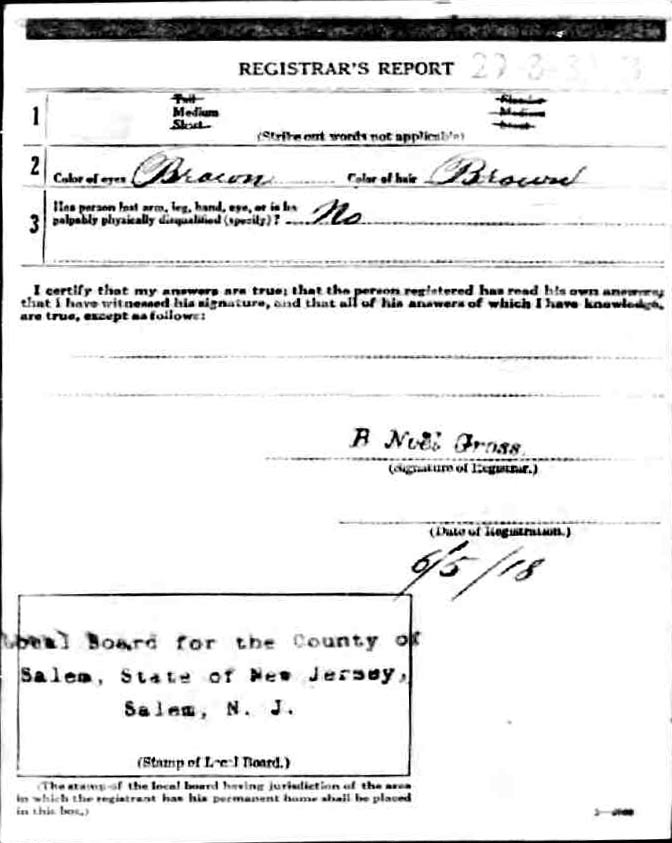
Marco Reginelli was born to Saverio Reginelli on January 2, 1897, in Neppazzano (Nepezzano), Teramo, in Italy's Abruzzo region. He sailed from Naples aboard the steamship Taormina on May 14, 1914, arrived in Philadelphia on June 14, 1914, and is recorded as entering the United States on June 24, 1914. His brother Nazareno was already living in Philadelphia at 800 South 10th Street.
By June 1917 Reginelli was living at 59 Pitman in Penns Grove, New Jersey, and working as a laborer at the E.I. DuPont chemical plant in Carney's Point. He shared that residence with Domenico Reginelli, likely a brother. By 1920 Domenico remained in Penns Grove while Marco appears to have returned to Philadelphia.
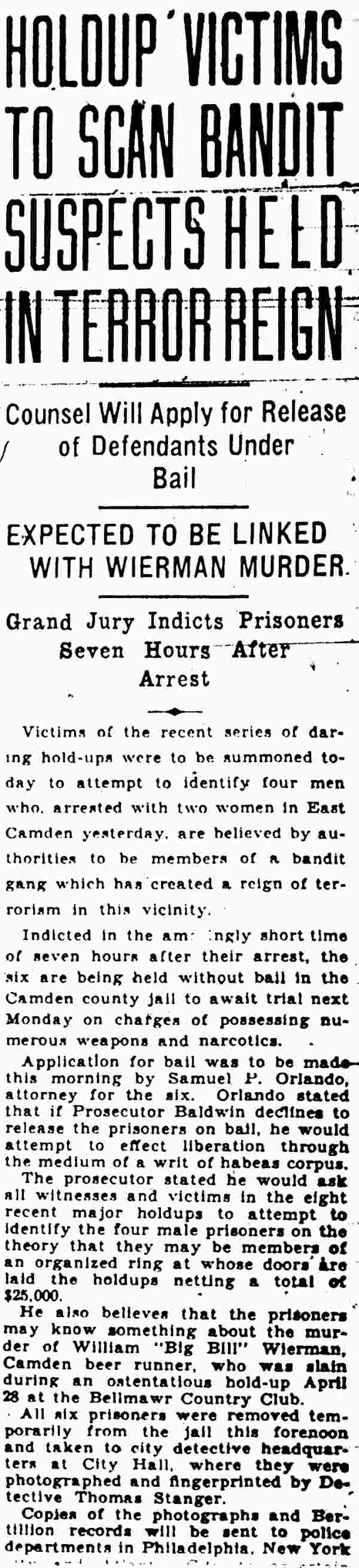
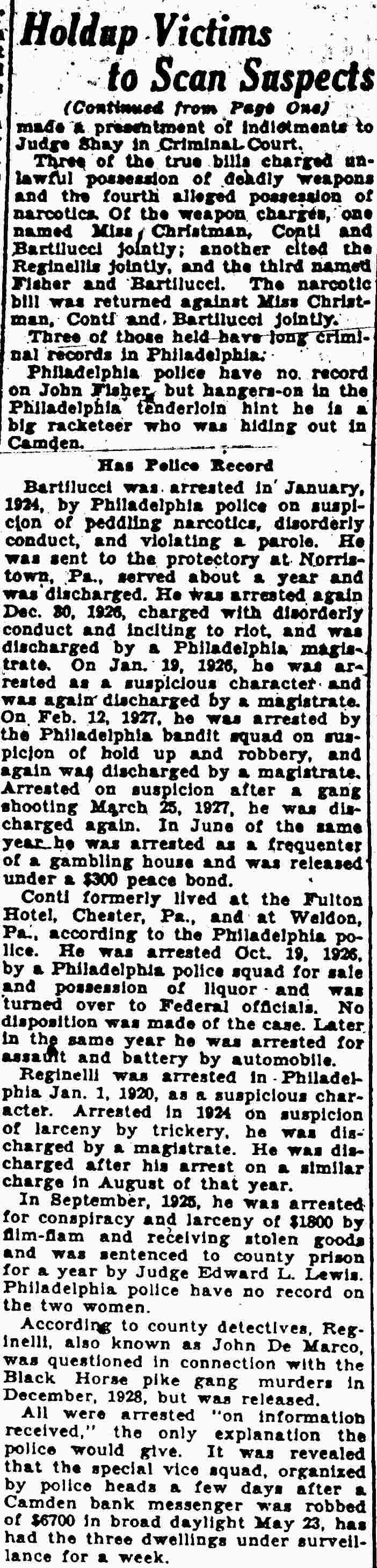
Reginelli's early run-ins with the law included two 1924 arrests for larceny by trickery that were dismissed, and an arrest on January 1, 1925 in Philadelphia as a "suspicious character." In September 1925 he was sentenced to one year in Philadelphia County Prison for conspiracy, larceny, and possession of stolen goods.
Following his release he moved back across the bridge into South Jersey. In December 1928 he was questioned in connection with gangland murders in the region.
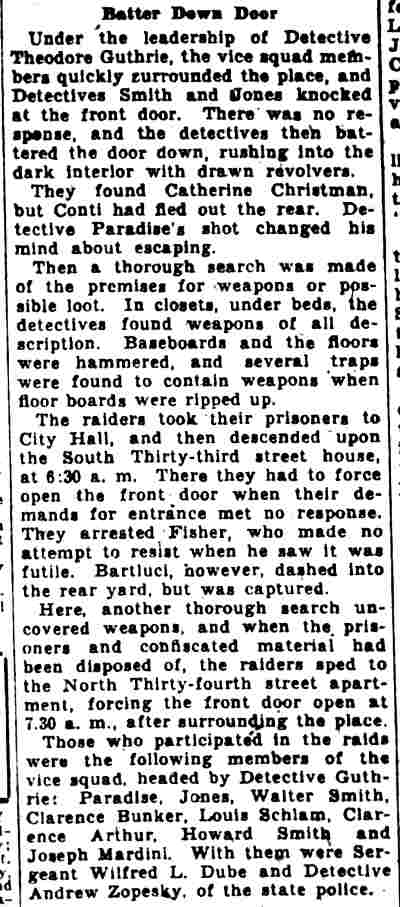
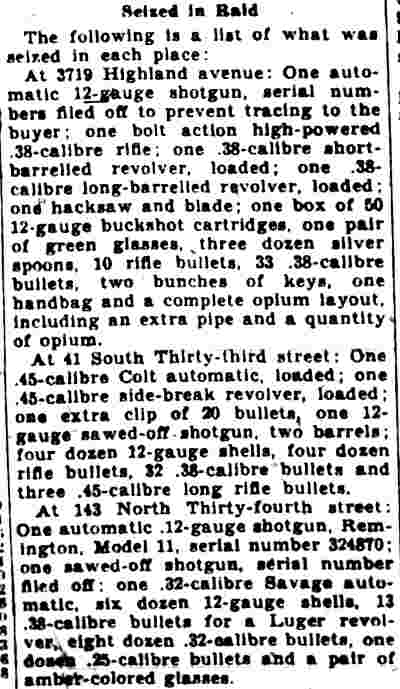
By spring 1930 Marco lived in East Camden at 143 North 34th Street. Contemporary newspapers report he was married. He was one of six people arrested on weapons and related charges at that time; in Reginelli’s case those charges were not proven.
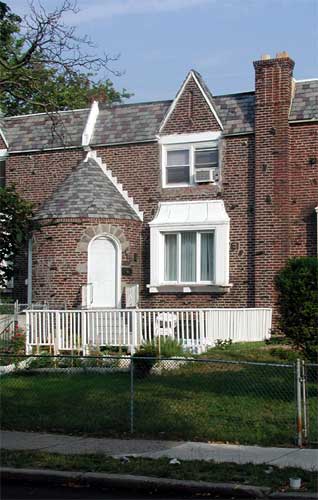
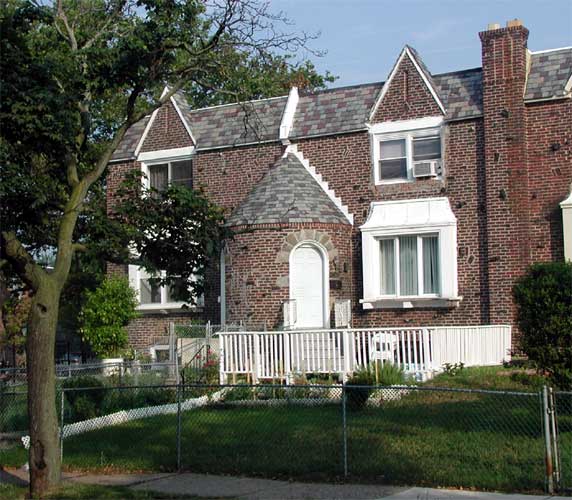
By the late 1930s he had become a recognized power in Camden and South Jersey organized crime. The 1940 Polk’s City Directory lists him at the Plaza Hotel, 500 Cooper Street, and by April 1942 he had purchased a home at 2403 Baird Boulevard in East Camden.
Specializing in gambling and the numbers racket, Reginelli extended his influence from Camden through South Jersey into Atlantic City. From the mid-1940s onward he was tied to 2403 Baird Boulevard, frequented Sciamanna's Cafe (also called Sherman's Cafe) at South 4th and Royden Street, and at times resided at 426 Line Street in Camden.
Through the postwar years and until his death in 1956, Reginelli—whose principal interest was gambling—effectively ran the Philadelphia family from Camden after his promotion to underboss. He promoted several gambling associates into mid-level management roles, including Angelo Bruno, noted for his numbers operations.
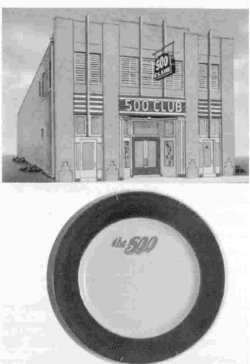
Despite his small stature, Reginelli inspired both fear and respect within the Philadelphia organization. He built and owned Atlantic City's 500 Club, a prominent venue of the era where Dean Martin and Jerry Lewis first teamed and a frequent stop for Frank Sinatra in the 1940s.
The federal government sought to deport Reginelli, but those efforts were unsuccessful; he retained high-profile counsel, including attorney Murray Chotiner. He was naturalized in the mid-1950s, though his citizenship was revoked shortly before his death.
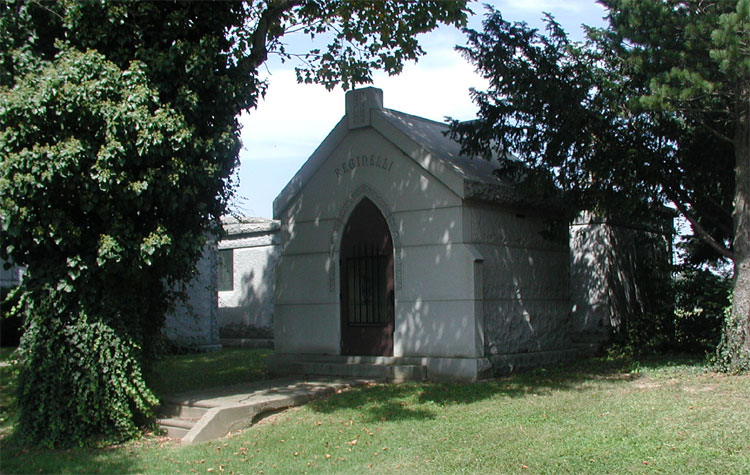
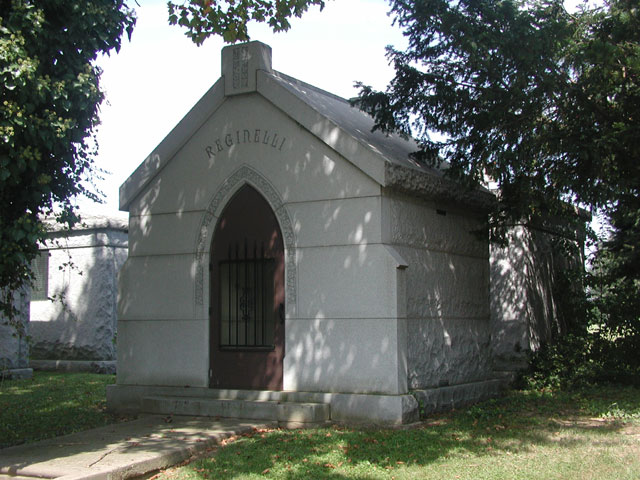
Marco Reginelli died of natural causes on May 26, 1956, in Baltimore, Maryland, and was interred at Calvary Cemetery in what was then Delaware Township (now Cherry Hill), New Jersey.
After his death Dominick "Big Dom" Olivetto is reported to have assumed many of Reginelli's rackets under Philadelphia boss Joe Ida. Olivetto attended the November 1957 Appalachin meeting in upstate New York in conference with Vito Genovese and was among those arrested. Following Appalachin, Olivetto appears to have stepped aside, and Angelo Bruno later consolidated control of the Philadelphia and South Jersey operations.
Photos of Marco Reginelli
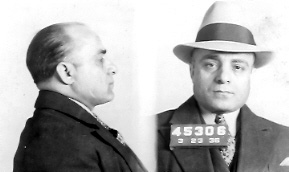
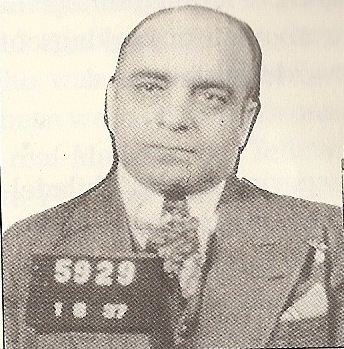
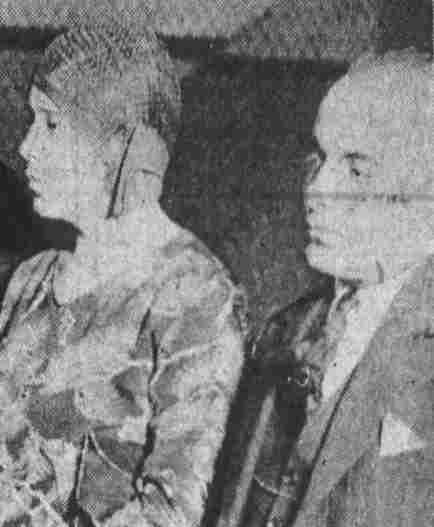
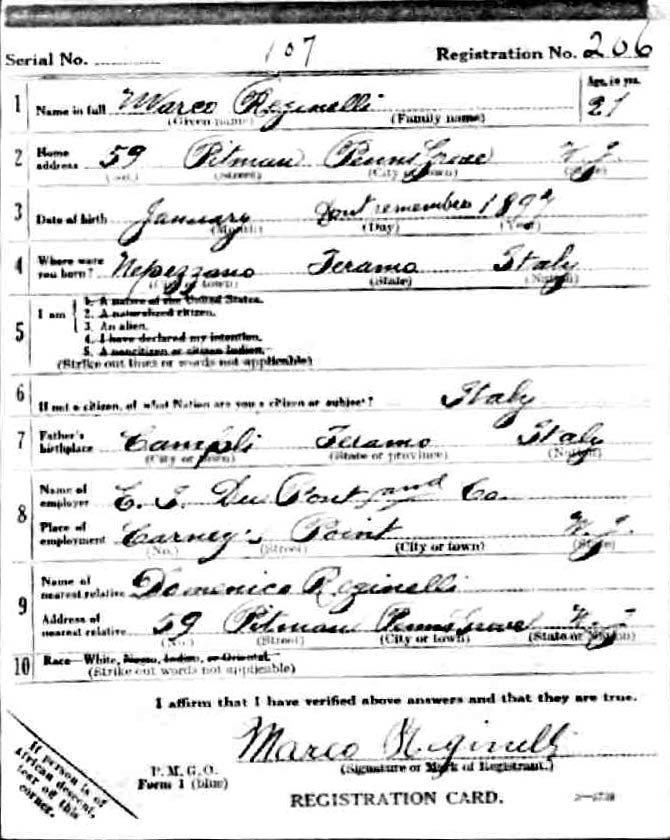
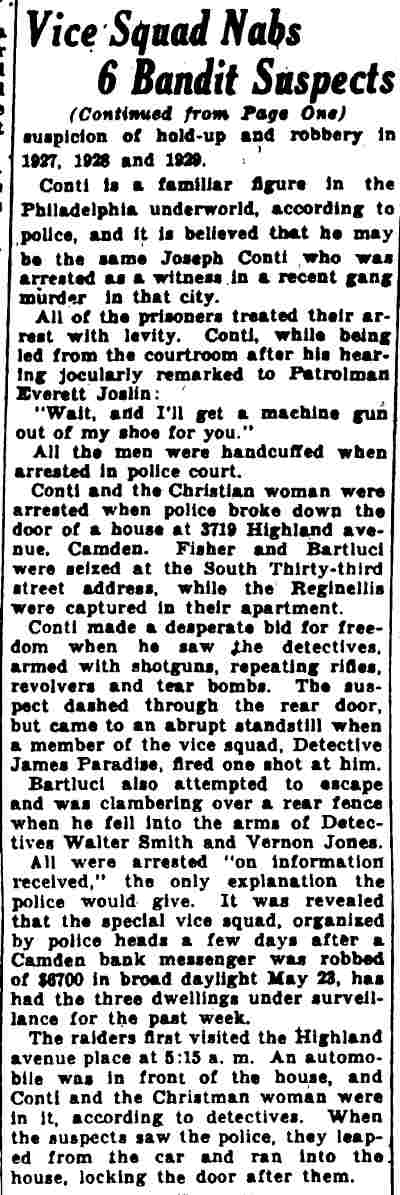
New Vice Squad in 3 Raids Nabs 6 as Suspects in Bandit Gang
Camden Courier-Post - June 3, 1930
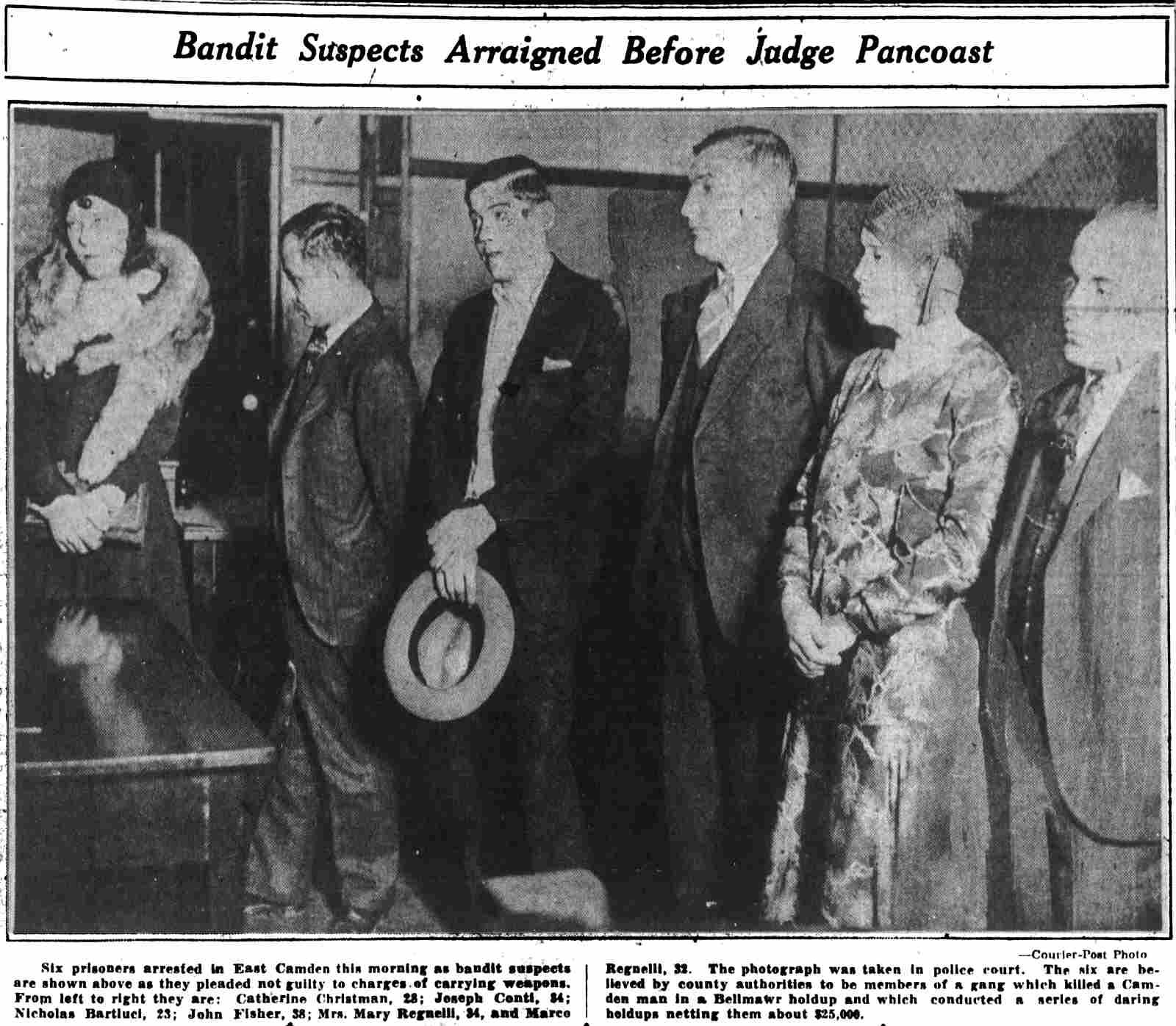
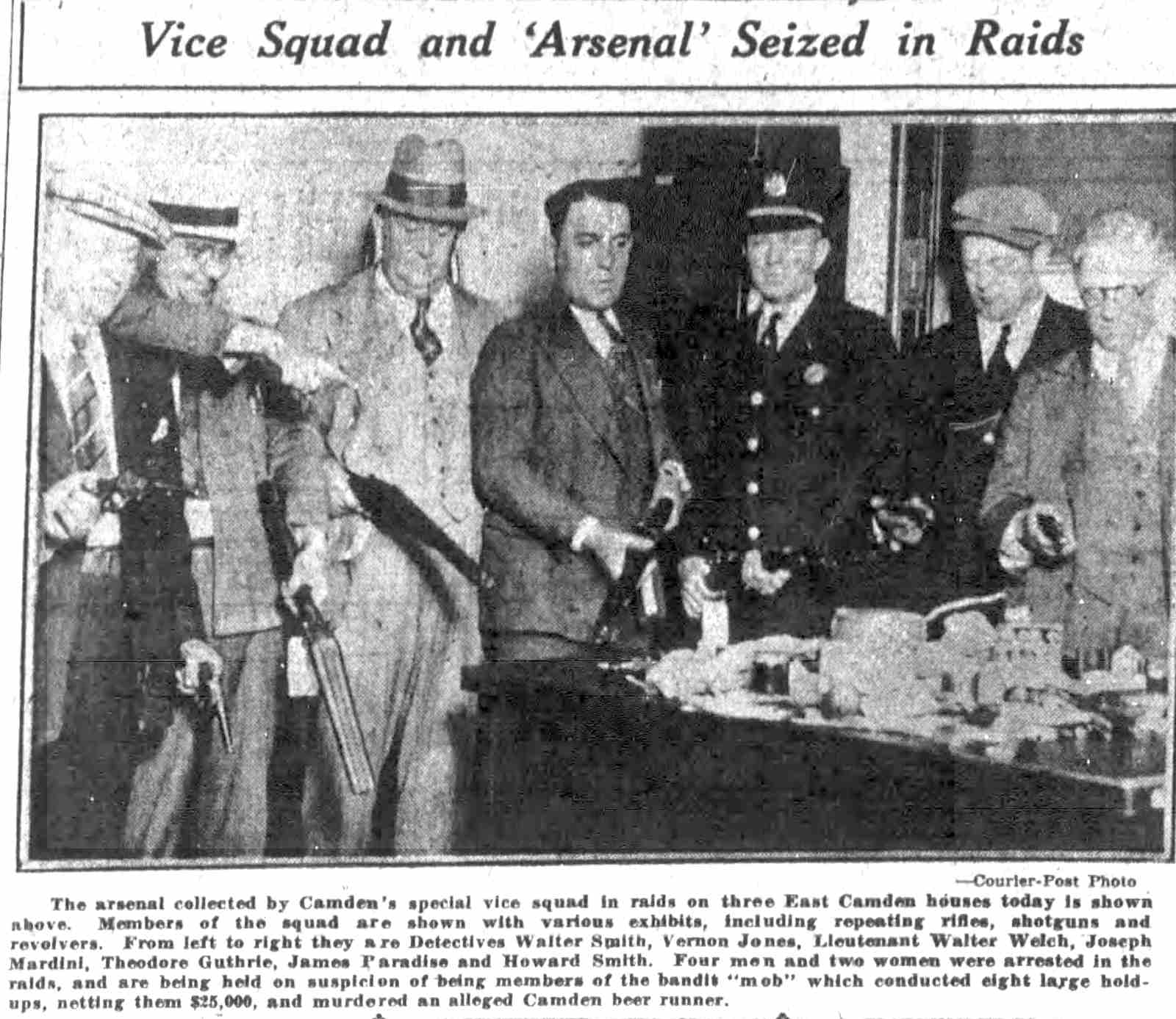

Holdup Victims to Scan Bandit Suspects Held in Terror Reign
Camden Courier-Post * June 4, 1930
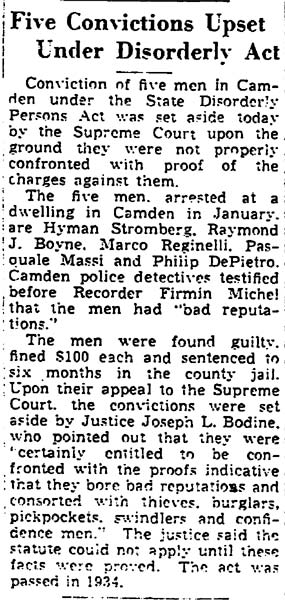
Fire Convictions Upset Under Disorderly Act
Trenton Times - July 7, 1937
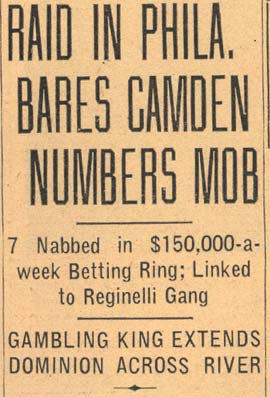
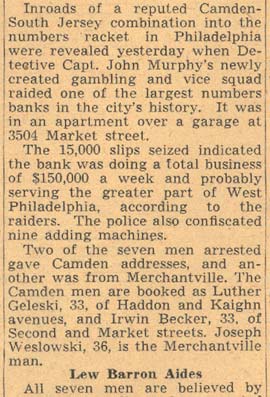
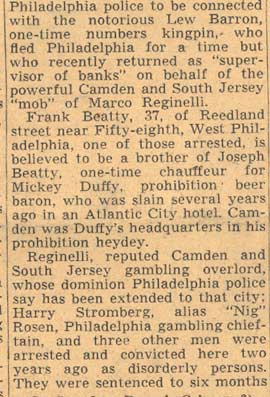
Raid in Phila. Bares Camden Numbers Mob
Camden Courier-Post - June 7, 1939
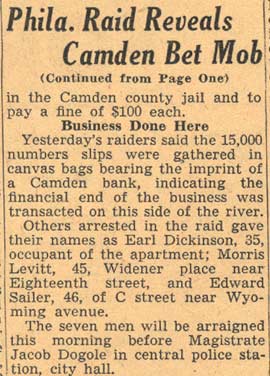
Salesman Slain; Girl Questioned
Trenton Times - March 30, 1942
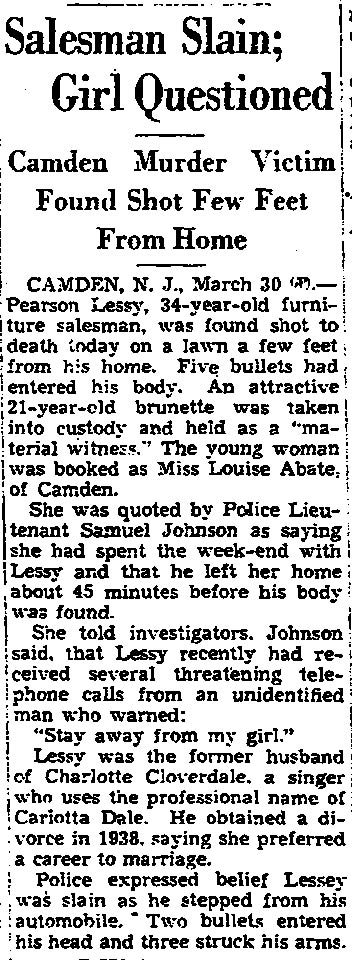
Camden Murder Laid to Gunmen
Trenton Times - March 31, 1942
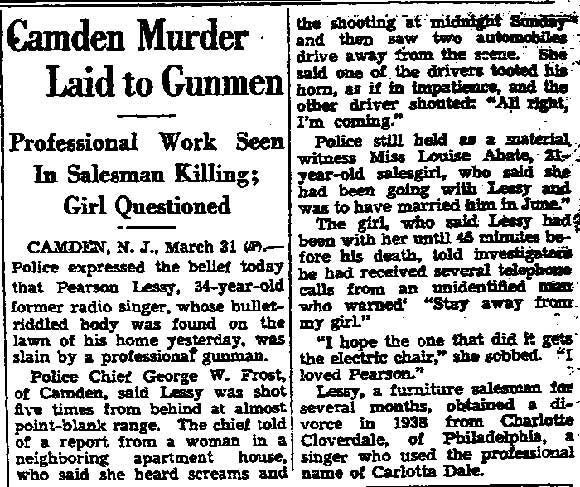
Camden Baker Is Indicted by U.S.
Trenton Times - April 15, 1942
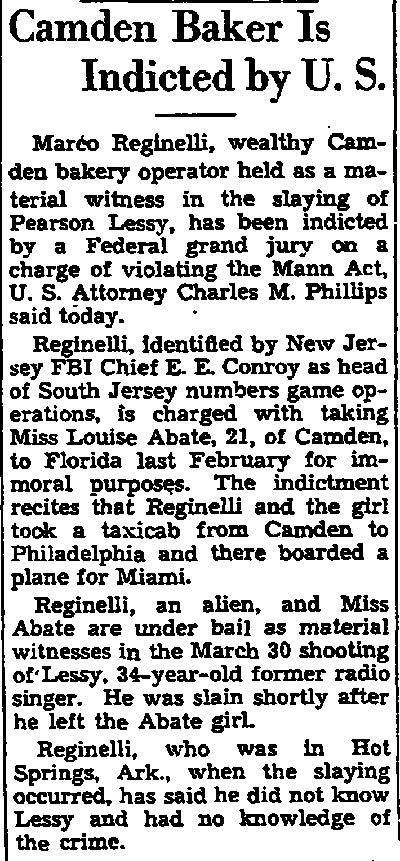
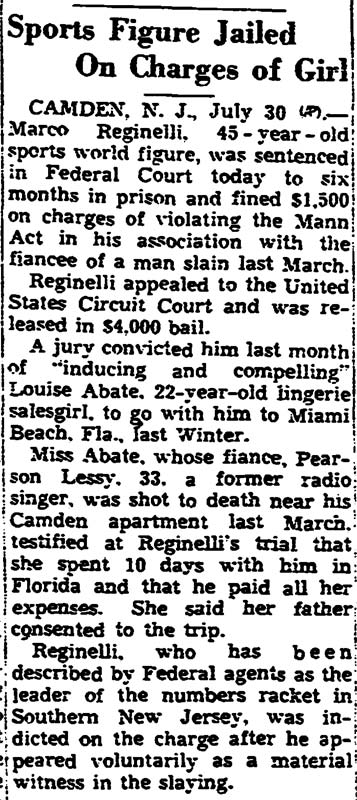
Sports Figure Jailed On Charges of Girl
Trenton Times - July 30, 1942
Huge Gambling Joint Raided By State
Maple Shade Progress - July 28, 1949
Police Confiscate $38,700, 187 Men Are Nabbed
Gamblers Felt Secure As They Thought Raid Wasn't Possible
Race Wires Are Being Traced By Police
LAND FOR BUILDING SOLD BY TOWNSHIP
Maple Shade's so-called “plumbing warehouse” proved to be just what residents suspected it to be — an elaborate gambling establishment.
New Jersey state troopers from North Jersey smashed their way into the thriving gambling house early Thursday morning at Fellowship road and State Highway Route S-41, arrested 187 men, and confiscated more then $40,000 in cash.
Two revolvers and a clip of ten loaded cartridges for a carbine were seized in the surprise swoop.
About twenty of those arrested were taken into custody when they arrived at the jam packed establishment unaware that the police had moved in.
Thirty men were questioned as suspected operators, lookouts, card dealers and dice “stick men,” and 19 of them were eventually held as “principals.”
All the others were given a prompt hearing before a judge in Maple Shade, and were released after depositing $25 cash bail. Most of them said they were from Camden or Philadelphia.
The raid, described by its leaders as one of the biggest ever staged in South Jersey was executed at 12:50 a.m. by eight uniformed troopers and nine plain clothesmen acting under special orders from Colonel Charles H. Schaeffel, head of the state police. Eight additional uniformed men were called in later from barracks at Columbus, Berlin, and Riverton.
Maple Shade Police and township officials were not notified of the raid until after it had taken place.
It was one of the biggest gambling raids ever staged in New Jersey. The target was a one-story cinder brick structure, resembling a garage or warehouse, nestled in a clearing surrounded by thick woods not far from intersections of Route S-41 and Fellowship road. A narrow country lane, located about 150 feet off Fellowship road, served as the entrance.
Police said that many patrons had been taken to the gambling house by “luggers” operating limousine service from Philadelphia, and from other places within a radius of about 60 miles.
The ground for the building was sold to Domenic Iacovelli at public sale by the Maple Shade Township Committee on April 26 with Thomas Vogdes, Main Street real estate agent, acting as agent for Iacovelli. On July 12, Iacovelli bought another piece of land adjoining the first parcel from the township. An investigation today revealed that the township has no record of Iacovelli's address although it is believed he resides in Camden.
It is reported that the building was erected in 17 days with workmen working 24 hours a day. Some local men worked on the erection of the building.
The raiding party was led by Captain Arthur Keaton and Emerson Tschupp, deputy director of the New Jersey Alchoholic Beverage Control Commission.
The magnitude of the raid was such that it was more then eight hours after the troopers struck the gambling joint at 1 a.m. until the last of those seized had been booked at the Maple Shade police station.
Fourteen of those arrested were held in $5,000 bail each as principals by Municipal Judge Bowers of Cinnaminson township; four were held in bail of $1,000 each as material witnesses and one held in $2,000 bail as a material witness.
The 14 men booked as principals on charges of aiding, abetting and assisting in the operation of a gambling establishment were:
- Nicholas Bocchicchio, of Clifton avenue, Westmont, identified by Keaton as a brother of Felix Bocchicchio, who is manager of heavyweight Jersey Joe Walcott.
- Levi Cicero, 715 Second street, Florence.
- Pasquale Beato, 2820 North Twenty-third street, Philadelphia.
- Thomas Girgenti, 1208 Haddon avenue, Camden.
- Henry Duncan, 600 Holmes street, Burlington.
- Gardon C. Gober, Cedar lane, Florence.
- Christie Scittina, 1207 Callahan street, Yeadon, Pa.
- Dominick Di Mattia, 16 South Forklanding road, Maple Shade.
- Joseph Putek, Fulton street, Delaware township.
- Anthony Meloni, 5302 Sherwood Terrace, Pennsauken.
- Manuel Gattabrio, 312 South Twenty-seventh street, Camden.
- Harry Donaphy, 3901 Lawndale avenue, Philadelphia.
- Frank Pollastrelli, 723 Monmouth street, Trenton.
Bail was posted for Girgenti by N. Morton Rigg, a Burlington attorney. Complaints against the suspects were signed by State Police Lt. Clinton J. Campbell, Columbus barracks.
The other 166 seized were booked as disorderly persons and were released in $25 cash bail each for a hearing August 17.
Captain Keaton, who led state troopers last Tuesday in raiding the national headquarters of a $50,000,000 lottery ring in New York, said he recognized henchmen of Marco Reginelli among men seized.
After undergoing questioning in the gambling establishment for more then three hours, the patrons were transported in one of Fred Olt's buses to the Maple Shade police station. The station became so crowded it was necessary to use the auditorium of the municipal building to book the men.
Lookouts Sound Alarm
The raiding party, in addition to Captain Keaton and Tschupp, included eight uninformed troopers in charge of Lt. Albert G. Varrelman, and nine in plain clothes.
They reached the place at exactly 1 a.m.
Lookouts stationed in a cupola-like arrangement in front of the building, immediately detected them and alarm buzzers were heard sounding inside the 100-foot long building.
Previous inspection of the exterior of the building, it was learned from the troopers, indicated there were only two exits, the four-foot wide door in front and another the same size at the rear.
As they pulled into the ground one trooper drove his car to the rear and blocked the door.
Others, carrying 20-pound sledge hammers, attacked the front door, later found to be lined with armor plate, but could not batter it down.
Spotlights on the troopers' cars were turned on the front of the building and revealed a window, about six by 12 inches, to one side. Working from the top of one of the cars, the troopers smashed away at this until a hole was made large enough for one of them to crawl through.
Sgt. Thomas Degaetano was then lifted through the opening and as he dropped to the floor inside, he drew his revolver and ordered everybody inside to the rear end of the room.
Degaetano was followed by Sgt. Hugo Stockburger, who, on getting inside, unlocked a door leading to the entrance hallway and then removed the steel bars barricading the front entrance and admitted the main body of raiders.
As he led his men in Capt. Keaton found the place a shambles from efforts of the operators to destroy all gambling evidence possible.
Four slot machines that had occupied a table to one side of the main room, had been carried into an office whose door also was lined with bullet-proof armor.
Three expensive dice tables, each large enough to accommodate 35 to 40 players, and a black-jack table, almost as large, were found with their felt lining partly ripped off.
None of the men in the room offered any resistance, largely Keaton said he believed, because he and the rest of the troopers came in “with guns swinging.”
Keaton then divided the patrons and the staff operating the place into two groups and ordered themto opposite sides at the rear of the building.
He and other officers among the troopers began questioning the men while waiting for a squad of eight more troopers from the headquarters identification bureau at Trenton.
When these troopers arrived they took over the formal questioning. They directed each man to give his name and occupation and show identification cards. Then they fingerprinted everyone in the building.
Any of the patrons who had less then $400 cash or who was not recognized as a police character was listed as an inmate of a gambling establishment.
Most of the money confiscated was found on those listed as principals. One of these had a $13,000 bankroll. Two more had $12,000 each; another had $10,000, and a fifth man had $8,000.
Across one side of the room was a large sign that read: “Open every day and night including Sunday.”
Elaborate arrangements for handling bets on horse races included blackboards listing each race at Monmouth Park, Arlington Park, Chicago and Saratoga, N. Y., and Suffolk Downs, East Boston, Mass,
Another sign advised the minimum bet accepted was $2 and the limit paid on straight bets was 25 to 1, was 10 to 1, place, and 5 to 1. (next sentence omitted—very hard to read on copy—payoffs on “ifs and reverse”)
The payoff on daily doubles, still another sign read, was 5 to 1.
The setup also included counters made of plywood, some where bets were accepted and others used in paying off winners. These counters were large enough, Keaton said, to accommodate from 20 to 30 players at a time.
The only windows in the building were about 18 inches by 10 inches, and were located almost at the top of the walls, about 12 feet high.
Ventilation was furnished by two huge electric fans which played on a continuous flow of water in a trough-like arrangement of tin and the air was forced into the room through two six foot tunnels made of plywood.
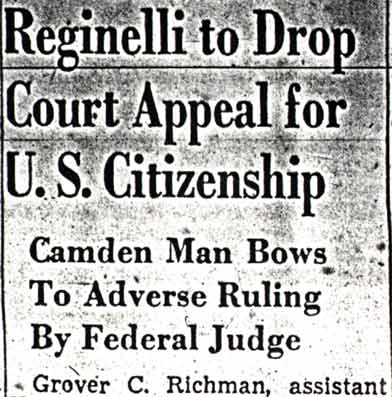
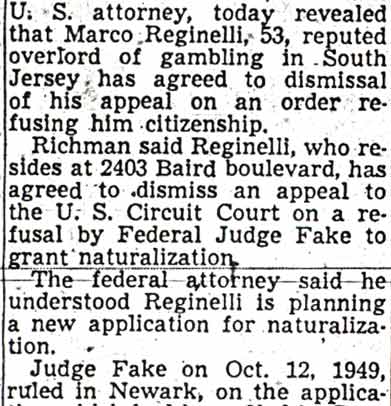
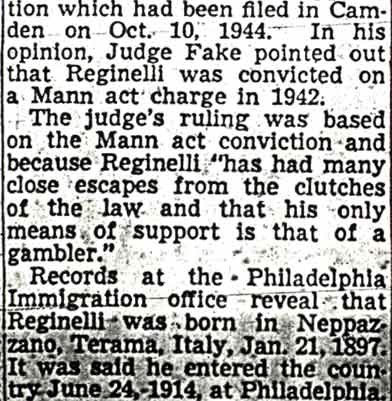
Reginelli to Drop Court Appeal for U.S. Citizenship
Camden Courier-Post - March 10, 1950
Marco Reginelli's Camden Home
2403 Baird Boulevard, Camden, NJ
The 500 Club
Wiretap Evidence Is Studied In Case Against Reginelli
Camden Courier-Post - October 27, 1955
U. S. Seeks Mob Ties In Move to Revoke His Citizenship
Wiretap evidence against Philadelphia mobs is being examined by immigration agents in an effort to strip Marco Reginelli, South Jersey gambling czar, of his citizenship.
The investigation was revealed when Samuel Horowitz, of the Bureau of Immigration and Naturalization legal staff, conferred with District Attorney Samuel Dash and police officials in Philadelphia.
Immigration officials expect hundreds of reels of tape-recorded telephone conversations obtained by Philadelphia police will provide evidence linking Reginelli to racket mobs in Philadelphia, it was learned. Such evidence would be used in the Government's fight against the citizenship granted to Reginelli on June 21 by the Atlantic County Court.
Reginelli was granted citizenship in Atlantic County, which has no Federal court, after three Federal courts elsewhere had refused him citizenship. The citizenship conferred by the county court was subject to a Federal examiner's approval.
Before Reginelli was sworn as a citizen he faced deportation to his native Italy as an undesirable.
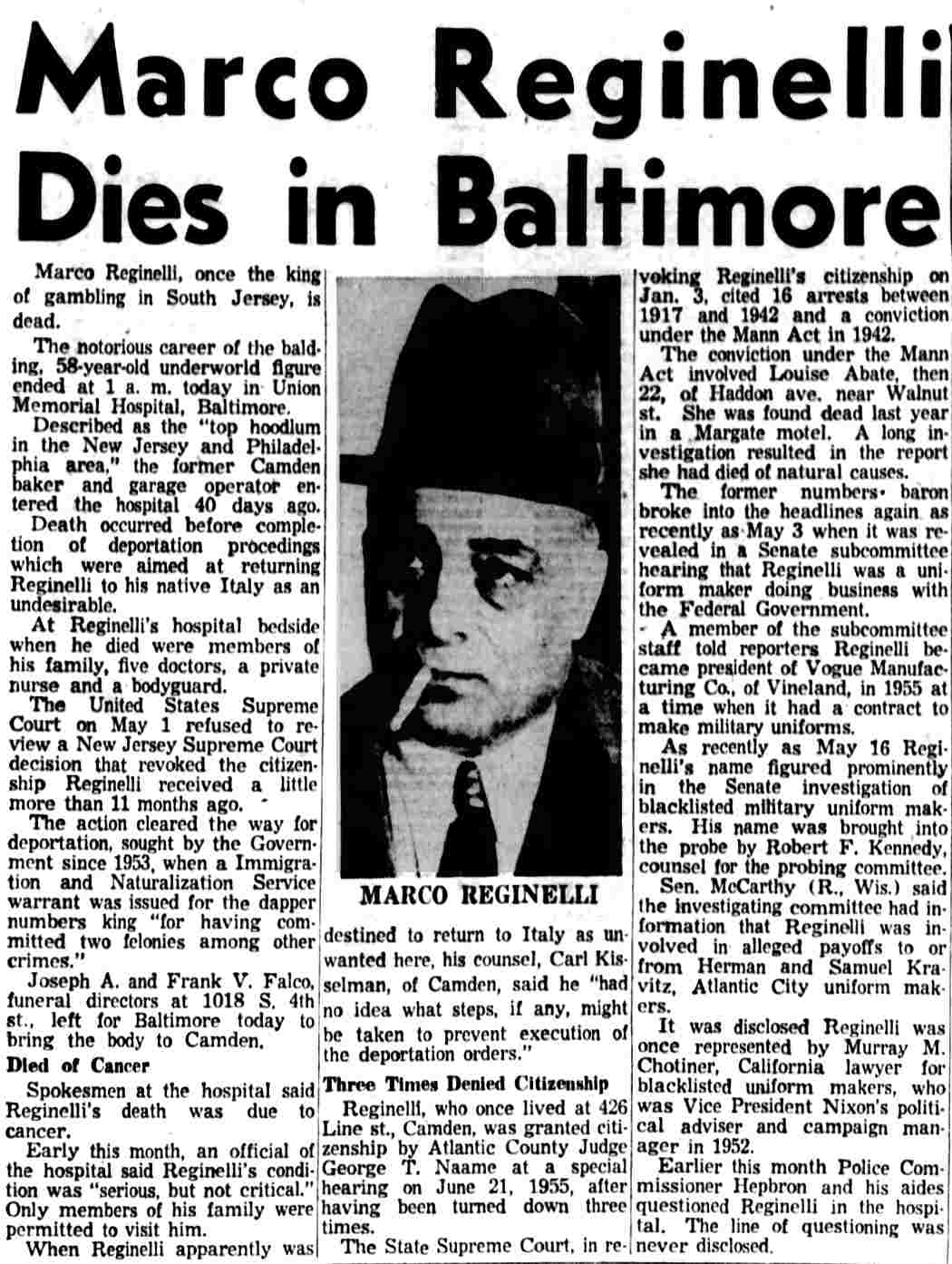
Marco Reginelli Dies in Baltimore
Camden Courier-Post - May 26, 1956
Top Hoodlum Dies in Baltimore Hospital
The News - Frederick MD, Saturday, May 26, 1956
BALTIMORE, May 25 - Marco Reginelli, once described at a congressional committee hearing as “the top hoodlum of the Philadelphia-New Jersey area,” died today in Union Memorial Hospital. He was 58.
Reginelli's name was brought up in a Senate Investigations Subcommittee hearing on charges of corruption in handling government contracts for making uniforms. Robert F. Kennedy, committee counsel, called Reginelli a “hoodlum” and said he had been arrested 16 times, convicted 6 times and was “involved in three murders.”
The Italian born Reginelli achieved citizenship but it was revoked after the New Jersey Supreme Court ruled he had “failed to prove good moral character as required.”
Reginelli was, last arrested in 1942 when he was convicted of transporting a woman from New Jersey to Florida for immoral purposes. The woman, Miss Louise Abate, was found dead in a Margate, N.J. motel and Reginelli was questioned. It was later ruled she died of natural causes. Reginelli was a Margate resident.
Reginelli's previous convictions were for fraudulent conversion, larceny, receiving stolen goods, conspiracy to steal and a violation of the Mann Act.
His chief physician, Dr. Howard Chandler Smith, a urologist, would not discuss the nature of Reginelli's illness.
Washington Merry-Go-Round
Daily News - Aberdeen SD - May 29, 1956
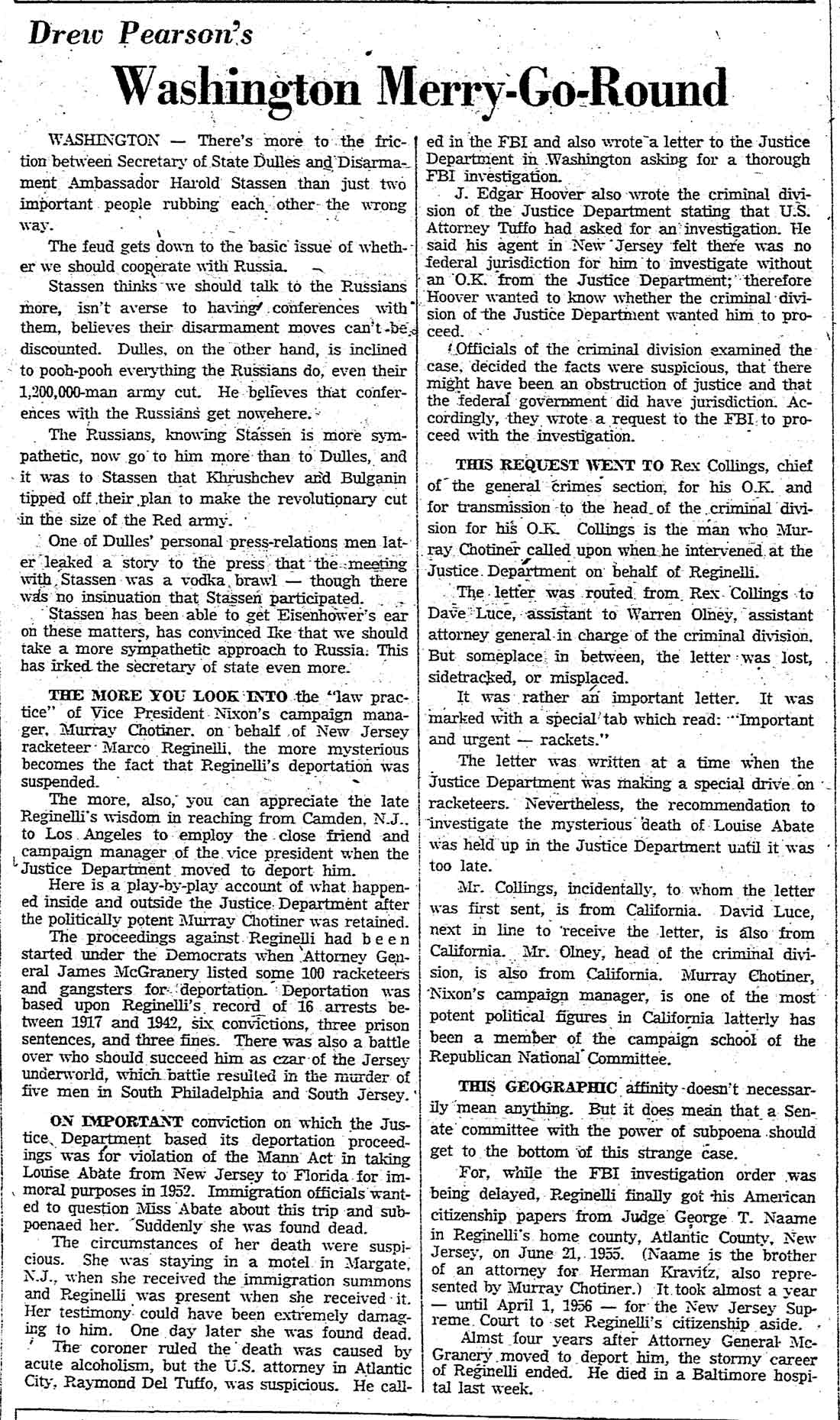
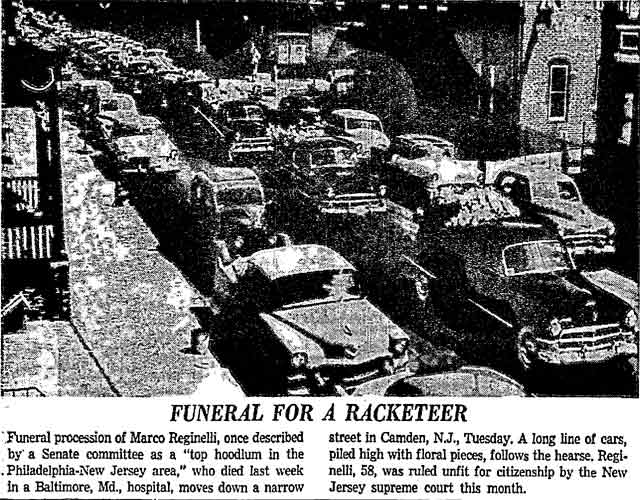
Funeral for a Racketeer
DMorning News - Dallas TX - May 30, 1956
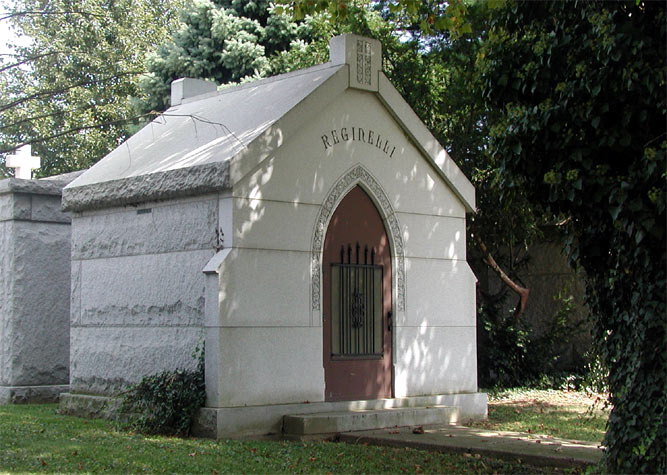
Final Resting Place of Marco Reginelli
Calvary Cemetery, Cherry Hill, NJ
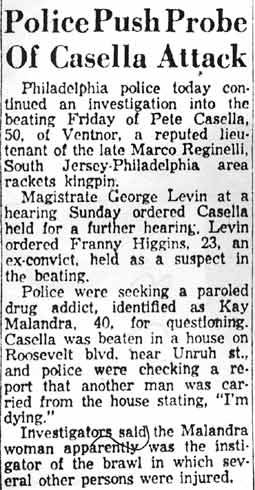
Police Push Probe of Casella Attack
Camden Courier-Post - December 30, 1957
Pat Yocolano Anecdote
My Dad, Frank Yocolano was a musician (sax player) as well as a sheet metal worker until he passed away in 1988. At one point in the 50's he worked at Warren Webster's until he got a job at Edgecomb Steel in 1963. His best friend was a fellow named Woody Sherman (Sciamanna) who was a trombone player. His Dad had a bar on 4th and Royden [Sciamanna's Cafe, also known as Sherman's Cafe --Ed.].
Woody told a story of Marco Reginelli who took numbers and hung at the bar. My old man was quite a drinker at 9 while tapping my Grandpop's wine barrels with his uncle Leo Doria and was hanging around the bar when a ragged black man came into the bar asking for food. As the story went Marco said “so you're really hungry huh?” The man replied “yes.” The locals at the bar knew that the guy would be in serious trouble if he wasn't. Marco said “give him a bowl of tripe” which Mr. Sherman served up and Marco offered him a glass of wine which he gratefully took. When he finished Marco asked “are you still hungry” and the man said “yes, I am” and Mr. Sherman gave him another large bowl of tripe with bread and he ate it all.
When he was done Marco said “you have a lotta guts walking in here for a handout” and reached into his pocket and handed the man $50 and told him “I don't ever want to see you in here again.”
I never read anything about Marco until tonight and my Pop's story was told to me on several occasions. Later in life my Pop mentioned that Marco was a major racketeer but obviously had a kind streak.
—Pat Yocolano, September 11, 2007