Joseph Doyer
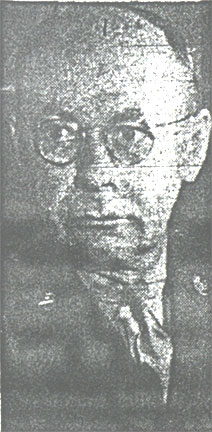
Joseph Doyer, Chief Warrant Officer, U.S. Army.
Chief Warrant Officer • U.S. Army
5307th Composite Unit (Merrill’s Marauders)
Entered service from New Jersey • Died January 20, 1945
Buried at Beverly National Cemetery, Plot 2 O 361B, Beverly, New Jersey
Awards: Legion of Merit, Victory Medal, Purple Heart, British Distinguished Conduct Medal, Belgian Croix de Guerre, 1915 Star, Combat Infantry Badge, Presidential Citation
Introduction
Chief Warrant Officer Joseph Doyer of Clementon, NJ, was born on November 8, 1898. His early years were spent in Milton, MA. He began his military career in 1915 at the age of 17 when he enlisted in the Canadian Army after being turned down at home for poor eyesight. He transferred to the U.S. Army in 1918 while overseas. When the war ended in November 1918, Joseph Doyer remained in the Army. A career soldier, he would be a soldier for the rest of his days.
In 1920, while stationed at Camp Custer, Joseph Doyer, then a private, mistook Private Otto Pugh for an escaped prisoner, while Pugh mistook Doyer for a bandit. Both soldiers drew pistols and were wounded in the ensuing gun battle.
Joseph Doyer rose through the ranks of the peacetime Army and served at various posts. In March of 1928 he was attached to a National Guard unit in Appleton, WI, where he was responsible for training and administrative work. Along with Captain James K. Campbell, Sergeant Doyer drilled and inspected National Guard units throughout northern and northeastern Wisconsin.
Stationed in California when the Japanese attacked Pearl Harbor, Master Sergeant Doyer received the Legion of Merit medal for his work at the West Coast Port of Embarkation. He subsequently volunteered for duty with the 5307th Composite Unit, popularly known as Merrill’s Marauders. As Regimental Sergeant Major, he was the highest-ranking non-commissioned officer in the unit. He was wounded during the battle for Myitkyina during the summer of 1944.
Promoted to Warrant Officer, Joseph Doyer was wounded again in January of 1945. He died from his wounds on January 20, 1945, at the 128th Evacuation Hospital. After the war, his body was returned to the United States, and he was buried at Beverly National Cemetery in Beverly, NJ. Joseph Doyer was survived by a sister, Mrs. Corinne Anderson of 128 West Atlantic Avenue in Clementon, NJ.
Mistaken Identity
Decatur Daily Review — July 16–17, 1920
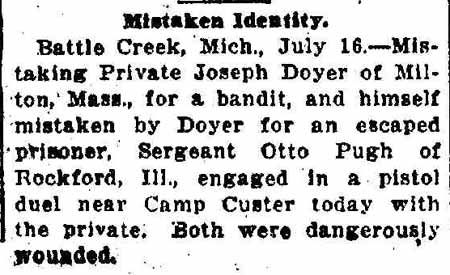
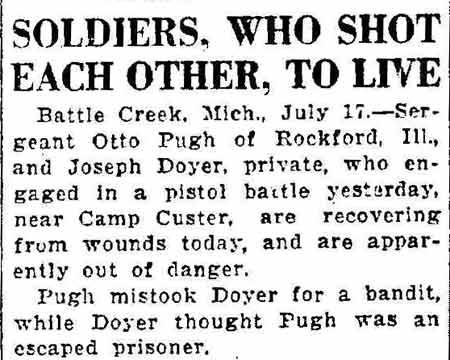
MISTAKEN IDENTITY.
Battle Creek, Mich., July 16.—Mistaking Private Joseph Doyer of Milton, Mass., for a bandit, and himself mistaken by Doyer for an escaped prisoner, Sergeant Otto Pugh of Rockford, Ill., engaged in a pistol duel near Camp Custer today with the private. Both were dangerously wounded.
SOLDIERS, WHO SHOT EACH OTHER, TO LIVE
Battle Creek, Mich., July 17.—Sergeant Otto Pugh of Rockford, Ill., and Joseph Doyer, private, who engaged in a pistol battle yesterday, near Camp Custer, are recovering from wounds today, and are apparently out of danger.
Pugh mistook Doyer for a bandit, while Doyer thought Pugh was an escaped prisoner.
It’s Great to Be in the Army, in Appleton Anyway
Appleton Post-Crescent —
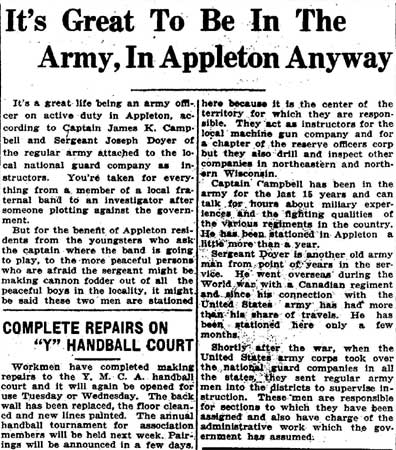
Appleton Post-Crescent, Appleton, WI, March 13, 1928. Captain James K. Campbell and Sergeant Joseph Doyer attached to the local reserve officers corps, drilling and inspecting National Guard units throughout northern Wisconsin.
Clementon Soldier Hero of Myitkyina
Camden Courier-Post —
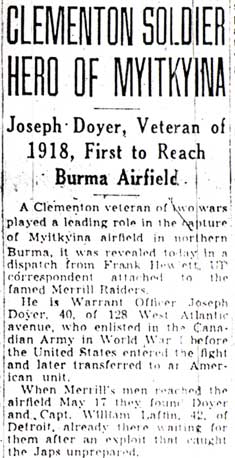
CLEMENTON SOLDIER HERO OF MYITKYINA
Joseph Doyer, Veteran of 1918, First to Reach Burma Airfield
A Clementon veteran of two wars played a leading role in the capture of Myitkyina airfield in northern Burma, it was revealed today in a dispatch from Frank Hewett, UP correspondent attached to the famed Merrill Raiders.
He is Warrant Officer Joseph Doyer, 40, of 128 West Atlantic avenue, who enlisted in the Canadian Army in World War I before the United States entered the fight and later transferred to an American unit.
When Merrill’s men reached the airfield May 17 they found Doyer and Capt. William Laffin, 42, of Detroit, already there waiting for them after an exploit that caught the Japs unprepared.
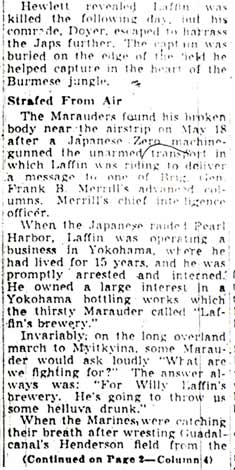
Hewlett revealed Laffin was killed the following day, but his comrade, Doyer, escaped to harass the Japs further. The captain was buried on the edge of the field he helped capture in the heart of the Burmese jungle.
Strafed From Air
The Marauders found his broken body near the airstrip on May 18 after a Japanese Zero machine-gunned the unarmed transport in which Laffin was riding to deliver a message to one of Brig. Gen. Frank B. Merrill’s advanced columns. Merrill’s chief intelligence officer.
When the Japanese raided Pearl Harbor, Laffin was operating a business in Yokohama, where he had lived for 15 years, and he was promptly arrested and interned. He owned a large interest in a Yokohama bottling works which the thirsty Marauder called “Laffin’s brewery.”
Invariably on the long overland march to Myitkyina, some Marauder would ask loudly “What are we fighting for?” The answer always was: “For Willy Laffin’s brewery. He’s going to throw us some helluva drunk.”
When the Marines were catching their breath after wresting Guadalcanal’s Henderson field from the Japanese, Laffin was gazing reverently at the Statue of Liberty from the deck of the Swedish exchange liner Gripsholm as it steamed into New York harbor.
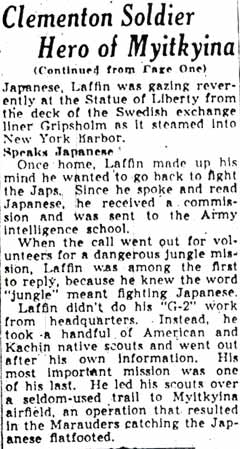
Speaks Japanese
Once home, Laffin made up his mind he wanted to go back to fight the Japs. Since he spoke and read Japanese, he received a commission and was sent to the Army intelligence school.
When the call went out for volunteers for a dangerous jungle mission, Laffin was among the first to reply, because he knew the word “jungle” meant fighting Japanese. Laffin didn’t do his “G-2” work from headquarters. Instead, he took a handful of American and Kachin native scouts and went out after his own information. His most important mission was one of his last. He led his scouts down a seldom-used trail to Myitkyina airfield, an operation that resulted in the Marauders catching the Japanese flatfooted.
Gen. Frank D. Merrill and Master Sgt. Joseph Doyer
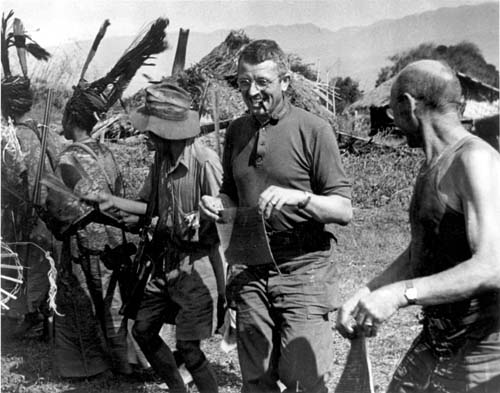
Gen. Frank D. Merrill and Master Sgt. Joseph Doyer participate in welcoming ceremonies and celebrations of villagers in honor of the 5307th Composite Unit arrival. Panpan, Burma, March 19, 1944.
Hero of 2 Wars Killed Fighting Japs in Burma
Camden Courier-Post —
Warrant Officer Joseph Doyer, 47, of Clementon, a hero of the last war who won the right to fight in this one by telling Brigadier General Frank Merrill he could out-walk and out-shoot him, has been killed in Burma.
Doyer was mortally wounded last Saturday while on a volunteer mission to clear out Japs menacing the recently completed Ledo Road, his sister, Mrs. Corinne Anderson, 128 West Atlantic Avenue, Clementon, was notified yesterday.
Doyer was one of two men from this area reported killed in action. Four are missing, 19 were wounded and another soldier is a prisoner of war.
Doyer began his fighting career in 1915 at the age of 17 when he enlisted in the Canadian Army after being turned down at home for poor eyesight. He transferred to the U.S. Army in 1918 while overseas and remained in it to the end.
When the Japs attacked Pearl Harbor, many of his soldier friends were killed, and Doyer swore revenge. After receiving the Legion of Merit for his work at a California port of embarkation, he was sent to Burma.
While training for the Burma campaign, General Merrill, leader of “Merrill’s Marauders,” called Doyer in and told him he would be assigned to a rear echelon because he was “too old to go to the front.” It was then that Doyer, who was seven years older than the general, remarked that he could out-walk and out-shoot Merrill.
Clementon Hero Buried in Beverly
Camden Courier-Post —
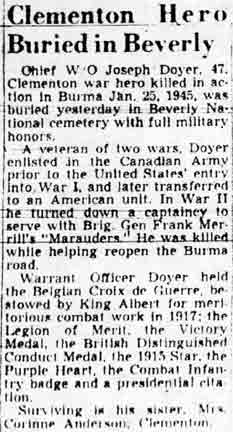
CLEMENTON HERO BURIED IN BEVERLY
Chief W. O. Joseph Doyer, 47, Clementon war hero killed in action in Burma Jan. 25, 1945, was buried yesterday in Beverly National cemetery with full military honors.
A veteran of two wars, Doyer enlisted in the Canadian Army prior to the United States’ entry into War I, and later transferred to an American unit. In War II he turned down a captaincy to serve with Brig. Gen Frank Merrill’s “Marauders.” He was killed while helping reopen the Burma road.
Warrant Officer Doyer held the Belgian Croix de Guerre, bestowed by King Albert for meritorious combat work in 1917; the Legion of Merit, the Victory Medal, the British Distinguished Conduct Medal, the 1915 Star, the Purple Heart, the Combat Infantry badge and a presidential citation. Surviving is his sister, Mrs. Corinne Anderson, Clementon.
Photos
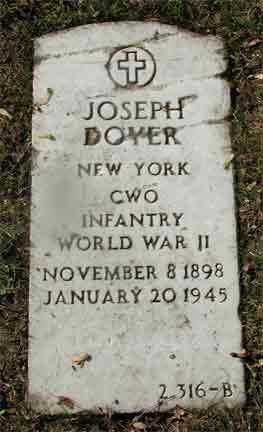
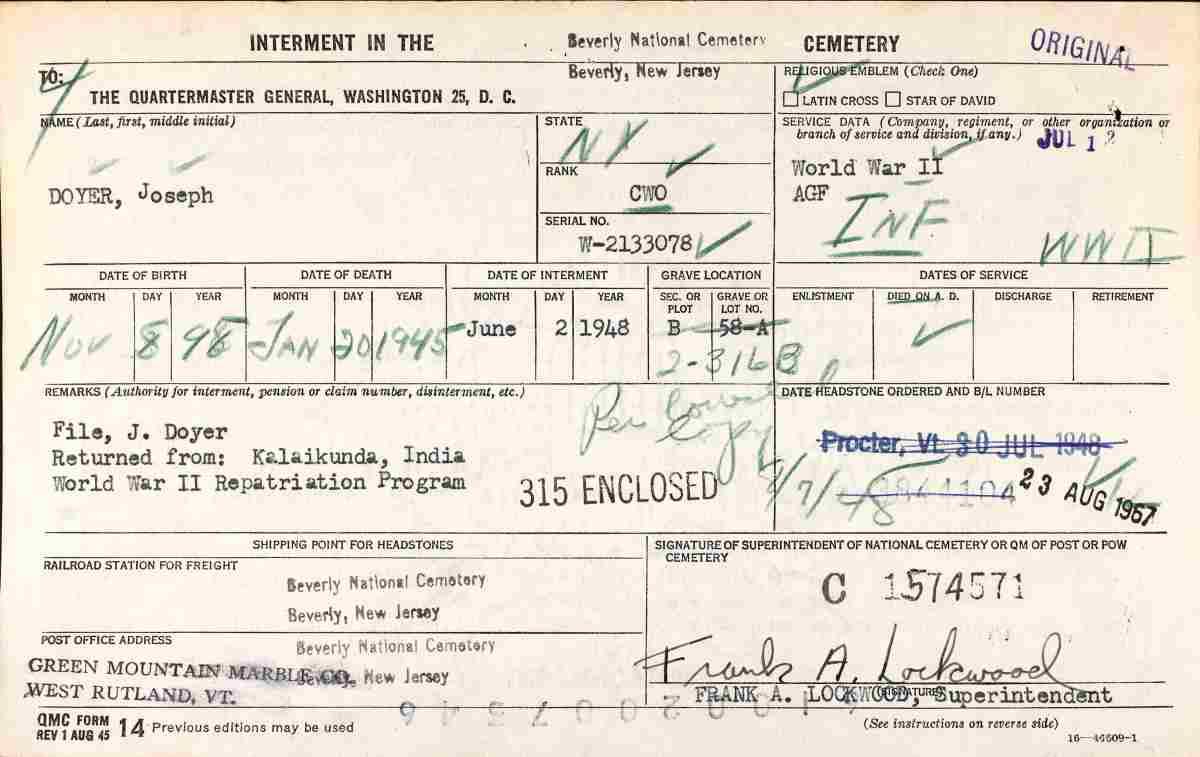
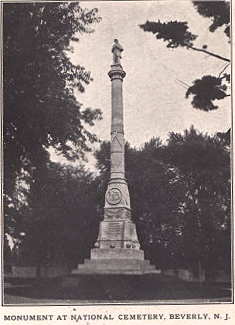
Top left: Clementon, NJ, World War II memorial. Top right: Beverly National Cemetery interment record. Bottom: Beverly National Cemetery monument, Beverly, NJ.