Joseph C. Arrison
Rank: Machinist’s Mate Third Class, U.S. Navy
Entered service from: New Jersey
Died:
Burial: Section D, Plot KK-17-5 — Calvary Cemetery, Pennsauken, NJ
Awards: Purple Heart
Introduction
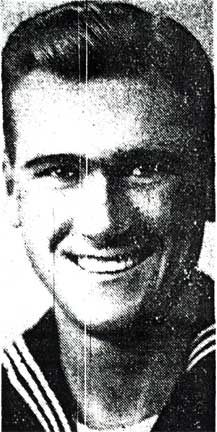
Machinist’s Mate Third Class Joseph C. Arrison
Machinist’s Mate Third Class Joseph C. Arrison was born on March 6, 1923 to Joseph T. and Myrtle Arrison. He grew up in Pennsauken, NJ, attended St. Cecelia’s Church, and was a member of the Holy Name Society. He graduated from Pennsauken Junior High School. He worked as a machinist for a firm in Pennsauken before entering the United States Navy on February 2, 1943. Joseph Arrison received his basic training at Sampson, NY, and was sent to the Wentworth Institute, near Boston, MA, for further training, graduating from that course on August 7, 1943. After another month’s training in New York, he transferred to a Navy base and was assigned to the newly built destroyer USS Twiggs (DD-591) for sea duty.
Joseph C. Arrison was reported missing following a collision at sea near Norfolk, VA while serving with the United States Navy, at the age of 20, on March 5, 1944. His body was later recovered. He was survived by his parents, Mr. and Mrs. Joseph Thomas Arrison of 2309 Cove Road in Pennsauken, NJ, a brother Charles, and a sister Marie, both still living at home at the time of his death. Joseph Arrison was also survived by his fiancée, Miss Pearl Kelly of Pennsauken, whose wedding had been postponed till after the war when he left for the Navy. His death was reported in the evening edition of the March 10, 1944 Camden Courier-Post. His body was recovered and sent home to New Jersey, where he was buried on April 20, 1944.
Grave
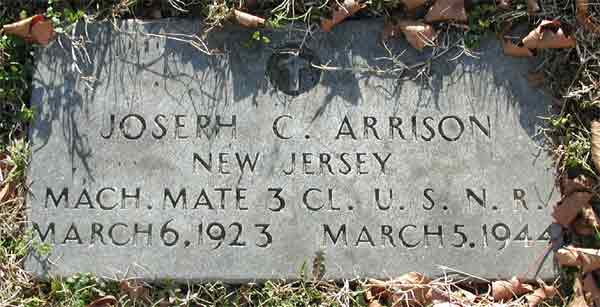
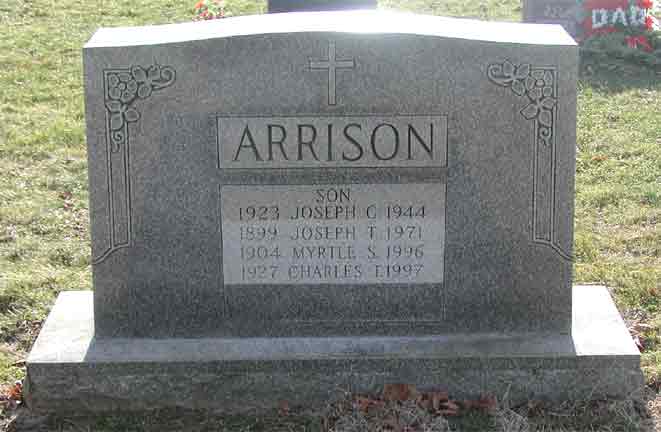
Grave of Joseph C. Arrison, Calvary Cemetery, Pennsauken, NJ
3 South Jersey Men Are Killed In Action
Camden Courier-Post —
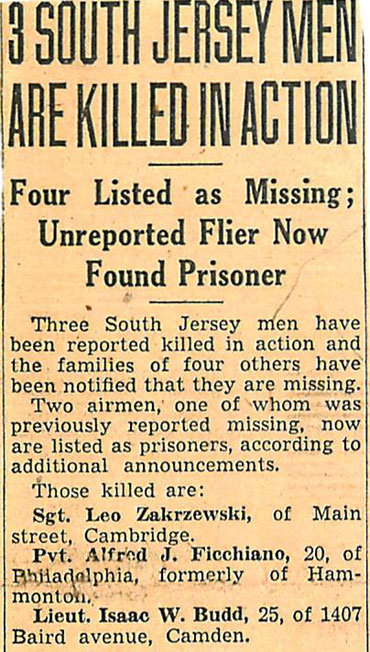
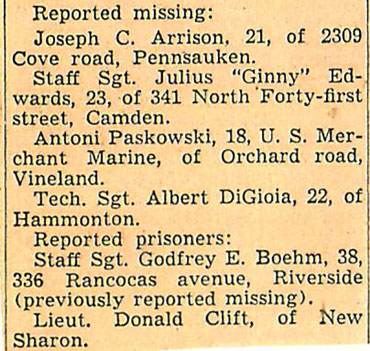
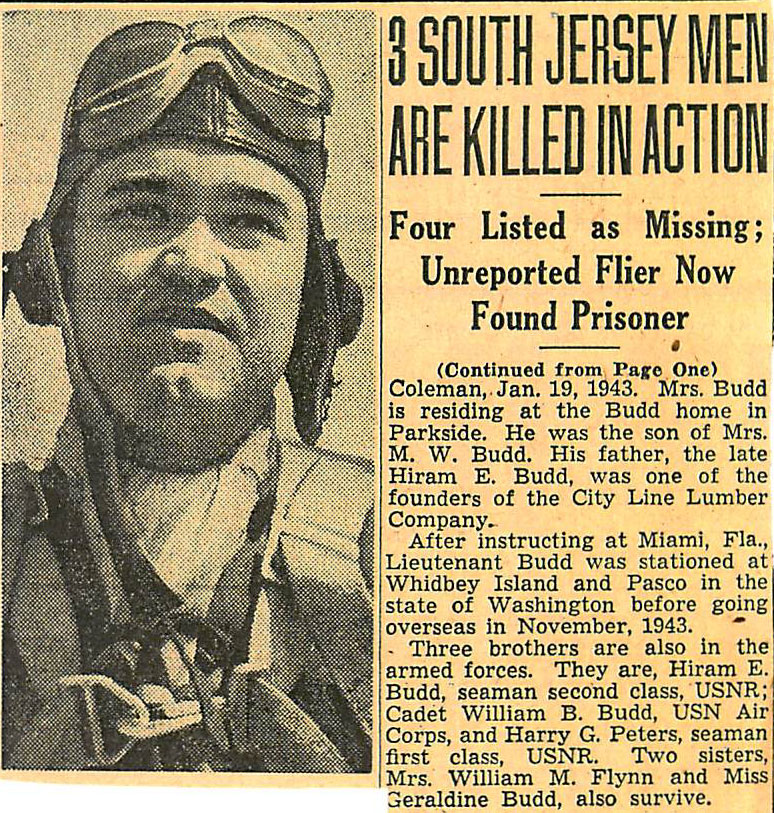
Three South Jersey men have been reported killed in action and the families of four others have been notified that they are missing. Two airmen, one of whom was previously reported missing, now are listed as prisoners, according to additional announcements.
Those killed are: Sgt. Leo Zakrzewski, of Main street, Cambridge; Pvt. Alfred J. Ficchiano, 20, of Philadelphia, formerly of Hammonton; Lieut. Isaac W. Budd, 25, of 1407 Baird avenue, Camden.
Reported missing: Joseph C. Arrison, 21, of 2309 Cove road, Pennsauken; Staff Sgt. Julius “Ginny” Edwards, 23, of 341 North Forty-first street, Camden; Antoni Paskowski, 18, U.S. Merchant Marine, of Orchard road, Vineland; Tech. Sgt. Albert DiGioia, 22, of Hammonton.
Joseph C. Arrison Funeral Monday
Camden Courier-Post —
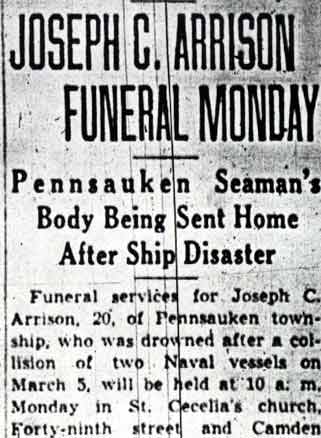
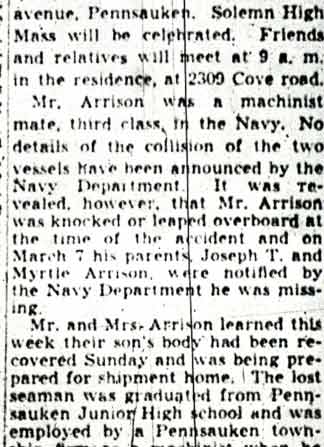
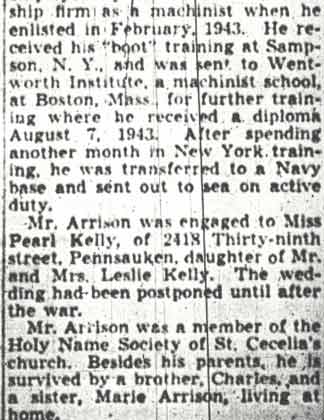
Funeral services for Joseph C. Arrison, 20, of Pennsauken township, who was drowned after a collision of two Naval vessels on March 5, will be held at 10 a.m. Monday in St. Cecelia’s church, Forty-ninth street and Camden avenue, Pennsauken. Solemn High Mass will be celebrated. Friends and relatives will meet at 9 a.m. in the residence, at 2309 Cove road.
Mr. Arrison was a machinist mate, third class, in the Navy. No details of the collision of the two vessels have been announced by the Navy Department. It was revealed, however, that Mr. Arrison was knocked or leaped overboard at the time of the accident and on March 7 his parents, Joseph T. and Myrtle Arrison, were notified by the Navy Department he was missing.
Mr. and Mrs. Arrison learned this week their son’s body had been recovered Sunday and was being prepared for shipment home. The lost seaman was graduated from Pennsauken Junior High school and was employed by a Pennsauken township ship firm as a machinist when he enlisted in February, 1943. He received his “boot” training at Sampson, N.Y., and was sent to Wentworth Institute, a machinist school, at Boston, Mass., for further training where he received a diploma August 7, 1943. After spending another month in New York training, he was transferred to a Navy base and sent out to sea on active duty.
Mr. Arrison was engaged to Miss Pearl Kelly, of 2418 Thirty-ninth street, Pennsauken, daughter of Mr. and Mrs. Leslie Kelly. The wedding had been postponed until after the war. Mr. Arrison was a member of the Holy Name Society of St. Cecelia’s church. Besides his parents, he is survived by a brother, Charles, and a sister, Marie Arrison, living at home.
USS Twiggs (DD-591)
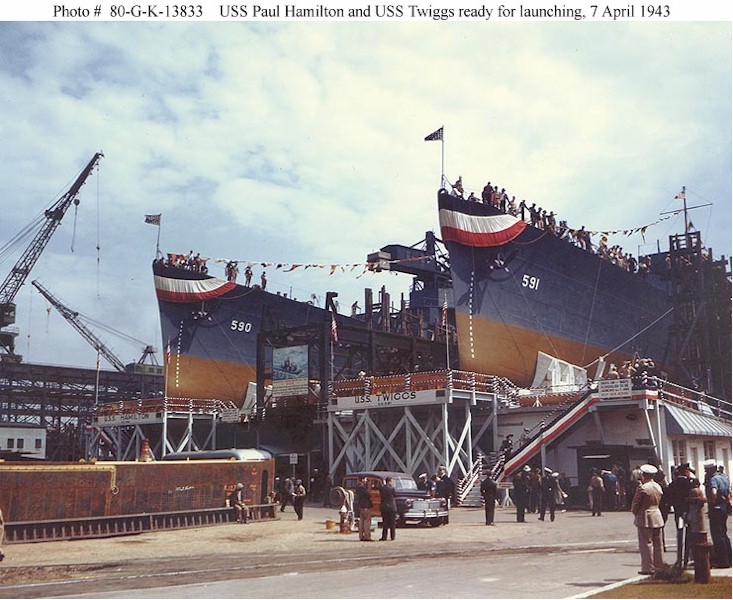
USS Twiggs (DD-591)
The USS Twiggs (DD-591) was a Gleaves-class destroyer commissioned on November 10, 1943. In the early months of 1944, the Twiggs was operating out of Naval Operating Base, Norfolk, Virginia as a training ship for destroyer nucleus and balance crews in the lower Chesapeake Bay area.
On March 5, 1944, while getting underway from Berth 54, Pier 5, N.O.B., Norfolk at 0848, the Twiggs was in collision with the SS James Elwood Jones, which had previously sounded danger signals. The Liberty ship collided with the destroyer at frames 184 to 192 on the port side, flooding compartment C-205-L. During the collision, Machinist’s Mate Joseph Arrison was lost overboard. Despite search efforts, he was initially listed as missing. His body was subsequently recovered and returned to his family in Pennsauken.
The USS Twiggs survived the 1944 collision and went on to serve in the Pacific theater. She was sunk on June 16, 1945, during the Battle of Okinawa, when she was struck by a Japanese “Jill” torpedo bomber in a Kamikaze attack. The vessel sank in thirty minutes with the loss of 188 of her crew.
War Diary of the USS Twiggs — March 5, 1944
CONFIDENTIAL — UNITED STATES SHIP TWIGGS (DD-591) — Sunday 5 March 1944
08 to 12: Moored as before. 0820 USS FRANKFORD underway from starboard side of USS PAUL HAMILTON. 0848 Having made all preparations, got underway from Berth 54, Pier 5, N.O.B., Norfolk, Va., captain at conn, navigator on the bridge, steering various courses at various speeds to maneuver out of slip. 0850 All engines stopped to allow HMS PREMIER to cross astern approaching north side of Pier 5. 0855 Maneuvering on various courses at various speeds, backing into channel. 0858 SS JAMES ELWOOD JONES coming up channel on the port quarter sounded danger signal, having previously sounded one blast, repeated at three different times. All engines ahead emergency full. 0859 SS JAMES ELWOOD JONES collided with this ship at frames 184 to 192 on port side flooding compartment C-205-L. Sounded collision quarters. 0900 All engines stopped. 0901 Let go port anchor. 0906 Having made emergency tests, having shifted steering control aft, anchors aweigh and underway, assisted by tug PEERLESS, pilot at the conn, returning to south side of Pier 5, N.O.B., Norfolk, Va. 0924 Moored port side to Berth 58, Pier 5, N.O.B., Norfolk, Va. 0931 Secured from collision quarters. All trainees left the ship. 0936 Preliminary medical report shows following men injured in collision: SMITH, Jack R., MM3/c; MERITT, R. B., Fl/c; GATER, Norman, Fl/c; WINWARD, L. A., MMS/c; COOKSEY, B. H., Fl/c. 0945 Held quarters for muster. Absentees: ARRISON, Joseph Charles, MM3/c, V-6, USNR; LONG, C. D., Fl/c; HACKETT, R. E., SC1/c; PAPACALOS, D. G., S1/c; REVENEW, R. R., PhM3/c.
The Last Day of USS Twiggs
By Ernest Herr, USS O'Bannon Shipmates Association —
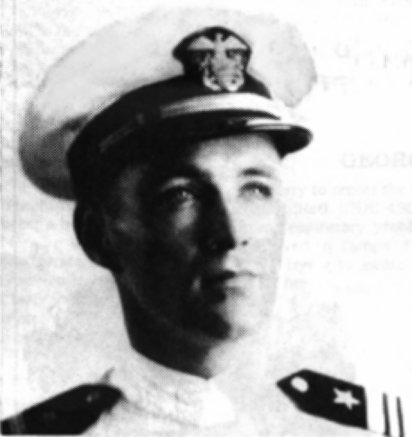
Commander George Philip, Commanding Officer, USS Twiggs (DD-591)
By the third week in June the battle for Okinawa was drawing to a bitter end. Implacably the forces of General Buckner were closing in on the remnant regiments of Ushijima’s 32nd Army, standing in the craggy hills of southern Okinawa with their backs to the sea. The Navy, too, closed in. Shore bombardments were called for as the cornered Japanese forces neared land’s end. These were dangerous assignments, for the enemy forces were dying hard. And the Kamikaze flyers were setting the pace. During the evening of June 16, the rabid airmen struck again. One of them struck at a destroyer which was standing offshore for bombardment duty — the USS Twiggs, captained by Commander George Philip.
Time: about 2030. The plane, a “Jill” torpedo bomber, dropped down out of the dusk like a thunderbolt. When detected, it was less than 1,000 yards from the destroyer, and coming with the velocity of a bullet. An unleashed torpedo knifed into the water and raced at the ship. Before Twiggs could be swung away, the torpedo ripped into the No. 2 magazine. Then the plane crashed into the ship aft. Torpedo explosion — magazine explosion — aircraft explosion — the triple blasting tore the destroyer’s frame and sent sheets of fire throughout her superstructure. Damage controlmen never had a chance. And in an instant, the ship was a furnace, with men fighting their way topside to escape roasting heat and suffocating smoke, only to find the deck a burning griddle.
All able hands rallied to rescue the wounded, battle the fire, and save the ship, but the Twiggs had become a death-trap. Thirty minutes after the Kamikaze smash, the ship’s after magazine blew up with a shattering detonation. The vessel plunged immediately. Down with her she took 18 of her 22 officers. One hundred and sixty-five men were lost with the ship. Down with the destroyer went her captain, Commander Philip.
The survivors drifted in clots on the sea, and waited for help to come. Presently the destroyer Putnam arrived to pick up these latest victims of the “Divine Wind.” Many of the 131 who were recovered needed surgery and hospitalization. The three surviving officers were among the wounded: the Twiggs disaster was one of the few in which every officer in the embattled ship was either killed or injured. She was the twelfth destroyer downed off Okinawa, and she was downed in the twelfth week of the campaign. One destroyer a week, and a destroyer-escort in addition. “Operation Iceberg” and the Japanese Kamikaze program would never be forgotten by the US Navy’s destroyer men. But the campaign was not over. Okinawa had yet to be secured.