John S. Mac Laughlin, Jr.
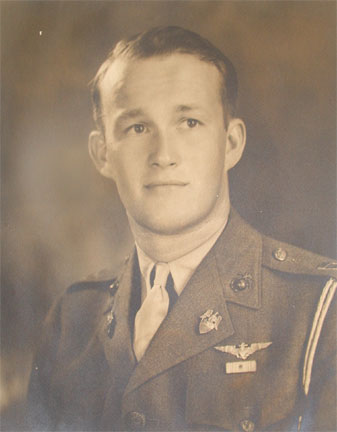
Lieutenant Colonel John S. Mac Laughlin, Jr. of Collingswood, NJ.
Rank: Lieutenant Colonel, U.S. Marine Corps
Serial Number: O-005801
Unit: Marine Fighter Squadron VMF-422
Hometown: Collingswood, New Jersey
Died: , Missing in Action or Buried at Sea
Memorial: Tablets of the Missing, Honolulu Memorial, Honolulu, Hawaii
Lieutenant Colonel John S. Mac Laughlin, Jr. was born in 1915. His father was an accountant for the Phosphor Bronze Smelting Company of Philadelphia. He grew up in Collingswood, NJ, attending St. John’s parochial school, and was a 1932 graduate of Collingswood High School. He attended Alabama Polytechnic Institute for one year before entering the United States Naval Academy at Annapolis, MD, where he graduated in 1938. He was active in soccer and lacrosse.
Upon graduation, John Mac Laughlin was commissioned in the United States Marine Corps and was stationed at the Philadelphia Navy Yard for one year. He was then sent to the Pensacola Naval Air Station, FL, for flight training, where he received his wings and was promoted to First Lieutenant in 1940. On June 7, 1940, he married Miss Naomi Oppenheimer in Pensacola.
John Mac Laughlin was then transferred to the Coronado Naval Air Station near San Diego, CA. In 1941 he was appointed aide to General Ross G. Rowell, Commander, Marine Air Wings, Pacific, and promoted to Captain. He was sent to Hawaii for seven months, returning to California in the summer of 1942.
In April 1943 he was promoted to Major and given command of Marine Fighter Squadron VMF-422. The squadron went to the Pacific in October of 1943. On January 24–25, 1944, his entire squadron was caught in a typhoon on a flight from the Gilbert Islands to the Ellice Islands. Twenty-one of the twenty-three planes in the squadron were forced down by the storm. Major Mac Laughlin was among those who did not survive.
A Major at the time of his disappearance, John Mac Laughlin was posthumously promoted to the rank of Lieutenant Colonel while still listed as missing, and was officially declared dead on January 25, 1945.
John Mac Laughlin was survived by his wife, Naomi (the former Naomi Oppenheimer), and their nine-month-old son, John Mac Laughlin III. He was also survived by his parents, of 23 Merrick Villa, Collingswood, NJ, and two sisters: Edith, who had served as a Navy nurse, and Lorna, who served in the Navy WAVES. His loss was reported in the February 4, 1944 edition of the Camden Courier-Post. His name appears on the World War II War Memorial at Knight’s Park in Collingswood, NJ.
Photos
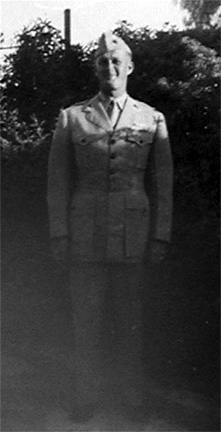
John S. Mac Laughlin, Jr.
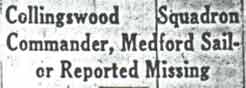
Collingswood Squadron Commander, Medford Sailor Reported Missing
Camden Courier-Post —
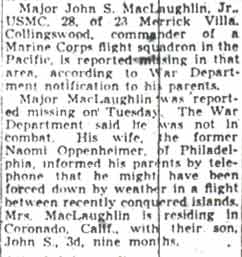
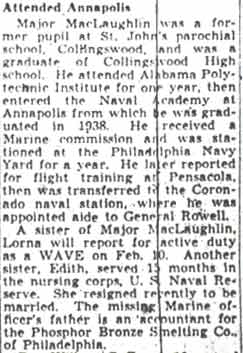
Major John S. MacLaughlin, Jr., USMC, 28, of 23 Merrick Villa, Collingswood, commander of a Marine Corps flight squadron in the Pacific, is reported missing in that area, according to War Department notification to his parents. Major MacLaughlin was reported missing on Tuesday. The War Department said he was not in combat. His wife, the former Naomi Oppenheimer, of Philadelphia, informed his parents by telephone that he might have been forced down by weather in a flight between recently conquered islands. Mrs. MacLaughlin is residing in Coronado, Calif., with their son, John S., 3d, nine months old.
Attended Annapolis: Major MacLaughlin is a former pupil at St. John’s parochial school, Collingswood, and was a graduate of Collingswood High school. He attended Alabama Polytechnic Institute for one year, then entered the Naval Academy at Annapolis from which he was graduated in 1938. He received a Marine commission and was stationed at the Philadelphia Navy Yard for a year. He later reported for flight training at Pensacola, then was transferred to the Coronado naval station, where he was appointed aide to General Rowell. A sister of Major MacLaughlin, Lorna will report for active duty as a WAVE on Feb. 10. Another sister, Edith, served 13 months in the nursing corps, U. S. Naval Reserve. She resigned recently to be married. The missing Marine officer’s father is an accountant for the Phosphor Bronze Smelting Co. of Philadelphia.
Major M'Laughlin Missing on Flight
Camden Courier-Post
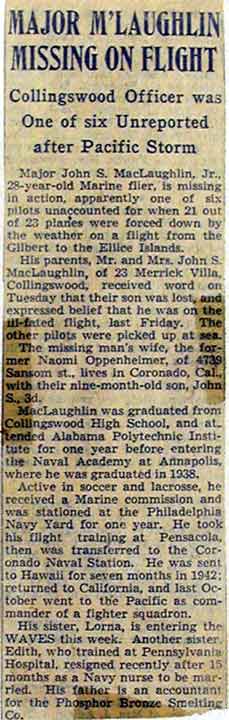
Major John S. MacLaughlin, Jr., 28-year-old Marine flier, is missing in action, apparently one of six pilots unaccounted for when 21 out of 23 planes were forced down by the weather on a flight from the Gilbert to the Ellice Islands.
His parents, Mr. and Mrs. John S. MacLaughlin, of 23 Merrick Villa, Collingswood, received word on Tuesday that their son was lost, and expressed belief that he was on the ill-fated flight, last Friday. The other pilots were picked up at sea. The missing man’s wife, the former Naomi Oppenheimer, of 4739 Sansom st., lives in Coronado, Cal., with their nine-month-old son, John S., 3d.
MacLaughlin was graduated from Collingswood High School, and attended Alabama Polytechnic Institute for one year before entering the Naval Academy at Annapolis, where he was graduated in 1938.
Active in soccer and lacrosse, he received a Marine commission and was stationed at the Philadelphia Navy Yard for one year. He took his flight training at Pensacola, then was transferred to the Coronado Naval Station. He was sent to Hawaii for seven months in 1942; returned to California, and last October went to the Pacific as commander of a fighter squadron.
His sister, Lorna, is entering the WAVES this week. Another sister, Edith, who trained at Pennsylvania Hospital, resigned recently after 15 months as a Navy nurse to be married. His father is an accountant for the Phosphor Bronze Smelting Co.
Collingswood WWII Memorial Information Card
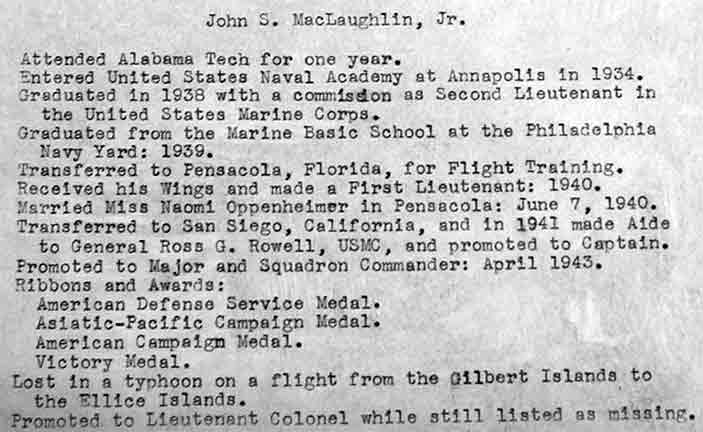
Collingswood World War II Memorial information card for Lieutenant Colonel John S. Mac Laughlin, Jr.
A Tale of Heroes
By Justin King — Edited by Jeremy Rouse
My friends, Fellow readers, I would like to spend the time to tell you a story, a story that is as true as the sky is blue. A story of true patriotism, bravery, and actions that had been taken throughout this country’s history by the men and women in uniform who have served this country with great honor and pride so that we Americans can live with the freedoms we have today. A story that in my hopes will never be forgotten so that future generations can realize that this is just one of millions of stories of sacrifice, honor, and duty that so many before them have shown in the face of odds that were most definitely stacked against them. A story of a Marine — yet not just any Marine, but my grandfather. A man that I will always be proud of, about whom I will always speak to those who will listen, and who I will always hold in the highest regard.
My grandfather, who had fought in a few wars as a Marine fighter pilot, had started his career during WW2. Like many of his counterparts he was a young patriot calling up to join the fight against an enemy who had struck the forces of America without reason. As a child, I can remember wearing my grandfather’s Marine cover — his khaki one stands out the most in my memory. I always felt so proud donning it. I remember wearing his test pilot helmets that were three times my size, and feeling like a grown pilot wearing it instead of the young child I was. I remember how he would pick up Marine hats for us, his grandkids, and how he would sternly and quickly correct my aunts when they called them “Army hats.” I learned very young that there was a truly distinct difference between the Army and Marines by one who would know; a Marine. I remember his medals that I had finally seen after years of having been left in a drawer no doubt; medals that he received over his career; medals that I felt proud and truly blessed to even look at. I knew that, like many Marines of his era, he didn’t think that he was a hero. Yet in my eyes and the eyes of many others he was, and still is. The actions and sacrifices these men had made had secured our existence to this day. I was amazed by some of the stories I would hear from him and those in my family who knew him well. Stories of his service through out his lengthy career from which he finally retired in 1992. Yet one tale always caught my curiosity: a tale about a lost squadron, a tale of desperation, bravery — and at long last, survival. After combing books and finding out-of-print magazines and articles with the help of my other grandfather (who is the ultimate authority in airplane history,) I was able to produce a well-documented story, and this is the story I will share with you today.
My grandfather belonged to VMF 422, which was organized on New Year’s Day of 1943 in San Diego. Before it was a month old, the squadron was moved to Santa Barbara where the men were given their full course of fighter pilot training. From here, they were sent upon the USS Bunker Hill to Pearl Harbor, then off to Midway, where they went further into training and served as a fighter defense force. On the 15th of December, 1943, the squadron had been issued the most famed F4U1D Corsair “whispering death” nicknamed by the Japs. This famous gull-winged fighter was considered a favorite by the many pilots from the era with whom I’ve spoken (including my grandfather.) These planes were equipped with six .50 cal. guns carrying a full 2400 rounds of ammunition, well prepared for any enemy that the fighter may come across. A Vietnam Huey pilot veteran told me that the Corsair was given to the Marines because the Navy didn’t want them. Well the Marines ended up turning that fighter into one of the most greatest fighters of the war, serving on into Korea and after, fighting for France in central Asia. It was a fighter that could take a pounding and still give it back — a fighter suitable for a Marine.
On the date of January 25th 1944 VMF422 was about to be baptized by an uncontrollable enemy: Fate. At 0930 hours, 23 of the 24 F4U’s embarked from Hawkins field on Tarawa atoll. They were going to Funafuti with a stop over in Nanomea, a distance of 463 miles from Tarawa. (The 24th pilot didn’t end up taking off due to engine issues.) So onward, 23 planes headed toward Nanomea with great flying weather. Two hours into the flight — fifteen minutes from the refueling point of Nanomea — the Squadron entered into what would become an enemy worse than the Japanese, who they had trained for so long to fight.
I’ve read that there were many possible reasons for what was about to happen. One reason was due to Major John MacLaughlin not requesting a escort plane to accompany the squadron; another reason was a missed weather report or communications issues between the islands. Nonetheless, the squadron of VMF 422 entered into a enormous storm front that sent their way an unbelievable rain, that according to Major Mark W. “Breeze” Syrkin was “As if a fire hose were being turned on the front of the aircraft.” I guarantee you that this was absolutely horrifying for the squadron. Yet being Marines, they pressed onward as the storm ravished the squadron causing communication break-ups and leaving absolute confusion. Lt. John Hansen had lost contact of his crew and luckily found the Funafuti radio range — and after five hours in the air, landed with 80 of his 350 gallons of fuel left. Lt. Jake Wilson had also lost contact. Flying alone, he found a break in the weather over an Island Niutao atoll and crash landed in a lagoon. There he was taken ashore by natives. At this point twenty planes led by Maj. MacLaughlin flew on.
Lt. Chris Lauesen had radioed that his engine was dying out. Lt. Curly Lehnert followed him down. He had circled until he noticed Mr. Lauesen was having trouble with his life raft — at this Curly bailed out to help him (which earned him the Marine Corps Medal.) Yet, by the time Curly was able to inflate his own life raft Mr. Lauesen had disappeared under twenty foot waves. There Curly stayed floating in the sea, alone. 48 hours later he was rescued by a PBY. Lt. Lauesen was never found.
Now only eighteen flew on with Capt. John Rogers, also missing. Over the next several hours one by one pilots began to drop from the formation — or in Major MacLaughlin’s case, fly into the abyss of the dark and formidable storm clouds. Lts. Tommy Thompson, Ted Thurneau and Bill Aycrigg were later reported to have crash landed into the sea. Lt. Bob “Tiger” Moran was listed as missing, until some time after the long search was terminated the natives of Nui island had notified the Marine Corps that they had seen him parachute over the beach but got tangled up in his shroud lines. The Marine landed in the surf yet with all of his fighting he failed to save himself from the ocean’s grip, and he was drowned before the natives could reach him. The natives gave him a ceremonial burial and there laid him to rest in their own graveyard.
Completely overwhelmed by the elements and with no place to land safely, Capt. Rex Jeans made a decision that just may had saved the remaining men’s lives. He ordered the remaining 13 pilots to make a traffic pattern over the sea and crash land at that point after they would latch their rafts together and ride the storm out. This way they would not lose contact with each other again.
The crash landing happened with almost no issue, save for Lt. Mark “Breeze” Syrkin who barely made it into his life raft with a shark hot on his tail. Chick Whalen, one of the last in the formation, had struck his head upon landing and was franticly flopping in the sea. My grandfather Lt. John “Abe” Lincoln, already in his raft, had left the gathering formation of rafts and floated himself to Chick, and pulled him into his own raft. Mr. Whalen had been so frantic that reportedly he had removed almost all of his flight gear and clothes while flailing in the ocean. (Soon after this event, Mr. Whalen had grounded himself and was sent back to the U.S. only to eventually return to Korea as a well-respected ground officer during the Korean war.) There, almost unconscious, Mr. Whalen and my grandfather Lt. “Abe” Lincoln reconnected with the group of eleven, becoming twelve rafts harboring thirteen Marines from the unforgiving sea. The ocean opened up its worst on the men: some were bleeding, others sick, and Lt. Syrkin’s shark being joined by two others did not make things any better. Lt. Don Walker broke into song, “It ain’t going to rain no more, no more.” His song was sadly far from the truth.
For the next two days, the sea seemed to pour its worse on the pilots. They sat, drenched and shivering, through two nights of horrendous downpours and waves that nearly flipped them over constantly. The relentless three sharks had continued to swim nearer and nearer to the rafts and the men would fire their pistols to fend them away. At one point, they had even given names to the sharks: Oscar, Leroy, and Herbert. They identified each by the sharks’ dorsal markings. During those two days, the men who had joined up to fight the good fight went through some of the worst Mother Nature could offer. They lived off of malted milk tablets and even pieces of a seagull that had landed on Capt. Charley Hugh’s raft. They suffered from the elements and also from the constant transfer of Mr. Whalen: the rafts made for one man were just not able to hold two for too long, as it caused not only stress on the pilots but also their rafts.
On the third day as they were preparing themselves for the night ahead, my grandfather John Lincoln had noticed something in the sky. Flying above was a PBY Catalina flown by Lt. George Davidson of the Navy Patrol Squadron 53. The U.S. forces had been for the past day or two performing one of the greatest search and rescues of the entire Pacific campaign. Now above the floating Marines the PBY, their salvation, had spotted them. The pilots had been firing flares and even their pistols in the air to get its attention. The PBY flew overhead, tilted its wings, and after a few circles landed. Yet the plane’s landing on the rough seas had cracked the hull. It seemed as if luck was not on their side. Lt. George Davidson of the PBY had gotten the thirteen Marines into his hull but with the Marines and seawater filling the plane there was no way he could take off. He at once did what he could to keep from sinking and radioed his position back to base. That evening before dark, the USS Hobby, a destroyer that had been searching, had answered their call. Without hesitation, they took the survivors and their would-be rescuers aboard. In all, VMF 422’s losses were 22 planes and six pilots. The surviving Marines were brought back to base and they healed up the best they could. Within a short time, they were refitted with planes, and were back at it again to do their duty as Marines. Their sacrifice and that of the ones who didn’t make it on this fateful voyage will never be forgotten.
Every day we as Americans should awake and thank God for those men and their courage, who have secured our rights as free Americans; and we as free Americans should not and can not allow that freedom to be taken by anyone, lest their sacrifice be proved vain.
My grandfather, after a long and eventful career in the Marine corps, retired in 1992. Yet once a Marine, always a Marine. In August of the year 2000, he lost the fight with cancer. Yet his spirit, the same spirit that kept him going in the stormy seas of the Pacific, lives on. I will never forget him or his contribution to this nation of ours. I ask you, the reader, to do the same. Never forget any of those honorable warriors who gave it all for our society. Keep their spirits alive and forever honor them. For in no small way it is they who we have the honor to thank for our freedoms.
—J. King