A Postcard’s Story: Mystery Postcard — Who was John Randolph Watson?
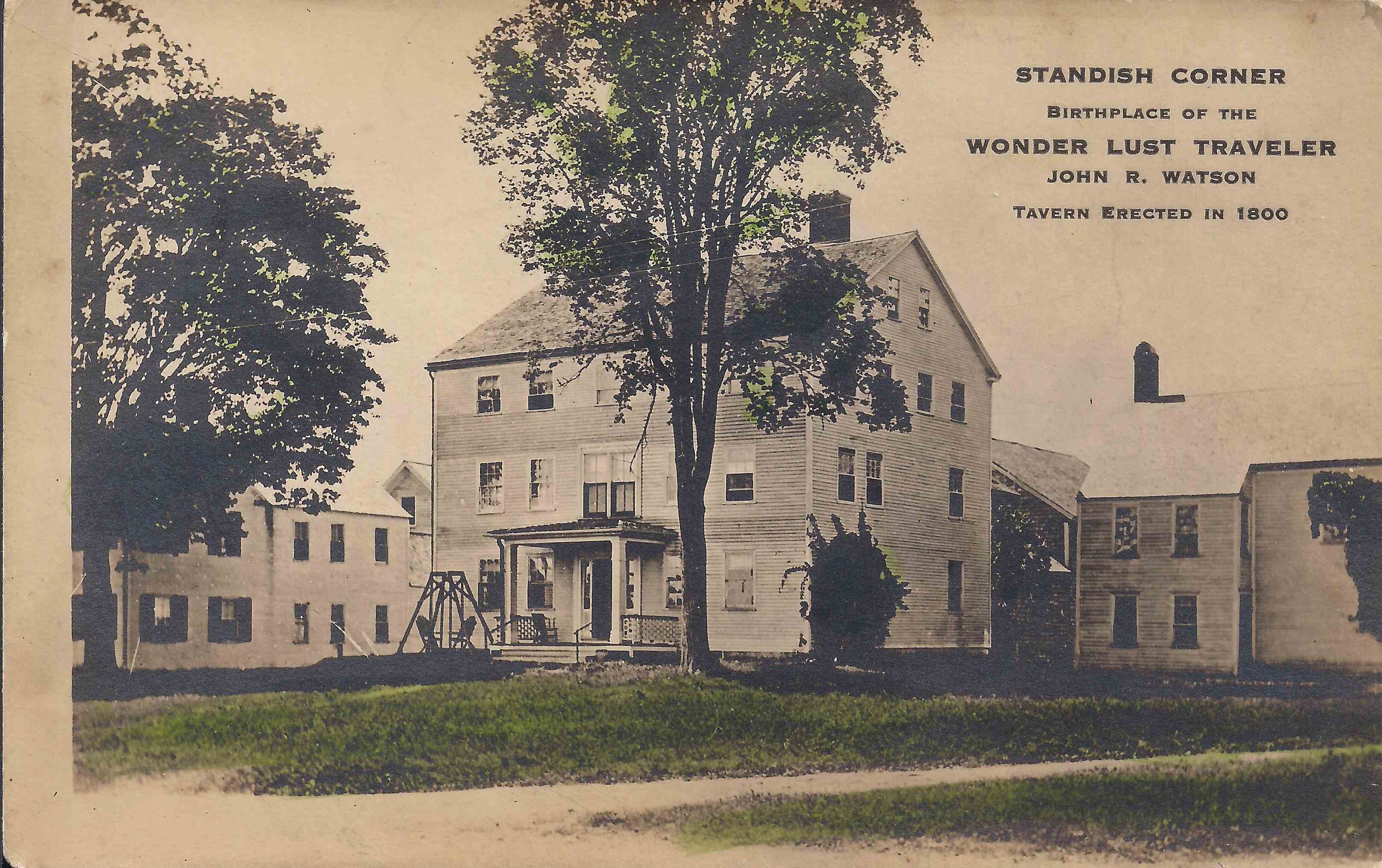
Postcard front: Standish Corner, Maine — “Birthplace of the WONDER LUST TRAVELER, JOHN R. WATSON. Tavern Erected in 1800.”
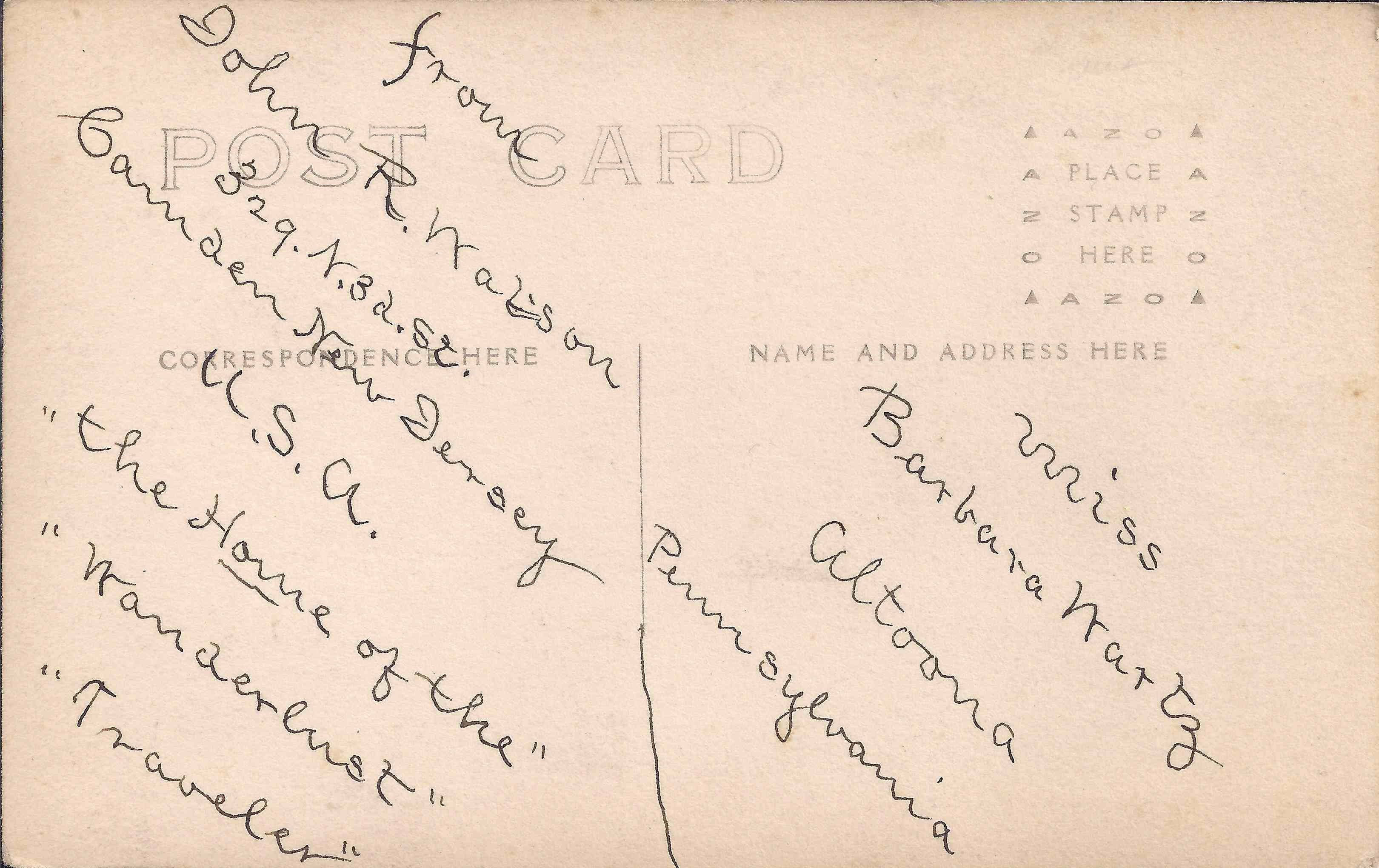
Named: Postcard reverse: From John R. Watson, 329 N. 3d St., Camden, N.J., “The Home of the ‘Wanderlust’ ‘Traveler’”, and To Miss Barbara Martz, Altoona, Pennsylvania.
Over Memorial Day weekend of 2015, I received an e-mail from Carl Gainsborough containing the two scanned images above. As you can see, the never mailed postcard is of a tavern in Standish Corner, and the rear shows the name and address of the sender. Carl called it a mystery… and that is about all it took to get me interested in the card and the people named.
The first thing that caught my eye was the address, which Carl took for 329 North 32nd Street. John R. Watson’s lower case “d” does resemble a “2,” and the actual address was 329 North 3rd Street. I used the address to determine when the postcard had been signed. John R. Watson appeared at that address in the 1910 Census, and in City Directories from 1913 through late 1918. The census of 1920, which was taken in January, shows that he had moved to 300 Cooper Street. That frames the date as being any time between the spring of 1912 and late summer of 1918.
With the “when” established, it was time to move on the “who.” Who were John R. Watson and Miss Barbara Martz? To date I have not nailed down who Miss Martz was with any certainty. In the case of John R. Watson, I have found quite a bit, and it is a fascinating story taking us into an earlier and quite different time in America.
John Randolph Watson — The Wonder Lust Traveler
John Randolph Watson was born in Standish, Maine on May 29, 1836. He was the third of four children born to Stephen C. Watson and his wife, the former Lucy Paine, coming after older brothers Samuel S. Watson and Charles Watson, and before sister Phoebe Watson. The family was living in Limington Maine when the Census was taken in 1850. Stephen C. Watson was working as a window sash and blind maker, while older brothers Samuel, 21, and Charles, 19, were, according to the Census, working as laborers — more likely as apprentices of some sort. Samuel Watson became a goldsmith and traveled extensively through the United States; in 1854 he married Mary P. Ingalls of Tremont, Illinois. Charles Watson moved to Camden, New Jersey. He met and married Amanda Archer in 1856, and by 1859 had opened a grocery in Camden’s North Ward. Amanda Archer’s younger brother, Benjamin F. Archer, became one of Camden’s leading businessmen in the 1800s, as a principal and after 1881 president of the Camden Gas Lighting Company. Benjamin Archer’s wife was Catherine Starr, daughter of Jesse W. Starr, who owned the Camden Iron Works foundry, and uncle, John F. Starr, served in Congress and was for many years president of the First Camden National Bank for over 30 years.
Samuel S. Watson settled down in Indianola, Iowa in the mid-1850s. His parents and younger brother came to live with him there; sadly his wife Mary passed away there in 1856. John R. Watson worked in Indianola in the late 1850s as a teacher and as a “daguerrian artist,” that is to say, as a photographer.
What John Watson did between 1859 and 1864 is not known. He came to Montana in 1864, one of the first settlers, with a small stock of groceries, and opened up the first store in what was to become the state capital, Helena. Samuel Watson married again and by 1866 had moved his family and mother to Montana. They too settled in Helena. Samuel Watson’s wife Louisa gave birth to a son, Stephen, around 1866. Another son, Leander, was born in 1869.
In Camden, Charles Watson appears also to have done quite well, as did his brother-in-law Benjamin F. Archer. A marriage was arranged between Benjamin Archer’s sister-in-law Sarah Starr and his younger brother John R. Watson. He traveled east and the two were wed in December of 1868. The couple then returned to Helena, where they were blessed with a son, Jesse Starr Watson, in March of 1870.
The 1870 Census shows the Samuel and John Watson, their mother, wives and children living in Helena. Samuel Watson had taken a post as an Internal Revenue collector, while John R. Watson continued in the grocery business. Sadly the family would go through a very tragic period in July of 1870. Young Jesse Watson died on July 7, his mother on July 8, and Leander Watson died on July 11.
John R. Watson never remarried. He remained in Helena as late as 1894, where he was a prominent figure in business circles and dabbled in politics. He retired from business around that time, although he had interests in Helena as late as 1899. When gold was discovered in the Klondike region of Alaska, the pioneer spirit returned to him, and although past 60 years of age, he headed north, leaving for Dawson in January of 1898, and arriving on June 1, with plans to stay throughout the winter into the following year. Trouble with his vision forced a return to Helena in August for an eye operation. He gave a long statement describing conditions in the Klondike, which was published in the Helena Independent newspaper on August 28, 1898.
For reasons that are not particularly clear at this time, John R. Watson left Montana and went to live with his brother Charles. He arrived at the family home, 223 Cooper Street at some point after June 6, 1900 when the Census was taken. John R. Watson first appears in Camden City Directories in 1901 at 223 Cooper Street and is last listed at that address in 1908.
Charles Watson, one of the best-known businessmen in Camden and one of its wealthiest citizens, died as a result of complications of a stroke in Camden on March 30, 1904, leaving a daughter, Emma, and his wife, the former Hannah Wilson. His first wife, Amanda Archer Starr had died in November of 1873.
The 1910 Census and Camden City Directories from 1913 through late 1918 show John R. Watson living at 329 North 3rd Street. By the time the Census was taken in January of 1920 he was rooming at 300 Cooper Street. John R. Watson does not appear in City Directories from 1920 forward, and given his age, 83 at the time of the 1920 Census, it is probable that he passed away not long afterwards.
John R. Watson did not lose his appetite for adventure and travel after arriving in Camden. He applied for passports in 1907, 1908, 1910, and 1911… even when he was past 70, he remained the Wonder Lust Traveler.
Watson Brothers — Helena City Directory, 1868
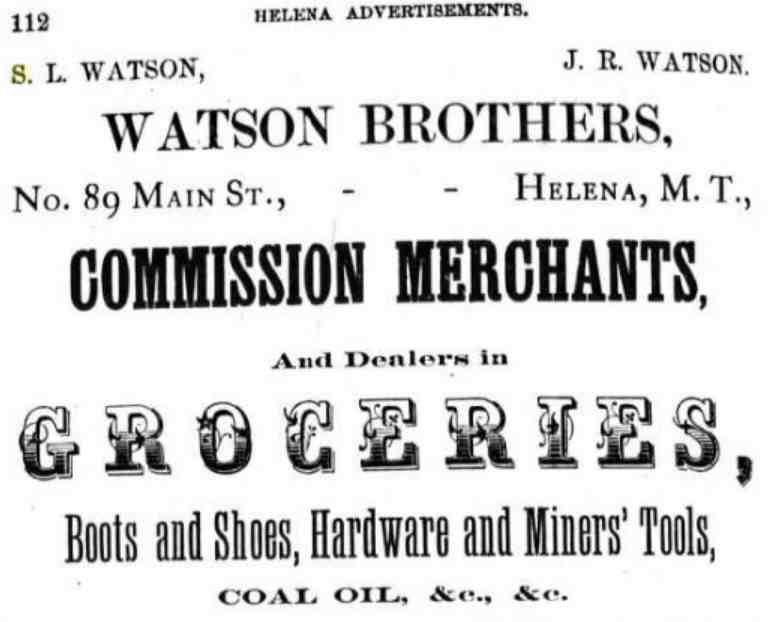
1868 Helena City Directory: Watson Brothers (S. L. Watson & J. R. Watson), Commission Merchants, No. 89 Main St., Helena, M.T. — Dealers in Groceries, Boots and Shoes, Hardware and Miners’ Tools, Coal Oil.
FROZEN FROM BELOW
Helena Independent —
Theory Advanced By Miners in the Klondike to Explain Great Depths of Frozen Ground
MOSS ADDS TO THE DIFFICULTIES — Effectually Conceals Outcroppings of Quartz Leads, and Makes Prospecting Extremely Laborious — John R. Watson Tells of Some of the Peculiarities of the North
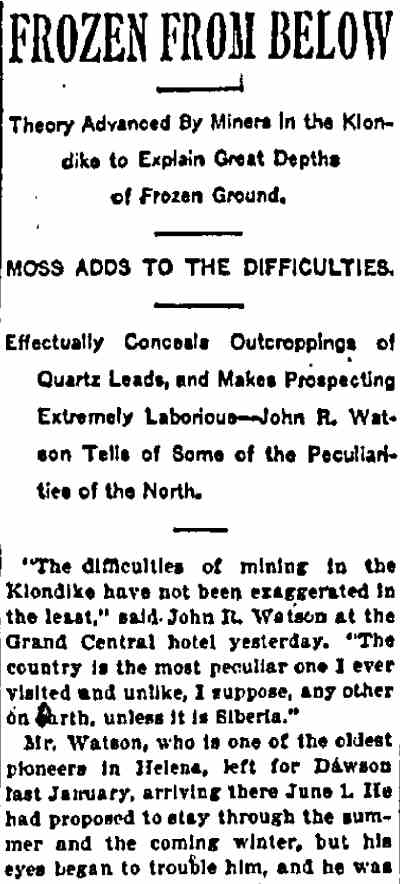
Helena Independent, August 28, 1898 — column 1
Helena Independent, August 28, 1898 — column 2
Helena Independent, August 28, 1898 — column 3
Helena Independent, August 28, 1898 — column 4
Helena Independent, August 28, 1898 — column 5
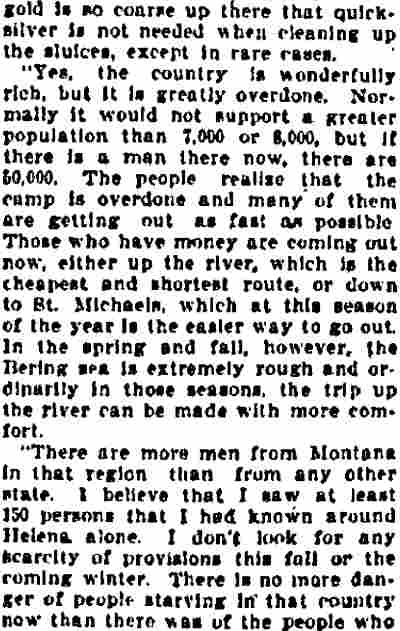
Helena Independent, August 28, 1898 — column 6
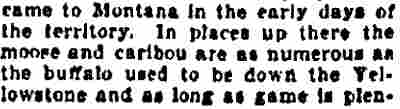
Helena Independent, August 28, 1898 — column 7
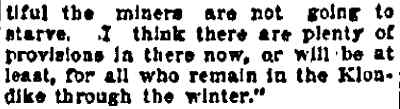
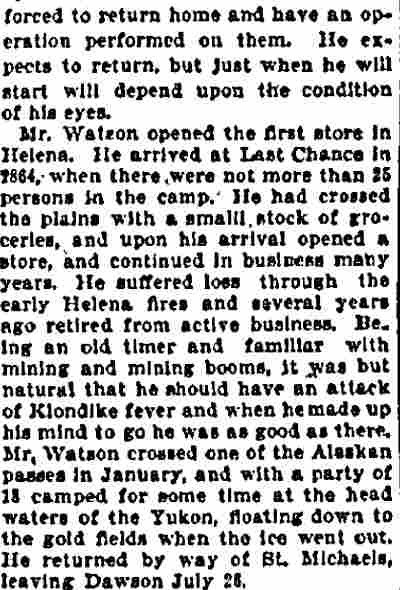
“The difficulties of mining in the Klondike have not been exaggerated in the least,” said John R. Watson at the Grand Central hotel yesterday. “The country is the most peculiar one I ever visited and unlike, I suppose, any other on earth, unless it is Siberia.”
Mr. Watson, who is one of the oldest pioneers in Helena, left for Dawson last January, arriving there June 1. He had proposed to stay through the summer and the coming winter, but his eyes began to trouble him, and he was forced to return home and have an operation performed on them. He expects to return, but just when he will start will depend upon the condition of his eyes.
Mr. Watson opened the first store in Helena. He arrived at Last Chance in 1864, when there were not more than 25 persons in the camp. He had crossed the plains with a small stock of groceries, and upon his arrival opened a store, and continued in business many years. He suffered loss through the early Helena fires and several years ago retired from active business. Being an old timer and familiar with mining and mining booms, it was but natural that he should have an attack of Klondike fever and when he made up his mind to go he was as good as there. Mr. Watson crossed one of the Alaskan passes in January, and with a party of 18 camped for some time at the head waters of the Yukon, floating down to the gold fields when the ice went out. He returned by way of St. Michaels, leaving Dawson July 28.
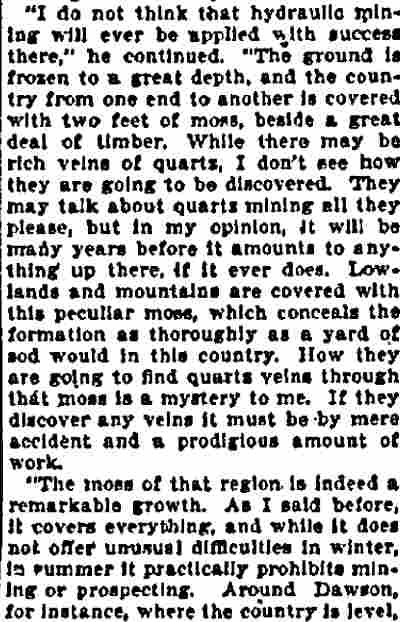
“I do not think that hydraulic mining will ever be applied with success there,” he continued. “The ground is frozen to a great depth, and the country from one end to another is covered with two feet of moss, beside a great deal of timber. While there may be rich veins of quartz, I don’t see how they are going to be discovered. They may talk about quartz mining all they please, but in my opinion, it will be many years before it amounts to anything up there, if it ever does. Lowlands and mountains are covered with this peculiar moss, which conceals the formation as thoroughly as a yard of sod would in this country. How they are going to find quartz veins through that moss is a mystery to me. If they discover any veins it must be by mere accident and a prodigious amount of work.
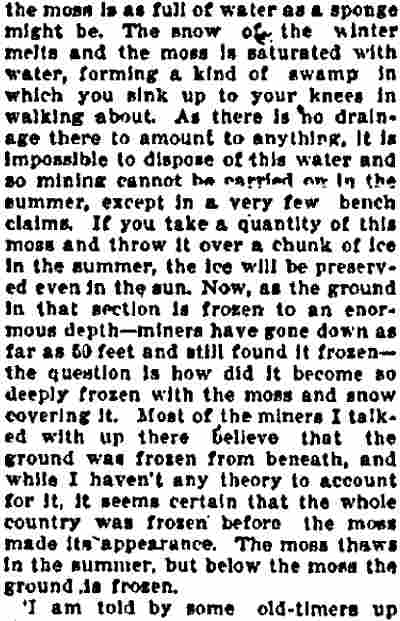
“The moss of that region is indeed a remarkable growth. As I said before, it covers everything, and while it does not offer unusual difficulties in winter, in summer it practically prohibits mining or prospecting. Around Dawson, for instance, where the country is level, the moss is as full of water as a sponge might be. The snow of the winter melts and the moss is saturated with water, forming a kind of swamp in which you sink up to your knees in walking about. As there is no drainage there to amount to anything, it is impossible to dispose of this water and so mining cannot be carried on in the summer, except in a very few bench claims. If you take a quantity of this moss and throw it over a chunk of ice in the summer, the ice will be preserved even in the sun. Now, as the ground in that section is frozen to an enormous depth — miners have gone down as far as 60 feet and still found it frozen — the question is how did it become so deeply frozen with the moss and snow covering it. Most of the miners I talked with up there believe that the ground was frozen from beneath, and while I haven’t any theory to account for it, it seems certain that the whole country was frozen before the moss made its appearance. The moss thaws in the summer, but below the moss the ground is frozen.
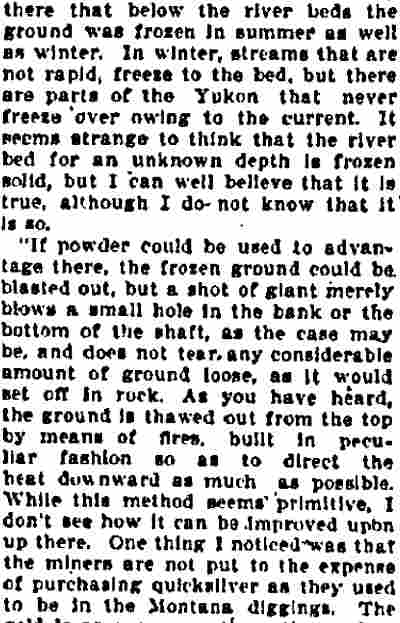
“I am told by some old-timers up there that below the river beds the ground was frozen in summer as well as winter. In winter, streams that are not rapid, freeze to the bed, but there are parts of the Yukon that never freeze over owing to the current. It seems strange to think that the river bed for an unknown depth is frozen solid, but I can well believe that it is true, although I do not know that it is so.
“If powder could be used to advantage there, the frozen ground could be blasted out, but a shot of giant merely blows a small hole in the bank or the bottom of the shaft, as the case may be, and does not tear any considerable amount of ground loose, as it would set off in rock. As you have heard, the ground is thawed out from the top by means of fires, built in peculiar fashion so as to direct the heat downward as much as possible. While this method seems primitive, I don’t see how it can be improved upon up there. One thing I noticed was that the miners are not put to the expense of purchasing quicksilver as they used to be in the Montana diggings. The gold is so coarse up there that quicksilver is not needed when cleaning up the sluices, except in rare cases.
“Yes, the country is wonderfully rich, but it is greatly overdone. Normally it would not support a greater population than 7,000 or 8,000, but if there is a man there now, there are 60,000. The people realize that the camp is overdone and many of them are getting out as fast as possible. Those who have money are coming out now, either up the river, which is the cheapest and shortest route, or down to St. Michaels, which at this season of the year is the easier way to go out. In the spring and fall, however, the Bering sea is extremely rough and ordinarily in those seasons, the trip up the river can be made with more comfort.
“There are more men from Montana in that region than from any other state. I believe that I saw at least 150 persons that I had known around Helena alone. I don’t look for any scarcity of provisions this fall or the coming winter. There is no more danger of people starving in that country now than there was of the people who came to Montana in the early days of the territory. In places up there the moose and caribou are as numerous as the buffalo used to be down the Yellowstone and as long as game is plentiful the miners are not going to starve. I think there are plenty of provisions in there now, or will be at least, for all who remain in the Klondike through the winter.”
CHARLES WATSON DEAD IN CAMDEN
Philadelphia Inquirer —
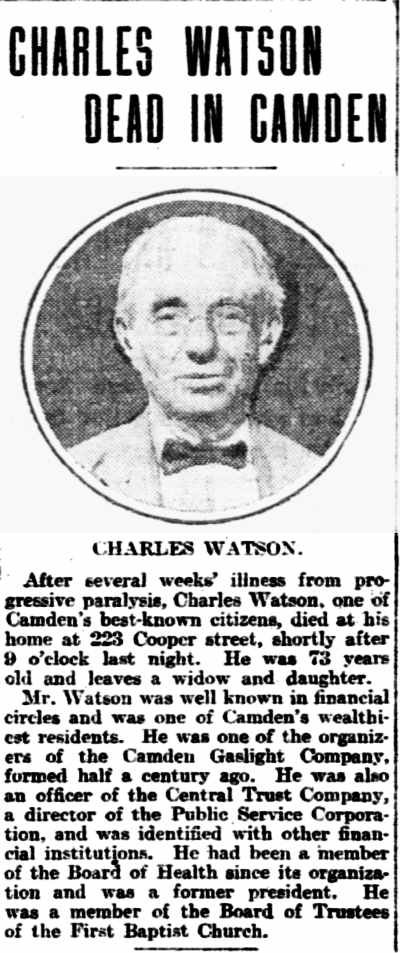
After several weeks’ illness from progressive paralysis, Charles Watson, one of Camden’s best-known citizens, died at his home at 223 Cooper street, shortly after 9 o’clock last night. He was 73 years old and leaves a widow and daughter.
Mr. Watson was well known in financial circles and was one of Camden’s wealthiest residents. He was one of the organizers of the Camden Gaslight Company, formed half a century ago. He was also an officer of the Central Trust Company, a director of the Public Service Corporation, and was identified with other financial institutions. He had been a member of the Board of Health since its organization and was a former president. He was a member of the Board of Trustees of the First Baptist Church.