John I. Bate
Rank: Sergeant, U.S. Army
Serial: 32483850
Unit: Company K, 397th Infantry Regiment, 100th Infantry Division
Entered service from: New Jersey
Died:
Burial: Berlin Cemetery, West Berlin, NJ
Awards: Bronze Star, Purple Heart
Biography
Sergeant John I. Bate was born in New Jersey in 1916 to Luke and Charlotte Bate. In 1930 the family owned a home on Haddon Avenue near Hudson Avenue in West Berlin, NJ, and his father worked as a carpenter. Sergeant John I. Bate was killed in action on January 1, 1945, at the age of 28, at Rimling, Germany, while serving with Company K, 397th Infantry Regiment, 100th Infantry Division.
Survived by his parents and sisters, his death was reported in the April 2, 1945 edition of the Camden Courier-Post. After the war, his body was returned to the United States, and he was buried at Berlin Cemetery in West Berlin, NJ.
Military Services For Sgt. J. I. Bate
Camden Courier-Post —
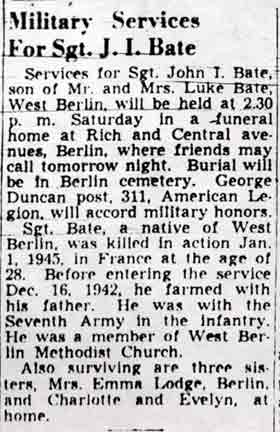
Military Services For Sgt. J. I. Bate
Services for Sgt. John I. Bate, son of Mr. and Mrs. Luke Bate, West Berlin, will be held at 2:30 p.m. Saturday in a funeral home at Rich and Central avenues, Berlin, where friends may call tomorrow night. Burial will be in Berlin cemetery. George Duncan post, 311, American Legion, will accord military honors.
Sgt. Bate, a native of West Berlin, was killed in action Jan. 1, 1945, in France at the age of 28. Before entering the service Dec. 16, 1942, he farmed with his father. He was with the Seventh Army in the infantry. He was a member of West Berlin Methodist Church.
Also surviving are three sisters, Mrs. Emma Lodge, Berlin, and Charlotte and Evelyn, at home.
American Stubbornness at Rimling
By Allyn Vannoy
As the US Seventh Army shifted units to cover the gap created by the departing Third Army divisions that were being moved into the Ardennes during December 1944, the 44th and 100th Divisions, on the westernmost flank of the Seventh Army, found themselves holding extended fronts in the Low Vosges forest.
Holding the left wing of the 100th Division was the 397th Infantry, commanded by Colonel John M. King. Here, from the critical junction at the town of Rimling, roads branched out throughout the Century Division’s sector.
Initially, the operations staff of German Army Group G planned to conduct the main attack of Operation Nordwind through the Low Vosges with four volksgrenadier divisions, a mountain division, and a panzer division. The object was to split the US Sixth Army Group, isolate the 3rd and 45th Divisions of VI Corps, and recapture Strasbourg.
On the last day of 1944, the 3rd Battalion, 397th Infantry Regiment, was holding positions around the village of Rimling. The 1st Platoon of Company K was dug in on a bare summit called Schlietzen Hill, just west of town. The 2nd Platoon was on the left, with the 3rd Platoon in the town itself.
The east end of Rimling was held by Company L. Its lines extended eastward along the road between Rimling and Epping-Urbach to the junction with the north-south road between the towns of Guderkirch and Reyersviller.
The 1st Battalion, 397th, on the right flank of the regiment, extended about two kilometers east of the 3rd Battalion. Company I, in support, formed defensive positions running east and west just south of Rimling.
Because the 397th had been in position for a few days, their foxholes were deep and roofed with logs and earth. December snow provided a covering which made them almost invisible. There had been a warning on the night of the 29th that a German attack was imminent.
A little before midnight on New Year’s, elements of the 44th Division’s 71st Infantry, to the west of Company K, sent word that they were under attack by at least five companies of German troops. The 3rd Battalion, 397th, put all men on full alert.
Only minutes after midnight, veteran troops of the 37th SS Panzergrenadier Regiment, 17th SS Panzergrenadier Division, attacking along the entire battalion front, hit Company K. Apparently hoping to surprise the American positions, they were advancing rapidly, hollering and shouting. However, Company K had been warned, and was ready.
Although the first wave had been stopped, small groups continued to fire on Company K’s front. Often they stood upright and hollered “American gangsters” or “Yankee bastards” as they fired.
The main assault had been against the western two platoons of Company K on Schlietzen Hill, but there was also heavy patrol action against the 3rd Platoon and against Company L along the Epping-Urbach road. Company L had its machine guns situated to fire on an area 75 yards to its front.
The GI’s of the 3rd Battalion could hear the sounds of heavy fighting on the 71st Infantry’s front to the west. After about an hour the Company K outposts heard the Germans regrouping to their front.
During the ensuing lull, one platoon of Company I went into line just to the east of the flank platoon of Company K while another Company I platoon took over the positions of 1st Platoon, Company K, on Schlietzen Hill.
In the meantime the 71st was pushed back, but due to a communications failure the 3rd Battalion, 397th, was not informed of the withdrawal, exposing its left rear. Colonel Ercil D. Porter, commander of the 3rd Battalion, sent Company K’s reserve platoon to hold the flanks.
The third German assault against the 397th, again preceded by artillery, came just before dawn. Although repulsed, the Germans discovered an unprotected 1,000 yard section of ground along the 3rd Battalion’s left rear and began infiltrating through it.
With the Germans infiltrating behind its position and small attacks to its front, the 2nd Platoon, Company K, was finally forced to withdraw from the top of Schlietzen Hill.
S.Sgt. Saul Scheiman, of Company I, directed mortar and artillery fire on German patrols in the area, but one group, in platoon strength, managed to enter the south end of Rimling. It was not quite light yet, and the GI’s could not distinguish friend from foe in the dim early morning light.
With the Germans on three sides of the town, patrols constantly engaging in firefights, and German artillery fire falling in and near their positions, the 2nd Platoon, Company K, even after it had withdrawn from Schlietzen Hill, continued to hold the south portion of the town.
The German assault was so wholly directed at the west flank of the regiment that Company L, to the east of Rimling, faced only minor attacks, as did Companies A and B, 397th, further east.
Over the next six days a series of back and forth indecisive actions raged west of Rimling around Schlietzen Hill.