John Dibble
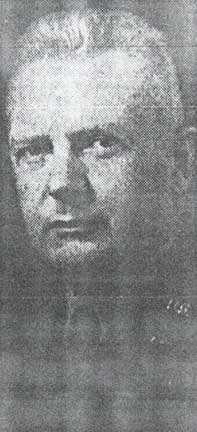
Colonel John Dibble, U.S. Army Medical Corps, Surgeon of the Third Army.
Colonel John Dibble was born in New Jersey in 1890. He grew up in Camden NJ. His father was Theodore Hoyt Dibble, a Civil War veteran who served with Company A of the 5th Connecticut Infantry, entering as a Sergeant and leaving service as a Captain. His wife, Clara Wilkinson Dibble, was much younger, born in 1863. In 1890 and 1891, Theodore and Clara Dibble made their home at 427 Washington Street in Camden NJ. Theodore Dibble passed away prior to January of 1910. In 1910, John and his mother Clara Dibble lived at the home of his grandparents, Leander and Mary Wilkinson, at 559 Washington Street in Camden NJ. His grandfather was a retired railroad engineer, who had run the first train from Jersey City to Atlantic City, the then-famous “Nellie Bly.”
John Dibble attended the E.A. Stevens School, and graduated from the original Camden High School at Haddon and Newton Avenues in 1909, which later became Clara S. Burrough Junior High School. While at Camden High, he participated in several after school activities, including the class debating team. As a senior he took part in the Senior-Junior Debate, which was judged by Howard M. Cooper, Edgar A. Freeman, and Harry C. Dole.
John Dibble went on to study medicine at the University of Pennsylvania. After graduating from Penn, he interned at Episcopal Hospital in Philadelphia. After completing medical school, he enlisted in the United States Army in 1917. He graduated from the Army’s school for flight surgeons, at Roosevelt Field, on Long Island NY, and went on to serve in Germany with the Army of Occupation after World War I. When occupation duty ended, Dr. Dibble remained in the Army, and would be a soldier for the rest of his life. He served in various posts throughout the 1920s and 1930s, including a stint as the Chief of Medical Service at Fort McKinley in the Philippine Islands. Colonel Dibble was named as Surgeon of the Third Army just after Pearl Harbor.
John Dibble had married a girl from Camden, Mary Walford. He always maintained his Camden address throughout his career, the last one being that of his uncle, George Wilkinson, 654 Washington Street, who, like Leander Wilkinson, was a railroad engineer. His aunt, Ella Boyle Wilkinson, was the daughter of Hugh Boyle of the Camden Police department. John Dibble’s last trip home to Camden was in May of 1942.
Colonel Dibble was killed with 16 others when the transport plane they were in crashed in the Pacific Theater of Operations on February 7, 1943. He was survived by his son, Captain John Dibble, then serving at Fort Hood TX, and a daughter, Mrs. John Corbey, whose husband was at that time a Major in the Army, his uncle, George Wilkinson, and a brother, Theodore Savage Dibble. His mother had passed away sometime after April of 1930.
Colonel Dibble is memorialized at the Tablets of the Missing at the Honolulu Memorial, Honolulu, Hawaii.
Camden High School, Class of 1909
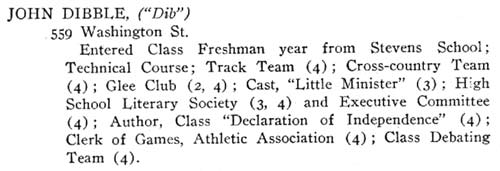
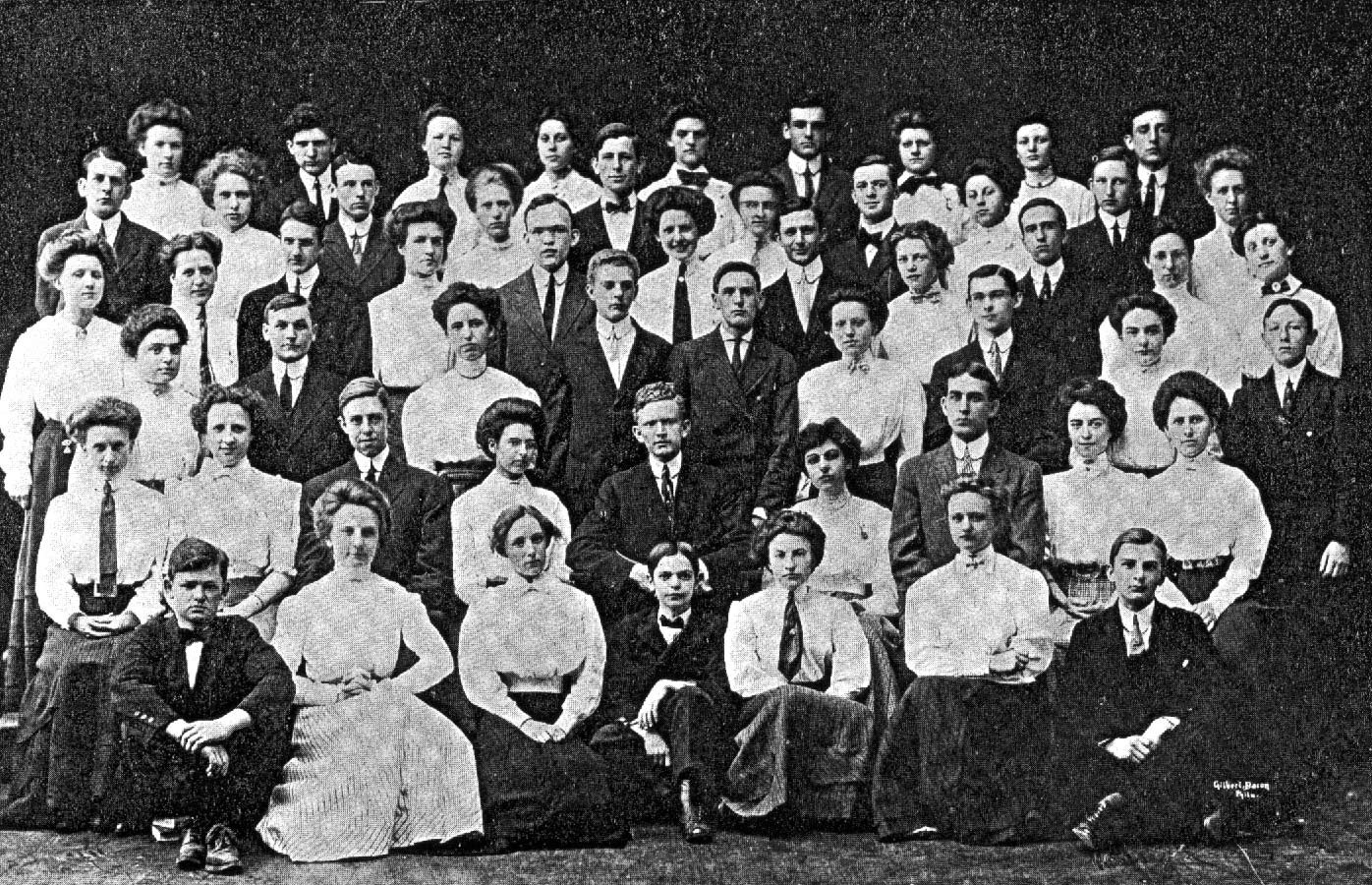
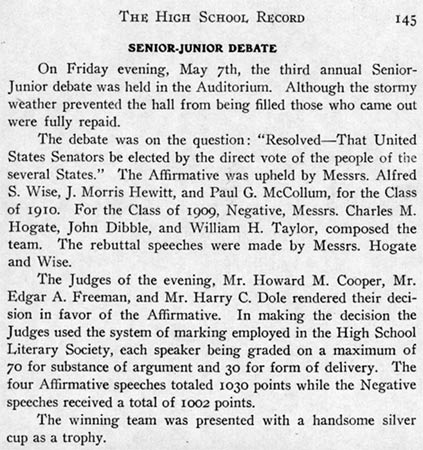
John Dibble in the 1909 High School Record; the Camden High School Class of 1909; and the Senior-Junior Debate team, from the 1909 High School Record.
654 Washington Street, Camden NJ
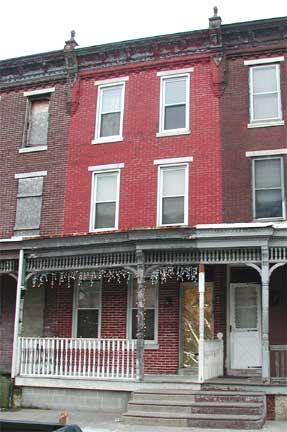
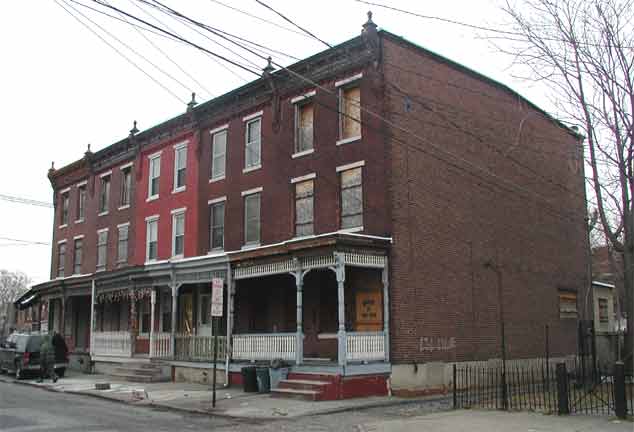
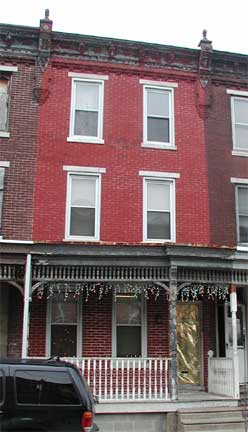
654 Washington Street, Camden NJ, the home of George Wilkinson (Colonel Dibble’s uncle) where he maintained his Camden address. Photographs taken December 27, 2002. Note: 427 Washington Street and 559 Washington Street no longer stood as of December 2002.
Leander Wilkinson
Philadelphia Inquirer —
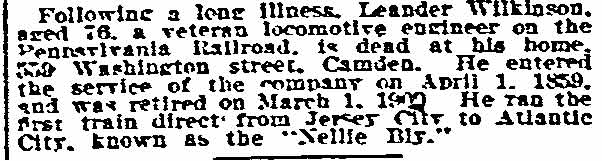
Following a long illness, Leander Wilkinson, aged 76, a veteran locomotive engineer on the Pennsylvania Railroad, is dead at his home, 559 Washington street, Camden. He entered the service of the company on April 1, 1859, and was retired on March 1, 1900. He ran the first train direct from Jersey City to Atlantic City, known as the “Nellie Bly.”
One Killed, 17 Are Missing After Crash in Pacific
Helena Independent —
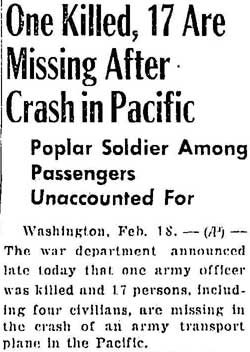
Washington, Feb. 18. — (AP) — The war department announced late today that one army officer was killed and 17 persons, including four civilians, are missing in the crash of an army transport plane in the Pacific.
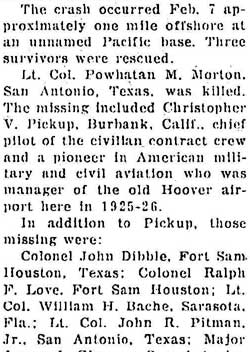
The crash occurred Feb. 7 approximately one mile offshore at an unnamed Pacific base. Three survivors were rescued.
Lt. Col. Powhatan M. Morton, San Antonio, Texas, was killed. The missing included Christopher V. Pickup, Burbank, Calif., chief pilot of the civilian contract crew and a pioneer in American military and civil aviation who was manager of the old Hoover airport here in 1925–26.
In addition to Pickup, those missing were:
Colonel John Dibble, Fort Sam Houston, Texas; Colonel Ralph F. Love, Fort Sam Houston; Lt. Col. William H. Bache, Sarasota, Fla.; Lt. Col. John R. Pitman Jr., San Antonio, Texas; Major James J. Gleason, San Antonio; Major Clark W. Mayne, Springfield, Ill.
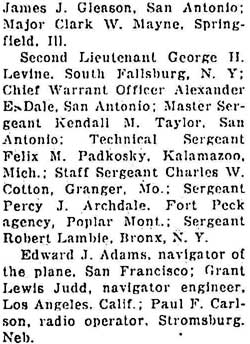
Second Lieutenant George H. Levine, South Fallsburg, N. Y.; Chief Warrant Officer Alexander E. Dale, San Antonio; Master Sergeant Kendall M. Taylor, San Antonio; Technical Sergeant Felix M. Padkosky, Kalamazoo, Mich.; Staff Sergeant Charles W. Cotton, Granger, Mo.; Sergeant Percy J. Archdale, Fort Peck agency, Poplar Mont.; Sergeant Robert Lambie, Bronx, N. Y.
Edward J. Adams, navigator of the plane, San Francisco; Grant Lewis Judd, navigator engineer, Los Angeles, Calif.; Paul F. Carlson, radio operator, Stromsburg, Neb.