Irving Eisenman Jr.
Rank: Seaman Second Class, U.S. Navy
Serial: 04051940
Ship: USS Atik AK-101
Entered service from: New Jersey
Died:
Burial: Missing in Action or Buried at Sea — Tablets of the Missing at East Coast Memorial, New York City
Awards: Purple Heart
Biography
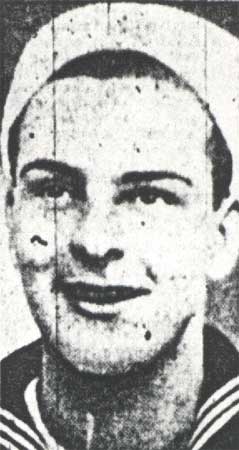
Irving Eisenman Jr.
Seaman Second Class Irving Eisenman was the eldest child of Irving and Margaret Eisenman. His father had served in World War I. At the time of the 1930 Census, the Eisenmans were renting a home at 2121 Browning Road in Pennsauken NJ. The elder Eisenman was working as a radio technician at the RCA plant in nearby Camden NJ. At the time of the census, the family included Irving, known to family and friends as “Buster,” brother Robert, and sister Margaret Elaine. Another brother, Douglas, was born after the census was taken. After the birth of Douglas, Margaret Eisenman was killed in an automobile accident while riding in the rumble seat of a car. Irving “Buster” Eisenman and his brother Bobby went to live with their maternal grandparents, Ralph Henry and Margaret Blakely Suydam, at 3449 Elm Avenue, in Pennsauken NJ.
Irving Eisenman enlisted in the United States Navy in September of 1941. He received his basic training at Pensacola FL. He subsequently was assigned to the crew of the USS Atik (AK-101). The Atik was a Q-ship — a disguised freighter carrying heavy armaments (four 4-inch guns, four .50-caliber machine guns, four .30-caliber Lewis machine guns, and six depth charge projectors). Her mission was to lure German submarines into attacking her, then respond with her concealed weapons. The Atik had been the Carolyn, a small freighter that had been in service since 1912. Her sister ship, the Evelyn, was also converted into a Q-ship and named the USS Asterion.
Commissioned on March 5, 1942, the Atik underwent brief sea trials, and with her sister ship the USS Asterion, sailed from Portsmouth NH on March 23, 1942. Steaming south, she was approximately 300 miles east of Norfolk VA on the night of March 26–27, 1942.
Shortly after midnight on March 27, 1942, the USS Atik was torpedoed by the German submarine U-123. The crew of the Atik responded with machine gun fire, but after the ship was hit by a second torpedo from U-123, Atik exploded. Although the crew had been seen taking to lifeboats before the explosion, no survivors were recovered from the heavy seas encountered by rescue craft.
Seaman Eisenman was reported missing in action on April 5, 1943.
USS Atik (AK-101)
Department of the Navy — Naval Historical Center
A double star in the constellation Perseus; the name itself is a shortened version of the Arabic al-Atik.
(AK-101: displacement 6,610; length 382’2”; beam 46’1”; draft 21’6”; speed 9 knots; complement 141; armament four 4-inch guns, four .50-caliber machine guns, four .30-caliber Lewis machine guns, six depth charge projectors)
Carolyn—a steel-hulled, single-screw steamer—was laid down on 15 March 1912 at Newport News, Va., by the Newport News Shipbuilding and Dry Dock Co., for the A. K. Bull Steamship Lines; launched on 3 July 1912.
For the next 30 years, Carolyn carried freight and passengers between the West Indies and ports on the eastern seaboard of the United States.
By 12 January 1942, the British Admiralty’s intelligence community had noted a “heavy concentration” of U-boats off the “…North American seaboard from New York to Cape Race.” That day, U-113 under Kapitanleutnant Reinhard Hardegen, torpedoed and sank the British steamship Cyclops, inaugurating Operation “Paukenschlag” (literally, “roll on the kettledrum”) and commencing a veritable “blitz” against Allied coastal shipping between New York harbor and the Outer Banks. U-boat commanders found peacetime conditions prevailing along the coast: towns and cities were not blacked-out and navigational buoys remained lighted; shipping followed normal routines and “carried the normal lights.
Committed to fighting the rampaging Japanese in the Pacific and to assuring the safe arrival of vital convoys to Great Britain in the Atlantic, the American Navy could spare few ships to deal with this new threat close to our shores. As a result of the crisis, it launched a new, imaginative, and daring program. Because of the secret nature of the project, its inception is shrouded in mystery. It appears that President Franklin Roosevelt, well known for his affinity for things novel and naval, desired that the Navy establish a “Q-ship” program similar to that which had been used by the British with some success in the first World War.
Acquired by the Navy from the Maritime Commission, Carolyn steamed to Portsmouth, New Hampshire, where she was turned over to the Navy under a bareboat charter on 12 February 1942.
Atik (AK-101) was placed in commission at 1645 on 5 March 1942 at the Portsmouth (N.H.) Navy Yard, Lt. Comdr. Harry Lynnwood Hicks, USN, in command. Following fitting out and brief sea trials, she and Asterion got underway on 23 March 1942. Soon after leaving port, Atik and Asterion went their separate ways.
At the outset, all connected with the program apparently harbored the view that neither ship “was expected to last longer than a month after commencement of [her] assigned duty.” Atik’s holds were packed with pulpwood, selected as the best obtainable material to assure “floatability.
Atik’s mission was to lure some unsuspecting U-boat into making a torpedo attack. According to the projected scenario, the submarine, having deemed the venerable tramp unworthy of the expenditure of more torpedoes, would surface to sink the crippled foe with gunfire.
The plan presupposed a “backup” which was to come to the rescue whenever a “Q-ship” ran into difficulties. In March 1942, though, there was no such “safety net.” The commanding officers of the two ships were told that they could expect little help if they got into trouble, as the situation was critical. Every available combatant ship and plane was being employed to the maximum for convoy and patrol duties.
In the gathering darkness, three days after Atik had sailed from Portsmouth, she attracted the attention of the German submarine U-123, under the command of Kapitanleutnant Reinhard Hardegen, on her second war patrol off the eastern seaboard. The U-boat, on the surface, began stalking Atik at 2200, and at 0037 on 27 March fired one torpedo from 700 yards away which struck the ship on her port side, under the bridge. Fire broke out immediately, and the ship began to assume a slight list.
Carolyn was not dead—yet. After U-123 turned to starboard, Atik gathered steerage way, paralleling her course by turning to starboard as well, and dropped her concealment, commencing fire from her main and secondary batteries. The first shell dropped short of the U-boat, as she made off presenting a small target; the others were off in deflection. A veritable hail of .50-caliber machine gun fire, though, ricocheted around the U-boat’s decks as she bent on speed to escape the trap into which Hardegen had fallen. One bullet mortally wounded a midshipman standing watch on U-123’s bridge.
Gradually, the U-boat pulled out of range behind the cover of a smoke screen emitted by her straining diesels, and her captain assessed the damage. As he later recorded, “We had been incredibly lucky.
Not so, Atik. U-123 submerged and again approached her daring opponent. At 0229, the U-boat loosed a torpedo into Atik’s machinery spaces. Satisfied that this blow would prove to be the coup de grâce, U-123 stood off to await developments as Atik settled by the bow, her single screw now out of the water.
Once again, Atik’s crew could be seen embarking in her boats, as their ship clung stubbornly to life. U-123 surfaced at 0327, perhaps to finish off the feisty Q-ship once and for all. Suddenly, at 0350, a cataclysmic explosion blew Atik to pieces. Ten minutes later, U-123 buried her only casualty—the midshipman killed by Atik’s machine gun fire. Atik’s entire crew perished—either in the blast or during the severe gale that lashed the sea soon after the ship disintegrated.
The next morning, an Army bomber was dispatched to Atik’s last reported location but found nothing. The destroyer Noa (DD-343) and the tug Sagamore (AT-20) steamed toward the area as well. Heavy seas forced Sagamore to return to port, but Noa remained in the vicinity and ultimately sighted wreckage from Atik.
Asterion, too, had heard her sister ship’s cry for help and plodded to the scene, but Asterion encountered casualties to her steering gear, and only continued the search for 24 hours before being forced to put into Hampton Roads for repairs.
On 9 April, Radio Berlin reported that a U-boat had sunk an adversary after a “bitter battle,” but gave no details. It was not until after the war that translated German records shed light on what had become of Atik.
4 Pennsauken Dogs Join Service To Avenge Pal Jiggs, Lost on Duty
Camden Courier-Post —

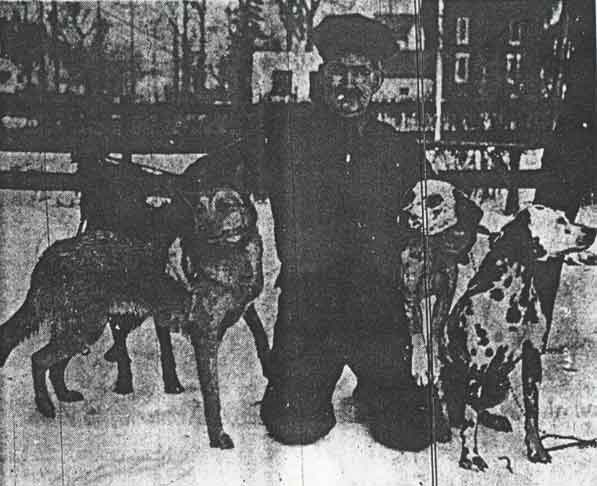

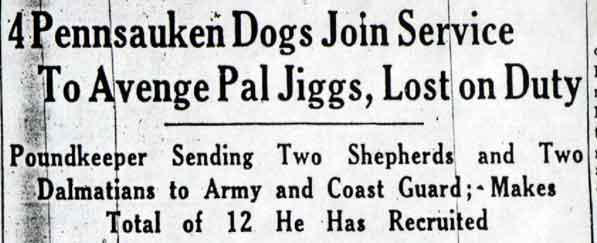
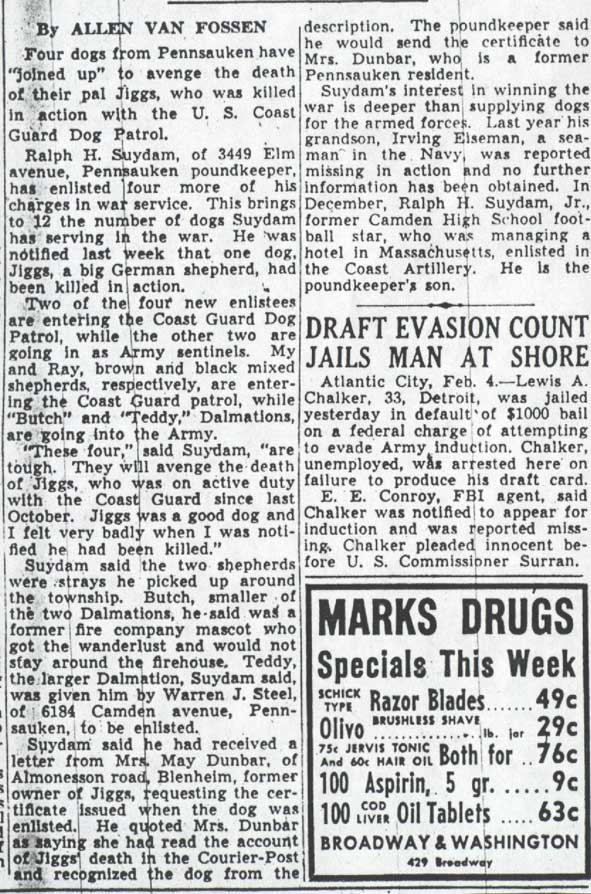
4 Pennsauken Dogs Join Service To Avenge Pal Jiggs, Lost on Duty
Poundkeeper Sending Two Shepherds and Two Dalmatians to Army and Coast Guard; Makes Total of 12 He Has Recruited
Ralph H. Suydam, Pennsauken poundkeeper — grandfather of Irving Eisenman — enlisted his dogs for war service. The two on the left, My and Ray, are in training with the U.S. Coast Guard patrol, while the two Dalmatians, Butch and Teddy, joined up as Army sentinels. Suydam enlisted 12 dogs for war service, one of which was killed in action.