Herbert Hartley
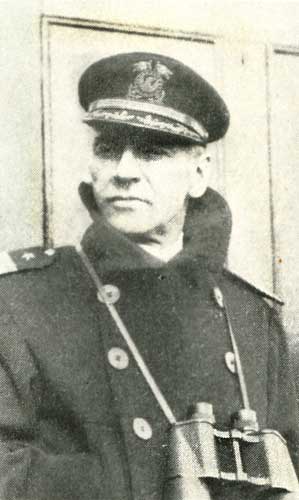
Commodore Herbert Hartley
HERBERT HARTLEY was born May 28, 1873 in Oswego Falls NY. His father, Ellis Hartley, had been born in England, and eventually brought his family to Camden. Herbert Hartley first went to sea at the age of 18, and rose through the ranks to command what at the time was the world’s largest ocean liner, the Leviathan.
Herbert Hartley served much of his career on the liner S.S. St. Louis, and had risen to the captaincy of that ship by 1914. When America entered World War I, the St. Louis was renamed the U.S.S. Louisville and converted into a troop transport. Herbert Hartley was commissioned as a Lieutenant Commander in the United States Navy, and, under the command of Admiral Henry Braid Wilson Jr., sailed the Louisville to and from Europe on convoy duty. Lieutenant Commander Hartley was awarded the Navy Cross for his actions during World War I.
After the war Herbert Hartley served as captain of the S.S. Manchuria and S.S. Mongolia. In 1923 he was given the helm of the Leviathan, where he remained until his retirement in February of 1928. He was also Commodore of the United States Lines fleet during this period.
In 1955 Herbert Hartley’s autobiography was published by Vulcan Press of Birmingham, Alabama. The book was titled Home Is The Sailor, and is credited to Commodore Hartley as told to Clint Bonner, with illustrations by Bonner and Charles Smith.
Herbert Hartley died May 9, 1957 in Opelika, Alabama.
Navy Cross Citation

Navy Cross
Hartley, Herbert
Lieutenant Commander, U.S. Navy (Reserve Forces)
Commanding Officer, U.S.S. Louisville
Date Of Action: World War I
Citation:
The Navy Cross is awarded to Lieutenant Commander Herbert Hartley, U.S. Navy (Reserve Forces), for distinguished service in the line of his profession as commanding officer of the U.S.S. Louisville, engaged in the important, exacting and hazardous duty of transporting and escorting troops and supplies through waters infested with enemy submarines and mines.
The St. Louis Ends Career as a Liner
Camden Courier-Post —
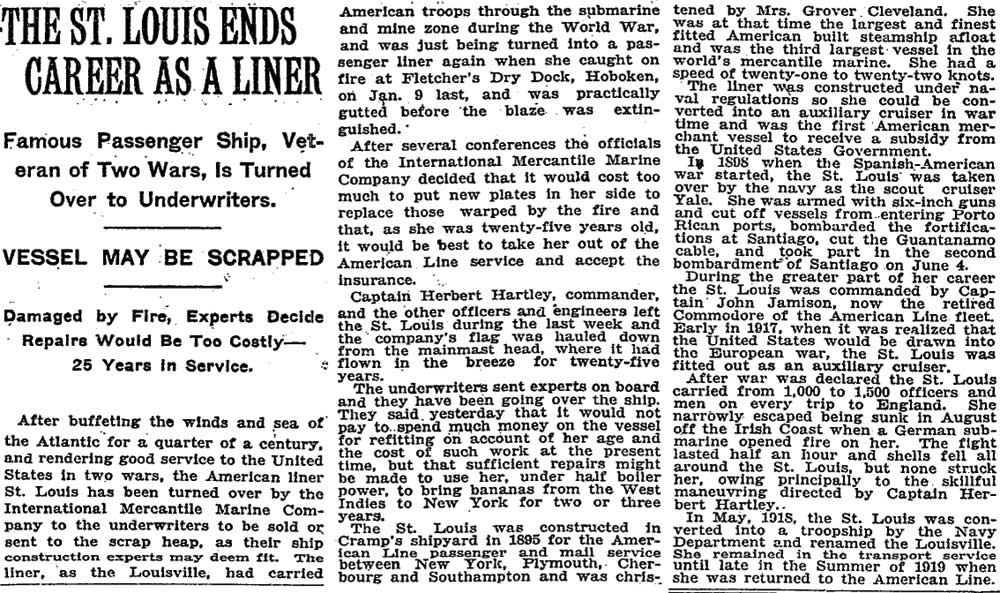
After buffeting the winds and sea of the Atlantic for a quarter of a century, and rendering good service to the United States in two wars, the American liner St. Louis has been turned over by the International Mercantile Marine Company to the underwriters to be sold or sent to the scrap heap, as their ship construction experts may deem fit. The liner, as the Louisville, had carried American troops through the submarine and mine zone during the World War, and was just being turned into a passenger liner again when she caught on fire at Fletcher’s Dry Dock, Hoboken, on Jan. 9 last, and was practically gutted before the blaze was extinguished.
After several conferences the officials of the International Mercantile Marine Company decided that it would cost too much to put new plates in her side to replace those warped by the fire and that, as she was twenty-five years old, it would be best to take her out of the American Line service and accept the insurance.
Captain Herbert Hartley, commander, and the other officers and engineers left the St. Louis during the last week and the company’s flag was hauled down from the mainmast head, where it had flown in the breeze for twenty-five years.
The underwriters sent experts on board and they have been going over the ship. They said yesterday that it would not pay to spend much money on the vessel for refitting on account of her age and the cost of such work at the present time, but that sufficient repairs might be made to use her, under half boiler power, to bring bananas from the West Indies to New York for two or three years.
The St. Louis was constructed in Cramp’s shipyard in 1895 for the American Line passenger and mail service between New York, Plymouth, Cherbourg and Southampton and was christened by Mrs. Grover Cleveland. She was at that time the largest and finest fitted American built steamship afloat and was the third largest vessel in the world’s mercantile marine. She had a speed of twenty-one to twenty-two knots.
The liner was constructed under naval regulations so she could be converted into an auxiliary cruiser in war time and was the first American merchant vessel to receive a subsidy from the United States Government.
In 1898 when the Spanish-American war started, the St. Louis was taken over by the navy as the scout cruiser Yale. She was armed with six-inch guns and cut off vessels from entering Porto Rican ports, bombarded the fortifications at Santiago, cut the Guantanamo cable, and took part in the second bombardment of Santiago on June 4.
During the greater part of her career the St. Louis was commanded by Captain John Jamison, now the retired Commodore of the American Line fleet. Early in 1917, when it was realized that the United States would be drawn into the European war, the St. Louis was fitted out as an auxiliary cruiser.
After war was declared the St. Louis carried from 1,000 to 1,500 officers and men on every trip to England. She narrowly escaped being sunk in August off the Irish Coast when a German submarine opened fire on her. The fight lasted half an hour and shells fell all around the St. Louis, but none struck her, owing principally to the skillful maneuvring directed by Captain Herbert Hartley.
In May, 1918, the St. Louis was converted into a troopship by the Navy Department and renamed the Louisville. She remained in the transport service until late in the Summer of 1919 when she was returned to the American Line.
Secretary Davis Boards the Leviathan, July 4, 1923
Camden Courier-Post —
Secretary James J. Davis was among the passengers aboard the Leviathan on July 4, 1923. Secretary Davis was going abroad to study the immigration problem.
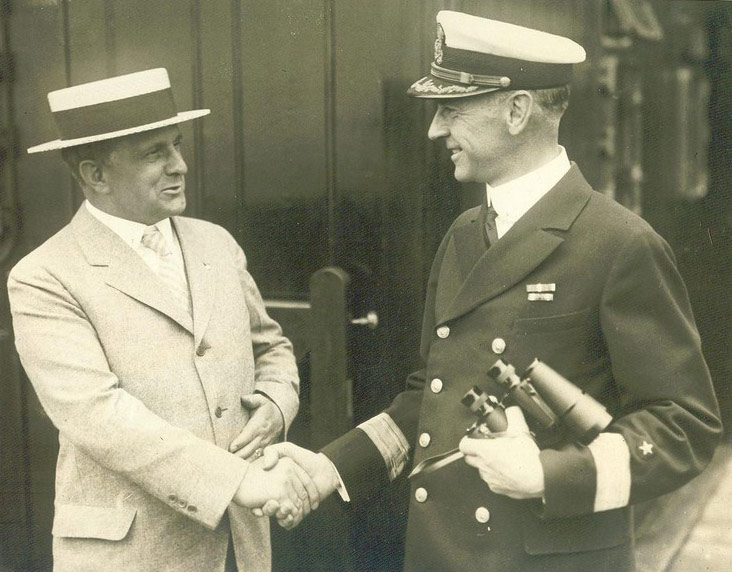
Secretary James J. Davis and Commodore Herbert Hartley aboard the Leviathan — July 4, 1923
Leviathan
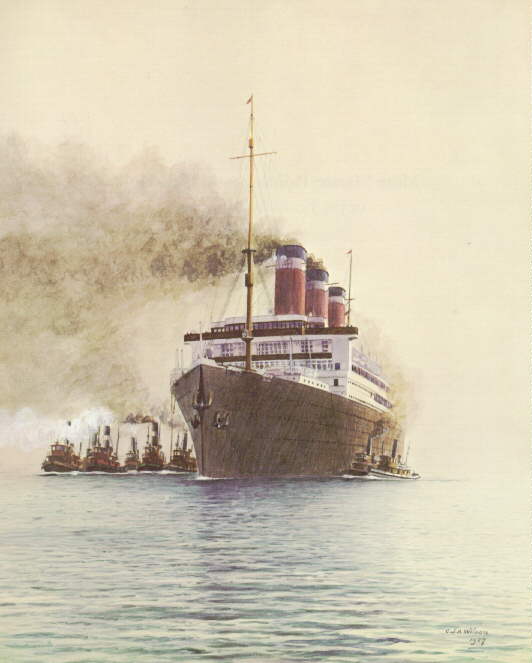
Named: Leviathan, C. J. A. Wilson (1880, and 1965). Oil on canvas, 21⅛ in. by 16⅞ in..
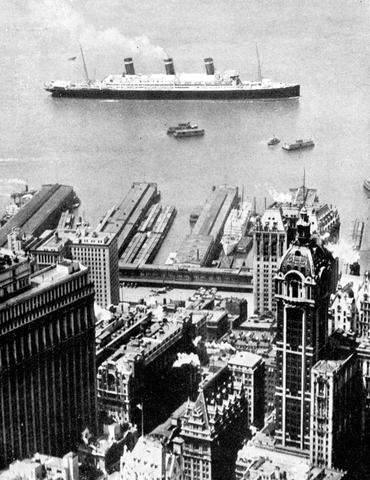
Leviathan and the Singer Building, New York City, 1923
Hartley Quits as Commander of Leviathan
Camden Courier-Post —
Former Camden Boy Quits Sea After 35 Service Years’
FAMED SKIPPER PLANS BUSINESS CAREER
U.S. Shipping Board Accepts Decision Reluctantly; Effective Feb. 1
Thirty-five years’ buffeting by tossing seas and occasional raging storms is sufficient to satiate the veriest of salts, a former Camden boy, who has risen, to the rank of his profession, agreed today. He is to change the rolling deck of the steamer for the prosaic career of a businessman.
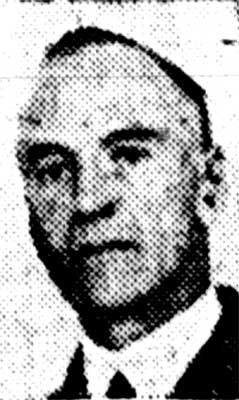
He is Commodore Herbert Hartley, gallant skipper of the Leviathan, one of the world’s greatest ships, likewise head of the merchant fleet of the U. S. Shipping Board. His father, Ellis Hartley, resides at 433 State Street. The Commodore yesterday tendered his resignation to T. V. O’Connor, chairman of the U. S. Shipping Board. It is to take effect February 1.
“I have had enough of the sea,” said he. “I have not had a home ashore since I was 18 years old and I would like to see some of the other boys have the Leviathan now. Many would naturally aspire to the position.”
At Washington last night Captain Hartley indicated he concluded it was about time to forego the delights of the sea.
Regret Resignation
The resignation of the captain was accepted with reluctance by the Shipping Board.
“The ship is the greatest in the world and Commodore Hartley has measured up to the standards needed for her command,” said O’Connor. “If he were resigning to take command of any other vessel we would wish to refuse to accept it, but since he is retiring from the sea after 35 years of good service to the American Merchant Marine, we can do nothing but wish him God-speed in his new undertaking.”
Mr. Hartley was born in Oswego Falls, N. Y., May 28, 1873. He spent most of his early seafaring career on the St. Louis of the American Line and was brought up to learn his duties as a seaman and a navigator by the veteran commander John C. Jamison, who had served his apprenticeship on the famous clipper Dreadnought in the Atlantic trade.
Mr. Hartley was a cadet in 1895 in the American Line which was under contract with the Government to carry two on deck and two in the engine room on each of its four ships. He was one of the very few who stuck to the job and he eventually rose through the various grades until he was made commander of the St. Louis which became the Louisville in the World War.
Command ‘Lucky’
He described his getting the command of the Leviathan as one of the luckiest events in his life. He was a careful shipmaster, but had the misfortune to ground the Manchuria and later to do the same with the Mongolia of the American Line in 1923. While he was suspended as an act of discipline, Captain Hartley went to Washington to see his old friends. In recall afterward he said:
“I had no more idea of being offered the command of the Leviathan that day than a child. Like most other shipping men in New York I naturally believed Cunningham would be promoted from the George Washington.
“I went to the Riggs House for lunch with my friends of Washington and was introduced to some of the officials who were then connected with the United States Shipping Board.
“When we were chatting after the meal one of the officials said to me ‘How would you like to have command of the Leviathan?’ I said ‘Stop your kidding.’ To my surprise he said, ‘I am not kidding. We want a captain for the Leviathan and if you would like to have the ship come round to the Shipping Board offices at 4 o’clock this afternoon.’
“Just a Fluke”
“I did so,” said Captain Hartley, “and shortly after 5 o’clock I left the building with my appointment to take command of the Leviathan in my pocket, and walked the streets of Washington as if I were treading on air. It was a fluke that I went there that day.” During the time he has been in command of the Leviathan Commodore Hartley has had many anxious hours. The mammoth liners of her type are difficult to drive in heavy seas as they are likely to crack in the middle or do other damage to the superstructure of the ship. On his last westward voyage he hove-to the Leviathan for five hours because of the strain in the pounding of the heavy seas.
Mr. Hartley has married twice. The first time, when he was chief officer of the St. Louis, to Charlotte Adler, of Jersey City, who died and left him with a daughter, now about eighteen years old. He met his second wife, who is from Opelika AL, when he was on the Leviathan. They have a son 3 years old.
Hartley Will Join 4-Day Liner Firm
Camden Courier-Post —
Former Leviathan Skipper Gives Up Idea of Leaving the Sea
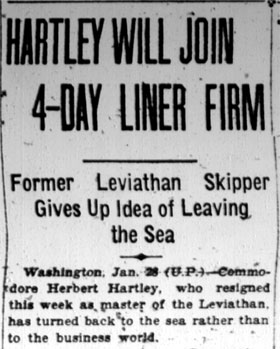
Washington, Jan. 28 (U.P.) — Commodore Herbert Hartley, who resigned this week as master of the Leviathan, has turned back to the sea rather than to the business world.
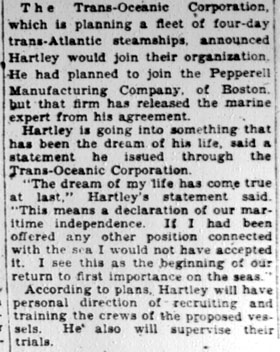
The Trans-Oceanic Corporation, which is planning a fleet of four-day trans-Atlantic steamships, announced Hartley would join their organization. He had planned to join the Pepperell Manufacturing Company, of Boston, but that firm has released the marine expert from his agreement.
Hartley is going into something that has been the dream of his life, said a statement he issued through the Trans-Oceanic Corporation.
The dream of my life has come true at last,” Hartley’s statement said. “This means a declaration of our maritime independence. If I had been offered any other position connected with the sea I would not have accepted it. I see this as the beginning of our return to first importance on the seas.
According to plans, Hartley will have personal direction of recruiting and training the crews of the proposed vessels. He also will supervise their trials.
Hartley Tell How America May Lead In Marine Trade
Camden Courier-Post —
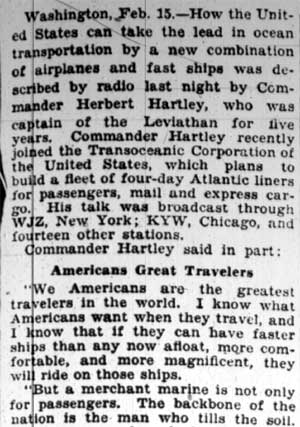
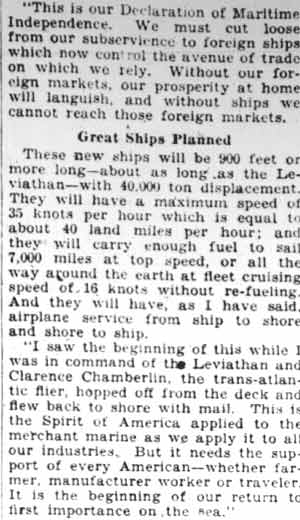
Washington, Feb. 15. — How the United States can take the lead in ocean transportation by a new combination of airplanes and fast ships was described by radio last night by Commander Herbert Hartley, who was captain of the Leviathan for five years. Commander Hartley recently joined the Transoceanic Corporation of the United States, which plans to build a fleet of four-day Atlantic liners for passengers, mail and express cargo. His talk was broadcast through WJZ, New York; KYW, Chicago, and fourteen other stations.
Commander Hartley said in part:
Americans Great Travelers
We Americans are the greatest travelers in the world. I know what Americans want when they travel, and I know that if they can have faster ships than any now afloat, more comfortable, and more magnificent, they will ride on those ships.
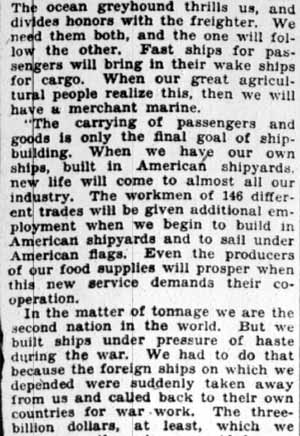
“But a merchant marine is not only for passengers. The backbone of the nation is the man who tills the soil. The ocean greyhound thrills us, and divides honors with the freighter. We need them both, and the one will follow the other. Fast ships for passengers will bring in their wake ships for cargo. When our great agricultural people realize this, then we will have a merchant marine.
“The carrying of passengers and goods is only the final goal of shipbuilding. When we have our own ships, built in American shipyards, new life will come to almost all our industry. The workmen of 146 different trades will be given additional employment when we begin to build in American shipyards and to sail under American flags. Even the producers of our food supplies will prosper when this new service demands their cooperation.
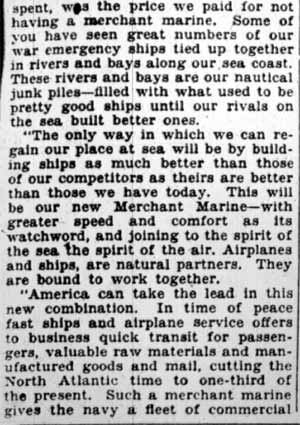
“In the matter of tonnage we are the second nation in the world. But we built ships under pressure of haste during the war. We had to do that because the foreign ships on which we depended were suddenly taken away from us and called back to their own countries for war work. The three-billion dollars, at least, which we spent, was the price we paid for not having a merchant marine. Some of you have seen great numbers of our war emergency ships tied up together in rivers and bays along our sea coast. These rivers and bays are our nautical junk piles — filled with what used to be pretty good ships until our rivals on the sea built better ones.
“The only way in which we can regain our place at sea will be by building ships as much better than those of our competitors as theirs are better than those we have today. This will be our new Merchant Marine — with greater speed and comfort as its watchword, and joining to the spirit of the sea the spirit of the air. Airplanes and ships, are natural partners. They are bound to work together.
“America can take the lead in this new combination. In time of peace fast ships and airplane service offers to business quick transit for passengers, valuable raw materials and manufactured goods and mail, cutting the North Atlantic time to one-third of the present. Such a merchant marine gives the navy a fleet of commercial Saratogas with every potential equipment for defense in the air and a trained rank and file in the Naval Reserve.
“This is our Declaration of Maritime Independence. We must cut loose from our subservience to foreign ships which now control the avenue of trade on which we rely. Without our foreign markets, our prosperity at home will languish, and without ships we cannot reach those foreign markets.
Great Ships Planned
These new ships will be 900 feet or more long — about as long as the Leviathan — with 40,000 ton displacement. They will have a maximum speed of 35 knots per hour which is equal to about 40 land miles per hour; and they will carry enough fuel to sail 7,000 miles at top speed, or all the way around the earth at fleet cruising speed of 16 knots without re-fueling. And they will have, as I have said, airplane service from ship to shore and shore to ship.
I saw the beginning of this while I was in command of the Leviathan and Clarence Chamberlin, the trans-atlantic flier, hopped off from the deck and flew back to shore with mail. This is the Spirit of America applied to the merchant marine as we apply it to all our industries. But it needs the support of every American — whether farmer, manufacturer worker or traveler. It is the beginning of our return to first importance on the sea.
Bad Luck Pursues Leviathan to ‘Grave’
Camden Courier-Post —
Edinburgh, Scotland, Feb. 4 (UP). — The Leviathan, once the queen ship of the United States merchant marine, narrowly escaped going aground today on her final voyage to be scrapped in a Scottish shipyard.
The liner, which anchored one mile east of the Firth of Forth bridge after her last voyage across the Atlantic, dragged anchors in a gale and was forced downstream. She barely missed grounding on one of the small islands in the river but eventually started her engines and steamed back to her previous position.
The American members of the crew which was mainly British were expected to leave the ship tomorrow to go home. Two of them were reported injured in falls during the voyage.
The U.S.S. St. Louis in 1898
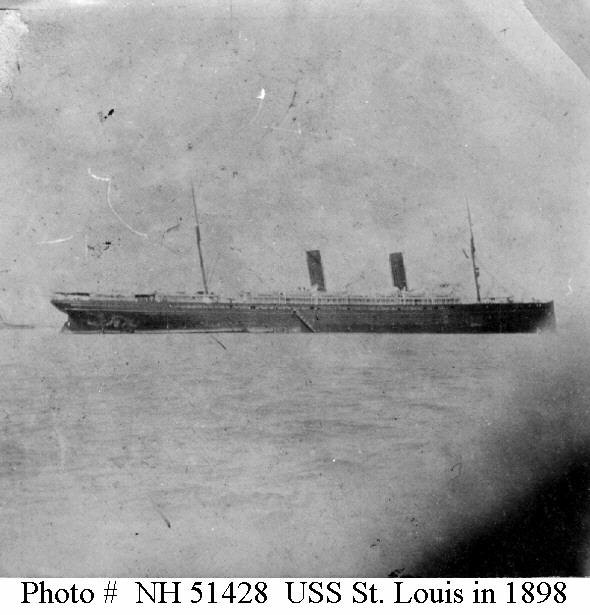
USS St. Louis (1898) — Photographed during the Spanish-American War. Note that, though in U.S. Navy service, this ship remains in her civilian paint scheme. Courtesy of Rear Admiral H.C. Taylor. U.S. Naval Historical Center Photograph.
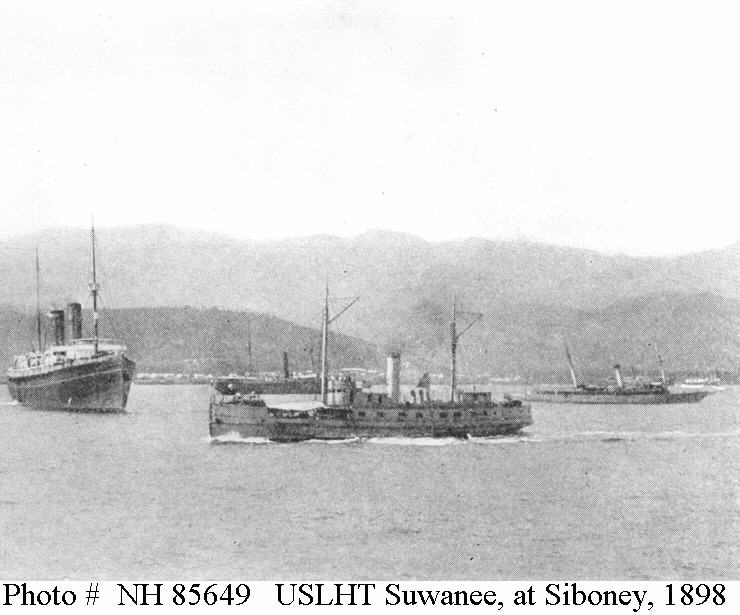
U.S. Light House Tender Suwanee — Halftone photograph, published in the book War in Cuba, 1898, showing Suwanee underway off Siboney, Cuba, during the Spanish-American War. Ships in the background include USS St. Louis (left) and USS Vixen (right). Courtesy of Alfred Cellier, 1977. U.S. Naval Historical Center Photograph.
Popular Science Monthly — October 1927
The Conflict Between Science and Religion
A Discussion by Leaders in American Life, with an Introduction
By BRUCE BARTON
Author of “The Man Nobody Knows” and “The Book Nobody Knows”
THERE is no conflict between science and religion. The trouble, if any, lies at the foundation of hasty conclusions of prejudiced or biased minds.
Evolution as a theory can certainly be harmonized with the Biblical account of creation. They travel in separate and parallel grooves. The creation of life is a single and distinct achievement. The development and evolution of life is another.
I believe it more reasonable to conclude man was created by a slow process of evolution than that he was made instanter. If we accept the theory of evolution we do not by that acceptance reject the Biblical account of creation. No scientist has yet dared to deny the one great account of the origin of life. They only attempt to trace it on through the ages.
Commodore Herbert Hartley
Commander, S. S. Leviathan