George F. Frederick
Captain, U.S. Army Air Forces
O-372630
12th Air Liaison Party
Headquarters, Fifth Air Force
Entered the Service from: New Jersey
Died: March 30, 1944
Buried at: Plot F, Row 6, Grave 102
Manila American Cemetery
Manila, Philippines
Awards: Legion of Merit, Distinguished Flying Cross, Air Medal, Purple Heart
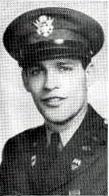
Captain George F. Frederick
Introduction
Captain George F. Frederick was born on December 14, 1914, in Pennsylvania, to Harry and Mary L. Frederick. The oldest child, his father was by 1930 working as a clerk for the railroad, and the family had purchased a home on Walnut Avenue in Laurel Springs NJ sometime after 1920. The family later moved to Beach and Lakewood Avenues in Laurel Springs. Besides George, there were two younger children, Harry and Eleanor E. Fredrick.
Harry Frederick and his two sons were all members of the New Jersey National Guard. When the Guard was mobilized in 1940 both brothers were sent to Camp Claiborne. George Frederick was already an officer; brother Harry Jr., then a sergeant, was sent to Officers Candidate School at Fort Lewis in Washington state.
After qualifying for flight duty, George Frederick trained as a pilot. During the summer of 1942 he was stationed at a flight training center at Pittsburgh, Kansas for six weeks. While there he met a local girl. They dated, and before George Frederick was sent to his next station he proposed. He was transferred to Lubbock, Texas, where the November 20, 1942 evening edition of the Camden Courier-Post reported that George Frederick, then a lieutenant, was at the South Plains Army Flying School. His father, Harry Frederick Sr., was on active duty at the time with the rank of Captain.
George and Cleo Frederick were married on November 25, 1942, the day before Thanksgiving at South Plains. Mrs. Frederick returned to Kansas to finish her teaching contract, and returned to Lubbock the day before Christmas.
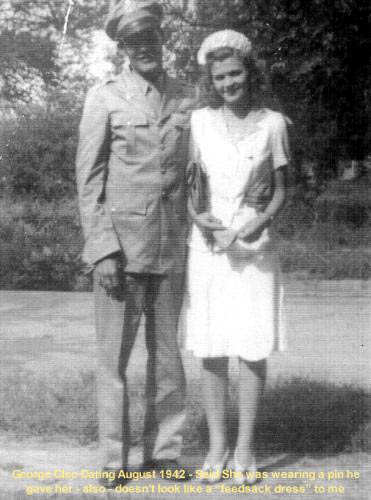
George & Cleo Frederick — on a date, August 1942. Printed on the photograph: “George & Cleo – Dating August 1942 – Said She was wearing a pin he gave her – also – doesn’t look like a ‘feedsack dress’ to me”.
Sent to the southwest Pacific on the 1st of April, 1943, Captain Frederick was stationed for some time at Port Moresby, Australia, where he served with a unit that was part of the 309th Bomber Wing.
The main theater of operations in the southwest Pacific at that time was New Guinea. Captain Frederick was trained as a glider pilot, but flew reconnaissance and was assigned at one point to provide reconnaissance for the 3rd and 7th Australian Infantry Divisions. Beginning on August 22, 1943, piloting the unarmed Stinson L-5, a plane similar to a Piper Cub, he began flying missions in New Guinea. In early September of 1943 he aided the Australian 3rd Division during the siege of Salamua, which fell on September 11th. Attached to the Australian 7th Division, he participated in the battle for Lae, which was taken on the 16th.
The Australian 7th Division continued the offensive, moving up the Markham Valley and the Ramu River, to occupy Dumpu by 4 October. Captain Frederick flew many missions in the Ramu and Markham Valleys during this period. He was awarded the Distinguished Flying Cross for finding a usable airstrip at Dumpu and flying wounded men out of New Guinea while under enemy fire from there during this time. Captain Frederick was flying missions as late as October 16, 1943. For his deeds in August, September, and October of 1943, Captain Frederick would be awarded the Distinguished Flying Cross and the Air Medal.
Heavy fighting developed on Shaggy Ridge in the Finisterre Mountains to the north, and Captain Frederick saw action there as well. As he was photographed carrying a rifle, it appears that his duties were changed, and he was performing the duty of air liaison officer, coordinating air support with infantry actions. He would go on to perform heroically in this role later. Japanese resistance collapsed on New Guinea by the end of January 1944.
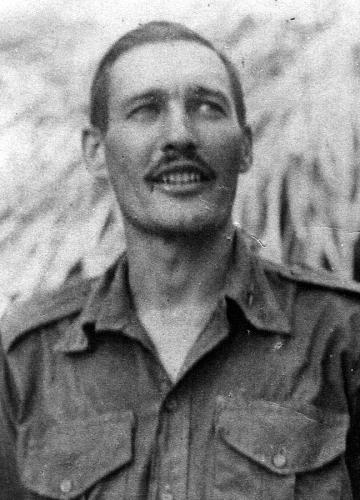
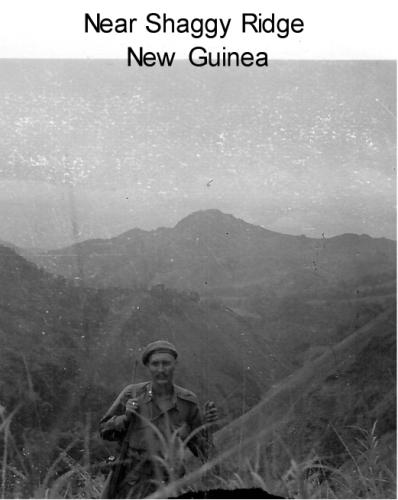
Late 1943 in New Guinea. By the time these pictures were taken, George Frederick was seeing a lot of action on the ground, coordinating air strikes. Note that in the picture on the right he is carrying a rifle.
Meanwhile, back in the United States, Cleo Frederick gave birth to a son, George Clinton “Clint” Frederick, in November of 1943.
As the campaign in New Guinea drew to a close, Captain Frederick was given a new assignment. Named commanding officer of the 12th Air Liaison Party, which was attached to the 1st Cavalry Division, to coordinate air-ground operations. Captain Frederick came ashore with the 1st Cavalry Division on Los Negros in the Admiralty Islands early in March 1944 as American ground forces attempted a quick capture of Momote airfield. Captain Frederick landed with the first wave on the invasion of Los Negros at 1100 hours. Captain Frederick personally received credit for killing two Japanese soldiers. General MacArthur himself came ashore at 1400 hours.
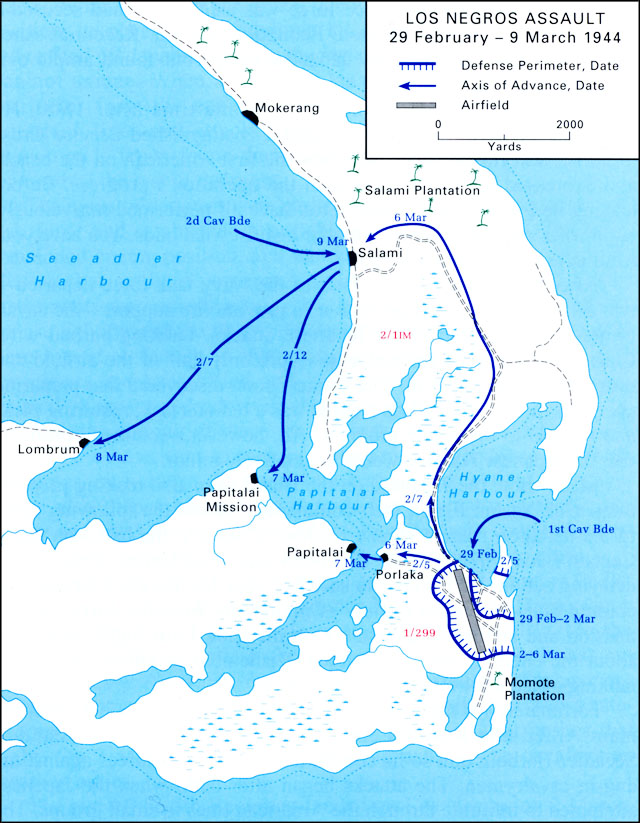
The Los Negros Assault, February 29 to March 9, 1944
After MacArthur pulled out promising to send troops and supplies, for about four days and nights 1,000 of the 1st Cavalry held off over 4,300 crack Japanese troops. As air drops were the only means of bringing food and ammunition to the Americans on the beachhead, the role Captain Frederick played during this action cannot be understated. In his diary Captain Frederick wrote that the Japanese dead were piled up in front of his position three and four deep after the night attack of March 3rd, 1944. It is thought that Captain Frederick was stationed behind Troop G, which took the brunt of the Japanese counter-attack. Captain Frederick’s own attitude towards his performance during this time, as evidenced in a letter home, was that he was simply doing his job. For directing air traffic while under fire from atop a revetment, he was nominated for the Silver Star; he was, however, awarded the Legion of Merit.
On March 9, 1944, Major General Ennis C. Whitehead, Deputy Commander of the Fifth Air Force, wrote a note to congratulate Captain Frederick on a job well done. A testament to George Frederick’s character is his request to General Whitehead that he write a similar note noting the work of his unit, the 12th Air Liaison Party.
During this period Captain Frederick was in and out of foxholes and under fire from Japanese ground forces, directing air strikes in support of American ground forces. Captain Frederick was credited with killing a third Japanese soldier later in March. With a day off he went souvenir hunting. He broke into a shack and found a wounded Japanese soldier, and called for medics who evacuated the injured man. The Japanese soldier died on the way to the hospital, so although he didn’t wound the soldier he did get credit for taking him prisoner before he died. On March 22, 1944, George Frederick had the opportunity to use a Signal Corps typewriter and compose a letter to his father. This would prove to be his last letter home.
After Los Negros and the neighboring island of Manus fell, operations were scheduled against the outlying islands in the Admiralty chain.
Amphibious assaults on the lesser islands of the Admiralties, along with mopping-up actions on Manus, comprised the last phase of combat operations. In light of the losses on Hauwei and with the expectation that landings would be opposed, attacks on the outlying islands would be made in considerable force. Pityilu Island, 3 miles north of Lugos Mission, was the first scheduled for attack on March 30, by the 1st Squadron, 7th Cavalry, reinforced.
Pityilu Island, thought to be defended by 60 Japanese, is nearly 3 miles long and varies in width from 250 to 650 yards. The beach chosen for the assault is the only one suitable for landing; it is of white, hard sand and is located about the center of the southern shore. Six waves transported in LVT’s, LCM’s, and LCV’s would make up the assaulting force, which would move inland through the coconut plantation covering the western two-thirds of the island. Captain Frederick accompanied the landing force to coordinate air support.
Naval gunfire, artillery, and air strikes had been used against this island at various times before the attack date. Destroyers had first bombarded it to keep down hostile fire when the approaches to Lorengau and Lugos Mission were being cleared of mines. A Japanese naval gun captured on Hauwei Island had been put back into commission and used to augment the fires on Pityilu. Preparation for the attack began at 0630 on 30 March by 2 destroyers which fired 30 rounds each until 0730. A spectacular air strike followed the naval fire.
For the first 10 minutes P-40’s dive-bombed the landing beach; the next 10 minutes P-40’s and Spitfires strafed the entire island. Immediately afterwards the 61st Field Artillery Battalion, which had registered the previous day from positions on the south side of the Lorengau air strip, pounded the island with a heavy concentration of 105’s. When the artillery barrage was lifted, two LCS’s (Landing Craft, Support) on either flank of the beach opened up with their rockets. By this time the assault waves were approaching the shore, and the rockets searched the island in front of the first wave.
The successive waves landed unopposed and the troops established a beachhead with Troop C as the left wing, Troop A in the center, and Troop B on the right. At 1000 some patrols sent out immediately after landing reported no contact with the enemy. The Reconnaissance Platoon moved by buffalo to the west, while Troop C in reserve on the beach sent patrols west into the interior. Troops A and B, with one medium tank leading the way, began an advance east toward the rain forest which covered that end of the island.
As the troops advanced they ran into light machine-gun and sniper fire which was easily silenced. Enemy guns in a hut, encountered by Troop B after moving 1,000 yards along the south coast, were neutralized by the tank, which blew up the entire position.
At 1212, after progressing 1,500 yards, Troop A ran into heavy resistance from dug-in positions midway between the north and south shores. Troop A started to withdraw to permit an artillery concentration to be placed on the position, but the Japanese followed the withdrawal so closely that it was impossible to evacuate our wounded until a light tank was brought up to cover this operation. Then a 45-minute artillery concentration was placed on the enemy bunker, after which Troop A, aided by the light tank, attacked the position and killed 14 Japanese.
Troop B came upon a hastily constructed trench containing 21 Japanese, who gave their position away by loud chatter. When 2d Lt. John R. Boehme and two privates went out to investigate the position, they were wounded by fire from the group. In spite of his wound, Pvt. Paul A. Lahman advanced on the position, firing clip after clip from his BAR. He was credited by Lieutenant Boehme with the destruction of practically the entire force. At 1720 the squadron withdrew on regimental orders to a position on the western edge of the rain forest and established a perimeter for the night. The Reconnaissance Platoon patrolled the western end of the island and returned to report no contact. Although the attacking force then did not know it, all the Japanese garrison had been killed or wounded. After a bombardment the next morning, the squadron advanced and discovered more dead Japanese, which made a total of 59 killed against 8 cavalrymen killed and 6 wounded in the mopping up of Pityilu. Also lost was Captain Frederick, killed in action at 1400 hours on March 30, 1944.
Seizing Pityilu was an expensive operation compared with the other small islands, which turned out to be either unoccupied or harboring only a handful of Japanese who hid out in the interior.
George Frederick was survived by his wife, Mrs. Cleo Frederick of Hiattsville, Kansas; a son, Clint; his parents, Major and Mrs. Harry Frederick of Laurel Springs NJ; and his siblings. Besides the Purple Heart, the Distinguished Flying Cross, and the Legion of Merit, he also was awarded the Air Medal.
Harry Frederick Sr. had been promoted to Major, and had requested a transfer to the Southwest Pacific so he could serve alongside his son. This request was initially denied. After Captain George Frederick was killed he was transferred. In the Pacific he ran into a number of Australian and American soldiers who had served with his son. Harry Frederick remained in the service, and served in Japan and Germany before retiring as a Lieutenant Colonel in 1954.
The Stinson L-5
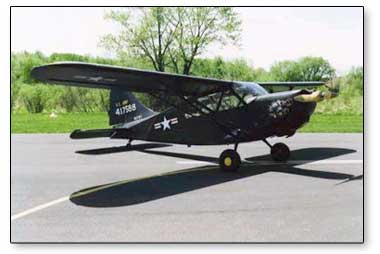
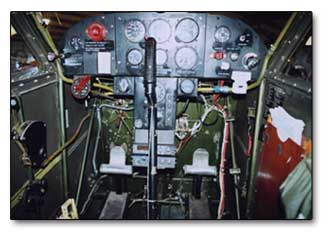
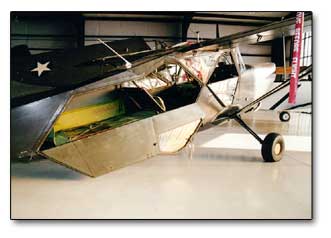
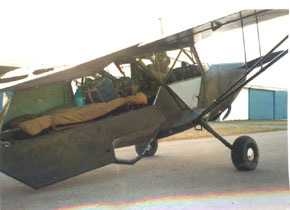
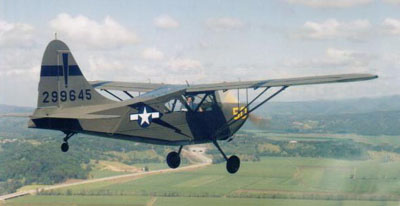
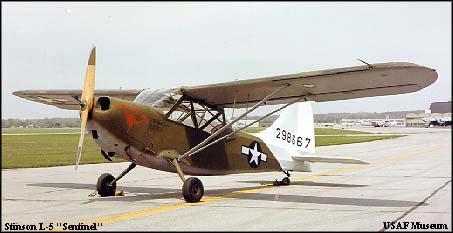
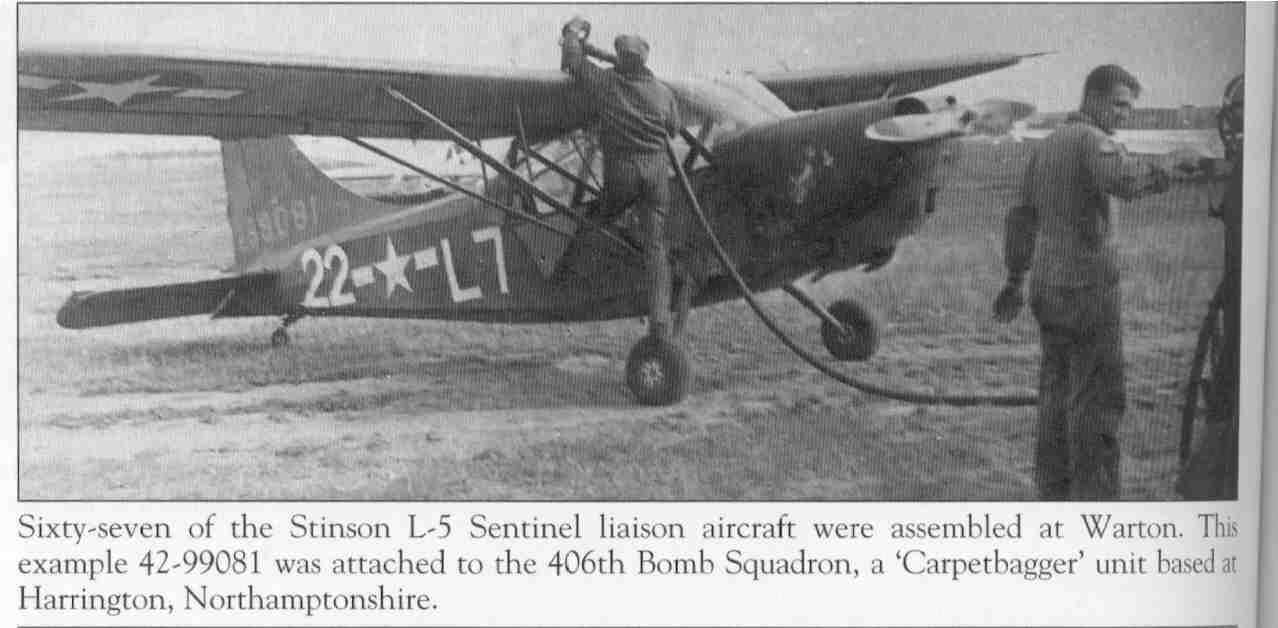
The Stinson L-5 liaison aircraft. Above: Stinson L-5 with ambulance door. Below: WWII-era photo of an L-5. Printed under the next-to-last photograph: “Stinson L-5 ‘Sentinel’” (left) and “USAF Museum” (right). Printed under the last: “Sixty-seven of the Stinson L-5 Sentinel liaison aircraft were assembled at Warton. This example 42-99081 was attached to the 406th Bomb Squadron, a ‘Carpetbagger’ unit based at Harrington, Northamptonshire.” (the caption is cut off at the right edge of the scan).
Letters from Maj. Gen. Whitehead
On March 9, 1944, Major General Ennis C. Whitehead, Deputy Commander of the Fifth Air Force, wrote to congratulate Captain Frederick on the 12th Air Liaison Party’s performance during the Los Negros assault.
Letter of Congratulation from Maj. Gen. Whitehead
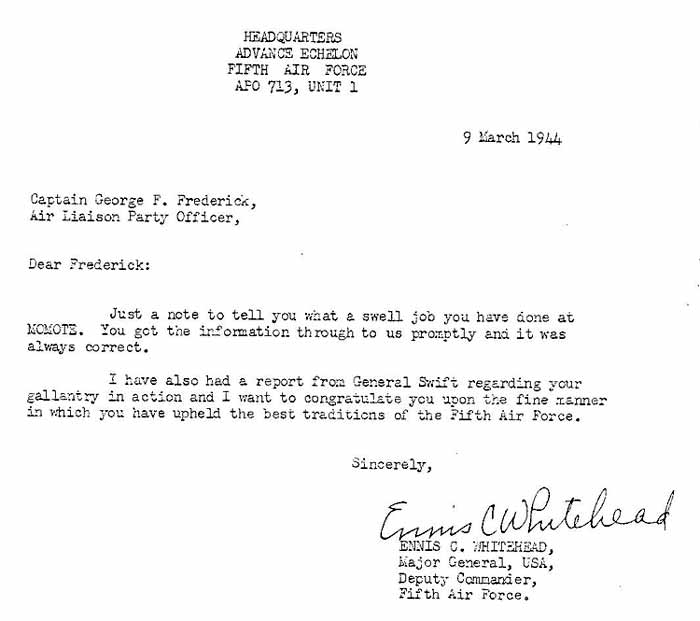
HEADQUARTERS ADVANCE ECHELON FIFTH AIR FORCE APO 713, UNIT 1
9 March 1944
Captain George F. Frederick, Air Liaison Party Officer,
Dear Frederick:
Just a note to tell you what a swell job you have done at MOMOTE. You got the information through to us promptly and it was always correct.
I have also had a report from General Swift regarding your gallantry in action and I want to congratulate you upon the fine manner in which you have upheld the best traditions of the Fifth Air Force.
Sincerely,
[signature: Ennis C. Whitehead]
ENNIS C. WHITEHEAD, Major General, USA, Deputy Commander, Fifth Air Force.
Commendation from Maj. Gen. Whitehead
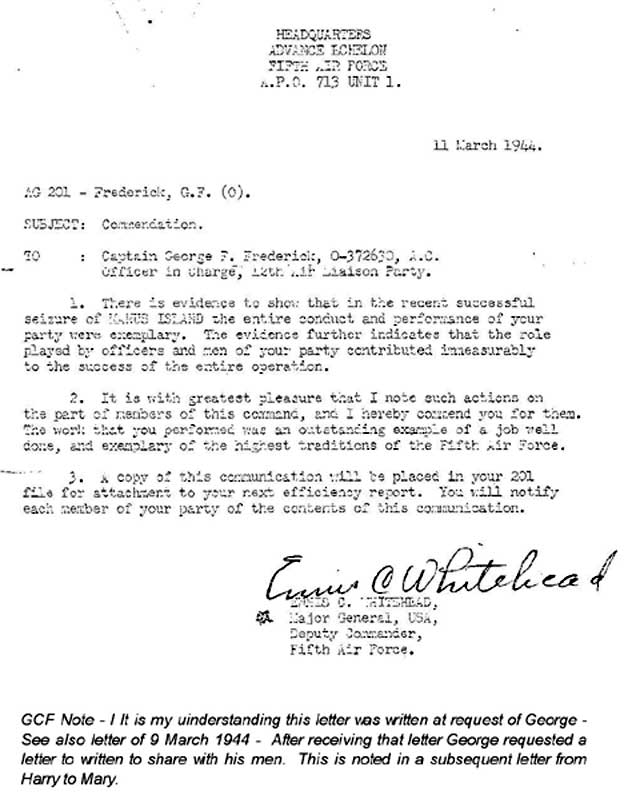
HEADQUARTERS ADVANCE ECHELON FIFTH AIR FORCE A.P.O. 713 UNIT 1.
11 March 1944.
AG 201 - Frederick, G.F. (O).
SUBJECT: Commendation.
TO : Captain George F. Frederick, O-372630, A.C. Officer in charge, 12th Air Liaison Party.
1. There is evidence to show that in the recent successful seizure of MANUS ISLAND the entire conduct and performance of your party were exemplary. The evidence further indicates that the role played by officers and men of your party contributed immeasurably to the success of the entire operation.
2. It is with greatest pleasure that I note such actions on the part of members of this command, and I hereby commend you for them. The work that you performed was an outstanding example of a job well done, and exemplary of the highest traditions of the Fifth Air Force.
3. A copy of this communication will be placed in your 201 file for attachment to your next efficiency report. You will notify each member of your party of the contents of this communication.
[signature: Ennis C. Whitehead]
ENNIS C. WHITEHEAD, Major General, USA, Deputy Commander, Fifth Air Force.
GCF Note - I It is my understanding this letter was written at request of George - See also letter of 9 March 1944 - After receiving that letter George requested a letter to written to share with his men. This is noted in a subsequent letter from Harry to Mary.
Last Letter Home
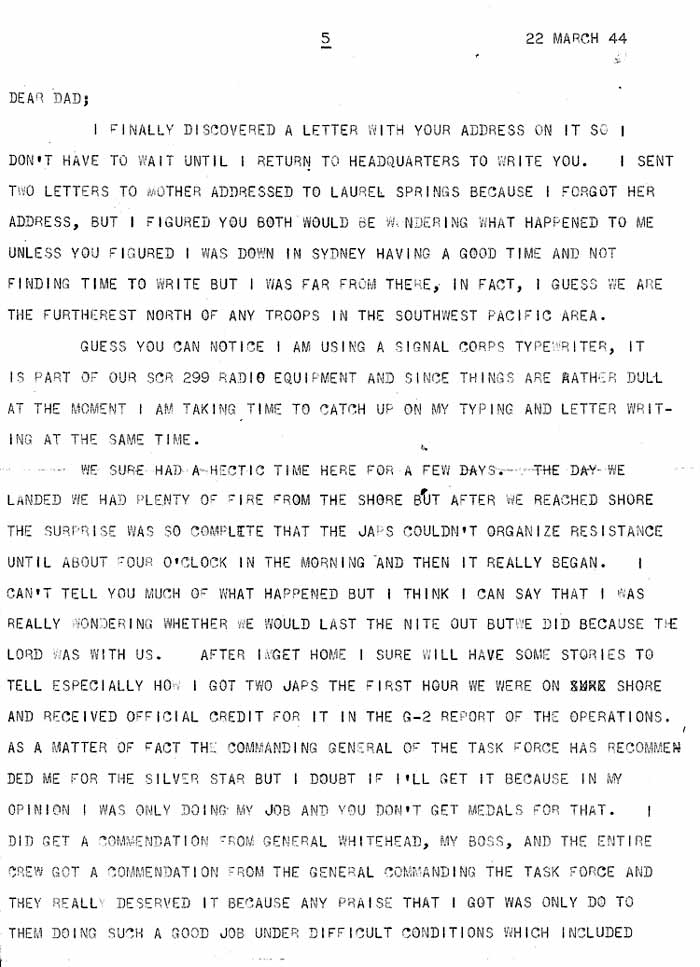
5
22 MARCH 44
DEAR DAD;
I FINALLY DISCOVERED A LETTER WITH YOUR ADDRESS ON IT SO I DON’T HAVE TO WAIT UNTIL I RETURN TO HEADQUARTERS TO WRITE YOU. I SENT TWO LETTERS TO MOTHER ADDRESSED TO LAUREL SPRINGS BECAUSE I FORGOT HER ADDRESS, BUT I FIGURED YOU BOTH WOULD BE W[?]NDERING WHAT HAPPENED TO ME UNLESS YOU FIGURED I WAS DOWN IN SYDNEY HAVING A GOOD TIME AND NOT FINDING TIME TO WRITE BUT I WAS FAR FROM THERE, IN FACT, I GUESS WE ARE THE FURTHEREST [sic] NORTH OF ANY TROOPS IN THE SOUTHWEST PACIFIC AREA.
GUESS YOU CAN NOTICE I AM USING A SIGNAL CORPS TYPEWRITER, IT IS PART OF OUR SCR 299 RADIO EQUIPMENT AND SINCE THINGS ARE RATHER DULL AT THE MOMENT I AM TAKING TIME TO CATCH UP ON MY TYPING AND LETTER WRITING AT THE SAME TIME.
WE SURE HAD A HECTIC TIME HERE FOR A FEW DAYS. THE DAY WE LANDED WE HAD PLENTY OF FIRE FROM THE SHORE BUT AFTER WE REACHED SHORE THE SURPRISE WAS SO COMPLETE THAT THE JAPS COULDN’T ORGANIZE RESISTANCE UNTIL ABOUT FOUR O’CLOCK IN THE MORNING AND THEN IT REALLY BEGAN. I CAN’T TELL YOU MUCH OF WHAT HAPPENED BUT I THINK I CAN SAY THAT I WAS REALLY WONDERING WHETHER WE WOULD LAST THE NITE OUT BUT WE DID BECAUSE THE LORD WAS WITH US. AFTER I GET HOME I SURE WILL HAVE SOME STORIES TO TELL ESPECIALLY HOW I GOT TWO JAPS THE FIRST HOUR WE WERE ON [?] SHORE AND RECEIVED OFFICIAL CREDIT FOR IT IN THE G-2 REPORT OF THE OPERATIONS. AS A MATTER OF FACT THE COMMANDING GENERAL OF THE TASK FORCE HAS RECOMMENDED ME FOR THE SILVER STAR BUT I DOUBT IF I’LL GET IT BECAUSE IN MY OPINION I WAS ONLY DOING MY JOB AND YOU DON’T GET MEDALS FOR THAT. I DID GET A COMMENDATION FROM GENERAL WHITEHEAD, MY BOSS, AND THE ENTIRE CREW GOT A COMMENDATION FROM THE GENERAL COMMANDING THE TASK FORCE AND THEY REALLY DESERVED IT BECAUSE ANY PRAISE THAT I GOT WAS ONLY DO TO [sic] THEM DOING SUCH A GOOD JOB UNDER DIFFICULT CONDITIONS WHICH INCLUDED
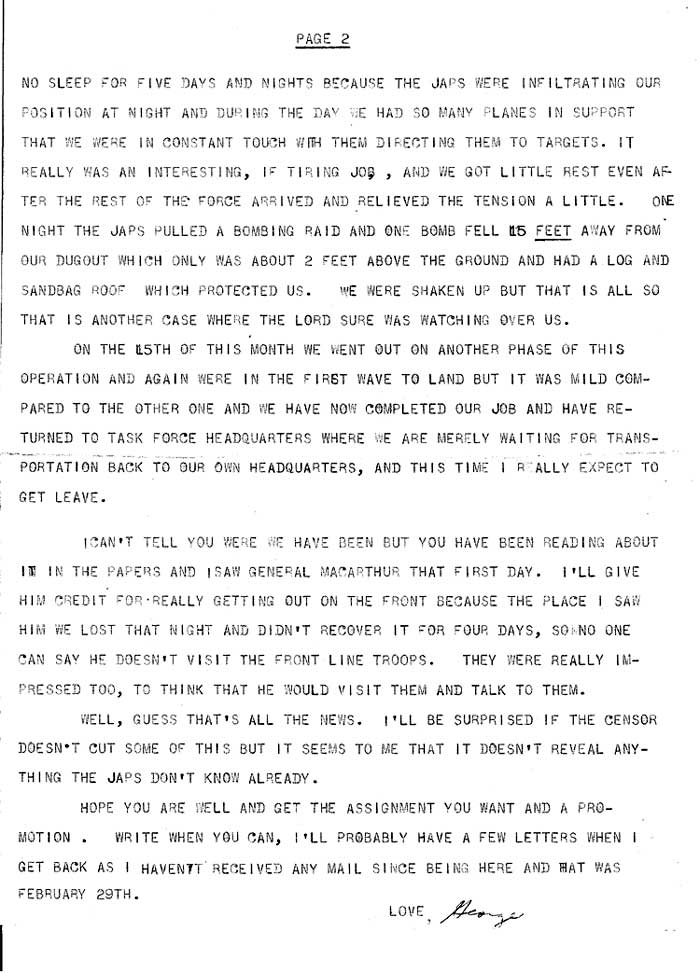
PAGE 2
NO SLEEP FOR FIVE DAYS AND NIGHTS BECAUSE THE JAPS WERE INFILTRATING OUR POSITION AT NIGHT AND DURING THE DAY WE HAD SO MANY PLANES IN SUPPORT THAT WE WERE IN CONSTANT TOUCH WITH THEM DIRECTING THEM TO TARGETS. IT REALLY WAS AN INTERESTING, IF TIRING JOB , AND WE GOT LITTLE REST EVEN AFTER THE REST OF THE FORCE ARRIVED AND RELIEVED THE TENSION A LITTLE. ONE NIGHT THE JAPS PULLED A BOMBING RAID AND ONE BOMB FELL 15 FEET AWAY FROM OUR DUGOUT WHICH ONLY WAS ABOUT 2 FEET ABOVE THE GROUND AND HAD A LOG AND SANDBAG ROOF WHICH PROTECTED US. WE WERE SHAKEN UP BUT THAT IS ALL SO THAT IS ANOTHER CASE WHERE THE LORD SURE WAS WATCHING OVER US.
ON THE 15TH OF THIS MONTH WE WENT OUT ON ANOTHER PHASE OF THIS OPERATION AND AGAIN WERE IN THE FIRST WAVE TO LAND BUT IT WAS MILD COMPARED TO THE OTHER ONE AND WE HAVE NOW COMPLETED OUR JOB AND HAVE RETURNED TO TASK FORCE HEADQUARTERS WHERE WE ARE MERELY WAITING FOR TRANSPORTATION BACK TO OUR OWN HEADQUARTERS, AND THIS TIME I REALLY EXPECT TO GET LEAVE.
I CAN’T TELL YOU WERE [sic] WE HAVE BEEN BUT YOU HAVE BEEN READING ABOUT I[T] IN THE PAPERS AND I SAW GENERAL MACARTHUR THAT FIRST DAY. I’LL GIVE HIM CREDIT FOR REALLY GETTING OUT ON THE FRONT BECAUSE THE PLACE I SAW HIM WE LOST THAT NIGHT AND DIDN’T RECOVER IT FOR FOUR DAYS, SO NO ONE CAN SAY HE DOESN’T VISIT THE FRONT LINE TROOPS. THEY WERE REALLY IMPRESSED TOO, TO THINK THAT HE WOULD VISIT THEM AND TALK TO THEM.
WELL, GUESS THAT’S ALL THE NEWS. I’LL BE SURPRISED IF THE CENSOR DOESN’T CUT SOME OF THIS BUT IT SEEMS TO ME THAT IT DOESN’T REVEAL ANYTHING THE JAPS DON’T KNOW ALREADY.
HOPE YOU ARE WELL AND GET THE ASSIGNMENT YOU WANT AND A PROMOTION . WRITE WHEN YOU CAN, I’LL PROBABLY HAVE A FEW LETTERS WHEN I GET BACK AS I HAVENTT [sic] RECEIVED ANY MAIL SINCE BEING HERE AND THAT WAS FEBRUARY 29TH.
LOVE, [signature: George]
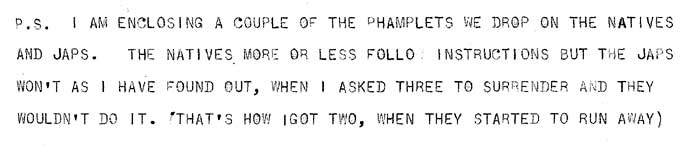
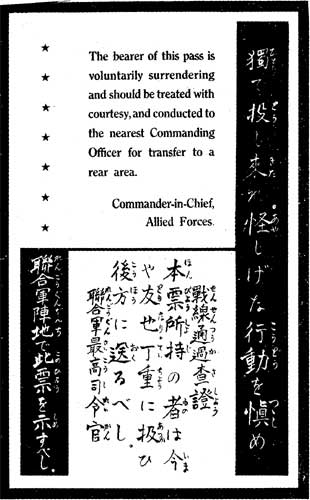
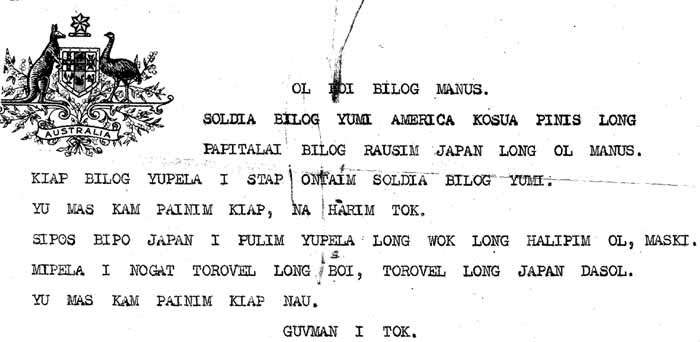
P.S. I AM ENCLOSING A COUPLE OF THE PHAMPLETS [sic] WE DROP ON THE NATIVES AND JAPS. THE NATIVES MORE OR LESS FOLLO[W] INSTRUCTIONS BUT THE JAPS WON’T AS I HAVE FOUND OUT, WHEN I ASKED THREE TO SURRENDER AND THEY WOULDN’T DO IT. (THAT’S HOW I GOT TWO, WHEN THEY STARTED TO RUN AWAY)
The bearer of this pass is voluntarily surrendering and should be treated with courtesy, and conducted to the nearest Commanding Officer for transfer to a rear area.
Commander-in-Chief, Allied Forces.
OL BOI BILOG MANUS.
SOLDIA BILOG YUMI AMERICA KOSUA PINIS LONG PAPITALAI BILOG RAUSIM JAPAN LONG OL MANUS.
KIAP BILOG YUPELA I STAP ONTAIM SOLDIA BILOG YUMI.
YU MAS KAM PAINIM KIAP, NA HARIM TOK.
SIPOS BIPO JAPAN I PULIM YUPELA LONG WOK LONG HALIPIM OL, MASKI.
MIPELA I NOGAT TOROVEL LONG BOI, TOROVEL LONG JAPAN DASOL.
YU MAS KAM PAINIM KIAP NAU.
GUVMAN I TOK.
Letter of Condolence from General Headquarters, Southwest Pacific Area
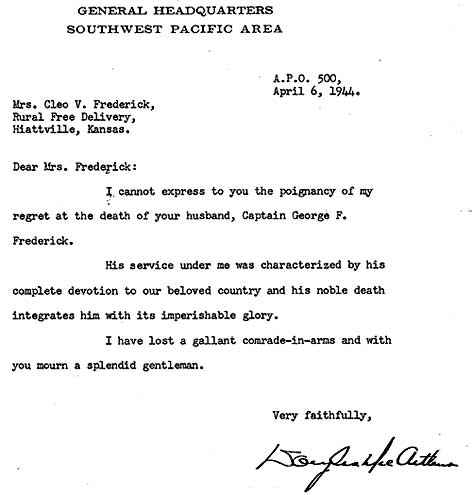
GENERAL HEADQUARTERS SOUTHWEST PACIFIC AREA
A.P.O. 500, April 6, 1944.
Mrs. Cleo V. Frederick, Rural Free Delivery, Hiattville, Kansas.
Dear Mrs. Frederick:
I cannot express to you the poignancy of my regret at the death of your husband, Captain George F. Frederick.
His service under me was characterized by his complete devotion to our beloved country and his noble death integrates him with its imperishable glory.
I have lost a gallant comrade-in-arms and with you mourn a splendid gentleman.
Very faithfully,
[signature]
Distinguished Flying Cross Awarded to Captain Frederick
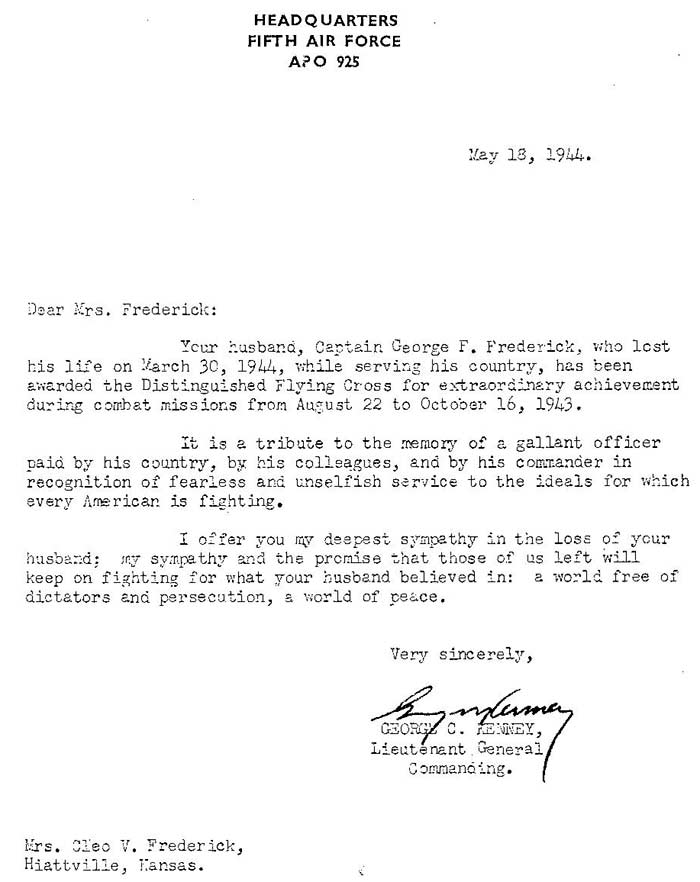
HEADQUARTERS FIFTH AIR FORCE APO 925
May 18, 1944.
Dear Mrs. Frederick:
Your husband, Captain George F. Frederick, who lost his life on March 30, 1944, while serving his country, has been awarded the Distinguished Flying Cross for extraordinary achievement during combat missions from August 22 to October 16, 1943.
It is a tribute to the memory of a gallant officer paid by his country, by his colleagues, and by his commander in recognition of fearless and unselfish service to the ideals for which every American is fighting.
I offer you my deepest sympathy in the loss of your husband; my sympathy and the promise that those of us left will keep on fighting for what your husband believed in: a world free of dictators and persecution, a world of peace.
Very sincerely,
[signature: George C. Kenney]
GEORGE C. KENNEY, Lieutenant General Commanding.
Mrs. Cleo V. Frederick, Hiattville, Kansas.
Distinguished Flying Cross and Air Medal Awarded to Captain Frederick
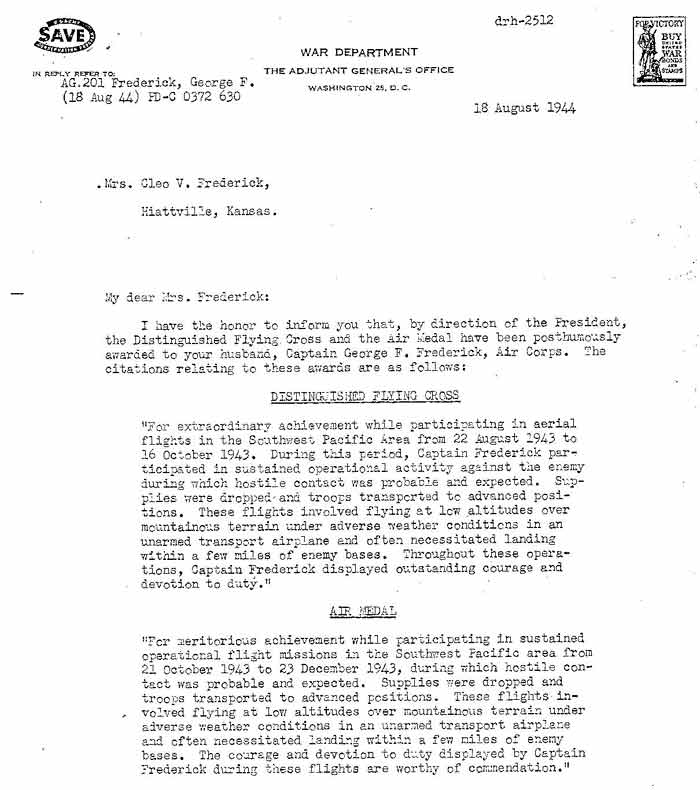
drh-2512
WAR DEPARTMENT THE ADJUTANT GENERAL’S OFFICE WASHINGTON 25, D. C.
IN REPLY REFER TO: AG.201 Frederick, George F. (18 Aug 44) PD-C 0372 630
18 August 1944
Mrs. Cleo V. Frederick, Hiattville, Kansas.
My dear Mrs. Frederick:
I have the honor to inform you that, by direction of the President, the Distinguished Flying Cross and the air Medal have been posthumously awarded to your husband, Captain George F. Frederick, Air Corps. The citations relating to these awards are as follows:
DISTINGUISHED FLYING CROSS
“For extraordinary achievement while participating in aerial flights in the Southwest Pacific Area from 22 August 1943 to 16 October 1943. During this period, Captain Frederick participated in sustained operational activity against the enemy during which hostile contact was probable and expected. Supplies were dropped and troops transported to advanced positions. These flights involved flying at low altitudes over mountainous terrain under adverse weather conditions in an unarmed transport airplane and often necessitated landing within a few miles of enemy bases. Throughout these operations, Captain Frederick displayed outstanding courage and devotion to duty.”
AIR MEDAL
“For meritorious achievement while participating in sustained operational flight missions in the Southwest Pacific area from 21 October 1943 to 23 December 1943, during which hostile contact was probable and expected. Supplies were dropped and troops transported to advanced positions. These flights involved flying at low altitudes over mountainous terrain under adverse weather conditions in an unarmed transport airplane and often necessitated landing within a few miles of enemy bases. The courage and devotion to duty displayed by Captain Frederick during these flights are worthy of commendation.”
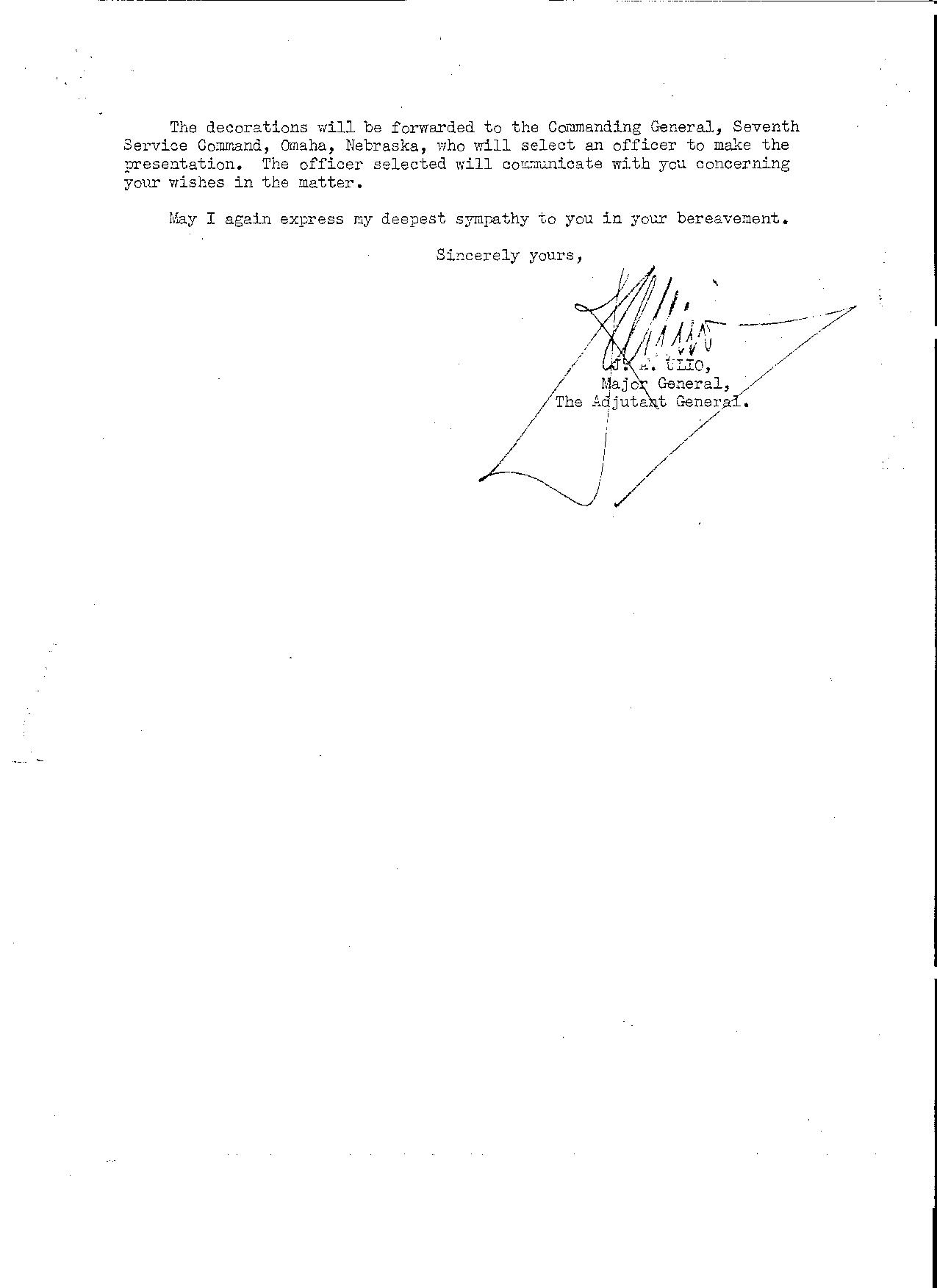
The decorations will be forwarded to the Commanding General, Seventh Service Command, Omaha, Nebraska, who will select an officer to make the presentation. The officer selected will communicate with you concerning your wishes in the matter.
May I again express my deepest sympathy to you in your bereavement.
Sincerely yours,
[signature: J. A. Ulio]
J. A. ULIO, Major General, The Adjutant General.
Legion of Merit Awarded to Captain Frederick
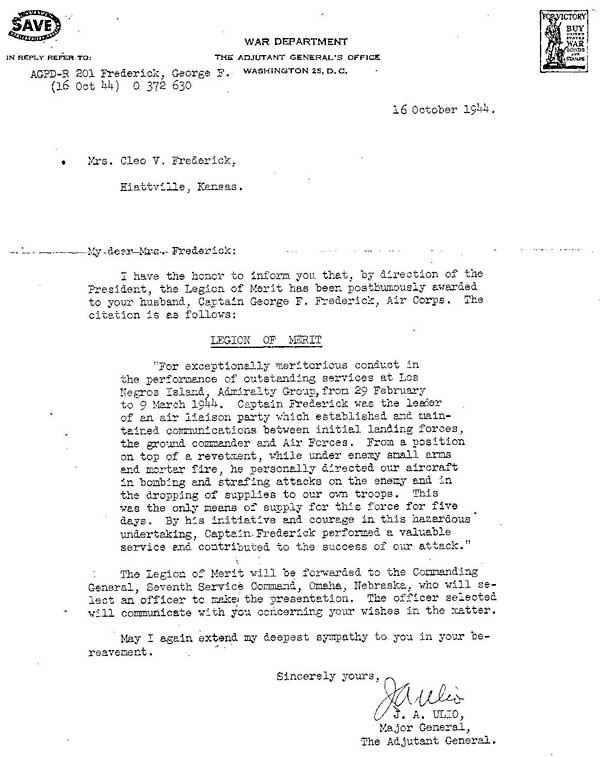
WAR DEPARTMENT THE ADJUTANT GENERAL’S OFFICE WASHINGTON 25, D. C.
IN REPLY REFER TO: AGPD-R 201 Frederick, George F. (16 Oct 44) 0 372 630
16 October 1944
Mrs. Cleo V. Frederick, Hiattville, Kansas.
My dear Mrs. Frederick:
I have the honor to inform you that, by direction of the President, the Legion of Merit has been posthumously awarded to your husband, Captain George F. Frederick, Air Corps. The citation is as follows:
LEGION OF MERIT
“For exceptionally meritorious conduct in the performance of outstanding services at Los Negros Island, Admiralty Group, from 29 February to 9 March 1944. Captain Frederick was the leader of an air liaison party which established and maintained communications between initial landing forces, the ground commander and Air Forces. From a position on top of a revetment, while under enemy small arms and mortar fire, he personally directed our aircraft in bombing and strafing attacks on the enemy and in the dropping of supplies to our own troops. This was the only means of supply for this force for five days. By his initiative and courage in this hazardous undertaking, Captain Frederick performed a valuable service and contributed to the success of our attack.”
The Legion of Merit will be forwarded to the Commanding General, Seventh Service Command, Omaha, Nebraska, who will select an officer to make the presentation. The officer selected will communicate with you concerning your wishes in the matter.
May I again extend my deepest sympathy to you in your bereavement.
Sincerely yours,
[signature: J. A. Ulio]
J. A. ULIO, Major General, The Adjutant General.
Credits
Thanks to Clint Frederick for his assistance in building this page.