Introduction
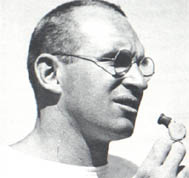
George Almon Munger
George Almon Munger was born in Elkins Park PA on June 24, 1909 to Mr. and Mrs. Herbert Munger. He was a descendant of George A. Munger, who was a prominent Camden businessman, involved in lumber, real estate, and who founded the Munger & Long Department Store at Broadway and Federal Street. Shortly after his birth, the Munger family moved to 420 Cooper Street in Camden. Herbert Munger and his brother Clarence were at the time partnered in the department store with Elmer E. Long.
George Almon Munger spent his early years in Camden, attending the local Friends School. His high school years were spent in Pennsylvania, where he starred in football, basketball, and track.
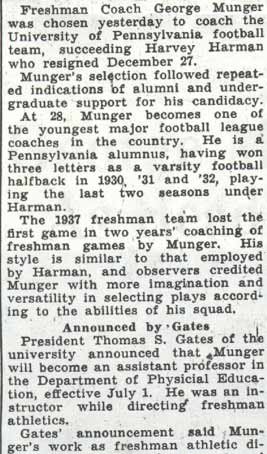
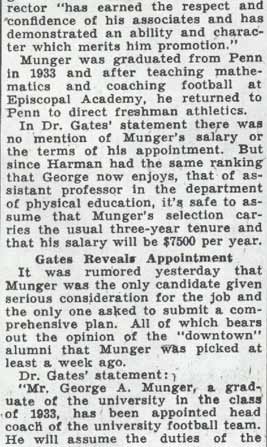
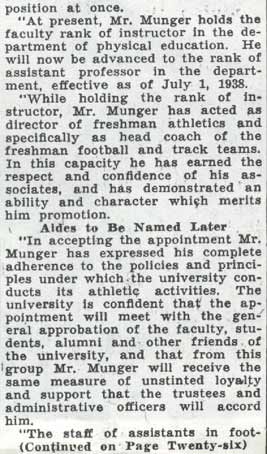
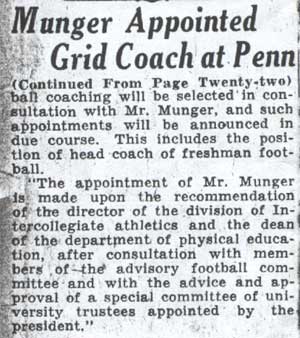
On January 19, 1938 George Munger was named head coach of the University of Pennsylvania football team. His 16 year career was quite successful, as he compiled a 52-7-4 record within the Ivy League, winning 84 games overall, and developed no less than 14 All-American players, including four-time All-American George Savitsky.
After George Almon retired as coach, he served for many years as the Penn athletic director, and Professor of Physical Education. After the 1953 season, Penn, as a new member of the Ivy League, decided to de-emphasize football, and the glory days of Penn football were over.
George Almon Munger passed away in 1994.
The Maxwell Football Club in Philadelphia awards the annual George Munger Award for College Coach of the Year in his honor.
George Munger Is Selected As Head Grid Coach at Penn
Camden Courier-Post —
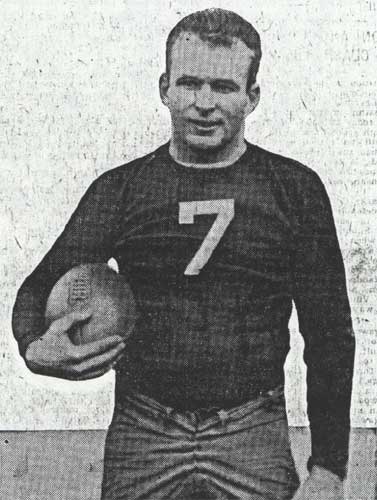
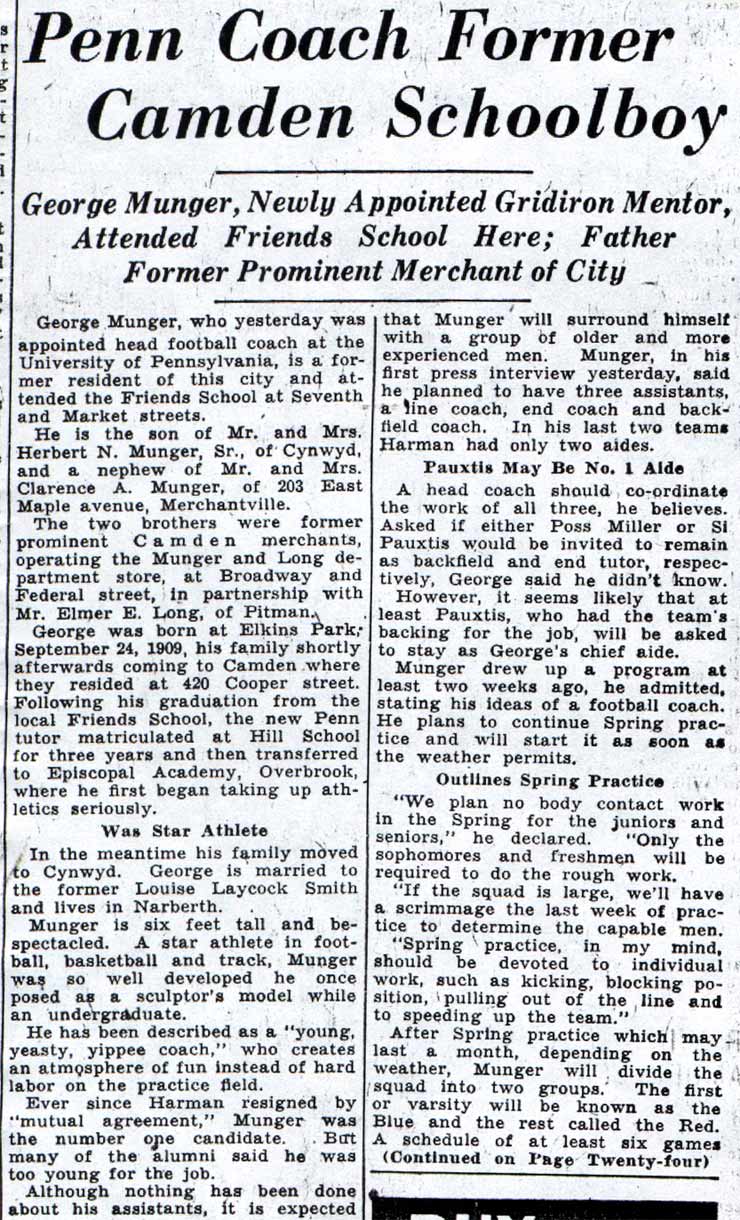

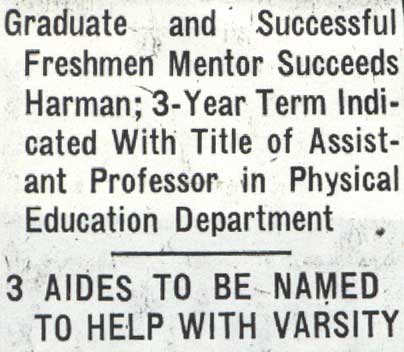
George Munger, Newly Appointed Gridiron Mentor, Attended Friends School Here; Father Former Prominent Merchant of City
George Munger, who yesterday was appointed head football coach at the University of Pennsylvania is a former resident of this city and attended the Friends School at Seventh and Market streets.
He is the son of Mr. and Mrs. Herbert N. Munger, Sr., of Cynwyd, and a nephew of Mr. and Mrs. Clarence A. Munger, of 203 East Maple avenue, Merchantville.
The two Mungers were former prominent Camden merchants, operating the Munger and Leon department store, at Broadway and Federal street, in partnership with Mr. Elmer D. Leon, of Philadelphia.
George was born at Elkins Park; September 24, 1909, his family shortly afterwards moving to Camden where they resided at 420 Cooper street. Following his graduation from the local Friends School, the new Penn tutor matriculated at Hill School for three years and then transferred to Episcopal Academy, Overbrook, where he first began taking up athletics seriously.
Was Star Athlete
In the meantime his family moved to Cynwyd. George is married to a former Louise Laycock Smith and lives in Narberth.
Munger is six feet tall and well-respected. George was athlete in football, basketball and track. Munger has also developed into what is poised as a sculptor’s model while an undergraduate.
He has been described as a “young, yeasty, yippee coach,” who creates an atmosphere of fun instead of hard labor on the practice field.
Ever since Harman resigned by “mutual agreement,” Munger was the number one candidate, and many of the alumni said he was too young at 28.
Although nothing has been done about his assistants, it is expected that Munger will surround himself with a group of older and more experienced men. Munger, in his first press interview yesterday, said he planned to have three assistants. A line coach, end coach and a backfield coach. In his last two teams Harman had only two.
Pauxits May Be No. 1 Aide
A head coach should co-ordinate the work of all three, he believes. George said George Pauxitis or Si Pauxitis would be invited to remain as backfield and end tutor, respectively. George said he didn’t know. However, it seems likely that si Pauxtis, who has the team’s backing for the job, will be asked to stay as George’s chief aide.
Munger drew up a program at least two weeks ago, he admitted, stating his ideas of a football coach. He plans to continue Spring practice and will start it as soon as the weather permits.
Outlines Coming Practice
“We plan no body contact work in the Spring for the juniors and seniors,” Munger says, “Required sophomores and freshmen will be required to do the rough work.”
“If the going is right, we’ll have a scrimmage the last week of practice to determine the capable men. The first month, in my mind, should be devoted to individual work, such as kicking, blocking position, taking care of the ends and to speeding up the team.”
Spring practice sessions, which may last a month, depending on weather, Munger will divide the squad into two groups. The team or varsity will be known as the Blue and the rest called the Red. A schedule of at least six games (Continued on Page Twenty-four)
125 in County Form U. of P. Alumni Club
Camden Courier-Post —
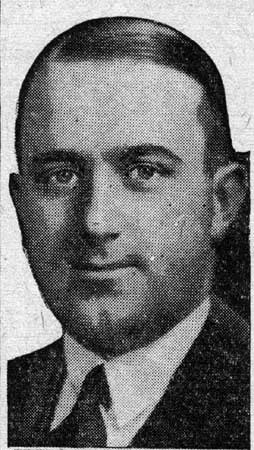
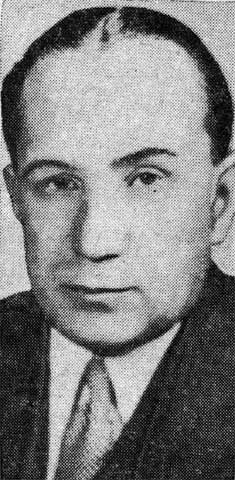
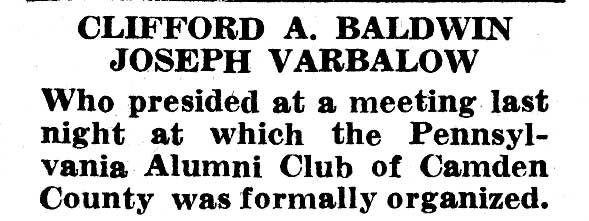

Named: Woodrow Wilson High School, Joseph A. Varbalow, Clifford A. Baldwin, Thomas J. Daley, J. David Stern, J. William Markeim, Dr. Joseph E. Roberts, Frank M. Travaline Jr., John H. Reiners Jr., Dr. Byron G. Tuttle, Dr. David D. Helm, and George Munger.
George Munger

George Almon Munger – Maxwell Football Club
When World War I ended, George Almon Munger was a little boy. But by the time World War II was over, George Almon Munger was halfway to the Hall of Fame.
Munger took over as Penn’s head football coach in 1939. He compiled a 52-7-4 Ivy League record over the next 16 years, creating a monstrous group of Quakers that left fans fighting for tickets at Franklin field, boosting Penn to the nation’s top spot in football attendance.
Thanks to a single-wing offense and a disciplined defense, Penn would win the Ivy League’s mythical title nine times during Munger’s tenure and 16 players, including Chuck Bednarik and Reds Bagnell, would be named All-Americans.
While Munger coached at Penn, three of his players went on to win the Maxwell Award. They were: Robert H. Odell (1943), Charles (Chuck) Bednarik (1948) and Francis J. (Reds) Bagnell (1950).
When I was 15, I knew I wanted to be a coach,” Munger once said. He credited his high school coach, Lambert F. Whetstone, with installing that interest in him. Whetstone coached at Episcopal Academy, where Munger captained the football team in 1928 and 1929.
Episcopal just happened to win every game and a pair of Interac championships those two seasons. Munger added those titles to three others his teams won at Episcopal — two in basketball and one in baseball. He knew his way around Episcopal’s track as well, setting school records in the pole-vault, high jump, discus and javelin.
As a student-athlete at Penn, Munger starred as a half-back and fullback in the Quakers’ backfield. But he carved his place into Franklin field lore by winning the decathlon at the 1931 Penn Relays.
After graduating from Penn in 1933, Munger returned to Episcopal to coach football and track and teach Math and Sacred Studies. He stayed there until 1936. That’s when he went back to Penn to coach the Quakers’ freshman track and football squads until he became head football coach three years later.
When his coaching career ended in 1954, Munger became director and professor of the University of Pennsylvania’s Department of Physical Education.
Among George Almon Munger’s countless awards is an honorary Doctors of Law Degree from his alma mater. In the presentation of that degree, the Trustees of the University of Pennsylvania called Munger “an angel with a single wing who soared into the record books.
The Maxwell Football Club honors that heavenly coach by making his coaching success, his devotion to ethics in athletics, and his commitment to education the standard for which all college coaches should strive.
Coach Munger passed away in 1994.