Frederick H. Baynes
Rank: Sergeant, U.S. Army
Unit: Company G, 114th Infantry Regiment, 29th Infantry Division
Entered service from: New Jersey
Died:
Buried at: Meuse-Argonne American Cemetery, Plot F, Row 23, Grave 29, Romagne, France
Sergeant Frederick H. Baynes was born in Buffalo, New York on May 22, 1895 to Frederick H. and Rebecca Baynes. His father worked as an inventor at the Welsbach and General Gas Mantle Co., which produced incandescent gas mantles from the late 1890s to 1941 in Camden and Gloucester City. The family lived at 935 Monmouth Street, Gloucester City, NJ. Prior to the war, Frederick Baynes worked as a fireman for the Pennsylvania Railroad in Camden. He had also served for three years with the old Third Regiment, National Guard of New Jersey, which had its headquarters in the armory at Haddon Avenue and Mickle Street. This building was known after 1954 as Camden Convention Hall. Frederick Baynes had been promoted to non-commissioned officer’s rank while serving with the National Guard.
Sergeant Baynes registered for the draft in Camden, NJ on June 5, 1917. He was sent along with the rest of the Third Regiment to Camp Edge, Sea Girt, on July 25, 1917, and later transferred to Camp McClellan, Anniston, AL. He became a member of Company G when the regiment was reorganized as the 114th Infantry. Sergeant Baynes was killed in action in the Meuse-Argonne offensive on October 9, 1918. He was survived by his parents Frederick H. and Rebecca Baynes of Gloucester City, and a sister, Helen Baynes, of the same address.
The Baynes family moved to 86 Homer Avenue in Buffalo, NY sometime during the 1920s. In 1930 Mrs. Rebecca Baynes took part in the Mother’s Pilgrimage to France.
World War I Draft Registration Card
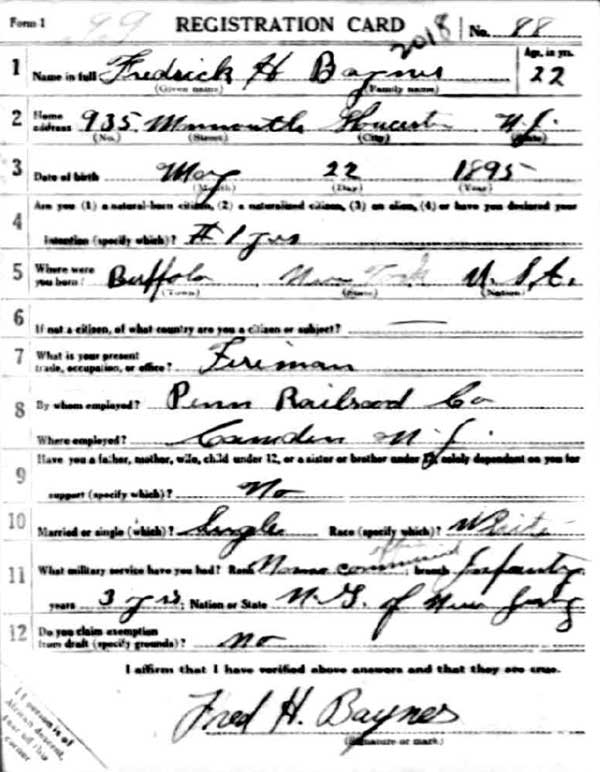
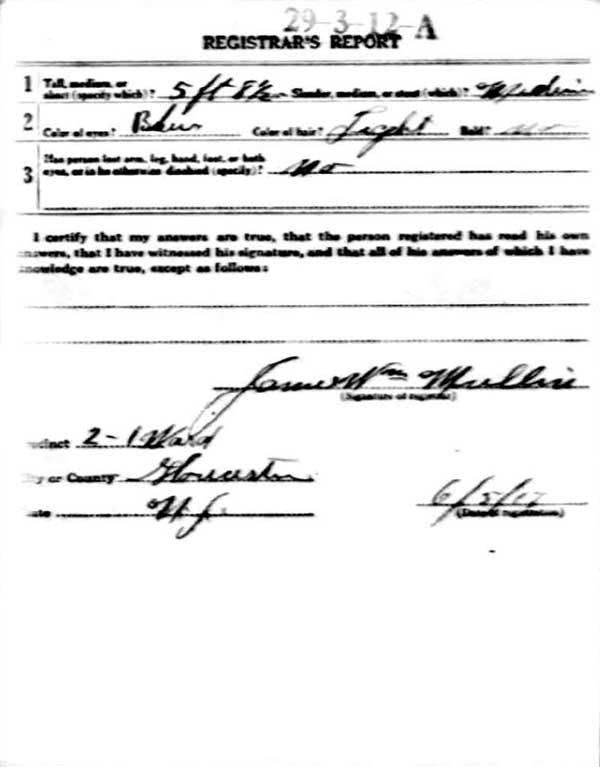
World War I Draft Registration Card for Frederick H. Baynes.
Honor Roll Card
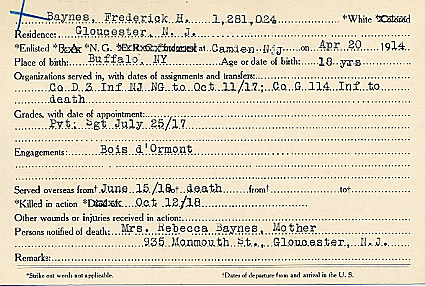
Camden County World War I Honor Roll card for Frederick H. Baynes.
The History of the Welsbach/General Gas Mantle Co.
The Welsbach Gas Mantle Building was constructed of reinforced concrete with unusual window areas and was exceptionally well ventilated. The cost of the building was over one million dollars in 1916. Individual rooms were set up to accommodate each step of the process: knitting, hardening, dipping, etc. The women employees had their own facilities in the factory consisting of restrooms, music rooms, reading rooms, writing rooms, dressing rooms, and a hospital.
During the manufacture of gas mantles in the early 1900s, ore containing radioactive thorium was processed. The thorium added to the gas mantles made them glow brighter when lit. As gas lighting was replaced by the electric light, the market for gas mantles dried up. The factory stopped manufacturing in the early 1940s.
In 1992 the building was occupied by Ste-Lar Textiles, who was using the building as a warehouse. The Department of Environmental Protection (NJDEP) examined the site and determined there was a serious environmental threat in the Welsbach building due to radiation contamination. As a first step they removed approximately 15,000 bolts of textiles contaminated with thorium. Removal of the contaminated textiles significantly reduced the potential health risks to the public in case of a fire. The NJDEP continues to study the site and plan for the eventual complete clean up.
The process of making gas mantles involved several steps, beginning with the knitting of the cotton/silk fabric. In the saturation step the fabric is saturated in lighting fluid. This fluid contains the thorium and cerium salts. The fabric is then dried on wood or glass forms and then carefully plaited together. An asbestos cord is drawn through to form a loop. The fabric is shaped to fit a mantle by fitting it over a wooden form. It was estimated that American consumers used 40,000,000 mantles per year when gas light was being used.
Written by Angel Mitchell of Camden High School and Mike Gallo, Tom DeGrazia, and John Amadio of Cherry Hill West High School, for the Case History Team.