Frank V. Gramenzi
Heroes of Camden, New Jersey
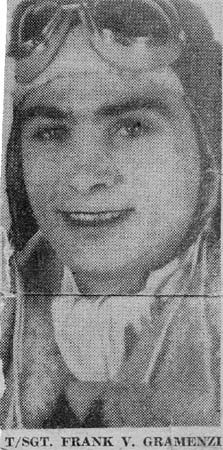
T/Sgt. Frank V. Gramenzi — 483rd Bombardment Group, B-17 flight engineer.
Technical Sergeant Frank V. Gramenzi
Frank V. Gramenzi was born in New Jersey on June 23, 1918. He grew up in Camden, at 322 Line Street, where his father Vincenzo Gramenzi operated his plumbing business, V. Gramenzi & Sons. He attended high school for three years before joining his father in the family business. On July 10, 1942 he was drafted into the United States Army. Qualifying for flight duty, Frank Gramenzi trained in aerial gunnery and as a flight engineer. He was promoted to Technical Sergeant and made part of a B-17 bomber crew at Salt Lake City, Utah in 1943.
The crew trained with the 398th Bombardment Group from November 29, 1943 until the end of the year at Rapid City, South Dakota. On January 1, 1944 this crew was transferred to the 483rd Bombardment Group and sent to MacDill Field in Tampa, Florida for further training prior to going overseas. The crew, commanded by Lieutenant Ewald Swanson, took the B-17 #42-32019, nicknamed MIZPAH, to Italy in March of 1944.
On July 14, 1944 the MIZPAH was shot down during a mission to bomb the Shell Oil Refinery at Budapest, Hungary. The nose of the MIZPAH took a direct hit from an 88mm antiaircraft shell, killing the bombardier and navigator. The rest of the crew, including Frank Gramenzi, who was manning the top turret gun, managed to bail out, and were taken prisoner by the Germans.
Frank Gramenzi spent 11 months in German POW camps. He was held initially at Stalag Luft 4 Gross-Tychow (formerly Heydekrug), Pomerania, Prussia — now part of Poland. As the Russians advanced toward Berlin in early 1945, the Germans moved their prisoners westward on a forced march. Technical Sergeant Gramenzi and the other POWs at Stalag Luft 4 were moved through the town of Wobbelin Bei Ludwigslust and then through Usedom Bei Savenmunde. On April 6, 1945 Frank Gramenzi escaped from his German captors. He eluded capture for eleven days, moving westward and surviving on next to nothing to eat until he was found by British infantry. It was not until May 29, 1945 — four weeks after the German surrender — that Frank Gramenzi returned to American lines.
Returning to Camden and to Line Street after the war, Frank Gramenzi rejoined the family business. He married and with wife Angelina lived at 319 Line Street until 1962, when the family moved to Woodbury Heights, New Jersey. He remained in Woodbury Heights until his passing on June 2, 1993.
The MIZPAH Shot Down Over Budapest — July 14, 1944
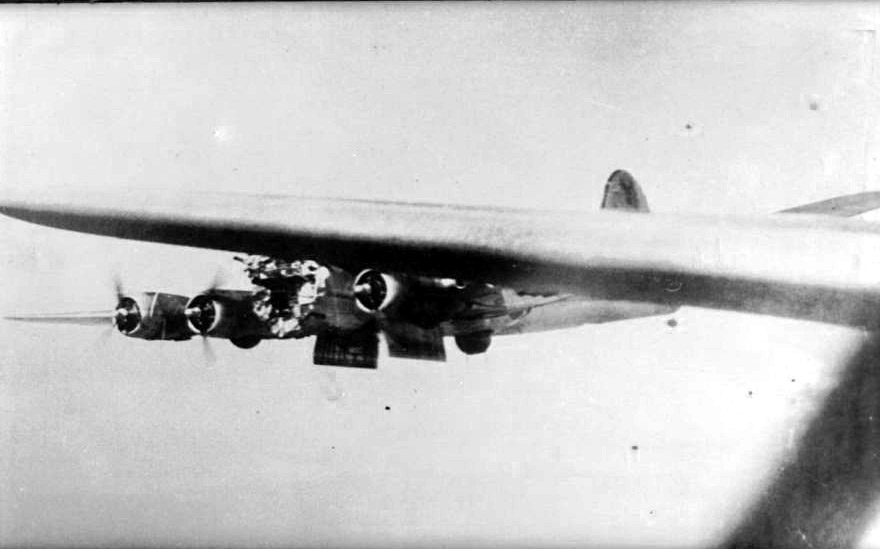
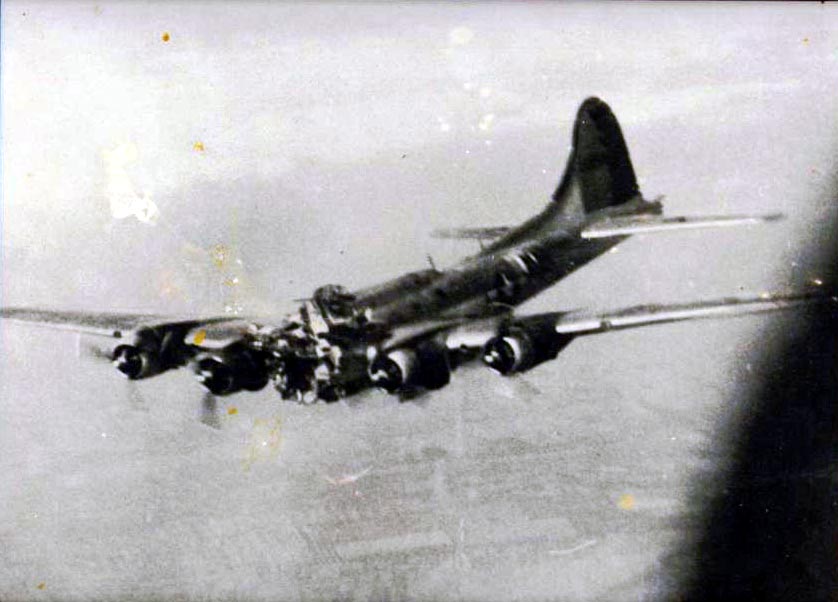
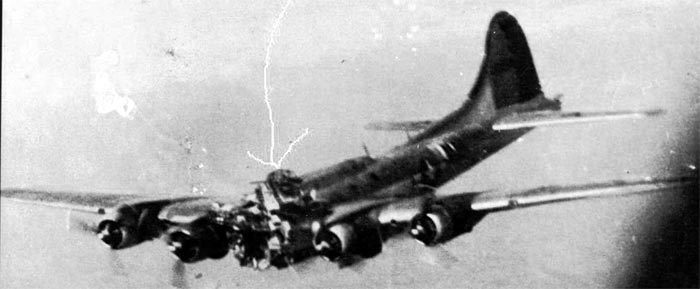
These photographs were taken by Robert W. Toombs, who was flying in another B-17. Frank Gramenzi’s father had no idea the photographs had been taken until sometime in the 1950s. The arrow on the bottom photo points to where Frank Gramenzi parachuted out, only to be captured upon landing.
His daughter Rochelle Gramenzi wrote: “My father was a Flight Engineer on the ‘Ewald Swanson Crew 483 Bombardment Group 840 Squadron’. The name of my father’s B-17 was the MIZPAH. The MIZPAH was shot down July 14th, 1944, over Hungary. My father’s B-17 is the plane with the nose blown off. He had no idea the photographs had been taken until sometime in the 1950s. The arrow on the bottom photo points to where my father parachuted out, only to be captured upon landing. He was in a German prison camp for 11 months along with his surviving crew members. Incredibly, my father escaped somehow and made it back to safety.”
Over Budapest — July 14, 1944. The B-17 MIZPAH had just been hit by German anti-aircraft fire. The bombardier and navigator had been killed, but the pilot, co-pilot and rest of crew were uninjured. Seconds later, the B-17 MIZPAH begins to fall out of formation. Technical Sergeant Frank Gramenzi can be seen manning his machine gun in the top turret.
Crew Rosters — 483rd Bombardment Group
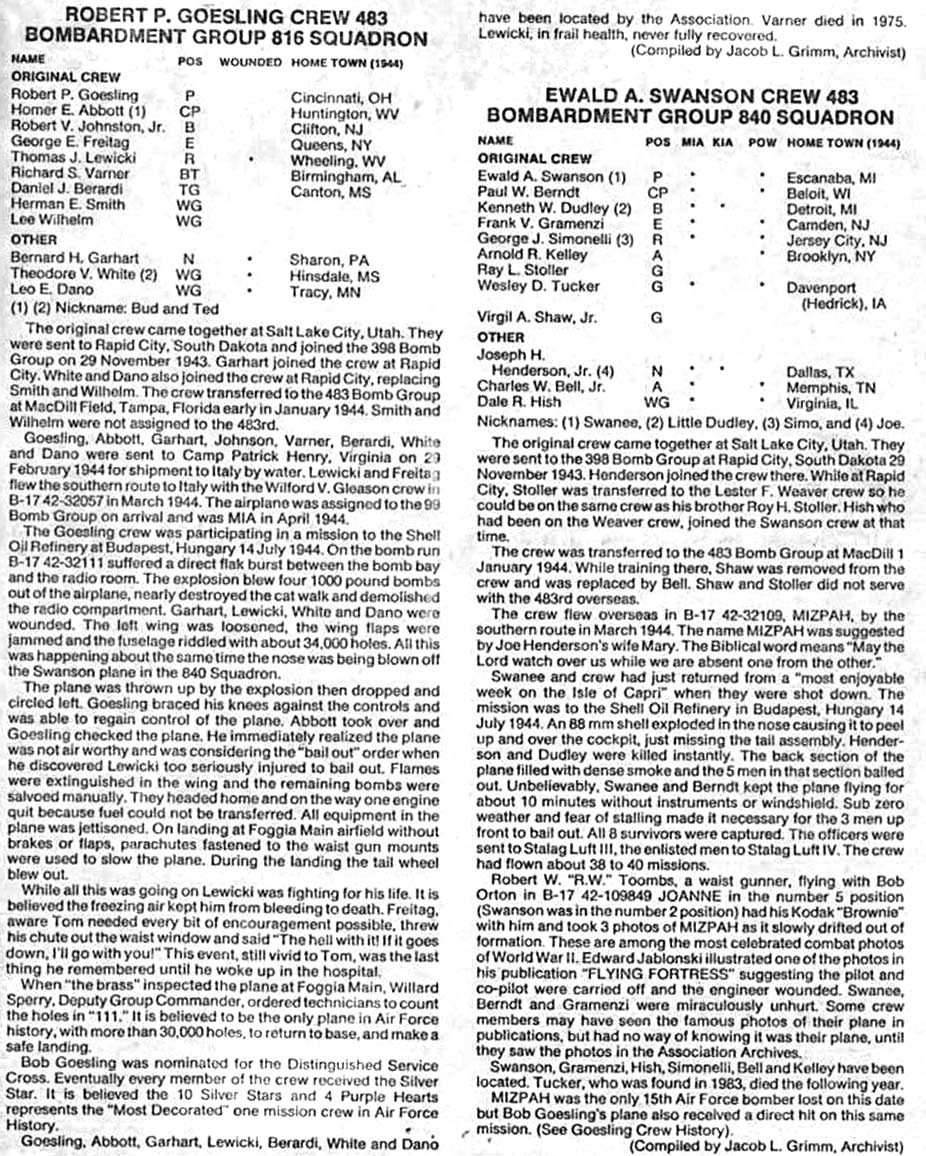
Crew rosters for the Robert F. Goesling Crew (816 Squadron) and the Ewald Swanson Crew (840 Squadron), 483rd Bombardment Group.
Camden Man Bares Nazi Trick Trying to Poison U.S. Captives
Camden Courier-Post

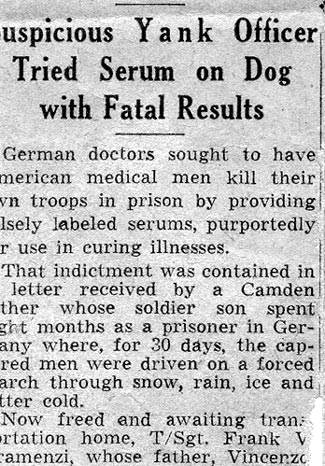
Suspicious Yank Officer Tried Serum on Dog with Fatal Results
German doctors sought to have American medical men kill their own troops in prison by providing falsely labeled serums, purportedly for use in curing illnesses. That indictment was contained in a letter received by a Camden father whose soldier son spent eight months as a prisoner in Germany, where, for 30 days, the captured men were driven on a forced march through snow, rain, ice and bitter cold.
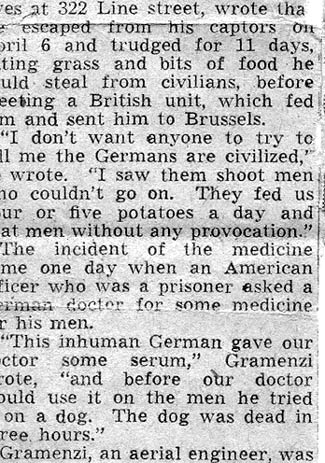
Now freed and awaiting transportation home, T/Sgt. Frank V. Gramenzi, whose father, Vincenzo, lives at 322 Line street, wrote that he escaped from his captors on April 6 and trudged for 11 days, eating grass and bits of food he could steal from civilians, before meeting a British unit, which fed him and sent him to Brussels.
“I don’t want anyone to try to tell me the Germans are civilized,” he wrote. “I saw them shoot men who couldn’t go on. They fed us four or five potatoes a day and beat men without any provocation.”
The incident of the medicine came one day when an American officer who was a prisoner asked a German doctor for some medicine for his men. “This inhuman German gave our doctor some serum,” Gramenzi wrote, “and before our doctor could use it on the men he tried it on a dog. The dog was dead in three hours.”
Gramenzi, an aerial engineer, was a member of the Ewald Swanson crew of the 483rd Bombardment Group.
The Forced March from Stalag Luft 4 — February 1945
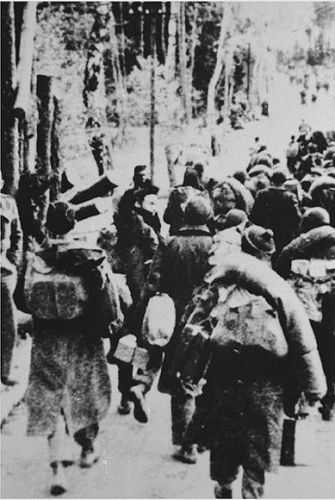
Prisoners on the forced march from Stalag Luft 4, February 1945. As the Russians advanced toward Berlin, the Germans moved POWs westward on foot through snow, rain, and ice.