Introduction
Everett R. Meves was a frequent writer of letters to the editor in the Camden Courier-Post during the 1930s.
Now We Know
Camden Courier-Post —
To the Editor:
Sir—Mr. Showalter wishes that some one would please tell me that selective breeding of the mind is impossible.
Will some one please tell Mr. Showalter that he certainly knows nothing about biology and eugenics? If he did he would not fall into such an error.
Selective breeding of the mind is possible, and is one of the most important objects of the eugenic program, the breeding of a more intelligent race.
He asks, supposing we are the product of evolution, what would I have us evolve to instead of human beings? The answer is, into more healthy, intelligent and ethical human beings.
He asks whether the intelligent minority elected Mr. Hoover. He, no doubt refers to the depression of 1929, which was world-wide, inevitable as the result of the great war, and which reached us last of all. It was by no means Mr. Hoover’s depression. The intelligent minority in 1936 voted for Mr. Landon, foreseeing that the present administration, if kept in power, would bring us into another depression, which is unescapably the Roosevelt depression. Calling it just a “recession” does not make it any sweeter.
EVERETT R. MEVES
Honest Millions
Camden Courier-Post —
To the Editor:
Sir—Mr. Samko asks if a man can become wealthy honestly.
That reminds me of the late William Jennings Bryan, who, in his righteous youth, used to say that no man could earn a hundred thousand dollars honestly. After he accumulated more than that amount for himself, he changed his tune to the effect that no man could earn a million honestly. Much depends on the point of view.
Mr. Samko pictures the wealthy as “hoarding” money, “swallowing the nation’s currency,” which is limited in amount, not enough to go around, and merely a medium of exchange. Isn’t that a laugh!
The wealthy do not hoard money, the currency medium of exchange. What they have is real wealth, ownership of property, goods and services. Money is only its symbol. Nor do the wealthy hoard it. They plow it back into industry in loans, represented by bonds, or ownership, represented by stock. All this is service, supplying capital to industry and providing jobs. The amount of wealth available for all is limited only by ability to produce, distribute and consume.
In addition to supplying working capital, the wealthy also supply management, without which industry would be a leaderless mob wasting its action in confusion and chaos. This ability is rare, consequently well-paid, and rightly so, for it is all that saves us from destruction. Why, then, cavil at wealth? It is the accumulation of such wealth that has given us our high standards. Limit it and you limit everything else.
EVERETT R. MEVES
Agnosticism and Haywire
Camden Courier-Post —
To the Editor:
Sir—Mr. Welsh warns me, “not so fast,” but he is completely off the track. He blames my life-long search for knowledge and the truth for my lack of faith. Then the way to have faith is to remain ignorant and refrain from seeking the truth! That may satisfy him, but not me.
He uses an “old quotation” that an agnostic admits a first cause and then dismisses God. The agnostic neither admits nor denies a first cause or a God. In common with every one else he knows nothing about either.
Unlike most, however, he honestly and cheerfully admits his ignorance, so neither fools himself nor permits others to fool him.
Mr. Welsh says that Isaiah did foretell the virgin birth of Jesus. I repeat, the word translated “virgin” means just “young woman.” The king of Judah was being attacked by the kings of Syria and Israel. The prophet quieted his fears by saying that a young woman would conceive and bear a son, and that, before this boy was old enough to choose between good and evil “the land that thou abhorrest shall be forsaken of both her kings.” (Isa. 7, 1–16.) There is nothing here about Jesus.
The prophet then saw to it personally that the young woman should conceive, taking two witnesses along to certify to the fact. (Isa. 8, 1–4.)
What happened? Instead of the king of Judah being relieved from the attack, these two kings gave him a most unmerciful beating. (2 Chron. 28, 1–8.)
This was the very opposite of what was prophesied, and it all had nothing to do with the birth of Jesus several hundred years later.
EVERETT R. MEVES
Thinks Jager Forgot What It Was He Was About to Say
Camden Courier-Post —
To the Editor:
Sir—Mr. Jager finally speaks, and uses 400 words for invective.
But not one word explaining Socialism. I doubt if the public is interested in his opinion of me, or mine of him.
The first requisite of debate is to establish clearly what is being debated. Mr. Jager wishes to establish Socialism. Does he hope to do this through persuasion and the ballot? Then he must let the people know what Socialism is. Or perhaps he belongs to the direct action sect of Socialists, who would impose their will by force. In this case he would be quite consistent in refusing to divulge their plans.
To set forth the principles of Socialism and to show how it is in harmony with human nature would not require the quotation of all of Marx’s writings. Mr. Jager has the right to summarize. It is not difficult. I do it with every subject I discuss, citing authorities.
Let him give us his idea of Socialism, so we shall have something to debate about.
EVERETT R. MEVES
Questions Meves’ Qualifications as Scientist and Invites Him to Church
Camden Courier-Post —
To the Editor:
Sir—The subject of evolution has been frequently discussed in the Mail Bag. Mr. Meves has written probably the most frequently and certainly the most convincingly; that is to those who already believe in the theory of evolution. But he has failed to convince me and many others.
Mr. Meves, you have said of other men that they are not scientists: Please tell us to what extent you are, and I do not mean by that what you have read in books.
Evolution is certainly not a lay man’s subject. Though it is of interest to most people, and rightly so, few are really qualified to discuss it. My opinion may be expressed, but to it I can not attach any authority. However, I do believe in the authority of the Bible. I have two more requests to make of Mr. Meves. I would like to have him explain to Mail Bag readers why it is that evolution cannot be established on the bases of facts furnished by living animals. I also request his presence at a public meeting to be held in St. Paul’s Evangelical Lutheran Church, Thirty-sixth street, above Federal, Saturday, February 26, beginning about 7.30 p. m. This meeting will feature a scientific lecture by James A. Nelson, Ph.D., entitled, “What the Evolutionists Would Have You Believe.” The lecture will be followed by an open forum in which questions from the audience will be presented to the speaker.
DAVID CHRISTENSEN
Merchantville
Bible Argument
Camden Courier-Post —
To the Editor:
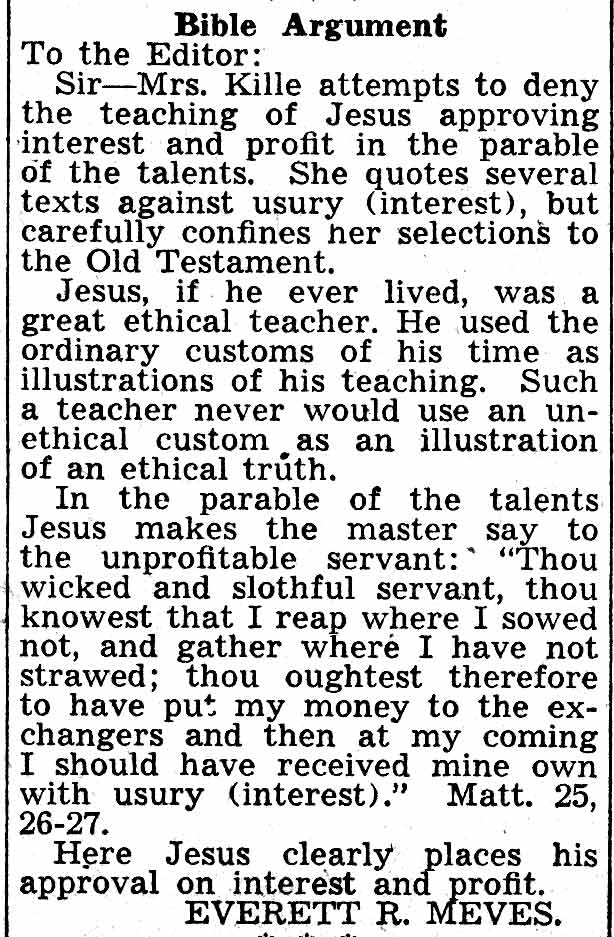
Sir—Mrs. Kille attempts to deny the teaching of Jesus approving interest and profit in the parable of the talents. She quotes several texts against usury (interest), but carefully confines her selections to the Old Testament.
Jesus, if he ever lived, was a great ethical teacher. He used the ordinary customs of his time as illustrations of his teaching. Such a teacher never would use an unethical custom as an illustration of an ethical truth.
In the parable of the talents Jesus makes the master say to the unprofitable servant: “Thou wicked and slothful servant, thou knowest that I reap where I sowed not, and gather where I have not strawed; thou oughtest therefore to have put my money to the exchangers and then at my coming I should have received mine own with usury (interest).” Matt. 25, 26–27.
Here Jesus clearly places his approval on interest and profit.
EVERETT R. MEVES
Respects Honest Doubters
Camden Courier-Post —
To the Editor:
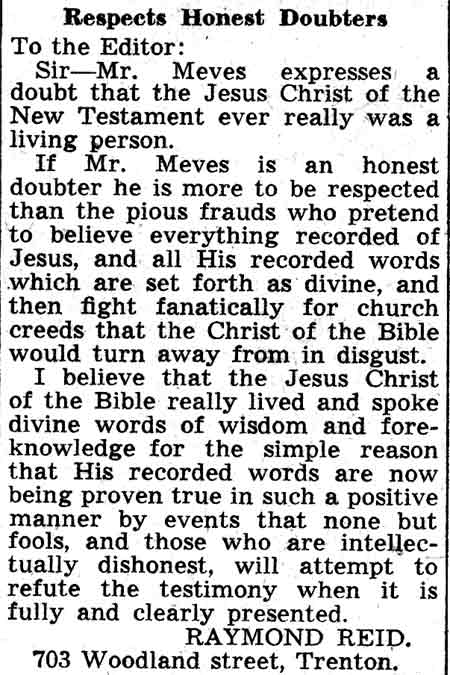
Sir—Mr. Meves expresses a doubt that the Jesus Christ of the New Testament ever really was a living person.
If Mr. Meves is an honest doubter he is more to be respected than the pious frauds who pretend to believe everything recorded of Jesus, and all His recorded words which are set forth as divine, and then fight fanatically for church creeds that the Christ of the Bible would turn away from in disgust.
I believe that the Jesus Christ of the Bible really lived and spoke divine words of wisdom and foreknowledge for the simple reason that His recorded words are now being proven true in such a positive manner by events that none but fools, and those who are intellectually dishonest, will attempt to refute the testimony when it is fully and clearly presented.
RAYMOND REID
703 Woodland street, Trenton
He’s Sorry, Mr. Meves
Camden Courier-Post —
To the Editor:
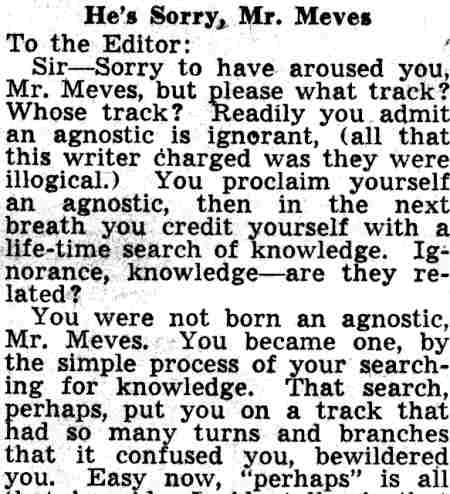
Sir—Sorry to have aroused you, Mr. Meves, but please what track? Whose track? Readily you admit an agnostic is ignorant, (all that this writer charged was they were illogical.) You proclaim yourself an agnostic, then in the next breath you credit yourself with a life-time search of knowledge. Ignorance, knowledge—are they related?
You were not born an agnostic, Mr. Meves. You became one, by the simple process of your searching for knowledge. That search, perhaps, put you on a track that had so many turns and branches that it confused you, bewildered you. Easy now, “perhaps” is all that is said. Incidentally, is that the track you mention?
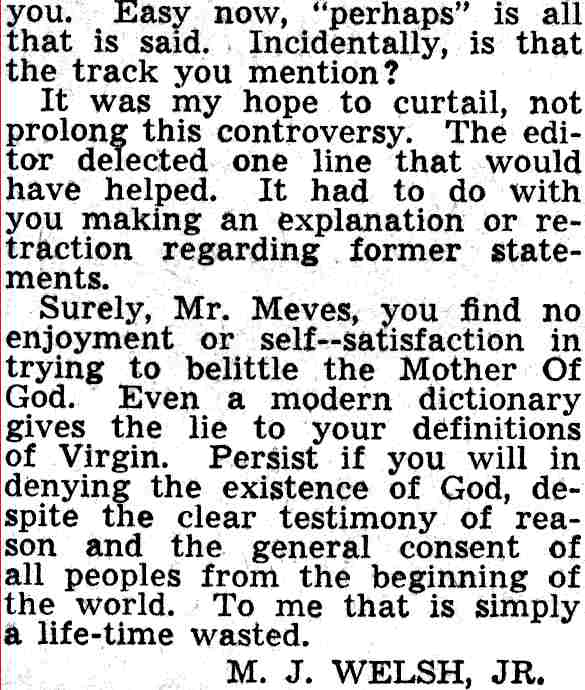
It was my hope to curtail, not prolong this controversy. The editor deleted one line that would have helped. It had to do with you making an explanation or retraction regarding former statements.
Surely, Mr. Meves, you find no enjoyment or self-satisfaction in trying to belittle the Mother Of God. Even a modern dictionary gives the lie to your definitions of Virgin. Persist if you will in denying the existence of God, despite the clear testimony of reason and the general consent of all peoples from the beginning of the world. To me that is simply a life-time wasted.
M. J. WELSH, JR.
Root of All Evil
Camden Courier-Post —
To the Editor:
Sir—Mr. Meves says the wealthy do not hoard money, that their wealth consists chiefly of goods, property and services, that money is only its symbol, that they plow it back into industry in loans, in the form of stocks and bonds. He tells us that wealth for all is limited only by ability to produce, distribute and consume, he says that wealth supplies management, without which industry would perish and that capital saves us from destruction, that it gives us our high standards, and why cavil at it?
The duPonts could not defend the usurping wealthy classes better than Mr. Meves has done.
If the wealthy do not hoard money (the symbol of services and labor) and their wealth consists of just plain goods, services and property then how in the world can they assume ownership of almost anything that they desire and whenever they desire it?
After all we must earn money to buy what we need. And when we are denied the right to earn this money by those who have it, how can we purchase what we need?
PETE SAMKO