Erle P. Flanagan
Rank: Staff Sergeant
Branch: U.S. Army Air Forces
Serial: 12076389
Unit: 871st Bomber Squadron, 497th Bomber Group, Very Heavy
Entered the service from: New Jersey
Died:
Buried at: Plot P, Row 1, Grave 037, Honolulu Memorial, Honolulu, Hawaii
Awards: Air Medal, Purple Heart
Introduction
Staff Sergeant Erle Patrick Flanagan was born in Pennsylvania to Edgar J. and Margaret J. Flanagan. Army records show his birthday to be July 9, 1918, however an inscription on his parents’ tombstone gives his year of birth as 1917. The 1920 Census shows the family living in Philadelphia, Pennsylvania. By 1930 the family, which included brother Edgar Jr. and sister Doris, owned a home at 400 Nicholson Road in Audubon NJ. Edgar Flanagan Sr. was working as the Superintendent of Service Stations for a gasoline company. The family later moved to 219 South Logan Avenue in Audubon. The 1940 Census shows him living in Haddon Heights, New Jersey with his wife, O. Doris Flanagan. He was then working as a meter reader, while his wife worked as an assembler at a radio factory.
Erle Flanagan enlisted in the United States Army on October 17, 1942. He qualified for flight duty, and in November of 1943 was training at the Army Air Force Navigation School at San Marcos TX.
Staff Sergeant Flanagan was assigned to the 871st Bomber Squadron, 497th Bomber Group, Very Heavy. The 497th was constituted as 497th Bombardment Group (Very Heavy) on November 19, 1943 and activated on November 20 at El Paso TX. On December 1, the group moved to Clovis NM and prepared for overseas duty with B-29’s until April 13, 1944, when the unit moved to Pratt Army Air Field in Kansas. The group moved to Saipan in stages between July and October of 1944, and assigned to Twentieth Air Force. Based at Isley Field on Saipan, the unit began operations in October of 1944 with attacks against Iwo Jima and the Truk Islands. The 497th took part in the first attack on November 24, 1944 on Japan by Army Air Force planes based in the Marianas, and flew many missions against strategic objectives in Japan; on numerous raids, the group made its attacks in daylight and from high altitude.
The 497th received a Distinguished Unit Citation for a mission on January 27, 1945. On that day, although weather conditions prevented the group from bombing its primary objective, the unescorted B-29’s withstood severe enemy attacks to strike an alternate target, the industrial area of Hamamatsu. The group was awarded a second Distinguished Unit Citation for attacking strategic centers in Japan during July and August, 1945. The group assisted the assault on Okinawa in April 1945 by bombing enemy airfields to cut down air attacks against the invasion force. Beginning in March 1945 and continuing until the end of the war the group made incendiary raids against Japan, flying at night and at low altitude to bomb area targets.
Staff Sergeant Flanagan served as the Central Fire Control Gunner aboard B-29 Superfortress #44-69899 when it was shot down by an enemy Ki-44 fighter over Honshu, Japan while on a mission to Kobe, May 5, 1945. Sergeant Flanagan bailed out and parachuted to the ground, and was taken prisoner. He was executed by the Japanese along with 14 other American prisoners on July 20, 1945, one of them being Staff Sergeant Logan M. Sparks, the Flight Engineer on the B-29 Flanagan was in. The airplane commander, Second Lieutenant Joe S. McSpadden, was murdered on August 15, 1945. The bombardier-navigator, Second Lieutenant Harry Foley, was taken prisoner but it is not known if he was murdered or died of injury or disease. He may have been executed with Lieutenant McSpadden on August 15. Both of their bodies were recovered.
The Army declared Staff Sergeant Flanagan dead on August 15, 1945. He was survived by his wife Doris, then living at 1024 Merrick Avenue in Collingswood, New Jersey; his parents and his siblings. Erle P. Flanagan’s body was recovered months later and he was buried at the Honolulu Memorial cemetery in Honolulu, Hawaii. He is memorialized where his parents and brother rest at New St. Mary’s Cemetery in Bellmawr, New Jersey.
One can only speculate why the government and the media chose not to publicize this incident once the facts were discovered.
Burial
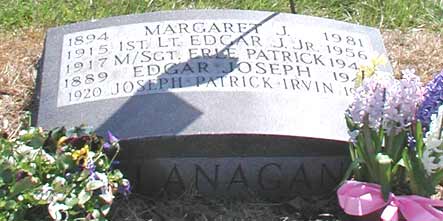
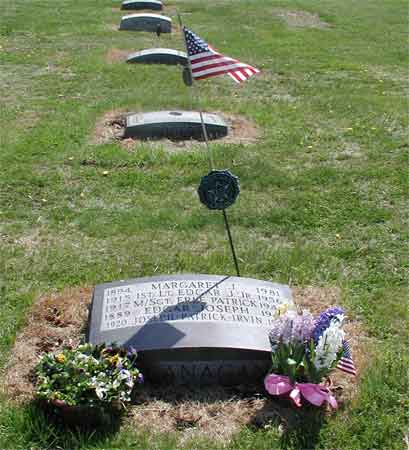
Grave markers of Staff Sergeant Erle P. Flanagan, Honolulu Memorial, Honolulu, Hawaii
Audubon's Tribute to Those Who Served in WWII
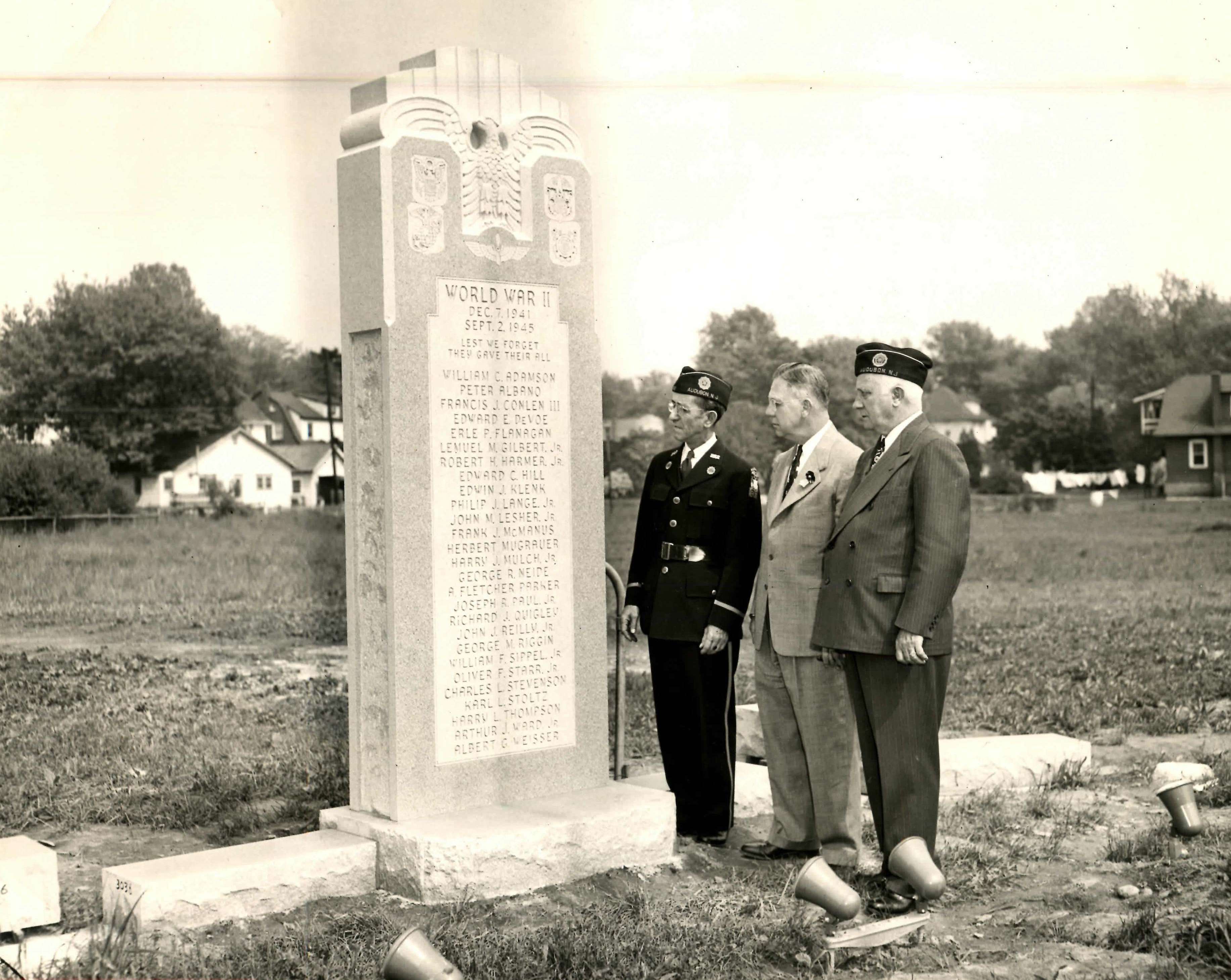
Audubon’s Tribute to Those Who Served in WWII
Missing Air Crew Report — MACR #14365
497th BG, 871st BS — 44-69899 — MACR #14365
REPORT NO. 11 (Eleven) CONFIDENTIAL
MISSING AIR CREW REPORT
871st Bombardment Squadron
1. ORGANIZATION: Location, by Name Saipan, M.I; Command or Air Force XXI Group 497th Squadron 871st;
2. SPECIFY: Place of departure Saipan, M.I; Course 330°
Target or Intended Destination: Hiro Naval A/C Plant, Kure, Honshu, Japan
Type of Mission: Bombing
3. WEATHER CONDITIONS AND VISIBILITY AT TIME OF CRASH OR WHEN LAST REPORTED: Ceiling and visibility unlimited.
4. GIVE: (a) Day 5 Month May Year 1945 Time 0118Z and Location 34° 00 N; 135° 45′ E of last known whereabouts of missing aircraft.
5. AIRPLANE WAS LOST, OR IS BELIEVED TO HAVE BEEN LOST, AS RESULT OF: Enemy Aircraft
6. AIRPLANE: Type, Model and Series B-29; AAF Serial Number 44-69899
7. NICKNAME OF AIRCRAFT, If Any: None
10. THE PERSONS LISTED BELOW ARE RECORDED AS: Battle Casualty
11. NUMBER OF PERSONS ABOARD AIRCRAFT: Crew 11; Passengers None
- Ap Co — McSpadden, Joe S. 2d Lt, Rising Star, TX — KIA while POW
- Pilot — King, Wilson K. 2d Lt, Bennettsville, SC — KIA
- Nav-Bombardier — Hooser, Jack R. F/O, Rochester, PA — KIA
- Bomb-Navigator — Foley, Harry J. 2d Lt, Highland, KS — KIA while POW
- Flt Engineer — Sparks, Logan M. S/Sgt, Durham, NC — KIA while POW
- Radar Oper — Croake, Thomas J. 2d Lt, South Orange, NJ — KIA
- Radio-Oper-Gnr — Kisti, Joseph F. S/Sgt, Trenton, NJ — KIA
- CFC Gunner — Flanagan, Erle P. S/Sgt, Collingswood, NJ — KIA while POW
- Left Gunner — Meier, John A. S/Sgt, Littlefield, TX — KIA
- Right Gunner — Johnson, Howard R. Sgt, Valparaiso, IN — KIA
- Tail Gunner — Hansser, Louis J. T/Sgt, Fort Wayne, IN — KIA
12. IDENTIFY BELOW THOSE PERSONS WHO ARE BELIEVED TO HAVE LAST KNOWLEDGE OF AIRCRAFT:
Evans, Ralph J. 1st Lt; Eichenberger, William H. Sgt; Post, William N. Sgt; Broskey, John K. S/Sgt
DATE OF REPORT 6 May 1945
17. REMARKS OR EYEWITNESS STATEMENTS:
At 0110Z at 35° 00N 135° 45′ E B-29 A-56 lost #3 and #4 engines due to enemy fighter attack. Number 3 engine was on fire and both #3 and #4 were feathered. The aircraft maintained altitude and dropped its bombs but lost the formation.
B-29 A-55 (Lt. Evans and crew) left the formation and followed A-56, picking the aircraft up at 33° 50′ N 134° 00E at 18000 feet. At this time both #3 and #4 engines were feathered, and #3 was intermittently on fire. A-56 dropped down to 11,000 feet and a Tojo made three passes from three and nine o’clock high before A-55 came to her help. Diving down A-55 tried to head the enemy aircraft off and maneuvered in order to give all the turrets full play. The enemy aircraft was fired on by all gunners up to 400 yards and left smoking. It did not return.
At this time the right wing of A-56 broke off between the two feathered engines and the wing started to blaze. A-56 slid into the ground and blew up. The right gunner, left gunner, and tail gunner of Lt. Evans’ crew saw this happen, and the right gunner saw four (4) parachutes open at 2,000 feet (that was the maximum of which the gunner was certain). There is a possibility of eight (8). The crewmen were not seen hitting the ground; the ground was mountainous, there was no habitation. The aircraft crashed at 0118Z, 34° 00N, 135° 45′ E.
Though uninjured when captured, none of these men returned. Japanese documents state that the plane, after having been attacked by a fighter, crashed at Ryujin Village, Hidaka County, Wakayama Prefecture. Seven men were killed, four prisoners taken, who were moved to Osaka Kempei Tai Headquarters. Sergeants Flanagan and Sparks were murdered on July 20, 1945. Lieutenant McSpadden was murdered on August 15, after Emperor Hirohito broadcast his surrender announcement.
Excerpt from Allied Aircraft and Airmen Lost over the Japanese Mainland:
53 of 57 American fliers who were captured in Chubu Army District were treated by Chubu Kempei Tai, and all of them never returned to the US.
8 died of their wounds or diseases while they were imprisoned in Chubu Kempei Tai HQ in Osaka. 6 were poisoned by reason of their heavy wounds or diseases. 5 were executed by shooting at Shinodayama Military Maneuver Grounds on 5 July. 15 were executed by shooting at Shinodayama Military Maneuver Grounds on 20 July. 14 were executed by shooting at Jonan Rifle Range near Osaka Castle on 5 August. 5 were executed by shooting or beheading at Sanadayama Army Cemetery in Osaka in the afternoon on 15 August.
After the war, at the War Crimes Trial in Yokohama, Japanese Kempei Tai commander Lt. Gen. Sanji Okido was sentenced to life confinement for the reason of issuing the secret order to each District Kempei Tai to “dispose the American fliers strictly.” Chubu District Kempei Tai Commander Maj. Gen. Tsugio Nagatomo was sentenced to life confinement as he decided the executions. Chubu District Army Commander Lt. Gen. Eitaro Uchiyama and Chief Staff Lt. Gen. Michio Kunitake were found guilty as they permitted the executions, and sentenced to 40 years to the former, life imprisonment to the latter.
Chubu District Kempei Tai officers who led the executions, Lt. Col. Hideo Fujioka and Maj. Ikoma Shiuchi were sentenced to life confinement. Chubu District Army Intelligence officer Maj. Norio Yamanaka, Staff officer Capt. Kojiro Oba, Chubu Kempei Tai members Lt. Col. Hiroshi Anjyo, Warrant Officer Yasuo Wada, Warrant Officer Jiro Hamamoto, M/Sgt. Tomekichi Hamada, M/Sgt. Takao Mori, civilian Interpreter Masamoto Nakano were sentenced to 2–15 years confinement. 10 NCOs or private soldiers of Chubu Kempei Tai who executed American fliers were found not guilty.
Interment Form
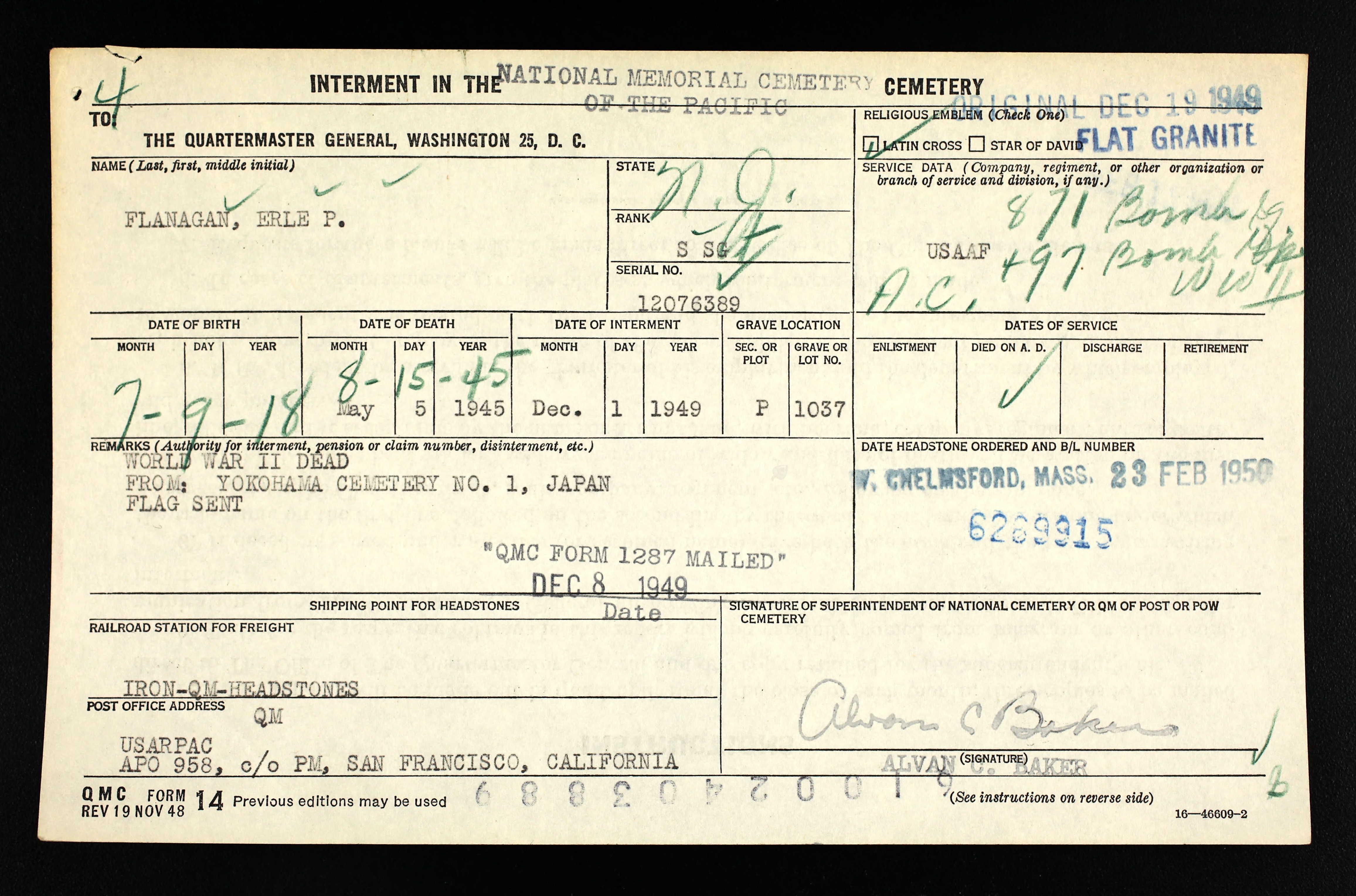
Interment form, Staff Sergeant Erle P. Flanagan