Elwood K. Van Horn
Rank: Torpedoman’s Mate Third Class, U.S. Navy
Serial Number: 06511978
Unit: USS Swordfish (SS-193)
Entered service from: New Jersey
Died: January 1945
Status: Missing in Action or Buried at Sea
Memorial: Tablets of the Missing, Honolulu Memorial, Honolulu, Hawaii
Awards: Purple Heart
Torpedoman’s Mate Third Class Elwood Kenneth Van Horn was born in Camden, NJ, around 1920, to Elwood and Matilda Van Horn. He lived most of his life in Westmont, NJ, and was known to friends and family as Ken. After volunteering for submarine duty, he was assigned to USS Swordfish (SS-193). The Swordfish was lost with all hands on her thirteenth war patrol in January of 1945.
Elwood K. Van Horn is memorialized on the War Memorial on Haddon Avenue in Westmont (Haddon Township), NJ.
Loss of USS Swordfish (SS-193)
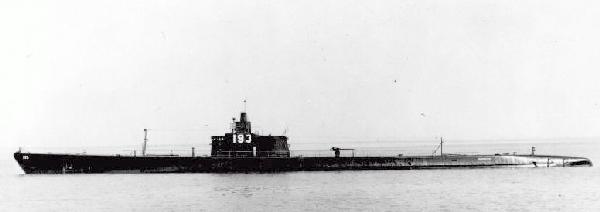
USS Swordfish (SS-193).
A Sargo-class submarine, USS Swordfish was commissioned on July 22, 1939, with Lt. Chester C. Smith in command. Built at the Mare Island Naval Shipyard, Vallejo, California, she carried a crew of 5 officers and 50 enlisted men.
USS Swordfish (SS-193) operated out of San Diego until early 1941, when she set sail for Pearl Harbor. On November 3, 1941, Swordfish, in company with three other U.S. submarines, departed Pearl Harbor, and on November 22, arrived at Manila, Philippine Islands. The submarine remained at Manila until the Japanese attack on Pearl Harbor on December 7, 1941. The following day she set sail on her first war patrol, conducted off the coast of Hainan, China. After damaging several enemy vessels, Swordfish sank her initial victim of the war on December 16. Hit amidships by one of three torpedoes, the cargo ship erupted in a cloud of smoke and flames and disappeared beneath the waves. On December 27, Swordfish embarked the organizational staff of the Submarine Asiatic Command Staff at Manila and headed for Soerabaja, Java, arriving January 7, 1942.
Swordfish departed Soerabaja on January 16 for her second war patrol, conducted in the Celebes Sea and in the Philippines. On January 24, she torpedoed and sank a cargo ship off Kema, Celebes Islands. On February 20, she submerged in the entrance of Mariveles, Luzon, only to surface after dark to take on board the President of the Philippines and his family. She departed through a minefield and arrived at San Jose, Panay, Philippine Islands on the 22nd, where the President and his party were transferred to a motor tender. Swordfish then returned to Manila Bay and embarked the High Commissioner of the Philippines, arriving at Fremantle, Western Australia, on March 9.
Swordfish got underway from Fremantle on April 1 for her third war patrol, with her primary mission being to deliver 40 tons of provisions to the besieged island of Corregidor. However, Corregidor fell to the Japanese before the mission could be carried out and the submarine was ordered to patrol in the vicinity of Ambon Island. The only ships sighted were beyond effective range, and the submarine returned to Fremantle on May 1.
Departing Fremantle for her fourth war patrol on May 15, Swordfish was in the South China Sea on May 29 where she sank a 1,900-ton cargo ship and was in the Gulf of Siam on June 12 where she torpedoed and sank another cargo ship. The submarine returned to Fremantle on July 4.
Although her fifth war patrol, conducted in the Sulu Sea, and her sixth war patrol, conducted in the Solomon Islands, were unproductive, during her seventh war patrol Swordfish sank a 4,122-ton cargo ship on January 19, 1943. Returning to Pearl Harbor on February 23, the submarine underwent overhaul until July 29, when she got underway for her eighth war patrol.
On August 22, she sighted her first target of the patrol, and quickly sent the cargo ship to the bottom, the victim of two torpedo hits. A convoy was intercepted on September 5, and Swordfish damaged a large tanker before sinking a cargo ship. The submarine concluded this patrol at Brisbane, Australia, on September 20.
Swordfish’s ninth war patrol lasted only three weeks. Shortly after reaching her assigned patrol area, material defects were discovered, and the submarine had to return to port.
On the day after Christmas 1943, Swordfish departed for her tenth war patrol, conducted in Tokyo Bay. On January 14, 1944, she sank a passenger-cargo ship and two days later sank a converted gunboat. On January 27, she fired two torpedoes at a converted salvage vessel which broke in half and sank. Swordfish terminated her tenth patrol at Pearl Harbor on February 7.
Swordfish put to sea on March 13 for her eleventh war patrol, conducted in the Mariana Islands. Although several enemy ships were damaged during this patrol, no sinkings could be confirmed; and the submarine returned to Majuro on April 29.
Swordfish’s twelfth war patrol was conducted in the area of the Bonin Islands. On June 9, the submarine found a Japanese destroyer clearly illuminated against the horizon and sank the enemy ship with two torpedoes from her bow tubes. On June 15, she torpedoed and sank a cargo ship. The submarine terminated her twelfth patrol at Pearl Harbor on June 30.
On December 22, Swordfish departed Pearl Harbor to conduct her thirteenth war patrol, in the vicinity of Nansei Shoto. She topped off with fuel at Midway on December 26 and left that day for her area. In addition to her regular patrol, Swordfish was to conduct photographic reconnaissance of Okinawa in preparation for the Okinawa Campaign.
On January 2, 1945, Swordfish was ordered to delay carrying out her assigned tasks in order to keep clear of the Nansei Shoto area until completion of carrier-based air strikes which were scheduled. She was directed to patrol the general vicinity of 30°N, 132°E until further orders were received. In the last communications received from Swordfish, she acknowledged receipt of these orders on January 3.
On January 9, 1945, Swordfish was directed to proceed to the vicinity of Okinawa to carry out her special mission. It was estimated that the task would not take more than seven days after arrival on station, which she should have reached on January 11. Upon completion of her mission, Swordfish was to proceed to Saipan, or to Midway if she was unable to transmit by radio. Since neither place had seen her by February 15, and repeated attempts to raise her by radio had failed, she was reported as presumed lost on that date.
In the report of her loss, mention was made that USS Kete (SS-369), which at the time was patrolling the vicinity of Okinawa, reported that on the morning of January 12 she contacted a submarine by radar. It was believed that contact was with Swordfish, since it was in 27°N, 128°40'E. Four hours later Kete heard heavy depth charging from this area, and it was believed that this attack might have been the cause of Swordfish’s loss. Japanese information on antisubmarine attacks does not mention the attack heard by Kete on January 12, and records no attack in which Swordfish is likely to have been the victim. However, it is now known that there were many mines planted around Okinawa, since the Japanese were expecting an allied invasion of that island. It is considered about equally likely that Swordfish was sunk by depth charge attack before she reached Okinawa for her special mission or that she was lost to a mine at that place.
USS Swordfish (SS-193) earned eight battle stars for World War II service.