Introduction
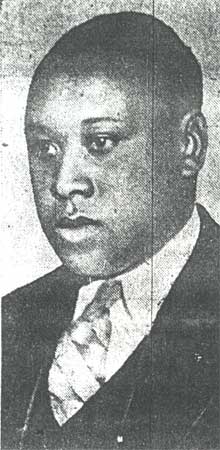
Edward Phillips was one of the leading Black racketeers in the 1930s in Camden NJ. When arrested in a May 1935 raid at 634 Sycamore Street, he was alleged to control an illegal enterprise with over $1,000,000 in annual revenue. His rackets were profitable enough for Phillips to have obtained a home at 1454 Kaighn Avenue in the upscale Parkside neighborhood.
After serving a two to five year sentence in state prison, Edward Phillips returned to Camden. He was working as an exterminator when he died after accidentally inhaling fumes from the pesticide he was using, on August 21, 1942.
Former Numbers Baron Killed By Cyanide Gas in North Camden
Camden Courier-Post —
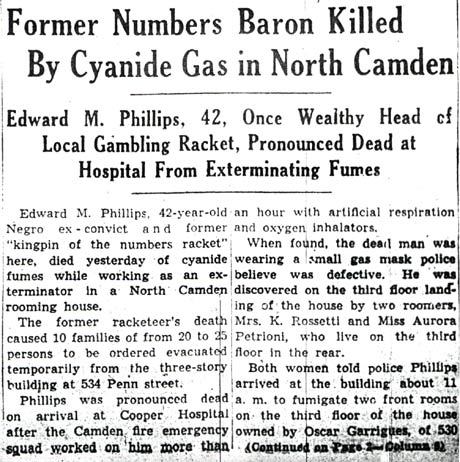
Edward M. Phillips, 42-year-old Negro ex-convict and former “kingpin of the numbers racket” here, died yesterday of cyanide fumes while working as an exterminator in a North Camden rooming house.
The former racketeer’s death caused 10 families of from 20 to 25 persons to be ordered evacuated temporarily from the three-story building at 534 Penn street.
Phillips was pronounced dead on arrival at Cooper Hospital after the Camden fire emergency squad worked on him more than an hour with artificial respiration and oxygen inhalators.
When found, the dead man was wearing a small gas mask police believe was defective. He was discovered on the third floor landing of the house by two roomers, Mrs. K. Rossetti and Miss Aurora Petrioni, who live on the third floor in the rear.
Both women told police Phillips arrived at the building about 11 a. m. to fumigate two front rooms on the third floor of the house owned by Oscar Garrigues, of 530 Penn street, who hired Phillips for the work.
At noon, the two women found Phillips lying on the third floor landing breathing heavily, they said, but he said he was all right. They said they returned to the rooming house at 3 p. m. and found the victim still lying in the same spot, but apparently not breathing. Mrs. Rossetti called Garrigues, who notified police.
Other Homes Evacuated
Dr. Edward Yantes, attached to the Cooper Hospital, pronounced Phillips dead of cyanide poisoning. Coroner Harry Leonard said he would hold an autopsy today and meanwhile ordered the rooming house evacuated by the 10 families.
When Phillips was arrested in May, 1935, on a charge of being connected in the numbers racket, Samuel P. Orlando, then prosecutor, described him as one of the biggest numbers operators in the east with a $1,000,000 yearly business.
Phillips was arrested with three other Negroes by Philadelphia and Camden county detectives and state police in a sensational raid on the Phillips alleged numbers bank at 634 Sycamore street. More than $3000 in numbers slips, two adding machines and other equipment were seized.
Sentencing and Tax Disputes
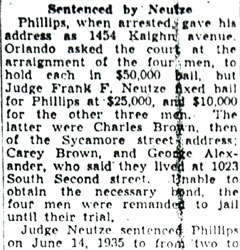
Sentenced by Neutze
Phillips, when arrested, gave his address as 1454 Kaighn avenue. Orlando asked the court at the arraignment of the four men, to hold each in $50,000 bail, but Judge Frank F. Neutze fixed bail for Phillips at $25,000, and $10,000 for the other three men. The latter were Charles Brown, then of the Sycamore street address; Carey Brown, and George Alexander, who said they lived at 1023 South Second street. Unable to obtain the necessary bond, the four men were remanded to jail until their trial.
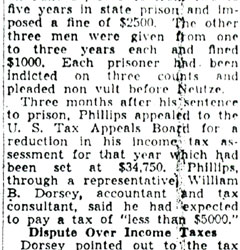
Judge Neutze sentenced Phillips on June 14, 1935, to from two to five years in state prison and imposed a fine of $2500. The other three men were given from one to three years each and fined $1000. Each prisoner had been indicted on three counts and pleaded non vult before Neutze.
Three months after his sentence to prison, Phillips appealed to the U. S. Tax Appeals Board for a reduction in his income tax assessment for that year which had been set at $34,750. Phillips, through a representative, William B. Dorsey, accountant and tax consultant, said he had expected to pay a tax of “less than $5000.”
Dispute Over Income Taxes
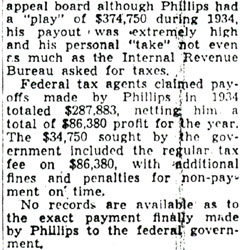
Dorsey pointed out to the tax appeal board although Phillips had a “play” of $374,750 during 1934, his payout was extremely high and his personal “take” not even as much as the Internal Revenue Bureau asked for taxes.
Federal tax agents claimed payoffs made by Phillips in 1934 totaled $287,883, netting him a total of $86,380 profit for the year. The $34,750 sought by the government included the regular tax fee on $86,380, with additional fines and penalties for non-payment on time.
No records are available as to the exact payment finally made by Phillips to the federal government.