Edward L. Golden
Corporal Edward L. Golden was the sixth of at least nine children born to Thomas and Catherine Golden. He was born in Pennsylvania in 1923, coming after Catherine, Hannah, Lawrence, Francis, and Marion, and before Rose, Matthew, and Regina. The Golden family moved to 207 Market Street in Camden, NJ, shortly after the birth of Regina Golden in March of 1929. Thomas Golden was in 1930 working as a molder for a storage battery company.
Edward Golden left the Civilian Conservation Corps in May of 1940 to enlist in the United States Army. He went overseas in November of 1941 as part of the 30th Bomber Squadron, 19th Bomber Group, Heavy, and was stationed at Clark Field, near Manila in the Philippines, when the Japanese attacked in December of that year. He was unable to escape the Philippines, and was taken prisoner when Bataan fell in May of 1942. There was no word on his fate until September of 1943, when he was reported to be a prisoner of war in a Japanese POW camp in the Philippines.
Corporal Golden survived the battles with the Japanese for the Philippines, survived the Death March of 1942, and survived over two years in the hell that was the Prison Camps of the Japanese. He was imprisoned at the Davao Penal Colony, where the men were made to work in a large plantation that provided food for the Japanese Army.
As the Allies drew closer, the Japanese began moving POWs out of the Philippines by sea. A thousand and more prisoners were crammed into cargo holds — spaces only big enough for a quarter that number — oftentimes with only enough room to sit for a journey that would last weeks. Never enough buckets for their waste, and with hundreds of dysentery cases, the healthy succumbed. Deprived of air and water and exposed to intoxicating heat, men suffocated or went mad. While Japanese weapons transports bore Red Cross markings, ships carrying prisoners of war went unmarked and were targeted by American submarines.
In 1944, 750 American POWs were in Lasang, near Mindanao, helping build and improve a Japanese airstrip. One of these men was Corporal Golden; another was First Lieutenant Bruno S. Ulak, also from Camden. By August 1944, U.S. forces were bombing the area heavily, so the Japanese decided to get the POWs out of the Lasang area. On August 20, 1944, they were loaded into a ship and taken to Zamboanga, Mindanao; there they transferred into the Shinyo Maru to be used as slave laborers. The Japanese told the POWs that if any U.S. forces attacked, they would kill them. On September 5, 1944, the Shinyo Maru set sail. The men were locked in cargo holds with no sanitary facilities, and little if any food or water.
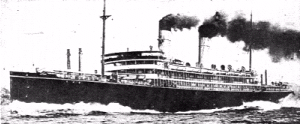
The Shinyo Maru
On September 7, 1944, at 4:37 p.m., the U.S. submarine USS Paddle fired four torpedoes at a tanker and two at the Shinyo Maru. The prisoners heard a commotion as the Japanese guards on board began to shoot them. When the ship began to sink, the Japanese threw hand grenades into the cargo holds. Prisoners were shot coming out of the hold and shot in the water. As the surviving POWs started to swim toward shore, Japanese on small boats went by, shooting them as they swam or holding them down to drown them.
A few POWs managed to jump off the boat and swim ashore. Filipinos there escorted the survivors to guerrilla groups; eventually, they were sent back to the United States. There were 750 POWs aboard the Shinyo Maru, already weakened from disease, malnutrition, and the abuse of the Japanese; 688 men lost their lives that day.
Both Edward Golden and Bruno Ulak were among those murdered by the Japanese when the Shinyo Maru was sunk. Corporal Golden was officially reported killed in action in September of 1944.
On September 14, 1945, Corporal Golden’s sister, Mrs. Hannah Golden O’Malley of 609 Cedar Street, Camden, NJ, reported that she had received a card from her brother in the Philippines, stating he was alive and well. It is unclear as to when this card was mailed. Edward Golden was listed as killed in action on the 1946 casualty lists assembled by the Department of the Army. He is listed on the Missing in Action or Buried at Sea Tablets of the Missing at Manila American Cemetery, Manila, Philippines.
Thanks to Fred Baldassarre of “The Battling Bastards of Bataan,” who supplied much of the information concerning Corporal Golden’s whereabouts and the conditions he endured.
Camden Soldier 'Buried' at Sea Notifies Family He Is Alive, Well
Camden Courier-Post —
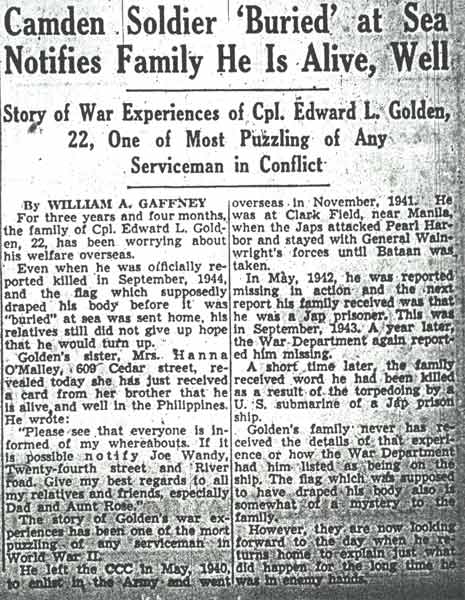
Story of War Experiences of Cpl. Edward L. Golden, 22, One of Most Puzzling of Any Serviceman in Conflict
By WILLIAM A. GAFFNEY
For three years and four months the family of Cpl. Edward L. Golden, 22, was in the dark concerning him and his welfare overseas.
His relatives had been officially notified that Ed was dead and buried, and the flag which supposedly covered his body after it was “buried” at sea was sent home. His relatives still did not give up hope that he would turn up.
Golden’s sister, Mrs. Hannah O’Malley, 609 Cedar street, received through the mail a card from Ed stating he was alive and doing well in the Philippines.
“Please see that everyone is informed of my whereabouts as soon as possible, notify Joe Wandy, Ed Rooney and guys along the Road. Give my best regards to all those guys who had me down as dead.”
The story of Golden’s war experiences is considered one of the most puzzling of any serviceman in conflict.
Shinyo Maru Reunion Address
Gen. Lloyd W. Newton, Commander, Air Education and Training Command —
Delivered at the wreath-laying ceremony of the Shinyo Maru Reunion, San Antonio, Texas, September 7, 1998
Throughout our proud history, America’s sons and daughters have answered the call to defend our fundamental liberties and to safeguard freedoms of peace-seeking countries around the globe.
Representing the finest this nation has to offer, the members of our armed forces have given everything of themselves in defense of the independence and democracy we hold so dear.
This year we have a special opportunity to honor the heroic men who paid the heaviest price while answering the call in the Pacific.
Fifty-four years ago some of our friends, husbands, fathers and sons were liberated when an American submarine sank the Shinyo Maru. Of the 750 POWs being transported on the “hell ship,” 18 of the 82 survivors are here. You are American heroes and you are survivors; including Arthur Waters who died just one week ago Tuesday (Aug. 25, 1998) in an automobile accident on his way to this reunion.
Not only did all of you survive the fall of the Philippines, death marches, imprisonment, starvation and the sinking of the Shinyo Maru, but also machine gun fire from Japanese gunboats as you swam toward the distant shoreline.
In spite of your mental and physical scars, you were eventually integrated into the guerrilla organizations and resumed active combat against the enemy. By November 1944, you were returned to the United States and to your families who wept with joy to have you home again.
But for those families whose loved ones did not return, there were no tears of joy — only feelings of devastation and loss. For the wife, this was a husband and a companion who never came back. For the son or daughter, the father they lost. For their friends, their colleagues with whom they shared many memories were gone.
For our young people who have not experienced war, this ceremony provides many important lessons. It is a symbol of the sacrifices made in our country’s name. It stands to be appreciated by all that understand why our service men and women give of themselves for our freedoms.
Today, we pay special tribute to you brave warriors who endured the “hell ship” and other brutalities. Your courage and devotion to duty, honor and country — often in the face of brutal treatment and torture by your captors — will never be forgotten.
And as we honor all of you today, we recognize that your experience, after being torpedoed, parallels that of the 350 men who were executed in March 1836 at Goliad (Texas) while prisoners of General Santa Ana.
It’s right for us to pause also for a moment to remember and pay tribute to the personal sacrifices which took place here just over 162 years ago.
It’s difficult to imagine a place more uniquely Texan than the Alamo, yet so much a part of the American spirit. The courage, loyalty and dedication to freedom displayed by Col. William Travis and his men capture our imaginations. They serve as an enduring example of the strength and purpose of the American character.
As school-children, we studied the 13 days to glory. The events of March 1836 are as integral a part of the American experience as Gettysburg. They define who we are as a people.
Remember the Alamo” became a rallying cry for troops around the world.
Support of freedom, even in distant lands, has defined America ever since. Our sons and daughters throughout our history willingly stepped forward to secure freedom for people they didn’t know.
Hundreds of thousands of Americans have followed the example of Travis, Crockett, Bowie and the other Alamo defenders, including the 18 Shinyo Maru survivors here today. You placed the defense of freedom above family and self, exemplifying one of our core values — “service before self.
It remains for us to remember your sacrifices and courage, and to rededicate ourselves to those ideals.
There are thousands of Americans doing that at this very moment — in places like Bosnia, Korea and the Persian Gulf.
Recalling your sacrifices, the Alamo defenders, and the countless others who have willingly stood up for freedom, should spark a rededication to the same ideals and dreams in each of us.
A rededication to stand up for our beliefs — to fight for our ideals — and to champion the cause of freedom.
We all know the ultimate goal of freedom is to nurture the dignity and value of each individual. This was the story of the Shinyo Maru survivors, the Alamo, and if we’re steadfast in our commitment, it will be the story of the 21st century.
This wreath-laying ceremony and this reunion are opportunities for solemn rededication, as well as a time for joyous celebration. Today, we honor the sacrifices of the past, celebrate the fruits of those sacrifices, renew our commitment to the ideals of freedom, and resolve to carry these ideals with us as we prepare to meet the challenges of the 21st century!
Outline of Events: The Defenders of Bataan
The Battling Bastards of Bataan
The purpose of this “Outline of Events” is to provide an overall picture into the plight suffered by the Defenders of Bataan. It is not meant to provide detailed, all-inclusive information. If you wish detailed information on any of the steps of this outline, feel free to contact “The Battling Bastards of Bataan.” Their intent is to provide the truth.
- On Dec. 7, 1941, Japan attacked Pearl Harbor. The American Pacific Naval Fleet suffered heavy losses in lives and ships. The Fleet was incapacitated and could not, in that state, defend American interests in the Pacific Rim and in Asia.
- Only eight hours later, on Dec. 8, 1941 (due to the difference in time zones), Japan launched an aerial attack on the Philippines. Most of the American Air Force in the Philippines was destroyed while the planes were on the ground.
- A few days later, Japanese forces, led by Lt. Gen. Masaharu Homma, landed on the Philippines. The Japanese landings were in Northern Luzon and in the Southern Mindanao Islands.
- Gen. Douglas MacArthur, Commander of the Filipino-American forces, decided to meet the Japanese at their points of landing. This course of action deviated from the original War Plan, which called for the American forces to withdraw into the Bataan Peninsula in case of attack.
- Inexperienced troops failed to stop the Japanese at these points of landing. MacArthur had to revert back to the original plan, withdrawing the Filipino-American forces into the Bataan Peninsula. By January 2, 1942, the Northern Luzon forces were in place for the defense of Bataan.
- Their mission, in the baseball vernacular, was to “lay down a bunt.” They were to stall the Japanese advancement, by forcing them to use much of their troops and resources in the capturing of the Philippines, for as long as possible. This would buy the necessary time needed to rebuild the American Pacific Fleet, which had been crippled by the Pearl Harbor attack and the bombing of the American Air Bases in the Philippines.
- The Filipino-American Defense of Bataan was hampered by many factors: (a) A shortage of food, ammunition, medicine, and attendant materials. (b) Most of the ammunition was old and corroded. The AA shells lacked proper fuses, as did many of the 155mm artillery shells. (c) Tanks, trucks, and other vehicles were in short supply, as was the gasoline needed to power them. (d) Poorly trained Filipino troops, most of whom had never fired a weapon, were thrown into frontline combat against highly trained Japanese veterans. Americans from non-combatant outfits — such as air corpsmen and, in some instances, even civilians — were formed into provisional infantry units.
- The Defenders of Bataan continued to hold their ground, without reinforcements and without being re-supplied. Disease, malnutrition, fatigue, and a lack of basic supplies took their toll.
- On March 11, 1942, Gen. MacArthur was ordered to Australia. Gen. Wainwright took his place in Corregidor as Commander of the Philippine forces, and Gen. King took Wainwright’s place as Commander of the Fil-American forces in Bataan.
- Around the latter part of March, Gen. King and his staff assessed the fighting capabilities of his forces in view of an impending major assault planned by Gen. Homma. Gen. King and his staff determined the Fil-American forces in Bataan could only fight at 30% of their efficiency, due to malnutrition, disease, a lack of ammunition and basic supplies, and fatigue. On April 3, 1942, the Japanese launched their all-out final offensive to take Bataan.
- On April 9, 1942, Gen. King surrendered his forces on Bataan, after the Japanese had broken through the Fil-American last main line of resistance.
- The Japanese assembled their captive Fil-American soldiers in the various sectors in Bataan, but mainly at Mariveles, the southernmost tip of the Peninsula. Although American trucks were available to transport the prisoners, the Japanese decided to march the Defenders of Bataan to their destinations. This march came to be known as the “Death March.”
- The “Death March” was really a series of marches, which lasted from five to nine days. The distance a captive had to march was determined by where on the trail the captive began the march.
- The basic trail of the “Death March” was as follows: a 55-mile march from Mariveles, Bataan, to San Fernando, Pampanga. At San Fernando, the prisoners were placed into train-cars made for cargo, and railed to Capas, Tarlac, a distance of around 24 miles. Dozens died standing up in the railroad cars, as the cars were so cramped that there was no room for the dead to fall. They were then marched another six miles to their final destination, Camp O’Donnell.
- Several thousand men died on the “Death March.” Many died because they were not in any physical condition to undertake such a march. Once on the march, they were not given any food or water. Japanese soldiers killed many of them through various means. Also, POWs were repeatedly beaten and treated inhumanely as they marched.
- Approximately 1,600 Americans died in the first forty days in Camp O’Donnell. Almost 20,000 Filipinos died in their first four months of captivity in the same camp. The healthier prisoners took turns burying their comrades in mass graves, just as they themselves would be buried days or weeks later.
- Camp O’Donnell did not have the sanitation sub-structure or water supply necessary to hold such a large amount of men. Many died from diseases they had since Bataan. Many caught new diseases while at the camp. There was little medicine available to the prisoners. Their inadequate diets also contributed to the high death rate. Diseases such as dysentery, from a lack of safe drinking water, and Beri-Beri, from malnutrition, were common to the POWs. The Japanese soldiers continued to murder and mistreat their captives.
- Due to the high death rate in Camp O’Donnell, the Japanese transferred all Americans to Cabanatuan, north of Camp O’Donnell, on June 6, 1942, leaving behind five hundred as caretakers and for funeral details. They in turn were sent to Cabanatuan on July 5, 1942. The Filipino prisoners were paroled beginning in July 1942.
- Cabanatuan was the camp in which the men from Corregidor were first united with the men from Bataan. No Americans from Corregidor ever made the “Death March” or were imprisoned in Camp O’Donnell. Not having suffered the extreme deprivations and conditions endured by the men from Bataan, the prisoners from Corregidor were, overall, much healthier.
- Cabanatuan, for most prisoners, ended up being a temporary camp. The Japanese had a policy (which was a direct violation of the Geneva Convention) that prisoners were to be used as a source of labor. They sent most of the prisoners from Cabanatuan to various other camps in the Philippines, China, Japan, and Korea, where they were used as slave labor. Some worked in mines, others in farms, others in factories, and others unloading ships in port areas, for the remainder of the war. Each subsequent prison camp, after Cabanatuan, has a story of its own.
- Left behind in Cabanatuan were approximately 511 officers and the prisoners too sick to move (and most of those too sick to move never recovered and died in Cabanatuan). Towards the end of the war, most of the men who stayed behind were placed on ships and sent to other camps in Japan, Korea, and China. The Japanese did not mark these ships to note that there were prisoners on board. They were bombed and torpedoed by American planes and submarines. Most of these men died by drowning at sea.
- Most prisoners who left Cabanatuan in 1942 were sent to the other countries mentioned in ships appropriately called “Hell Ships.” These “Hell Ships” sailed from Manila to their various destinations in Japan, Korea, or China. As mentioned earlier, the Japanese did not mark these ships as being prison ships, so they were targets for American planes and submarines. Thousands of Americans who were passengers on these ships met their deaths by drowning at sea.
- The conditions on these ships are indescribable and far worse than the conditions endured on the “Death March” and in Camp O’Donnell.
- For the remaining three years of their captivity, the Defenders of Bataan were spread throughout the various slave labor camps in Japan, Korea, China, and the Philippines, until each camp was individually liberated in 1945. These prisoners endured the whims of their brutal captors, with similar conditions and mistreatment as those experienced on the “Death March” and in Camp O’Donnell, and the uncertainty of when, if ever, their captivity would end.
- Coming from the warm tropical climate of the Philippines, the men sent to Japan, Korea, and China had to adjust to the sub-freezing temperatures of Northern Asia, without the proper personal equipment and indoor heating to survive such cold temperatures. In Manchuria, China, the POWs who died in the winter were placed in an unheated shack for their bodies to freeze, because the ground was so frozen and hard that they could not be buried until the spring.
- After they were released, these men were sent to various military hospitals for physical examinations. Many of their ailments, due to malnutrition, went undiagnosed. Many of the systemic fevers they had contracted went undiagnosed. More importantly, the psychological scars they suffered were never recognized. It was not until years after the Vietnam War that the U.S. government recognized “Post Traumatic Stress Disorder” or PTSD as a legitimate disorder. It is safe to say each of these men has carried these scars for the rest of their lives, and indirectly, so did their families.
- After the war, little was made of the plight of these men. Until recently, few books were written about their ordeal. There were many reasons for this: by the time the Defenders of Bataan came home, the U.S. had already heard a multitude of war stories about the great battles in the Pacific and in Europe. The Defenders of Bataan had surrendered. (Most Americans failed to recognize that the Defenders of Bataan were surrendered as a force, by their Commanding General. They did not surrender as individuals.)
- After the war, Japan and the U.S. formed an alliance to ensure their mutual economic prosperity and mutual security. It became an unwritten policy to play down Japanese war crimes, satisfied with the meager results produced by the Tokyo and Manila war crimes trials.
- Unknown to most: POWs held by the Germans died at a rate of 1.1%. POWs held by the Japanese died at a rate of 37%. The death rate amongst the Defenders of Bataan was much higher, because of their weakened condition prior to their capture.
- Germany has acknowledged their war crimes and has made restitution to the victims. Japan has denied everything. In their history books and in their school books, they have rewritten history in an effort to falsely show they were the victims of the war, citing the atomic bombs in Hiroshima and Nagasaki as proof of their victimization.
After the war and faced with the threat of the Soviet Union, the United States and its allies permitted Japan to escape the close scrutiny given to the Germans. Known Japanese war criminals went free to walk not only the streets of Japan, but the streets of the United States as well.
Please bring this outline to the attention of your school systems, which are negligent in presenting this part of World War II to American youth.