Introduction
Edward Dudley was born in 1849 to Thomas H. Dudley and his wife, the former Emeline Matlack. His father was one of Camden’s leading citizens and played a vital role in national politics and as a diplomat both during and after the Civil War. He served as Camden County Clerk, and authored Camden’s first city charter. The “Dudley Charter” would serve Camden until 1871. An early member of the Republican party, he was a delegate to the Republican national convention in Chicago in 1860, and was instrumental in securing the presidential nomination for Abraham Lincoln. He was the American consul in Liverpool from 1861 to 1872, during which time he settled the Alabama Claims.
Thomas Dudley owned a large estate along Federal Street in what is now East Camden, centered by his mansion and known as Dudley Grange.
Edward Dudley followed his father into the practice of law, beginning in 1874. He was quite successful professionally. Personally his life did not go well. He married Mary Shaw, who appears to have died in childbirth in April of 1879 while giving birth to a son, also Edward Lawrence Dudley. On November 15, 1881 he married May T. Brooks of Boston, Massachusetts in Boston. This marriage produced a daughter, May Irene Dudley. Sadly, this marriage also ended, most likely again to the death of the then Mrs. Dudley. Professionally he was well respected and was promoted as a legislative candidate in the 1890s but decided that he was not interested in running for office.
In 1898 Edward Dudley married Mary Mulock in Naples, Italy. A socialite from Philadelphia, she was 25 years his junior and appears to have married entirely for money. By 1905 Edward Dudley had enough, and divorce proceedings were instituted. Mrs. Dudley counter-sued and the Dudleys were in and out of the courts and the newspapers even after Edward Dudley’s passing. The notoriety and the time spent defending himself from frivolous legal action took up much of his time and in his own words, destroyed his legal practice. Edward Dudley died at The Grange on September 13, 1920.
Rich Lawyer Vents Hatred on Wife by Willing Her $200
Philadelphia Inquirer —

Last Testament Asserts It Is Payment for 20 Years of Dispute
Estate Valued at $750,000; Said Publicity Over Suits Had Ruined His Practice
Hatred reaching from beyond the grave was bared yesterday in Camden with the reading of the will of Edward Dudley, a well-known Camden lawyer, prior to his death in September.
The dead lawyer directed his hate against his wife, Mrs. Marie Dudley, from whom he had been separated, and satisfies it by leaving her but $200 out of his estate valued at from $500,000 to $750,000.
In his will Mr. Dudley states that he thinks his wife has already gotten her one-third of his holdings and has cost him as much, if not more, through her persistent litigation in the past twenty years and loss of his practice through the ensuing publicity.
In the portion of his will relating to his wife’s legacy, Mr. Dudley states in great detail his reasons for his action:
“During the years 1900, 1901, 1902, 1903, 1904 and 1905,” the will reads, “my wife, Marie Dudley, treated me terribly; refused to live with me as a wife, threatened to ruin me financially, spent most of her time at the Waldorf-Astoria in N.Y., worked against my prospects, she became extravagant and ran up bills everywhere, until in 1905, I was compelled to send public notices to all stores, hotels in Philadelphia, New York, Paris and London to cease giving her further credit.
“I was compelled to sell securities of over $40,000 over and above my actual income. She took $5000 worth of silver in 1905 and left me for good. She knew that I would not continue the house, as she disgraced me in New York, as reported by Town Topics, in 1905.
“She then commenced proceedings in numerous courts, making all kinds of false charges, which the Court of Chancery threw out as unjust, and after years of litigation. She ran up bills again, so that I had to pay some thousands of dollars more in 1905, then these numerous cases in court cost me many thousands of dollars, and the continued publications in the newspapers injured and finally destroyed my legal practice.
“Since then I have been maintaining her and sending her a check each month. Lately, to wit, November, 1915, she has spent most of her time in Criminal Court in New Jersey, trying to get the Vice Chancellor indicted, and her own counsel as well as my counsel and myself for contempt of court, and when the jury came in shook hands with each man and thanked them. Just what she was to gain by this I do not know. So I made up my mind at once, to change my will and give all away rather than she should have anything from my estate.
“She has already received more than one-third of my estate, or caused me to spend that much for her benefit, so that is the reason I only leave her the sum of $200, which I hereby instruct my executor to give her as soon as possible after my decease.”
The will was filed yesterday in the Camden Surrogate’s office. Aside from the $200 given to his wife, Mr. Dudley leaves his estate to his son F. Lawrence Dudley, and his daughter, Mrs. May Irene Goodman, both of Philadelphia. The Dudley Estate, The Grange, at East Camden, also goes to the two children.
Dudley Grange
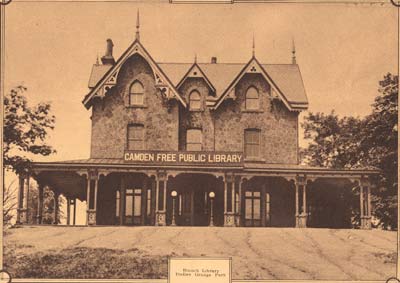
Dudley Grange as it appeared in 1926