Introduction
Dempsey Butler was born in Virginia in 1818. A very light-skinned man of Black parentage, he achieved great financial success in spite of the discrimination that was prevalent in his times, due in great part to his ability to travel in both worlds (white and Black). When he died in 1900, he was reported to be among the wealthiest Black men in the State of New Jersey.
Dempsey Butler came to Camden in the 1840s, reportedly late in the decade, and engaged in a number of business pursuits, opening up a general store on Kaighn Avenue and a number of real estate ventures, which included building houses in the Kaighnsville neighborhood and apparently operating boardinghouses for Camden’s Black residents.
In 1867 he founded the Butler Cemetery, located adjacent to Evergreen Cemetery, then restricted to white burials, on Ferry Avenue in what was then Camden’s South Ward. The reason ascribed in recent times to his decision to found the cemetery is that it was in reaction to the refusal of the proprietors of Evergreen Cemetery to allow his wife to be buried there, and that may have been a factor. However, as the cemetery was a for-profit enterprise where burials were carried on as late as 1924, many years after his death, it is just as likely, given Butler’s evident business acumen, that he saw an opportunity to make money and took it. It was the first privately owned and operated cemetery, i.e., not connected to either a church or local government, that catered to a Black clientele and that was wholly-owned and operated by Blacks, in the area.
Dempsey Butler had more than a few encounters with the law reported by local and national newspapers between the late 1860s and his death in 1900. While he had few criminal encounters, judgments were found against him a number of times in civil courts.
Dempsey Butler was present and sworn testimony states that he participated in a racially motivated riot at a polling place in South Camden in 1871, although what his exact role was is unclear, as there was a great deal of conflicting testimony on all sides surrounding this incident. He shot a man to death in a Philadelphia pawnshop, but this was judged to be an accidental death.
Dempsey Butler’s most notable encounter with the law, and what had his name on the front pages of newspapers around the country, occurred in March of 1889. Bodies were being buried in shallow graves, many only 12 to 18 inches below ground. The smell of rotting flesh was rampant, dogs were reported in the area gnawing at bones found in the cemetery, and there was at least one case of body-snatching reported. Records of burials were found to be all but non-existent, burials were being made in the cemetery without the legally-mandated burial permits issued by the City of Camden. After investigation was made, the case was referred to the Grand Jury in May and Butler had his day in court on June 20, 1889. He pled non vult (no contest) to the charges made in the indictment. Dempsey Butler was allowed to walk away from these charges after paying for the costs of the investigation and by “promising to have the nuisance abated.”
Dempsey Butler suffered a stroke that took his life in January of 1900. His estate, when his will was probated, was valued at over $100,000 in cash and property. In his will he left $10,000 to various charitable institutions including the Cooper and Pennsylvania Hospitals, and the Camden Home for Destitute Colored Children orphanage. He left $3,00 for the construction of a Masonic Hall on Kaighn Avenue.
Dempsey Butler’s will also provided for the free burial of poor Black children at his cemetery for five years, as reported in the New York Times and Philadelphia Inquirer. Everyone else obviously paid for that privilege.
In a time and place where many of the cards in life’s deck were stacked against him, Dempsey Butler did exceedingly well for himself. When he died, he left a good portion of his estate for the betterment of the world he left behind. Like all of us, the story of his life was no more or no less of us than his deeds. Let the record of those deeds tell the story — history is what did happen, not what we wish had happened.
Fire in Camden
Philadelphia Public Ledger —
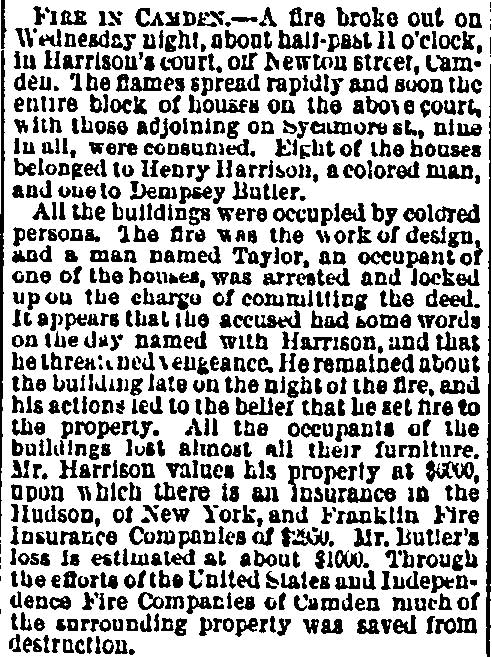
A fire broke out on Wednesday night, about half-past 11 o’clock, in Harrison’s court, off Newton street, Camden. The flames spread rapidly and soon the entire block of houses on the above court, with those adjoining on Sycamore st., nine in all, were consumed. Eight of the houses belonged to Henry Harrison, a colored man, and one to Dempsey Butler.
All the buildings were occupied by colored persons. The fire was the work of design, and a man named Taylor, an occupant of one of the houses, was arrested and locked up on the charge of committing the deed. It appears that the accused had some words on the day named with Harrison, and that he threatened vengeance. He remained about the building late on the night of the fire, and his actions led to the belief that he set fire to the property. All the occupants of the buildings lost almost all their furniture. Mr. Harrison values his property at $5000, upon which there is an insurance in the Hudson, of New York, and Franklin Fire Insurance Companies of $250. Mr. Butler’s loss is estimated at about $1000. Through the efforts of the United States and Independence Fire Companies of Camden much of the surrounding property was saved from destruction.
The Celebration
Philadelphia Inquirer —
THE CELEBRATION
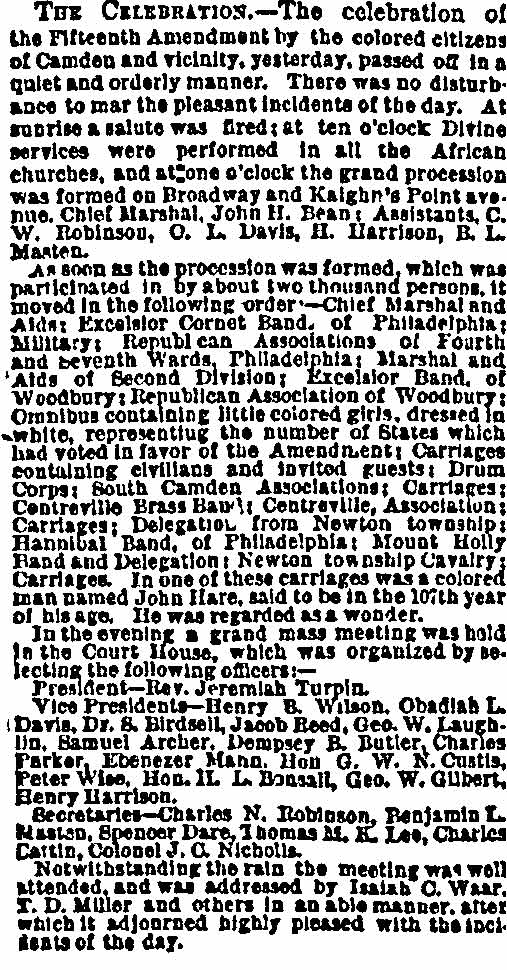
The celebration of the Fifteenth Amendment by the colored citizens of Camden and vicinity, yesterday, passed off in a quiet and orderly manner. There was no disturbance to mar the pleasant incidents of the day. At sunrise a salute was fired; at ten o’clock Divine services were performed in all the African churches, and at one o’clock the grand procession was formed on Broadway and Kaighn’s Point avenue. Chief Marshal, John H. Bean; Assistants, C. W. Robinson, O. L. Davis, H. Harrison, B. L. Masten.
As soon as the procession was formed, which was participated in by about two thousand persons, it moved in the following order:—Chief Marshal and Aids; Excelsior Cornet Band, of Philadelphia; Military; Republican Associations of Fourth and Seventh Wards, Philadelphia; Marshal and Aids of Second Division; Excelsior Band, of Woodbury; Republican Association of Woodbury; Omnibus containing little colored girls, dressed in white, representing the number of States which had voted in favor of the Amendment; Carriages containing civilians and invited guests; Drum Corps; South Camden Associations; Carriages; Centreville Brass Band; Centreville, Association; Carriages; Delegation from Newton township; Hannibal Band, of Philadelphia; Mount Holly Band and Delegation; Newton township Cavalry; Carriages. In one of these carriages was a colored man named John Hare, said to be in the 107th year of his age. He was regarded as a wonder.
In the evening a grand mass meeting was held in the Court House, which was organized by selecting the following officers:—
President—Rev. Jeremiah Turpin.
Vice Presidents—Henry B. Wilson, Obadiah L. Davis, Dr. S. Birdsell, Jacob Reed, Geo. W. Laughlin, Samuel Archer, Dempsey B. Butler, Charles Parker, Ebenezer Mann, Hon. G. W. N. Custis, Peter Wise, Hon. H. L. Bonsall, Geo. W. Gilbert, Henry Harrison.
Secretaries—Charles N. Robinson, Benjamin L. Masten, Spencer Dare, Thomas M. K. Lee, Charles Cattin, Colonel J. O. Nicholls.
Notwithstanding the rain the meeting was well attended, and was addressed by Isaiah C. Waar, T. D. Miller and others in an able manner, after which it adjourned highly pleased with the incidents of the day.
Death by Shooting in Philadelphia
New York Herald —
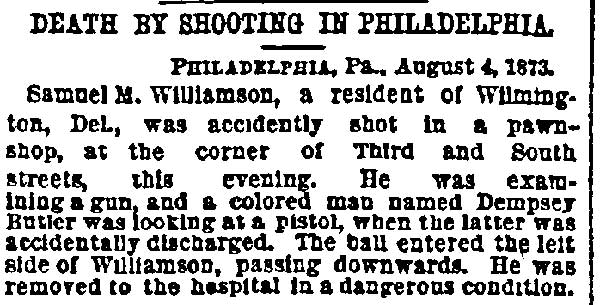
Philadelphia, Pa., August 4, 1873. Samuel M. Williamson, a resident of Wilmington, Del., was accidently shot in a pawnshop, at the corner of Third and South streets, this evening. He was examining a gun, and a colored man named Dempsey Butler was looking at a pistol, when the latter was accidentally discharged. The ball entered the left side of Williamson, passing downwards. He was removed to the hospital in a dangerous condition.
Freeman Gould Held for Assault on Dempsey Butler
Philadelphia Inquirer —
Mayor Gaul yesterday held Freeman Gould, colored, to answer a charge of assault and battery on Dempsey Butler, of the Seventh Ward.
Over the River
Philadelphia Inquirer —
THE COURTS
In the District Court of Camden, Judge Miller presiding, yesterday, the following cases were disposed of: James McLoughlin vs Dempsey Butler, debt. The case was adjourned for one week; Cottrell vs. Edmund J. Butcher, debt. Verdict for plaintiff, $32.86. Michael Cottrell vs William Small, debt. Verdict for plaintiff, $21; Samuel K. Hires vs. John Darragh. Verdict for plaintiff, $60.23; Meyer Bisenger vs. Owen R. Jones, debt. Judgment in favor of plaintiff, $39.80. The General Quarter Sessions commence the May term this morning.
Over the River
Philadelphia Inquirer —
Camden Courts—May Term
The May term of the Camden County Courts was opened yesterday by Judge Parker, recently appointed to the circuit in place of Judge Woodhull. The following named persons were selected as grand jurors: Thomas McKeen, James R. Carson, James A. Bray, Andrew Casselman, Edward Delacroix, James Garrison, Jr., Rudolph W. Birdsell, John W. Branning, David B. Kaighn, Daniel Dukeman, B. W. Pierce, Dempsey D. Butler, Joseph H. Hall, William Thompson, Noah Morton, John M. Pettit, Alfred Cramer, Joseph H. Cole, John Gill, Jr., Thomas J. Wentz, Henry Stewart, James Flinn, B. W. Bennett, J. F. Bodine. All were qualified except Garrison, Flinn and Branning, who were not present.
United States Circuit Court
Philadelphia Inquirer —
The United States Circuit Court was in session yesterday at the Government Building, Judge John T. Nixon presiding. In the case of Robert J. Douglas et al., v. Dempsey D. Butler, on bill, &c., final hearing, F. C. Lowthorp, Jr., was heard for the complainant. No one appeared for the defendant, and the Court took the papers and reserved decision.
Breeding a Pestilence
Chicago Daily Inter-Ocean —
Colored People Buried Too Near the Surface at Camden, N. J.
CAMDEN, N. J., March 28.—The special committee of the Camden Board of Health, appointed to investigate the condition of Butler’s burial-ground for colored people, in the rear of the Evergreen Cemetery, have made an official investigation, assisted by several city officials. The inquiry developed the fact that the State sanitary and burial laws had been grossly violated, and that serious results might follow during the coming hot weather, and an epidemic of death-dealing disease might result from the surface interments. Thirty-five tests were made as to what depth bodies had been interred. The iron struck coffins eighteen inches below the surface, and in several cases the bodies were only one foot deep. It was also said by the commission that when they dug up several graves bones were turned up and the feet of persons were plainly visible. Altogether, it is said, few bodies are buried as deep as three feet, and the stench of the decomposing flesh makes the place a nuisance and breeds disease. Dempsey Butler, the owner of the place, is said to be worth $60,000 and is a magnate among the colored people. He said tonight: “I know nothing about ghastly rumors of dogs going into the graveyard and eating human bones; dogs might have been seen there, but no complaint has been made, to my knowledge. Bodies have been buried without my knowledge and without permits, but what they were I can not say.” The Inspector of the Board of Health says that no permits of burial have been granted for this cemetery for a month, yet it is claimed there have been burials in the interval. Probably State prosecution will await action of the board of free holders.
A Horrible State of Things
Cleveland Plain Dealer —
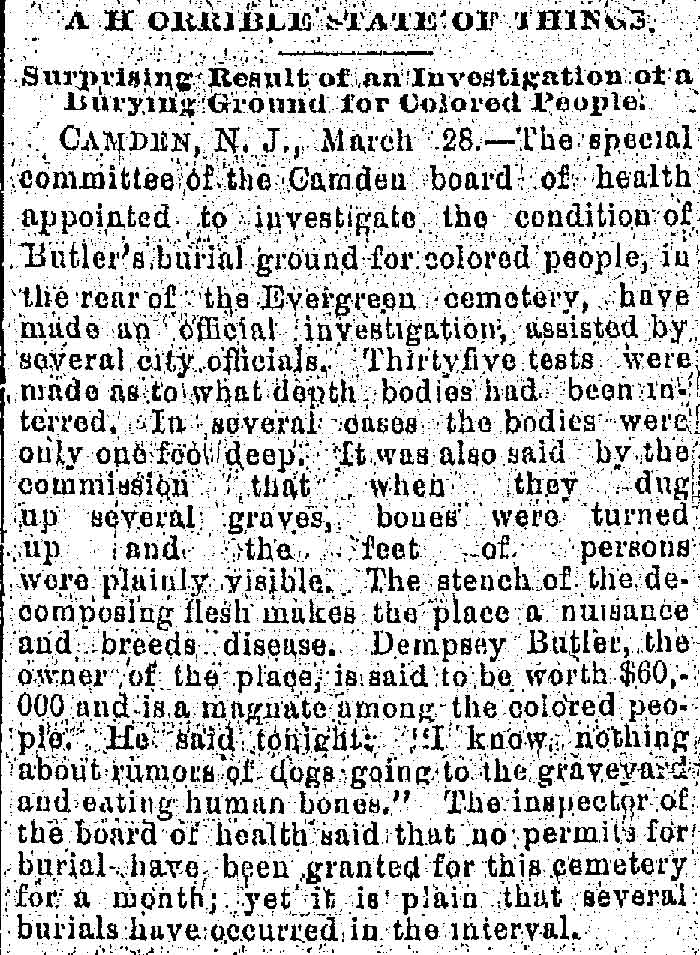
Surprising Result of an Investigation of a Burying Ground for Colored People
CAMDEN, N. J., March 28.—The special committee of the Camden board of health appointed to investigate the condition of Butler’s burial ground for colored people, in the rear of the Evergreen cemetery, have made an official investigation, assisted by several city officials. Thirty-five tests were made as to what depth bodies had been interred. In several cases the bodies were only one foot deep. It was also said by the commission that when they dug up several graves, bones were turned up and the feet of persons were plainly visible. The stench of the decomposing flesh makes the place a nuisance and breeds disease. Dempsey Butler, the owner of the place, is said to be worth $60,000 and is a magnate among the colored people. He said tonight: “I know nothing about rumors of dogs going to the graveyard and eating human bones.” The inspector of the board of health said that no permits for burial have been granted for this cemetery for a month; yet it is plain that several burials have occurred in the interval.
Dempsey Butler’s Burial Ground for Colored People
Maryland Sun —
A special committee of the Camden (N. J.) board of health appointed to investigate the condition of Dempsey Butler’s burial-ground for colored people, in rear of Evergreen Cemetery, found that bodies were buried eighteen inches and one foot deep, and the stench of decomposing flesh makes the place a nuisance and breeds disease.
Grave Robbers at Work
Philadelphia Inquirer —
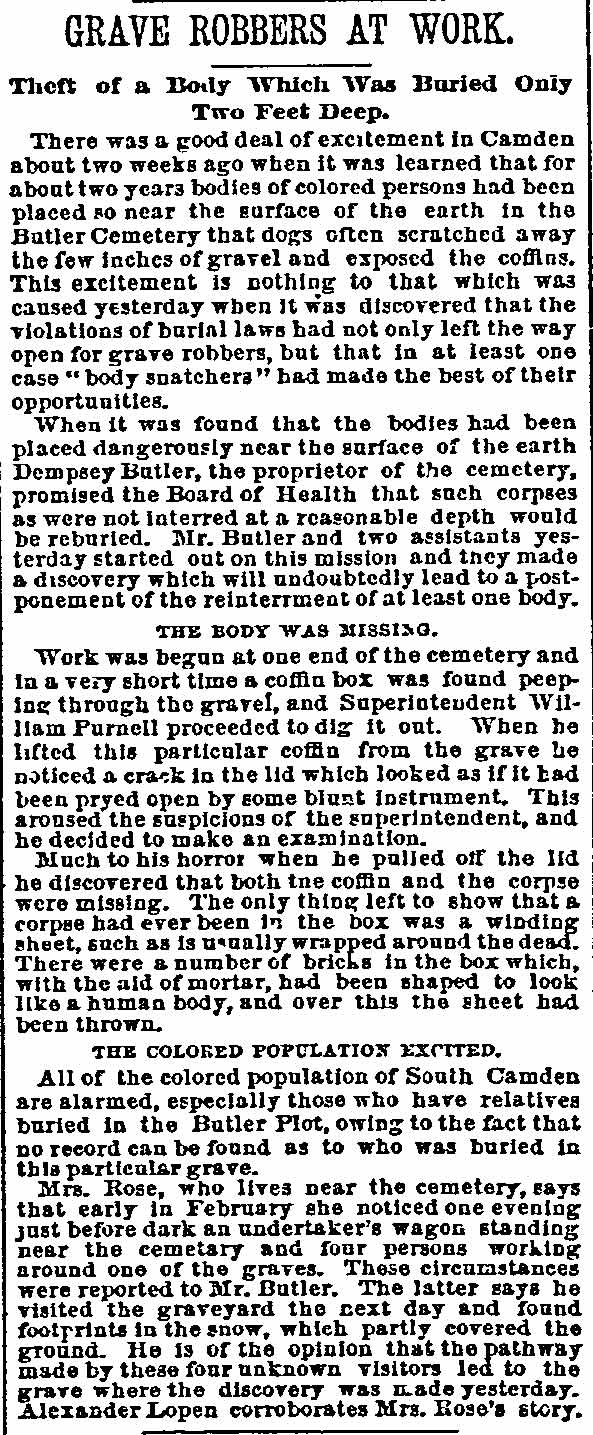
Theft of a Body Which Was Buried Only Two Feet Deep
There was a good deal of excitement in Camden about two weeks ago when it was learned that for about two years bodies of colored persons had been placed so near the surface of the earth in the Butler Cemetery that dogs often scratched away the few inches of gravel and exposed the coffins. This excitement is nothing to that which was caused yesterday when it was discovered that the violations of burial laws had not only left the way open for grave robbers, but that in at least one case “body snatchers” had made the best of their opportunities.
The Body Was Missing
Work was begun at one of the sections of the cemetery and in a very short time a coffin box was found peeping through the gravel, and Superintendent William Purnell was surprised to find out when he lifted this particular coffin from the grave he noticed a crack in the lid which looked as if it had been pried open by some blunt instrument. This aroused the suspicions of the superintendent and he decided to make an examination.
Much to his horror when he pulled off the lid he discovered that both the coffin and the corpse were missing. The only thing left to show that a corpse had been there was a folding sheet, such as is usually wrapped around the dead. There were a number of bricks in the box which, with the aid of mortar, had been shaped to look like a human body, and over this sheet had been thrown.
The Colored Population Excited
All of the colored population of South Camden are alarmed, especially those who have relatives buried in the Butler Plot, owing to the fact that no record can be found as to who was buried in this particular grave.
That Overcrowded Cemetery
Philadelphia Inquirer —
The Camden Grand Jury yesterday found a true bill against Dempsey Butler, the proprietor of the colored cemetery on the outskirts of the city and which bears his name. It was there where bodies were discovered a few months ago, only six inches from the surface of the ground.
He Did Not Bury Deep Enough.
Philadelphia Inquirer —
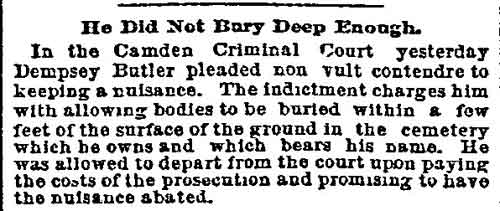
In the Camden Criminal Court yesterday Dempsey Butler pleaded non vult contendre to keeping a nuisance. The indictment charges him with allowing bodies to be buried within a few feet of the surface of the ground in the cemetery which he owns and which bears his name. He was allowed to depart from the court upon paying the costs of the prosecution and promising to have the nuisance abated.
Dempsey Butler Seeks New Trial in Libel Action
Philadelphia Inquirer —
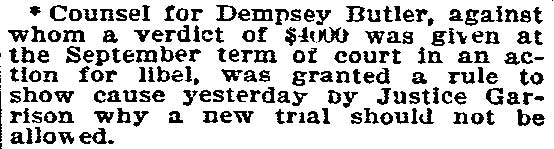
Counsel for Dempsey Butler, against whom a verdict of $1000 was given at the September term of court in an action for libel, was granted a rule to show cause yesterday by Justice Garrison why a new trial should not be allowed.
Dempsey Butler Stricken with Paralysis
Philadelphia Inquirer —

Dempsey Butler, said to be the wealthiest colored person in Camden, was stricken with paralysis on Saturday, and is in a critical condition.
Colored Man Bequeaths $10,000 for Charity
Philadelphia Inquirer —
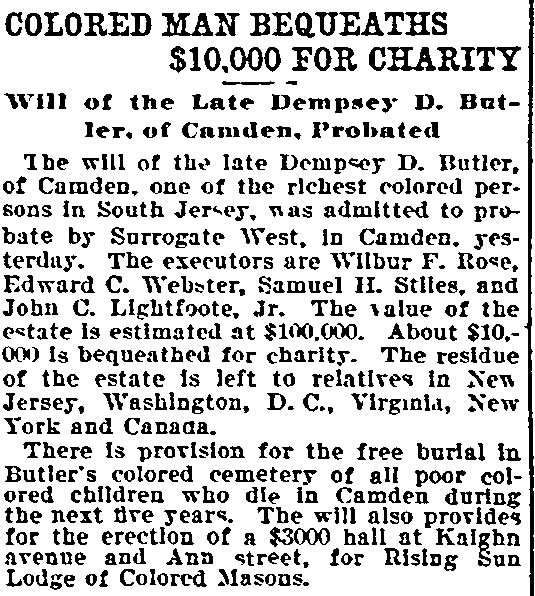
Will of the Late Dempsey D. Butler, of Camden, Probated
The will of the late Dempsey D. Butler, of Camden, one of the richest colored persons in South Jersey, was admitted to probate by Surrogate West, in Camden, yesterday. The executors are Wilbur F. Rose, Edward C. Webster, Samuel H. Stiles, and John C. Lightfoote, Jr. The value of the estate is estimated at $100,000. About $10,000 is bequeathed for charity. The residue of the estate is left to relatives in New Jersey, Washington, D. C., Virginia, New York and Canada.
There is provision for the free burial in Butler’s colored cemetery of all poor colored children who die in Camden during the next five years. The will also provides for the erection of a $3000 hall at Kaighn avenue and Ann street, for Rising Sun Lodge of Colored Masons.
Will of a Wealthy Negro
New York Times —
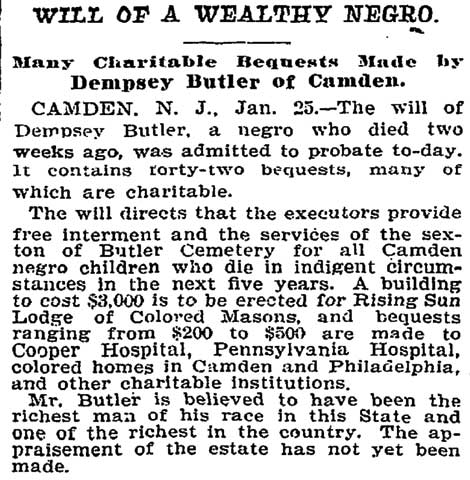
Many Charitable Bequests Made by Dempsey Butler of Camden
CAMDEN, N. J., Jan. 25.—The will of Dempsey Butler, a negro who died two weeks ago, was admitted to probate to-day. It contains forty-two bequests, many of which are charitable.
The will directs that the executors provide free interment and the services of the sexton of Butler Cemetery for all Camden negro children who die in indigent circumstances in the next five years. A building to cost $3,000 is to be erected for Rising Sun Lodge of Colored Masons, and bequests ranging from $200 to $500 are made to Cooper Hospital, Pennsylvania Hospital, colored homes in Camden and Philadelphia, and other charitable institutions.
Mr. Butler is believed to have been the richest man of his race in this State and one of the richest in the country. The appraisement of the estate has not yet been made.
Butler’s Cemetery Lots Sold at Foreclosure
Philadelphia Inquirer —
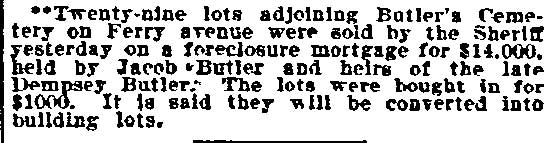
Twenty-nine lots adjoining Butler’s Cemetery on Ferry avenue were sold by the Sheriff yesterday on a foreclosure mortgage for $14,000, held by Jacob Butler and heirs of the late Dempsey Butler. The lots were bought in for $1000. It is said they will be converted into building lots.