Chester L. Bennett
Rank: Private, U.S. Army
Unit: Machine Gun Company, 16th Infantry Regiment, 1st Infantry Division
Entered service from: New Jersey
Died:
Buried at: Aisne-Marne American Cemetery, Belleau, France — Plot A, Row 9, Grave 51
Private Chester L. Bennett was one of at least five children born to Harry J. and Hattie Bennett. He was born in Burlington County, New Jersey in April of 1898. When the Census was taken in 1900 the family was living in Medford, NJ, where Harry Bennett worked as a day laborer.
Chester Bennett enlisted in the regular Army on January 17, 1917, before America entered World War I. He was first sent to Eagle Pass, TX, being attached to the 30th Infantry Regiment. He was later transferred to the Machine Gun Company of the 16th Infantry Regiment, 1st Infantry Division.
Private Bennett was killed in action July 19, 1918 at Chateau Thierry at the beginning of the Allies’ major offensive, after having participated in the Battle of Cantigny. Machine gun bullets through the abdomen caused his death. He was survived by his mother, Mrs. Hattie E. Bennett, who was living in Paulsboro at the time of his death. She moved to 34 Kresson Road, Haddonfield, not long afterwards.
Honor Roll Cards
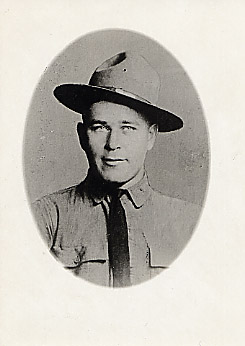
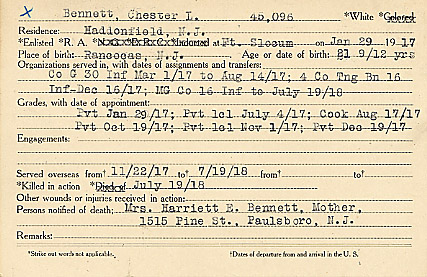
Camden County World War I Honor Roll cards for Chester L. Bennett.
Unveiling Ceremony Is Peace Jubilee
Philadelphia Inquirer —
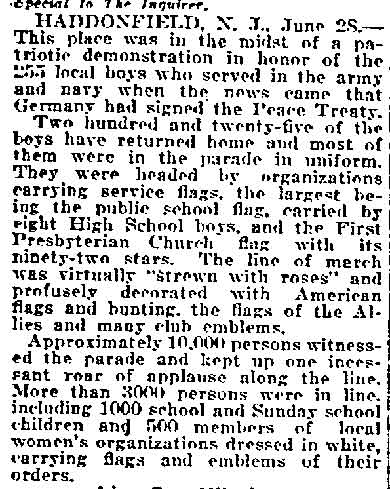
Haddonfield Honoring Boys When Peace News Reaches Committees in Charge
Governor Runyon Delivers Patriotic Address at Uncovering of Bronze Tablet
HADDONFIELD, N. J., June 28.—This place was in the midst of a patriotic demonstration in honor of the 255 local boys who served in the army and navy when the news came that Germany had signed the Peace Treaty.
Two hundred and twenty-five of the boys have returned home and most of them were in the parade in uniform. They were headed by organizations carrying service flags, the largest being the public school flag, carried by Big High School boys, and the First Presbyterian Church flag with its twenty-nine stars. The march was virtually “strewn with roses,” and profusely decorated with American flags and bunting, the flags of the Allies and many club emblems.
Approximately 10,000 persons witnessed the parade and kept up one incessant roar of applause along the line. More than 4,000 persons were in line, including 1,000 school and Sunday school children and 500 members of local women’s organizations dressed in white, carrying flags and emblems of their orders.
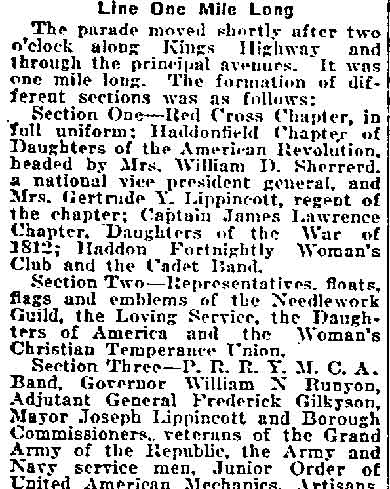
Line One Mile Long
The parade moved shortly after two o’clock along Kings Highway and through the principal avenues. It was one mile long. The formation of different sections was as follows:
Section One—Red Cross Chapter, in July, uniform; Haddonfield Chapter of Daughters of the American Revolution, headed by Mrs. William D. Schermerhorn, a national vice president general, and Mrs. Gertrude Y. Lippincott, regent of the chapter; Captain James Lawrence Chapter, Daughters of the War of 1812; Haddon Fortnightly Woman’s Club and the Cadet Band.
Section Two—Representatives, floats, flags and emblems of the Needlework Guild, the Loving Service, the Daughters of America and the Woman’s Christian Temperance Union.
Section Three—P. R. R. Y. M. C. A. Band, Governor William N. Runyon, Adjutant General Frederick Gilkyson, Mayor Joseph Lippincott and Borough Commissioners, veterans of the Grand Army of the Republic, the Army and Navy service men, Junior Order of United American Mechanics, Artisans.
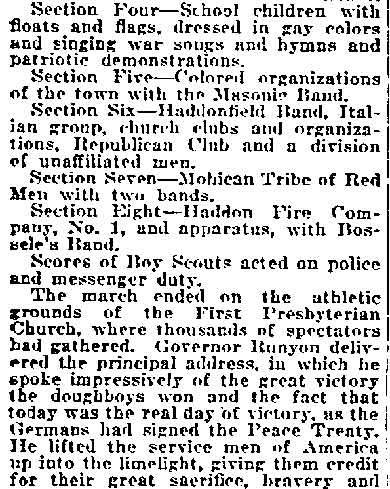
Section Four—School children with floats and flags, dressed in gay colors and singing war songs and hymns and patriotic demonstrations.
Section Five—Colored organizations of the town with the Masonic Band.
Section Six—Haddonfield Band, Italian group, church clubs and organizations, Republican Club and a division of unaffiliated men.
Section Seven—Mohican Tribe of Red Men with two bands.
Section Eight—Haddon Fire Company, No. 1, and apparatus, with Bossele’s Band.
Scores of Boy Scouts acted on police and messenger duty.
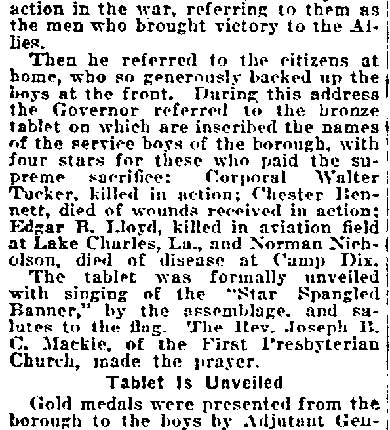
The march ended on the athletic grounds of the First Presbyterian Church, where thousands of spectators had gathered. Governor Runyon delivered the principal address, in which he spoke impressively of the great victory the doughboys won and the fact that today was the real day of victory, as the Germans had signed the Peace Treaty. He lifted the service men of America up into the limelight, giving them credit for their great sacrifice, bravery and action in the war, referring to them as the men who brought victory to the Allies.
Then he referred to the citizens at home, who so generously backed up the boys at the front. During this address the Governor referred to the bronze tablet on which are inscribed the names of the service boys of the borough, with four stars for these who paid the supreme sacrifice: Corporal Walter Tucker, killed in action; Chester Bennett, died of wounds received in action; Edgar B. Lloyd, killed in aviation field at Lake Charles, La., and Norman Nicholson, died of disease at Camp Dix.
The tablet was formally unveiled with singing of the “Star Spangled Banner,” by the assemblage, and salutes to the flag. The Rev. Joseph B. C. Mackie, of the First Presbyterian Church, made the prayer.
Tablet Is Unveiled
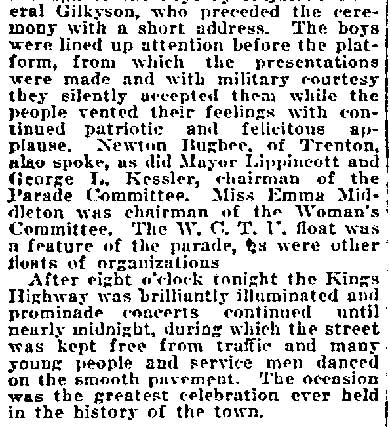
Gold medals were presented from the borough to the boys by Adjutant General Gilkyson, who preceded the ceremony with a short address. The boys were lined up at attention before the platform, from which the presentations were made and with military courtesy they silently accepted them while the people vented their feelings with continued patriotic and felicitous applause. Newton Bugbee, of Trenton, also spoke, as did Mayor Lippincott and George L. Kessler, chairman of the Parade Committee. Miss Emma Middleton was chairman of the Woman’s Committee. The W. C. T. U. float was a feature of the celebration, as were other floats of organizations.
After twilight tonight the Kings Highway was brilliantly illuminated and promenade concerts continued until nearly midnight, during which the street was kept free from traffic and many young people and service men danced on the smooth pavement. The occasion was the greatest celebration ever held in the history of the town.