Charles L. Stevenson
Rank: First Lieutenant
Branch: U.S. Army Air Force
Serial: O-807944
Unit: 368th Bomb Squadron, 306th Bombardment Group, Heavy
Entered the service from: New Jersey
Died:
Buried at: Plot A O 8A, Beverly National Cemetery, Beverly NJ
Awards: Purple Heart
Introduction
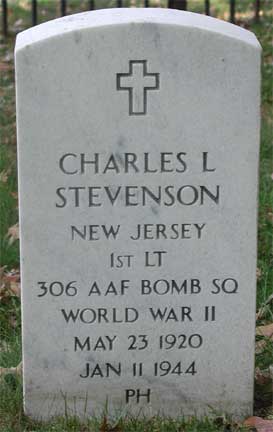
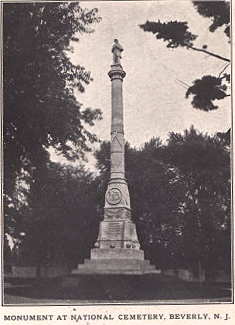
Charles L. Stevenson; Beverly National Cemetery, Beverly NJ
First Lieutenant Charles L. Stevenson was born in Pennsylvania on May 23, 1920 to Howard and Elinor Stevenson. His father, in 1930, was working as a draftsman in an electric shop. By the time Charles was three the family had moved to New Jersey, and at the time of the 1930 Federal Census the family had moved to South Barrett Avenue in Audubon NJ. Besides Charles, there were two older brothers, Edwin R. and Howard Russell, and a younger sister, Eleanor. He graduated from Audubon High School and was attending the Drexel Institute School of Engineering in Philadelphia when he joined the Army Air Force in February of 1942. Shortly before going overseas in 1943 he had married Grace Lohring of Clementon NJ. His last stateside address was 327 Lake Avenue, Clementon NJ.
Lieutenant Stevenson trained as a navigator and flew with a bomber crew led by its pilot, Lieutenant Charles W. “Smithy” Smith. Other members of the crew were Co-Pilot: 2nd Lt. Merle P. Brown, Bombardier 2nd Lieutenant Herman F. Allen, Engineer Sgt. Carl A. “Tiny” Heuser, Radio operator Sergeant Victor R. Marcotte, Waist gunners Sergeant Donald S. Courson and Joseph S. Paul, Tail gunner Sergeant R.B. Trumble, and Ball Turret gunner Sergeant Thomas E. Stillson.
Assigned to the 306th Bomber Group, he was based in Thurleigh, England. Flying a B-17 Flying Fortress bomber, he was killed in action while serving with the 306th Bomber Group on January 11, 1944. On this date, without fighter escort and in the face of powerful opposition, the 306th completed an assault against fighter aircraft factories at Halberstadt in central Germany. The American bombers met fierce opposition in the form of anti-aircraft fire and an estimated 500 enemy fighters. 60 aircraft were lost on this raid. The 306th Bomb Group was awarded a Distinguished Unit Citation for this mission.
Charles L. “Steve” Stevenson was the navigator and flew side by side with bombardier Herman Allen in “the nose” of the B-17, and they became close friends.
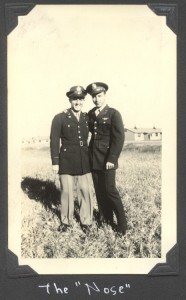
“The Nose” — Bombardier Herman Allen and Navigator Charles Stevenson
On January 11, 1944, Herman Allen did not fly with his crew, as he was out with a broken ear drum. The Charles Smith crew was assigned to a B-17 known as “Weary Bones,” with Lieutenant Burton C. Gustafson replacing Lieutenant Allen in the nose. During these attacks, the nose of Weary Bones was struck by shell fire. The bombardier called on the intercom: “The navigator has been hit!” He was the only crew member close enough to give aid to his wounded comrade but Charles Stevenson died instantly. Lieutenant Smith wrote in the year 2000 that “the horror of those few seconds during the afternoon of January 11, 1944 still remains to haunt the surviving crew members of Weary Bones.”
Herman Allen was deeply affected by this. If not for his ear drum he would have been sitting next to Stevenson. He wrote soon afterward:
WE WILL REMEMBER
And we shall say to him, when we meet once again ‘over there’ — ‘There were no tears, we bowed our heads, each with a silent prayer, each with a personal thought — through each flight you were with us, in spirit, in guidance, as it always was —
We will remember with each bomb dropped, each mile flown, each letter written — yes, Steve, we will remember.
In memory of Charles Stevenson, Navigator, killed in action January 11, 1944, Halberstadt Mission.
Herman Allen
January 15, 1944.
On March 6, 1944, with new navigator Lieutenant Stanley Buck, the Charles Smith crew was assigned to take the B-17 Liberty Lady on a raid against Berlin. Two engines were damaged by anti-aircraft fire. Lieutenant Smith managed to fly his damaged aircraft as far as the island of Gotland, in neutral Sweden, where he and the rest of his crew were interned until the end of the war.
Lieutenant Burton C. Gustafson, the bombardier who replaced Herman Allen that day, was shot down on May 24, 1944 on a mission to Berlin and was taken prisoner. He was held until the end of the war at Stalag 7A, Moosburg, Bavaria.
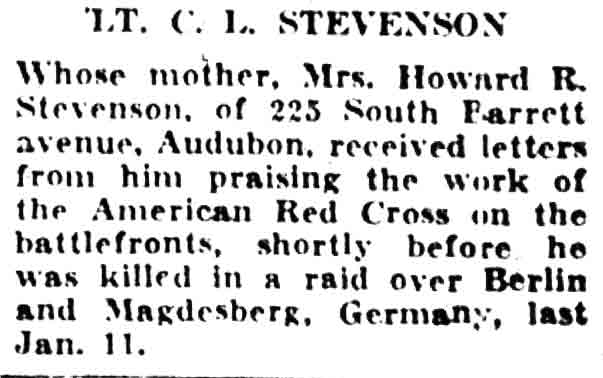
Lieutenant Charles Stevenson’s death was reported in the February 12, 1944 edition of the Camden Courier-Post. He was brought home after the war ended. He was survived by his wife, Grace L. Stevenson, his parents, of 255 South Barrett Avenue, Audubon, his sister, and his brothers, who also were serving in the Army Air Force. He was buried at Beverly National Cemetery in Beverly NJ on July 16, 1948.
On September 2, 1949, his brother, Captain Edwin R. Stevenson was killed when the Army C-47 he was piloting crashed near Anchorage AK.
Five members of Audubon High School’s 1937 graduating class were also lost while serving in America’s military during World War II. Besides Charles Stevenson, the dead include Charles Adamson, George Riggin, Edwin Klenk, and Peter Albano.
Photos
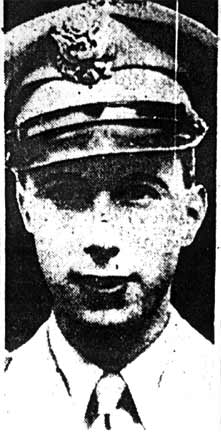
Charles L. Stevenson
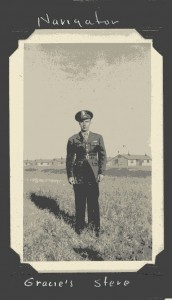
Charles L. Stevenson — “Gracie’ Steve” refers to his wife. This picture was probably taken in England in the fall of 1943, by his friend, Second Lieutenant Herman F. Allen.
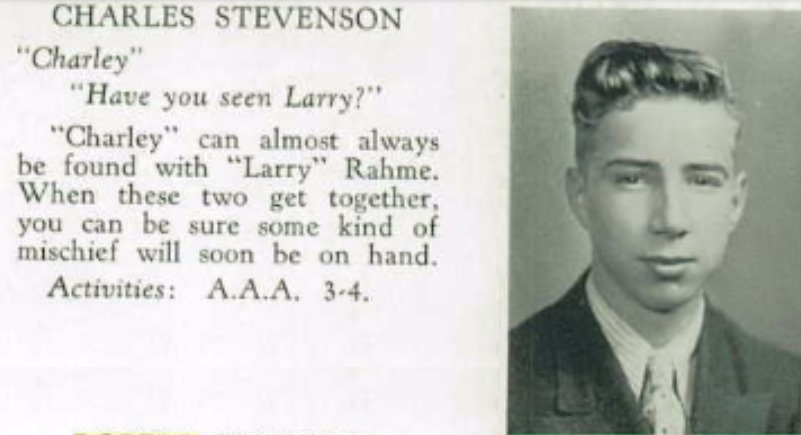
Audubon High School, class of 1937
Red Cross Is Aided by Voice of Dead
Camden Courier-Post —
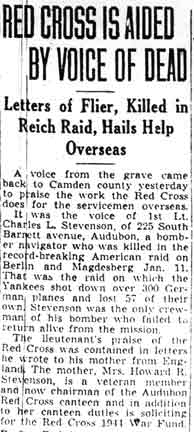
Red Cross Is Aided by Voice of Dead
Letters of Flier, Killed in Reich Raid, Hails Help Overseas
A voice from the grave came back to Camden county yesterday to tell of the work the Red Cross does for the servicemen overseas. It was the voice of 1st Lt. Charles L. Stevenson, of 225 South Barrett avenue, Audubon, a bomber navigator who was killed in the record-breaking American raid on Berlin and Magdesburg Jan. 11. That was the raid in which the Yankees shot down over 300 German planes and lost 57 of their own. Stevenson was the only crewman of his bomb who failed to return alive from the mission. The lieutenant’s praise of the Red Cross was contained in letters he wrote to his mother from England. The mother, Mrs. Howard R. Stevenson, is a veteran member and now chairman of the Audubon Red Cross canteen, and in addition to her canteen duties is soliciting for the Red Cross 1944 War Fund.
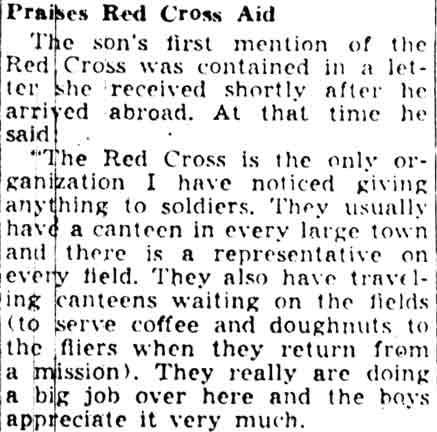
Praises Red Cross Aid
The son’s first mention of the Red Cross was contained in a letter she received shortly after he arrived abroad. At that time he said:
“The Red Cross is the only organization I have noticed giving anything to soldiers. They usually have a canteen in every large town and there is a representative on every field. They also have traveling canteens waiting on the fields (to serve coffee and doughnuts to the fliers when they return from a mission). They really are doing a big job over here and the boys appreciate it very much.”
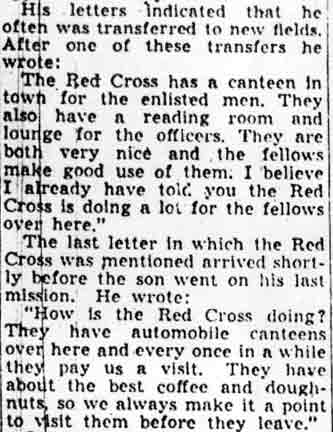
His letters indicated that he often was transferred to new fields. After one of these transfers he wrote:
“The Red Cross has a canteen in town for the enlisted men. They also have a reading room and lounge for the officers. They are both very nice and the fellows make good use of them. I believe I already have told you the Red Cross is doing a lot for the fellows over here.”
The last letter in which the Red Cross was mentioned arrived shortly before the son went on his last mission. He wrote:
“How is the Red Cross doing? They have automobile canteens over here and every once in a while they pay us a visit. They have about the best coffee and doughnuts, so we always make it a point to visit them before they leave.”
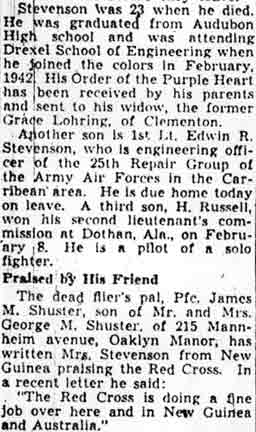
Stevenson was 23 when he died. He was graduated from Audubon High school and was attending Drexel School of Engineering when he joined the colors in February, 1942. His Order of the Purple Heart has been received by his parents and sent to his widow, the former Grace Lohring, of Clementon.
Another son is 1st Lt. Edwin R. Stevenson, who is engineering officer of the 25th Repair Group of the Army Air Forces in the Caribbean area. He is due home today on leave. A third son, H. Russell, won his second lieutenant’s commission at Dothan, Ala., on February 8. He is a pilot of a solo fighter.
Praised by His Friend
The dead flier’s pal, Pfc. James M. Shuster, son of Mr. and Mrs. George M. Shuster, of 215 Mannheim avenue, Oaklyn Manor, has written Mrs. Stevenson from New Guinea praising the Red Cross. In a recent letter he said: “The Red Cross is doing a fine job over here and in New Guinea and Australia.”
Audubon Captain Is Killed in Air Crash in Alaska
Camden Courier-Post —
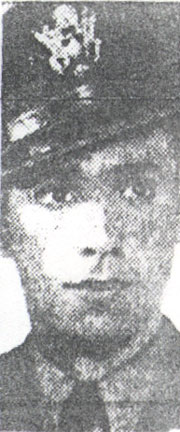
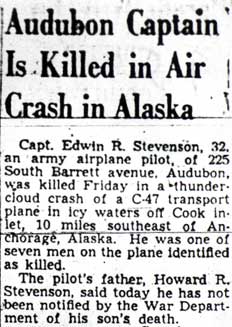
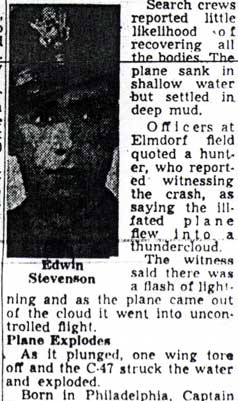
Audubon Captain Is Killed in Air Crash in Alaska
Capt. Edwin R. Stevenson, 32, an army airplane pilot, of 225 South Barrett avenue, Audubon, was killed Friday in a thundercloud crash of a C-47 transport plane in icy waters off Cook Inlet, 10 miles southeast of Anchorage, Alaska. He was one of seven men on the plane identified as killed. The pilot’s father, Howard R. Stevenson, said today he has not been notified by the War Department of his son’s death.
Search crews reported little likelihood of recovering all the bodies. The plane sank in shallow water but settled in deep mud. Officers at Elmdorf field quoted a hunter, who reported witnessing the crash, as saying the ill-fated plane flew into a thundercloud. The witness said there was a flash of lightning and as the plane came out of the cloud it went into uncontrolled flight.
Plane Explodes
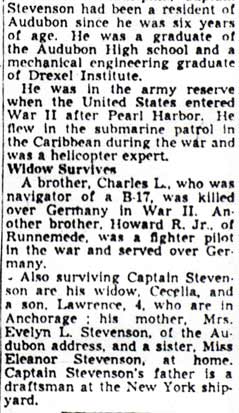
As it plunged, one wing tore off and the C-47 struck the water and exploded. Born in Philadelphia, Captain Stevenson had been a resident of Audubon since he was six years of age. He was a graduate of the Audubon High school and a mechanical engineering graduate of Drexel Institute. He was in the army reserve when the United States entered World War II after Pearl Harbor. He flew in the submarine patrol in the Caribbean during the war and was a helicopter expert.
Widow Survives
A brother, Charles L., who was navigator of a B-17, was killed over Germany in World War II. Another brother, Howard R. Jr., of Runnemede, was a fighter pilot in the war and served over Germany.
Also surviving Captain Stevenson are his widow, Cecilia, and a son, Lawrence, 4, who are in Anchorage; his mother, Mrs. Evelyn L. Stevenson, of the Audubon address, and a sister, Miss Eleanor Stevenson, at home. Captain Stevenson’s father is a draftsman at the New York shipyard.
Audubon's Tribute to Those Who Served in WWII
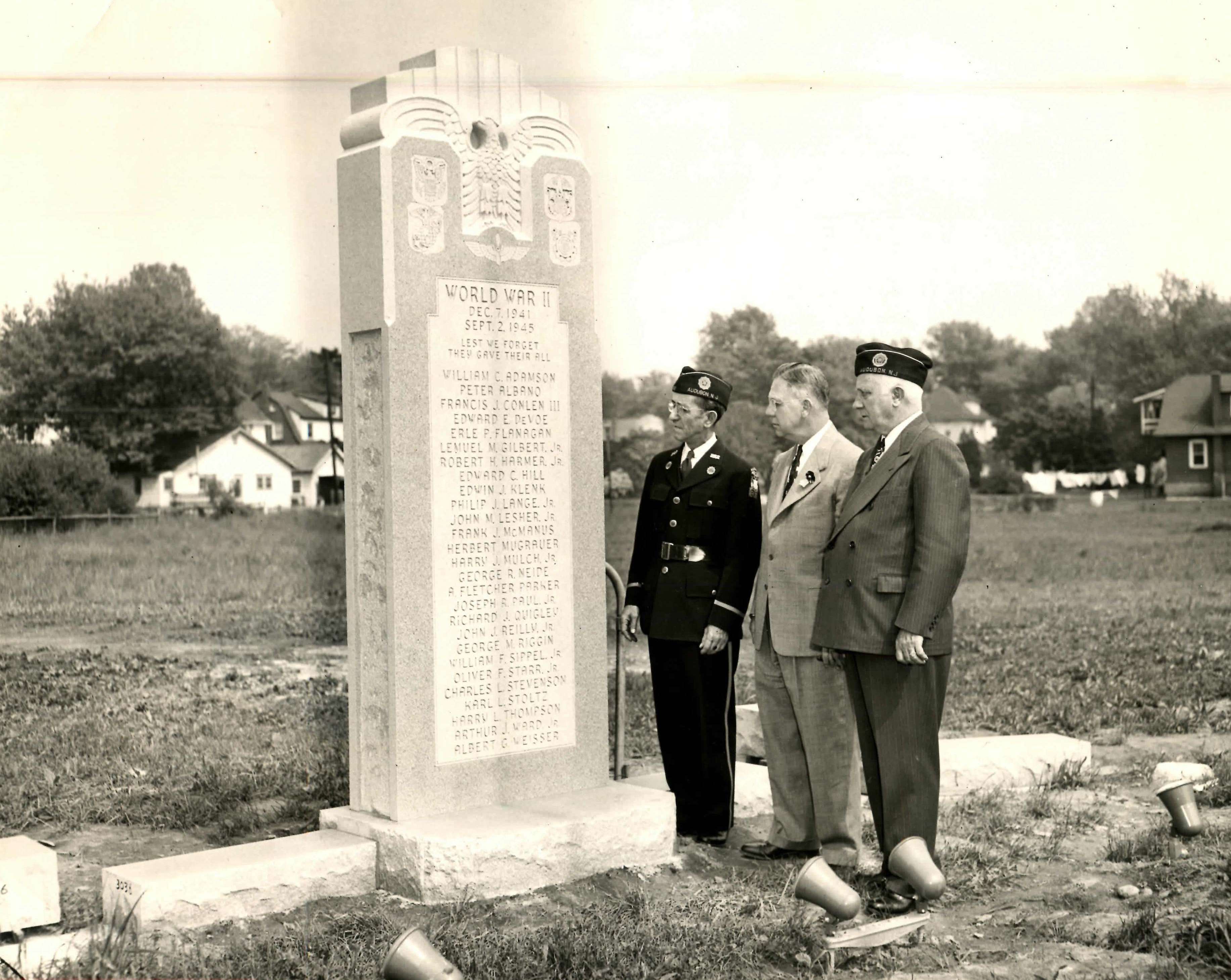
Audubon’s Tribute to Those Who Served in WWII
Acknowledgments
Sincere thanks to Pat DiGeorge, the child of Herman F. Allen, for help in creating this page. Pat has started a website and is writing a book about her parents’ wartime experiences.