Introduction
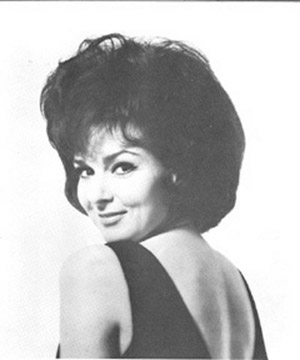
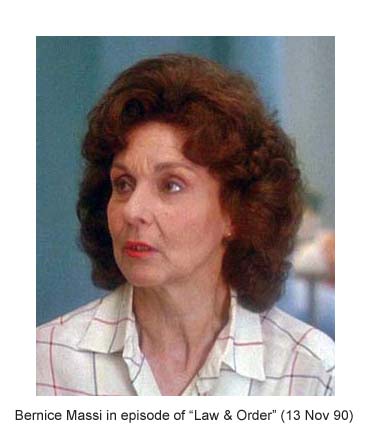
Bernice Massi — Actress and Singer
BERNICE MASSI is a singer and actress. She was Miss New Jersey in 1952 and has made numerous appearances on Broadway, on television, and at least once in movies. Perhaps the highlight of her career was her role as Laurette Harrington in the original Broadway cast of the hit musical What Makes Sammy Run? After that hit she appeared opposite Howard Keel as Aldonza in Man of La Mancha. In his autobiography Keel called her “the best Aldonza of all.”
Bernice Massi was in the chorus role in the national company of “South Pacific,” when she was sixteen. She subsequently appeared in “Wish You Were Here,” “By the Beautiful Sea,” “Can-Can,” “The Vamp” and “Beg, Borrow or Steal.” But it was as the very rich Texas girl in Richard Rodgers’ “No Strings” that she made her big impact on critics and audiences, prior to her role in What Makes Sammy Run? She also appeared opposite Hugh O’Brian in a summer stock production of “Destry Rides Again.”
Bernice Massi's Television and Movie Appearances
Complete film and television credits
Television
| Title ↕ | Year ↕ | Role ↕ | Episode ↕ |
|---|---|---|---|
| Toast of the Town | 1962 | self | The Ed Sullivan Show (USA: new title) |
| Coronet Blue | 1967 | Margaret | A Charade for Murder |
| NBC Special Treat | 1979 | Isabel | New York City Too Far from Tampa Blues |
| Law & Order | 1990 | Mrs. Diamond | Law & Order Prime |
| Mathnet | 1991 | Hester Phestor | The Case of the Galling Stones |
Films
| Title ↕ | Year ↕ | Role ↕ | Episode ↕ |
|---|---|---|---|
| The Pool | 1987 | self | The Pool |
Bernice Massi's Broadway Appearances
From the Internet Broadway Database
Productions
| Title ↕ | Type ↕ | Dates ↕ | Credit ↕ | Role ↕ | Replacement ↕ | Replacement Date ↕ |
|---|---|---|---|---|---|---|
| I Ought to Be in Pictures | Original,Play,Comedy | Apr 3, 1980 – Jan 11, 1981 | Performer | Steffy | true | Oct 5, 1980 |
| Filumena | Revival,Play | Feb 10, 1980 – Mar 9, 1980 | Standby | Filumena Marturano | ||
| How the Other Half Loves | Original,Play,Farce | Mar 29, 1971 – Jun 26, 1971 | Performer | Fiona Foster | ||
| Man of La Mancha | Original,Musical,Drama | Nov 22, 1965 – Jun 26, 1971 | Performer | Aldonza (Dulcinea) | true | Jul 25, 1967 |
| What Makes Sammy Run? | Original,Musical | Feb 27, 1964 – Jun 12, 1965 | Performer | Laurette Harrington; Kit Sargent (Replacement, Mar 22, 1965) | ||
| No Strings | Original,Musical | Mar 15, 1962 – Aug 3, 1963 | Performer | Comfort O'Connell | ||
| Beg, Borrow or Steal | Original,Musical | Feb 10, 1960 – Feb 13, 1960 | Performer | Ethel | ||
| The Vamp | Original,Musical,Comedy | Nov 10, 1955 – Dec 31, 1955 | Performer | Singer | ||
| Wish You Were Here | Original,Musical,Comedy | Jun 25, 1952 – Nov 28, 1953 | Understudy | Teddy Stern | true |
OLIVER!
OLIVER! in June of 1966 at the Valley Forge Music Fair (a Saturday matinee for only $3.75!), in a tent with a cast that included:
Oliver Cast, June 1966
Stage adaption of Oliver in June 1966. Performed at the Valley Forge Music Fair
Cast
| Role ↕ | Performed By ↕ |
|---|---|
| Oliver Twist | Darel Glaser |
| Fagin | Walter Slezak |
| The Artful Dodger | George Priolo |
| Nancy | Bernice Massi |
| Bet | Sheila Gaines |
| Bill Sikes | Danny Sewell |
Workhouse Boys and Fagin’s Gang: Chris Month, Mark Month, Michel Month, Bill King, Lee Franklin, David Reese, Steven Oliva, Anthony Endon
Londoners: John Beyer, Wendy Shaffer, Sam Schuman, Gracie Angelo, Ludmilla Tchor, Charley Peak, Dylan Davis, Regina Ann Sesso.
Bernice Massi at the Paper Mill Playhouse, Millburn NJ
1966 — The Women — Starring Peggy Cass, Sheila MacRae, Phyllis Thaxter, Bernice Massi. Directed by Stanley Prager
1982–1983
Man of La Mancha - Starring Jerome Hines, Bernice Massi
Directed and Choreography by Rudy Tronto; Musical Direction by Rudolph Bennett
1988–1989
Broadway Bound - Starring Barbara Caruso, Rudy Goldschmidt, Salem Ludwig, Bernice Massi, Alan Mixon, Marc Riffon
Directed by Philip Minor; Scenic Design by David Mitchell; Lighting Design by David Kissel
Costumes by Alice S. Hughes
Bernice Massi Recordings
Dream Along With Me ( I’m On My Way To A Star ) (1956) by Perry Como.
Santa Claus Is Comin’ To Town (1959) by Perry Como.
Bernice Massi was in the chorus on these recordings as a member of the Ray Charles Singers.
No Strings (1962 Original Broadway Cast) [CAST RECORDING]
Richard Rodgers (Composer, Performer),
Ann Hodges (Performer),
Bernice Massi (Performer),
Diahann Carroll (Performer),
Don Chastain (Performer),
Mitchell Gregg (Performer),
Noelle Adam (Performer),
Polly Rowles (Performer),
Richard Kiley (Performer)
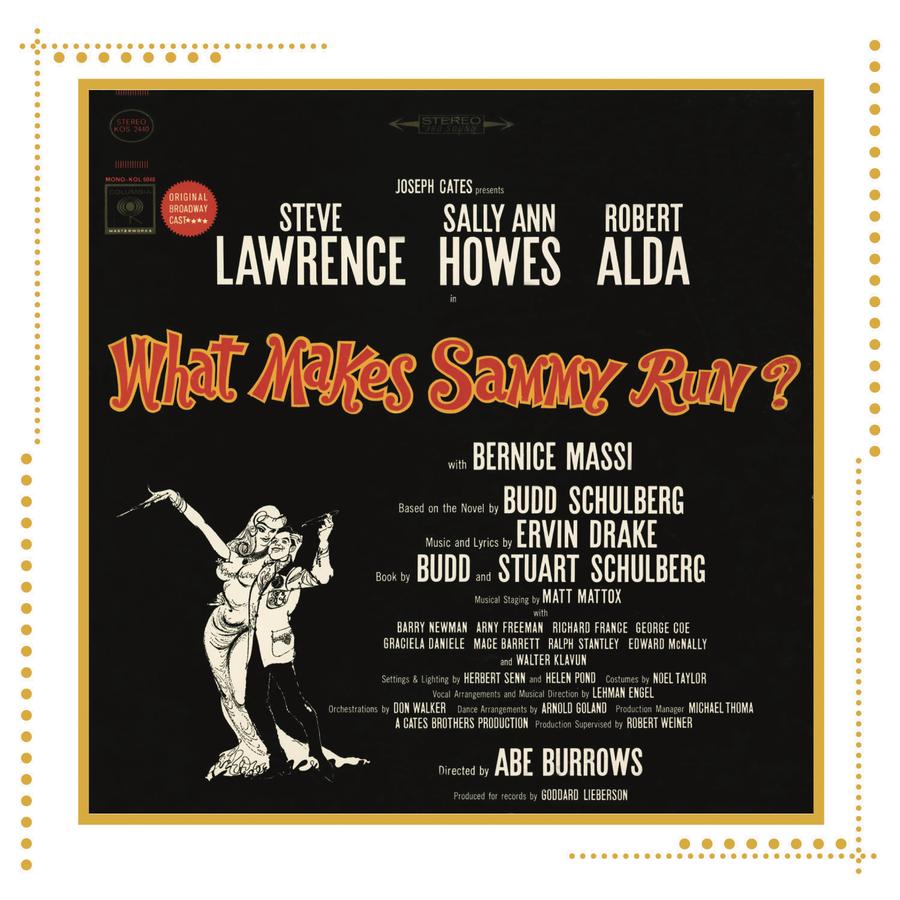
Title: What Makes Sammy Run?-Orig Cast Sdtk
Artist: Lawrence, Steve/various Artists
Steve and Eydie’s smash Broadway hit musical, on CD for the first time! Includes ’Overture; 24 Hours a Day; We Got Us; He Needs Me Now; Kid; For Once in Your Life; Taking Care of You; I’ve Gotta Be Me; Entr’acte; Taste; Desert Moon; All in Fun; It’s You Again; He Needs Me Now’ (reprise); ’Golden Rainbow; How Could I Be So Wrong’, and ’Finale: We Got Us.’
“STEVE’S BROADWAY TRIUMPH!” by ALLEN POLLOCK - PLYMOUTH, UK
The anti-hero of novels has always held a strange fascination especially when featured within the Hollywood theme of greed and corruption. Budd and Stuart Schulberg’s libretto for the 1964 musical, WHAT MAKES SAMMY RUN? was based on Budd’s novel which put the spotlight on Sammy Glick, a first-rate heel and opportunist played by Steve Lawrence in his first Broadway role. The show and Steve’s performance were successful enough to ensure a run of 540 performances. Certainly the varied score by Ervin Drake runs the gamut of emotions from romance to satire when heard on disc, with sprightly well sung numbers involving the whole cast, including Sally Ann Howes. Steve is well-served by A NEW PAIR OF SHOES, I FEEL HUMBLE, SOME DAYS EVERYTHING GOES WRONG and particularly MY HOME TOWN which he continued to sing beyond the show’s run. However, it is the charming duet, A ROOM WITHOUT WINDOWS, with Ms. Howes which became the best known number, while her solo, SOMETHING TO LIVE FOR, and Bernice Massi’s THE FRIENDLIEST THING were successfully recorded elsewhere by Steve’s wife, Eydie Gorme. Show music collectors will welcome the availability of this score as will others interested in Steve’s career.
Signed Photograph
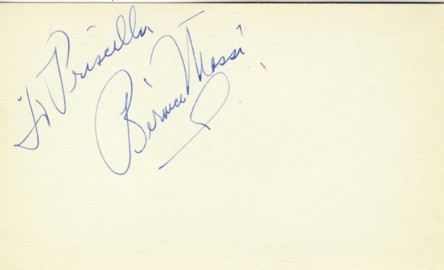
Signed photograph, 1962
TIME Magazine article about What Makes Sammy Run?
Heel’s Progress
What Makes Sammy Run? is the musical saga of Sammy Glick, who progresses, like a good heel should, from cutting corners to cutting throats. But since the book came out in 1941, something unsettling has happened to the heel; now the question is whether he should be scorned for his gall or admired for his How-to-Succeed spunk, shunned as a social leper or respected as a social dynamo. When the Sammy Clicks and Harry Bogens (I Can Get It for You Wholesale) first appeared in novels, the socio-economic climate was troubled, and heels were regarded as products of “the system,” whose hardboiled inhumanity they reflected and whose boils they were. But a healthier social order, not needing to seek someone to blame, absolves the heel of ultra-contemptibility and sees him as merely ultracompetitive. This dates Sammy more destructively than its period-piece spoofing and cigar-chomping producers. One cannot do Once in a Lifetime thrice in a lifetime.
People are consumer products to Sammy Glick, and when he has consumed enough—script writers, girl friends, studio chiefs—he reaches the projection room at the top of World Wide Studio. At musical’s end, he is faced with the topman cliché: “You’re all alone, Sammy Glick.” As Sammy, Steve Lawrence moves with the wary savage grace of a jungle cat, and when he claws, he claws. Bernice Massi, the banker’s daughter Sammy marries, matches him in velvety ferocity. In a subplot romance, Robert Alda and Sally Ann Howes seem to be going through motions rather than emotions. The two best songs in the score are sexy: A Room Without Windows (“a room without doors”) and The Friendliest Thing (“two people can do”). Too many of the lyrics sound like alliances between words that should never have met (“raison d’ètre . . . et cetera”).
Two months before curtain time, when Sammy was “in trouble” on the road, Abe Burrows was called in to direct. The Burrows touch has undoubtedly whipped up the pace and flipped up the quips, but the old play doctor was called in too late.
TIME Magazine article about How the Other Half Loves
Big Funny, Small Funny
If someone is going to put a wet diaper in your hand, pick Sandy Dennis to do it. The girl makes it seem like some sort of unpublicized honor. A delectable scatterbrain, she appears to be permanently stalled somewhere between bed and breakfast. Sandy is one of life’s winning losers. Her eyes imply that the tear ducts were installed first, and her voice box quivers with a heart broken in transit. Perhaps she is every father’s illusion of a vulnerable daughter. Count her a big funny plus in a small funny British comedy import called How the Other Half Loves.
Ditto: Phil Silvers. If someone is going to do an in-place jog in your living room in a blue sweatsuit, and rig the timer so that he won’t collapse in the middling prime of his life, then why not share the pleasure of Phil’s strenuously hilarious company? What with his toothy grin and Dennis’ prehensile incisors, the pair might be auditioning for a dentists’ convention.
The play is about that common sequel to marriage, adultery. To define it further, it is also about that common sequel to adultery—how to keep the spouse from finding out. Silvers is the cuckold. His wife (Bernice Massi) has spent part of the night with a prized employee of his. Among sexual detectives, Silvers rates on a par with Dr. Watson. Only the final curtain brings light to his cloudily creased forehead.
This is not a comedy that will incur the enthusiasm of devotees of Aristophanes, Molière, or even Neil Simon. To laugh at How the Other Half Loves is a little like making a midnight raid on the refrigerator, half ashamed but sneakingly satisfied.