Benjamin H. Wells
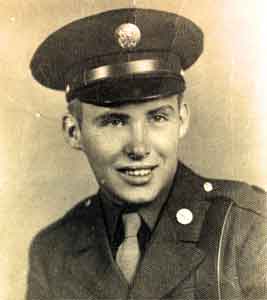
Benjamin H. Wells
Benjamin H. Wells was born October 25, 1924 in Camden, NJ to James and Hazel Wells. He attended school in Camden, NJ. His father was in the plumbing and heating business. Benjamin left school after the eighth grade and apprenticed to his father’s plumbing business, and took vocational courses at night.
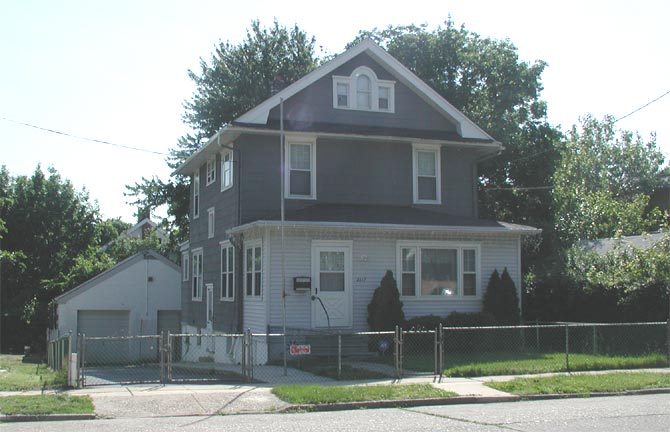
By the time the war came, the Wells family was living at 2117 44th Street in Pennsauken NJ.
P.F.C. Benjamin H. Wells — In His Own Words
I lived in Pennsauken NJ at 2117 44th Street. I was eighteen years old when I was inducted in the service on March 8, 1943 and entered March 15, 1943. That day we went to Fort Dix NJ. We were issued Army clothes and gear. We stayed there for two days. We got all our shots, and then we were put on a train and went to Fort Jackson SC to take our basic training, in the 106th Division.
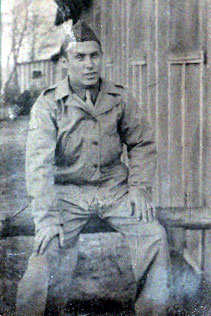
Benjamin Wells at Fort Jackson SC, May 1944
We left there and went for two days maneuvers in Tennessee. From there, we went to Camp Atterbury IN.
At that time they were calling for replacements for overseas. Some of the guys I was close with went with me to Fort Monmouth NJ and we got on a ship in New York. I was real close to Yee Toy, he is Chinese. He did not go with us; they sent him to the Pacific. The other fellow I was close to was Nick Rubino. Nick lived in Hoboken NJ. Before we got on the ship we went to see his parents and we got back just in time to leave on the ship, the Mauritania. We went by the Statue of Liberty, it was the first time I ever saw it.
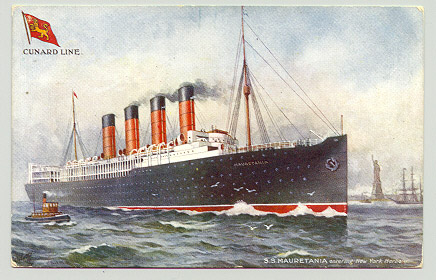
The SS Mauritania at New York Harbor
We picked up a destroyer escort for two days and then we were on our own. We were seven days crossing the Atlantic Ocean. We left on 18 Sept 1944 and got there 25 Sept 1944, in Liverpool, England.
As we were leaving the ship, there were officers from the 101st Airborne Division wanting volunteers, so Nick Rubino and I joined them. We wanted to be with a good outfit and not as replacements. We then took two months airborne training jumping out of C-47 airplanes. Nick and I packed our first parachutes, and I was an assistant machine-gunner. I jumped 18 times in training.
We completed our training and we flew to the French coast. We were waiting for our orders. One morning at three o’clock they woke us to go to the front line where the Battle of the Bulge was taking place in Bastogne, Belgium. We could not fly because of bad weather. We were loaded on open tractor-trailers and taken to the front.
We moved to within two miles of the front and went in on foot. We found out that the 106th Division, which I was in back in the states where I took my training, was there getting beat terribly. It was hell, snow was deep and we had trouble getting supplies because the weather was bad. On Christmas Day, 25 December, we did get some Xmas rations. We one time killed a rabbit and ate it.
On January 3rd, our squad was ordered to take over an area of woods where the Germans were. We took it over and held it for three hours. We were attacked by three German tanks and soldiers. We could not get out, and there were only three of us left. We had no more ammo to fight with.
We were captured and taken back to the German camp to be interrogated. I carried a small Bible testament. The German officer asked what it was. I told him and he gave it back to me.
We then were taken by truck for four hours, and then had to walk for three weeks with guards changing every town we went through. They did not feed us. When the guards would eat they would scrape together what they had left in a pile, mostly it was potato skins. In one town we had to stop and work in a bakery loading bread into a warehouse. We then were loaded on to boxcars with a lot of prisoners. They gave us a small piece of cheese and bread. They did not open the doors for five days. We moved at night. We were unloaded and walked one day to where the prison camp was at. The camp was Stalag IVB at Mulberg, Germany. There were 70,000 in the camp, Americans, British, Dutch, Canadians, and Russians.
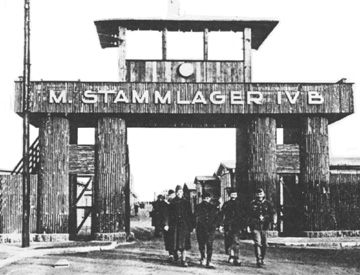
Stalag IVB, Mulberg, Germany
I was put in with the British soldiers, that were captured in the Africa campaign. We were fed a piece of bread and cheese and a bowl of grass soup a day. I was 97 lbs when the Russians liberated us.
We were told not to leave because the war was still going on. Later on we moved to a town in Germany called Halle. The Russians fed us and gave us medical treatment. We had to sign a record book to be taken to the U.S. government.
We left there on our own and U.S. trucks picked us up. A week later we were taken to Le Havre, France by plane. We stayed there for three weeks and then boarded a ship to come home. Again seven days to get to New York, where we were then taken to Atlantic City to hotels which were used as recovery hospitals.
After recovery I was sent to Fort Benning GA and finally discharged 30 Nov 1945.
Some of the British soldiers I still keep in contact with. Yee Toy I still hear from. As for Nick Rubino, I do not know how to locate him, he lived in Hoboken NJ.
P.F.C. Nick Rubino — Army Serial # 32764654 — Co D 501 Parachute Infantry — APO 472 c/o Postmaster NYC, NY
Pencil Sketch at Stalag IVB
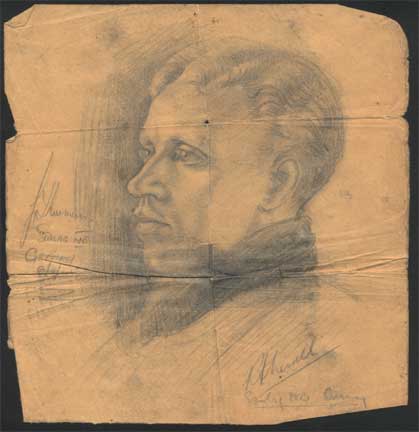
This pencil sketch was made while at Stalag Luft IVB, by a fellow POW.
Welcome Home
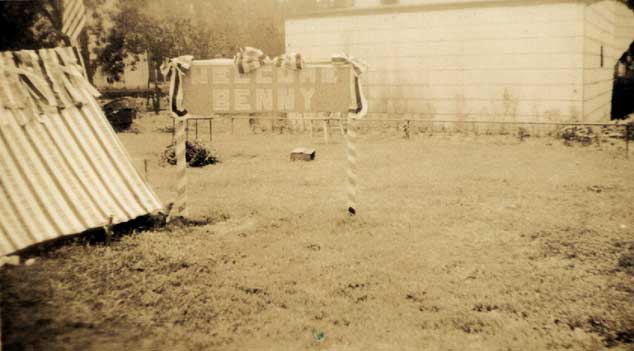
Welcome home
After the War
After being discharged from the Army, Benny Wells returned to Pennsauken and the family plumbing and heating business, from which he retired in 1988. He married Erna Woerner in 1949. They have two sons, three daughters, 11 grandchildren, and two great-grandchildren.
Mail Call — Letters Home
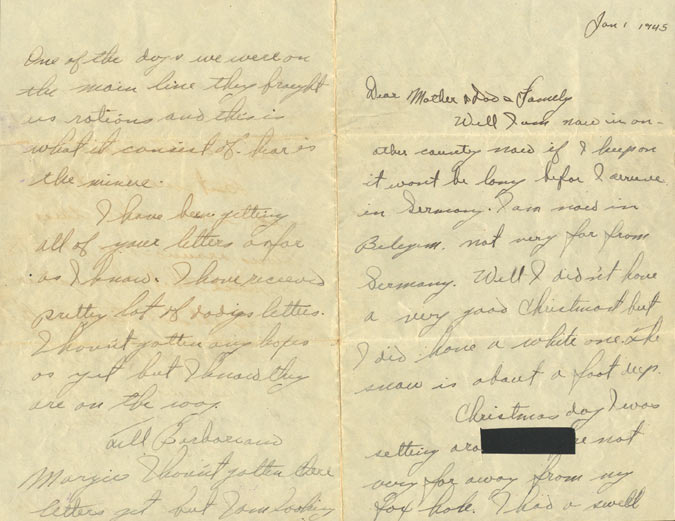
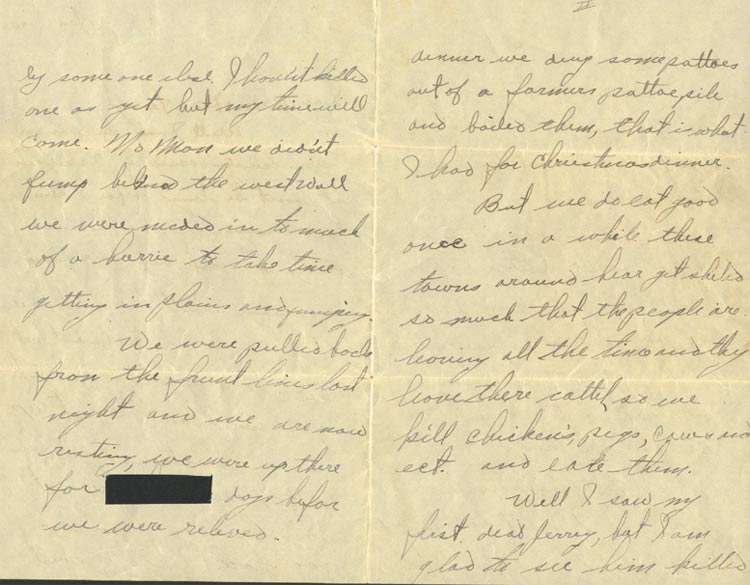
Letter home, written from the front, dated January 1, 1945
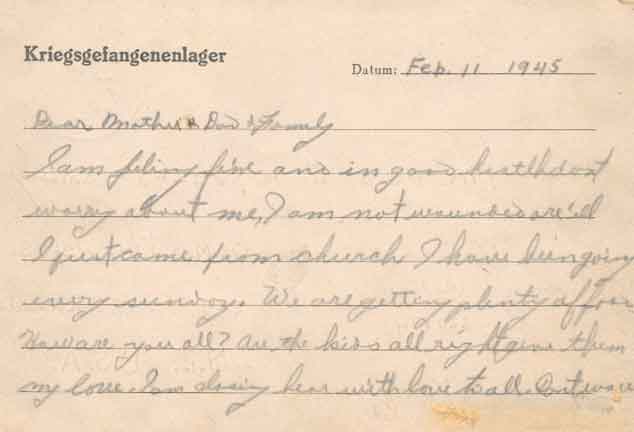
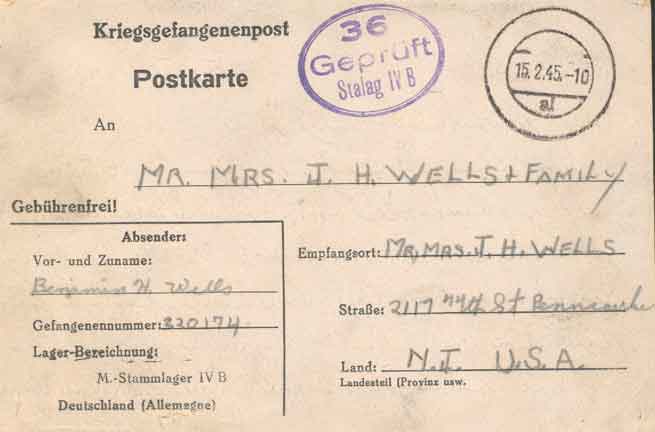
Letter home, written from Stalag Luft IVB, dated February 11, 1945
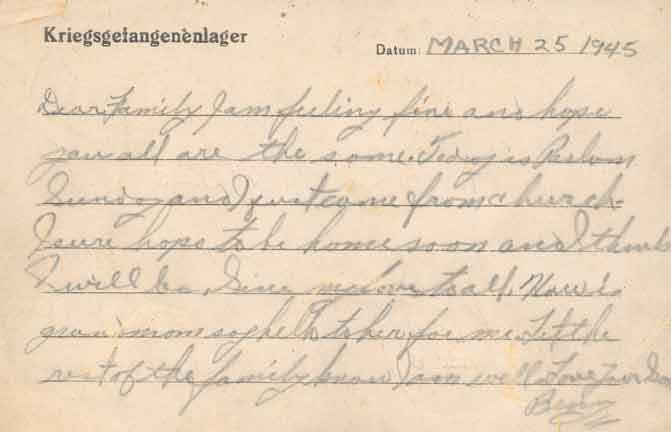
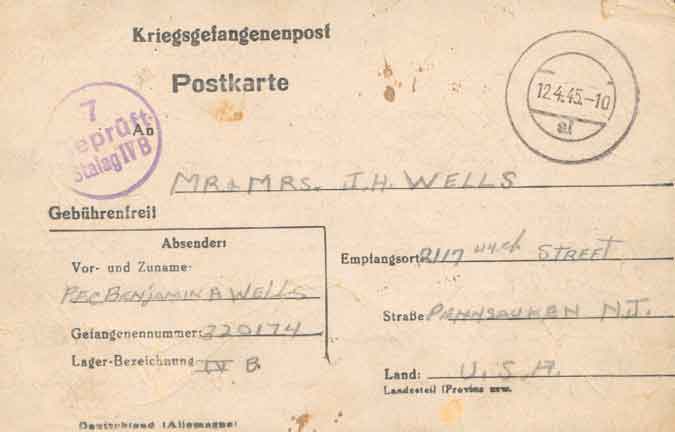
Letter home, written from Stalag Luft IVB, dated March 25, 1945
Friends
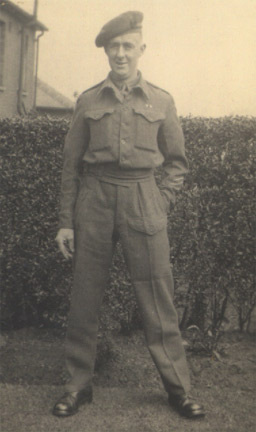
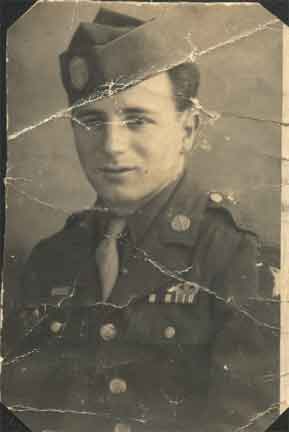
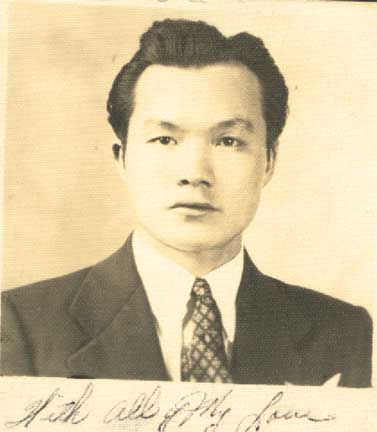
Friends: Jack; Nick Rubino, Hoboken NJ; Yee Toy in 1946
POW Camp Identification Card
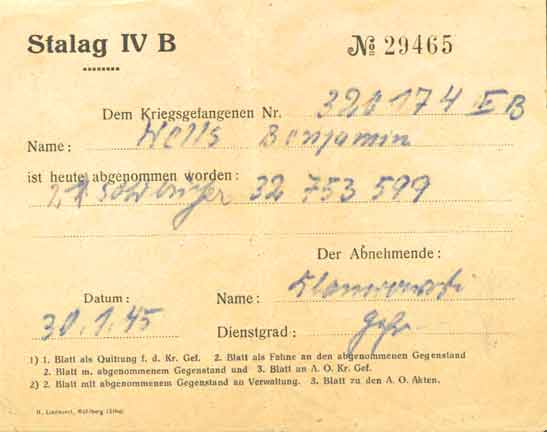
Benjamin Wells — POW Camp Identification Card