Allen H. Middleton
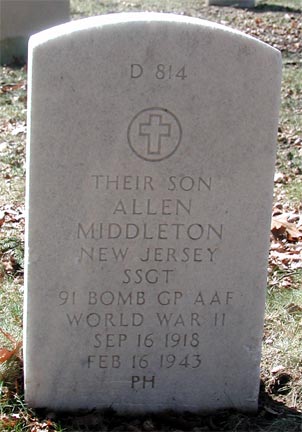
Allen H. Middleton
Rank: Staff Sergeant, U.S. Army Air Force
Serial: 12011018
Unit: 324th Bomber Squadron, 91st Bomber Group, Heavy
Entered service from: New Jersey
Died: , Saint-Nazaire, France
Burial: Beverly National Cemetery, Beverly, NJ
Awards: Air Medal, Distinguished Service Medal, Silver Star, Purple Heart
Biography
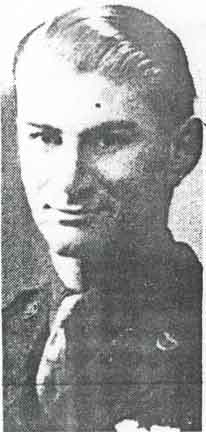
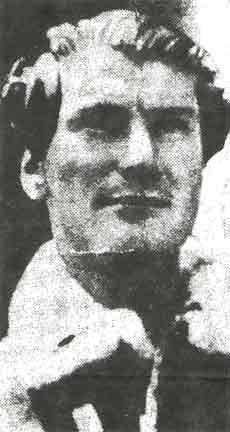
Allen H. Middleton
Staff Sergeant Allen H. Middleton was born on September 16, 1918 to Horace Cooper Middleton and Adeline Schulle Middleton. His father had served in World War I as a private in Company F, 60th Infantry Regiment, 9th Infantry Division and was a former employee of the Philadelphia Bulletin and the New York Shipbuilding Corporation. The oldest of eight children, he was a 1936 graduate of Woodrow Wilson High School, in Camden NJ. A fine athlete, he played on the Camden Eagles baseball team. The family lived at 808 Penn Street, in Camden NJ. Allen Middleton had worked at the Kieckhofer box factory in the Delair section of Pennsauken NJ before he enlisted in the Army.
Allen Middleton enlisted in the Army on December 8, 1941—the day after Pearl Harbor. He qualified for flight duty, and served as a radio operator and gunner in the 324th Bomber Squadron, 91st Bomber Group, flying in a B-17 Flying Fortress bomber.
A charter member of the 324th Bomber Squadron, he was wounded on the third mission, a raid against the submarine pens at St. Nazaire, France on November 8, 1943. He spent four months in a hospital in England. For actions on this raid, he had received the Purple Heart, Silver Star, and the Distinguished Service Medal.
Shortly after returning to active duty, Staff Sergeant Allen Middleton was killed in action when his plane was hit by a 20mm shell during another raid on St. Nazaire, on February 16, 1943. His father had been stationed there for a time during the First World War.
Allen Middleton was brought home after the war, and he was buried at Beverly National Cemetery in Beverly NJ, on July 23, 1948. He now rests near his father and his mother. He was survived by his parents and siblings Jeanne, Roland, Marion, Dolores, Richard, Harry, and William. His death was reported in the March 6, 1943 edition of the Camden Courier-Post.
60 Years Ago from the Official Dailies of the 91st Bombardment Group (H)
November 7, 1942 (Saturday)
The 91st Group participated in its first operational mission against the enemy today. The target was Brest. Only two squadrons, the 322nd and 324th, furnished aircraft for this target. The 91st was one of three groups to participate. Fourteen aircraft were dispatched. A briefing was held shortly before 5 a. m. and the planes took off between ten-twenty and ten-thirty. Of the 14 dispatched, six returned early because of gun and other mechanical failures. The results of the bombing were difficult to observe because of heavy broken cloud formations over the target. Eight aircraft dropped 80 x 500 lbs. GP bombs, and preliminary reports indicate that at least a good many of these were in the general vicinity of the aiming point. All aircraft returned to this base without loss and the Group was very fortunate in that no casualties were suffered. Several enemy aircraft were seen, some of which made desultory attacks upon the formation. Several of our aircraft suffered minor battle damage. Claims against enemy aircraft are one destroyed, two probably destroyed, and none damaged. The 323rd and 401st Squadrons were scheduled to fly a practice mission, which took place according to schedule. Chemical Warfare and some other classes were held for ground personnel and combat crews not flying. However, the general excitement resulting from this first operational sortie reduced attendance at these classes to a small fraction of what it should have been.
The success of today’s mission and the general improvement in the weather have contributed to raise the morale of the personnel of this station above its usual high plane.
323rd Squadron Daily
323RD BOMBARDMENT, STATION 121 November 1942 — PREPARED BY Capt. Alexander H. Bright
Day 7
On this date the first operational mission against the enemy was carried out by the 91st Bombardment Group (H). The total effort was fifty-six (56) Fortresses of which our Group supplied fourteen (14) ships from the 322nd and 324th Bombardment Squadrons. Lt. John H. Roten, participated as Navigator for one ship, and S/Sgt. Steven J. Perri, participated as Ball Turret Gunner and assistant aerial engineer on another ship. No ships or complete crews of this Squadron participated in this mission. Objective was the enemy Submarine Base at Brest, in occupied France.
Lt. Col. Stanley T. Wray, Group Commander, was leader of this Mission. Results: Because of scattered clouds, which partly obscured visibility of target, the results were not observed. However, photographs of the targets reveal that considerable damage was done.
Day 8
Four (4) ships and complete crews of this Squadron participated in Bombing Mission against an enemy Airdrome and Dispersal Area at Abbeville, in Occupied France. Strong enemy pursuit was encountered and Flak from enemy A. S. was heavy. However, our bombers were escorted by a Squadron of Spitfires, which aided materially in protecting them from the enemy pursuit planes. This was what is known as a Diversion raid, the main attack being against the enemy Locomotive and Steel Works at Lille, in occupied France. Lt. Everett L. Clinard Jr. was quite seriously wounded, and was hospitalized immediately after landing. Lt. Lyle G. Karnath, Bombardier, was seriously wounded, being hospitalized immediately after landing, due to wounds received on account of Flak. Lt. Clinard was a Navigator and Lt. William M. Anderson was his pilot. Their ship was severely damaged, and Lt. Eugene B. Ellis, Pilot of another ship, seeing Lt. Anderson lose formation, dropped back to aid him and escorted the injured ship and crew safely to the home base. The enemy, doing his best to bring this ship down, failed on account of the skill and teamwork of our crews. Clouds made observation of results of this mission difficult. S/Sgt. Howard, flying in ship #589, was officially credited with destroying one (1) enemy plane, FW-190.
Day 9
As part of an effort of forty-four (44) ships, thirteen (13) from the 91st Bombardment Group (H), two (2) ships and complete crews of this Squadron, pilots Lt. Charles R. Giauque and Lt. Martin W. McCarty Jr., participated in a Bombing Mission against Enemy Submarine Docks and Pens at St. Nazaire, in occupied France. Due to our skill in making approach to vicinity of target, the enemy was taken by surprise and failed to get his pursuit planes in action against us. However, Flak from the ground defenses was quite heavy. A shell exploded in Bombardiers Compartment of Lt. McCarty’s ship, fatally wounding Lt. Louis B. Briglia, Bombardier, who expired during the night after ships had returned to their Base. He rec’d the first Purple Heart Medal in the 91st. Sgt. William W. Dunnavant was severely wounded in action and his ship severely damaged. Ships landed at Exeter, Southwest England, for purpose of refueling. Mission was quite successful.
Transcribed by Nancy Perri 2/26/03
November 8, 1942
The second operational mission of the 91st Group was flown today. This mission was somewhat different than that of yesterday. The 91st Group made a single-handed diversion attack upon the enemy airdrome at Abbeville, while the other groups carried out the main attack upon Lille. The briefing for the mission took place at seven-forty-five, and the 15 aircraft took off shortly after one o’clock. Of this number, five returned early for gun and other mechanical failures. The ten aircraft which attacked the target were escorted by five squadrons of Spitfires. During the course of the attack, all of our aircraft received some battle damage. Two received severe damage and had to be sent to the service squadron for extensive repairs. 100 x 500 lb. GP bombs were dropped and many hits were observed by combat crew members on the aiming point. The results of the bombing were very good. The following is a list of the casualties suffered by the Group:
Haley W. Aycock, Capt, Pilot — Serious Wound, 401 B. Sq.
Everett L. Clinard, 2nd Lt, Navigator — Serious Wound, 323 B. Sq.
Lyle G. Karnath, 2nd Lt, Bombardier — Serious Wound, 323 B. Sq.
Maurice W. Knutson, S/Sgt, R.W.G. — Serious Wound, 324 B. Sq.
Jerald H. Jones, Sgt, L.W.G. — Slight Wound, 324 B. Sq.
(R.W.G. = Right Waist Gunner; L.W.G. = Left Waist Gunner)
November 9, 1942
The 91st Group participated in a medium-level bombing attack on submarine pens at St. Nazaire, France. The tactics employed were somewhat different from those flown previously. The Group flew most of the mission at an altitude of approximately 500 feet, climbing to between 8,000 and 9,000 feet just in time to commence the bombing run at that altitude. Another formation of approximately 21 aircraft flew the entire mission at between 20,000 and 22,000 ft. The object of the low-altitude mission by the 91st Group was to surprise German RDF installations, but there is some question as to whether this object was accomplished. However, some of the combat crews report that the German anti-aircraft gunners were fooled and that when the bombing run was begun by the group’s formation they were flashing recognition signals at the formation. This indicates that they were not certain of the identity of the aircraft of this Group until after the bombing run had been begun. The attack was very successful and many hits were observed in the target area. Fourteen aircraft were dispatched on this mission, only two of which failed to attack the target. 65 x 1,000 lb. GP bombs were dropped. The formation took off at approximately 1015 hours and was over the target at approximately 1400 hours. This is the first operational mission in which aircraft from all four squadrons participated. All but one of the aircraft participating in this mission received considerable battle damage. Following is the list of casualties:
Robert B. Bowcock, 2nd Lt, Navigator — Slight Wound, 322 B. Sq.
Louis B. Briglia, 2nd Lt, Bombardier — KIA, 323 B. Sq.
Norman Bryant, 2nd Lt, Bombardier — Slight Wound, 322 B. Sq.
Linden W. Cockran, 2nd Lt, Navigator — Serious Wound, 322 B. Sq.
Herbert E. Fisher, S/Sgt, W.G. — Slight Wound, 401 B. Sq.
Allen Middleton, S/Sgt, W.G. — Slight Wound, 324 B. Sq.
Charles D. Wright, S/Sgt, W.G. — Slight Wound, 324 B. Sq.
Andrew H. Burnett, Sgt, T.G. — Serious Wound, 322 B. Sq.
William W. Dunnavant, Sgt, W.G. — Slight Wound, 323 B. Sq.
Carson C. Richardson, Sgt, W.G. — Serious Wound, 322 B. Sq.
Roslyn C. Richardson, Sgt, W.G. — Slight Wound, 324 B. Sq.
Rufus W. Youngblood, Cpl, W.G. — Slight Wound, 324 B. Sq.
(T.G. = Tail Gunner; W.G. = Waist Gunner)
There seems to be some difference of opinion about the tactics used in this mission. It has just been learned that another Group which bombed at the same altitude lost three aircraft. The combat crews, in their own conversations, are very critical of the general idea of bombing at such a low altitude.
16 February 1943
Last night the 91st Group was alerted to prepare for another mission to St. Nazaire. Preparations for the mission were completed early in the morning. The combat crews were awakened at 0345 hours, and briefing was held at 0430 hours. Eighteen aircraft of the Group took off at 0830 hours and bombed the target just before 1100 hours. Weather conditions were ideal throughout the entire mission. A few low clouds were encountered over the English Channel and over the northern coast of France, but visibility was unlimited over practically all of England and in the whole of the target area. Five aircraft of the 91st Group returned early because of mechanical failures, but the remaining 13 flew on and dropped twelve 1,000-pound bombs with more devastating effect than they had on almost any previous mission. At least six bombs from the 91st formation fell within 50 feet of the pinpoint target and additional bombs fell within a circle of 1,000 feet in radius.
Accurate heavy anti-aircraft fire was experienced in the target area and one aircraft received major battle damage and seven received slight battle damage. Attacks were also carried out by between 25 and 30 enemy aircraft, but fortunately a majority of these were concentrated upon the other three groups attacking the same target. The 91st Group was credited with officially destroying five enemy aircraft and probably destroying two others. Lieutenant Brill, of the 324th Squadron, was the only aircraft in the 91st formation to receive any consistent attacks. Staff Sergeant Middleton, who was killed in action, was the only serious casualty of the group. Two other combat crewmembers of the Group were wounded during the mission. It was indeed a lucky day for the 91st formation, inasmuch as each of the other three groups lost two aircraft during this mission.
The return of the Group formation to Bassingbourn was accomplished without any difficulty whatever, and all aircraft returned together at approximately 1400 hours. All combat crews who completed the mission reported that it could have been much worse, especially in view of the punishment, which was inflicted upon the other three groups. The consensus of the officers who participated in the mission was that the tight formation maintained by the 91st aircraft was responsible for the fact that the German fighter pilots made only seven attacks on the Group during the course of the entire mission. They reported that several of the aircraft, which were shot down, became easy victims of attack when they straggled from their formations. Combat crewmembers also reported that this was the first time during which they observed German fighter aircraft using aerial bombs against Fortress formations. The fighter escort which was supposed to have accompanied the bombers during this mission either failed to meet its appointed rendezvous or else these fighters remained so far in the distance that they were not observed by the participating combat crew members. The success enjoyed by the Group on this mission went a long way towards boosting the morale of practically everyone out of the depression into which it had fallen during the past ten days. The combat crews were enthusiastic about the success, which they had attained on the mission and the ground personnel were soon to catch the infection of this wholesome reaction.
Army Rites Friday For Sgt. Middleton
Camden Courier-Post —
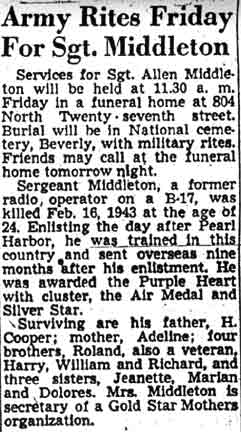
Services for Sgt. Allen Middleton will be held at 11.30 a. m. Friday in a funeral home at 804 North Twenty-seventh street. Burial will be in National cemetery, Beverly, with military rites. Friends may call at the funeral home tomorrow night.
Sergeant Middleton, a former radio operator on a B-17, was killed Feb. 16, 1943 at the age of 24. Enlisting the day after Pearl Harbor, he was trained in this country and sent overseas nine months after his enlistment. He was awarded the Purple Heart with cluster, the Air Medal and Silver Star.
Surviving are his father, H. Cooper; mother, Adeline; four brothers, Roland, also a veteran, Harry, William and Richard, and three sisters, Jeanette, Marion and Dolores. Mrs. Middleton is secretary of a Gold Star Mothers organization.
Photos
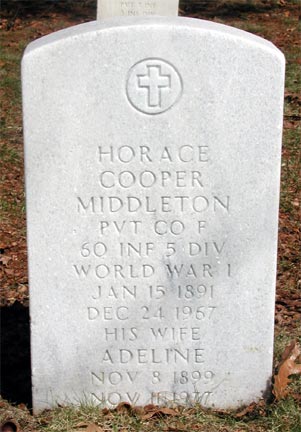
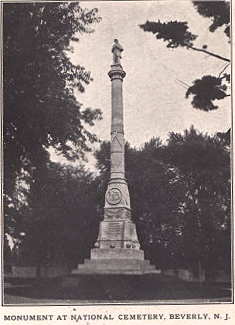
Beverly National Cemetery, Beverly, NJ — Allen H. Middleton