Congregation B'nai Abraham
Camden is well known for its ethnic communities. The large Polish, Italian, Irish, German, and Jewish communities played a great role in Camden's history in the 19th and first part of the 20th century, while Black and Puerto Rican families have given the city much of its recent flavor. There are other, lesser known ethnic groups that have made up the fabric of the city's life over the years. Greeks, Armenians, and Ukrainians grouped together in the city in Camden's growth years. More recently, Mexicans, Vietnamese, Jamaicans, Dominicans, Haitians, and Koreans have come to the city to live and seek the American dream.
Congregation B'nai Abraham, best remembered as the Lichtenstein shul, was, depending on who one hears the story from, either the first or second synagogue organized in Camden. Its main patron was Abraham (Avram) Lichtenstein, whose family had a successful business around the corner on the 300 block of Kaighn Avenue. Mr. Lichtenstein, who lived on South 4th Street, south of Kaighn Avenue, procured a rowhouse at 335 Liberty Street and had it converted into a small synagogue in the 1890s. As there were a good number of Jewish families in the immediate area … roughly from Mechanic to Chestnut Street between South 2nd and Broadway … the synagogue filled the immediate needs of the local residents. Another congregation, Sons of Israel, came together on the other side of Broadway. Neither had a full-time rabbi in the early years. Rabbi Louis Segal was the community rabbi during the 1900s and through most of the 1910s. Rabbi Naftali Riff came to Camden in the late 1910s and by September of 1918 was leading Congregation Sons of Israel, who soon had moved to South 8th and Sycamore Street, gaining the name “Eighth Street shul.”
Even though most of the Jewish families that were originally part of Congregation B'nai Abraham had moved to Parkside and elsewhere by the 1950s, the synagogue was still operating at the end of the decade as “Congregation Shomra Sabbath, Sons of Abraham.” Further loss of membership and crime put an end to the synagogue. In December of 1967 the property at 335 Liberty Street was sold to Congregation Sons of Israel in Parkside, who in turn sold it to a private party in September of 1968. There still were a few Jewish families in the neighborhood in 1969, who then attended services elsewhere. In a few short years they, too, had left and so had Congregation Sons of Israel.
The building itself at 335 Liberty Street was used as a church for many years. In recent times the church that was housed there disbanded, and the building was used as a residence. On August 28, 2009 at 6:00 AM, a fire was reported. Units of the Camden Fire Department under the command of Battalion Chief Edward Glassman responded and quickly put the blaze out, but not before the old synagogue and the home next door at 337 Liberty Street were badly damaged. Fortunately, no one was badly hurt, although one person escaped the fire by jumping out of a second-floor window.
On this page you will find a number of articles and accounts written about Congregation B'nai Abraham also known as the Lichtenstein shul. There are some discrepancies between what was written from memory and the documented record as to what actually was, most notably in the address of the synagogue.
Photos
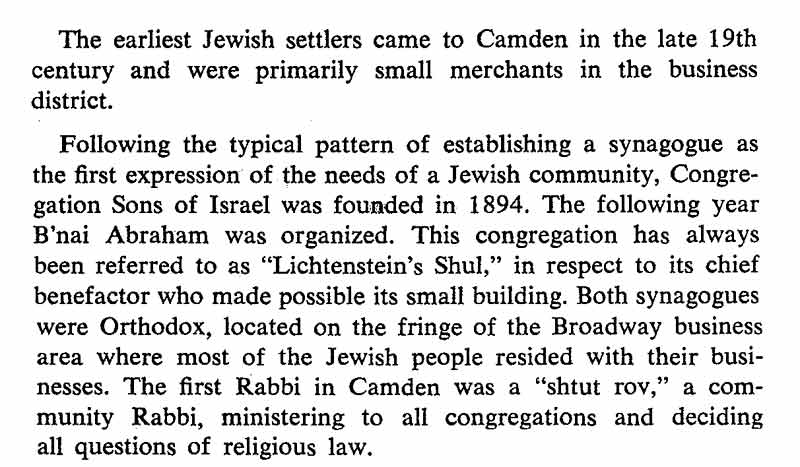
The earliest Jewish settlers came to Camden in the late 19th century and were primarily small merchants in the business district.
Following the typical pattern of establishing a synagogue as the first expression of the needs of a Jewish community, Congregation Sons of Israel was founded in 1894. The following year B'nai Abraham was organized. This congregation has always been referred to as “Lichtenstein's Shul,” in respect to its chief benefactor who made possible its small building. Both synagogues were Orthodox, located on the fringe of the Broadway business area where most of the Jewish people resided with their businesses. The first Rabbi in Camden was a “shtut rov,” a community Rabbi, ministering to all congregations and deciding all questions of religious law.
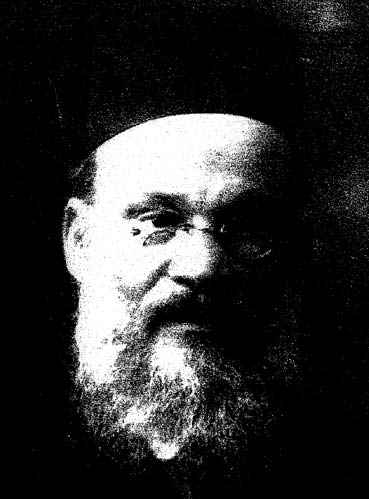
Rabbi Louis Segal — circa 1910
The First Synagogue in the Greater Camden Area
Harriet Lichtenstein Ostroff, as told to Milton R. Asbell
Note: This article refers to 312 Liberty Street, which is an error. The address was 335 Liberty Street.
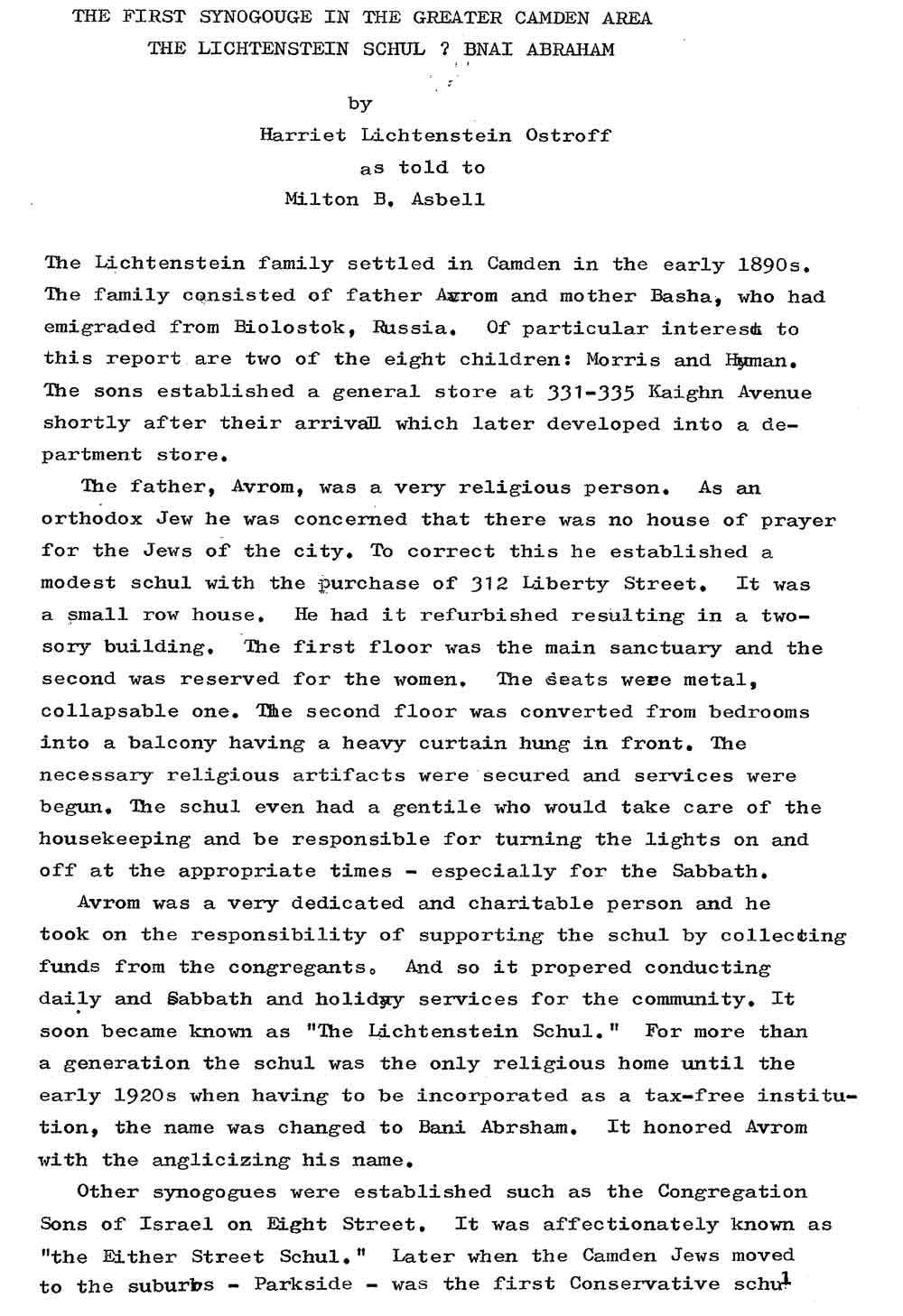
The Lichtenstein family settled in Camden in the early 1890s. The family consisted of Avrom and mother Basha, who had emigrated from Bialestok, Russia. Of particular interest to this report are two of the eight children: Morris and Hyman. The sons established a grocery at 312 Kaighn Heights shortly after their arrival which later developed into a department store.
The father, Avrom, was a very religious person. As an orthodox Jew he was concerned that there was no house of prayer for Jews of his faith in this area. He established a modest shul with the purchase of 312 Liberty Street. It was a small row house. He had it refurbished resulting in a two-story building. The first floor was the main sanctuary and the second was reserved for the women. The seats were metal, collapsible ones. The second floor was converted from bedrooms into a single room for the women's services. The necessary religious artifacts were secured and services were convened. Mr. Lichtenstein retained a woman to do all of the housekeeping and be responsible for turning the lights on and off at the appropriate times — especially for the Sabbath.
Avrom Lichtenstein became its patron and supporter. It took on the responsibility of supporting the schul by collecting funds from the congregants. And as it prepared conducting daily services, holding Sabbath services and special holidays, it soon became known as “The Lichtenstein Shul.” For more than forty years it functioned as a synagogue. In the early 1920s when having to be incorporated as a tax-free institution, the name was changed to Bnai Abraham. It honored Avrom who had passed on by this time.
Other synagogues were established such as the Congregation Sons of Israel on Eight Street. It was affectionately known as the “Eighth Street shul.” Later a third Jewish congregation moved to the suburbs — Parkside — as the first Conservative schul.
Additional Accounts
Note: These accounts refer to 312 Liberty Street, which is an error. The address was 335 Liberty Street.
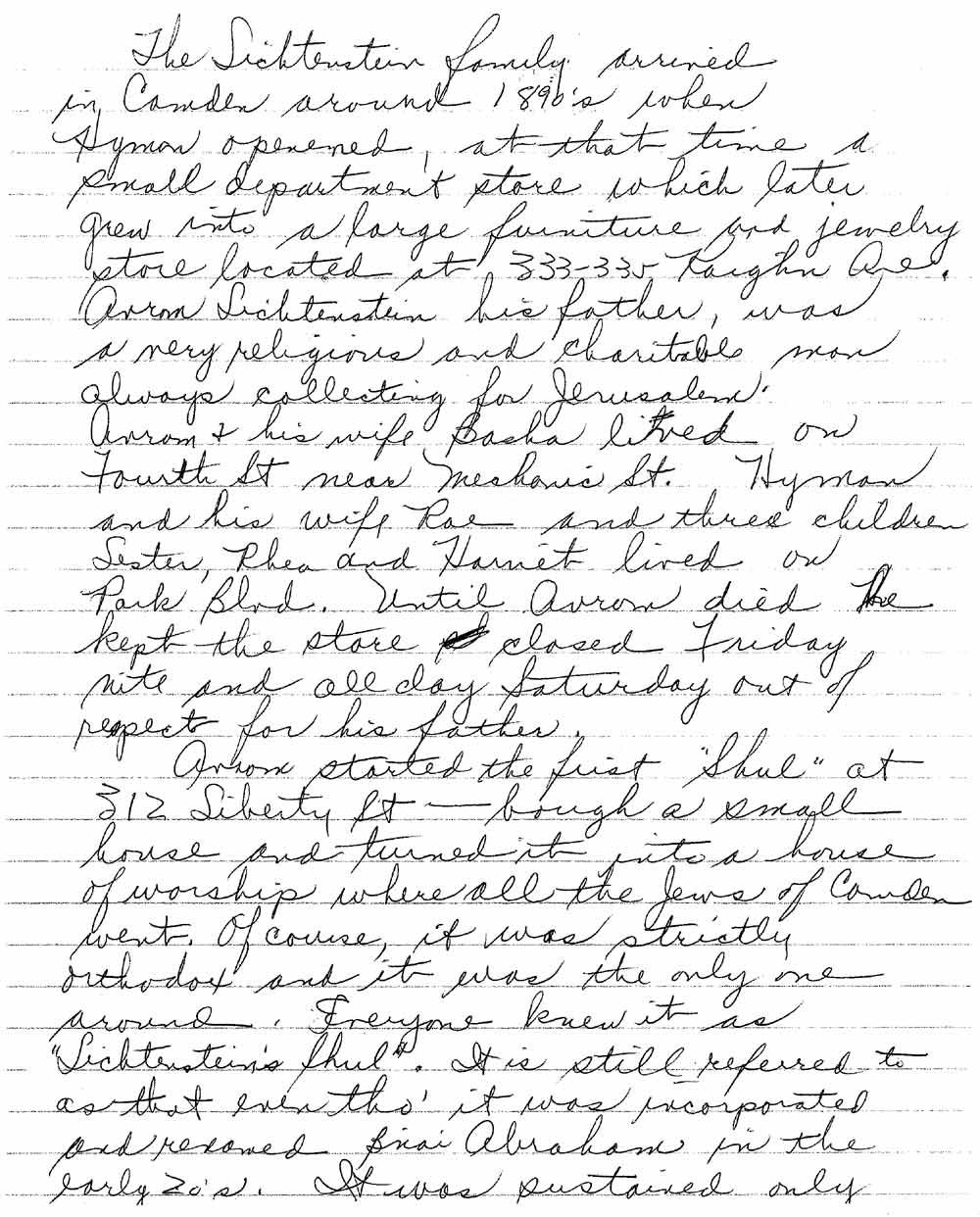
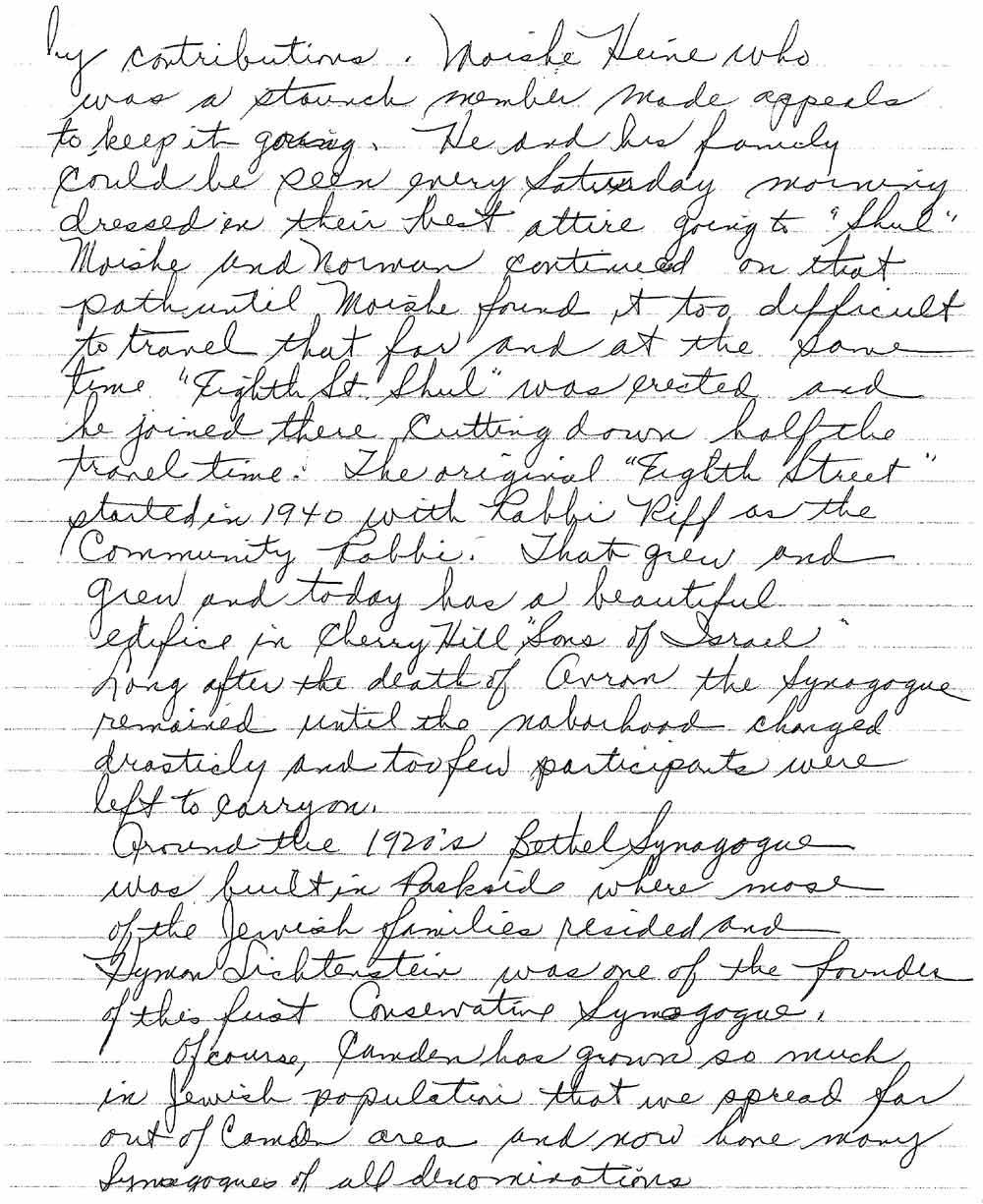
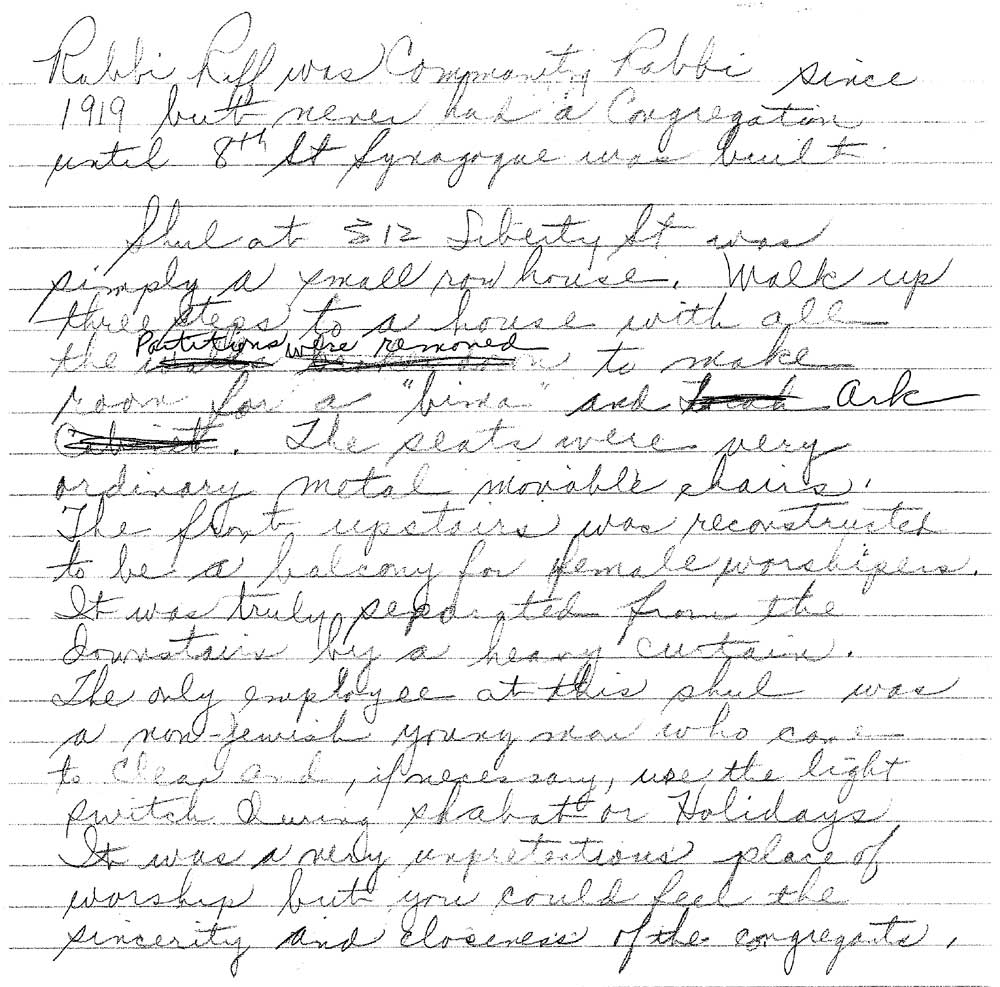
Handwritten accounts of the Lichtenstein family and Congregation B'nai Abraham