|
Trespass Against Them
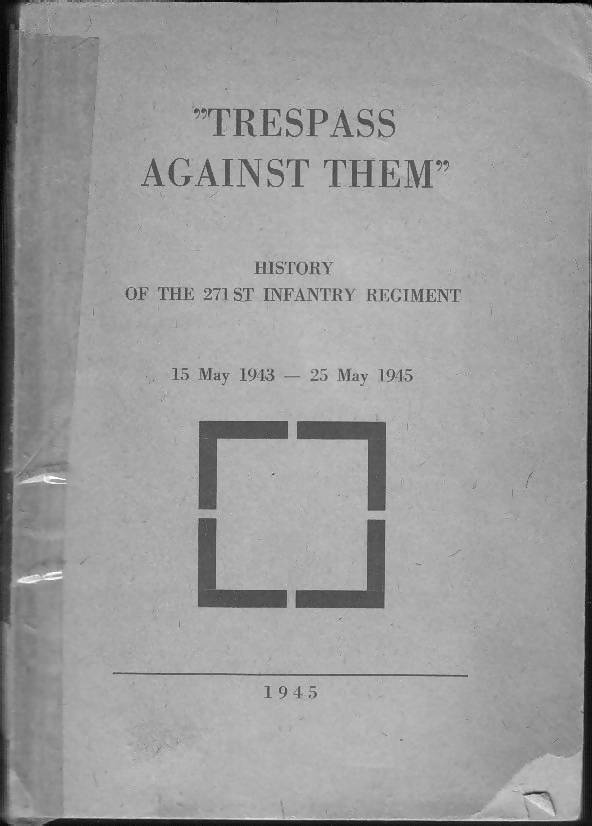
History
of The 271st Infantry Regiment
Written
by Lt. John F. Higgins, 2nd Bn, wherabouts unknown.
A
copy of "TRESPASS AGAINST THEM" as printed in Germany in
1945 and issued to 271st INFANTRY REGIMENT members is no longer
available to our knowledge. The
Unit History here is the Text portion only from "TRESPASS AGAINST
THEM" covering about 25 pages.
Casualties, Decorations, Command Post Locations, Towns
and
cities captured, Statistics, Leaders and Units Attached bring the
total pages to 92.
This
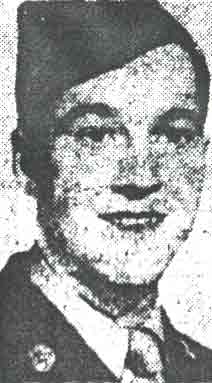
booklet is reprinted here up to the date of PFC Gartland's death. It
can be read in its entirety at https://www.69th-infantry-division.com/histories/271.html.
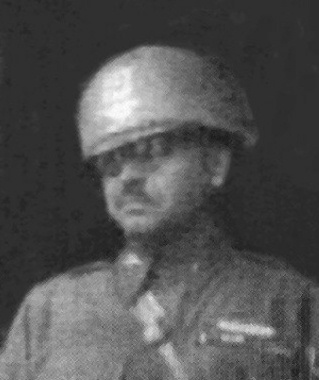
Col. Henry B. Margeson
Regimental Commander
271st Infantry Regiment
Preface
This
history of the 271st United States Infantry is respectfully dedicated
to Major General Emil F. Reinhardt, Commanding General of the 69th
Infantry Division.
On
these pages is the history of an infantry regiment of particular
interest to us since it is our own, the 271st Regiment of the Fighting
69th Division. A history
often leaves much to the reader�s imagination in its necessarily
brief mention of persons, places and events, especially when the
reader has had so vital a part of its making.
Your memory, which can never be left behind, will fill in the
details that are not inscribed on these pages.
To
all of us, it is a story of years, places, events, hard work, good
fun, comradeship, common cause, individual and collective courage,
danger, and hard-won success; in short, a summation of the efforts of
a group in the cause of a nation.
It tells of the men you knew; men from every state of the
Union, every walk of life, participating in the accomplishment of an
enormous undertaking, nourished by a glorious national tradition,
bonded together in the sublimity of their purpose.
It is typical of the annals of any group of our Armed Forces in
that it portrays a part of the courage, the initiative, the ability,
the tenacity that our enemies failed to take into account when they
labeled us �soft and decadent.�
The
important thing about it to us is that it represents a part of the war
that we know first-hand, the part that will live with us long after
Time has obscured the full magnitude of operations.
It tells why, in future years, when people speak of the war as
a tremendous undertaking, anyone who has been a member of this
regiment may proudly say: �Yes, I know!�
Good
luck, soldier!
On
15 May 1943, a new division, the 69th, was activated at Camp Shelby,
Miss. One of its
regiments, the 271st, was born the same day, and this is its story to
date. Every soldier, no
matter what his present desire, Army career or civilian life, will
long remember the outfit with which he went to war.
Perhaps these are some of the things that will come to your
mind at the American Legion Convention many years hence, when someone
asks you what outfit you were in.
Camp
Shelby, Mississippi! Who
will ever forget it? That
place could get so cold in the winter and so hot in the summer!
For over 17 months, we lived and trained there, among the woods
and chiggers, in the dust and mud of good old DeSoto National Forest,
until many began to think that all the world was Mississippi, and that
Hattiesburg was the capital of the world.
You could get a good steak in Hattiesburg for about three
dollars and a quart of blood, and living space was adequate if you
were lucky enough to have a trailer or a tent.
�The
69th will never leave Shelby!�
Remember? That
byword must have been put out by the Hattiesburg Chamber of Commerce
to give its citizens some good excuse for living there!
It reminds you of the man who kept saying to the end: �They
can�t do this to me!�
It
is a proven fact that no division in the Army got more or better
training than we did. A
great many of our officers and men have been with the outfit since it
was activated. But who is
there among us who can forget how we got that old B.B.B. nickname?
It seemed that you�d just about be getting used to sleeping
in a bunk, and your chigger bites would be healing a bit, when someone
would announce that we were getting �garrison bound,� and off
we�d go to the woods again. Oh
well, in the light of later developments, we were grateful for the
experience we�d had.
The
time spent in Shelby netted us many lasting friendships and pleasant
associations. Also not to
be overlooked is the fact that the �Southerner� ran through
Hattiesburg, and there was always New Orleans.
Remember?
It
was on 31 October 1944 that we crawled out from under a mountain of
equipment and sank down in a Pullman chair for a last look at Camp
Shelby. Reactions to the
parting were mixed and varied. There
were those who had been there so long that they would actually miss
such landmarks as Lake Shelby, Highway 49, O.P. 5, Whiskey Creek, the
red-scarred hill, and the �lone pine tree.�
Some welcomed the move, as the start of a new adventure, the
culmination of our extended training.
There would be no more �D� Series, no more Biloxi Bounce,
nor Hattiesburg bus lines. This
was the point at which we were to start the long trek to a fighting
front.
But
where were we going? The
Pullman porter knew, but like all railroad employees, he was the
vaguest source of information, and there remained only the usual
unimpeachable channels of latrine rumors.
It wasn�t long, however, before word started spreading from
car to car that we were doing the �Jersey Bounce!�
The Yankees in the crowd started immediately to expound on the
merits of New Jersey, with assurances to all who had never been there
that they were now to see how the �other half� lived.
It was true. We
were on the way to Camp Kilmer, near New Brunswick, and the prospect
was thrilling to those lucky individuals who happened to live in the
vicinity. The trip was
pleasant, with the usual troop train diversions.
Some played cards, others sat and talked; some just sat.
The food was good, and the Pullman bunks were clean and
comfortable.
The
first group of the regiment arrived at Kilmer early the morning of 2
November, and all during the day, the balance of the command arrived.
To the accompaniment of some lively music, we marched to the
two-story barracks that were to be our home for the next few days.
Almost immediately began the overseas orientation schedule, and
it was amazing to note the efficiency with which the many details were
accomplished. Remember
the cargo nets, the lifeboat drill, the lectures on censorship, the
procedure in case of capture, the introduction to the Army�s new
type of gas mask, etc.? Or
who will forget that physical exam, where they passed you by an
electric bulb, and if they couldn�t see through you, the seal of
approval was put on your forehead, the equivalent of a free ticket for
an ocean trip.
Of
the many good features of Kilmer, its most appealing was its proximity
to New York, just 20-odd miles away.
Remember those passes to the big city?
Time Square, the Village, the Music Hall, and the way you
skidded through the gates in Penn. Station for that 5 a.m. train back
to Kilmer�There was so much to do and so little time in which to do
it�Take a last look; pour down that last scotch and soda�It may be
a long time. It was even
harder for those who had been able to get home and had to say the last
farewell when the last pass neared its expiration hour.
But this was what we had been training for.
On
14 November, we again boarded a train, but this time it was a very
short trip; in fact so short that it almost wasn�t worthwhile to get
out of the GI harness, since they were soon lining us up to get off.
Next a ferry ride, but without the familiar atmosphere of the
accordion player and considerably less comfortable.
Across the river, amid much speculation as to where we were
headed, we finally pulled in at Pier 44, where they added insult to
injury by having a band play �Somebody Else Is Taking My Place.�
The Red Cross was on hand to pass out coffee and sinkers to
those who still had strength enough to hold up the cup.
Beside us was a large ocean liner, dark and gray in the night.
It was at this time that all who had the hot tip on the
�Queen Mary� paid off their bets, and we all struggled up the
gangplank of the MS John Ericcson.
Formerly the Swedish luxury liner Kungsholm, she was to be our
home for several days. The
ship was spacious and well planned as a trooper, so that there was no
confusion as the men were rapidly assigned to their quarters.
A new and thrilling experience for most of us, and about this
time, we began to wonder if the 69th would ever leave Shelby!
Once
assigned and quickly oriented to the need of wearing lifejackets, we
put the weary bones to bed on canvas cots, which were in four tiers
and strung in every possible place.
It was not until 0600 the next morning that we set sail, and in
the gray mist of early morning, we saw the familiar and beloved
skyline of New York drop from view.
Through the Narrows, and out into open water, where we were
soon joined by many other ships that were to be in our convoy.
One had only to look around at these vessels to be impressed
with the stupendous shipping problem that war presented and be struck
with the efficiency with which the problem was being met.
Those
of us who had been landlubbers all our life were soon tossing coins to
decide which was port and which was starboard, and trying hard not to
look too lost when someone said something about the �Liberty two
points off the port bow.� It
wasn�t long before the gulls began to drop back, and we came to
realize that the ocean was a pretty large place.
Life
aboard ship was fun, although the first few days, there were many
subscribers to the idea that all the world should be land.
Several green complexions and �I-don�t-care-if-I-die�
expressions were noted about the third day out when we hit a rough
sea. A lot of those
fellows whom you saw bent over the rail were not looking for fish.
And you remember how training was conducted for those hardy
souls who were still able to sit up.
In one corner you�d see a group dutifully listening to the
voice that was telling them how much beer they could buy for a
shilling, and if you stumbled further down the deck through the mass
of humanity, it was common to see a bunch of puzzled faces and
unwilling mouths trying to �parlez Francais� in a few not-so-easy
lessons.
Then
they had Ship�s Inspection each day.
There were so many people in the inspecting party that it was
hard to tell where today�s inspection ended and tomorrow�s began!
You couldn�t stay on deck � they were cleaning it; you
couldn�t go below � they were inspecting it; and the crew�s
quarters were off limits. That
left one alternative, namely jumping overboard.
It�s a good thing we were following the southern route; it
was easier to swim alongside the ship during an inspection.
This
was our first opportunity to buy cigarettes for a nickel a pack, and
maybe you think the men didn�t stock up.
How many of us shed a sympathetic tear for the civilians at
home who couldn�t buy them at any price.
Special Service did a fine job on board ship, showing movies,
putting on shows, arranging religious services, providing recreational
facilities, and in general, making things as pleasant as possible for
the men. The food was
good, and on Thanksgiving Day, we were pleasantly surprised to find
turkey and all the trimmings awaiting the lusty appetites that the
salt air had given us. It
was a memorable meal.
As
for excitement during the trip, there wasn�t any, other than the
thrill of standing on deck in the evening and watching the white
phosphorus in the cleaved water alongside the ship, or feeling the
tang of the sea air against your face.
Almost made you understand the mariner�s devotion to the sea.
One evening, a brightly lighted hospital ship passed near our
convoy, and another time, several depth charges were dropped by the
escorting naval vessels, shaking our ship considerably and making the
men in the lower deck compartments wonder if their nickname,
�Torpedo Junction,� might not be too far from the truth.
The
10th day out, gulls were sighted, and we knew that land could not be
too far off. Our
destination had already been announced, so that everyone was eager for
his first glimpse of England. On
the morning of 26 November, land was sighted, and we were soon passing
the beautiful Isle of Wight, in southern England.
From here on, it was impossible to keep the men from the rails,
as no one wanted to miss a moment of it.
Remember all those landing barges we saw as we approached
Southampton? Could anyone
help thinking of all the men who had recently used them to storm the
citadel of Hitler�s Europe?
They
say that England has two seasons, winter and August.
We missed August. It
was cold as we debarked at Southampton on 27 November to entrain for
our billet area. After
being served some very welcome coffee and doughnuts by the Red Cross,
we helped each other get through the narrow doors of the railroad
coaches, and were carried about 15 miles inland to Winchester, the
ancient capital of England. Winchester,
rich in story and legend, where the statue of King Alfred looks down
the crooked, winding streets, and the solemn majesty of Winchester
Cathedral stands quiet guard over the city, able to tell so many
stories of the changes it has seen in man�s life.
Most
of the regiment was billeted in Winchester Barracks, in the middle of
the city, and here one got his first taste of British military
tradition on noticing that over each door was inscribed the name of
some famous battle in which the Hampshire Regiment had participated.
After we cleaned up and got the chill out of the buildings,
they turned out to be quite comfortable.
The 3rd Battalion went to nearby Arlysford and there received
their billets in its vicinity. Headquarters
and I Company were at Armsworth House, Companies K and L were at
Bighton, and M Company stayed at Bishop�s Sutton.
You
will recall the many points of interest in and about Winchester.
The Cathedral, built in 1079, the church of St. Cross, the
Guildhall, King Arthur�s Roundtable, the Westgate, etc.
It was an interesting and informative insight into British
history and tradition. Remember
too the pubs, the �alf & alf,� fish and chips, and last but
not least those passes to London.
Many lasting friendships were made in England during the seven
weeks we stayed there. Much
was done toward working out a more thorough understanding between
Americans and Britons. Who
could help but marvel at the courage and tenacity of these people upon
seeing the havoc wrought in London and other cities by air raids and
V-bombings?
On
16 December, we sewed our patched back on our sleeves and were
permitted to tell people the identity of our unit.
Christmas found us becoming quite British in our manner and
having a party for those pink-cheeked English kids, most of them
evacuees from bombed areas. Made
you a bit homesick, didn�t it?
Also
on Christmas day, we received a rush call to furnish riflemen as
replacements for the forces in the Ardennes.
Eight hundred and thirty-one men were sent to the front, which
was saddening to those who remained behind while all this was going on
across the Channel.
The
holiday week found many companies having private parties in the large
gymnasium at Winchester. Music
and beer were plentiful, and the English ATS girls and WRENS helped so
much to brighten the occasions. Many
of our men were surprised to see how well these girls could jitterbug,
and equally amazed at their ability to consume bitters.
New
Years came and passed quickly. The
pubs all closed at 2200 as usual, so that celebrations were in many
cases nipped in the bud. Somehow
or other, the raucous celebrations of former years would have seemed
in bad taste before these people who had been bearing the burden of
war for so long.
Training
was conducted and numerous checks made of the combat serviceability of
our equipment, which had been arriving in large piles.
Weapons were zeroed in on the range, and as far as possible, we
attempted to complete the finishing touches before going across the
Channel. Behind the
pleasant scenes at Winchester, there was ever present the sobering
thought that soon we would be put to the test.
When
the HMS Liangiby Castle left Southampton on 20 January, there were
many who were already thinking about overseas stripes and rotational
furloughs. This ship was
a sister ship of the ill-fated Morro Castle and was very comfortable,
having been completely refitted as a trooper.
The Channel was safely negotiated, and at sunrise the morning
of the 21st, we got our first glimpse of the snow-covered French
coast. Since the sea was
rough, we had to wait till late next evening before climbing aboard
LCIs to go ashore. Who
will forget the sensation he got when the nose of that LCI plopped
itself down on the dark shore of LeHavre?
Or that seemingly endless walk with full equipment through the
ruins of the city to the railroad station, where those deluxe coaches
awaited us. They were the
famed 40-and-8s, and we were soon to learn why our fathers had always
spoken of French boxcars as a bad memory.
There had been little change since they rode them, except that
the cars were 25 years older and more mellow with age.
Designed to carry 40 men or 8 horses, it would appear from the
odor that they had been concentrating on the latter, and from our
later impressions, we all wished that they had been devoted
exclusively to horses.
Snow
fell all night, and it was bitter cold.
We all lay huddled in a shivering mass of humanity, and no one
got much sleep. Some
humorist suggested setting each other�s clothes on fire, but the
supply sergeants expressed a strong veto.
Next morning, we saw why Normandy has always been pictured as a
place of beauty. The snow
had covered most of the scars of war, and the scenery was lovely.
The hedgerows and the neatly laid-out farmland, with the fruit
orchards in trim rows; it was easy to appreciate the fame of Normandy.
Yes, it was beautiful, but God, it was cold!
At
1600 the next day, we arrived at our destination.
The organic vehicles had gone ahead in motor convoy, carrying
with them the quartering party, so that when we arrived, we were
driven with a minimum of confusion to our billets.
Schoolhouses, private homes, chateaux and other buildings had
been picked for us. We
stayed in what was left of a French chateau, since the Jerries had
looted the place of everything worthwhile, even tearing out the wiring
and fireplaces in their retreat.
Regimental CP (Command Post) was at Buchy, and the battalions
were spread out in neighboring towns.
With
the aid of our GI French books and our high-school French, we soon
learned that the French were warm and sincere in their greeting, and
that they had suffered much. We
also were introduced to two staple items of French life, apple cider
and huge loaves of oven-baked bread.
There was a spirit of amity and goodwill between us and the
Normandy French.
Some
training was carried on, but most of the time was devoted to servicing
weapons and equipment. We
were preparing ourselves mentally and physically for what lay ahead.
On
1 February 1945, we left Buchy enroute to a Marshalling Area.
It was Liesse-Gizy, or �Lizzie Gizzie� as it became known,
and the regimental CP was set up in the nearby town of Pierrepont.
The mud here was so deep that Retreat ceremony had to be cut
short, since the men would disappear from sight in a few minutes!
You had to take three steps before your shoes could move.
However, we were fortunate enough to secure large tents, which
were easy to keep warm, and cots upon which to sleep.
The place will be remembered by most of us as �Tent City.�
People were beginning to wonder if the 69th would ever leave
Shelby.
We
were getting to be seasoned travelers by this time, so it was with
little strain that we packed up and took another train trip on 7
February. After another
blissful 24 hours in the boxcars, we detrained at Pepinster, Belgium,
and were put aboard trucks. Just
as we started, so did the rain, and a miserable few hours were spent
in the trucks, cold and very wet.
As always, the motors had gone on ahead in motor convoy, and by
the grace of someone�s clever planning, we all ended up in the same
place, namely the town of Waimes in Belgium.
Here again, we saw evidences of the destructive force of war,
as the place had been heavily bombed.
In spite of what they had suffered in the war, the Belgian
people were warmly hospitable. Although
our stay was a short one, there were many evidences of goodwill, and
even appreciation for their having been freed from German domination.
Entering
Germany
The
10th of February was the day we entered Germany.
That morning, we moved out, combat-loaded, and took up the
positions occupied by the 395th Infantry of the 99th Division in the
vicinity of Hollerath, just inside the first belt of pillboxes of the
infamous Siegfried Line. By
1630, all positions had been taken over, and the battle-green 69th was
ready to apply the principles learned in all the months of training.
The
men were far from comfortable that first night.
With only one blanket and a sleeping bag in the below-freezing
weather, not to mention the fact that we were subjected to harassing
artillery fire, supplemented by �screaming Meemies� and
considerable use of the flares. Extensive
patrol activity, aimed at feeling out the strength and disposition of
the enemy, was carried out for the following two weeks, and it was not
long before most men had become quite used to life at the front.
As someone put it: �You don�t have to worry about the ones
you can hear!� After a
time, you can fairly accurately tell where they will land.
Morale of the command was excellent, especially when the
kitchens arrived in the area, and it was possible to send up hot food
to the men in the line.
During
this period, all duffle bags were turned in, so that the units could
travel fast and light. Condition
of roads in the area was wretched, which seriously accentuated the
supply problem. In the 17
days before our first attack, 30 prisoners were taken, of whom 10 were
captured by our patrols. In
this area too, great emphasis was put on maintaining weapons and
equipment as well as much attention to proper sanitation.
First
Attack
After
being postponed several times, our first attack was launched at 0600,
27 February. We arose at
0300, had breakfast and spent the remainder of the time in final
preparations. The night
was very still, and a slight mist hung in the air, an ideal morning
for our purpose. It is
not boasting to say here that anyone who had come into our area that
morning could have accurately predicted that we would measure up to
any combat assignment given us. There
was no visible nervousness, no confusion, no slackening of morale.
Everyone stood ready to perform his assigned tasks as though it
were maneuvers at Shelby, secure in the knowledge that whatever
exigencies arose, we were ready.
To borrow the much-used expression: �This was it!,� and
every man in the 271st knew it.
The
plan of attack was as follows: The 69th Division, two regiments
abreast, with 661st Tank Destroyer Battalion, were to seize and hold
the high ground between Honningen and Giescheld inclusive, in order to
clear the Hellenthal-Hollerath road for use as a supply route.
The
271st Infantry, with 879 Field Artillery, 880 Field Artillery and
Company A of the 269th Engineers in support, would seize and hold its
portion of the Division objective, after which it would be prepared to
assist by fire the 273rd in the capture of Giescheid.
The Second Battalion, with 879 Field Artillery, a platoon of
Engineers, a platoon of Company C, 661 Tank Destroyer in support, was
on the left; the First Battalion on the right, and the Third Battalion
in reserve. The Third was
to stand ready to furnish carrying parties to the attacking battalions
during the hours of darkness, and also to occupy Dickerscheid with one
company, upon call from Second Battalion, when the town was captured.
Cannon
Company supported the attack of the regiment, with priority of fire to
the Second Battalion. Anti-Tank
Company was to provide litter squads, and also have its mine platoon
sweep the roads to Dickerscheid and Buschem, after clearing mines in
the vicinity of the bridge site.
Company A of 269 Engineers was to construct a bridge in Second
Battalion sector, and also clear mines and abatis in the First
Battalion area. These
were the plans, and with them well in mind, the 271st Infantry
Regiment went into action the morning of 27 February 1945.
The
First and Second Battalions crossed the line of departure on time and
advanced towards their objectives.
With a few unavoidable exceptions, the regiment reached and
held its objective according to plan.
The
First Battalion, in the face of stiff resistance, achieved its
objective by 1030, with all companies committed.
The remainder of the day they spent digging in and
consolidating their positions.
Company
G of the Second Battalion attacked Dickerscheid and by noon had taken
four houses; by 1700 had nearly completed mopping up the town.
Company F, attacking Buschem and Honningen, was able to take
half of Buschem before being pinned down by fire from nearby Honningen,
and was ordered to hold its present position for the night.
One platoon of Company E assisted G in mopping up Dickerscheid
and clearing the woods east of the town.
Company K was then ordered to occupy Dickerscheid, which was
accomplished, releasing G Company to close the gap between themselves
and F Company.
The
Third Battalion was alerted that night, but not committed until next
day. Next morning, E
Company was committed to assist F Company, and the two companies
cleared Buschem and went on to take Honningen.
Two counterattacks were repulsed in the area.
At
1400, 28 February, Company B led the First Battalion in its attack on
Hahnenberg, moving towards the village from the draw southwest of it.
Concurrently, plans were made for the Third Battalion, Company
I on the right, Company L on the left, to take Oberreifferscheid,
following a five-minute artillery preparation.
Company L, however, experienced some delay in the assembly
area, and did not cross the line of departure until 1450.
Nonetheless, the attack was successful, and positions were
consolidated.
In
all the advances of these two days, enemy artillery, mortar,
nebelwerfer, and machine-gun fire were encountered.
However, our artillery countered with good results, causing the
enemy artillery to cease firing temporarily.
Throughout
the attack, morale remained at its high level.
Everyone performed his duties, and many far exceeded the call
of duty. It was not a
pleasant experience, but through close cooperation and teamwork, all
missions were accomplished, and each man emerged more mature, wiser,
more aware of the task ahead.
Praise
must be given the Medical Detachment of the Regiment.
Anyone who heard the cry, �Hey, Medic!,� in the heat of
battle, will never forget the manner in which that call was answered.
With disregard for personal safety, and themselves suffering
casualties, our Medics were outstanding in the performance of their
duties. Instances of aid
men continuing their ministrations under sniper and mortar fire were
common. There is no
greater aid to morale than the knowledge to the individual that, if he
is hit, there is help close behind.
Evacuation of casualties was done expeditiously, to which fact
many men today owe their lives.
One
hundred and seventy prisoners were taken in those two days, most of
them by Company G in the Dickerscheid area.
Twenty-four machine guns were destroyed, two captured, eight
80-mm mortars and six 50-mm mortars, and one 7.5 Infantry howitzer
were destroyed; one anti-tank gun, four 88-mm self-propelled guns were
knocked out and one battery of enemy artillery was silenced.
Casualties
in the regiment were reasonably light.
One officer and 38 men were killed; one man died of wounds, 19
were seriously wounded. Three
officers and 117 men were missing in action, and non-battle casualties
included four officers and 107 men.
Total casualties for the period were nine officers and 305
enlisted men.
The
first day of March found the regiment still advancing.
Having captured the village of Wahld shortly before midnight on
the 28th, Company B went on to occupy Hescheld.
Company C sent a platoon to B as reinforcements, while Company
A adjusted its positions to tie up with B.
Other company positions in the regiment remained the same;
lines were adjusted and straightened, positions consolidated and
contact established. Anti-tank
weapons were moved well forward and roads were swept of mines.
A bridge was erected to provide a continuous road to the First
Battalion. Companies G
and K changed places, restoring tactical unity to both battalions.
During
the first few days of March, our entire front was under sniper and
artillery fire. In
Buschem, the anti-tank guns had to be moved to new positions after
coming under direct fire of 88s.
Most of the companies were able to get hot food to their men
and to issue them clean, dry clothes, something which had not been
seen for many days.
There
were several minor skirmishes, which it is believed were aimed at
forcing us to disclose the location of our weapons.
Occasionally, there were barrages of artillery and mortars,
most of which fell in the Third Battalion area.
Small-arms fire was limited.
Schmidt
heim
German
prisoners taken the morning of 6 March confirmed the fact that the
enemy was leaving his positions and pulling back.
The obvious reason was the large-scale offensives being
launched on both our flanks by the bulk of the First and Third Armies
who were close to effecting a function just short of the Rhine.
The Krauts were fast deciding that the best way for them to
travel was east and fast!
Accordingly,
when a large-scale reconnaissance disclosed an almost complete lack of
potential resistance in our sector, a plan was formulated whereby we
could make a big move to the vicinity of Schmidtheim.
This was the plan: At 0800, one reinforced company of the First
Battalion would push out on reconnaissance in force to seize and hold
the town of Schmidtheim. The
remainder of the battalion would move on regimental order to occupy
Schmidtheim, clearing up any pockets of resistance in its sector.
The Second Battalion was to sweep the area in its sector of the
regimental zone and leave a guard of not more than one squad in each
town until relieved by the Military Government.
Upon regimental order, the battalion would move to Schmidtheim.
The Third Battalion was to seize the town of Hecken at dawn,
and send one reinforced company to conduct reconnaissance in force and
to outpost the regimental sector to the north and east of Schmidtheim.
Special units were to support the advance as in previous
similar movements.
The
advance was made swiftly and almost without event.
It was apparent that the enemy was withdrawing faster than our
troops could keep up with them.
First
Battalion arrived in Schmidtheim at 1330 and then moved on to clear
the area to the east at 1715. The
Second Battalion completed its mission, clearing the pillboxes in the
regimental area. Third
Battalion moved out at 0900 and after reaching Schmidtheim, Companies
K and L went on to the east at 1500.
Four towns and 14 prisoners were taken in this move.
When the area east of Schmidtheim was cleared, the regimental
Command Post was set up in Blankenheim.
Regimental Headquarters Company and Anti-Tank Company set up in
Blankenheim, as did the entire Second Battalion.
The First and Third Battalions were in Schmidtheim.
We learned at this time that we had been pinched out by the
junction of the First and Third Armies and must await further
developments before being recommitted.
Blankenheim
had been dealt heavy blows by our Air Corps, but our stay there was
comfortable and gave the men a chance for needed rest, reorganization
and servicing of equipment. It
was brightened somewhat by the fact that some of our exploring non-coms
were able to find and liberate a good supply of wine.
A few lucky individuals were able to get passes to Paris.
We remained in the Schmidtheim-Blankenheim area for 15 days,
during which Special Service provided entertainment, and presentations
of awards for heroic achievement and meritorious service were made.
Shower facilities were set up, and clean clothes issued.
Our
next movement was to an area which had been recently figuring large in
the conduct of the war. On
the morning of 23 March, we moved out in motor convoy, and after an
uneventful trip, arrived at Sinzig, which had, in better times, been a
resort town on the Rhine, but which was now the scene of more activity
than any sector since the St. Lo breakthrough.
Streams of men and equipment were pouring through to cross the
Rhine in the area of Remagen. Here
we saw the remains of the Ludendorf bridge, which had done so much to
facilitate the progress recently made.
It was interesting to note the reaction of the German civilians
to the tremendous display of men and equipment which was passing in a
never-ending stream through their streets.
One could see mixed amazement and a hint of resignation to the
fact that it could not last much longer.
Regimental
Command Post was in Sinzig, as were those of Second Battalion and
Service Company. The rest
of the regiment were in towns in the immediate vicinity.
One of the highlights of our five-day stay was the opportunity
for the men to take sulphur baths.
Very luxurious for a doughfoot!
Across
the Rhine
On
28 March, we crossed the Rhine on Victor Bridge, the longest tactical
pontoon bridge in the world, and a tribute to the Engineers who built
it. All along the route
to our destination were thousands of recently liberated nationals of
conquered countries who were outspoken in their demonstrations of
appreciation. The
distance covered in the move was approximately 50 miles, and the
regimental Command Post was set up in the town of Winden, near Nassau.
As
the month of March drew to a close, the Regiment was still advancing
rapidly without meeting any resistance from the Heinies, who were
withdrawing faster than we could follow them.
We were all wondering where they would make a determined stand
and were not long in finding out.
Easter
Sunday found the Regimental Command Post in Grossen Buseck, after
having made several long and uninterrupted jaunts since the Rhine
crossing. The day had
with it an undertone of optimism on the duration of the European phase
of the war. The hint of
victory was unmistakably in the air, although everyone realized that
much fighting remained to be done.
For
the next few days, the regiment made successive moves until, averaging
about 35 miles a day, we pulled into the ravaged city of Kassell on 5
April. Remember the
feeling you got on entering Kassell?
Everyone was agreed that Germany was a good place for it to
happen! What a mess!
Leaving
Kassell on 8 April and moving eastward behind a spearhead of the Ninth
Armored Division, the regiment again began making contact with the
enemy. Each battalion was
charged with the responsibility of mopping up the bypassed resistance
in the zone of its advance. Orders
were to continue a bold and determined advance until sufficient
resistance was met to hold up the column.
During this period, the First Battalion was attached to the
273d Regiment and assisted in taking the town of Hann Munden, where
stiff resistance was encountered.
Battle
of Weisse
nfels
The
regiment�s first large battle began the evening of 12 April.
The Second Battalion moved up to take the town of Weissenfels,
approximately 25 miles southwest of Leipzig.
It was originally believed that the city was not too strongly
held, but it turned out to be the major garrison before Leipzig,
strongly and bitterly defended.
Entering
the city�s outskirts, a firefight of considerable intensity
developed, and immediately Companies G and E were committed, supported
by the weapons of H Company. It
was immediately apparent that this was no small delaying force.
Anti-tank guns were rushed to the scene and assisted in
neutralizing strong points with point-blank fire.
By dusk, only the west part of the city had been cleared after
heavy fighting, and in the determination of their defense, the Germans
blew up all the bridges across the Saale River, after withdrawing to
the east bank. The river
coursed through the city, and was a natural defensive barrier.
At
1930, the battalion CP was set up in a paper mill in the cleared part
of Weissenfels, and patrols were sent out to estimate the strength of
the enemy and reconnoiter for possible assault crossing points.
Meantime, Companies E and F moved up into position alongside G
Company, poised for the attack in the morning.
Assault boats were rushed up and G Company made a bold and
costly crossing. In the
process, five boats were shot up and sunk, with some casualties, and
only two platoons got across. Quickly
another crossing point was decided upon, and the remainder of G
Company got across under fire from soldiers and civilians alike.
Resistance was fanatical.
F Company got across at the lower point without too much
opposition and were quickly followed by E Company and the attachments
of H Company. Fighting of
great intensity raged when the bridgehead was made, and the riflemen
were able to advance only a few hundred yards into the eastern part of
the city. The Engineers
had meanwhile started putting in a pontoon bridge, but armored help
was urgently and immediately needed.
By a round-about route through Naumburg, the aid of medium and
light tanks of Task Force Zebra was rushed across the river and sped
up to Weissenfels to help the doughboys.
When
they arrived, they were immediately split up into three groups, one
attached to each rifle company, and the city was likewise divided into
three sectors, one per company. The
work of clearing the city proceeded amid savage fighting and much
interference from civilian snipers, whose special targets seemed to be
medical aid men. The
riflemen kept plugging ahead until the only Krauts left were dead
ones, and the astounding total of 1,500 PWs were taken, among them
many SS men and Gestapo agents. Next
day, even after the city was considered cleared, there were still
fanatical snipers making things uncomfortable for the troops.
One
man in the Second Battalion discovered that the telephone lines were
still intact; immediately proceeded to call the Weissenfels operator
and tell her that if the sniping did not cease, we would withdraw from
the town and level it with artillery.
It wasn�t long afterward that many snipers turned themselves
in to the nearest GI. This
same man in a previous town had cleverly extracted some choice
military information from an operator, telling her in perfect German
that he was lost from his outfit and asking where the German soldiers
were. She told him and
followed the conversation with an enthusiastic �Heil Hitler!�
It
was on 13 April that we received the saddening news of the death of
our Commander in Chief, President Franklin D. Roosevelt.
The only tangible tribute we were able to offer to his memory
was the fact that we were helping to bring about the victory for which
he had labored and expended his life.
On
this same day, the Third Battalion moved into action north of
Weissenfels. In
attempting to gain a bridgehead, the entire battalion was pinned down
by a withering barrage of artillery, mortar, machine-gun and flak
fire. It was necessary to
remain in this position until darkness when it was possible to move
out. Most of the
casualties were suffered by Cannon Company, who were caught trying to
go into firing positions. The
next day, the battalion moved south through Weissenfels, east and then
north, back into its own sector, picking up a platoon of tanks and
tank destroyers on the way. Their
next order was to take the town of Lutzen, and this was done
successfully. Four other
towns were also taken by them the same day.
After
clearing Weissenfels, the Second Battalion was ordered on 14 April to
advance to Kreisan and clean up some batteries of dual-purpose 88-mm
guns which had been giving our Third Battalion and a neighboring
division much trouble. Company
E moved to the attack, and by 1900 had completed its mission,
overrunning and capturing 32 of the deadly weapons and amassing
approximately 500 PWs.
Meanwhile,
the First Battalion had been working closely behind Ninth Armored
units, spearheading the bold regimental advance.
Orders were to bypass resistance if possible.
With Company A, 661 Tank Destroyer Battalion, and Company A,
777 Tank Battalion attached, the battalion left Birkungen and traveled
71 miles, often out ahead of the armor, to the town of Beichlingen,
where sharp fighting ensued on the outskirts and in the castle area.
Many snipers were flushed out, several big guns neutralized,
and one medium tank was lost when it suffered a direct hit from an 88.
From here, the battalion moved ahead to Bernsdorf, again in
front of the armor, and at one time were the closest Americans to
Berlin. On 12 April, they
moved out ahead of the armor and advanced until heavy flak fire was
encountered in the vicinity of Pulgar, but in accordance with their
mission, the battalion broke away, cutting south to get back on the
route of the armor. In so
doing, a firefight developed with Volksturm units in the town of
Pettstadt, where several PWs were taken.
During this fight, the battalion was shelled from its rear by
fire which it later learned was being directed by a 17-year-old German
girl, supposedly a nurse. First
Battalion stayed in Pettstadt that night, moving out next morning
through Naumburg and on to the town of Stontzsch.
Next day, 15 April, the battalion had the mission of securing a
regimental assembly area in the vicinity of Rotha, for the attack on
Leipzig, and proceeded to Kiertszch, where a small firefight
developed, and 100 PWs were taken.
On
16 April, First Battalion moved on to Rotha, and from there to
Espenhain, where they came under severe shelling from AA guns at the
head and tail of the long column.
Company A was hard hit and incapable of moving, but B Company
was able to go back to knock out the guns which were assailing the
tail of the column. This
was done successfully, and B Company held up in Rotha.
C Company meanwhile was sent north to clear up two small towns,
which was likewise accomplished.
Private
First Class Gartland was killed in action on April 16, 1945
|