Introduction
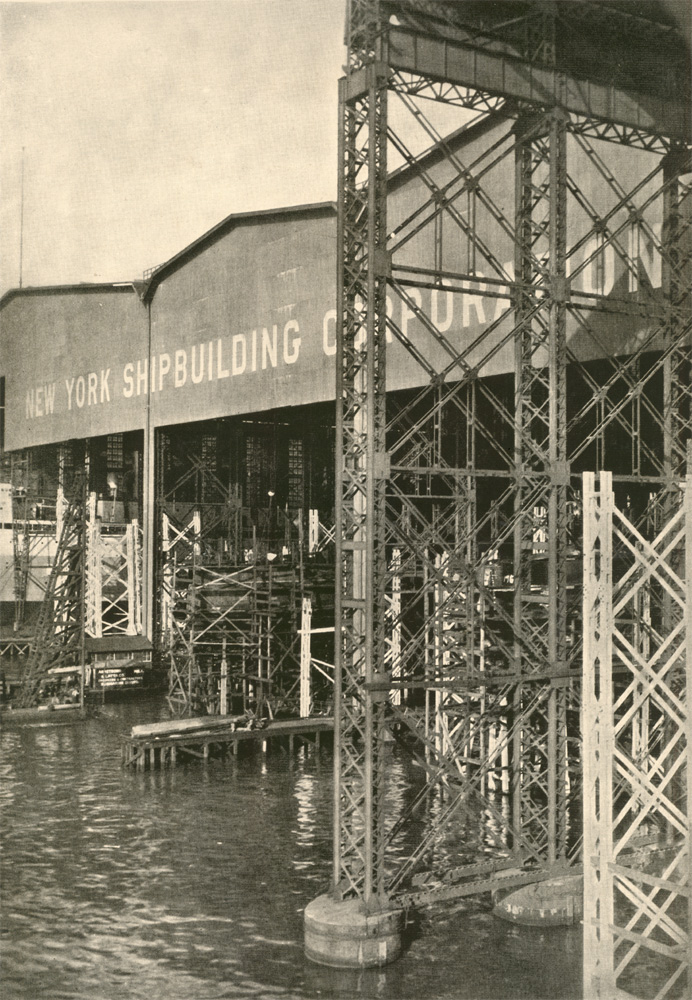
New York Shipbuilding Corporation — Photographic Impressions of the World’s Largest Shipyard, 1921. Copyright 1921, New York Shipbuilding Corporation. Executive Offices: 120 Broadway, New York City. General Office and Works: Camden, New Jersey.
Extending nearly a mile along the Delaware River to the south of Camden, New Jersey, opposite Philadelphia, lies the plant of New York Shipbuilding Corporation. The size and completeness of its shops, shipbuilding berths and outfitting basins and the skill of its personnel give this shipyard an unparalleled capacity for the construction of the most specialized types of merchant and naval vessels. Twenty-eight ships may be under construction at one time in its shipbuilding berths, which comprise five double ways, eight large single ways, and ten smaller ways. Nearly as many more vessels may at the same time be in the course of completion in the outfitting basins.
Back from the waterfront is a complete system of shops in which labor-saving machinery and methods have been developed that are now the accepted standards in modern steel ship construction. Passing through these shops the crude material is made into the thousands of parts that compose the hull, boilers, machinery and equipment of the finished ship. A comprehensive crane system insures the efficient handling of this material throughout the entire course of its fabrication and erection.
This great physical plant is the means through which an organization of specialists in one hundred and forty-six trades, led by an able executive staff, cooperate in the intricate tasks of modern ship construction. The complete facilities of the yard, greatly expanded by war-time demands, and the experience of over twenty years in the successful construction of passenger-and-cargo liners, naval vessels and such specialized types as oil tankers and colliers, are now directed to the building of over forty ships, including two battleships and a battle cruiser for the United States Navy and the most important group of ocean liners now under construction.
With rapid progress toward the completion of the war-time programme, New York Shipbuilding Corporation finds itself able to devote its shipbuilding skill and capacity to the construction for private interests of ships that will meet most profitably the individual demands of peace-time commerce.
Photographic Impressions
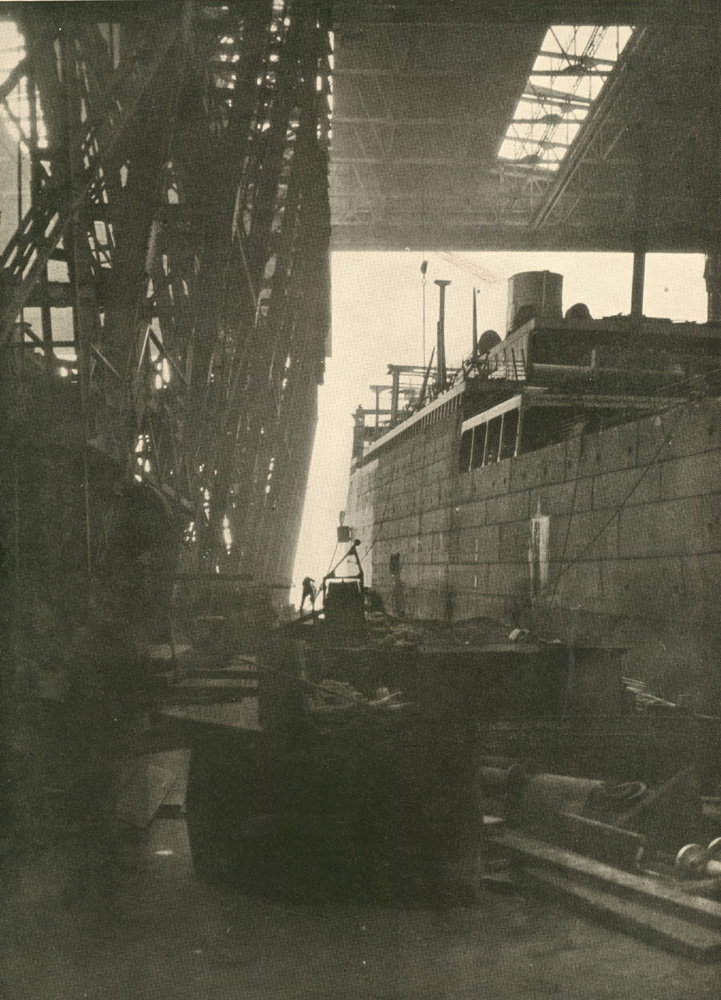
Outfitting one of sixteen 21,000-ton passenger liners in the covered wet slip.
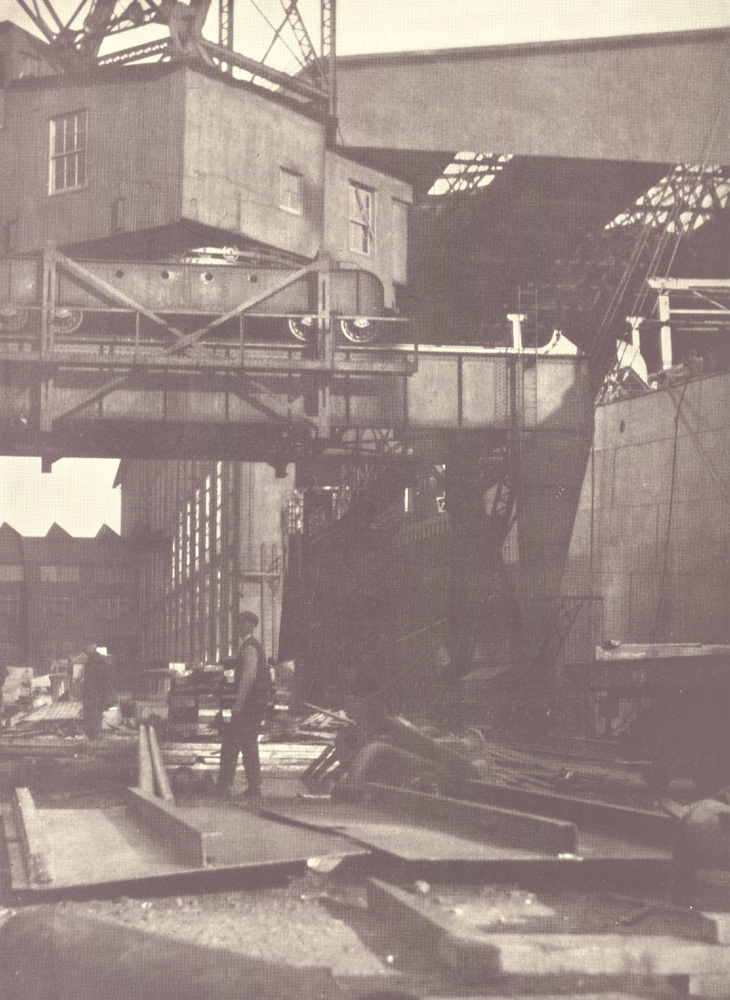
Another view of this wet slip, looking towards the shops.
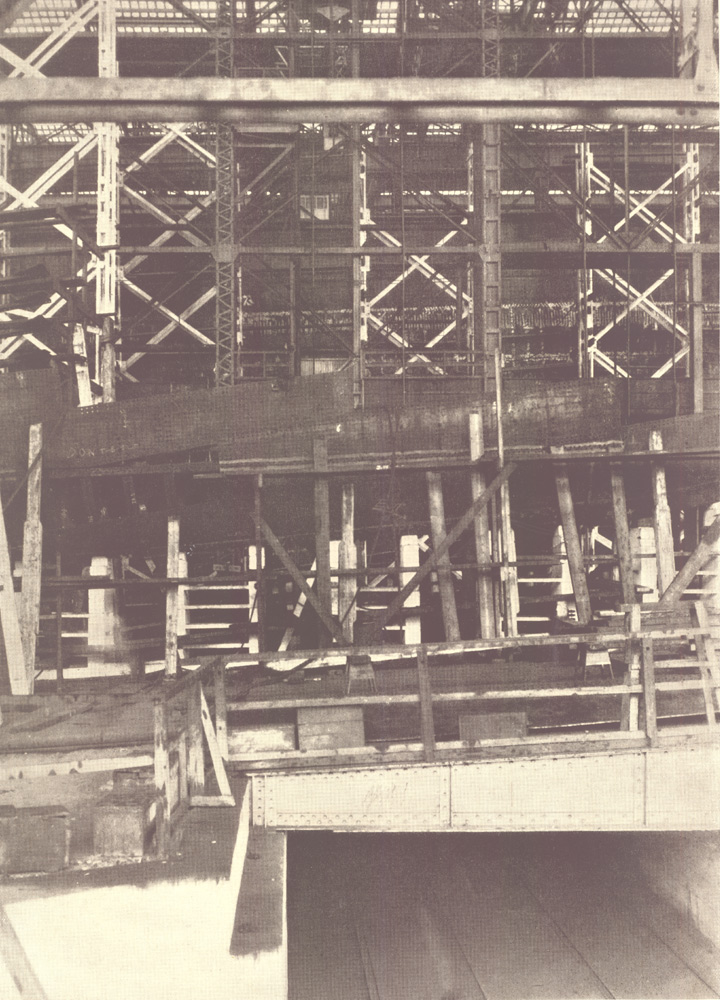
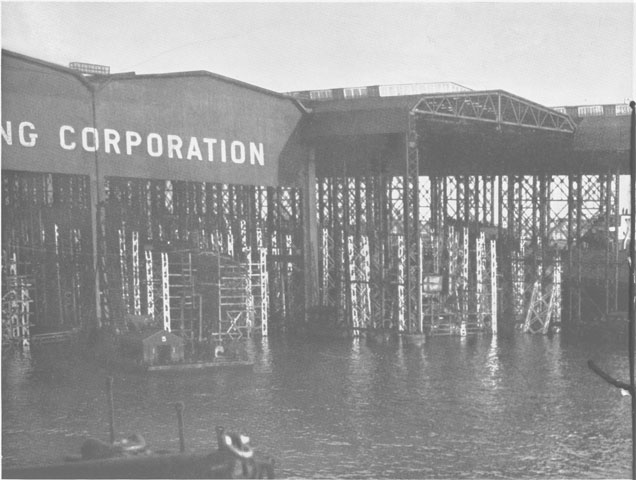
From distributing tracks to roof, the covered way structure rises 138 feet.
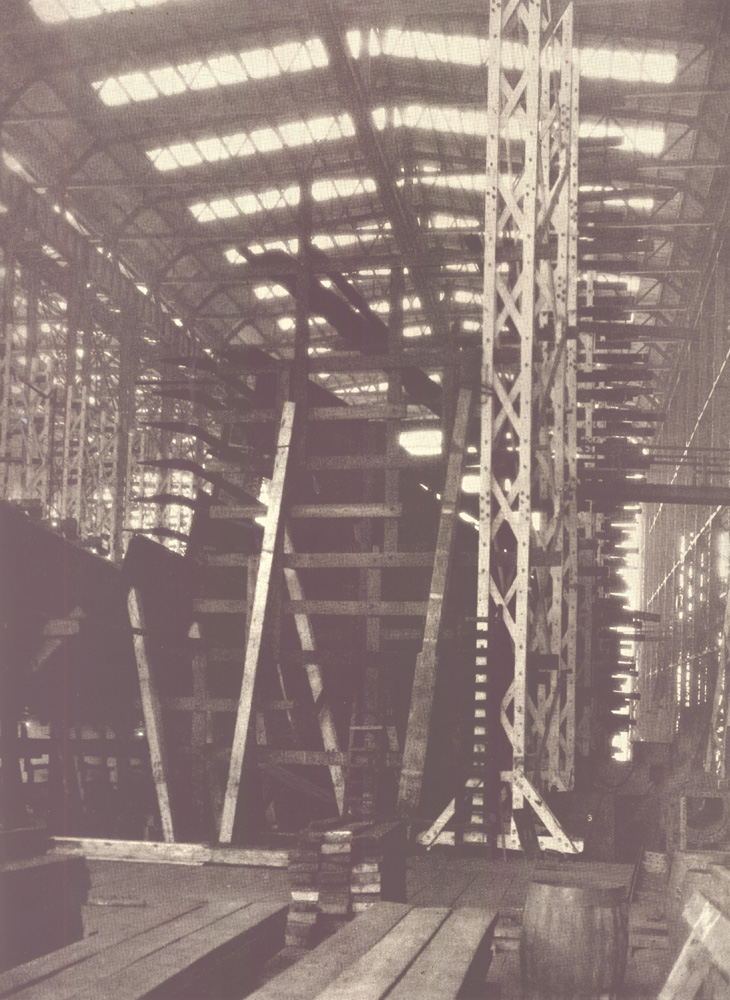
Under this lofty roof are built the largest naval and merchant ships.
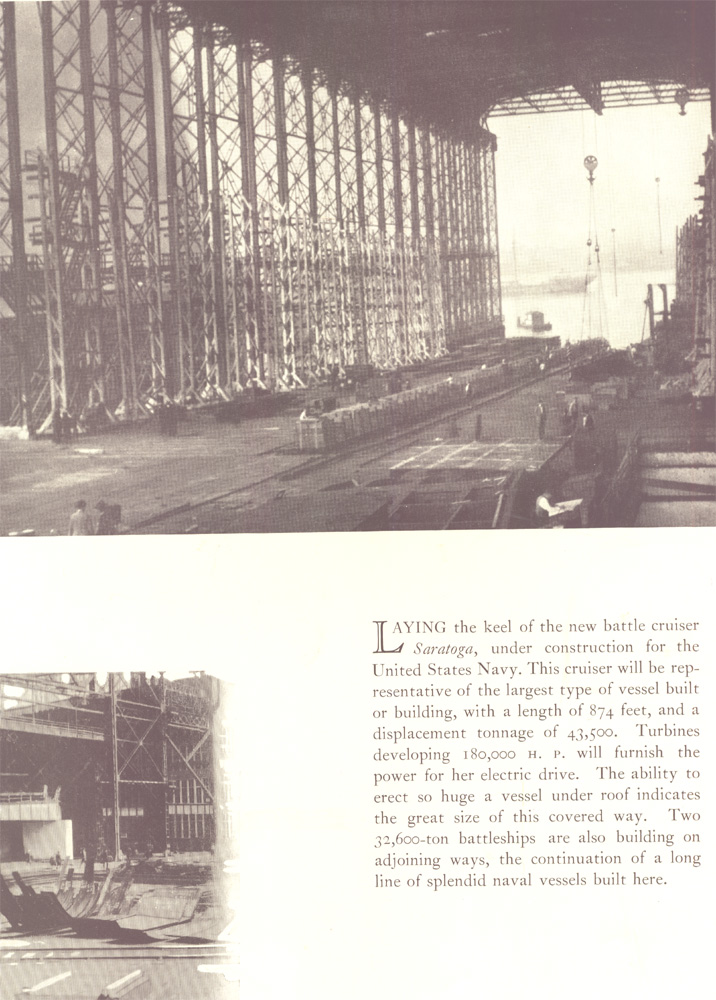
Laying the keel of the new battle cruiser Saratoga, under construction for the United States Navy. This cruiser will be representative of the largest type of vessel built or building, with a length of 874 feet, and a displacement tonnage of 43,500. Turbines developing 180,000 H.P. will furnish the power for her electric drive. The ability to erect so huge a vessel under roof indicates the great size of this covered way. Two 32,600-ton battleships are also building on adjoining ways, the continuation of a long line of splendid naval vessels built here.
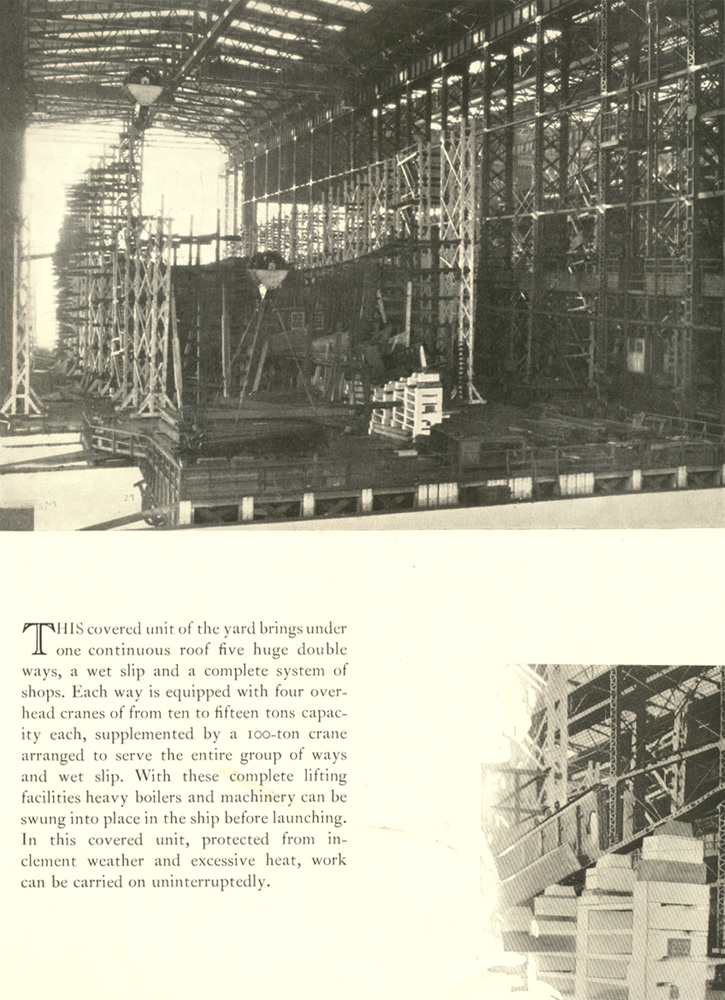
This covered unit of the yard brings under one continuous roof five huge double ways, a wet slip and a complete system of shops. Each way is equipped with four overhead cranes of from ten to fifteen tons capacity each, supplemented by a 100-ton crane arranged to serve the entire group of ways and wet slip. With these complete lifting facilities heavy boilers and machinery can be swung into place in the ship before launching. In this covered unit, protected from inclement weather and excessive heat, work can be carried on uninterruptedly.
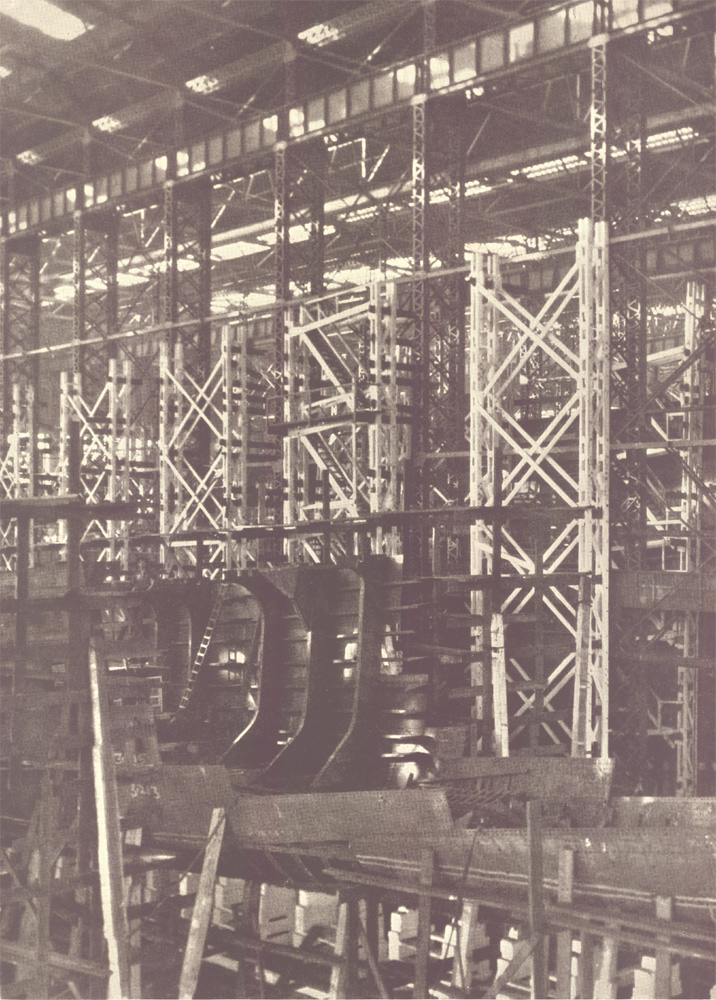
Early stage of hull construction of a passenger liner.
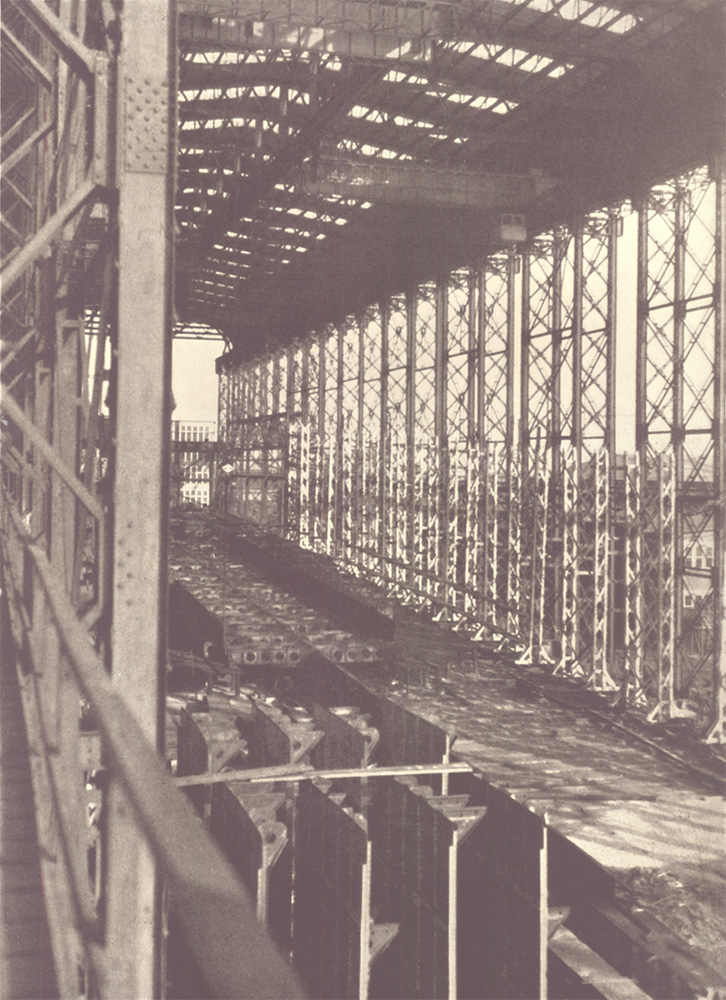
Keel of the battle-cruiser “Saratoga” with machine shop in background.
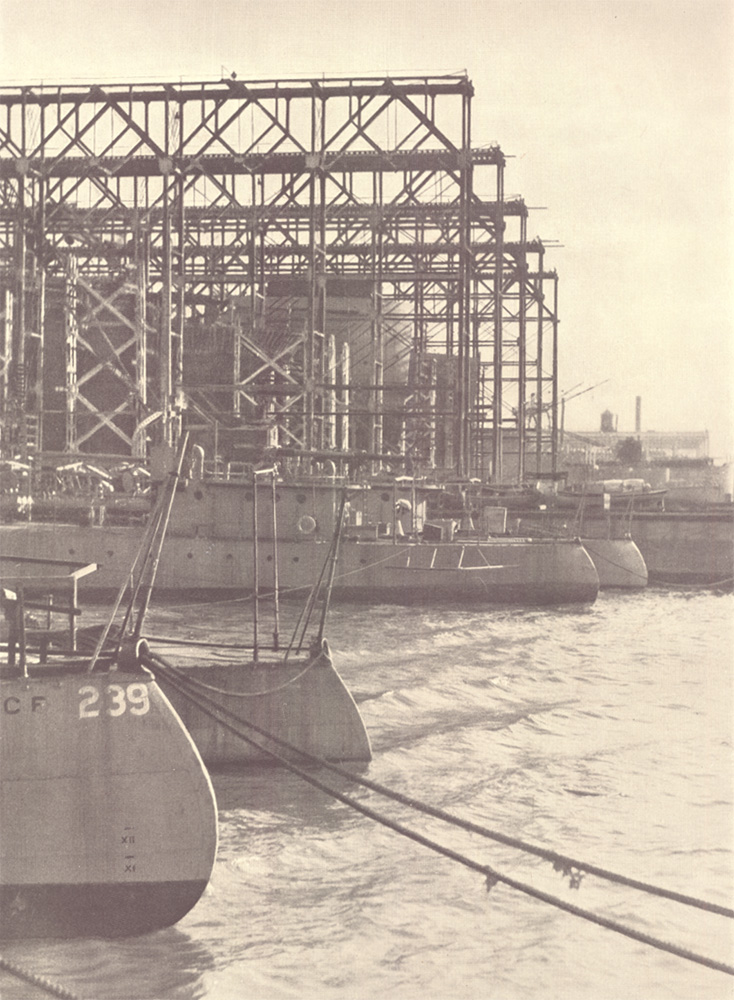
Between the covered unit and the distant South Yard are two other groups of ways.
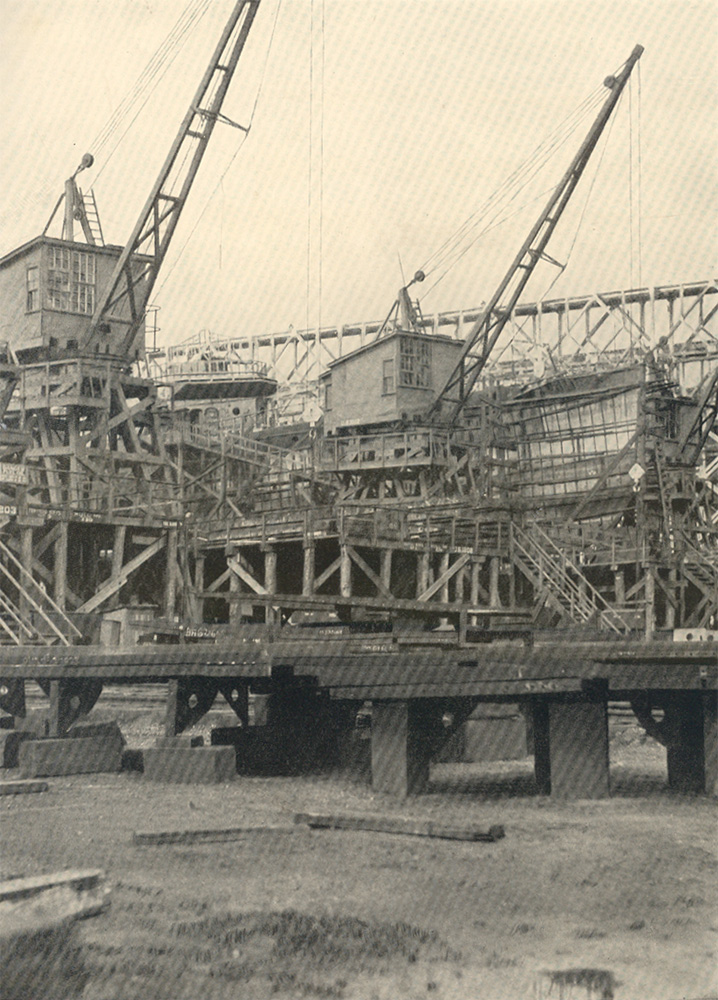
Two of the ten destroyer ways with Middle Yard unit in the background.
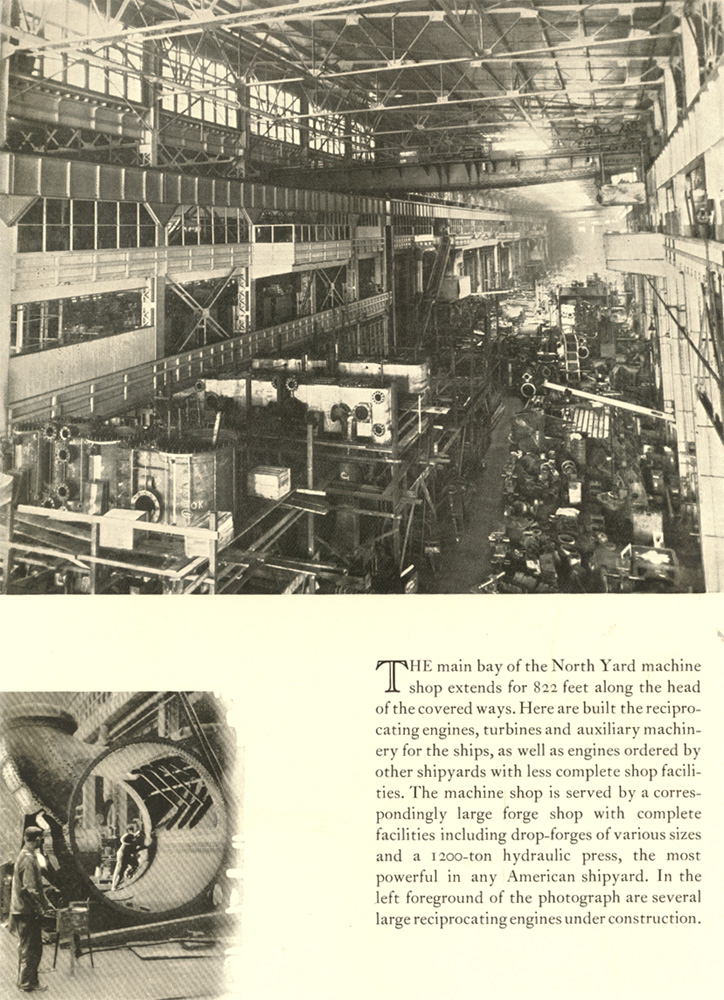
The main bay of the North Yard machine shop extends for 822 feet along the head of the covered ways. Here are built the reciprocating engines, turbines and auxiliary machinery for the ships, as well as engines ordered by other shipyards with less complete shop facilities. The machine shop is served by a correspondingly large forge shop with complete facilities including drop-forges of various sizes and a 1,200-ton hydraulic press, the most powerful in any American shipyard. In the left foreground of the photograph are several large reciprocating engines under construction.
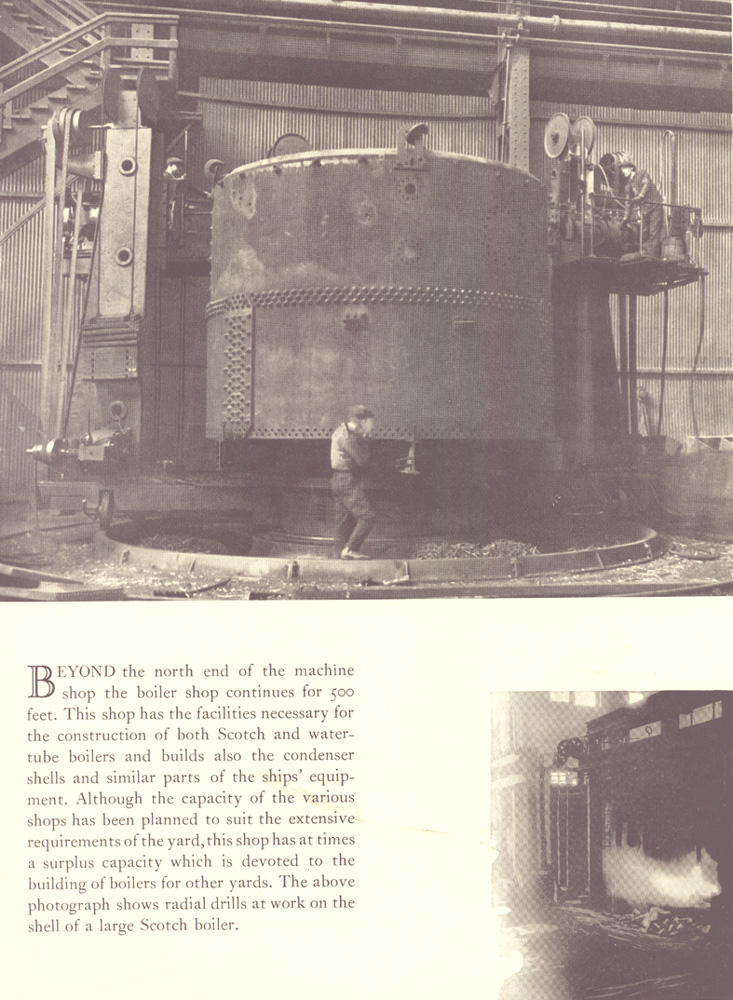
Beyond the north end of the machine shop the boiler shop continues for 500 feet. This shop has the facilities necessary for the construction of both Scotch and water-tube boilers and builds also the condenser shells and similar parts of the ships’ equipment. Although the capacity of the various shops has been planned to suit the extensive requirements of the yard, this shop has at times a surplus capacity which is devoted to the building of boilers for other yards. The above photograph shows radial drills at work on the shell of a large Scotch boiler.
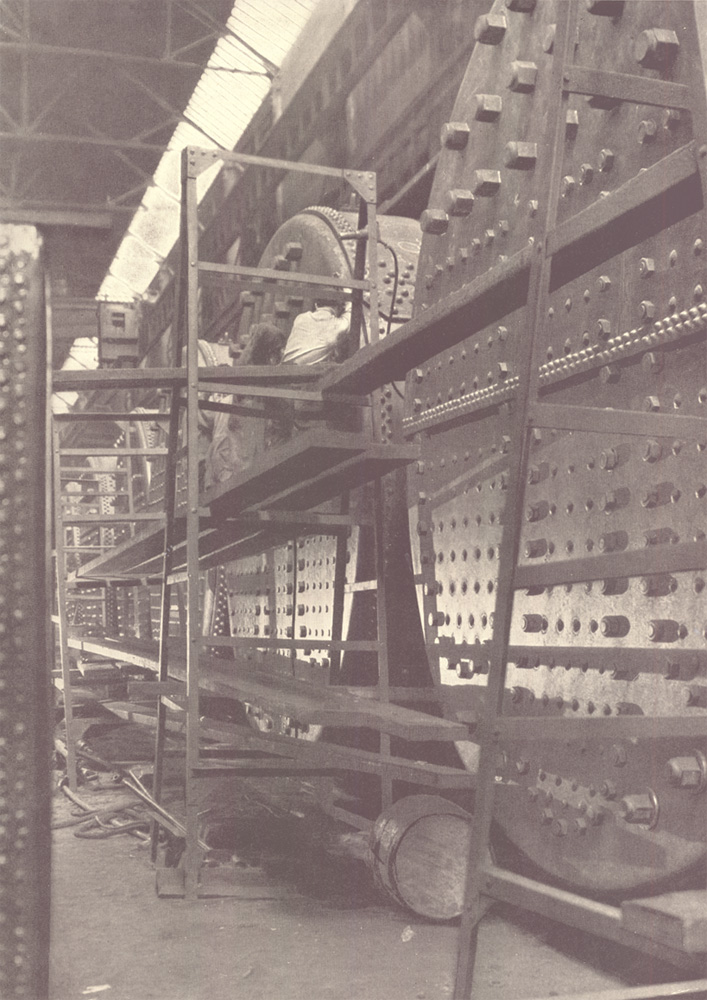
Battery of Scotch boilers under construction for passenger liners.
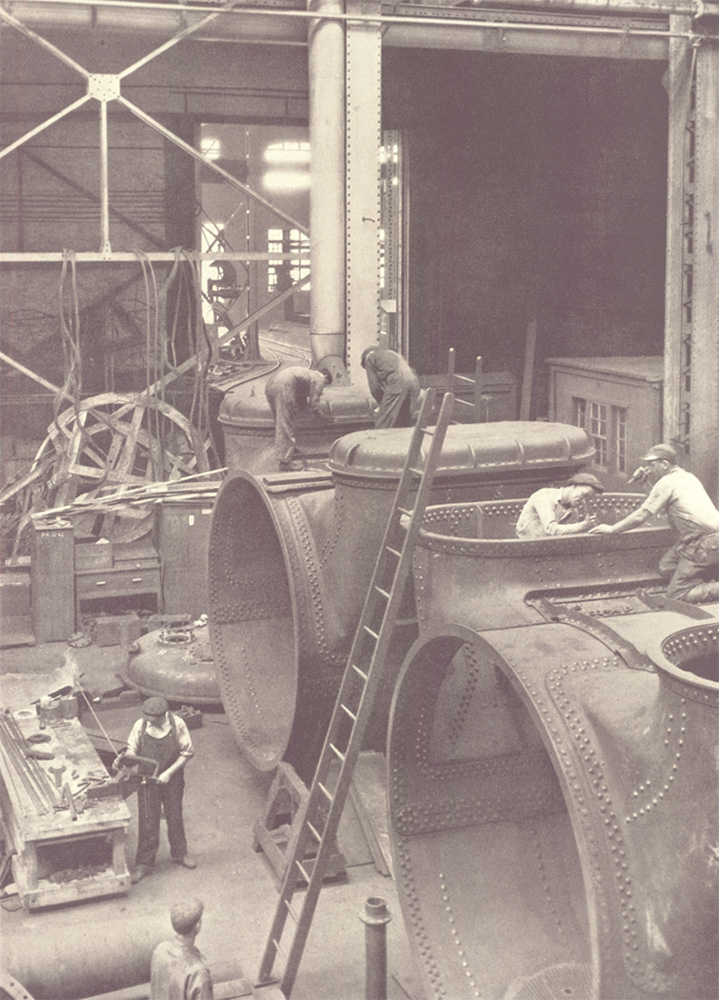
At work on condenser shells for the two 32,000-ton battleships.
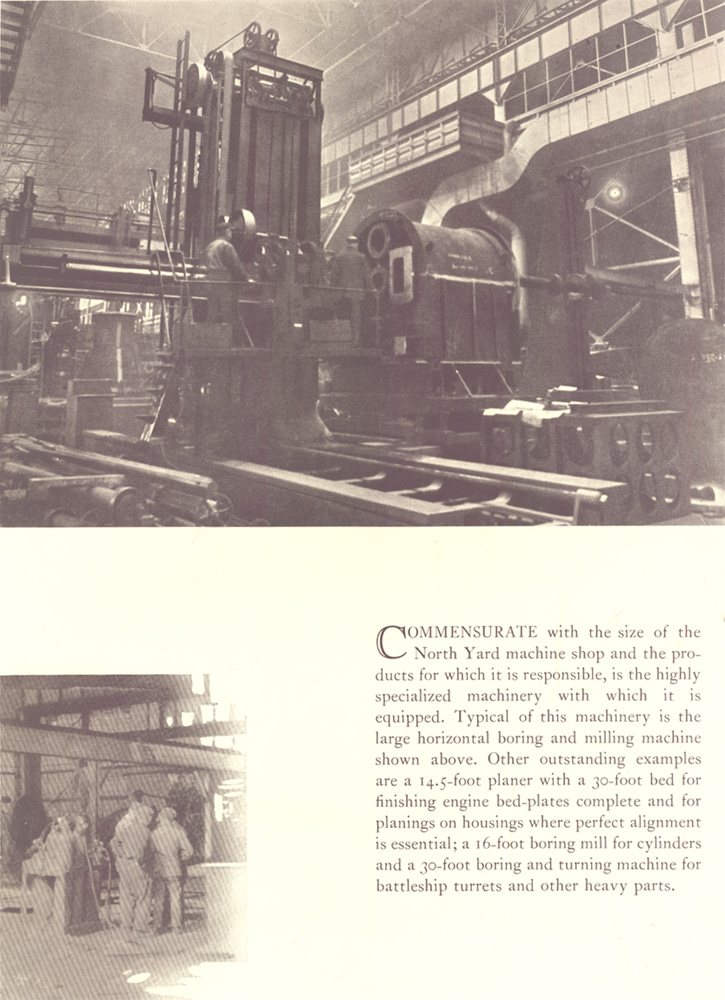
Commensurate with the size of the North Yard machine shop and the products for which it is responsible, is the highly specialized machinery with which it is equipped. Typical of this machinery is the large horizontal boring and milling machine shown above. Other outstanding examples are a 14.5-foot planer with a 30-foot bed for finishing engine bed-plates complete and for planings on housings where perfect alignment is essential; a 16-foot boring mill for cylinders and a 30-foot boring and turning machine for battleship turrets and other heavy parts.
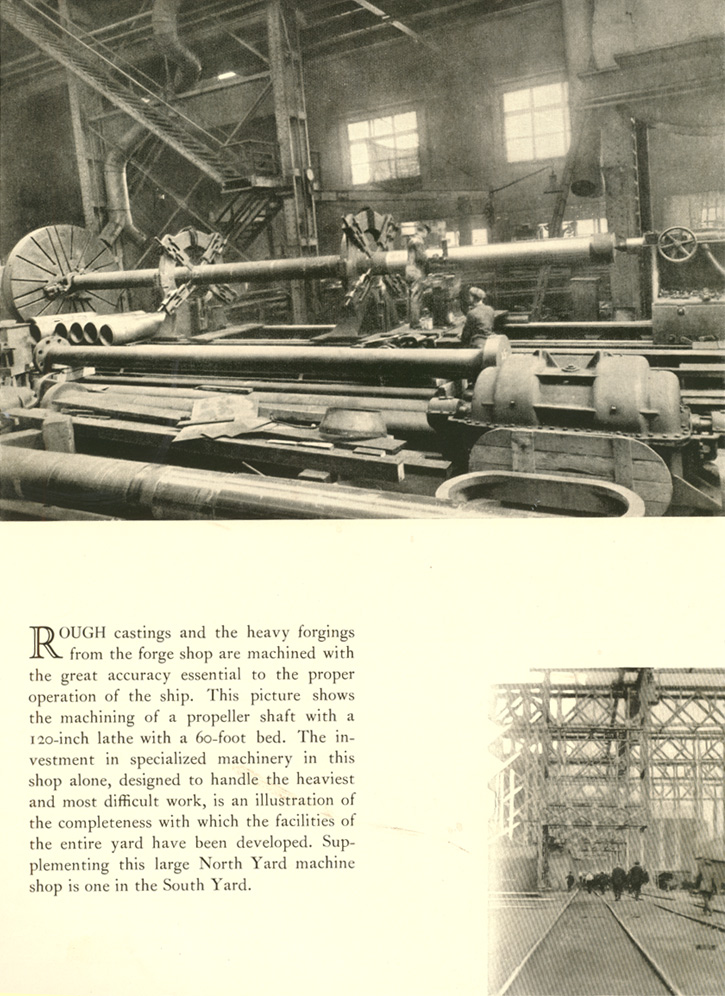
Rough castings and the heavy forgings from the forge shop are machined with the great accuracy essential to the proper operation of the ship. This picture shows the machining of a propeller shaft with a 120-inch lathe with a 60-foot bed. The investment in specialized machinery in this shop alone, designed to handle the heaviest and most difficult work, is an illustration of the completeness with which the facilities of the entire yard have been developed. Supplementing this large North Yard machine shop is one in the South Yard.
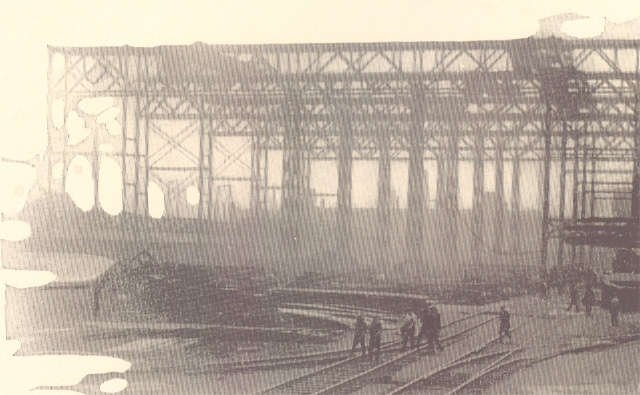
In 1916 when the Company was reorganized as the present New York Shipbuilding Corporation, the plant comprised the one large unit of five covered ways, wet slip and shops. During the war three additional groups of ways, with a total capacity for eighteen ships, were constructed, with their own shop facilities. Each of these units is equivalent in capacity to an average yard. This development has extended the yard southward along the Delaware River until it now occupies a mile of water-front.
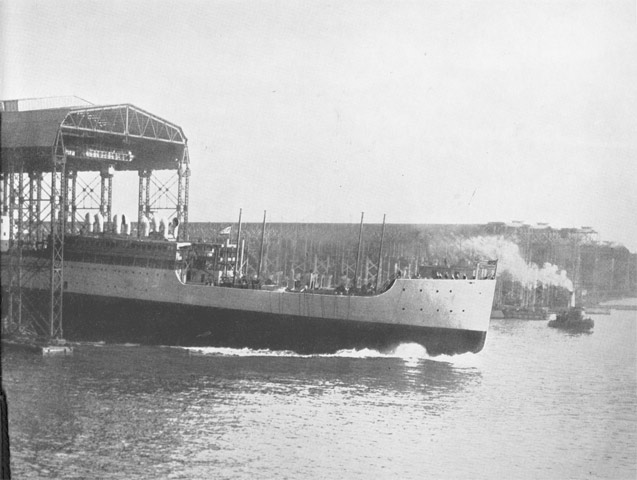
During 1917 and 1918, the years of the active participation of the United States in the war and of the expansion of the plant, twenty merchant ships aggregating 176,000 deadweight tons, were delivered. Since then all of the increased facilities have come into operation and the yard is now engaged in a shipbuilding programme consisting of 100,000 deadweight tons of tankers, 347,000 displacement tons of passenger-and-cargo liners and naval construction including one battle cruiser, two battleships and the completion of an order for thirty destroyers. The above photograph of a launching shows a part of the extensive waterfront.
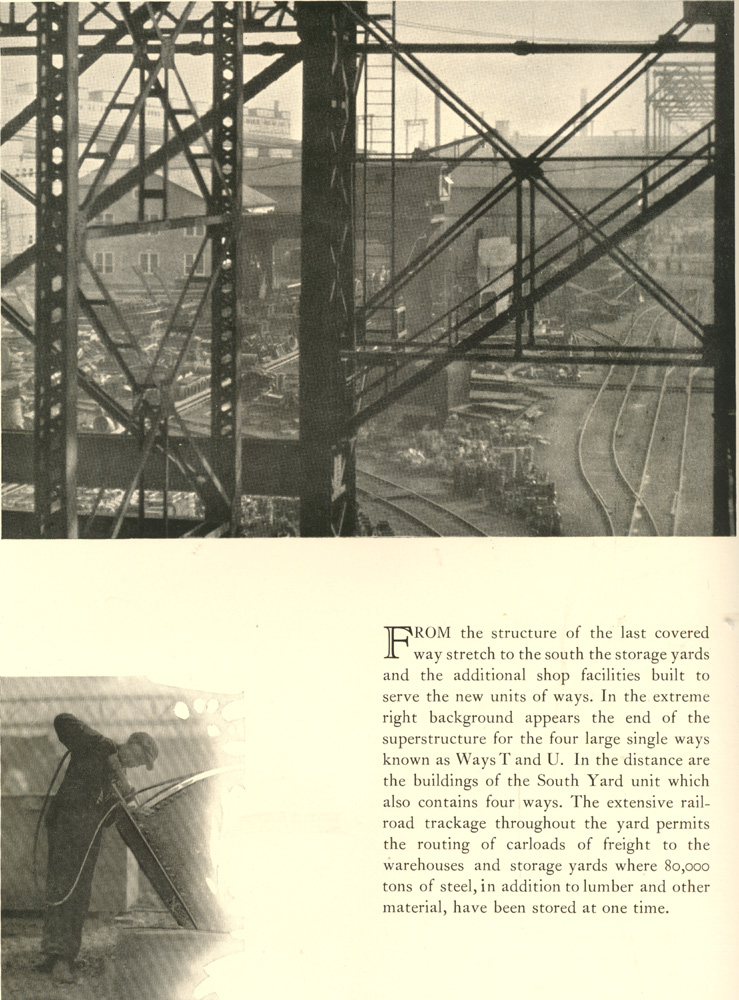
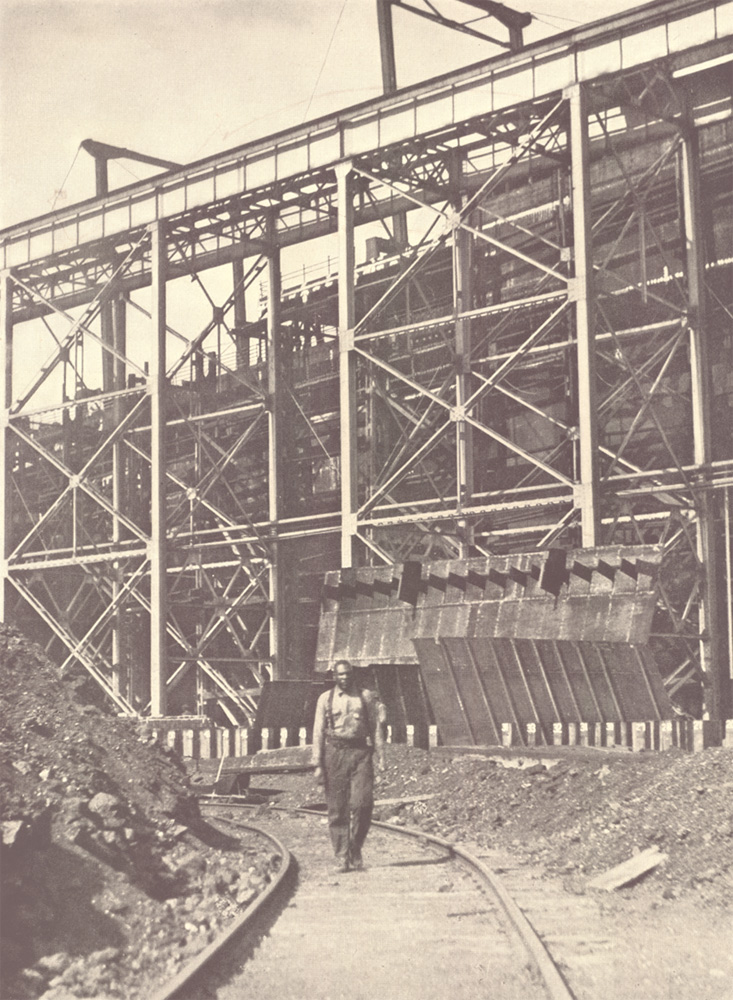
From the structure of the last covered way stretch to the south the storage yards and the additional shop facilities built to serve the new units of ways. In the extreme right background appears the end of the superstructure for the four large single ways known as Ways T and U. In the distance are the buildings of the South Yard unit which also contains four ways. The extensive railroad trackage throughout the yard permits the routing of carloads of freight to the warehouses and storage yards where 80,000 tons of steel, in addition to lumber and other material, have been stored at one time.
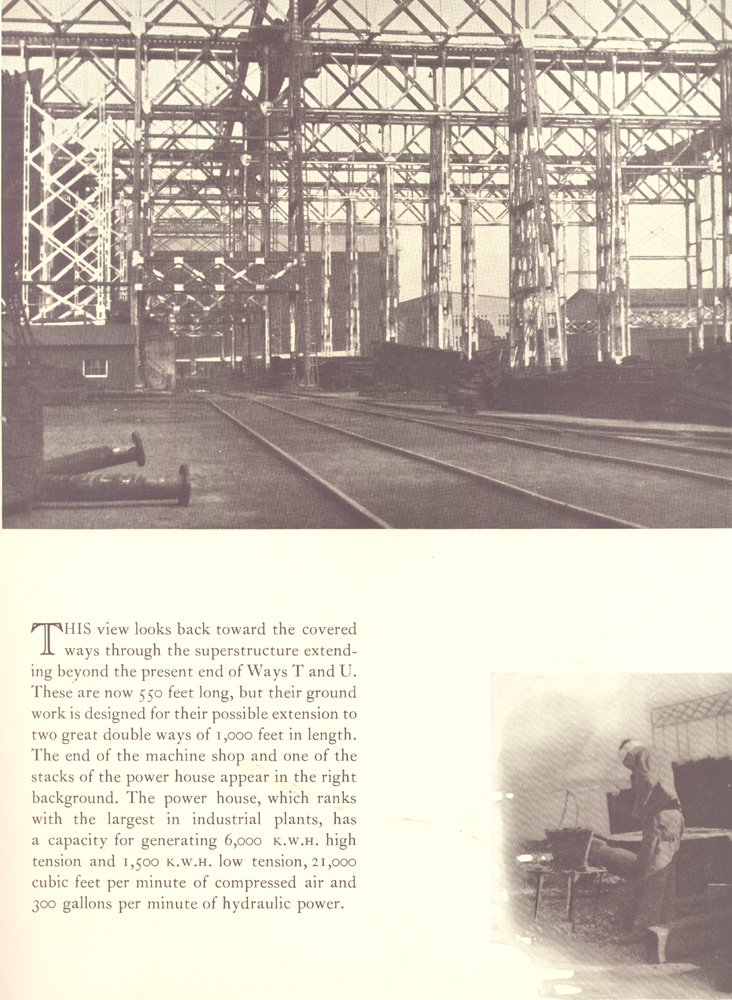
This view looks back toward the covered ways through the superstructure extending beyond the present end of Ways T and U. These are now 550 feet long, but their ground work is designed for their possible extension to two great double ways of 1,000 feet in length. The end of the machine shop and one of the stacks of the power house appear in the right background. The power house, which ranks with the largest in industrial plants, has a capacity for generating 6,000 kilowatt hours high tension and 1,500 kilowatt hours low tension, 21,000 cubic feet per minute of compressed air and 300 gallons per minute of hydraulic power.
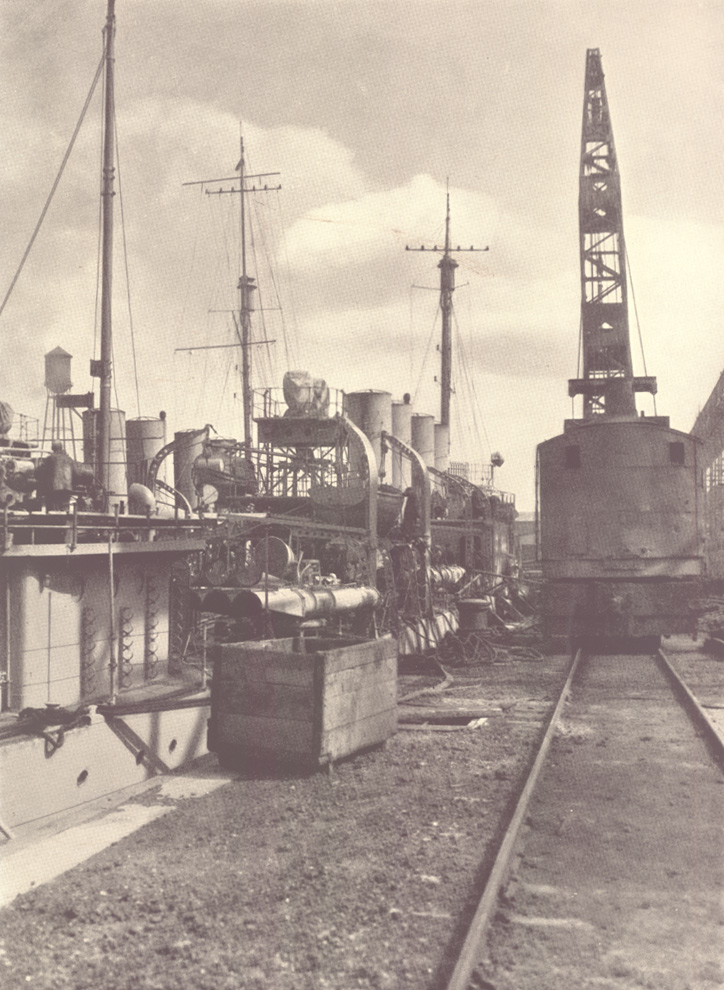
Last of the thirty new destroyers alongside outfitting pier.
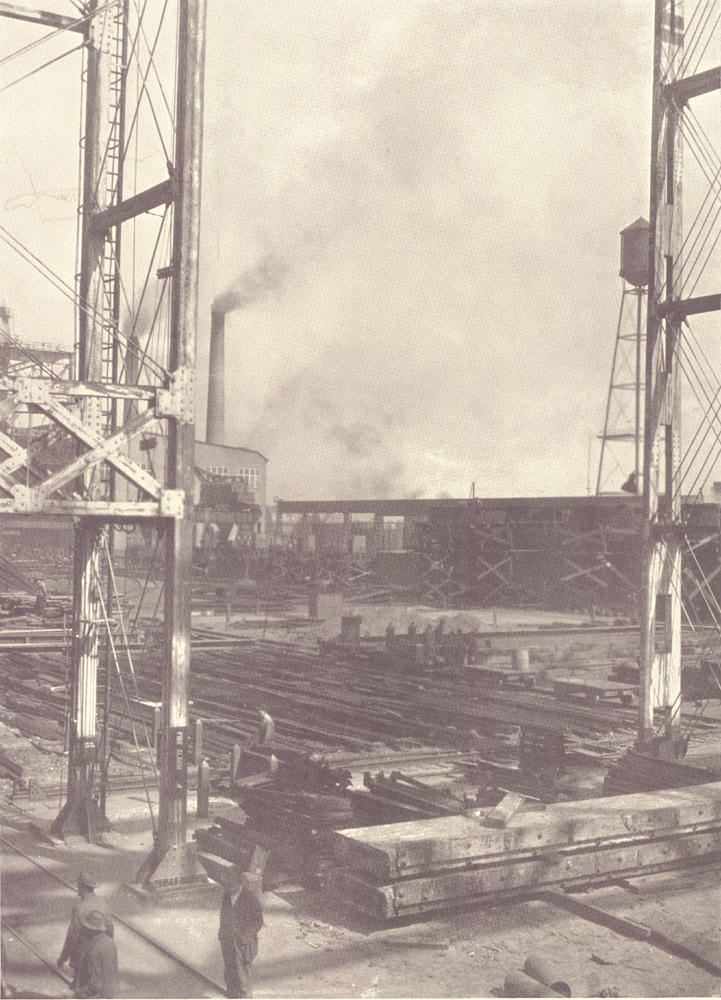
A glimpse of the storage facilities and power house, North Yard.
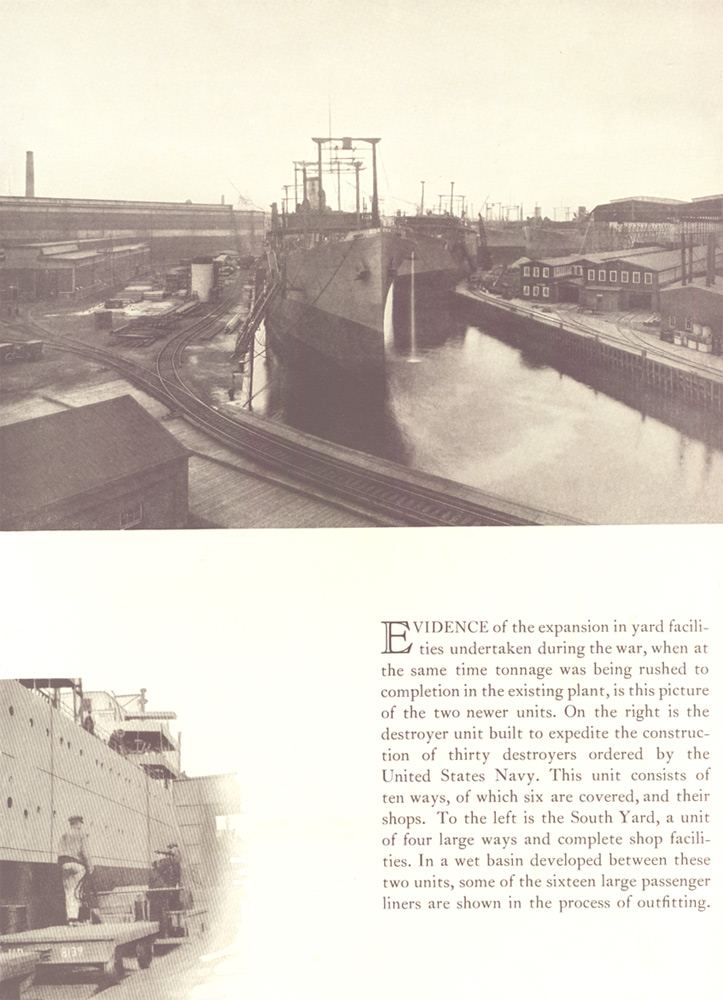
Evidence of the expansion in yard facilities undertaken during the war, when at the same time tonnage was being rushed to completion in the existing plant, is this picture of the two newer units. On the right is the destroyer unit built to expedite the construction of thirty destroyers ordered by the United States Navy. This unit consists of ten ways, of which six are covered, and their shops. To the left is the South Yard, a unit of four large ways and complete shop facilities. In a wet basin developed between these two units, some of the sixteen large passenger liners are shown in the process of outfitting.
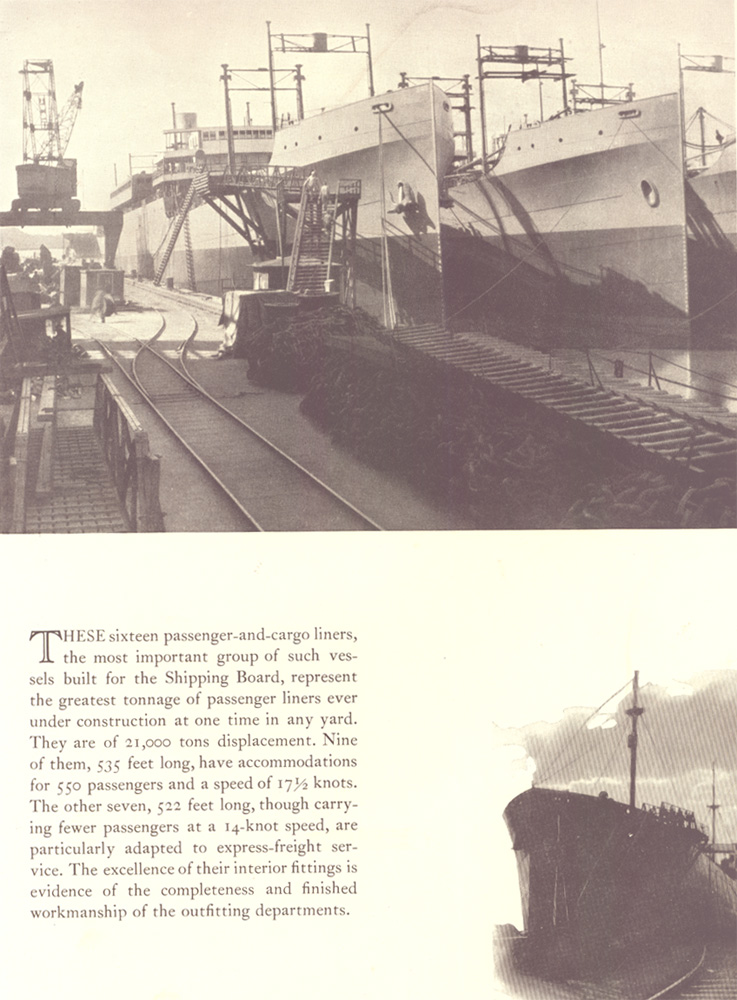
These sixteen passenger-and-cargo liners, the most important group of such vessels built for the Shipping Board, represent the greatest tonnage of passenger liners ever under construction at one time in any yard. They are of 21,000 tons displacement. Nine of them, 535 feet long, have accommodations for 550 passengers and a speed of 17½ knots. The other seven, 522 feet long, though carrying fewer passengers at a 14-knot speed, are particularly adapted to express-freight service. The excellence of their interior fittings is evidence of the completeness and finished workmanship of the outfitting departments.
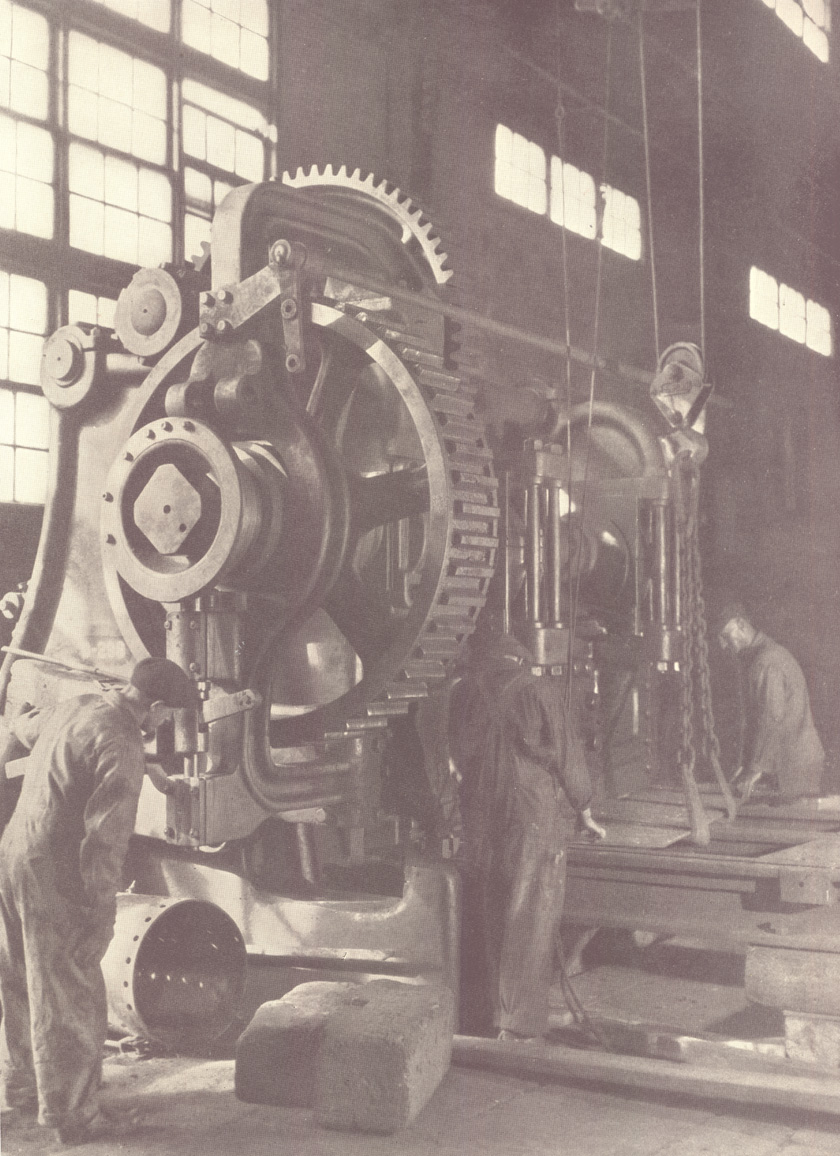
Guillotine shear with six-foot blade capable of cutting 1.25” plates.
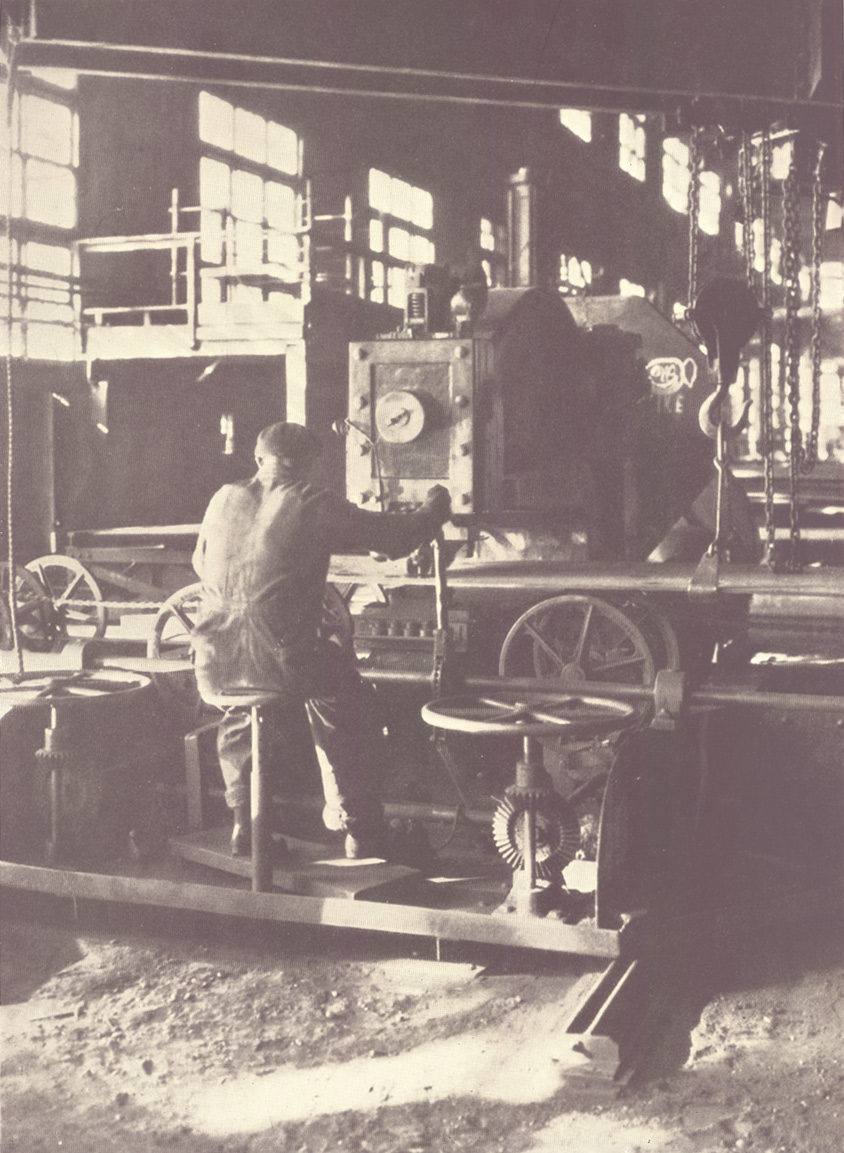
Lysholm plate punching table, designed here, one of twenty in use.
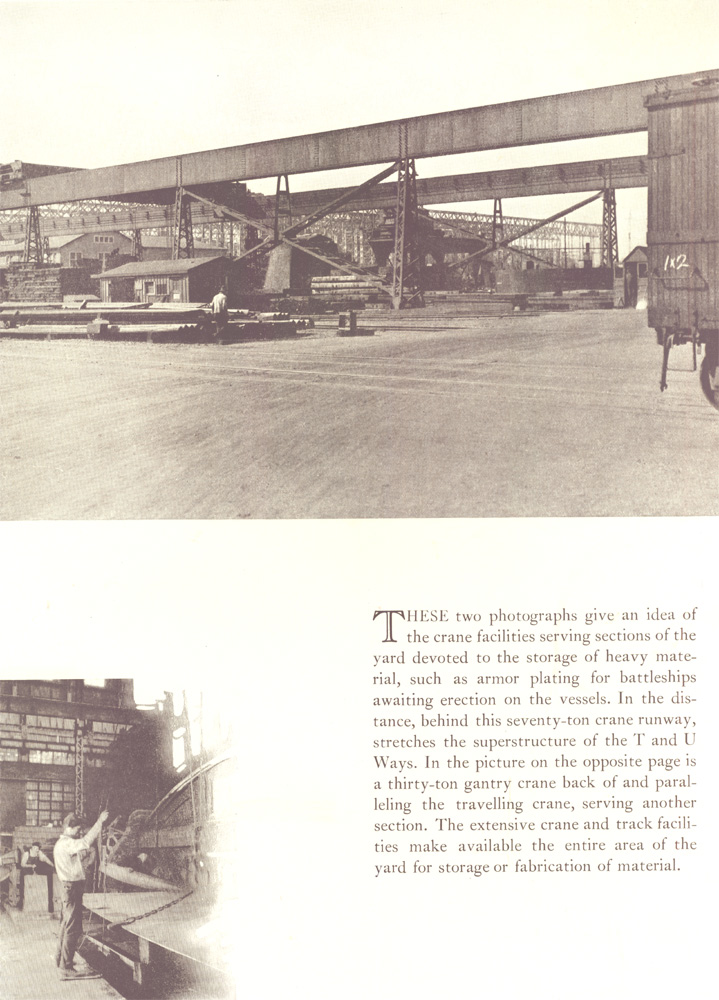
These two photographs give an idea of the crane facilities serving sections of the yard devoted to the storage of heavy material, such as armor plating for battleships awaiting erection on the vessels. In the distance, behind this seventy-ton crane runway, stretches the superstructure of the T and U Ways. In the picture on the opposite page is a thirty-ton gantry crane back of and paralleling the traveling crane, serving another section. The extensive crane and track facilities make available the entire area of the yard for storage or fabrication of material.
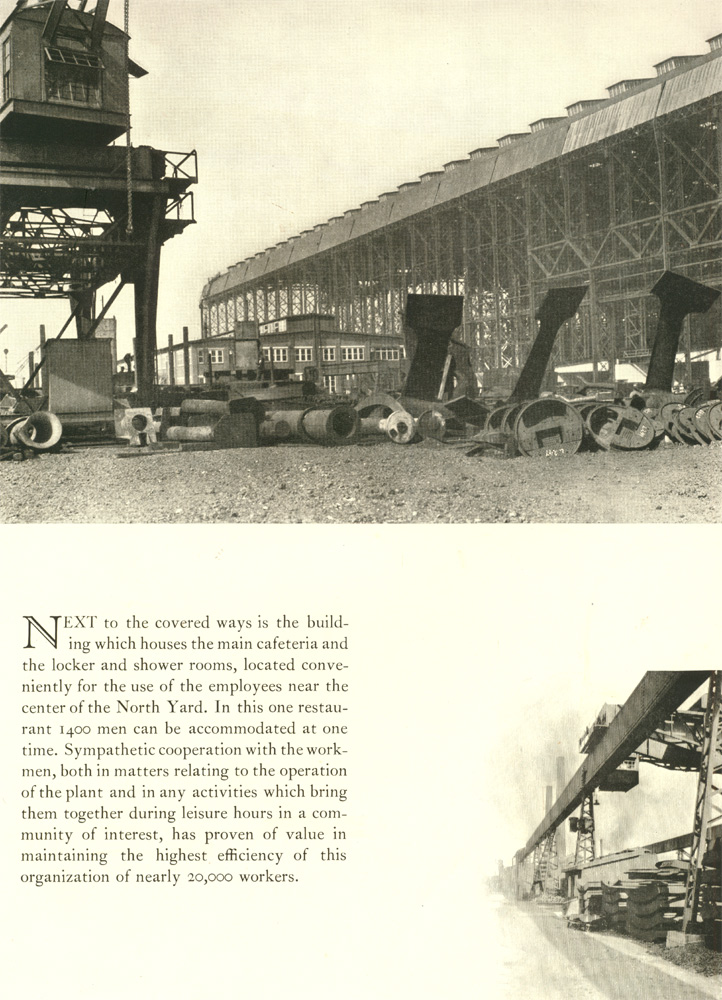
Next to the covered ways is the building which houses the main cafeteria and the locker and shower rooms, located conveniently for the use of the employees near the center of the North Yard. In this one restaurant 1,400 men can be accommodated at one time. Sympathetic cooperation with the workmen, both in matters relating to the operation of the plant and in any activities which bring them together during leisure hours in a community of interest, has proven of value in maintaining the highest efficiency of this organization of nearly 20,000 workers.
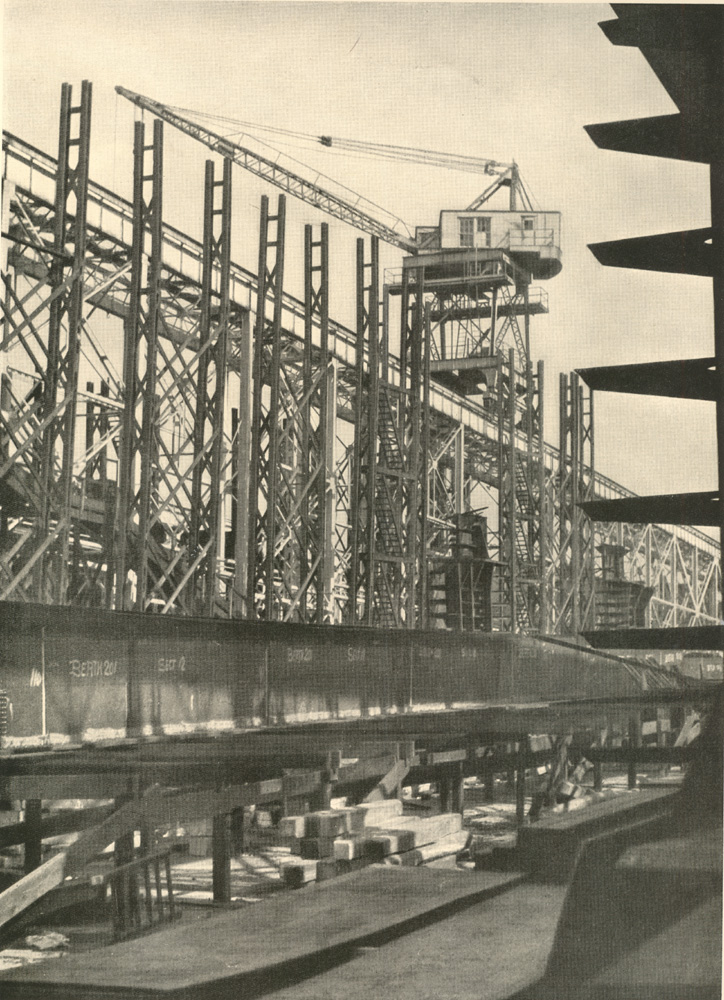
Keel of 12,600-ton tanker in one of four ways in the South Yard.
Another view of the South Yard ways, large liner nearing completion.
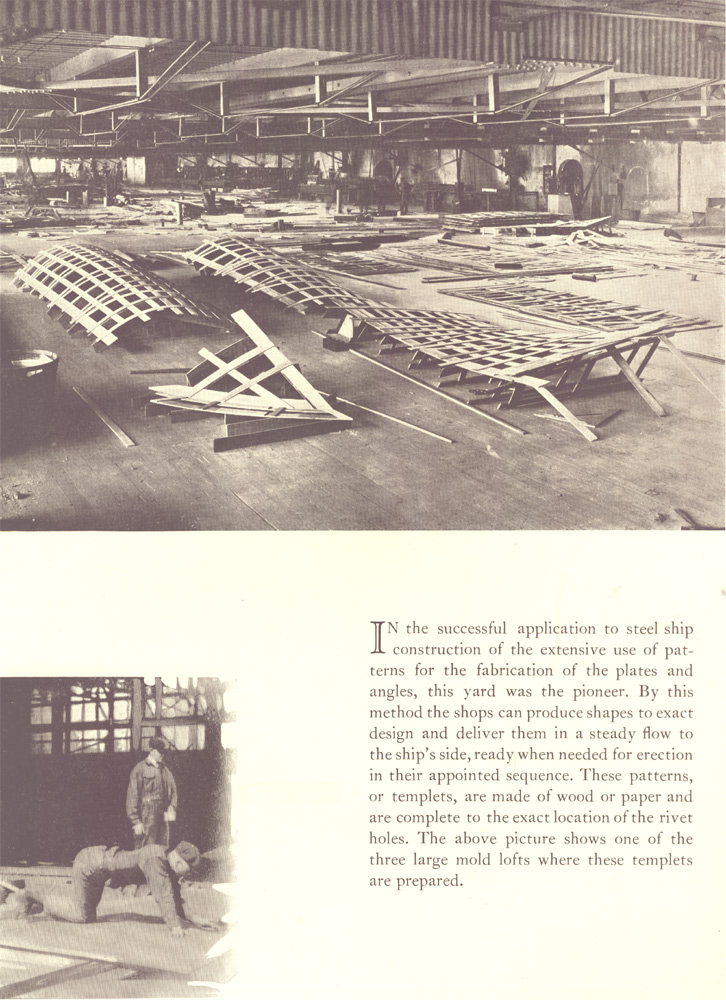
In the successful application to steel ship construction of the extensive use of patterns for the fabrication of the plates and angles, this yard was the pioneer. By this method the shops can produce shapes to exact design and deliver them in a steady flow to the ship’s side, ready when needed for erection in their appointed sequence. These patterns, or templets, are made of wood or paper and are complete to the exact location of the rivet holes. The above picture shows one of the three large mold lofts where these templets are prepared.
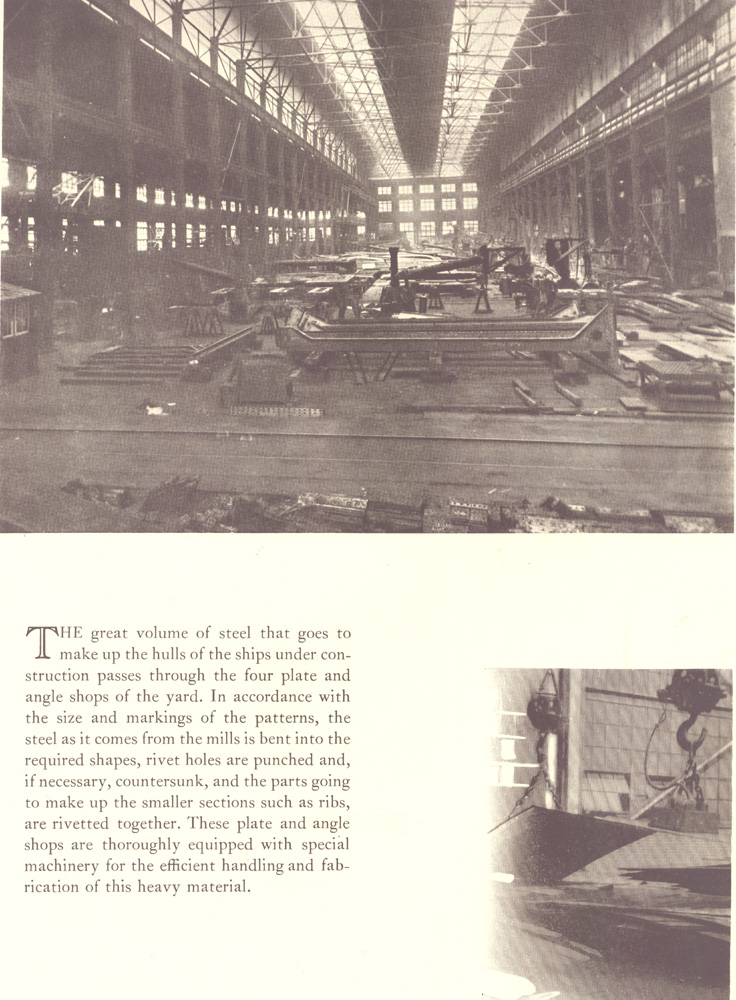
The great volume of steel that goes to make up the hulls of the ships under construction passes through the four plate and angle shops of the yard. In accordance with the size and markings of the patterns, the steel as it comes from the mills is bent into the required shapes, rivet holes are punched and, if necessary, countersunk, and the parts going to make up the smaller sections such as ribs, are riveted together. These plate and angle shops are thoroughly equipped with special machinery for the efficient handling and fabrication of this heavy material.
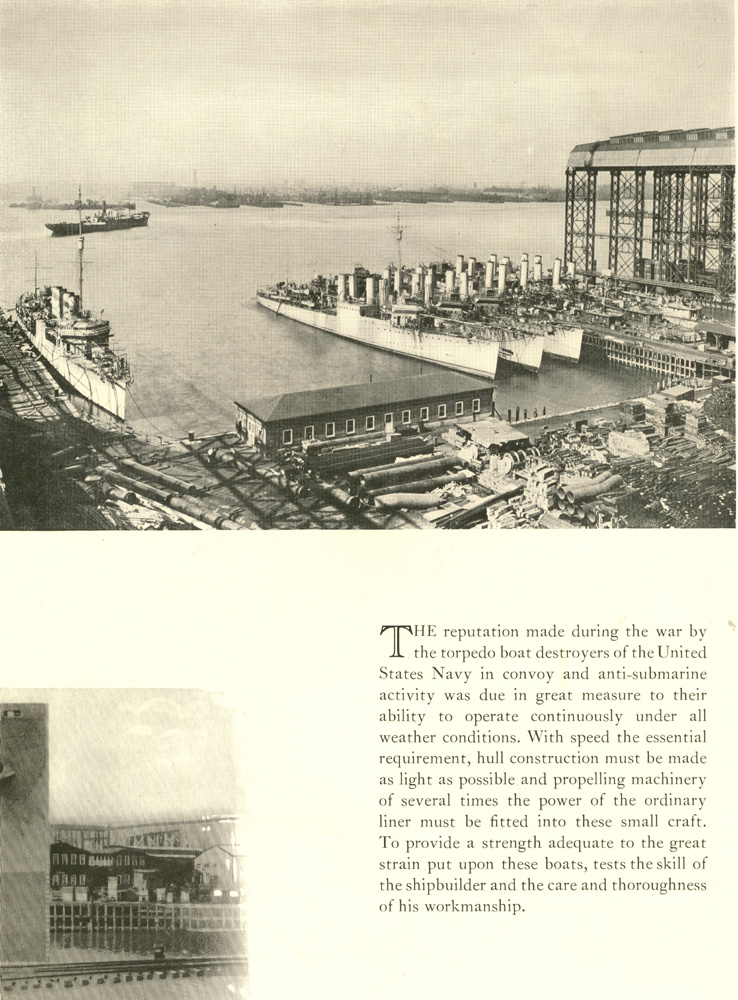
The reputation made during the war by the torpedo boat destroyers of the United States Navy in convoy and anti-submarine activity was due in great measure to their ability to operate continuously under all weather conditions. With speed the essential requirement, hull construction must be made as light as possible and propelling machinery of several times the power of the ordinary liner must be fitted into these small craft. To provide a strength adequate to the great strain put upon these boats, tests the skill of the shipbuilder and the care and thoroughness of his workmanship.
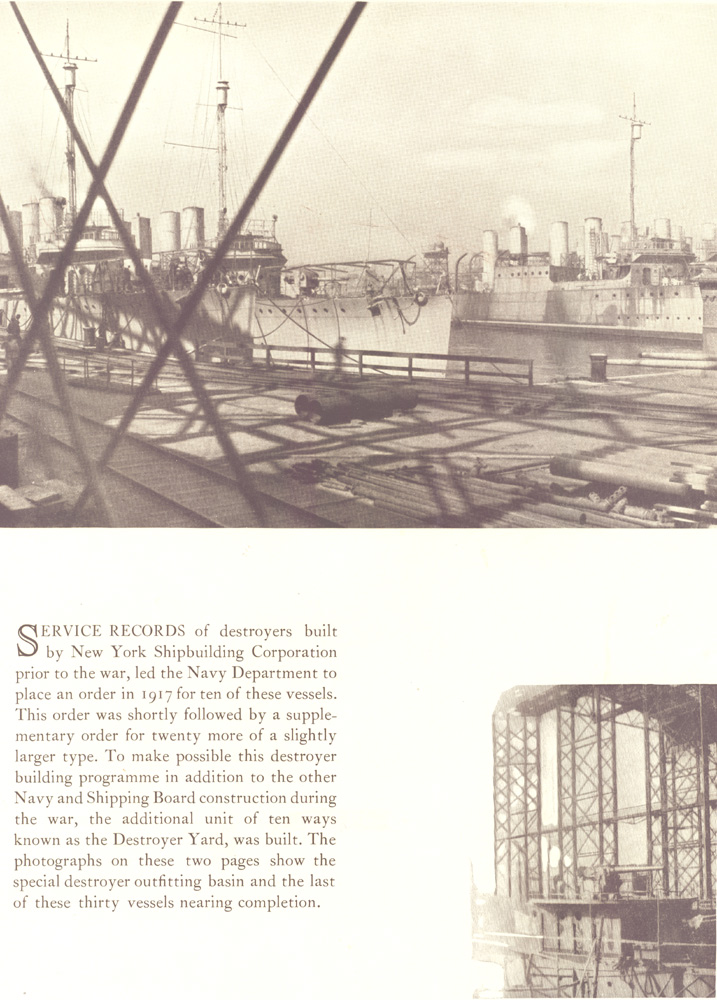
Service records of destroyers built by New York Shipbuilding Corporation prior to the war, led the Navy Department to place an order in 1917 for ten of these vessels. This order was shortly followed by a supplementary order for twenty more of a slightly larger type. To make possible this destroyer building programme in addition to the other Navy and Shipping Board construction during the war, the additional unit of ten ways known as the Destroyer Yard, was built. The photographs on these two pages show the special destroyer outfitting basin and the last of these thirty vessels nearing completion.
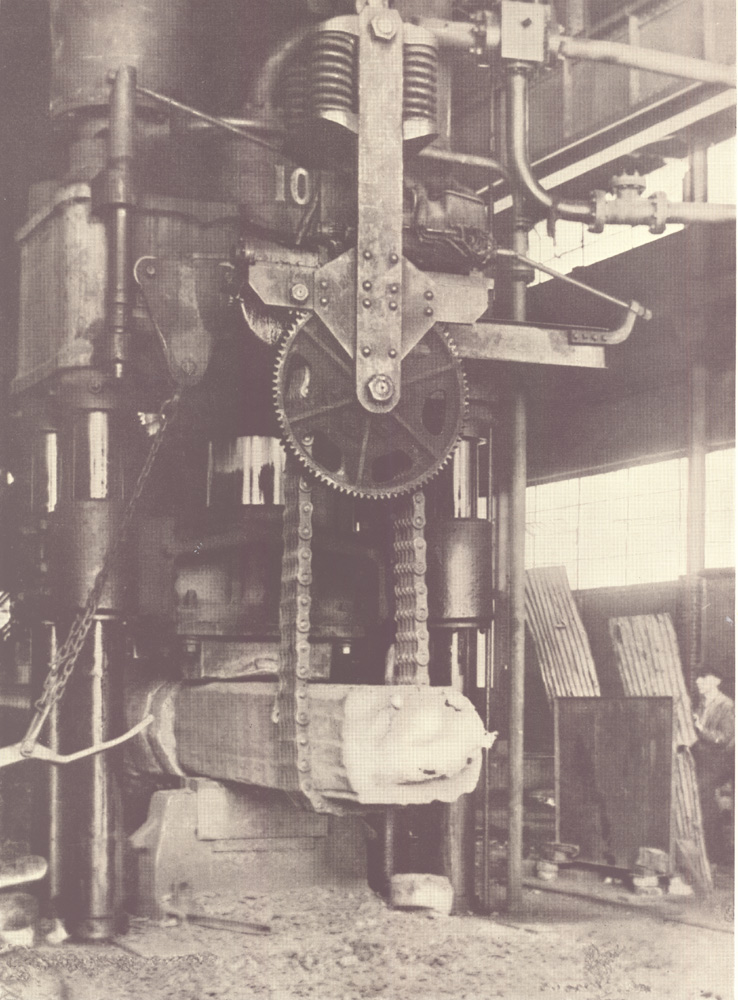
This 1,200-ton press is part of an unparalleled forge shop capacity.
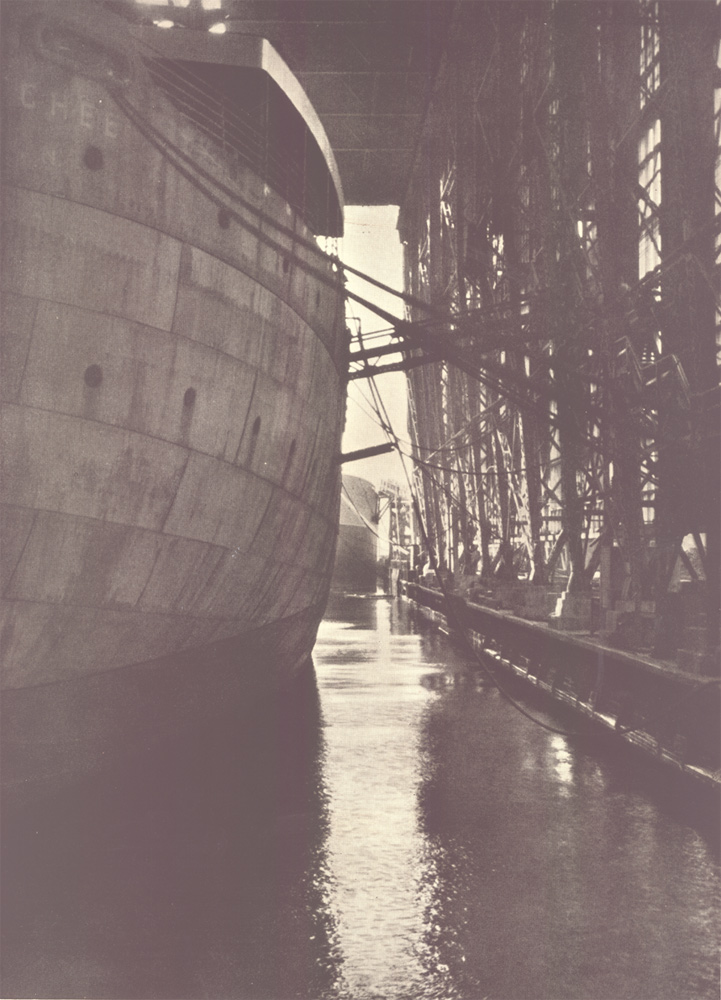
In the covered wet slip.
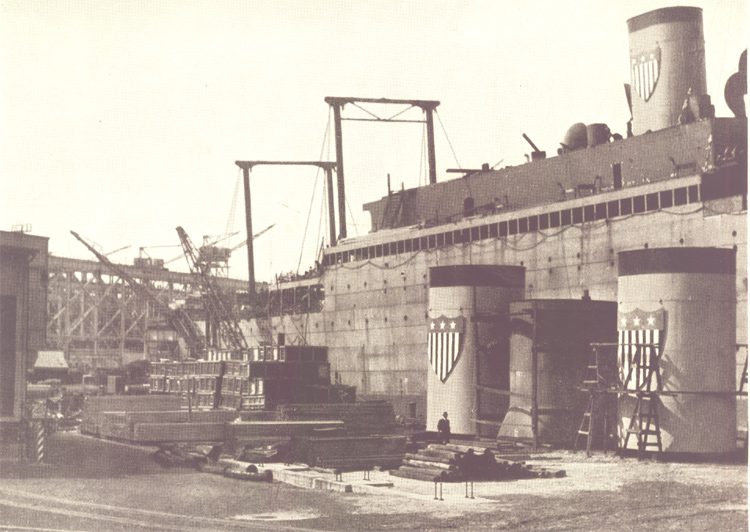
Varied in size and type are the ships of the great fleet built and now building at the yard of New York Shipbuilding Corporation. The 264 ships composing this fleet include:
Naval vessels—battleships, battle cruisers, destroyers: 57
Passenger-and-cargo liners: 27
Tankers: 31
Colliers: 22
General cargo boats: 13
River and harbor passenger steamers: 7
Miscellaneous craft—steam lightships, mine planters, car-floats, barges, dredges, etc.: 107
The organization of experienced executives and skilled shipworkers, developed during twenty years of modern ship construction, now has at its disposal shipway capacity and shop facilities equal to the most exacting requirements of ship design and construction for economical operation in any phase of ocean transportation.
Plant Map
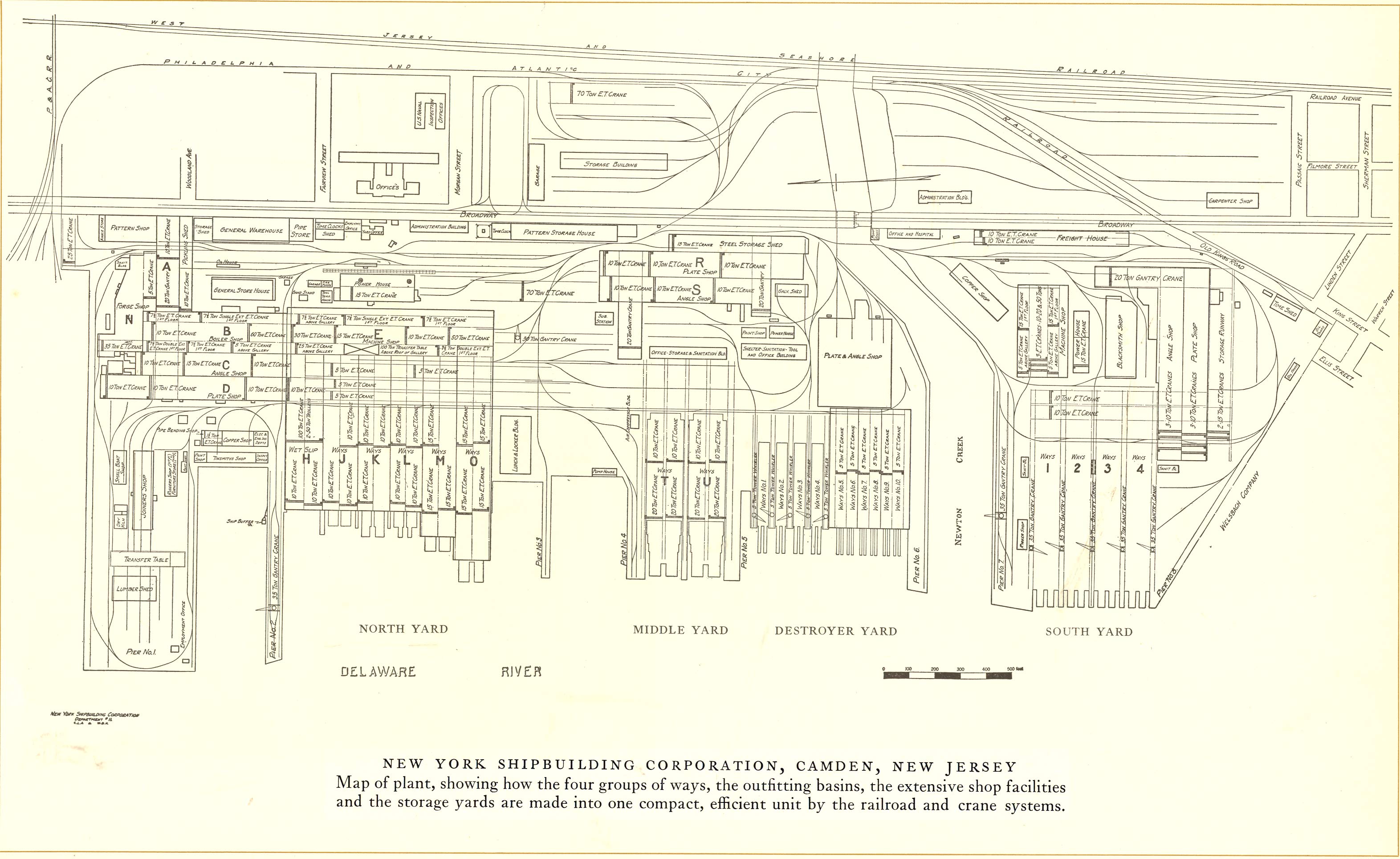
New York Shipbuilding Corporation, Camden, New Jersey. Map of plant, showing how the four groups of ways, the outfitting basins, the extensive shop facilities and the storage yards are made into one compact, efficient unit by the railroad and crane systems.