Oysters in Camden: Restaurants, Oyster Saloons, Retail & Wholesale
Oysters were a delicacy in Camden and elsewhere along the Delaware for many years until the trade was all but destroyed after a disease called MSX ravaged the Delaware Bay, beginning in 1957.
An examination of Camden’s City directories from the years 1887 through 1891 show many men involved in various aspects of the trade, from running restaurants to selling oysters wholesale and retail. One of Camden’s most famous restaurants, Turner’s Oyster House, dates back to this period, when Robert Turner first went to work in the trade. Turner’s remained in business through at least the late 1940s. Robert Lore was in the wholesale end of the trade, family connections stretching down into Chesapeake Bay. His nephew, J.C. Lore Jr., founded the J.C. Lore & Sons oyster packing firm, which remained in operation as late as 1978.
Another man who ran a restaurant specializing in oysters, an oyster saloon, in the parlance of the day, was boxer Daniel McConnell, whose establishment was in the 100 block of Main Street in North Camden. His son, also known as Dan McConnell, went on to become a well-known journalist with the Camden Post-Telegram and the Camden Courier-Post.
Persons Involved in the Oyster Business in Camden and Gloucester City, 1887–1891
Source: Ancestry.com. Camden, New Jersey Directories, 1887–91 [database on-line]. Provo, UT: The Generations Network, Inc., 2000. Original data: Camden City Directory, 1887–1888; 1888–1889; 1890–1891. Camden, NJ: C. E. Howe Co. Also: Camden Courier-Post — October 3, 1936.
| Name | Business | Residence | Years |
|---|---|---|---|
| Jesse Adams | Philadelphia | 117 Linden | 1888–1889 |
| Martin L. Adams | Philadelphia | 209 Erie | 1890–1891 |
| John J. Amer | 261 Pine | 261 Pine | 1887–1888 |
| Mark Ballinger | Fulton near Cooper Avenue, Cramer’s Hill (Stockton) | 1887–1888 | |
| Mark Ballinger | Philadelphia | Fulton near Cooper Avenue, Pavonia (Stockton) | 1888–1891 |
| William N. Banks | 119 Main | 119 Main | 1890–1891 |
| John Bower | 5th corner Main | 500 N. 5th | 1887–1888 |
| Maltier F. Brown | 522 West (1887–1888) | 426 West | 1887–1891 |
| William D. Buck | 311 Kaighn’s Avenue | 311 Kaighn’s Avenue | 1887–1888 |
| Joseph R. Chambers | 310 Liberty | 1887–1890 | |
| Hannah S. Chandler (Widow of Edwin) | Market below 2nd | 3 S. 2nd | 1890–1891 |
| William H. Chandler | 3 S. 2nd | 3 S. 2nd | |
| John W. Dickson | 249 Chestnut; 255 Chestnut | 1888–1889; 1890–1891 | |
| James Etheridge | 121 Main | 121 Main | 1887–1889 |
| Joseph H. Fernandes | West Corner Bridge Avenue | West Corner Bridge Avenue | 1887–1888 |
| Charles Ford | 201 Broadway | 201 Broadway | 1887–1888 |
| Charles Nathan Gandy / Nathan Gandy | Booth 109 & 111 Federal St. Market; 10 N. 3rd | 218 Mickle | 1887–1889; 1890–1891 |
| Harry Garren | 27 S. 4th | 27 S. 4th | 1887–1891 |
| David Gaunt | 28 Kaighn’s Avenue | Liberty below 3rd Street | 1887–1888 |
| William Gilliard | Federal Street & Atlantic Railroad | 820 Walnut | 1888–1889 |
| James Godfrey | 837 S. 5th | 837 S. 5th | 1887–1888 |
| Aaron Heaton | Philadelphia | 29 Wood | 1887–1889 |
| Harry E. Henion | 414 Vine | 1887–1888 | |
| John Huhn & Son (John Huhn and William A. Huhn) | 124 N. 3rd | 330 Arch; 313 Clinton | 1887–1891 |
| Isaac C. Jeffries | 909 S. 5th, Camden | 1888–1891 | |
| Thomas W. Krips | 952 Central Avenue | 952 Central Avenue | 1890–1891 |
| George C. M. Kurz Sr. & Jr. | 454 S. 6th | 454 S. 6th; 455 S. 6th | 1887–1889; 1890–1891 |
| Robert Law | Philadelphia | 306 S. 3rd, Camden | 1888–1889 |
| Daniel O. Leeds | Philadelphia | 211 Pearl | 1887–1891 |
| William Lloyd | Philadelphia | 508 Broadway | 1887–1888 |
| Robert T. Lore | Philadelphia | 306 S. 5th | 1890–1891 |
| William C. Lore | Philadelphia | 508 Broadway | 1887–1888 |
| Clifford Mayhew | 435 Washington | 1888–1889 | |
| Theodore T. Miller | 828 S. 4th | 828 S. 4th | 1887–1891 |
| William G. Miskelly | 700 Kaighn’s Avenue | 700 Kaighn’s Avenue | 1888–1889 |
| Thomas Mulford | 231 N. 3rd | 1890–1891 | |
| James P. Newkirk | Philadelphia | 207 Cooper | 1887–1891 |
| Charles Poekerto | 39 Haddon Avenue | 39 Haddon Avenue | 1890–1891 |
| William D. Price | 227 Mount Vernon | 1888–1889 | |
| William M. Price | 328 S. Delaware Ave | 431 Broadway | 1888–1891 |
| Benjamin E. Pullen | 600 Walnut | 600 Walnut | 1888–1889 |
| William E. Purnell | 721 Kaighn’s Avenue | 721 Kaighn’s Avenue | 1888–1889 |
| Maurice A. Rogers | Philadelphia | 229 Mount Vernon | 1887–1891 |
| Thomas A. Rogers | Philadelphia | 235 Mount Vernon | 1887–1891 |
| John W. Rose | Ferry Avenue above Broadway | 10th corner Budd | 1890–1891 |
| Louis C. Rumford | 17 S. 4th; 23 S. 4th | 1888–1889; 1890–1891 | |
| Louis Sacks | 311 Kaighn’s Avenue; 1004 S. 4th | 311 Kaighn’s Avenue | 1890–1891 |
| Christian P. Schock | 117 Danenhower | 1890–1891 | |
| Samuel H. Severns | 556 Line | 556 Line | 1888–1891 |
| Peter P. Shaney | 1112 Emma | 1888–1891 | |
| William Sheridan | 10 N. 3rd | 10th corner Pine | 1888–1889 |
| William Shillingsburg | Philadelphia | 413 N. 2nd | 1887–1891 |
| John Smith | Philadelphia | 117 Linden | 1888–1889 |
| Albert K. Snyder | 339 Kaighn’s Avenue | 339 Kaighn’s Avenue | 1887–1891 |
| Benjamin Story | 546 Walnut | 546 Walnut | 1888–1891 |
| William B. Tallman | 830 Market | 830 Market | 1887–1891 |
| Abram Taylor | 416 N. Front | 616 Vine | 1888–1891 |
| Charles H. Thorn | 527 Market | 527 Market | 1887–1891 |
| Joseph Trout | 804 Chestnut | 804 Chestnut | 1887–1888 |
| Robert Trout | 804 Chestnut | 632 Chestnut | 1887–1888 |
| Frederick Turner | 234 Federal; 210 Federal | 234 Federal; 210 Federal | 1887–1888; 1890–1891 |
| Wagner & Reeves (Francis M. Wager & William B. Reeves) | 801 Federal | 530 Bridge, 756 Carman; 530 Bridge, 756 Carman, 801 Carman | 1890–1891 |
| William C. Walker | Philadelphia | 303 Linden | 1887–1888 |
| Morton C. Walker | Philadelphia | 318 Friend’s Avenue | 1888–1889 |
| John W. Ward | 281 Mechanic | 1888–1889 | |
| James H. Watson | 222 Market | 222 Market | 1887–1888 |
| George Watson | 222 Market | 222 Market | 1890–1891 |
| William T. Watson | 327 Federal | 624 Mount Vernon | 1888–1891 |
| John F. White | 221 S. 5th | 221 S. 5th | 1887–1889 |
| Willets & Driver (Elmer S. Willits & John M. Driver) | 11 S. 2nd | 563 Royden; 563 Royden | 1887–1891 |
| John L. Williams, Jr. | 135 Kaighn’s Avenue | 336 Liberty | 1887–1891 |
| Gloucester City, NJ | |||
| Hosea Castro | King corner Market, Gloucester, NJ | 1888–1889 | |
| Peter Karge | King corner Middlesex, Gloucester, NJ | 1888–1889 | |
| Jesse Peterson | Jersey Avenue above King, Gloucester, NJ | 1888–1889 | |
The History of the Delaware Bay Oyster Trade
From the earliest days of native American settlement on its shores, the Delaware Bay was a highly productive source of seafood. One important resource was the American or Eastern oyster (Crassostrea virginica). The Lenni Lenape, a local Native American tribe used the oyster for many purposes: a food source, the shells as decorations and even as money or wampum for trade. Ancient shell piles or middens were the only kitchen wastes to endure hundreds and thousands of years, and were a testament to the use of oysters.
With the coming of the European settlers, however, oystering increased dramatically. Initially settlers collected shellfish for their own personal consumption, but commercial harvesting arose as towns and markets grew. Laws to regulate over-fishing were passed as early as 1719 (NJ) and 1812 (DE), but they had little effect. In 1755 (NJ), a law was passed that prohibited the burning of whole oysters for lime only as it was a great waste that endangers the entire oyster bed community. Further laws were passed in 1846 (NJ) — An Act for the preservation of clams and oysters — and in 1830 (DE) — legalizing and protecting the planting of seed oysters in creeks, ditches, and ponds. Oysters were planted in areas of lower salinity (upper seed beds) as there were less predation there. In 1876, the railroad came to the Maurice River, making it possible to ship large quantities of oysters causing a boon in the industry. Ten years later, over 80 train cars of oysters were shipped every day from Bivalve, the center of the New Jersey oyster industry. Whole towns grew up around the oyster industry: Port Norris, Bivalve, Shellpile, and Maurice River in South Jersey; Bowers Beach, Leipsic, and Little Creek in Delaware. At the peak of the oyster fishery, Port Norris could claim more millionaires per square mile than any other town in New Jersey! The prosperity extended throughout the region, even as far as Philadelphia, where some business and ship shareholders were based.
Oysters were the #1 fishery product in the US. In 1880, an exceptionally good year, 2.4 million bushels of oysters were harvested, although by 1950, that number had dropped to around 1 million bushels. The economic significance is staggering, a multi-million dollar industry centered around the oyster resource. At the height fishery, more than 500 vessels (schooners and other types of boats) and 4,000 people worked in commercial oystering in Cumberland County—not to mention the many others involved in processing, shipping, blacksmithing and other industries dependent on the oyster. Oysters were originally sold in shell after being floated in crates along the river, but this practice was banned around 1927, after a typhoid epidemic feared to be from Delaware Bay oysters but later proven to have come from milk in Chicago. The practice of floating oysters was done alongside the piers, near population centers and polluted waters. After the ban, shucking (opening oysters) arose. An exclusively African American work force was imported by shucking house operators from the Chesapeake Bay region where there was a skilled labor pool, to work as shuckers in the packing houses. It is generally agreed that they lived in deplorable conditions, shanty towns often without running water or electricity. Oysterboat crews at this time also now had an influx of southern Blacks.
Most of the ships used in oystering on the Delaware Bay were built on the Maurice and Cohansey Rivers: Leesburg, Dorchester, and Greenwich were among several major South Jersey shipbuilding centers. Wood resources and skilled labor were two important factors in the growth of the shipbuilding industry in this area. The A.J. Meerwald was built in 1928. It’s typical of the later style of wooden, two-masted, bald-headed, centerboard schooners used in the Delaware Bay oyster dredging. It was considered a new style schooner without top sails, with a spoon bow instead of a clipper bow and with a larger deck space to accommodate more oysters. These boats were out oystering from September to April. A crew of about 10 to 12 would work and live aboard the schooners, spending six days a week out on the Bay (during planting season). Only the hardiest sailors could thrive under these conditions often only to December with die-hards continuing through January and February. When harvesting they would come in when the boat was full at the end of the day.
The oysters in the Bay are concentrated in two major areas, the upper seed beds and the lower planted or harvested beds. This is an artificial distinction; there is a line and above it the seed beds and below it the planting grounds. In the Delaware Bay, there is about 25 miles of seed bed bottom located from just south of Artificial Island to the mouth of the Delaware Bay on both the NJ and DE sides. The oysters spawn in the upper seed beds where there is a lower mortality rate of the vulnerable spat because many of their predators cannot tolerate low salinity. But due to the lower salinity, the oyster grows slower. Therefore, the seed beds were dredged for seed and cultch and this material was then planted in the high salinity harvest beds where they can grow more rapidly and have better meat quality. The oyster industry of the Delaware Bay is managed much like farming, using words like planting, harvesting, seed, and dealing with issues like bed maintenance and pests that threaten the crop. On the Delaware Bay, oysters were traditionally dredged from seed beds in the spring (May and June) under sail and planted on the lower beds and harvested under power (September–January) to grow to market-size (3” is the legal minimum). Oyster dredging in the Delaware Bay is done on public seed beds and on private harvest beds leased from the respective states.
The planting of oyster seed in the lower beds in the Delaware Bay was first done in the 1820s in the Maurice River Cove and off Port Mahon and Little Creek in Delaware. A policy of importing seed eventually became necessary as the Delaware Bay seed stock became depleted. Seed oysters were imported from the James River and Chincoteague Bay in Virginia, the Chesapeake Bay (the opening of the C&D Canal in 1829 facilitated this practice), and Long Island. This practice was banned in 1957 after the outbreak of MSX, indicating possible contamination from the imported seed. After World War II, dredging seed beds under power was allowed, and most of the old schooners cut their masts and converted to power, allowing more oysters to be caught with less effort. Unfortunately, this policy had a negative impact on the condition of the seed beds.
In 1957, the Delaware Bay oyster industry collapsed, primarily because of an oyster disease called MSX (multinucleated sphere unknown). MSX is a protozoan parasite (Haplosporidium nelsoni). MSX is temperature and salinity dependent, preferring higher water temperatures and high salinity. MSX has an incredibly high mortality rate. Within two years, oyster harvests from the planted beds dropped 90–95% while oysters in the seed beds suffered a 50% mortality (lower salinity, less MSX). Oyster harvests fell from 711,000 bushels in 1956 to 49,000 bushels in 1960. The industry never fully recovered.
Although the oysters slowly developed a slight resistance to MSX, another disease called Dermo hit the industry in 1990. Dermo (Perkinus marinus) is a protozoan parasite found in the Gulf of Mexico and southern coastal areas, liking warm and salty water. Dermo has plagued the oyster industry, with increased mortalities during unusually warm weather. The causes of both of these diseases are still under debate, although certain conditions may have promoted their introduction and persistence in the Delaware Bay: both disease organisms may have come from elsewhere in the world on ships (e.g. in ballast water); stress to the oysters from pollution or eroded sediment may have intensified their reaction to these disease although are not independently causative; changed salinity due to increased freshwater use (e.g. 800 million gallons per day diverted for New York use); increased water temperature and salinity created a more hospitable environment for the parasite; disposal of imported oyster effluent from the shucking house and/or recruitment from foreign oysters held or disposed of in the river and Bay may have spread the diseases.
MSX is thought to be water borne, affecting the gill and palp epithelium or systematically in hemolymph (blood). The infective period lasts from May through October and mortalities begin within four to six weeks after initial exposure. Dermo infections occur during the summer and can be transmitted oyster from parasites released from the decomposition of dead oysters or through a vector, the shucking snail (Boonea impressa). Mortalities begin after one to two months after the initial infection and both MSX and Dermo cause a disruption of metabolic processes including: feeding, slowing of shell and soft tissue growth, weakened adductor muscle, and impaired reproductive potential. Neither of these diseases affect humans. Both of these diseases have migrated north and are now even found in Maine.
The loss of the oyster business has turned many South Jersey and Delaware communities into ghost towns. MSX and Dermo have continued to prevent the restoration of a commercially viable oyster fishery, although extensive research continues to discover more about both disease and develop disease resistant varieties of oysters. In Bivalve, NJ, Haskin Shellfish Research Laboratory is currently conducting this research.
Thanks to Liz Gerity for her help in creating this page.
Camden Courier-Post — October 3, 1936
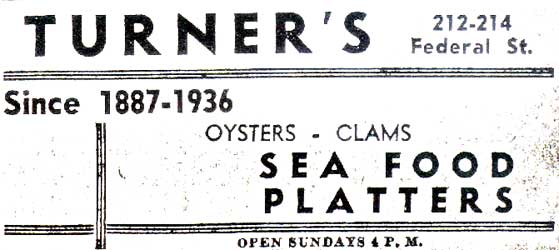
TURNER'S 212-214 Federal St.
Since 1887-1936
OYSTERS - CLAMS
SEA FOOD PLATTERS
OPEN SUNDAYS 4 P. M.